“What’s your age?” isn’t typically a fair question, but Spotify’s making it OK.
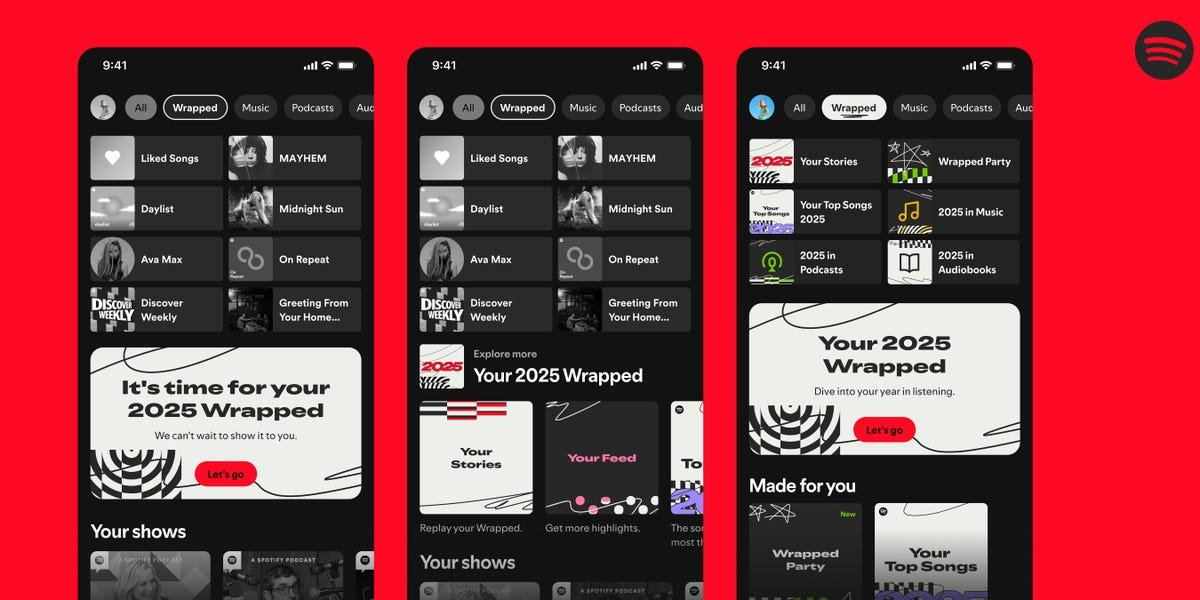
Spotify Wrapped is back, and the big, new feature for the streamer’s year-end recap for users is the “listening age.” While some weren’t too exciting — my listening age (34) wasn’t far off from my real one (36) — others had a different experience, like newsletter editor Grace Lett, 28, whose listening age was 51.
Grace took the news in stride, but others weren’t so happy, writes BI’s Katie Notopoulos.
The whole thing might seem like a silly gimmick (it is), but it’s also the perfect representation of Spotify Wrapped: a smart marketing tool to get people talking about their Spotify use with each other.
There’s also a method to the madness. Wrapped isn’t just about doing a quick search of users’ top artists and songs. (Justice and “Hate” by ThxSoMch for me, since I know you were dying to know.)
Wrapped takes the entire year, with work for next year’s edition beginning as soon as the current year’s drops. Executives analyze reactions on social media and figure out how to adjust going forward. Three Spotify executives walked BI’s Henry Chandonnet through the whole process.
Spotify Wrapped isn’t easily replicable.
Like most popular things, plenty of companies have tried recreating Spotify’s success. That includes rival YouTube, which launched YouTube Recap this year.
But few, if any, have penetrated the zeitgeist quite like Spotify.
Some platforms don’t deserve a recap. I’d be depressed if I saw how much I spent on takeout this year or the number of hours I logged playing video games.
Others come off as too braggadocious. I would rather gouge out my eyes than see a recap of your Strava or Peloton history.
Music is a sweet spot, though. It’s fun to look back at what you listened to throughout the year, kind of like catching up with an old friend. And there’s a genuine interest in how others’ lists stack up. (It’s always fun finding an undercover Swiftie or a lowkey Deadhead.)
One group still seemed unimpressed on Spotify’s big day: investors. Spotify’s stock finished down almost 3.5%.
Companies are getting creative with rewarding standout workers, but few are giving out $170,000 luxury cars or cruises to the Bahamas.
ThreatLocker, an Orlando-based cybersecurity firm with about 700 employees, gives luxury cars to its two most collaborative workers at its annual holiday party, the company told Business Insider.
The firm, which also has offices in Dublin, Dubai, and Australia, receives hundreds of votes each month for the two most helpful employees — one in the US, and one abroad. It flies in its international workers in for the holiday party.
Additionally, every manager votes for the best performer on their team that month. At the end of the year, the total votes for the top performer and the most helpful employee are combined to determine the two car recipients, the company said.
The firm usually awards an electric model, but has also handed out a $125,000 Porsche Panamera. The company hasn’t announced its car for this year yet, but told Business Insider one of the models is worth $173,000.
The tradition began in 2021 as a prize for the top performer, but CEO Danny Jenkins said it created a “dog-eat-dog” work environment. In the cybersecurity industry, teamwork is crucial to the company’s success, he said. Jenkins said the firm operates 24 hours a day with an average pick-up time of 23 seconds for any customer support issue, and colleagues need to work together to achieve that.
“Everything we do is with this matter of urgency,” Jenkins said. “So if you don’t have this teamwork where people are willing to get on a call at 2 a.m. in the morning and help each other and collaborate, then it doesn’t work.”
Jenkins said he works about 100 hours a week, and he keeps his phone on 24/7 in case issues arise.
Retaining the top
AI development has led to a boom in the cybersecurity industry, resulting in heightened demand for qualified talent. Jenkins said the company has never done layoffs and is currently hiring 40 to 50 people a month.
“I’d like to be in a situation where I don’t feel like we’re drowning because we’re constantly struggling to hire and onboard people fast enough,” said Jenkins.
That makes it all the more worthwhile to retain top talent and those who contribute to a strong culture.
He said that before the car winners are announced, between 14 and 16 runner-ups are honored in front of the company, and then offered a spot on a fully paidlong-weekend getaway.
Jenkins said the trip has included a Royal Caribbean cruise to the Bahamas, as well as trips to Boston or New York. The group typically includes employees from various departments, and they all receive a spending budget of $2,500 on their trip, he said.
ThreatLocker also offers other perks to standout employees. Jenkins said that most employees work 40-hour workweeks, but sometimes teams may have to put in 18 or 19 hours straight to address an issue. Jenkins said when workers push through tight deadlines or go above and beyond, the company may reward them with court-side seats at games in the Orlando Kia Center, where the company has a permanent box.
Jenkins said the trip and car giveaway have bolstered employee success and that no car recipient has ever left the company.
Director Carl Eric Rinsch made so many failed, seven-figure option bets after Netflix wired him $11 million that his broker at Wells Fargo tried — and failed — to stop him, a New York fraud jury heard on Tuesday.
“I can afford to lose the money,” Rinsch said, according to testimony by his former Wells Fargo advisor, Ronald See.
And when the brokerage hit the brakes — limiting him to $250,000 per transaction — the show developer was undaunted.
On March 30, 2019, just three weeks after receiving the $11 million, Rinsch instructed See, of Wells Fargo Advisors, to wire his remaining $8.5 million to Citibank so he could establish a new brokerage account with Charles Schwab.
“They won’t put restrictions on me there,” Rinsch wrote See in a letter shown to jurors.
Rinsch, 48, is on trial in federal court in Manhattan, fighting charges that he had no right to use the $11 million Netflix sent him on anything other than “White Horse,” the 120-minute TV series he’d already spent $44 million of Netflix’s money on. (Rinsch ultimately never finished a single episode of the clones-versus-humans sci-fi thriller.)
Defense lawyers counter that the $11 million was actually Rinsch’s contractually-promised payment for having completed principal photography, and was his money to spend as he pleased.
Either way, testimony on Tuesday by two of Rinsch’s former financial advisors showed that he was eager to spend the cash prosecutors say the director had quickly moved into his Wells Fargo account.
The streamer wired Rinsch the $11 million on March 6, 2020, as the COVID-19 pandemic halted film production worldwide.
Over the next three weeks, he then lost some $5.8 million, almost all of it on highly risky options trades involving Gilead Sciences, which was developing COVID-19 treatment drugs. (See would earn a $22,000 fee on these losses, the defense pointed out on cross-examination.)
The director was off to the races again as soon as he switched to Charles Schwab, according to testimony.
“I could send $3 mm personal to get started,” he wrote to his new financial advisor, Adam Checchi, who also testified on Tuesday.
“I understood that to mean three million from his personal funds,” Checchi said under questioning by a federal prosecutor.
Checchi told jurors that Rinsch would soon lose almost $6 million more, mostly on failed, highly risky bets that Gilead’s stock would rise and that the S&P 500 would decline.
“I’m not a broad, diversify kind of guy,” Rinsch explained in a late March 2020 email, adding that he pursues “aggressive” option trading “fully expecting to lose it all.”
Earlier in the day, former Netflix executive Peter Friedlander, who on Monday called Rinch’s project “visionary,” completed a second day of testimony.
On overhead screens, defense attorney Benjamin Zeman showed Friedlander — and the jury — emails from August 2019, in which Rinsch begged for “immediate support” with casting in Brazil.
“Show is set to collapse,” Rinsch wrote.
The defense is blaming the implosion of White Horse on Netflix’s decision to pull support for the project in September 2020.
In the email chain projected throughout the courtroom on Tuesday, Zeman attempted to show jurors that a year earlier, Friedlander was already cold toward the show developer’s requests for help.
“His own delays in decisions have caused this,” Friedlander wrote in forwarding Rinsch’s email to Mike Posey, an original series vice president, and others, including production executive Shelley Stevens and Rahul Bansal, an original series director.
Rinsch would continue asking for support — and money — for another six months before Netflix forwarded the $11 million payment at the center of the trial. The project was ultimately written off by Netflix as a tax loss eight months later, in November 2020.
Rinsch’s trial is expected to continue through next week. He faces up to 90 years in prison if convicted of wire fraud, money laundering, and engaging in unlawful monetary transactions.
The nation’s largest grid operator is facing a choice — between serving more data centers or keeping the lights on for all its existing customers.
In a complaint filed on November 25 with the Federal Energy Regulatory Commission, Monitoring Analytics, LLC, an independent market monitor for PJM, requested that the regulator mandate that the energy wholesaler only add large data centers to its system if all customers can be reliably served.
“PJM is currently proposing to allow the interconnection of large new data center loads that it cannot serve reliably and that will require load curtailments (black outs) of the data centers or of other customers at times,” the complaint read.
“That result is not consistent with the basic responsibility of PJM to maintain a reliable grid and is therefore not just and reasonable,” the complaint added.
PJM serves over 65 million people, including households and other consumers, across all or parts of 13 states and the District of Columbia. While it is not a utility provider, it helps move electricity across a service area of about 369,000 square miles.
According to the complaint, large data centers are responsible for higher transmission costs, as well as energy and capacity prices. Monitoring Analytics added that existing and expected data center loads already increased PJM’s capacity revenues in its last two capacity auctions by $16.6 billion, and the figure would only “continue to grow.”
The complaint also described a “Critical Issues” meeting among PJM’s Board of Managers to address the issue of data centers, but the board ultimately could not come to an agreement since “most stakeholders simply assume that PJM must agree to add large loads to the system.”
The purpose of the complaint, wrote Monitoring Analytics, is to make the board’s job “significantly more manageable” if a regulator could clarify that PJM does have the authority to “require that the loads can be served reliably before allowing the loads to be added to the system.”
A spokesperson of PJM told Business Insider that the company is still “going through the complaint” and would not comment at this time. The spokesperson added that the Board of Managers is “expected to act on the large load issues raised” in the meeting and “should provide an indication of its next steps over the next few weeks.”
Large data centers have been driving up utility costs nationwide, particularly in states like Virginia, where the “data center alley” is located. The North American Electric Reliability Corporation wrote in a November report that data centers are one of the leading causes of a rise in energy demand this winter, which increases the risk of blackouts.
The Trump administration plans to invest $500 billion to build AI infrastructure in collaboration with OpenAI, Oracle, and Softbank. OpenAI CEO Sam Altman told the White House Office of Science and Technology Policy in a letter in October that the US should add 100 gigawatts of new power capacity annually to stay competitive in the AI race.
Meta has hired longtime Apple design leader Alan Dye to run a new creative studio inside its Reality Labs division, CEO Mark Zuckerberg announced in a series of posts on Threads on Tuesday.
“Today we’re establishing a new creative studio in Reality Labs led by Alan Dye, who has spent nearly 20 years leading design at Apple,” Zuckerberg wrote on Threads, saying the group will help define “the next generation of our products and experiences.”
Zuckerberg said the studio will bring together “design, fashion, and technology” and that Meta wants to “treat intelligence as a new design material and imagine what becomes possible when it is abundant, capable, and human-centered.”
The goal, he added, is to “elevate design within Meta” by assembling a team with “craft, creative vision, systems thinking, and deep experience building iconic products that bridge hardware and software.”
Dye will work alongside several high-profile design leaders. He will report to Meta’s chief technology officer and Reality Labs head Andrew Bosworth.
Dye is one of the most prominent figures in Apple’s modern design history. He has led Apple’s design studio since 2015 and has played a key role in shaping the company’s software and the look and feel of many of its devices, including the interfaces for products such as the Apple Watch, iPhone X, and Vision Pro headset.
Most recently, Dye was responsible for Liquid Glass, Apple’s new design across its devices that makes elements of the user interface look transparent.
His team has also worked on a slate of new smart home hardware, according to Bloomberg, which first reported his move to Meta.
Zuckerberg said that Dye will be joined by “another acclaimed design lead from Apple,” Billy Sorrentino, as well as Joshua To, who leads interface design across Reality Labs; industrial design lead Pete Bristol; and metaverse design and art teams led by Jason Rubin.
The CEO framed the move as part of Meta’s push into AI-powered devices such as smart glasses.
“We’re entering a new era where AI glasses and other devices will change how we connect with technology and each other,” Zuckerberg wrote.
While the potential is “enormous,” he said the new studio will focus on making every interaction “thoughtful, intuitive, and built to serve people.”
Earlier this year, Meta hired another Apple engineer, Ruoming Pang, to its new Superintelligence Labs organization. Pang led Apple’s AI models team.
Apple did not respond to a request for comment from Business Insider. A Meta spokesperson pointed to Zuckerberg’s posts on Threads.
Have a tip? Contact Pranav Dixit via email at pranavdixit@protonmail.com or Signal at 1-408-905-9124. Use a personal email address, a nonwork WiFi network, and a nonwork device; here’s our guide to sharing information securely.
If you’re still looking for best-in-class or best-of-breed when it comes to your enterprise management systems, it might be time to raise your expectations.
According to Stephan de Barse, president of the global Business Suite for SAP, a new gold standard has emerged — a superlative he calls “best of suite.”
In de Barse’s view, the competitive arena for enterprise management now exists within an integrated framework of AI, data, and core applications. That elevates it from a narrower proving ground, where being a “best of breed” provider checks only one or two of those boxes.
And while being “best of suite” isn’t all about AI, the rapid acceleration of AI-centered workflows meant that SAP needed to think differently about the role of AI in enterprise management. This outcome — a clear path and proximity for AI to easily navigate between divisions and functions — is one of the ways the SAP Business Suite lives up to the new designation.
“Many companies treat AI like a separate layer somewhere in the technology stack,” said de Barse. “That way, it’s disconnected from your end-to-end business processes and disconnected from your data strategy. The moment AI doesn’t make it back to the end-to-end business-process context it’s very, very difficult to drive value.”
.
AI with suite-wide sweep
According to McKinsey’s on-going tracking of enterprise AI from the C-Suite perspective — captured in regular releases of its State of AI reports — the percentage of organizations that report using AI in three or more divisions more than doubled between 2021 and 2025. Use of AI in four or more company divisions tripled across that time period. Companies using AI across five or more divisions — while starting smaller at 4% of those surveyed in 2021 — posted quadruple growth, forecasting near enterprise-wide ubiquity for AI use.
Insider Studios/Getty Images
This trajectory toward AI native enterprises is significant. Where the AI ROI conversation was once centered around generalized productivity powered by LLMs, de Barse has watched it reach hard improvements in both the P&L (e.g. improvement of topline revenue) and the Balance Sheet (e.g. improvement of working capital).
He cited the example of an AI agent on the commercial side of an enterprise forecasting deals likely to close. This would send a signal to manufacturing to increase capacity and procurement to line up raw materials.
“If you think about the entire value chain, from sourcing components to getting a product in the hands of customers, that has to be orchestrated by a series of agents that can help organizations reach better decisions and improve business results,” de Barse said. “Customers want to work with us to get there, because they understand this must be across business processes.”
Best in suite meets best in orchestration
SAP’s own proprietary AI interface is known as Joule, which de Barse described as a “superorchestrator” — a single, accessible entry point to all business applications that, in aggregate, determine how an enterprise runs and employees work, as well as the customer experience.
With Joule, “you ask questions, but you also give instructions,” de Barse said. “You don’t have to log into five different applications to do something — it’s all being orchestrated by Joule. So the way we think about interacting with software becomes different.”
For manufacturers, that can mean an easy conversational prompt to forecast potential supply-chain disruptions and arrive at a solve. In the finance context, it means instant insight into the cash conversion cycle relative to working capital.
“At the enterprise level, this is happening at an unprecedented pace,” he said.
In de Barse’s view, these capabilities also call for cultural shifts within organizations — leaning away from optimizing current processes to rethinking how entire functions should be done, so that what becomes automated and tasked to agents is operating in “best-of-suite” condition.
“It’s pretty exciting. This,” he said, “is the opportunity.”
As technology continues to advance and companies look to remain competitive in meeting market demand, the skills that employees will need are also evolving. A growing number of companies are exploring how to address these skills and workforce gaps with artificial intelligence.
HR can use AI to reveal “patterns and gaps” and benchmark “current workforce skills against evolving business needs or industry trends,” said Lauren Winans, CEO and principal human resources consultant at Next Level Benefits.
What AI offers in this realm isn’t exactly new, said Will Howard, practice lead of HR trends and AI at McLean & Company. HR teams have long collected and analyzed workforce data manually, he said, but AI can make the process more “feasible and efficient” through automation.
Here, HR experts share four factors to consider when using AI to identify workforce and skills gaps:
1. Organize your data
Headshot of Sanmay Das, associate director of AI for Social Impact at Virginia Tech.
Virginia Tech
Organizations have troves of HR data, such as job advertisements, performance reviews, and employee job histories and training, that can be mined to uncover skills gaps, said Sanmay Das, associate director of AI for Social Impact at Virginia Tech. But this data often lacks “quality and completeness,” Winans said.
Before adopting AI, organizations must embrace “good data hygiene” by ensuring the data they plan to analyze is accurate, current, and consistent, said George Denlinger, operational president of US technology talent solutions at Robert Half.
Otherwise, AI insights will be limited or inaccurate. “The phrase ‘garbage in, garbage out’ rings especially true here,” Howard said.
Companies need a clear and consistent process for collecting, maintaining, and updating workforce data, Howard said. For instance, standardize job descriptions, including specific skills, knowledge, and activities, so that AI can make accurate comparisons.
2. Analyze the insights
Headshot of George Denlinger, operational president of US technology talent solutions at Robert Half.
Robert Half
Large language models, like ChatGPT and Microsoft Copilot, can summarize and report on data, Das said. But, for a deeper analysis, companies often need specialized AI tools designed for HR, including workforce planning and analytics, Howard said. Workday and Disco are some examples.
Ultimately, AI tools can leverage your existing data and identify strengths and weaknesses in your workforce, Denlinger said.
For example, with data on employee performance for a specific project and sales forecasts, AI could suggest the skills or roles necessary to meet the organization’s future demands, Howard said. Examining an employee’s job and training history, AI could quantify their capacity to acquire new skills via upskilling or reskilling, Winans said.
IBM, for example, uses an AI system that analyzes its employees’ digital footprints within the company to identify their skills and predict skill proficiency levels. The company then uses that analysis to offer employees personalized educational opportunities and career coaches, helping them identify job opportunities and new career paths. In 2024, IBM reported that the approach had boosted employee engagement by 20%.
3. Understand AI’s limitations
While AI can analyze data, it may overlook nuances and the human aspects of what makes a role successful, such as small tasks not listed in a job description, soft skills, or the behind-the-scenes efforts employees put in, Das said.
Companies should also focus on data privacy, trust, and employee buy-in, Winans said. Employees may worry about how their data is being used and how it could impact them, such as changes to their roles or responsibilities. She suggested communicating transparently about what data will be used, how it will be used, and why.
Data literacy is another challenge: HR teams must know what to do with the AI results, Howard said. “Even the most advanced AI technology still requires a human to put the results into a business context and communicate and take action on the insights within the organization.”
For instance, the AI analysis on skills gaps should inform decisions about new roles the company needs to create or the training necessary for existing employees, Winans said.
4. Refine your strategy
“Skill requirements evolve rapidly,” Winans said. Using AI to uncover skills gaps should be a “continuous process, not a one-time audit,” she added.
While AI can be useful for tracking ongoing skills gaps, Denlinger said this is still an emerging use of the technology that will likely evolve.
Al also isn’t a “silver bullet that can take you from zero to best in class,” Howard said. “Organizations shouldn’t view AI as a shortcut. It still requires the foundational skills and structures that have always been there,” such as clean data and employees confident in using the technology.
Then, he said, AI “becomes the cherry on top that can take your workforce planning and data analysis to the next level.”
It’s been said that the way to one’s heart is through their stomach. It sounds like Meta CEO Mark Zuckerberg wanted to see if the AI talent war, or at least one skirmish, could be won the same way.
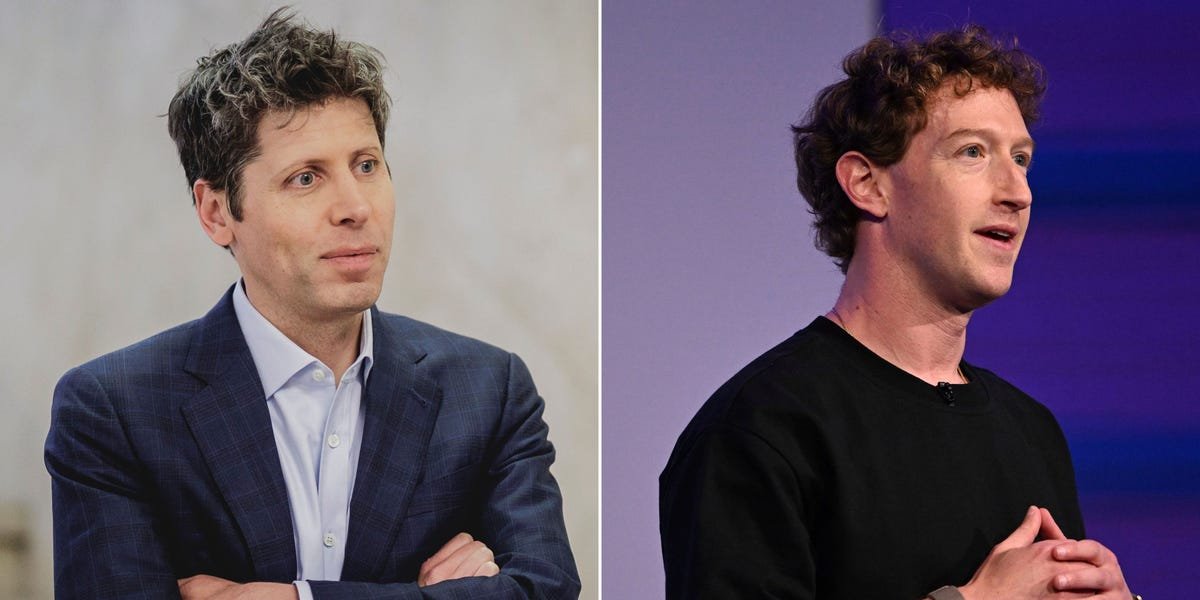
Mark Chen, chief research officer at OpenAI, recently said that Zuckerberg personally delivered homemade soup to an OpenAI employee as part of a campaign to recruit the unnamed worker to Meta.
“It’s been kind of interesting and fun to see it escalate over time. You know, some interesting stories here are Zuck actually went and hand-delivered soup to people that he was trying to recruit from us,” Chen told Ashlee Vance on the author’s “Core Memory” podcast.
Chen said Zuckerberg’s move was “shocking to me at the time” but since then, he said he’s returned the favor.
“I’ve also delivered soup to people we’ve been recruiting from Meta,” Chen said, laughing.
The poaching efforts focused on OpenAI’s researchers and engineers underscores the company’s position in the AI race, Chen said.
“We’re always under attack,” Chen told Vance. “This is how I know we’re in the lead, right? Any company starts, where do they try to recruit from? It’s OpenAI. They want the expertise, they want our vision, our philosophy of the world. And we’ve made so many star researchers, right? I think OpenAI, more than anywhere else, has been a place that makes names in AI today.”
Arguably, no other rival tech company has been as aggressive in the so-called AI talent wars against OpenAI as Zuckerberg’s Meta.
In June, OpenAI CEO Sam Altman said that Meta tried to lure some of his engineers with $100 million signing bonuses. The CEO said at the time that none of his top talent was poached, but ChatGPT co-creator Shengjia Zhao later joined Meta’s Superintelligence Lab.
Chen said that Meta tried to recruit “half” of Chen’s direct reports unsuccessfully, but that OpenAI has been “fairly good” at retaining top talent. A Meta spokesperson declined to comment.
Top AI researchers have become a hot commodity in the AI race, as it’s generally believed that there is a relatively small number of researchers and engineers capable of achieving breakthroughs or building new LLMs from the ground up.
“It’s like looking for LeBron James,” Databricks’ vice president of AI, Naveen Rao, told The Verge’s Command Line newsletter last year. “There are just not very many humans who are capable of that.”
If AI feels overhyped now, Eric Schmidt suggests that businesses should brace themselves — the real disruption hasn’t even begun yet.
In an interview with Professor Graham Allison at the John F. Kennedy Jr. Forum at Harvard University on Monday, the former Google CEO pushed back on the idea that AI’s rapid growth is a speculative bubble, saying that the technology is actually under-hyped.
“If anything, it’s under-hyped because you are fundamentally automating businesses,” he said.
The real transformation, he said, is happening deep inside companies, where AI systems are beginning to take over the “boring” tasks that quietly consume billions in corporate spending.
The biggest gains, he suggested, will come from automating the backbone of corporate work: the repeatable, time-consuming processes buried deep inside every organization.
The former Google chief listed billing, accounting, product design, delivery, and inventory management as examples of this.
“There’s an awful lot there — it’s extraordinary,” he said, pointing to areas like medicine, climate solutions, and engineering as sectors where automation could accelerate breakthroughs.
Schmidt, who helped steer Google’s early investments in AI and later co-authored a book on AI with Henry Kissinger, implied the technology’s economic impact will be far larger than markets or executives appreciate.
Still, not everyone agrees with that perspective. Some economists are sounding alarm bells that the AI boom is overheated.
In an interview this week, renowned economist Ruchir Sharma said the AI surge displays all four traits of a classic bubble and could unravel if interest rates rise, while tech leaders such as Sam Altman and Bill Gates have cautioned that parts of the market resemble the dot-com era.
Far beyond coding
To illustrate how quickly AI capabilities are advancing, Schmidt described watching an AI system generate an entire software program.
“Holy crap. The end of me,” he said.
“I’ve been doing programming for 55 years. To see something start and end in front of your own life is really profound,” he added.
However, he said that AI’s long-term upside extends far beyond coding.
From back-office workflows to logistics and scientific discovery, Schmidt believes the automation curve is still in its early stages of scaling and that Wall Street is underestimating the magnitude of the shift.
“The reason people are spending this amount of money,” he said, “is to automate the boring parts of their business.”
This story is available exclusively to Business Insider
subscribers. Become an Insider
and start reading now. Have an account? .
Tesla scored a rare win in China, earning bragging rights over its biggest rival in the process.
Elon Musk’s automaker saw its sales rise by nearly 10% in November, while its arch-rival BYD’s fell.
Tesla has had a difficult year, with sales underwhelming in China and collapsing in Europe.
Things are finally looking up for Tesla in China.
The US automaker’s sales rose 9.9% in November compared to the same month last year, according to data released by China’s Passenger Car Association on Tuesday.
That’s a rare win for Tesla, which has had a difficult year in almost all of its biggest markets. The company has faced a sales collapse in Europe, been squeezed by intense competition in EV-friendly China, and is on track to see its overall sales decline for the second consecutive year.
One bright spot for Tesla: it’s not the only one with problems. The Elon Musk-run automaker’s biggest Chinese rival, BYD, has hit some speed bumps in recent months.
The Shenzhen-based EV giant, which has become one of China’s largest carmakers thanks to a range of affordable and high-tech electric models, has had three straight months of sales declines.
BYD said it sold just over 480,000 EVs and hybrids in November, its highest total this year, but still around 5.3% less than the same period in 2024.
The Chinese automaker, which was once backed by Warren Buffett, has struggled in the face of a renewed price war in China’s ultra-competitive EV market and a government crackdown on aggressive discounting.
Despite these headwinds, BYD is still on course to take Tesla’s crown as the world’s largest seller of battery EVs this year, and the company is rapidly taking market share from Musk and co. outside China.
BYD’s overseas sales hit a record 131,935 in November. The Chinese auto giant is taking advantage of Tesla’s woes in Europe, with BYD outselling its US rival by more than two to one in October.