Instagram-is-testing-a-new-definition-of-friends.jpeg

Instagram is testing a new definition of ‘friends’

Friends … followers … where is the line?

Instagram is testing out new tweaks that emphasize friends. It also has a new definition of friends: People who mutually follow each other.

The Instagram test involves changing a user’s “following” count on a profile to a “friends” count. That means if you follow thousands of people, but maybe only a few hundred of those people follow you back, that’ll show up as your “friends” count.

For those of you who care about those precious follower-to-following ratios, get ready for a potentially even more telling public ratio: How many of those Instagram followers are friends?

Instagram is quietly running this as a “small global test,” a Meta spokesperson confirmed to Business Insider, adding that the platform is trying to understand how users respond to seeing more content from friends in the app.

“Friends are central to the Instagram experience, so we’re exploring ways to make these connections more visible and meaningful,” a Meta spokesperson said. “We’re running a small test to highlight Friends throughout Instagram.”

As part of the test, Meta is also labeling some content in the feed as “friends” instead of “posts” or “following.”

Is Instagram for friends anymore?

As influencers, brands, and now AI slop have invaded Instagram’s feed, it’s felt less and less like a space to share content with your friends.

That’s part of the reason Instagram has doubled down on its “Close Friends” features over the years, focused on direct messaging (where friends and family often share content), and added more friend-focused features.

For instance, Instagram rolled out a feature called “Blend,” which lets you and a friend share a mutual feed of reels.

Last year, Instagram also introduced features like a social mapping experience similar to Snapchat’s map, as well as a “Friends” feed in the reels tab, where you can see content your friends (by Instagram’s definition) are engaging with.

Instagram’s top executive, Adam Mosseri, said in an August post that he wants Instagram to be somewhere where users can “actually engage with and connect with the people that you care about.”


Source link

Joshua Zitser's face on a grey background

Steven Bartlett says using AI in this way is the most important thing he’s done for his business

Steven Bartlett said one use of AI has mattered more to his business than anything else: translating his podcast into other languages.

“There’s nothing more important than what we’ve done for our business than translations. Period,” Bartlett said during the “What it Takes to Build” panel at the World Economic Forum at Davos on Tuesday.

The British entrepreneur and host of “The Diary of a CEO” podcast was in conversation with Jessica Lessin, the CEO of The Information, alongside Bret Taylor, formerly the co-CEO of Salesforce and CTO of Meta.

Bartlett said using AI tools to translate the podcasts was initially an “expensive experiment.” The problem he was trying to solve, he said, was reaching the untapped market of non-English speakers.

“If we’re just in English, we’re reaching like 10% of the world,” Bartlett added.

There were technical challenges, too. Some languages use longer words, Bartlett said, meaning three-hour English-language conversations could become significantly longer when translated, risking the audio and video falling out of sync.

Two years ago, Bartlett announced on LinkedIn that “The Diary of a CEO” had hired a full-time data scientist who helped the company achieve a technological breakthrough, enabling them to use AI to translate the podcast into “EVERY language.”

At Davos and in the LinkedIn post, Bartlett did not elaborate on exactly how the AI translations work. Today, however, the videos show Bartlett speaking Spanish in a voice similar to his own, a shift he said had significantly expanded the podcast’s reach.

“This month, 28% of my audience is Spanish,” he said, adding that Spanish speakers now have access to interviews with some of the world’s most high-profile podcast guests, citing his own interview with former first lady Michelle Obama as an example.

Other guests on the podcast include former vice President Kamala Harris, Simon Cowell, and the psychologist Jordan Peterson.

Spotify said in its “2025 Wrapped” press release in December 2025 that “The Diary of a CEO with Steven Bartlett” was the platform’s second-most-listened-to podcast globally, behind “The Joe Rogan Experience.” On YouTube, Bartlett’s podcast channel has 14.5 million subscribers.


Source link

Davos-day-2-live-updates-Statement-scarves-croissants-and-Trump.jpeg

Davos day 2 live updates: Statement scarves, croissants, and Trump anticipation

Robot drivers will ultimately outperform humans on safety, Uber CEO Dara Khosrowshahi said on Tuesday in Davos.

“If you think about the world 20 years from now, your Uber is going to be driven largely not by a human being, but by a robot driver — a piece of software on top of a car,” Khosrowshahi said, adding that vehicles are becoming increasingly sophisticated and more like “computers on wheels.”

Robot drivers will ultimately outperform humans on safety, Uber CEO Dara Khosrowshahi said on Tuesday in Davos.

“If you think about the world 20 years from now, your Uber is going to be driven largely not by a human being, but by a robot driver — a piece of software on top of a car,” Khosrowshahi said, adding that vehicles are becoming increasingly sophisticated and more like “computers on wheels.”

Khosrowshahi said autonomous systems have clear advantages over human drivers. “There’s no doubt in my mind that the robot driver can be safer than a human driver,” he said. Robot drivers don’t get tired or distracted, don’t text while driving, and can operate continuously while improving over time, he added.

The key question, Khosrowshahi said, is what level of safety is “enough” for robot drivers — whether matching human performance is sufficient or whether autonomous vehicles should be held to a higher standard.

In the longer term, he said, human driving could resemble horseback riding today, becoming a niche activity done for enjoyment.

“There’s no doubt that 10 years from now, there will be questions as to whether humans are safe enough,” he said.


Source link

Netflix-strengthens-its-Warner-Bros-bid-as-Paramounts-David-Ellison.jpeg

Netflix strengthens its Warner Bros. bid as Paramount’s David Ellison tries to wreck its deal

Netflix is breaking open its piggy bank to keep Paramount Skydance CEO David Ellison from crashing its Warner Bros. deal.

The streaming giant just sweetened its offer for the Warner Bros. studio and HBO by offering all-cash, matching a key feature of Paramount’s hostile bid. Warner Bros.’ board of directors has approved the all-cash bid, and the companies said they expect Warner shareholders to vote on the transaction by April.

“Our revised all-cash agreement will enable an expedited timeline to a stockholder vote and provide greater financial certainty,” Netflix co-CEO Ted Sarandos said in a statement announcing the news.

“Today’s revised merger agreement brings us even closer to combining two of the greatest storytelling companies in the world,” David Zaslav, president and CEO of Warner Bros. Discovery, said in a statement on Tuesday.

While Netflix isn’t raising its bid from $27.75 per share, converting $4.50 per share in stock to cash takes away a variable for Warner Bros. Discovery shareholders. Netflix shares are down 13% since the Warner Bros. deal was made public and have fallen 28% since late October.

Paramount believes its all-cash offer of $30 per share for all of WBD is superior to Netflix’s winning bid for WBD’s key assets, which include its studio, HBO, and HBO Max, but not its TV networks. Ellison has made eight bids for WBD, all of which have been rejected. Paramount is now suing WBD while fighting for spots on its board.

A key remaining point of difference between the two bids hinges on the perceived value of WBD’s networks. Paramount is looking to buy them, while Netflix is not.

If WBD’s cable channels, such as CNN, TNT, and HGTV, are valued at less than $2.25 per share, or $5.9 billion, then Paramount’s proposal appears, at first glance, to be more appealing than Netflix’s. However, WBD has said that it must knock off $1.79 per share from Paramount’s bid to account for costs it would incur by changing course, like a $2.8 billion breakup fee to Netflix. That would mean WBD’s cable networks only need to be worth $0.46 per share for Netflix’s bid to be financially superior in the board’s eyes.

Paramount has argued that the WBD cable networks it wants to buy are worth $0 per share, or only as much as the debt they’re expected to carry. Ellison and company acknowledged “the theoretical possibility” that those TV assets could be worth $0.50 per share.

Most media analysts have a rosier view of WBD’s cable business, valuing its channels anywhere from the low single digits to $3.51 per share. Even a glass-half-empty view based on the valuation of new cable company Versant would put WBD’s networks at $1.20 per share as of last week, a Business Insider analysis found.

Netflix’s updated all-cash offer helps solidify WBD’s decision to choose it, after accounting for the added costs from Paramount’s bid.

Unless WBD shareholders band against its board of directors, Paramount may face pressure to sweeten its offer by raising its bid.


Source link

Line chart

Inside Amazon’s ‘mind-blowing’ plan to fix groceries and beat Walmart

For years, Amazon was cast as Walmart’s great disruptor. Now, it’s borrowing from the retail giant it once sought to upend.

The company is rolling out Walmart-inspired ideas, including “Supercenter” warehouses, a new distribution layer known internally as the “1DC” network, and microfulfillment centers within Whole Foods stores, according to internal documents obtained by Business Insider.

The shift reflects a hard lesson: mastery of e-commerce does not translate into dominance in groceries, particularly perishable items that drive frequent shopping. Walmart’s dense network of stores and distribution centers, designed to move everyday goods quickly and cheaply, has proved difficult to replicate.

Nearly a decade after paying $13.7 billion for Whole Foods, Amazon still trails Walmart in everyday grocery shopping, and is now reshaping its retail infrastructure to compete head-on with Walmart’s Supercenter model.

Earlier this month, plans emerged for a roughly 225,000-square-foot Amazon megastore near Chicago. Bigger than a typical Walmart Supercenter, the new concept is designed to let customers buy “fresh groceries, household essentials, and general merchandise — all in one trip,” according to Amazon.

Michael Levin and Josh Lowitz, cofounders of Consumer Intelligence Research Partners, called the move “mind-blowing” and said “it reveals a degree of Walmart jealousy that we didn’t expect.”

Powerful store network

There’s a lot to be jealous about. With roughly 90% of the US population estimated to live within 10 miles of a Walmart store, the company’s 5,000-plus locations give it a powerful edge in selling fresh food and other perishables, along with many other everyday staples.

According to research firm Numerator, Walmart accounted for about 21% of the US grocery market, both online and in-store, as of September. Amazon and Whole Foods, meanwhile, each held roughly 1.6% of the market.

Meanwhile, Walmart is leveraging its Supercenters to deliver online orders faster, challenging Amazon at its own game.

That’s fueled a surge in Walmart shares, valuing the company close to $1 trillion. The stock is up almost 150% over 5 years, far outpacing Amazon’s roughly 53% gain (although Amazon is still worth more).

Amazon does well with non-perishable goods and everyday essentials such as toothpaste and paper towels. Overall, it offers millions of products for same-day delivery.

But when it comes to more delicate food items, such as pears, meat, and cheese, the company knows it has more work to do.

A company spokesperson said Amazon serves more than 150 million US grocery customers, offers nearly 3 million grocery and household items, and provides same-day delivery in more than 9,000 cities and towns.

Grocery is an “ever-growing” part of its fast-delivery business, the spokesperson added, while noting that in 2025, Amazon added perishable groceries to its Same-Day Delivery service, now available in 2,300 locations, allowing customers to shop without trade-offs between speed, selection, and savings.

Amazon’s Supercenter ambition

One element of this fresh Amazon effort is a new type of same-day delivery warehouse internally called an “SSD Supercenter.” SSD refers to sub-same-day deliveries, typically within four hours. Unlike traditional SSD warehouses that tend to be smaller, these facilities are designed to be larger to close the selection gap, specifically with “Walmart” in groceries, the document said.

Internal planning documents show Amazon intended to launch at least five such sites last year. Amazon wanted to test whether customers would “step-change their shopping habituation and engagement” once the Supercenter warehouses went live, one of the documents stated. Amazon planned to add products not currently sold on its site to the new warehouse and take a more hands-on approach to inventory sourcing, with in-stock targets above 95%, according to the document.

Sub-same-day grocery delivery is still a tiny part of Amazon’s business. At the end of September, it had 30 million eligible customers for this service, according to one of the internal documents obtained by Business Insider. Only 1.6 million of them, or roughly 5%, shopped through the service.

Speed, at scale

Amazon’s Supercenter warehouses are part of a broader push to expand same-day grocery delivery. Internal forecasts called for at least 34 US same-day grocery sites in 2025. Amazon already operates over 80 same-day facilities nationwide, though not all handle groceries, according to Marc Wulfraat, president of logistics consultancy MWPVL.

Amazon is also planning to take the model overseas. Under an initiative known as Project Taylor, the company plans to expand sub-same-day grocery delivery across Europe. It also plans to pilot sub-two-hour “ultrafast” deliveries in London in 2026, one of the documents showed.

A new “1DC” layer in the network

Less visible, but just as important, is a new upstream distribution layer called “1DC.”

These facilities store the most frequently purchased products and replenish fulfillment centers as demand emerges. That can shift weeks’ worth of inventory out of space-constrained fulfillment centers and into distribution sites optimized for palletized storage and rapid transfer.

One internal document described the change as a move from a “push” system, in which inventory is positioned based on forecasts, to a “pull” system that allows fulfillment centers to draw inventory from distribution centers as needed.

Amazon began rolling out the 1DC concept last year through new buildings and retrofits. By the end of 2025, the company planned to operate a dozen of these centers, capable of moving at least 20 million units a week, according to one of the documents. As of October 2025, the facilities only handled non-perishables, including shelf-stable food items, but not frozen or chilled products, the document stated.

“Untenable”

The 1DC idea emerged after Amazon introduced one-day delivery in 2018, one of the documents stated. Longer delivery windows once allowed the company to rely on a single layer of warehouses that could ship inventory from any fulfillment center to any customer. But faster delivery promises made that model “untenable,” forcing Amazon toward a structure long used by traditional retailers, the document added.

MWPVL’s Wulfraat said Walmart pioneered the distribution-center model that stores inventory for replenishing retail locations, while Amazon built its business around fulfillment centers that ship directly to consumers. Amazon also operates a cross-dock network to resupply its fulfillment centers, he said, and the 1DC sites represent a newer, more targeted layer of that system focused on high-velocity items.

Amazon’s spokesperson told Business Insider that 1DC is part of a broader initiative the company previously announced to regionalize its delivery operations and reduce shipping costs.

Whole Foods as infrastructure

Perhaps the clearest signal of Amazon’s shift is its rethinking of Whole Foods. Once positioned mainly as a premium grocer, the chain is increasingly treated as logistics infrastructure.

Amazon has begun installing micro-fulfillment centers in the back of select stores, effectively turning them into local hubs for online orders.

One upgraded Whole Foods site in suburban Philadelphia, announced last year, now fulfills Amazon orders from the back of the store. The model lets shoppers buy Whole Foods-specific items while also ordering products available only on Amazon, reducing the need to shop at other retailers.

Amazon expects this store to serve roughly 100,000 e-commerce units a week by consolidating deliveries from nearby stores, and forecasts online order adoption to grow to 10% by the end of 2026, according to one of the documents.

This approach also mirrors Walmart’s strategy of using its stores to fulfill online orders. Walmart said last year that it can offer same-day delivery to 93% of US households through its store-fulfilled network, with about 35% of those orders arriving within three hours.

The perishables problem

The success of Amazon’s new approach depends on one of the hardest problems in logistics: perishables.

Internal plans show Amazon aiming to expand its perishables distribution capacity from 2.6 billion units in 2025 to 3.3 billion units by the end of 2026. The increase would come from new distribution centers and tighter operational standards across the existing network.

The push is central to Amazon’s same-day delivery strategy and its broader grocery ambitions. Company documents stress that delivering high-quality perishables quickly and reliably is essential to scaling the business.

The goal is expansive. One document calls for making perishables available to “100% of Prime customers” as quickly as possible.

Have a tip? Contact this reporter via email at ekim@businessinsider.com or Signal, Telegram, or WhatsApp at 650-942-3061. Use a personal email address, a nonwork WiFi network, and a nonwork device; here’s our guide to sharing information securely.




Source link

Italian-fashion-designer-Valentino-dies-at-93-His-legacy-was.jpeg

Italian fashion designer Valentino dies at 93. His legacy was his devotion to dressing women — many adored him.

  • Italian fashion designer Valentino Garavani has died at 93 in Rome.
  • He launched the Valentino fashion house in 1960 and soon became a key figure in the fashion world.
  • Here’s a look at how women across fashion and Hollywood paid tribute to him.

Italian fashion designer Valentino Garavani, known as Valentino, has died at 93, his foundation announced in an Instagram post on Monday.

“Our founder, Valentino Garavani passed away today at his Roman residence, surrounded by his loved ones,” the caption read.

Valentino founded his eponymous fashion house in 1960 and quickly became one of fashion’s defining figures. He was celebrated for his glamorous, elegant designs and his signature shade, “Valentino Red.”

His clothes were worn by numerous celebrities and even royalty, including Princess Diana, Jackie Kennedy Onassis, and Elizabeth Taylor.

“I know what women want,” he said in “Valentino: The Last Emperor,” a 2008 documentary about his life and career. “They want to be beautiful.”

Here’s how women across fashion and Hollywood paid tribute to the designer after his death.

Gwyneth Paltrow

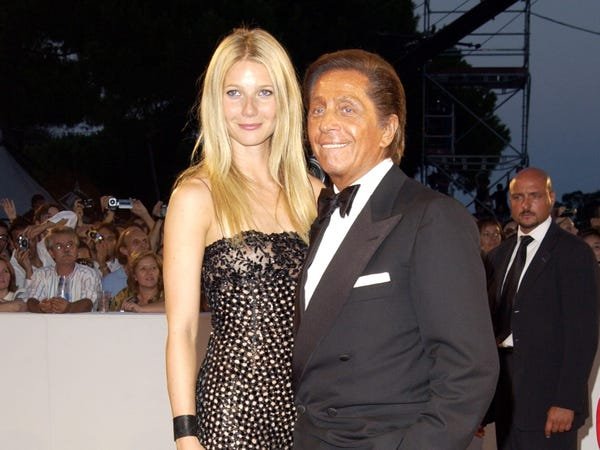
Gwyneth Paltrow and Valentino Garavani at the 2002 Venice Film Festival.

J. Vespa/WireImage

Gwyneth Paltrow paid tribute to Valentino in an Instagram post featuring a photo of her kissing the late designer on the cheek.

“I was so lucky to know and love Valentino-to know the real man, in private. The man who was in love with beauty, his family, his muses, his friends. His dogs, his gardens, and a good Hollywood story. I loved him so much. I loved how he always pestered me to ‘at least wear a little mascara’ when I came to dinner. I loved his naughty laugh,” Paltrow wrote in the caption.

“This feels like the end of an era. He will be deeply missed by me and all who loved him. Rest in peace, Vava,” she wrote.

Paltrow has worn Valentino gowns for many major moments over the years, including the 2013 Met Gala and her 2018 wedding to Brad Falchuk.

Cindy Crawford


Cindy Crawford and designer Valentino Garavani walk the runway at the finale of the Valentino Fall 1997 Couture Runway Show.

Cindy Crawford and Valentino Garavani at the Valentino Fall 1997 Couture runway show.

WWD/Penske Media via Getty Images

Cindy Crawford paid tribute to the designer on Instagram, sharing a photo of the pair on the runway together.

“I’m heartbroken to hear of Valentino Garavani’s passing. He was a true master of his craft, and I will always be grateful for the years I had the privilege of working closely with him,” Crawford wrote.

Crawford has walked the Valentino runway and appeared in multiple campaigns for the brand over the years.

Carla Bruni


Carla Bruni and Valentino Garavani at Paris Fashion Week in 2017.

Carla Bruni and Valentino Garavani at Paris Fashion Week in 2017.

Pascal Le Segretain/Getty Images

Former French first lady and model Carla Bruni also took to Instagram to share a tribute to Valentino.

“I’m moved by the departure of the immense Valentino who will leave so much beauty in the world. He was a teacher and it was an honor and a great privilege to know him and parade for him and I will always remember his great kindness and infinite elegance,” Bruni wrote in her caption in Italian. “My thoughts are with @giancarlogiammetti and all of Valentino’s family. Rest in peace #valentino.”

Bruni has modeled for Valentino numerous times throughout her career.

Claudia Schiffer


Valentino Garavani on the runway with model Claudia Schiffer during the finale of his spring 1998 couture collection.

Valentino Garavani on the runway with Claudia Schiffer during the finale of his spring 1998 couture collection.

WWD/Penske Media via Getty Images

Claudia Schiffer paid tribute to Valentino with a series of Instagram photos, including shots of her with the designer and from her campaigns for the brand.

“Heartbroken to hear of the passing of my old friend Valentino. He is what true legends are made of, living on forever through the brand he created, the embodiment of timeless elegance and glamour. I loved the special times where I got to bring his creations to life on and off the runway. One of my favourite campaigns was in Rome where I became Anita Ekberg in La Dolce Vita, a memory I will cherish forever,” Schiffer wrote in her caption.

“I will remember the fun holidays I spent with him in Mallorca, Ibiza and St Tropez. My Valentino wedding gown which I have framed at home as a constant reminder of his gentle, generous, sweet and loyal nature. Having him create my wedding gown was one of the great honors of my life, a moment I will cherish forever. I feel so proud to have been a part of his life. Repose en paix, Monsieur Valentino,” she wrote.

Sarah Jessica Parker


Valentino Garavani and Sarah Jessica Parker at the Schiaparelli and Prada Costume Institute Benefit red carpet.

Valentino Garavani and Sarah Jessica Parker at a red carpet event in the early 2010s.

Lars Niki/Corbis via Getty Images

Sarah Jessica Parker shared an Instagram post featuring a black background with red text that read “RIP VAVA. May 11, 1932 – January 19, 2026.”

“So many memories. So happy to recall. Of course, wish I had more. For your extraordinary talent, your decadent generosity and your love of all things beautiful, we are all more fortunate for the grand gestures you shared with the world. Godspeed Valentino Garavani,” Parker wrote in her caption.

Kim Kardashian


Valentino Garavani and Kim Kardashian attend the Valentino show at Paris Fashion Week in 2014.

Valentino Garavani and Kim Kardashian at the Valentino show at Paris Fashion Week in 2014.

Pascal Le Segretain/Getty Images

Kim Kardashian shared a series of Instagram Stories featuring photos of herself with the late designer.

“Sweet Valentino. You were magical, so special. Thank you for your magic. Rest in peace,” Kardashian wrote in her caption.

Helena Christensen


Helena Christensen and Valentino Garavani at an event in the early 2000s.

Helena Christensen and Valentino Garavani at an event in the early 2000s.

Evan Agostini/Getty Images

Model Helena Christensen left a comment on the Instagram post announcing the designer’s death.

“Such wonderful memories with this beautiful talented man and genius,” she wrote.

Christensen has appeared on the Valentino runway multiple times throughout her career.


Source link

Matthew Loh Headshot

Russia’s new jet-powered Geran-5 drone found with over a dozen US, Chinese parts: GUR

Ukraine’s defense intelligence agency, GUR, has identified over a dozen American and Chinese electronics parts that it says were found in a new Russian jet-powered attack drone.

GUR published its new analysis of the drone, dubbed the Geran-5, on Monday, as part of its ongoing directory of key foreign components used in Russia’s weapons or defense industry.

The intelligence directorate published images of what it said was the drone’s wreckage last week, saying that the Geran-5 was newly discovered after being used in an attack in early January.

Shaped like a traditional fixed-wing aircraft, the Geran-5 differs from past Gerans, which are delta-wing aircraft modeled after the Iranian Shahed drone.

GUR said last week that the Geran-5 closely resembles Iran’s Karrar uncrewed aerial vehicle, which in turn is believed to be modeled after the much older American MQM-107 Streaker attack drone.

At least nine of the Geran-5’s parts were produced by American companies, including digital signal processors, clock generators, and a transceiver, GUR said.

GUR said the drone also features a more powerful Chinese turbojet engine, allowing the Geran-5 to fly at up to 373 mph — much faster than the jet-powered Geran-3’s estimated 230 mph.

Three other parts, including a mesh network radio modem that retails for $8,100, were also sourced from China, GUR added.

One part on the list — the Geran-5’s transistor — is German.


Parts of a Geran-5 are displayed on snowy terrain, arranged to resemble the aircraft's original airliner-like structure.

GUR published an image of what appears to be gathered debris from a downed Geran-5.

Ukrainian Defense Intelligence Directorate (GUR)


Ukraine often warns that Russia’s military production base has been successfully evading international sanctions at a scale that allows it to manufacture a deep arsenal with foreign parts. Kyiv has long sought to compel international firms to introduce stringent due diligence programs to prevent their products from entering the black market.

GUR said in its initial report that the Geran-5 likely has a range of 600 miles and can carry a 200-pound warhead. The agency also said it had information indicating that Russia may seek to deploy the Geran-5 from Sukhoi Su-25 fighter jets, rather than from typical ground-based launchers, to extend its reach.

“Separately, the possibility of equipping the aircraft with R-73 air-to-air missiles to counter Ukrainian aviation is being considered,” the agency said.

The Geran drone family has come to describe loitering munitions that were based on Iranian designs but tweaked to be manufactured within Russia. Previous Gerans have taken inspiration from Tehran’s Shahed, and they’re so similar that they are often colloquially seen as synonymous.

The earlier Gerans are now one of Russia’s staple weapons against Ukraine, with the Kremlin manufacturing so many that it can afford to launch thousands of attack drones a month at Ukrainian cities.

Jet-powered versions of the Geran have been used more sparsely, though Ukrainian reports of the Geran-3’s use have grown increasingly common over the last year.


Source link

OpenAI-could-generate-25-billion-in-annual-ad-revenue-by.jpeg

OpenAI could generate $25 billion in annual ad revenue by 2030, and that should worry Google, top tech analyst says

Advertising could become a $25 billion business for OpenAI — and pose a threat to Google, according to new estimates on Monday from a top tech analyst.

Evercore ISI’s Mark Mahaney sees the startup generating that level of annual ad revenue by 2030 if it executes well on rolling out this new business.

OpenAI said on Friday that free and Go users of ChatGPT would start seeing ads “in the coming weeks.” OpenAI also laid out its advertising principles, such as clearly labeling them and not sharing user conversations with advertisers.

“A path to generating several billion dollars in ad revenue in 2026, going to $25B+ by 2030, seems reasonable,” Mahaney wrote in a note to investors.

That’s based on the likely scale of ChatGPT by that time, the proven monetization of high-intent performance marketing platforms, and the current size of this market, the analyst added.

OpenAI’s revenue is growing fast already. CFO Sarah Friar said in a recent blog post that the startup’s annualized revenue topped $20 billion in 2025, up from $2 billion in 2023. However, there are big question marks over OpenAI’s losses and whether it can become profitable in the future.

Advertising could be one way for OpenAI to boost its top and bottom lines.

Mahaney noted that Google’s Search and YouTube businesses likely generated close to $300 billion in ad revenue in 2025, with Meta generating an additional $180 billion. These are highly profitable operations, with operating profit margins of 40%, according to the analyst.

ChatGPT has almost 1 billion weekly average users, many of whom share valuable details with the chatbot, such as what they want and need. Advertisers are willing to pay up for access to this treasure trove. This is the type of intent-based information that forms the backbone of the massive digital ad businesses run by Google and Meta.

OpenAI has said that initial test ads will appear at the bottom of ChatGPT answers and be relevant to the user’s conversation with the chatbot. That approach might not be too intrusive for users, while still being attractive to advertisers, Mahaney said.

“OpenAI’s move directly challenges this core revenue stream by offering an alternative, highly engaging platform for users to discover products and services,” Mahaney wrote. “If ChatGPT can successfully integrate ads that are helpful rather than intrusive, it could siphon off valuable commercial queries that traditionally go to Google.”

The analyst also warned that if OpenAI can develop a “conversational” ad format, where users research and discuss potential purchases within ChatGPT, that could prompt advertisers to shift some of their marketing budgets because this is “high-intent engagement.”

Even if ChatGPT goes all-in on ads, though, don’t expect the chatbot to take Google’s share of the market overnight, Mahaney added.

OpenAI will still have to compete with the tech ecosystem that Google has spent years creating, such as its Chrome web browser, as well as web users’ habit of Googling stuff when they need an answer, Mahaney wrote.


Source link

Kelsey Vlamis's face on gray background.

US tariffs are paid almost entirely by Americans, a German study finds

A favorite tool of President Donald Trump has been costing Americans, according to new study.

The brunt of US tariffs — 96% — have been paid by US buyers, research from the Kiel Institute for the World Economy, a German think tank, found, while about 4% of the tariff burden was paid by foreign exporters.

“American importers and consumers bear nearly all the cost,” the researchers said of the tariffs.

The study, published Monday, said that the $200 billion increase in customs revenue that the US government raised in 2025 was a “tax paid almost entirely by Americans.”

The research contradicts Trump’s messaging that tariff costs would not be paid by Americans, but by other countries and overseas exporters. The president’s aggressive tariff policy launched last year placed additional duties on dozens of trade partners, including China, India, and the European Union.

The Kiel Institute study examined more than 25 million shipment records, worth nearly $4 trillion, between January 2024 and November 2025. The researchers found that there was a “near-complete pass-through” of the tariffs.

“US import prices rise nearly one-for-one with tariffs, while trade volumes contract,” the study said.

The findings echo other research that has found Americans are paying for tariffs, including from Harvard Business School and The Budget Lab at Yale. Analysts at Deutsche Bank and Bank of America also said last year that Americans were the ones paying for the tariffs.

The Kiel study said American importers and wholesalers are first hit by the tariff cost, followed by manufacturers and retailers, all of which must choose whether to absorb the tariff or pass it on to their customers. American consumers are then hit by increased prices, both on imported goods or American-made products that use foreign inputs. There’s been more limited availability of goods in the US, the researchers found.

Trump has continued to use tariffs, saying on Saturday that he would impose additional tariffs on Denmark and other European countries unless they agree to a deal that would transfer Greenland to the US.

Many of Trump’s tariff policies could also be undone. The Supreme Court is expected to rule soon on the legality of a host of Trump’s tariffs that were instituted under an emergency national security law. Trump has said the US would be “screwed” if the tariffs are overturned.


Source link

Screen Shot 2020 09 04 at 6.22.07 PM

OpenAI will focus on ‘practical adoption’ of AI in 2026, CFO says

OpenAI is going on all in on “practical adoption” of artificial intelligence in 2026, according to its CFO.

“The priority is closing the gap between what AI now makes possible and how people, companies, and countries are using it day to day,” Sarah Friar wrote in a recent blog post.

“The opportunity is large and immediate, especially in health, science, and enterprise, where better intelligence translates directly into better outcomes,” she added.

There are signs the startup is already taking advantage of these opportunities. Data from Ramp showed that business spending on OpenAI models surged to a record in December, outpacing rivals Anthropic and Google.

Still, some investors and analysts are concerned about OpenAI’s huge financial commitments and whether the startup will generate enough revenue to make a profit in future years. For example, OpenAI has announced roughly $1.4 trillion in infrastructure deals, such as data centers, in the past year or so.

One potential source of new revenue is advertising, something that OpenAI said on Friday it would start testing. CEO Sam Altman once labeled ads a “last resort,” although the move has been expected for months now.

Friar addressed concern about OpenAI’s finances in her recent blog, noting that revenue has grown in sync with compute availability.

OpenAI’s compute expanded from 0.2 gigawatts in 2023 to about 1.9 GW last year. Meanwhile, annualized revenue grew from $2 billion to more than $20 billion in the same period, Friar disclosed.

That represents “never-before-seen growth at such scale,” Friar wrote. “And we firmly believe that more compute in these periods would have led to faster customer adoption and monetization,” she added.

This did little to quell the critics.

On Monday, tech blogger Paul Kedrosky reacted to Friar’s blog post by saying: “Amusing reading from OpenAI CFO bragging that they are successfully selling dollars for $0.70 in huge volume.”


Source link