Jamie Dimon didn’t have much trouble telling Warren Buffett he’d hired one of his top lieutenants.
The JPMorgan CEO said that he called Buffett after hiring Todd Combs in December, who will lead a new $10 billion group at the bank and act as a special advisor to Dimon.
“It’s a free country, and people make their own decisions,” Dimon said in an interview at the Chamber of Commerce on Thursday. “I did call Warren. He probably wouldn’t have preferred it, but he said, ‘if he’s going anywhere, at least he’s going to you.'”
Combs had been at Berkshire since 2010, where he served as CEO of Berkshire-owned Geico and as one of Buffett’s two investment managers. In a press release, Buffett said that Combs “has resigned to accept an interesting and important job at JPMorgan,” and that the bank made “a good decision.”
In his own press release about the hire, Dimon called Combs, a former member of JPMorgan’s board, “one of the greatest investors and leaders I’ve known.” Dimon has praised Buffett time and again over the years, saying that he “represents everything that is good about American capitalism and America itself” after the 95-year-old announced he would step down as Berkshire’s CEO. Business Insider contacted Berkshire Hathaway and JPMorgan for comment.
Dimon, 69, addressed questions of his own future as a corporate leader during Thursday’s interview. When asked whether he wants to stay in the job his characteristic five more years, Dimon said yes, “at least.”
“I love what I do. It’s up to the board how long I do it. As long as I have the energy and the spit in the eye and the fire in the gut, yeah, I want to do it,” he said.
And he said he has absolutely no interest in becoming the Fed Chair: “Absolutely, positively, no chance, no way, no how for any reason.” (Dimon reiterated the importance of the central bank’s independence in the interview, which has come into question in recent days given the Justice Department’s investigation. He said that President Donald Trump also thinks we need an independent board.)
If a president offered him the job of Treasury Secretary, however, Dimon said he would “consider it.” He’d need to understand “what they want and how they want to operate” before making a decision.
For now, though, Dimon said he’s happy to be his own boss.
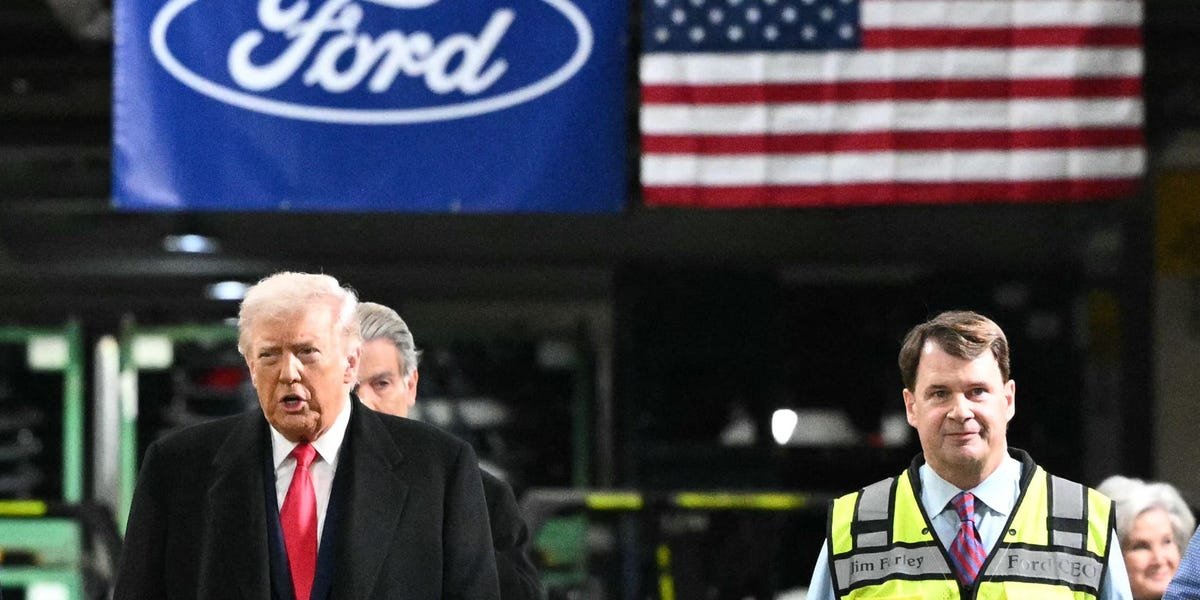
Hours after President Donald Trump toured a Ford pickup truck assembly plant, the big news story wasn’t about manufacturing jobs or the economy. It was about a Ford worker who heckled him and was later suspended.
The incident raised questions about the limits of free speech in the workplace — and when companies can discipline workers for political protest.
Business Insider spoke to five experts, including four employment lawyers and an HR executive, to find out.
Their conclusion was blunt: an employee’s words can quickly become fireable offenses.
‘An employer has the ability to discipline an employee for speech’
All four lawyers said workers retain legal free speech rights under the Constitution, but those rights rarely protect speech in their workplace.
“With very few exceptions, employees in the private sector don’t have free speech rights at work,” Mark Kluger, a co-founding partner at New Jersey-based law firm Kluger Healey, told Business Insider.
Jessica Childress, a managing attorney at Washington, DC-based The Childress Firm, said workers often confuse who the First Amendment actually applies to. The best way to think about it, she said, is to divide government action from a private company’s authority.
“The First Amendment’s right to freedom of speech only applies to government actors, not private employers, such as Ford,” she said. “A private company can — with certain exceptions — limit what their employees say.”
That distinction has played out in real-world cases before.
Juli Briskman, a former government contract worker, was fired from her job after a photograph lensed her flipping off Trump’s motorcade.
BRENDAN SMIALOWSKI/AFP via Getty Images
In 2017, Juli Briskman, a former marketing analyst for a government contractor, was fired from her job after professional photographers caught her giving Trump’s motorcade the middle finger.
Even though her action happened outside of the office, her lawsuit against her employer was tossed.
“Employers are legally allowed to regulate behavior that disrupts the workplace,” said Jared Pope, an employment law attorney and CEO at Work Shield. “That is why most organizations apply their codes of conduct consistently, even when speech happens off the clock or references public figures.”
Still, lawyers said workers generally have more protection if they express their political belief off-the-clock.
“If you are so inclined to protest, do it off-duty, off-premises, and off-company networks,” Eric Kingsley, a partner at Kingsley Szamet Employment Lawyers, told Business Insider. “An employer has the ability to discipline an employee for speech in matters of politics when it becomes misconduct.”
Ford decided to suspend the worker initially, not fire them. The UAW said it’s looking into the situation, while Ford said it doesn’t comment on personnel matters.
JEFF KOWALSKY/AFP via Getty Images
Why Ford likely suspended — not fired — the worker initially
Each lawyer we talked to said that Ford was well within its rights to suspend the employee, T.J. Sabula.
In fact, some said the automaker may have displayed restraint by not outright firing the factory employee after the decision.
“It implies Ford is buying time,” Kingsley added. “Suspending the employee gives them a chance to investigate and make a decision that may not be as rash as laying off an employee.”
On Wednesday, the United Auto Workers, the union representing the workers in Sabula’s plant, confirmed his suspension. Sabula, who has said he doesn’t regret heckling Trump and is set to receive over $800,000 in crowdfunded support, has not responded to requests for comment from Business Insider.
Laura Dickerson, a vice president for the UAW, said the union was reviewing Ford’s actions and said workers “should never be subjected to vulgar language or behavior by anyone — including the President of the United States.”
The union also said Sabula “believes in freedom of speech, a principle we wholeheartedly embrace, and we stand with our membership in protecting their voice on the job.”
Ford declined to comment on the suspension, saying it was “a personnel matter.”
“Ford is navigating a high-profile, politically charged moment,” Lauren Winans, CEO of the HR consulting firm Next Level Benefits, said. “The union’s involvement likely influenced Ford’s decision to suspend (not fire), because unilateral termination could lead to grievances and arbitration.”
For workers wondering if they can get fired for speaking their mind at work, Kluger made it clear the answer is yes.
“Try telling your boss what you really think of them and see how long you remain employed,” he said.
Do you think Ford should fire the employee? Let us know by taking our survey:
This story is available exclusively to Business Insider
subscribers. Become an Insider
and start reading now. Have an account? .
Department stores have changed dramatically over the last 100 years.
Department stores once sold necessities. Now, many are struggling to remain in business.
While some classic chains cease to exist, other retailers have found ways to increase sales.
In the early 1900s, department stores existed to sell necessities, including food, home goods, and apparel.
Today, many luxury department stores are struggling to survive.
The rise of the internet and surge in online sales have placed a major strain on department stores. Saks Global, the parent company of Saks Fifth Avenue, Bergdorf Goodman, and Neiman Marcus, became the latest department retailer to file for bankruptcy on Tuesday.
Take a look at how department stores have changed over the last 100 years.
In the early 1900s, department stores were focused on selling the necessities.
A Harrods department store. Heritage Images/Getty Images
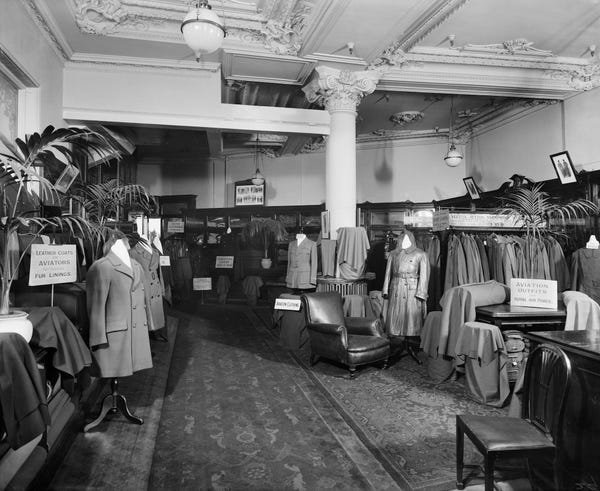
Core products included clothing and home goods. During times of war, the necessities on sale included military jackets, coats, and accessories.
That’s why Harrods, a famous department store in London, featured an in-house tailoring room throughout World War I. The space was utilized to alter used uniforms and sell new ones.
Department stores still sell the basics, but novelty items are also typically present.
A modern Harrods department store. Prisma by Dukas/Getty Images
You can find everything from household tools and fashionable clothes to toys and knickknacks at modern department stores — they seem to sell everything, in an apparent bid to compete with online retailers.
Harrods also sells store-branded items, including bags, stationery, and teddy bears.
Leading up to the 1930s, department stores were often crowded.
A crowded department store. Bettmann/Getty Images
Around 1929, people were encouraged to shop in order to help boost the nation’s sinking economy, Fortune reported.
But that same year, the stock market crashed, and the Great Depression officially began. The period lasted for 10 years, causing major layoffs, failing banks, and mass poverty.
Today’s department stores rarely see such large crowds, aside from major shopping events like Black Friday.
A Macy’s department store on Black Friday. Kamil Krzaczynski/Getty Images
Even during major holiday sales, many modern shoppers still prefer to shop online from the comfort of their homes.
In 2025, shoppers in the US were projected to spend a record $11.7 billion online on Black Friday, an 8.3% increase from 2024.
It marked a contrast from the wild Black Friday scenes that could be seen in stores in the decade before the COVID-19 pandemic.
In the 1920s, employees worked in department store basements to make change for cashiers upstairs.
The basement of a department store in the 1920s. Underwood Archives/Getty Images
In large stores that existed across multiple floors, vacuum systems transported the change upstairs through tubes.
None of those “tube rooms” are needed anymore, thanks to computers and credit cards.
A cashier at Macy’s. Kena Betancur/Getty Images
Modern shoppers often don’t even have to interact with a cashier if they don’t want to. Instead, they can use touchscreen self-checkout machines to purchase products from many department stores.
Starting in 1924, Macy’s celebrated the holidays with its first annual “Christmas Parade.”
A photo from the first parade was taken in 1924.
Macy’s
Live animals such as elephants were included in the early days of the Macy’s parade. Balloons depicting popular characters such as Mickey Mouse appeared a little later in the ’30s.
The name has since been changed to the “Macy’s Thanksgiving Day Parade.”
The Radio City Rockettes at the Macy’s Thanksgiving Day Parade. Scott Gries/NBC via Getty Images
Other aspects of the yearly tradition have also been changed. For example, live animals have been replaced with people dressed in costumes, and giant marching bands have become a staple. Tons of celebrities have also appeared on floats.
Minimal merchandise was showcased in store window displays throughout the ’40s.
A department store display window. Kirn Vintage Stock/Getty Images
Beginning in the 1870s at Macy’s, some chain retailers in New York City have made it a tradition to decorate store-front windows each holiday season.
There was some art to these displays, as props were placed alongside mannequins and merchandise to create a scene.
Contemporary display windows are unlike anything of the past.
A holiday display window at Macy’s. Nicolas Economou/NurPhoto
Modern department stores often incorporate technology, moving props, and bright lights into window displays.
As early as 1923, Barneys New York was a popular department store.
Barneys New York. Peter Morgan/AP
Barneys New York was created by a man named Barney Pressman when he pawned his wife’s engagement ring and opened a shop on Seventh Avenue and 17th Street in New York City.
By the ’60s, Barney’s son, Fred, had turned the location into a luxury store, and the company became a national sensation throughout the 1990s and 2000s. By 2019, there were 22 stores in the US.
However, the chain faced difficulties and shuttered all stores in 2020.
A closing sale at Barneys New York. WWD/Penske Media via Getty Images
Barneys New York filed for Chapter 11 bankruptcy in August 2019 and closed all remaining stores in February 2020.
Bonwit Teller was once a prominent luxury department store with a flagship location in New York City.
A Bonwit Teller department store. George Rinhart/Getty Images
The store was known for selling a range of high-end women’s clothing inside a luxurious Art Deco building. It grew to more than a dozen locations across cities, including Chicago, Philadelphia, and Columbia, South Carolina.
By 2000, every Bonwit Teller store had gone out of business.
Bonwit Teller’s closing sale. Barbara Alper/Getty Images
In 1979, the Bonwit Teller company was sold from its original owners to outside corporations. Ten years later, in 1989, the store filed for bankruptcy and began shutting all of its stores, with its last location closing in 2000.
While the flagship Bonwit Teller store would have been exempt from the closure, the building was purchased by Donald Trump in 1979, who demolished it to build Trump Tower.
The Saks Fifth Avenue flagship store in New York City opened in 1924.
Saks Fifth Avenue. Bettmann Archive/Getty Images
Saks Fifth Avenue was once a bustling destination for luxury shoppers. At 650,000 square feet, the store spans an entire city block.
Saks Global filed for bankruptcy on Tuesday.
Saks Fifth Avenue in New York City. ANGELA WEISS/AFP via Getty Images
Saks Global’s 2024 acquisition of Neiman Marcus for $2.7 billion left the company in debt and struggling to pay luxury vendors, some of whom have withheld inventory.
Business Insider reporter Madeline Berg visited the Saks Fifth Avenue flagship store the day Saks Global announced it was filing for bankruptcy and found it to be “nearly empty” with little foot traffic.
US planning for the high-risk raid to apprehend Venezuela’s former president, Nicolás Maduro, centered on a time when much of the country’s military would be on holiday leave, a newly released memo reveals.
The December 23 memorandum from the Department of Justice’s Office of Legal Counsel offers fresh details about how the US planned to pull off the daring nighttime raid to capture Maduro in his fortified compound and transport him to New York to stand trial. The former leader has pleaded not guilty to the drug and weapons charges he faces.
The raid began late on January 2 and ran into the next day. President Donald Trump said on January 3 that the initial plan was for the operation to occur four days earlier, on December 30, but he decided to wait for better weather.
“The expected duration of the operation within Venezuelan territory is [redacted] hours,” wrote T. Elliot Gaiser, a US assistant attorney general, wrote in the late December DOJ memo, which looks into the legality of the raid and was made public this week. Much of the planning section is blacked out.
“In order to minimize casualties, the strike will take place at 0100 am (local time) on a date where a maximum number of Venezuelan military would be on leave for the holidays,” Gaiser wrote.
The US attacked Venezuelan military targets as part of its raid earlier this month.
Federico PARRA/AFP via Getty Images
It’s unclear how many soldiers were away when the US actually executed the operation in January. Dozens of Venezuelan and Cuban security personnel were killed, the two countries said after Operation Absolute Resolve concluded.
The DOJ memo, which cited Pentagon planning information and details how the US could effectively present the action as a law enforcement operation rather than an act of war, said that the US expected to encounter “significant resistance” from Venezuela’s air defenses.
That anticipated resistance includes several dozen anti-aircraft systems on the approach to Fuerte Tiuna, a major military installation in Caracas where Maduro and his wife were believed to be and, indeed, were at the time of the operation.
The memo outlined how US aircraft would strike air defense systems to clear a path for assault forces to reach Tiuna. It said that the Pentagon aimed to target a local power switching station to keep the power off, which could explain Trump’s post-raid remarks that a “certain expertise” was used to turn off the lights in Caracas.
The US could have also carried out a cyberattack or employed electronic warfare capabilities. “Kinetic operations will be preceded by non-kinetic action,” the memo said.
More than 150 US aircraft participated in the operation.
Eva Marie Uzcategui/REUTERS
The memo was published several days before the raid, so it’s unclear how US planning may have changed between the time it was written and the actual operation.
Dan Caine, the chairman of the Joint Chiefs of Staff, said on January 3 after the raid that more than 150 US aircraft participated in the operation, including stealth jets, electronic attack aircraft, surveillance and reconnaissance planes, airborne early warning aircraft, bombers, and drones.
Many of these aircraft targeted and engaged Venezuela’s air defenses to clear a path for low-flying helicopters carrying the forces that stormed Maduro’s compound and apprehended the former president and his wife, consistent with the planning memo.
The US didn’t lose any aircraft during the raid. A helicopter took a hit but still remained operational, and a defense official said seven American service members were wounded during the night.
“Risks to the mission are significant,” the memo said, adding that its “success will depend on surprise.” In the aftermath, Caine said the US achieved “totally the element of surprise.”
Air France passengers were delayed by nearly two days after they were diverted to Turkmenistan.
Monday’s Flight 191 was already running 21 hours late when it departed Bengaluru, India, shortly after 11 p.m., according to data from Flightradar24. It was supposed to land in Paris about 10 hours later.
However, four hours into the journey, the Boeing 777 started descending. It made a U-turn to land in Ashgabat, the capital of Turkmenistan, a sparsely populated nation in Central Asia.
Registered as F-GSPI, the jet is 26 years old. The cause of the diversion has not been confirmed, though The Independent reported that the plane suffered an engine issue.
Passengers then had to wait nearly another whole day to continue their journey to Paris. Turkmenistan is ruled by what Human Rights Watch has described as a totalitarian, hereditary governmentand is one of the world’s most politically secluded countries.
Every time Pete publishes a story, you’ll get an alert straight to your inbox!
Stay connected to Pete and get more of their work as it publishes.
Air France did not respond to a request for comment sent by Business Insider.
Given that the flight departed from India, there were a number of Indian nationals on board, who were hosted by the nation’s consulate in Turkmenistan. It is unclear where the majority of the passengers on the flight stayed during their time in Ashgabat.
Ultimately, a new aircraft was dispatched to collect the passengers. Flight-tracking data shows another Air France Boeing 777 left Paris on Tuesday morning and arrived in Ashgabat after a five-hour flight.
It spent about three hours on the ground before departing Turkmenistan shortly after 1 a.m. That’s nearly 22 hours after the passengers first arrived there.
The plane then landed in the French capital at 3:23 a.m. on Wednesday. Along with the departure delay, that’s 43 hours later than passengers initially expected to get there.
Flight-tracking data appears to show that the original plane is still on the ground in Ashgabat as of Thursday morning, three days after it landed there.
This wasn’t the first time that Air France has sent a plane to rescue stranded passengers.
In May 2024, one of its Boeing 787s was flying from Paris to Seattle when a burning smell was detected in the cabin.
The pilots declared an emergency and diverted to Iqaluit, the capital of Canada’s Nunavut territory. A different flight was canceled so a Boeing 777 could take the passengers to New York.
A new lawsuit from a Democratic senator and combat veteran at the heart of a free speech fight seeks to block the Pentagon’s intensifying crackdown.
Arizona Sen. Mark Kelly sued Defense Secretary Pete Hegseth on Monday, warning that the Pentagon’s effort to punish him “sends a chilling message” to veterans who speak out against the Trump administration.
Hegseth accused Kelly of “seditious” acts after Kelly publicly reminded US service members that they are not required to follow illegal orders. The Pentagon’s actions against Kelly have troubling implications for the political speech of millions ofveterans, military law experts said.
Hegseth’s effort to muzzle a US senator “places other retirees who have spoken up potentially in jeopardy,” said Rachel VanLandingham, a professor at Southwestern Law School who is a retired Air Force JAG. “Not knowing whether or not he’s going to come after you already has a chilling effect.”
Kelly said his lawsuit is about fighting back. The Democratic lawmaker announced the federal lawsuit on Monday. His suit also named the Department of Defense, Navy Secretary John Phelan, and the Navy Department as defendants. Kelly’s video urging troops not to follow illegal orders.
Veterans who serve 20 years or more are eligible for a military pension, but those benefits can be revoked or reduced if retirees are found to have violated military law while in uniform. By contrast, Hegseth’s move seeks to punish a veteran for his speech long after serving in uniform, an approach one expert on military law called baseless.
Every time Kelsey publishes a story, you’ll get an alert straight to your inbox!
Stay connected to Kelsey and get more of their work as it publishes.
Kelly’s lawsuit argues that using the military justice system to punish veterans’ political speech risks setting a precedent that abuses the First Amendment rights of other retired troops.
Defense Secretary Pete Hegseth’s prosecution of Kelly has implications for veterans’ speech, legal analysts said.
DoW photo by U.S. Air Force Staff Sgt. Madelyn Keech
Legal basis in question
The lawsuit argues that nothing in the law allows the Pentagon to revisit a retirement determination based on a veteran’s speech. Such a move, the filing says, would raise “serious constitutional concerns” and leave retired service members facing a constant threat to their earned benefits.
There’s no legal basis for Hegseth’s pursuit, VanLandingham said. The defense secretary initially sought to court-martial Kelly, threatening him with the military equivalent of a criminal trial. It later opted for a lesser administrative punishment.
“The process is the punishment,” said Frank Rosenblatt, a retired Army JAG and professor at Mississippi College School of Law. “The claim against Kelly had no merit.”
“Senator Kelly’s speech is not punishable under the UCMJ,” the National Institute of Military Justice nonprofit group said in a December statement in reference to the Uniform Code of Military Justice.
The lawsuit seeks to halt actions that could reduce Kelly’s military rank and retirement pay and characterizes that effort as “unlawful.”
After filing the lawsuit, Kelly requested a temporary restraining order and a preliminary injunction from the federal court, seeking to halt the Pentagon’s actions while the case is reviewed on its merits. Both are emergency measures that ask a judge to stop government action before permanent harm occurs.
The federal government has been increasingly pushing cases important to the Trump administration onto a “rocket docket,” Rosenblatt said, accelerating litigation toward higher courts. If the judge assigned to the case, US District Judge Richard Leon, issues a ruling the government doesn’t like, “this could move very quickly to the DC Circuit and potentially the Supreme Court.”
Leon has previously ruled against the military’s authority over retirees.
“I am not concluding today that Congress could never authorize the court-martial of some military retirees,” Leon wrote in a 2019 memorandum opinion that rejected the government’s argument that military jurisdiction over all retirees was necessary to maintain good order and discipline of its active force. The judge noted he had not seen a clear argument for “why the exercise of such jurisdiction over all military retirees is necessary.”
In a post on X last week, Hegseth called Kelly’s video with five other Democratic lawmakers “reckless and seditious” and said it was “clearly intended to undermine good order and military discipline.”
The military justice provisions that Hegseth accused Kelly of violating — Articles 133 and 134 of the Uniform Code of Military Justice — are not explicitly tied to sedition and can cover a wide range of alleged misconduct.
Kelly’s lawsuit argues that allowing the executive branch to punish a member of Congress for speech is a threat to the Constitution and erodes congressional oversight of the armed services.
“We are aware of the litigation,” a Pentagon spokesperson said Tuesday when asked for comment on the lawsuit. “However, as a matter of policy, the Department does not comment on ongoing litigation.” That same day, Hegseth took aim at Kelly’s military rank in an X post: “‘Captain’ Kelly knows exactly what he did, and that he will be held to account.”
Marc Benioff shared what he thinks is the darkest aspect of AI.
On an episode of the “TBPN” show streamed on Wednesday, the Salesforce CEO said that he couldn’t “believe what he was watching” when he saw a “60 Minutes” documentary on chatbot-building startupCharacter.AI and its impact on children.
“We don’t know how these models work. And to see how it was working with these children, and then the kids ended up taking their lives,” he said, “That’s the worst thing I’ve ever seen in my life.”
Character.AI allows users to build custom chatbots that can emulate the behaviour of a close friend or romantic partner. The startup did not immediately respond to Business Insider’s request for comment about Benioff’s remarks.
“Tech companies hate regulation. They hate it,” Benioff said. “Except for one regulation they love: Section 230. Which means that those companies are not held accountable for those suicides.”
Every time Shubhangi publishes a story, you’ll get an alert straight to your inbox!
Stay connected to Shubhangi and get more of their work as it publishes.
Section 230 of the 1996 US Communications Decency Act protects social media companies from liability for user-generated content while also letting them moderate posts. Tech giants use Section 230 as a common defense strategy, saying they are just platforms and not responsible for what users say and do on them.
“Step one is let’s just hold people accountable,” he said. “Let’s reshape, reform, revise Section 230, and let’s try to save as many lives as we can by doing that.”
Executives, including Meta’s Mark Zuckerberg and former Twitter CEO Jack Dorsey, have repeatedly defended the regulation in Congress, asking for it to be expanded rather than removed.
Last week, Google and Character.AI agreed to settle multiple lawsuits from families whose teenagers died by suicide or hurt themselves after interacting with Character.AI’s chatbots.
These negotiations are among the first settlements in lawsuits that accuse AI tools of contributing to mental health crises and suicides among teenagers. OpenAI and Meta are facing similar lawsuits as they, along with others, race to build large language models that sound more friendly and helpful, ultimately keeping users coming back.
Grok will no longer be allowed to create AI photos of real people in sexualized or revealing clothing, after widespread global backlash.
“We have implemented technological measures to prevent the Grok account from allowing the editing of images of real people in revealing clothing such as bikinis,” X’s safety account said in a blog post on the platform on Wednesday. “This restriction applies to all users, including paid subscribers.”
The change was announced hours after California’s top prosecutor, Rob Bonta, said he launched an investigation into sexualized AI deepfakes, including those of children, generated by Grok. Bonta said that there had been a flood of reports in the last few weeks that Grok users were taking pictures of women and minors they found online and using the AI model to undress them in images.
Indonesia and Malaysia suspended Grok because of the images, the first countries in the world to ban the AI tool. Lawmakers in the UK publicly considered a suspension.
In Wednesday’s blog post, the social media company reiterated that image creation and the ability to edit images via Grok on the X platform will now only be available to paid users as an additional safety measure.
Every time Shubhangi publishes a story, you’ll get an alert straight to your inbox!
Stay connected to Shubhangi and get more of their work as it publishes.
The company restricted non-paying users last week after complaints from officials globally, but it was slammed for being insufficient.
A spokesperson for British Prime Minister Keir Starmer said it “simply turns an AI feature that allows the creation of unlawful images into a premium service.”
Elon Musk, who owns xAI, the maker of Grok, said that the UK government wanted “any excuse for censorship” in response to a post questioning why AI tools like Gemini and ChatGPT were not being looked into.
On Wednesday, a few hours before X’s official account posted about the ban on creating sexualized images, Musk asked users to try to get around the AI model’s image restrictions.
Bonta’s office and Starmer’s office did not immediately respond to requests for comment from Business Insider.
Marketers champing at the bit for AI chatbots to become the next major ad surface may have to suppress their appetites a little longer.
With Google’s Gemini surging in popularity, speculation has been bubbling in the ad industry that the app might be on the cusp of introducing ads to capitalize on the moment — and help offset the hefty AI infrastructure costs.
Not so, according to Google’s VP of global ads, Dan Taylor. In an interview with Business Insider this week, Taylor reaffirmed there are “no plans for ads in the Gemini app.”
Instead, the ads team is prioritizing ad placements within AI search. Google began introducing ads to AI Overviews — the natural language summaries of search results that appear at the top of its search engine results page — in 2024. Last year, it brought ads to AI Mode, its AI chatbot that appears on search pages, which enables users to conduct more in-depth research and ask follow-up questions.
“Search and Gemini are complementary tools with different roles,” Taylor said.
“While they both use AI, search is where you go for information on the web, and Gemini is your AI assistant,” he said. “Search is helping you discover new information, which can include commercial interests like new products or services. We see Gemini as helping you create, analyze, and complete that.”
From an advertising perspective, Google has over 25 years of experience with search ads. Monetizing AI assistants is a relatively new, uncharted territory with numerous questions to consider.
Here are a few:
Where and when should an ad show up?
What would these ads look like, and how should companies think about charging for them?
How can an AI chatbot balance commercial interests while also ensuring users feel they are getting accurate and objective answers?
Could the introduction of ads alienate users in a competitive landscape where apps like Gemini are fighting for supremacy against the likes of OpenAI’s ChatGPT, Microsoft’s Copilot, and Anthropic’s Claude?
A first-mover disadvantage?
Ads might feel inevitable as tech giants invest billions of dollars into their AI infrastructures. However, AI companies are aware that making the first move could be perceived as a degradation of their products and cause users to jump ship.
Google’s success in leveraging AI to create financial gains from its existing search product and advertising platform is one advantage it has over arch-rival OpenAI, which is under pressure to demonstrate a path to profitability. It potentially gives Google more leeway to wait before introducing an ad model to Gemini.
Stratechery tech analyst Ben Thompson said in a recent interview on the tech news show TBPN that OpenAI delaying ads in ChatGPT “risks the entire company.”
“They could have launched the world’s crappiest ads in 2023. By today, in 2026, they would be good,” Thompson said. “Now, they’re going to have to launch ads, they’re going to suck, and people are going to be like, ‘This sucks, I’ll just go to Gemini.'”
The rivalry between Google and OpenAI intensified late last year when Google released its Gemini 3 AI model, which received rave reviews. OpenAI CEO Sam Altman responded by issuing a “code red,” telling teams to redirect resources from newer projects, including a yet-to-be-released advertising program, to prioritize improving ChatGPT’s performance.
Gemini had 650 million monthly active users, Alphabet, Google’s parent company, said in its latest quarterly earnings report in October. OpenAI said in October that ChatGPT had 800 million weekly users.
What Google has learned from ads in AI search so far
Taylor said that more than 80% of Google’s advertisers are currently using some form of AI-powered search functionality. That’s largely through the adoption of tools like AI Max for Search and Performance Max, where Google’s AI algorithm automatically chooses which ad creatives a campaign should run and where to place those ads.
Advertisers can’t yet specifically choose to run ads within AI Mode or AI Overviews. Instead, the algorithm makes the decision to place them there based on targeting variables like location, demographics, keywords, and topics.
“We don’t have any plans to enable buying separately at this phase,” Taylor said.
Taylor said AI Overviews have notched up more than 2 billion monthly active users, and that people are clicking and engaging with AI Overview ads “at about the same rate” as traditional search ads.
Google’s testing of ads in AI Mode isn’t as far along and presents more challenges when trying to convert the traditional search ads playbook for the AI era. Users have longer back-and-forth conversations in AI Mode, and ads shown too early can feel “intrusive” and create “a trust problem,” Taylor said. A newbie runner seeking helpful information about how to prepare their body for a marathon later in the year might not be ready straight away for ads featuring performance running shoes, for example, he added.
This month, Google said it had begun testing a new ad format called Direct Offers, which will let advertisers present personalized discounts to shoppers who are about to make a purchase within AI Mode. Taylor said Google is only working with a specific set of advertisers on the Direct Offers pilot and didn’t have more information about when it might become broadly available.
Direct Offers was one of several announcements Google made regarding new AI-shopping experiences. New products included a forthcoming checkout function that will let shoppers complete their purchases inside AI Mode and the Gemini app.
Silicon Valley is raising its standards for talent.
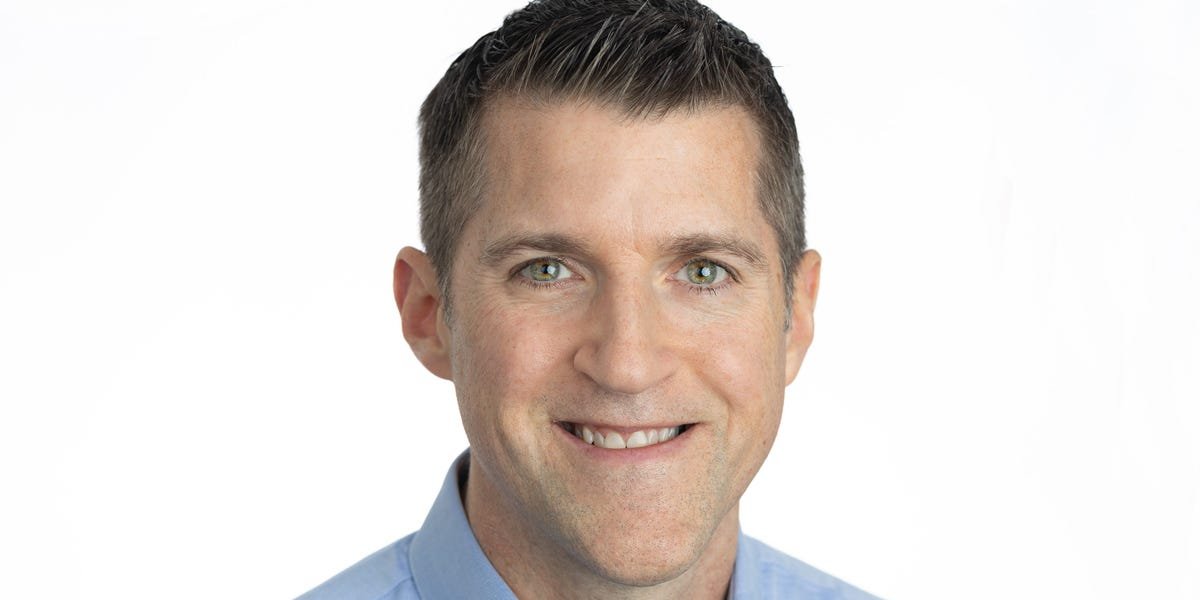
Adrien Friggeri spent over a decade combined at Meta — including back when it was called Facebook — with stints at Michael Bloomberg’s Hawkfish and Clubhouse as well. Now, he works as a partner software engineer at Microsoft, according to his LinkedIn profile.
The consequences of underperforming are “more drastic” now than they were 10 years ago, Friggeri said on “The Peterman Pod.”
In an email to Business Insider, Friggeri wrote that there is less “organizational ‘slack'” and higher expectations for tech employees.
“That means performance gaps are identified and addressed faster, and if someone is not meeting clearly defined expectations over time, the path to a formal performance-management process (and potentially a role change or exit) can be shorter than it used to be,” Friggeri wrote.
Meta has been especially strict with its performance expectations. The tech giant laid off roughly 3,600 employees in February, labeling them low performers.
There are also benefits to being above the pack. Meta is introducing higher bonuses for top performers, Business Insider reported on Monday.
In his email, Friggeri clarified that the trend was not specific to Meta. Rather, it was industry-wide and reflected the state of the market. Meta did not respond to a request for comment.
Friggeri shared four tips with Business Insider to stay ahead and avoid underperformance.
1.)Workers should make expectations explicit.
“Align with your manager on priorities and what ‘great’ looks like for the next 30/60/90 days,” Friggeri wrote.
2.) Employees should seek out feedback.
They shouldn’t wait for review cycles, Friggeri wrote. Feedback should be sought out “early and often.”
3.) Focus on “visible, high-leverage work.”
“Pick projects tied to clear outcomes and communicate progress, risks, and tradeoffs,” he wrote.
4.) Keep investing in your skills
Friggeri wrote that employees should “treat learning as part of the job, especially as teams and priorities shift.”
On the podcast, Friggeri advocated for being independent and building new projects — and not being silent about them. It’s not helpful to “lock yourself in a room,” build for three months, and show up with the finished product.
“Overcommunicate is really the strategy I would recommend,” he said.