Do you enjoy sorting through numbers and executives answering questions with lots of spin? If so, you’re in for a treat.
Earnings season is back, and the big banks kick things off. JPMorgan leads the way on Tuesday, followed by Bank of America and Citi on Wednesday. Goldman Sachs and Morgan Stanley bring us home on Thursday.
BI’s Reed Alexander previews the four biggest things to watch from Wall Street this earnings season. From dealmaking’s rebound to credit risks to AI (of course), there’s a lot to unpack this week.
Banks are a valuable group to open with. Their lending and dealmaking capabilities, coupled with their deep ties to consumers, put them at the epicenter of the business world. Their earnings reports are as much about themselves as the wider economy.
January earnings are also unique since they include a year-end recap. And what a year 2025 was …
A volatile first half was followed by stocks (including banks) hitting record highs by year-end despite ongoing talk of an AI bubble. Bank executives are likely to discuss maintaining that strong momentum in 2026.
There’s also a wild card to consider this earnings season.
President Donald Trump has made it clear he’s on a mission to address affordability, and sometimes that includes targeting specific companies.
Last week, Trump issued warnings against the defense sector and institutional investors in the residential housing market. While the threats lacked specific details, they were strong enough to catch investors’ attention.
Trump also said he’d be talking more about affordability in the coming weeks, including during his speech next week at Davos.
That could be a net positive for banks. A healthy consumer is typically good for them. But with no clarity on how Trump might approach improving affordability, it’s tough to say.
Meanwhile, other industries will need to remain on their toes in case they’re the next target on Trump’s affordability crusade. And even if they feel like the problem Trump is addressing isn’t necessarily applicable to them, the market might not care anyway.
Michael Burry, the investor made famous by “The Big Short,” says the era of Big Tech turning relatively small investments into huge profits is ending.
And he says AI is to blame.
In a recent Substack exchange with tech podcaster Dwarkesh Patel, Burry said the most important metric AI industry investors should be watching isn’t revenue growth, hiring, or even market size, but return on invested capital, or ROIC.
ROIC is a measure of how efficiently a company turns the money it puts into its business into profit.
“The measure to beat all measures is return on invested capital (ROIC), and ROIC was very high at these software companies. Now that they are becoming capital-intensive hardware companies, ROIC is sure to fall, and this will pressure shares in the long run,” Burry wrote.
Every time Peter publishes a story, you’ll get an alert straight to your inbox!
Stay connected to Peter and get more of their work as it publishes.
AI, Burry said, is pushing companies like Microsoft, Google, and Meta away from their historically asset-light software models and toward a far more capital-intensive future defined by data centers, chips, and energy.
Even if AI expands Big Tech’s addressable market, he said, falling ROIC could pressure stock prices for years to come.
Burry rose to fame after his bet against the mid-2000s housing boom was chronicled in “The Big Short.” Outside the occasional cryptic social media post, Burry, for a long time, spoke publicly only rarely.
That changed late last year when he closed his hedge fund to outside cash and began writing financial analysis on Substack.
Perhaps most notably, he has recently compared the AI boom to the late-1990s dot-com bubble, calling OpenAI the “Netscape of our time.” Netscape’s IPO marked the beginning of dot-com hype in 1995. Five years later, the bubble burst.
Burry’s hedge fund, Scion Asset Management, has made large bets against Nvidia and Palantir Technologies, two darlings of the AI era, according to a regulatory filing released in September last year.
Leading AI companies, like OpenAI, Anthropic, Google, and Meta, are spending big to build out the infrastructure they need to support their energy- and data-intensive chatbots and other AI applications. Debt and equity investors have lined up to back these projects.
So far, however, those companies have not shown significant profit returns on their AI products, leading investors like Burry to sound the alarm that AI is a bubble on the verge of bursting.
Agreed. And still, return on investment will continue to fall, almost all AI companies will go bankrupt, and much of the AI spending will be written off. Will it be the Panic of 2026? 2027? Does not have to be. https://t.co/VBWjh26vnc
“At some point, this spending on the AI buildout has to have a return on investment higher than the cost of that investment, or there is just no economic value added,” Burry wrote in the Substack post.
Federal Reserve Chair Jerome Powell said the US central bank was served grand jury subpoenas on Friday from the Department of Justice that threatened criminal indictment.
In a statement on Sunday night, Powell said the subpoenas focused on his June testimony about renovations at historic Fed office buildings. The Fed chair said the subpoenas were the latest move in the Trump administration’s pressure campaign on the central bank to lower interest rates.
“No one — certainly not the chair of the Federal Reserve — is above the law,” Powell said. “But this unprecedented action should be seen in the broader context of the administration’s threats and ongoing pressure.”
He added: “This is about whether the Fed will be able to continue to set interest rates based on evidence and economic conditions—or whether instead monetary policy will be directed by political pressure or intimidation.”
Powell also suggested that this latest threat won’t lead to his departure from his position, which President Donald Trump has repeatedly called for. Powell said he would continue to do his job.
Every time Shubhangi publishes a story, you’ll get an alert straight to your inbox!
Stay connected to Shubhangi and get more of their work as it publishes.
The dollar and US stock futures fell on concerns about the Fed’s independence on Sunday. Gold, seen as a haven investment, rose as much as 2%.
The $2.5 billion planned headquarters renovations have become a major talking point for White House officials, who have accused Powell of overspending and breaking oversight laws.
In July, Trump said that Powell’s actions were “sort of” grounds for dismissal but later said he was “highly unlikely” to fire Powell, unless it was for “fraud.” Powell has defended the renovations.
Trump has urged the Federal Reserve — an independent government agency — to lower interest rates as part of his plan to spur the American economy.
In its December meeting, the Fed cut rates to a range of 3.5%—3.75%, following similar reductions in September and October. After the meeting, Trump called Fed Chair Jerome Powell “a stiff” who approved a “rather small” cut and said the cut could have been “at least doubled.”
The president has also targeted Lisa Cook, a Fed governor. In August, he asked her to resign immediately due to allegations that Cook had committed illicit activity related to two mortgage loans. In September, a federal judge ruled that Cook can keep her job at the central bank for now.
The DOJ did not immediately respond to a request for comment. The White House referred Business Insider to the DOJ.
This story is available exclusively to Business Insider
subscribers. Become an Insider
and start reading now. Have an account? .
The 83rd annual Golden Globes took place at the Beverly Hilton in Los Angeles on Sunday.
Celebrities walked the red carpet in bold gowns and colorful suits.
Selena Gomez and Colman Domingo wore some of the best looks of the night.
The 2026 Golden Globes are officially upon us.
On Sunday, celebrities gathered at the Beverly Hilton in Los Angeles for the 83rd annual awards ceremony. The event, hosted by comedian Nikki Glaser for the second year in a row, celebrates the best in television shows and films.
Hollywood’s biggest stars arrived at the awards show in their red-carpet best, from statement suits to daring gowns.
Take a look at some of the best outfits of the night.
Hudson Williams
Hudson Williams attends the 2026 Golden Globes. Gilbert Flores/2026GG/Penske Media via Getty Images
Hudson Williams, who stars in the hit series “Heated Rivalry,” made his Golden Globes debut in an Armani set that included black trousers, a white blazer, and an unbuttoned top tucked into a satin cummerbund.
He also wore a Bulgari necklace and ring set that resembled gold serpents wrapped around him, along with Louboutin shoes.
Selena Gomez
Selena Gomez attends the 2026 Golden Globes. Kevin Mazur/Getty Images
The actor and Rare Beauty founder went classic Hollywood with a black Chanel gown. The strapless piece had a white, feathered neckline and a floor-length skirt.
She wore her hair in a wavy bob and donned a deep red lipstick.
Connor Storrie
Connor Storrie attends the 2026 Golden Globes. Amy Sussman/Getty Images
Connor Storrie, who also stars in “Heated Rivalry,” looked sharp in a black suit with satin lapels and detailing.
He wore it with a watch, a diamond brooch, sunglasses, and silver jewelry.
Glen Powell
Glen Powell attends the 2026 Golden Globes. Kevin Mazur/Getty Images
Glen Powell’s blue tuxedo had a retro flair thanks to its thick cummerbund, velvet fabric, and black lapels. He paired the statement suit with round sunglasses.
Minnie Driver
Minnie Driver attends the 2026 Golden Globes. Kevin Mazur/Getty Images
Minnie Driver’s striped, strapless gown featured sheer, bedazzled panels to offset its black fabric, creating a glamorous look that wasn’t over the top. Strips of fabric also flowed out from the sides to create a modern take on a train.
A sparkly choker completed the look.
Colman Domingo
Colman Domingo attends the 2026 Golden Globes. Kevin Mazur/Getty Images
Colman Domingo wore classic black trousers, a button-up top, and a matching jacket that was embellished with sparkling crystal pieces down one side. Valentino custom-designed the look.
He complemented the perfectly tailored suit with a statement watch.
Elle Fanning
Elle Fanning attends the 2026 Golden Globes. Frazer Harrison/WireImage/Getty Images
The actor sparkled in her sleeveless gown. It was form-fitting with a V-shaped neckline and a straight skirt that reached the floor.
To complete the look, she added a thick diamond necklace that sat across her collarbone.
After a slow start, Google’s AI chatbot is rapidly gaining users, topping AI benchmark leaderboards, and forcing its biggest competitor, OpenAI’s ChatGPT, into “code red” emergencies.
Now, in another big leap, Walmart, the world’s largest retailer, is partnering with Gemini on a new shopping experience — similar to one it struck with ChatGPT in October.
When people use Gemini to ask questions or search, the assistant will now automatically recommend relevant products from Walmart and Sam’s Club, drawing on users’ past online and in-store purchases, Walmart said in a press release on Sunday.
For users who have linked their Walmart accounts, Gemini can tailor recommendations based on purchase history and enable delivery of in-store items within three hours, or as little as 30 minutes.
Walmart CEO John Furner said the partnership marks a shift in how people shop.
“The transition from traditional web or app search to agent-led commerce represents the next great evolution in retail. We aren’t just watching the shift, we are driving it,” Furner said in the press release.
In recent years, discovery-led shopping experiences on social media platforms like TikTok Shop, Instagram Shopping, and live shopping services like Whatnot have disrupted the traditional digital shopping experience.
AI is reshaping the discovery process even further.
Gemini 3 plays catch-up
While Gemini still trails ChatGPT in overall number of users by a significant margin, it’s closing the gap and even outperforming OpenAI in other key ways.
In November, after years of taking heat as the slow-moving leviathan in the AI race, Googleredeemeditself with the launch of Gemini 3.
The latest version of Google’s chatbot was well received by both consumers and industry leaders. Its stock price surged in the weeks following the rollout, and Salesforce CEO Marc Benioff said he would switch from ChatGPT to Gemini, calling the latter “insane” in a viral post.
The hype forced OpenAI CEO Sam Altman to declare a “code red” at his company.
Gemini also benefits from Google’s larger ecosystem of products, like Search, Workplace, Android, and Google TV.
The protocol battle
Another promising development for Gemini, underpinning its partnership with Walmart, is the launch of a new retail protocol, which Google refers to as the Universal Commerce Protocol.
“AI agents will be a big part of how we shop in the not-so-distant future,” Google CEO Sundar Pichai said in a post on X on Sunday. “To help lay the groundwork, we partnered with Shopify, Etsy, Wayfair, Target and Walmart to create the Universal Commerce Protocol, a new open standard for agents and systems to talk to each other across every step of the shopping journey.”
Protocols have long served as the invisible scaffolding of the digital realm, and streamlining a new era of agent-to-agent communication is a critical step in unlocking an agent-powered world, founders building AI protocols previously told Business Insider.
OpenAI unveiled its own commerce protocol in September, following the launch of Instant Checkout. The new feature lets users buy items directly in ChatGPT from Etsy and over a million Shopify merchants, the company said in a blog post announcing the feature.
OpenAI also said the protocol behind it, the Agentic Commerce Protocol, is “an open standard for AI commerce that lets AI agents, people, and businesses work together to complete purchases.” It was developed alongside Stripe.
Google’s mission appears to be similar.
In response to a request for comment, a Google spokesperson referred Business Insider to a blog post Pichai wrote about its new Unified Commerce Protocol.
In it, he explains how the new protocol will change the consumer shopping experience.
He said if a shopper is looking for a suitcase, the protocol allows retailers to instantly offer a new-member price or prompt loyalty enrollment. Returning customers might see tailored discounts or product suggestions, such as packing cubes, when they check out. The transaction can then be completed in just a few taps through Google Pay — without leaving the chat, Pichai said.
The awards show ballot was once an innocent watch-party game.
Now, millions of dollars are at stake.
Fans planning to watch the 83rd Golden Globe Awards are plowing money into prediction markets, hoping for a windfall if they correctly choose a winner.
Millions have so far been bet on Golden Globe winners on Polymarket, one of the leading prediction market platforms. This year, Polymarket partnered with the Golden Globes, which airs on CBS and Paramount+ on Sunday at 8 p.m. ET.
“The collaboration will bring real-time, market-driven insights across the Golden Globes live events and a broad digital and editorial ecosystem touching fans’ greatest passion points across entertainment, fashion and pop culture,” a joint press release said.
Prediction markets, such as Polymarket and Kalshi, allow users to buy and sell shares on the outcomes of future events, including sports games or presidential elections, potentially resulting in a payday. Polymarket also provides real-time updates, meaning the data can provide insights into how consumers and investors think.
The relatively new markets are not strictly regulated, leaving room for those with insider knowledge to game the system. A last-minute bet on Polymarket last week that Venezuelan leader Nicolás Maduro would be ousted netted strong returns after the US captured Maduro in a surprise raid hours later. A new bill proposed last week in response would prohibit government officials from insider trading on prediction markets.
For the Globes, fans have already bet nearly $2.5 millionin contracts across 30 awards show categories on Polymarket, including Best Director and Best Motion Picture, as of Sunday afternoon.
So, who do betters think will win?
Predicted Winners on Polymarket
Best Director
On Polymarket, betters think Paul Thomas Anderson, whose film “One Battle After Another” also snagged Golden Globe noms, has a 94% chance of winning Best Director. Ryan Coogler, director of “Sinners,” is behind Anderson at 3%.
Best Actor — Drama winner
Betters gave Wagner Moura, who starred in “The Secret Agent,” a 73% chance of winning Best Actor in a motion picture drama. Michael B. Jordan of “Sinners” had a 24% chance.
Best Actor — Musical or Comedy winner
Timothee Chalamet, star of “Marty Supreme,” led with a 70% chance to win Best Actor in a Musical or Comedy motion picture on Sunday afternoon. Leonardo DiCaprio followed Chalamet at 17% for his work in “One Battle After Another.”
Best Actress — Drama winner
“Hamnet” star Jessie Buckley had a 96% of winning Best Actress in a drama motion picture. Behind Buckley, betters gave Renate Reinsve of “Sentimental Value” a 3% chance of winning.
Best Actress — Musical or Comedy winner
Polymarket betters think Rose Byrne has a 76% chance of winning a Golden Globe Award for her role in the film, “If I Had Legs I’d Kick You.” Emma Stone, star of “Bugonia,” came in second at 12%.
Best Motion Picture — Animated winner
On Polymarket, users gave Netflix’s “KPop Demon Hunters” a 92% chance of winning the top animation prize. “Acro,” written and directed by Ugo Bienvenu, followed at a 5% chance.
Best Motion Picture — Musical or Comedy winner
Betters on Polymarket threw their money behind “One Battle After Another” to win this category at 97%, beating “Marty Supreme,” which had a 2% chance.
Best Motion Picture — Drama winner
“Sinners” had the highest chance to win Best Motion Picture in the drama category on Polymarket at 55%. “Hamnet” came behind that at a 31% chance.
Just checking in — yup, it seems everyone is still obsessed with protein.
The new year means new health goals, and the government’s new dietary guidelines echoed what many have been calling a widespread protein obsession.
The Dietary Guidelines for Americans, released Wednesday, emphasized the role of protein and dairy products in its recommended daily diet, although dietitians have cautioned against protein-maxxing at the expense of other nutrients.
Whether it’s thanks to social media gym bros or Ozempic, more people are reaching for ultra-high-protein products, and if you remember the 1990s’ meal-replacement milkshake craze, this might feel a bit familiar.
Nutritional shakes — whether they’re used by athletes seeking nutrients on the go, parents to supplement their growing children’s diets, or adults with dietary needs seeking to pack in as many nutrients in a compact, easily digestible form — aren’t new to everyone’s diets.
As high-protein products, from protein pasta to protein beer, continue to take over grocery stores, the list of high-protein drinks continues to grow.
To better understand the high-protein drinks on sale today, I visited two New York City grocery stores and picked up every drink that advertised its protein content, with the lowest having 12 grams of protein, which is as much as two eggs.
I tried every brand’s chocolate flavor to best compare their taste and ranked all 14 based on flavor, as well as taking into consideration their nutritional content.
In general, I looked for drinks that tasted chocolatey, were sweet enough to serve as a sweet treat without going overboard, and were overall enjoyable to drink on their own.
It’s worth noting that many shakes on the market are considered ultra-processed foods, which the new government guidelines recommend avoiding.
Here’s how I ranked them, from lowest to highest.
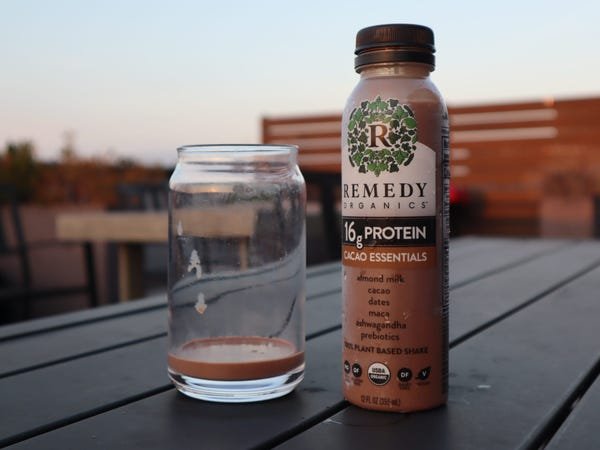
14. Remedy Organics Cacao Essentials Protein Shake
Remedy Organics Cacao Essentials Protein Shake had my least favorite flavor in the ranking. Kristine Villarroel/Business Insider
Cost: $4.99 for 12 fluid ounces
Calories: 210 calories
Protein: 16 grams
Added sugar: 7 grams
The taste of the Remedy Organics Cacao Essentials Protein Shake was what I could best describe as healthy.
The date-sweetened drink is packed with plant-based ingredients, including adaptogens like ashwagandha and maca root powders as well as tapioca prebiotic powder.
But taste-wise, they weren’t as sweet-treat-like as some of the other shakes. It tasted strongly of cacao, but it felt a little chalky, and seemed saltier than it did sweet.
While I liked the drink’s ingredients, I really disliked the taste. If you’re looking for a plant-based, adaptogen-full drink that will also help you reach protein goals, this could be an option for you — but don’t go into it expecting a sweet chocolate milk type of drink.
Flavor rating: 1/10
Overall rating: 6/10
13. Muscle Milk Zero Sugar Chocolate Protein Shake
I found the Muscle Milk Zero Sugar Chocolate Protein Shake to be overly sweet. Kristine Villarroel/Business Insider
Cost: $3.99 for 14 fluid ounces
Calories: 170 calories
Protein: 25 grams
Added sugar: 0 grams
When I first poured the Muscle Milk Zero Sugar shake, I noticed just how dark and thick it was. Tasting it, I found that it was way too sweet for my taste. This, combined with the thick texture, made for a pretty interesting drinking experience — I had to wash down the shake with some water to follow up the sweet taste left in my mouth.
Although I couldn’t finish drinking the small taste I’d poured myself, it also had the fewest calories and grams of sugar in the ranking, the highest fiber, and I felt like the protein payoff was great, which made the overly sweet taste feel more like a trade-off.
If you’re trying to get half of your daily protein in as few calories as possible while also watching out for sugar content, this drink might be good to have on your radar … but you’ll have to remind yourself of the nutrients in every sip.
Do it for the protein, bro.
Flavor rating: 3/10
Overall rating: 6/10
12. Koia Cacao Bean Protein Shake
I also did not love the taste of the Koia Cacao Bean Protein Shake. Kristine Villarroel/Business Insider
Cost: $4.99 for 12 fluid ounces
Calories: 190 calories
Protein: 18 grams
Added sugar: 4 grams
Compared to some of the other protein drinks, I found Koia’s Cacao Bean protein shake to be very thin and light in color when I first poured it.
Its flavor, as the name would indicate, is very cacao-bean forward. To me, it tasted exactly like cacao nibs, which can lean more nutty and earthy than chocolate-y.
In a statement to Business Insider, Koia said the Cacao Bean protein shake is “crafted to highlight cacao’s naturally bold, slightly bitter profile rather than masking it with excessive sweetness or artificial flavoring,” resulting in a flavor that “may be less sweet than traditional protein shakes.”
The almond-based, monk-fruit-sweetened drink, which isn’t too sweet and packs in plant-based ingredients like rice, pea, and chickpea protein and a prebiotic blend, wasn’t one of my favorites for taste, although it was fairly competitive with the other options in terms of nutrients.
Flavor rating: 4/10
Overall rating: 5/10
11. Chocolate Sport Shake
Although enjoyable and tasty, Sport Shake’s high sugar content wasn’t a worthy trade-off for me. Kristine Villarroel/Business Insider
Cost: $2.00 for 11 fluid ounces
Calories: 350 calories
Protein: 12 grams
Added sugar: 39 grams
I found the flavor of the chocolate Sport Shake to be one of the most enjoyable in the ranking, and it reminded me a lot of plain chocolate milk — it was very, very sweet. I also liked that it didn’t taste too much like dairy, something that bothered me with other drinks in the lineup.
However, the drink’s sweet and tasty flavor was overshadowed by its ultra-high added sugar content of 39 grams, or more than 9 teaspoons.
While the drink has some fiber in it, coming in with 3 grams, and it was the cheapest of the ranking, I couldn’t justify that much sugar. I will probably not reach for this again.
Flavor rating: 8/10
Overall rating: 1/10
10. Nesquik Chocolate Low Fat Milk
The Nesquik Chocolate Milk was a fun and nostalgic add to this lineup, although it wasn’t the best for protein. Kristine Villarroel/Business Insider
Cost: $2.50 for 14 fluid ounces
Calories: 250 calories
Protein: 14 grams
Added sugar: 18 grams
I was shocked when I learned that Nesquik’s classic chocolate milk could be considered a nutritional drink.
At 14 grams of protein, as advertised on the bottle, the drink has more grams of protein per serving than other drinks labeled as protein drinks.
Tasting it was just as nostalgic as expected. Compared to some of the other drinks, however, I noticed it had a stronger dairy taste and was very sweet, with a total of 18 grams of added sugar.
I also noticed that the bottle recommended a portion of half a bottle, probably due to the drink’s high sugar content, which would also result in half the protein intake overall.
I probably wouldn’t have reached for this in adulthood if not to compare it here, and I probably won’t really reach for it again.
Flavor rating: 6/10
Overall rating: 4/10
9. Muscle Milk Pro Knockout Chocolate Protein Shake
The Muscle Milk Pro packs an impressive 40 grams of protein. Kristine Villarroel/Business Insider
Cost: $5.99 for 14 fluid ounces
Calories: 220 calories
Protein: 40 grams
Added sugar: 0 grams
Like its low-sugar version, the Muscle Milk Pro looked dark and thick. Taste-wise, the drink was sweeter than chocolate-y, and I didn’t love the flavor.
Although the drink packs an impressive 40 grams of protein in 14 ounces and 220 calories, has the highest ratio of protein to fluid ounces, and also has the highest fiber content in the list, the taste was one of my least favorites, and I had to wash it down with some water after tasting, as it had such a lingering flavor on the tongue.
When considering the nutritional aspects of the drink, however, I felt like the taste was a solid trade-off for one of the most protein-efficient drinks in the ranking, having the second-highest amount of grams of protein in a single bottle.
But if you’re strictly going for the ultra-high-protein option, the Fairlife Core Power Elite — which comes later in this ranking — might be a better bet for flavor.
Flavor rating: 4/10
Overall rating: 7/10
8. OWYN Pro Elite Chocolate Protein Shake
I felt that the plant-based OWYN Pro Elite tasted a bit weird for my taste. Kristine Villarroel/Business Insider
Cost: $4.49 for 12 fluid ounces
Calories: 200 calories
Protein: 32 grams
Added sugar: 0 grams
When I first poured the OWYN — which stands for Only What You Need — Pro Elite Protein Shake, it looked much thicker than some of the other drinks in the ranking.
It tasted vastly different from the others, too. The ingredients gave some clues as to why: The main ingredients — water, pea protein, pumpkin protein, and flaxseed oil — were completely different from the other shakes.
The plant-based, dairy-, soy-, and wheat-free drink, which contains 3 grams of prebiotics, uses monk fruit extract to sweeten its cocoa-heavy flavor, and also has a greens blend that includes spinach, kale, and broccoli.
I figured that the odd flavor I experienced was perhaps due to some of its most health-forward ingredients, like the greens blend.
In a statement to Business Insider, OWYN said that the exclusion of artificial sweeteners and sugar alcohols in the formula “sometimes means a more natural, earthy taste profile,” when compared to their regular shake, which uses a blend of organic cane sugar and monk fruit.
Ultimately, I wasn’t a fan of the taste and probably wouldn’t reach for this drink again, although nutrition-wise, it was a solid ultra-high-protein plant-based option.
Flavor rating: 5/10
Overall rating: 6/10
7. Fairlife Core Power Elite Chocolate High Protein Milk Shake
I found the Fairlife Core Power Elite to have a very strong dairy taste that I didn’t love. Kristine Villarroel/Business Insider
Cost: $5.99 for 14 fluid ounces
Calories: 230 calories
Protein: 42 grams
Added sugar: 0 grams
One of three protein shakes in Fairlife’s line, the Core Power Elite shake was a bit thinner than many of the other drinks I tried.
It was less sweet than Fairlife’s regular chocolate milk, which I didn’t mind. However, it had a much stronger dairy taste — I don’t love the taste of dairy milk, so this worked against the drink for me.
Still, its insane amount of protein — as much as a whole chicken breast — earned it extra points in my ranking.
This drink was something I didn’t mind drinking, even if I wouldn’t usually go for it. Even as a non-gym-bro, I would probably reach for this drink if I were trying to get well over half of my needed protein for the day in a single serving.
Flavor rating: 5/10
Overall rating: 8/10
6. Chocolate Nutrament
The chocolate Nutrament was tasty, although packed in added sugar. Kristine Villarroel/Business Insider
Cost: $2.50 for 11 fluid ounces
Calories: 330 calories
Protein: 15 grams
Added sugar: 29 grams
When I poured the chocolate Nutrament, I noticed its consistency was among the runniest in the ranking.
The drink, the second-cheapest drink in the lineup, tasted just like chocolate milk, although it was still a bit too sweet for me.
I also noticed it had a long ingredients list with many unfamiliar terms, but on closer inspection, some seemed to be added vitamins and minerals. The drink also had the second-highest added sugar content at 29 grams.
The high sugar and comparatively low protein knocked this drink down a few points for me, and although I enjoyed it, I probably wouldn’t reach for this.
Flavor Rating: 9/10
Overall Rating: 5/10
5. Fairlife Chocolate Ultra-filtered Milk
Fairlife’s chocolate milk has 23 grams of protein in a 14-ounce bottle. Kristine Villarroel/Business Insider
Cost: $3.29 for 14 fluid ounces
Calories: 250 calories
Protein: 23 grams
The second in Fairlife’s line, its chocolate ultra-filtered milk, was another nostalgic offering.
It was very sweet, but if I were craving chocolate milk, this is definitely the option I would choose.
While it’s not marketed as a protein drink, it contains 23 grams in a 14-ounce bottle and has the second-lowest cost per gram of protein.
Flavor rating: 7/10
Overall rating: 7/10
4. Rich Chocolate Boost Plus Nutritional Drink
Aimed at weight gain or maintenance, Boost Plus is a tasty and enjoyable option. Kristine Villarroel/Business Insider
Cost: $18.99 for a six-pack of 8-ounce bottles (or $3.17 for 8 fluid ounces)
Calories: 360 calories
Protein: 14 grams
Added sugar: 18 grams
While some of the drinks in this lineup are aimed at the ultra-protein-efficient crowd and others are more directed at children, the Boost nutritional drink line is marketed toward adults with specific nutritional needs. The Boost Plus product, specifically, is aimed at adults hoping to gain or maintain weight.
Taste-wise, this was one of my favorites. The sweet and rich drink was very chocolatey, and it felt like a nice sweet treat.
With the product’s purpose in mind, the drink’s higher calories didn’t bother me, and I was pleased to see its nutrition label flooded with vitamins and minerals.
Out of many of the options, this is one I could see myself reaching for solely based on its taste, even though I wish it had a higher protein content.
Flavor rating: 9/10
Overall rating: 7/10
3. Nesquik Protein Power Chocolate Milk Beverage
I liked the taste of Nesquik’s Protein Power more than its classic chocolate milk. Kristine Villarroel/Business Insider
Cost: $3.00 for 14 fluid ounces
Calories: 290 calories
Protein: 23 grams
Added sugar: 18 grams
When I poured this drink, I was surprised by how runny it was compared to some of the other options. I really enjoyed the taste, even if it wasn’t exactly the same as the nostalgic chocolate-milk flavor of Nesquik’s classic option.
In fact, I actually liked this one more, even before factoring in the added nutritional value. It was adequately sweet, not too dairy-tasting, and it didn’t have the aftertaste that had put me off the classic option.
With 23 grams of protein, this drink could compete with some of its more nutrition-leaning counterparts. At $3 for a bottle, it was also one of the cheapest options with the highest protein content.
I could totally see myself reaching for this.
Flavor rating: 8/10
Overall rating: 8/10
2. OWYN Dark Chocolate Protein Shake
The OWYN Dark Chocolate Protein Shake was my favorite plant-based drink and my second-favorite overall. Kristine Villarroel/Business Insider
Cost: $4.29 for 12 fluid ounces
Calories: 180 calories
Protein: 20 grams
Added sugar: 4 grams
Compared to the higher-protein drink on OWYN’s line, the regular protein shake wasn’t as dark or as thick when I poured it.
While the OWYN Pro Elite had a taste I didn’t like, the OWYN Dark Chocolate Protein Shake had a simpler flavor that reminded me of chocolate milk.
It was very tasty and chocolatey, and I liked that it also had 3 grams of fiber.
Overall, this felt like a very solid option that I could see myself reaching for. It was also my favorite plant-based drink.
Flavor rating: 8/10
Overall rating: 10/10
1. Fairlife Core Power Chocolate High Protein Milk Shake
Fairlife’s Core Power shake was my favorite overall. Kristine Villarroel/Business Insider
Cost: $4.99 for 14 fluid ounces
Calories: 170 calories
Protein: 26 grams
Added sugar: 0 grams
While this drink didn’t exactly feel like a dessert or chocolate milk since it leaned more chocolatey and cocoa-tasting than sweet — and it did have somewhat of a dairy taste — I still found it very enjoyable and a very nice pick for both taste and protein.
Tied with the Muscle Milk Zero Sugar for the lowest calories in the ranking, I found the Fairlife Core Power shake much more enjoyable and even winning by a gram in the protein category.
Overall, this drink had the best balance between flavor and nutrition, and I can see myself reaching for it whenever I need a quick post-workout pick-me-up or just want to get a significant portion of my daily protein on the go.
I met an incredible woman on a random outing to London while I was living life in slow motion, alone in a quiet English seaside town.
I fell in love in a way that surprised me, both in its speed and its certainty. I knew it was her. The relationship unfolded across train rides, weekends, and the growing realization that what I thought was a temporary chapter in my life was quietly becoming its center.
After a few months together, a practical question emerged. Our rent contracts were ending. Suddenly, there was an opportunity to do something that felt both thrilling and reckless: move in together and move back to London after years in a small town.
It felt risky, especially after years of living alone and so soon after meeting. But it also felt like an invitation to fully embrace a new chapter abroad, without half-measures.
I wasn’t sure I knew how to share my space with a partner
My fear wasn’t about commitment in the abstract. It was far more mundane and, in some ways, more unsettling: I didn’t know if I actually knew how to live with someone.
I had lived with my parents and sisters in Mexico, and I also had roommates during my student exchange in Spain, but that was a long time ago. Ever since leaving my country to see what life had to offer, I had lived entirely on my own.
Living alone abroad had sharpened my sense of independence. I had my routines, my rhythms, and my silence. Sharing a space meant renegotiating all of that in a city as intense as London — while also being a foreigner still figuring out where I belonged, and doing it with someone I was still getting to know.
I worried about losing the version of myself I had worked hard to build over the past two years. I worried about friction, mismatched habits, and what happens when two people bring different expectations into the same kitchen, the same mornings, and the same tired evenings.
Staying separate felt equally wrong, though. At some point, I had to give it a real chance.
I was also afraid we’d lose the magic
Once we made the decision, another fear surfaced, one I hadn’t said out loud at first. I worried that moving in together would flatten the magic of the relationship.
Dating, especially in the early stages, allows for a certain level of curation. You see each other rested, excited, and intentional. Living together removes that buffer almost immediately. There are no intermissions, no reset between interactions.
I worried the romance would dissolve into logistics. That excitement would be replaced by grocery lists, chores, and bad habits. What if the softness of the early months would harden under the weight of constant proximity?
It felt like skipping too far ahead in the story. I wondered if we were rushing something that deserved more time to breathe. What if she realized I wasn’t what she hoped for? What if our energies didn’t align? What if it was simply too much?
But I learned that the honeymoon phase doesn’t end because of shared space. It ends when curiosity stops. Living together, as it turned out, demanded more curiosity, not less.
Moving transformed the relationship
The shift was immediate, but not in the way I expected. Living together didn’t make things smaller. It made them deeper.
We learned from each other in unglamorous but essential ways: how we start our mornings, how we decompress after long days, and how we navigate stress without turning it into conflict. The relationship became less performative and more real.
Living with my girlfriend allowed me to truly know her, not just the version of her that appears on dates. I saw her patience, her habits, her quiet moments, and her resilience. I learned how she shows care when no one is watching.
In that process, I also learned more about myself. I realized that independence doesn’t disappear when you share a life with someone. It evolves. Living together abroad didn’t shrink my world; it expanded it.
I’ve lived in many places and many houses, but this is the first time I can say that, with her, it feels like home.
This as-told-to essay is based on a conversation with Kassidy Angelo, a 25-year-old managing director at Gioia Hospitality Group in Fort Lauderdale, Florida. It has been edited for length and clarity.
I never imagined myself entering the restaurant business at the age of 24. I majored in American Studies at Georgetown University with the hope of attending law school.
Instead of pursuing a law career, I decided to apply for finance jobs and eventually landed an internship at JPMorgan in New York. Ultimately, I became an analyst in Miami, but I quit after two years.
My dad, an attorney by trade and restaurateur for many years, asked me if I’d ever consider partnering with him on a new venture. He already owned successful restaurants, and I thought this was a unique opportunity to learn from him and pursue my own entrepreneurial path. It’s the best decision I have ever made.
My biggest concern was how working together would change our father-daughter dynamic
Together, my dad and I are attempting to create a new world-class dining experience from the ground up, Daniel’s Steakhouse, in Fort Lauderdale. My dad is 62 years old and already owns several other successful restaurants, so he doesn’t really need to build this brand for himself.
Every time Michelle publishes a story, you’ll get an alert straight to your inbox!
Stay connected to Michelle and get more of their work as it publishes.
Working with him, I can gain hands-on experience alongside someone who has already mastered the art of entrepreneurship. We’ve always had a close relationship, and I’ve long admired his work ethic; however, I wasn’t sure how it would feel to work side by side, day in and day out.
Before I left my job at JPMorgan, we had a long conversation about expectations and how we wouldn’t only build a strong professional relationship but also maintain the personal closeness we had created throughout my life. He’s an amazing dad and has become an incredible business partner.
If the opportunity to work with my dad had not happened, I probably would have stayed in finance
Working in finance is always a great opportunity to seize. It helped me become more financially literate and gave me a lot of experience working with all types of people.
Ultimately, you’re in a client service role. Private finance, especially, is a people business. Every single day, I communicated with clients, assistants, coworkers, and others, and ultimately, I learned to work as part of a team and how to correspond effectively with high-net-worth individuals. But working in finance has a lot of pressures too.
The analyst role at JPMorgan is intended to be a two-year program. When the opportunity to work with my father came up, I had to make a decision: stay for the full two years and then make the leap, or leave to go through the process of a true restaurant opening.
Ultimately, I realized that if I were going to pursue a career in the restaurant industry, learning the ins and outs of an opening would be the best way to truly understand the business. I viewed it as a once-in-a-lifetime opportunity not only to work with my dad, but to build something from the ground up.
There are lots of positives, but it’s sometimes difficult to separate work and family
Working with family has been one of the most rewarding experiences of my life. One of the biggest pros is the amount of quality time I get to spend with my father. He understands my day-to-day, where my head is at, and where I may be struggling, and he’s always in my corner — not just as a resource, but as a true partner.
In terms of cons, I wouldn’t say there’s anything inherently negative, but it can sometimes be hard to find the “off button.” Family dinners, vacations, and time away often circle back to conversations about how we can improve and grow the business.
Being a financial analyst helped prepare me for building a new restaurant
I entered the restaurant industry with less experience, but more authority than I had as an analyst, which is the bottom of the totem pole in finance. Having worked with senior management at JPMorgan, I had the confidence to run the restaurant.
I also believe it was important that I worked for someone else before working with my dad. It taught me how to take constructive criticism, recognize my shortcomings, and develop confidence outside of my family’s influence. On my first day at the restaurant, I learned how to run the door, be a hostess, serve, and run private events. Now, I’m mentoring a woman who works for us, and I work six days a week on the floor, overseeing everything that goes into running a restaurant.
While there may not be the same financial benefits in the short term, and I must work holidays like Thanksgiving and Christmas, being an entrepreneur allows me to work and live in my home city.
Taking the unknown route can sometimes be the most rewarding
Working at JPMorgan immediately after graduating gave me an instant sense of accomplishment. On the other hand, joining a family business at its foundation was a bigger risk — but one that has been incredibly fulfilling.
I never like to say never to going back to finance, but I truly believe I’ve found my calling in the hospitality world, and doing it alongside my dad makes it even more meaningful.
Do you work with a family member and want to share your story? Please email this editor, Manseen Logan, at mlogan@businessinsider.com.
By the time 33-year-old private jet flight attendant Kelley Lokensgard greets her VIP passengers on the tarmac, she has been working for hours.
“I grocery shop the night before, then arrive two hours before the flight; I load my flower arrangements, prep my boarding appetizers, and touch up the cabin,” Lokensgard, the chief cabin attendant at Silver Air Private Jets, told Business Insider. “People don’t realize how many fingerprints they leave behind.”
That behind-the-scenes work is part of serving wealthy vacationers, business executives, and celebrities who expect flawless service and discretion.
Lokensgard, what started in 2021, said the job can be nonstop: she’s on duty for up to 21 days a month, sometimes at a moment’s notice, and is responsible for catering meals and tailoring each flight to client preferences.
This is a level of invisible labor that few people outside private aviation ever see; it’s not the glitz and glamour that social media often portrays. But Lokensgard — whose background is in music, youth education, and fine dining — said she loves the grind.
Lokensgard visited the Golden Temple in Kyoto.
Courtesy of Kelley Lokensgard
“It’s a lot of schlepping and problem-solving and delicate communication with a lot of moving parts and people; you have to be a laborer to want to do this job,” she said. “I can’t imagine something that better suits my random scope of skills.”
Private flight attendants are a small but growing niche within aviation. Jobs, which are largely non-union, span from small and medium-sized private companies like Silver Air to mega operators like NetJets and VistaJet.
While many roles offer full-time benefits, as in Lokensgard’s case, others resemble gig work, which can allow for a flexible lifestyle but often comes with less predictability and fewer labor protections than at most US airlines.
The work often involves long, irregular hours, extended travel, and the demands of high-profile clients. And private flight attendants usually don’t have access to the free standby flights that commercial crew typically enjoy — meaning they only fly if a seat is available.
Still, there’s a significant payoff. Lokensgard gets to see the world through the destinations of her clients — essentially for free — while earning much more than most of her airline counterparts.
Lokensgard, who lives in Los Angeles, earns in the low six figures, though she said some veteran, freelance, and specially skilled VIP cabin attendants can make as much as $350,000 annually. Glassdoor puts the nationwide median annual salary at about $94,000.
By comparison, commercial flight attendants at American, Delta, and United typically earn a base salary between $30,000 and $80,000, depending on seniority, along with a per diem and additional pay opportunities like overtime, holidays, and international flying. Many senior crew members reach six figures after years of service.
An example of one of Silver Air’s G550s.
Silver Air Private Jets
To prepare for her role, Lokensgard completed five days of training and an online course: “There was so much to learn, it’s professionalism, luxury, service, and safety,” she said. Silver Air also sponsored culinary classes.
Her training is far shorter than the weekslong courses commercial flight attendants must complete, though that’s because the Federal Aviation Administration does not regulate corporate cabin attendant positions — its “flight attendant” rules apply to airlines and public charters, not private jets.
This means cabin training varies widely across private operators, though Lokensgard, as chief attendant, said she is incorporating more shadow flying and collaborative learning at her company.
Private aviation is not your normal 9-to-5
Lokensgard spends most of her days on the Gulfstream G550, a giant multimillion-dollar private jet with a bedroom and enough range to travel across oceans and continents. The plane has an owner but is also managed by Silver Air as a rental; Lokensgard serves whoever is on board.
She said these often long flights mean she is away from home for days at a time and must work early and late hours. A flight from the Los Angeles-area Van Nuys Airport to Tokyo, for example, would take about 11 hours and involve at least two meal services, she said.
Lokensgard must organize catering for the passengers, but is regularly asked to cook. She’ll meal-prep meats and vegetables the night before and has access to an approved skillet, oven, microwave, and chiller to work with on the plane.
“Sometimes our clients don’t want catering, and I will be told, ‘Hey, arrange steak, sushi, chicken tenders, french fries, salads, fruit platter, snacks, and desserts for the flight,'” she said. “I’ll shop at Erewhon, or I’ll ask a local steakhouse to sear a steak that I’ll finish off on the plane. Your head just explodes with ideas.”
Erewhon is the US’ most expensive grocery store and a hotspot for the LA elite.
Some meal examples include a green goddess salad sourced from an Italian farmers market and a Yucatan-style ceviche.
Courtesy of Kelley Lokensgard
Besides food service, Lokensgard said she must also perform safety checks, prepare meals for the pilots, and make the bed, among other duties. She added that there is surprisingly little time to rest, even on ultra-long-haul flights.
On the ground, Lokensgard is responsible for tasks like dishes, dry cleaning, and arranging catering for the next trip. After international flights, everyone clears customs, and Lokensgard must follow agricultural rules when disposing of food and trash.
Rest policies vary by operator. Lokensgard said her crew gets at least a day of rest after long-haul international flights; previously, Silver Air cabin attendants often finished such trips only to almost immediately hop on a commercial flight home. She receives a minimum of 10 hours of rest after shorter flights.
Lokensgard added that it sometimes makes more logistical sense for the crew to stay with the plane for a few days in its destination, giving her extra time to explore places ranging from major cities like London, New York City, and Nice to quaint ski towns in Austria.
“I make the most of it since we’re sacrificing time away from our families and communities,” she said. “We explore, see museums, and eat amazing food.” She also dedicates time to cultivating relationships with local chefs in the cities she visits for catering needs.
Lokensgard said her husband flew to the French Riviera to propose to her during one of her layovers. She said he’s supportive of her travel-heavy career.
Courtesy of Kelley Lokensgard
Once home, Lokensgard said the first thing she does is wash her clothes and repack her suitcase, adding that she keeps a spare uniform in her car: “I have my road wardrobe and toiletries and my home ones.”
That constant readiness is essential in private aviation.
For example, on one reserve day — when she’s on standby for last-minute flights — Lokensgard was called at 6 a.m. for a flight that had to take off by 8:30 a.m. But the plane was departing from Teterboro Airport in New Jersey, at least 30 minutes from the crew’s Manhattan hotel.
“We’re ripping back the covers and packing our bags,” she said. “We’re calling to get the fuel trucks ready; I’m DoorDashing food to the airport and studying the client’s eight-page portfolio, but we were in the air by 8:26 a.m. That really built trust with the client.”