
Madeline berg on grey background

Trump wants to cap defense CEO pay. Here’s how much they make now.

President Donald Trump is targeting the bank accounts of defense contractor CEOs.

On Wednesday, Trump signed an executive order outlining new rules for defense contractors that would ban stock buybacks and dividends “until such time as they are able to produce a superior product, on time and on budget” — as well as limit executive compensation.

The order stipulates that in future contracts, if the Secretary of War were unsatisfied with a company’s performance, executive base salaries would be capped at current levels. Future contracts would also ensure compensation “not be tied to short-term financial metrics” and instead be “linked to an on-time delivery, increased production, and all necessary facilitation of investments and operating improvements.”

The goal, per the executive order, is to increase the speed of innovation at defense companies, rather than focus on corporate profits.

Trump also took aim at the leaders of defense contractors in a series of posts on Truth Social on Wednesday.

“Executive Pay Packages in the Defense Industry are exorbitant and unjustifiable given how slowly these Companies are delivering vital Equipment to our Military,” Trump wrote. “Salaries, Stock Options, and every other form of Compensation are far too high for these Executives.”

He proposed that no executive should earn “in excess of $5 million” until their production speed and maintenance improve, though the executive order did not cap pay at that exact amount.

The leaders of the big five defense contractors — Lockheed Martin, RTX (formerly known as Raytheon), Northrop Grumman, Boeing, and General Dynamics — each earned more than $18 million in total compensation in 2024, the most recent year for which data is available. Their total income was a combination of salary, incentives, stock options, and other forms of compensation, including the value of security services and changes in the value of pension funds.
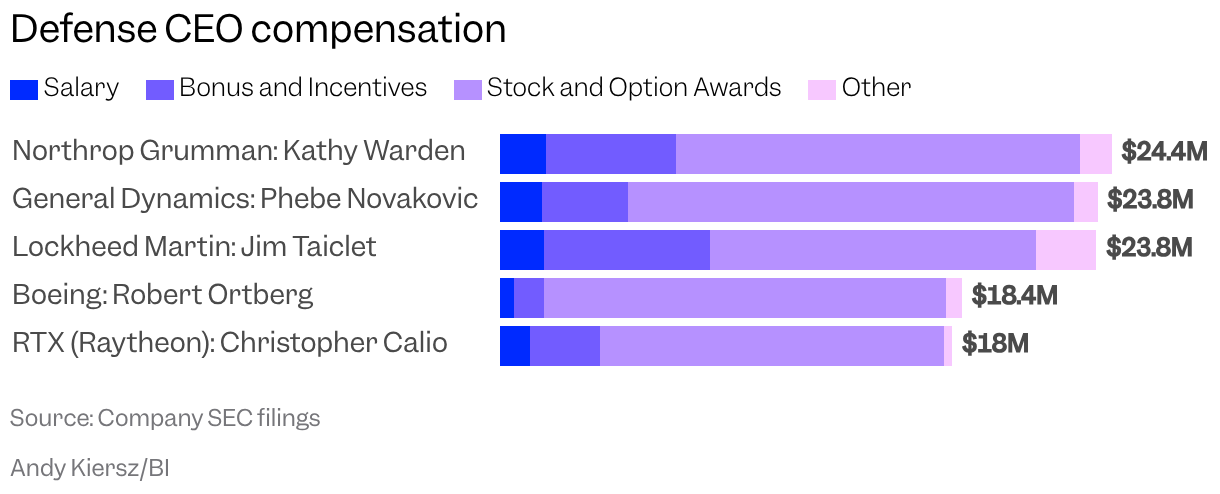
While exceeding the $5 million cap proposed by Trump by magnitudes, the CEOs’ compensation pales in comparison to that of some other business leaders.

Dozens of CEOs earned more than them in 2024. James Robert Anderson, who runs materials manufacturer Coherent, had a pay package of more than $100 million last year. The CEOs of Starbucks, GE, and Microsoft each made more than $75 million.

Executive pay and stock transactions are part of Trump’s larger plans for the military. On Wednesday evening, he said on Truth Social that America’s military budget should be increased to $1.5 trillion in 2027, up from the record 2026 defense budget of $901 billion.

That sent defense stocks climbing on Thursday morning, gaining back what they’d lost following the signing of the executive order.

In a statement to Business Insider regarding the order, a spokesperson for Lockheed Martin said the company “shares President Trump’s and the Department of War’s focus on speed, accountability, and results, and will continue to invest and innovate at scale to ensure our warfighters maintain a decisive advantage and are never sent into a fair fight.”

Boeing and General Dynamics declined to comment, and Northrop Grumman and RTX did not immediately respond to requests for comment.



Source link

James Faris headshot

Paramount’s head of streaming product and tech is leaving the company. Read his Slack message to colleagues.

The head of Paramount Skydance’s streaming product and tech is leaving the company, Business Insider has learned.

Vibol Hou told colleagues in the company’s streaming tech Slack channel that he’s leaving Paramount at the end of January.

“After nearly 12 years of exhilarating work pushing our businesses to new heights, it feels like the right time to hand the torch to the next wave of leaders while I take a much-needed pause to rest, focus on my health (including some serious marathon training), and spend more time with my family before I jump into whatever comes next,” Hou wrote in the Slack message, which was viewed by Business Insider.

Hou’s exit has been anticipated within Paramount for months.

In Hou’s Slack message, he referenced a previous memo from Dane Glasgow, Paramount’s chief product officer, that hinted at the move.

“Vibol has expressed interest in exploring other opportunities, and while he will remain in his role with an anticipated transition early next year, we will continue to explore new projects together,” Glasgow wrote in a mid-October email viewed by Business Insider.

Hou was at Paramount or its subsidiaries for over a decade, including six years at its free streamer, Pluto TV. In that span, Paramount went through several corporate changes, from a ViacomCBS merger to the Paramount Skydance merger that closed in the summer of 2025.

“What we’ve built together across Pluto TV, CBS All Access/Paramount+, and Network Streaming was never easy,” Hou wrote in the Slack message. “But we built these products from the ground up, in tough environments that didn’t necessarily believe in our vision, with limited resources and non-existent technology where we often had to build our own, and under constant pressure to deliver.”

Hou’s Slack message was received warmly, with 118 “care” emojis, 67 classic “red heart” emojis, and 43 “thank you” emojis, among other signals of support as of early Thursday afternoon.

Since Paramount Skydance CEO David Ellison took over in early August, he’s made several noteworthy moves, like landing UFC rights in the US and hiring Bari Weiss to lead CBS News.

Ellison is now focused on buying Warner Bros. Discovery, which has rejected its takeover offer eight times.

Paramount did not immediately respond to a request for comment.

Read Hou’s Slack message to colleagues announcing the move:

@channel Team,

As Dane shared in his note, I’ll be transitioning out of my role and leaving the company at the end of January. After nearly 12 years of exhilarating work pushing our businesses to new heights, it feels like the right time to hand the torch to the next wave of leaders while I take a much-needed pause to rest, focus on my health (including some serious marathon training), and spend more time with my family before I jump into whatever comes next.

What we’ve built together across Pluto TV, CBS All Access/Paramount+, and Network Streaming was never easy — but we built these products from the ground up, in tough environments that didn’t necessarily believe in our vision, with limited resources and non-existent technology where we often had to build our own, and under constant pressure to deliver. Yet again and again, this team showed grit, creativity, and passion. Whether you came from Pluto or another part of Streaming, the story is the same: we took on impossible problems and innovated our way through.

The culture we live — being curious about everything, feeling that hunger to solve problems, caring deeply for others, iterating constantly, and innovating in everything we do — belongs to all of you now. You should be proud of what you’ve achieved, and you should be confident that this is a team that can handle anything thrown its way.

As to the future, I have a lot of confidence in Dane and the vision and strategic pillars he’s laid out for the year ahead. They set a strong foundation for where this organization can go over the next several years, and I’m excited to see what you all do together under his leadership.

I plan to hold my last open office hours next Friday so anyone who wants to drop in, ask questions, or just say hello/goodbye has a space to do that together. In the meantime, if you’d like to stay in touch beyond my time here, please feel free to connect with me on LinkedIn.

Serving alongside you has been one of the great privileges of my life, and I’ll be proudly cheering you on as you write the next chapter together.

Boldly go, always. ❤️

Vibol


Source link

Amazon-gives-managers-a-new-way-to-spot-whos-barely.jpeg

Amazon gives managers a new way to spot who’s barely coming into the office

Amazon is equipping its managers with powerful new metrics to monitor their reports with a dashboard that tracks not only whether employees show up to the office, but also how many hours they spend there, according to an internal document obtained by Business Insider.

The move marks an escalation in the surveillance of white-collar workers at the e-commerce and cloud computing giant. Last year, Amazon implemented one of the industry’s most stringent RTO mandates, requiring most employees to work from an office for five days a week. Now, managers have a way to spot — and potentially confront — employees who fall short of these expectations.

The updated dashboard, which began rolling out in December, allows managers and HR to view how often employees come into an office, how long they stay, and the locations where they work. It refreshes at 5 p.m. PT daily and tracks these metrics over a rolling eight-week period.

The system flags three kinds of employees: “Low-Time Badgers,” defined as employees whose weekly median time in the office is less than four hours per day, averaged over a rolling eight-week period; “Zero Badgers,” who don’t badge into any Amazon building during that span; and “Unassigned Building Badgers,” who badge into a building other than the one they’re assigned to over half the time.

“These metrics are intended to surface employees operating significantly outside documented in-office expectations,” the document says.

“For more than a year now, we’ve provided tools like this for managers to help identify who on their team may need support in working from the office each day,” an Amazon spokesperson told Business Insider. “We recently updated the dashboard to make it more consistent for all managers, but most of the data and functionality was previously available. We continue to see the benefits of having our teams working together, and we haven’t changed our expectations for employees to be in the office.”

Amazon notes in the document that managers are expected to “apply judgment” when determining whether to initiate formal disciplinary follow-ups.

In 2023, Amazon began tracking and sharing individual office attendance records, reversing a previous policy that only tracked anonymized, aggregated attendance data.

A year later, the company began cracking down on “coffee badging” by informing some teams that they needed to be in the office for a minimum of two to six hours to have their attendance count. The crackdown received criticism from some employees, including one who compared the move to being treated “like high school students,” Business Insider previously reported.

The updated dashboard standardizes these metrics across Amazon’s entire corporate workforce, excluding workers such as warehouse staff and contractors. It grants managers direct, on-demand access to data that they would have previously had to request from HR, according to an Amazon employee familiar with the company’s policies.

Amazon is positioning the dashboard as a means to encourage in-person collaboration.

“Working In-office is important to our culture and is also about more than just being physically present during the week,” the document said. “Managers are expected to promote meaningful team collaboration through direct interactions with their team rather than just remotely monitoring badge swipes each week.”

Amazon is hardly alone in using badge data to police return-to-office rules.

Samsung rolled out a manager-facing tool that shows “days and time in building” metrics, aimed at discouraging “lunch/coffee badging.” Dell informed hybrid staff that it will track on-site presence via badge swipes and could factor attendance into performance and compensation.

Bank of America issued warning notices to employees, informing some that continued noncompliance with its RTO policy could result in further disciplinary action. At JPMorgan, employees have described an internal dashboard that calculates the share of eligible days spent in the office and is visible to senior managers.

In the UK, PwC has said it would track employees’ work locations to enforce its RTO policy.

Have a tip? Contact Pranav Dixit via email at pranavdixit@protonmail.com or Signal at 1-408-905-9124. Use a personal email address, a nonwork WiFi network, and a nonwork device; here’s our guide to sharing information securely.


Source link

Ayelet Sheffey

What Jensen Huang, and Larry Page’s reactions to the California wealth tax reveal

It’s a classic fight-or-flight response — with a billionaire’s twist.

A proposed wealth tax in California prompted the state’s resident billionaires to consider whether they wanted to continue their residency if the one-time 5% tax is approved.

Their reactions, said CFP professional Don Hilario, who works with financial planning clients in California, boil down to risk tolerance.

The tax, as proposed, would only apply to assets in the state during the 2026 tax year. Google’s billionaire cofounder, Larry Page, moved some of his assets out of California ahead of the January 1, 2026, deadline to avoid facing the tax, Business Insider first reported. Meanwhile, Nvidia’s billionaire CEO Jensen Huang said he has “not even thought about it once.”

“We chose to live in Silicon Valley, and whatever taxes they would like to apply, so be it,” Huang told Bloomberg TV’s Ed Ludlow. “I’m perfectly fine with it.”

Hilario, whose financial planning clients include individuals in Big Tech, said that the lingering uncertainty of the tax can trigger a need for certainty and autonomy.

“People who want to have a greater sense of control will do the Larry Page route,” he said, “versus people who have the temperament to endure will take Jensen’s route.”

Hilario described a hypothetical scenario in which individuals with high net worths are considering purchasing a home. In a period where the economy and interest rates are uncertain, do you want to put the lion’s share of your expenses toward the home in the event that rates will be higher in the future, or do you hold out and continue accumulating your wealth in the event that economic conditions improve?

“That’s the same type of emotions that exist with this tax bill because the fear of not taking any action is unsettling,” Hilario said.

The proposal, put forth by the union SEIU-United Healthcare Workers West to offset potential budget cuts to healthcare and education, is far from being implemented — it would require 870,000 signatures to make it onto the November 2026 ballot.

The SEIU said in its proposal that the concentration of billionaire wealth in California makes the state “uniquely positioned to address both the well-documented crisis of wealth inequality in the United States and the emerging and interrelated crises the state faces” with the budget cuts.

In addition to Huang and Page, other billionaires are voicing their opinions on the proposed wealth tax. LinkedIn’s cofounder, Reid Hoffman, wrote in a post on X that the proposal has “massive flaws.”

“Poorly designed taxes incentivize avoidance, capital flight, and distortions that ultimately raise less revenue,” he said.

Alex Spiro, an attorney who has previously represented billionaires, wrote in a letter to California Gov. Gavin Newsom that his clients would “permanently relocate” if the tax were to become law. Hilario said that the significant uncertainty surrounding the proposal, including how assets will be valued and whether the tax would change over time, likely forced billionaires to decide how risk-averse they really are.

“I still think ultimately it’s unclear. And I think when it’s unclear, it’ll make people, in this case, investors, be more cautious and defensive,” Hilario said. “And then a big part of it is, how do we respond emotionally? I think whether you’re taking early action or enduring, you do want to gather information and avoid making a decision that would ultimately be irreversible.”


Source link

I-rode-in-business-and-first-class-on-Amtraks-NextGen.jpeg

I rode in business and first class on Amtrak’s NextGen Acela, the fastest train in the US. Here’s how they compared.

  • The Amtrak NextGen Acela is the fastest train in the US.
  • I booked a business-class ticket from New York City to Washington, DC, for $180.
  • Then, I traveled from Washington, DC, to NYC in first class for $450.

I spent six hours and $630 on the fastest train in America.

The Amtrak Acela is the express option for travelers in the Northeast with only business and first-class seating. In August 2025, the route got a fresh new fleet called the NextGen Acela. In addition to a futuristic look and modern amenities, the train has a top speed of 160 miles per hour, making it the fastest train in the US.

In September 2025, I booked round-trip tickets between my home in New York City and Washington, DC, on the NextGen Acela. I got a taste of both classes.

First, I spent $180 for a three-hour business-class ride from New York City to Washington, DC.

A business-class car on the NextGen Acela train.

Joey Hadden/Business Insider

Since the Acela doesn’t have coach seating, business class is the standard ticket.

Then, I rode home to New York in first class for $450.


Passengers on the left board a first-class train car on the Amtrak Acela NextGen

Passengers board a first-class car on the NextGen Acela train.

Joey Hadden/Business Insider

My first-class ticket included a meal, priority boarding, attendant service, and lounge access at the train station.

The differences between these two bookings began when I arrived at each station.


A composite image of passengers standing with luggage in a train station and a wide view of an Amtrak lounge with two tiers of seating

Inside NYC’s Penn Station (left) and inside the Metropolitan Lounge at DC’s Union Station.

Joey Hadden/Business Insider

I waited for my business-class train to Washington, DC, on the floor of NYC’s Penn Station. The waiting room was full, and it would have cost me $50 to access the Metropolitan Lounge, which is complimentary for first-class passengers.

Since I held a first-class ticket for my ride home from Washington, DC, I had access to the Metropolitan Lounge at Union Station. Other passengers can pay $35 to enter the space.

The lounge was quiet and calm. There were couches, comfy chairs, tables, and colorful works of art on the walls. I especially appreciated the espresso and beverage station, snack bins stocked with a variety of treats — all of which were complimentary — and the clean bathroom.

I boarded earlier for the first-class ride.


Passengers walk into the priority boarding line inside a train station

The priority boarding line at Union Station in Washington, DC.

Joey Hadden/Business Insider

After relaxing in the lounge, I waltzed into the priority boarding lane for my first-class ride to New York. There were fewer than a dozen people in front of me.

Unlike when I rode in business class, where I was toward the back of a long line, I had several minutes to get situated on board before the train departed.

Inside the train, the cars were color-coded.


A composite image of the inside of a blue business-class train car and a red first-class train car

Inside a business-class car (left) and a first-class car (right) on the NextGen Acela train.

Joey Hadden/Business Insider

Aboard the Acela train, I quickly caught on that blue meant business class and red meant first class. From the headrests to the bathroom doors, the matching colors made it easy to tell which car I was in.

Another key difference was the layout. There were two rows of seats on either side of the aisle in business class, while first class had a single row of seats on one side of the aisle.

The seats had all the same amenities, but my first-class one was slightly more spacious.


A composite image of a business-class seat and two first-class seats on an Amtrak NextGen Acela train

A business-class seat (left) and a first-class seat (right).

Joey Hadden/Business Insider

The NextGen Acela seats had smooth lining, soft cushions, and supportive, winged headrests. They also had reading lights, USB ports between seats, and a reclining function.

The only significant difference I noticed was that the first-class seats were larger and had more legroom. I found both to be more comfortable than any other Amtrak seat I’ve booked.

Only the first-class ticket included a meal.


An aerial view of an Amtrak chicken dinner on a tray table

The author’s complimentary lunch on the NextGen Acela.

Joey Hadden/Business Insider

During my business-class ride, I grabbed a bite in the café car, where passengers can purchase grab-and-go meals from a self-service station, as well as snacks, drinks, and quick hot meals prepared by an attendant. I ordered a breakfast sandwich, which I thought tasted pretty decent for a microwaved meal, and brought it back to my seat.

In first class, I received attendant service and had a menu of complimentary meals to choose from.

I selected the chicken dish, which consisted of a charred thigh paired with roasted squash, verde sauce, a hard roll, and a Key-lime pie in a jar.

It was the most delicious and satisfying meal I’d ever had on an Amtrak train.

The bathrooms were identical.


The author stands in front of a mirror in an Amtrak NextGen Acela train with a red shelf on the left

Inside a bathroom on the NextGen Acela train.

Joey Hadden/Business Insider

Save for the color of the door, the bathrooms in each class are the same, an Amtrak representative told Business Insider. I was impressed by how clean, spacious, and high-tech they were.

These bathrooms featured automatic doors, lights to indicate when the space was in use, and ample room to stretch. I also appreciated the touch-free faucets, soap dispensers, and hand dryers.

Ultimately, I discovered that the fastest train in America was also the most comfortable.


A composite image of the author sitting in a first-class Amtrak NextGen Acela seat and the exterior of the front of the train

The author enjoys her ride on the NextGen Acela.

Joey Hadden/Business Insider

After my back-to-back three-hour journeys on the Amtrak NextGen Acela train, I expected to be thrilled to get off the rails. But my experiences were so comfortable that I was in no rush to exit. When we pulled into NYC’s Penn Station, I let other passengers get off first while I soaked up a few more minutes in my first-class seat.


Source link

Image of Lakshmi Varanasi

This is the key breakthrough AI still requires to reach superintelligence, according to those building it

In humans, working memory — our ability to hold and use information in everyday life — is closely linked to general intelligence.

That means the ability for AI to remember things could be the key to realizing a superintelligent AI, a still theoretical version of AI that reasons as well or better than humans.

OpenAI CEO Sam Altman thinks it’s hard to predict just how intelligent AI can really be because the possibilities of memory retention are limitless.

“Even if you have the world’s best personal assistant, they don’t, they can’t remember every word you’ve ever said in your life, they can’t have read every email, they can’t have read every document you’ve ever written, they can’t be looking at all your work every day and remembering every little detail, they can’t be a participant in your life to that degree. No human has like infinite, perfect memory,” Altman said recently on the “Big Technology” podcast.

AI, however, will definitely have the capacity for that, he said.

“Right now, memory is still very crude, very early,” he said. Once AI is able to remember every granular detail of a user’s life, including even the small preferences they didn’t explicitly indicate, it will be “super powerful,” he said.

Altman added that it’s one of the future features he’s most excited about — and he’s not the only one.

Andrew Pignanelli, the cofounder of The General Intelligence Company of New York, a company that builds AI agents for businesses, said that memory will become the biggest focus for AI companies in the coming year.

“It will become the most important topic discussed and recognized as the final step before AGI,” Pignanelli wrote in a blog post. “Every model provider will add and improve on memory for their apps after seeing OpenAI’s success with ChatGPT memory (like Claude just did).”

Pignanelli, however, said that the industry is still a long way from perfecting long-term memory.

“Larger context windows continue to improve things, as they allow more data to be passed into the context window, which allows the agent to better read parts of a large memory index,” he wrote, in reference to the amount of information a large language model can process in a single prompt. “Even then, though, the vast level of detail that we need to reach to consider something AGI requires memory architecture improvements.”

Even shorter-term episodic memory hasn’t been fully solved yet, he said.

Solving that memory problem is the ticket to turning AI from something that feels artificial to something that seems human, he said.

“Our systems today get the interaction part right. In terms of a Turing test for interaction, we’re basically all the way there. But that’s only half of what’s needed to make a digital self,” he wrote.

“The first AGI will be a very intelligent processor combined with a very good memory system,” he said.


Source link

Trump-said-he-wants-to-raise-the-US-military-budget.jpeg

Trump said he wants to raise the US military budget by 50% in 2027

  • Trump wants to spend $1.5 trillion on the US military in 2027.
  • He said that the raised budget would secure the country during “very troubled and dangerous times.”
  • The budget would be financed from “tremendous” tariff revenue, he said on Truth Social.

President Donald Trump says the US will be spending a lot more on the military next year.

Trump said in a Truth Social post on Wednesday that he had decided to raise the US’s military budget in 2027 from $1 trillion to $1.5 trillion.

“This will allow us to build the ‘Dream Military’ that we have long been entitled to and, more importantly, that will keep us SAFE and SECURE, regardless of foe,” Trump said.

He said that the larger budget would be financed by the tariffs he has imposed on almost all countries, and would secure the US during “very troubled and dangerous times.”

Trump said in the post that tariff income was so “tremendous” that even after allocating $1.5 trillion to the military budget, the US would still be able to pay off its debts and pay dividends to “moderate income” Americans.

Trump’s proposed military budget is significantly higher than the budget approved by Congress for defense spending in 2026: $901 billion. The 2027 budget increase must be approved by Congress.

Trump’s post about raising the military budget followed another post targeted at defense contractors. He criticized firms like Raytheon for issuing large dividends to shareholders, doing stock buybacks, and offering “exorbitant” pay packages to executives.

The president prohibited these companies from doing so until they pour more investments into manufacturing plants and equipment.

Stock prices for defense companies saw boosts in after-hours trading on Wednesday following Trump’s announcement of a larger military budget. Raytheon’s stock rose nearly 4% and Lockheed Martin’s rose more than 6%.

The post came after the US military conducted a raid on Venezuela last week and captured the country’s President Nicolás Maduro and his wife, who are now being prosecuted in New York. Trump threatened Colombia, Cuba, and Mexico with similar military intervention.


Source link

Amanda Goh

Matt Damon says cutting one thing out of his diet got him down to his ‘high school’ weight

Matt Damon, 55, says one diet change left him lighter than he has been in years.

During an appearance on Wednesday’s episode of the “New Heights” podcast, Damon spoke about how he prepared for his latest role in “The Odyssey.”

“I was in really good shape. I lost a lot of weight. He said he wanted me like lean but strong. It’s a weird thing,” Damon told hosts Jason and Travis Kelce, referring to the film’s director, Christopher Nolan.

To achieve that physique, Damon said he cut one thing out of his diet.

“I literally, just because of this other thing I did with my doctor, stopped eating gluten,” Damon said. “I used to walk around between 185 and 200. I did that whole movie at 167. And I haven’t been that light since high school. So it was a lot of training and a really strict diet.”

The actor said he works with a trainer, and compared the physical preparation to how the Kelce siblings would gear up for a football season, with training becoming part of his daily routine.

“You know, it’s like just part of your day. It’s part of your job, right? And it’s like yeah, you get really routinized about it and really kind of build your day around all that stuff,” Damon said.

The actor added that he hasn’t had gluten since. “I’m done. I’m done. I’m gluten-free everything,” Damon said.

A gluten-free diet eliminates gluten, a protein found in grains such as wheat, barley, and rye. It is often adopted for medical or digestive reasons, including to manage symptoms of celiac disease.

For most people, gluten isn’t necessarily harmful.

“Evidence suggests that, for general health, the emphasis should be on a whole, minimally processed, plant-based diet, which can include gluten-containing grains,” Grace Fjeldberg, a registered dietician with the Mayo Clinic Health System, told Business Insider in 2021.

Despite its popularity, a gluten-free diet doesn’t necessarily result in weight loss and isn’t a universal approach to better health.

Damon is no stranger to getting into peak shape for a role.

In a 2016 BBC interview, Damon said that getting back into shape for his return to the Bourne franchise was “brutal,” after his last appearance in 2007’s “The Bourne Ultimatum.”

“For the first Bourne movie I was 29 and I thought that was hard work getting into shape,” Damon said.

“Now I’m 45 and it’s just brutal. We shot this bare-knuckle fighting scene on my 45th birthday and it was a lot of work to get there,” he added.


Source link

This-case-is-going-to-trial-Judge-rejects-Sam-Altmans.jpeg

‘This case is going to trial’: Judge rejects Sam Altman’s efforts to toss Elon Musk’s OpenAI lawsuit

It looks like Sam Altman and Elon Musk are headed for a courtroom showdown.

During a hearing on Wednesday, a California judge said she plans to reject Altman’s lawyers’ last-ditch efforts to end Musk’s case against OpenAI and its CEO.

“This case is going to trial,” US District Judge Yvonne Gonzalez Rogers said at a hearing to consider whether the evidence was sufficient to warrant a jury trial.

“I think there’s plenty of evidence,” she said, referring to Musk’s case. “It’s circumstantial, but that’s how these things work.”

In his lawsuit filed in 2024, Musk accused OpenAI of misleading him in its decision to abandon its original nonprofit mission and structure in favor of a profit-oriented model, including through its partnership with Microsoft.

Musk says he donated $38 million to the maker of ChatGPT over the years to support its mission to develop AI for the benefit of humankind. The Tesla CEO is seeking monetary damages, as well as a judgment to void Microsoft’s licensing agreement with OpenAI.

At a hearing on Wednesday, an Oakland federal court judge said she felt there was enough evidence that Musk may have been deceived to allow the case to move forward to a jury. A trial is scheduled for March.

“There were assurances made, and promises made, that the structure would be maintained,” she said. “There was lots of information that was not shared.”

The judge added that she also felt “there are strong arguments by the defense.”

“I think the jury is going to get to decide,” she said.

OpenAI lawyers have denied Musk’s allegations, saying Musk was aware of the company’s for-profit plans as early as 2018. OpenAI has also pointed out that it is still controlled by OpenAI’s nonprofit arm.

“Mr Musk’s lawsuit continues to be baseless and a part of his ongoing pattern of harassment, and we look forward to demonstrating this at trial,” a spokesperson for OpenAI told Business Insider. “We remain focused on empowering the OpenAI Foundation, which is already one of the best resourced nonprofits ever.”

A spokesperson for Musk did not immediately respond to a request for comment.

Musk has filed multiple lawsuits against OpenAI. Most recently, his AI company, xAI, sued OpenAI in September, accusing it of stealing trade secrets and targeting its employees for recruitment. At the time, an OpenAI spokesperson told Business that the lawsuit is “the latest chapter in Mr. Musk’s ongoing harassment.”

Musk helped found OpenAI in 2015, but left the company in 2018. At the time he said his work with OpenAI could present a conflict of interest with Tesla’s AI ambitions.

Since, Musk has repeatedly criticized Altman and OpenAI, including the company’s structure. Musk later went on to launch his own AI company, xAI, in 2023.


Source link

Photos-show-the-Pacific-Palisades-one-year-after-the-Los.jpeg

Photos show the Pacific Palisades one year after the Los Angeles wildfires, from empty lots to rebuilt storefronts

  • The Palisades and Eaton fires began in Southern California on January 7, 2025.
  • They destroyed over 16,000 structures and burned 38,000 acres.
  • One year later, photos show the remaining devastation as rebuilding work continues.

In January 2025, the Palisades and Eaton fires burned 38,000 acres across Southern California.

Over 16,000 homes and businesses were destroyed as windstorms propelled the flames, according to the California Governor’s Office of Emergency Services. At least 31 people died in the fires.

One year later, some of the damaged areas have been rebuilt and repaired, while others remain scorched shells.

Here’s what the Pacific Palisades looks like one year after the devastating fires.


Source link