
AOC-and-Paris-Hilton-team-up-on-a-bill-targeting.jpeg

AOC and Paris Hilton team up on a bill targeting AI deepfake porn

Paris Hilton and Rep. Alexandria Ocasio-Cortez are taking on AI-generated deepfake porn.

The hotel heiress and businesswoman traveled to the Capitol on Thursday for a press conference with the New York Democrat and Republican Rep. Laurel Lee of Florida to promote the Disrupt Explicit Forged Images and Non-Consensual Edits Act, or DEFIANCE Act.

The bill would create a civil right of action allowing victims of AI-generated deepfake porn to sue the creators and distributors of those images.

“While these images may be digital, the harm to victims is very real,” Ocasio-Cortez said. “Women lose their jobs when they are targeted with this, teenagers switch schools, and children lose their lives.”

Hilton spoke emotionally about having an intimate video of her shared widely online when she was 19.

“People called it a scandal. It wasn’t. It was abuse. There were no laws at the time to protect me,” Hilton said. “There weren’t even words for what had been done to me. The internet was still new, and so was the cruelty that came with it.”

“What happened to me then is happening now to millions of women and girls in a new and more terrifying way,” Hilton added.

Though Elon Musk’s X and the AI chatbot Grok were not mentioned by name at the press conference, the push to pass the bill comes after the AI agent began generating sexualized images of people, including minors, in response to prompts from users on X. The AI images spurring widespread concerns and even bans on Grok in some countries.

X has since stopped the Grok account from generating sexualized images of real people when tagged on the social network — though you can still do so using the app. Elon Musk, the owner of X, has said that anyone “using Grok to make illegal content will suffer the same consequences as if they upload illegal content.”

“There is an explosion of AI generating explicit images of children,” Ocasio-Cortez wrote earlier this month in response to news coverage of the Grok-generated images. “And it’s not just actresses. Across the country, more and more teenage girls are becoming victims of deepfake harassment. Congress must step in and pass my DEFIANCE Act to ensure victims can seek justice.”

Social media companies have largely been shielded from being held legally liable for illegal content shared on their platforms thanks to Section 230 of The Communications Decency Act of 1996, though the provision has come under fire from both Republicans and Democrats in the last decade.

The DEFIANCE Act passed the Senate last week by a voice vote, meaning no senator objected. It remains unclear when the bill will come up for a vote in the Senate, though Speaker Mike Johnson told The Independent recently that he’s “certainly in favor of it.”

In May, President Donald Trump signed the “TAKE IT DOWN Act” into law, which includes a provision requiring platforms to take down AI-generated revenge porn. That provision doesn’t fully take effect until May 2026.

This isn’t the first time Hilton has come to Capitol Hill to advocate for a piece of legislation.

In both 2021 and 2023, she came to Washington to push for the passage of a bill aimed at combating abuse in residential treatment facilities for troubled teens.




Source link

I-spent-years-traveling-nonstop-It-took-me-too-long.jpeg

I spent years traveling nonstop. It took me too long to admit my ‘dream life’ was actually horrible for my health.

I was living the dream — flying internationally nearly once a month for my work as a travel writer, crisscrossing the globe to cover incredible destinations.

Invitations like cruising the Norwegian coastline and then jetting off to a buzzy restaurant opening in Las Vegas were too good to refuse, even if they were happening back-to-back.

Meanwhile, the frequent long-haul flights, indulgent meals, packed itineraries, and erratic sleep schedules were quietly taking a toll on my health — I was gaining a substantial amount of weight and frequently feeling exhausted.

I just told myself that less-than-stellar health was just the price of admission for this sort of career. After all, my job consisted of bucket-list-worthy experiences, like hiking in Peru and going on safari in Kenya!

It took me several years to admit to myself that I couldn’t keep living this way.

As much as I love traveling, doing it nonstop wasn’t great for my physical or mental health


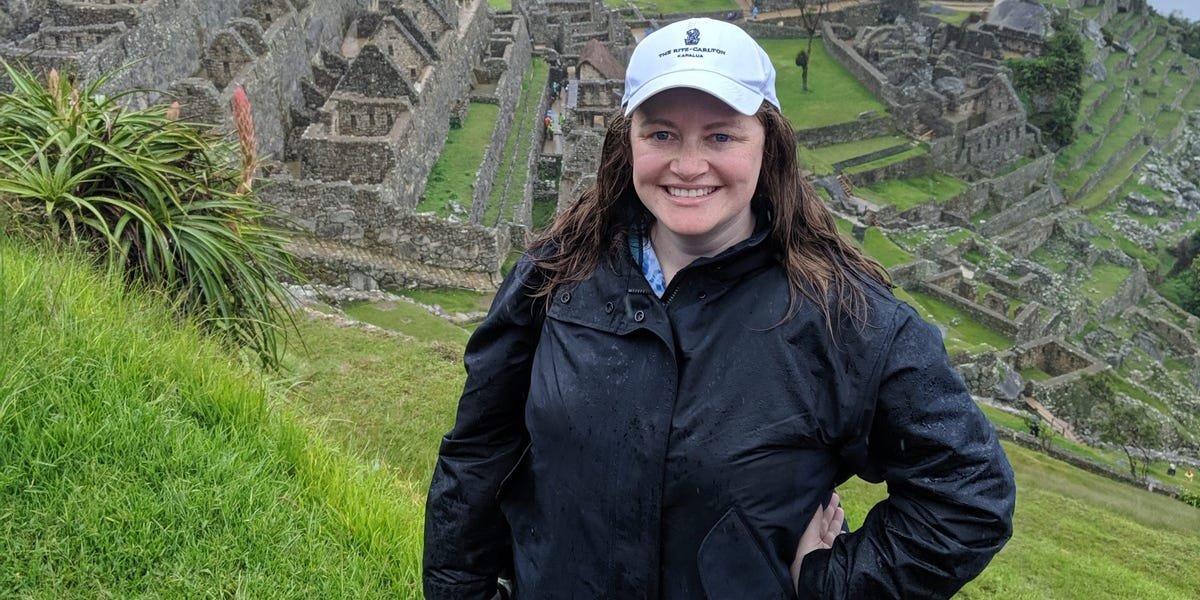
Woman smiling in front of stone relics

I love traveling, but it can be exhausting.

Meredith Bethune


In reality, the job of my dreams consisted of overnight flights where I’d get little to no rest, then hit the ground running as soon as I arrived at my destinations.

After I’d fly back home from some trips, it would take me nearly a week to recover from jet lag. My stress levels were often cranked up, dealing with flight delays, deadlines, and navigation across different states and countries.

With grueling daily schedules on the road, I rarely had time to answer emails. I’d come home to a full inbox and even fuller calendar.

The regular exposure to dry air on planes wasn’t helping my immune system, and neither was all the stress. I felt like I was constantly getting sick with colds, flus, or whatever was going around.

Meanwhile, my diet wasn’t balanced or nutritious. It largely consisted of indulgent meals on press trips, where I felt pressure to try everything so I could write about it.

Saying no felt awkward, even when I knew I’d feel better if I could set firmer boundaries.


Woman peeking out of red phone booth, smiling

I’ve been able to see many places through my work as a travel writer.

Meredith Bethune


On top of all that, I wasn’t exercising. After all, press trips run on tight schedules. I’d return to the hotel late, wake up early, sit in a van for hours between stops, and finish the day with a multicourse dinner.

Some fellow writers managed to fit in workouts, but I didn’t. It wasn’t a priority for me then.

All the travel felt isolating at times, too. I was spending most of my days with publicists, fellow writers, and guides. They were all lovely people, but not permanent fixtures in my life.

My closest friends lived far away, and I kept postponing visits because I was always either traveling or catching up from being away.

Meanwhile, my parents were getting older and needed more support.

After nearly a decade of jet-setting, by 2019, it had become undeniable that my mother’s memory problems went beyond normal aging. Finally, I felt compelled to take my health seriously.

My mother’s diagnosis felt like a wake-up call to prioritize my well-being


Woman smiling in ice hotel

Eventually, I realized I couldn’t travel so much without facing some consequences for my own health.

Meredith Bethune


By that time, my mother’s cognitive difficulties had progressed so much that she no longer seemed like herself. And though her official Alzheimer’s diagnosis came later, by then, it was just a formality. We had already known for years.

There wasn’t anything I could do to stop my mom’s Alzheimer’s from progressing, but I threw myself into researching the disease so I could know more about what the future held for her and, eventually, me.

I worried whether a similar diagnosis — one millions of Americans share — could be in the cards for me someday.

Though it’s not preventable, some studies and members of the medical community suggest that certain lifestyle changes, like being physically active and managing blood sugar and blood pressure levels, may lower one’s risk of developing some forms of the disease or delay its symptoms.

Even if I couldn’t prevent a future diagnosis, I knew finally taking care of my body and mind would be good for me. All that nonstop travel had been quietly wrecking my health, and the way I’d been living and working wasn’t sustainable.

I feel much better now that I’m traveling way less


Woman hiking grand canyon

I can’t control the future, but I can at least prioritize my health.

Meredith Bethune


It’s been over five years since I significantly cut back on travel.

I exercise almost every day and try to regularly follow a balanced diet. I’ve since lost over 50 pounds and sleep much better.

When I do go on trips, I do so with more intention and a lot of focus on the Northeast, close to home.

I probably take an overnight or weekend trip within driving distance about every six weeks. I still fly for work once or twice a year, but I’m no longer constantly on the road, and my body feels the difference.

When I go on bigger trips, I actually feel like I have more opportunities than I did before. Recently, I even hiked the Grand Canyon rim-to-rim, which I would never have attempted back when I was out of shape and constantly feeling drained.

Giving up on my dream job wasn’t easy, but I want to feel good and stay in great shape for as long as I can — even if that means finding peace at home instead of abroad.


Source link

An-interior-designer-shares-11-things-shed-never-have-in.jpeg

An interior designer shares 11 things she’d never have in her own home

  • An interior designer told Business Insider which items and trends she would never have in her home.
  • She said she’s not a fan of unorganized clothing racks, matching bedroom sets, or textured walls.
  • You also probably won’t find faux flowers, mirrored walls, or textured ceilings in her home.

With so many design options and changing trends, it can be difficult to decide what items are worth buying and which you may want to skip in your own home.

So, Business Insider has been checking in with interior designers for tips and inspiration. This time, we spoke with Alessandra Wood, an interior designer and design historian with over a decade of industry experience.

Here are a few items and trends Wood said she’d never have in her own home — plus a few styles she’d opt for instead.

Decorative mason jars just aren’t her cup of tea.

Mason jars don’t work with every interior-design style.

Anthony SEJOURNE/Getty Images

Mason jars have been a popular interior-design trend for years, especially among those who like rustic or farmhouse aesthetics. They can be found on Pinterest as repurposed soap dispensers, lighting fixtures, flower vases, candle holders, and so on.

However, these decorations can feel a bit too homemade for Wood.

Though mason jars work well for storing leftovers and dry goods, she said she’d never use them as decorative accents in her home.

Instead, she’d opt for more stylized accents and fixtures that fit her personal design style.

“For soap dispensers, you can find beautiful natural materials that take a sculptural vibe,” she told BI. “And for lighting fixtures, the world is your oyster.”

She swaps out “filler” decorative accessories for items with more personal meaning.


Living room with fireplace, green couch

A shelf feels more meaningful when it’s styled with souvenirs or special mementos.

Vasyl Cheipesh/Getty Images

Wood said she also avoids “filler” accessories, or decorative objects that are mass-produced and essentially meant to fill empty space.

“While these pieces can be great when they really speak to you, oftentimes we find ourselves buying them just to buy something,” Wood said.

Instead, she prefers to have a more curated look in her home, focusing on displaying decor with meaning.

“Choose decorative accents that you find yourself drawn to and really love or ones that you collect on your journeys,” Wood told BI. “I like to use this approach when deciding what to put in my home space and nix the objects that don’t support a larger narrative.”

For window treatments, Wood avoids roller shades, which can look dated.


Window with roller shades

Roller shades aren’t for everyone.

Ratchat/Getty Images

She’s not a huge fan of roller shades, a type of window covering that typically features a single piece of material that can be rolled up and down using a string or chain.

“I had these in my bedroom as a child,” Wood said. “I know they’ve come a long way since then, but I can’t have them in my current home.”

Cordless roman shades, which can be pushed and pulled, can be a stylish alternative, she added. They’re easy to operate and can add softness to a window.

An on-display clothing rack requires too much maintenance.


Clothing rack next to poster in bedroom

Clothing racks can look cluttered if they’re not carefully curated.

Photographee.eu/Shutterstock

Though a clothing rack can look chic in a bedroom, Wood said, it’s just too hard to keep it organized and display-worthy on a daily basis.

“This only looks good when curated and perfect, which is a lot to ask for something that you use every single day,” she told BI.

She said she’d rather have an armoire, which allows you to store clothing and accessories behind closed doors. That way, you don’t have to rearrange your belongings daily to keep your room looking perfect.

She tries to avoid textured walls and ceilings.


Beige wall with textured paint effect

It can be hard to get rid of textured walls and ceilings if you decide you no longer want them.

FollowTheFlow/Getty Images

Textured walls and ceilings aren’t her cup of tea, either, though she acknowledges they can be costly to remove in a home if they’re already there.

“Unless your walls are made of plaster, which has a gorgeous, natural texture, I would always refrain from adding texture to sheetrock,” Wood said.

Smooth sheetrock has a crisp look and feel, and doesn’t limit your decor options later. For example, she said, it’s challenging to put up wallpaper on textured walls and nearly impossible to use peel-and-stick options.

You won’t find her painting any rooms red and black.


Black and white bookshelves

Black paint can work nicely with a lot of different shades, but some aren’t harmonious.

tulcarion/Getty Images

A room that’s painted red and black screams “teenage boy” or “boudoir,” Wood said. She avoids this color palette in her home.

“Pure reds can be quite aggressive and carry a lot of energy with the color, especially when paired with black,” she told BI.

If you really like red, you may want to use a reddish brown that retains the hue’s warmth while adding softness. You can pair this color with earthy neutral tones for a more subdued look or with earthy greens for a bit of contrast, she suggested.

Faux flowers can just end up being dust collectors.


home decor shelf with faux flowers in pitcher, moss ball, stack of books

Real flowers look fresher than fake ones.

Laura Bergeron/Shutterstock

Faux flowers are also a pass for Wood.

“I’m not a fan of faux flowers,” she told BI. “While they do add a pop of color, they feel like dust collectors to me.”

Instead, it’s better to use a real bouquet or living plant to add life to a room.

She’ll pass on the polypropylene rugs, which can wear down quickly.


Living room with faded red couch, green bookshelves, green paneling halfway up wall

If a rug isn’t made of a durable material, it probably won’t last long.

Vasyl Cheipesh/Getty Images

Though polypropylene rugs can be affordable and often come in trendy colors and patterns, their synthetic material is not ideal.

They’re primarily made of plastic, which can break down and look worn in a few years, Wood said.

“Instead, I prefer to invest a bit more in natural-fiber rugs such as wool or cotton blends,” Wood said. “These rugs are meant to last years — even lifetimes — and bring great benefits.”

For example, wool rugs can be easy to clean, durable, and hypoallergenic.

Matching bedroom sets should stay at the furniture store.


Bedroom with backlights and wallpaper behind bed

Do some mixing and matching instead of buying full sets.

Mindaugas Dulinskas/Getty Images

“When you see a room that has a bed, nightstands, and dressers totally matching, it feels like the set was purchased right off the showroom floor and lacks the personality of the occupant,” Wood told BI.

Though a few matching pieces can create harmony for those who love order, she said, don’t go for the full furniture suite.

It’s important to mix in different textures and materials so your space looks more organic and feels much more personalized, she added.

Mirrored walls can make a room look like a dance studio.


Dining room with mirrored wall

Mirrored walls can also be tricky to keep clean.

foamfoto/Shutterstock

According to Wood, mirrored walls have a certain vibe that’s just not ideal for a home.

“While mirrors do wonders to add light and brightness to rooms, floor-to-ceiling mirrored walls have a distinctly dated feel,” she said. “They feel more appropriate for a ballet studio than a living room or bedroom.”

Wood recommended hanging large mirrors above a sofa or on a bedroom wall to get the same effect without having the feel of a 1980s Miami Beach condo.

Bathroom vanities with an all-in-one molded sink and counter lack personality.


Wallpaper bathroom with marble-top vanity with mirror above it

Some bathroom vanities can upgrade a space.

Joe Hendrickson/Getty Images

Bathroom vanities with an all-in-one molded sink can look really basic, Wood told BI.

She said these are often the cheapest options available and a “quintessential piece” in flipped homes that lack style.

Instead, Wood prefers vanities with stone counters and a separate sink made of a different material.

“This will make your bathroom look much more personalized and feel a bit more luxurious,” she added.

Click to keep reading other things interior designers say they would (or would never) have in their own space.

This story was originally published on June 4, 2021, and most recently updated on January 22, 2025.


Source link

Inside-the-restoration-hangar-where-the-National-Air-and-Space.jpeg

Inside the restoration hangar where the National Air and Space Museum repairs and preserves historic aircraft for display

When a one-of-a-kind aircraft from World War II needs work done, not just any body shop will do.

At the National Air and Space Museum’s Steven F. Udvar-Hazy Center in Chantilly, Virginia, staff members repair and preserve historic aircraft in an in-house restoration hangar that offers a behind-the-scenes look at the work that goes into maintaining the museum’s collection.


The Mary Baker Engen Restoration Hangar at the National Air and Space Museum's Steven F. Udvar-Hazy Center in Chantilly, Virginia.

The Mary Baker Engen Restoration Hangar at the National Air and Space Museum’s Steven F. Udvar-Hazy Center in Chantilly, Virginia.

Talia Lakritz/Business Insider


The Smithsonian museum’s second location, situated about 30 miles from the National Air and Space Museum’s flagship site in downtown Washington, DC, offers an expansive setting with 340,000 square feet of exhibit space.

The Mary Baker Engen Restoration Hangar, which is connected to the exhibits, can accommodate several aircraft at a time and houses everything workers might need, including a sheet-metal shop, a welding room, a paint room, and a fabric shop.

It also features floor-to-ceiling windows overlooking the hangar, allowing visitors to watch the work happening in real time.


Observation windows overlook the Mary Baker Engen Restoration Hangar at the National Air and Space Museum.

Observation windows overlook the Mary Baker Engen Restoration Hangar.

Talia Lakritz/Business Insider


Holly Williamson, public affairs specialist at the National Air and Space Museum, told Business Insider that visitors shouldn’t expect to see planes being built with the speed of a factory assembly line. Progress can be slow, with some restoration projects spanning months or years.

“This kind of will look like paint drying if you just sit here for the whole day,” Williamson said. “It’s a lot of research. It’s very detail-oriented.”

Despite the slow pace, there’s still plenty to see. One of the museum’s longer-term projects is “Flak-Bait,” a Martin B-26 Marauder that flew 202 combat missions during World War II, including D-Day.


“Flak-Bait,” a Martin B-26 Marauder.

Talia Lakritz/Business Insider


When the museum first opened in 1976, visitors were allowed to touch the aircraft’s nose, which wore down the paint. Workers have focused on restoring its appearance while preserving its authentic combat damage.

“It flew more missions than any other aircraft in World War II for the US, so we want it to look like it’s been through hundreds of missions,” Williamson said.

Another striking display is a Sikorsky JRS-1 seaplane, the only aircraft in the museum’s collection that was present at Pearl Harbor when it was attacked on December 7, 1941. After Pearl Harbor, the Sikorsky JRS-1 patrolled for Japanese submarines. It arrived at the Mary Baker Engen Restoration Hangar in 2011.


A Sikorsky JRS-1.

A Sikorsky JRS-1.

Talia Lakritz/Business Insider


Staff members are also working to restore a McDonnell F-4S Phantom II, a fighter and bomber that shot down an MiG-21 during the Vietnam War. After the Vietnam War, it underwent modernization and was redeployed in 1983, remaining in service until its last squadron duty in 1987.


A McDonnell F-4S Phantom II in the Mary Baker Engen Restoration Hangar.

A McDonnell F-4S Phantom II.

Talia Lakritz/Business Insider


The rest of the hangar floor is a maze of tools, machinery, aircraft parts, and storage bins, indicators of just how intricate the museum’s restoration efforts are.

Certainly more interesting than watching paint dry.


Source link

Katherine Tangalakis-Lippert's face on a white background

Chipotle’s new PAC signals a change in how the company engages in politics

Chipotle Mexican Grill has filed paperwork to form a political action committee, marking a shift in how the burrito chain engages in US politics.

The filing, a Statement of Organization submitted to the Federal Election Commission early this month, establishes a corporate PAC, a vehicle that allows companies to collect voluntary political donations from employees and executives and give that money to federal candidates.

Two corporate governance and political campaign finance experts said that, for a consumer-facing brand that has previously kept its distance from direct campaign giving, the move signals a more formal and proactive approach to federal politics — just as the 2026 midterm elections are heating up.

The decision also represents a departure from Chipotle’s prior stance. In versions of its Government Affairs Engagement Policy dating from 2021 and 2024, the company said it did not operate a PAC, though it noted that it could form one in the future.

“As Congress debates critical issues in 2026, the PAC is a meaningful way to give our 130,000 employees a voice in the political process that impacts their lives, communities, and our business, on a day-to-day basis,” Laurie Schalow, Chipotle’s Chief Corporate Affairs Officer, told Business Insider.

Why now?

The timing of Chipotle’s move is notable. The 2026 midterm elections are expected to be exceptionally competitive, in part because several states have undertaken mid-decade redistricting — a move that can make races more unpredictable and more expensive.

“When elections are heavily contested, they tend to cost more money,” Ciara Torres-Spelliscy, a professor of law at Stetson University College of Law and a Brennan Center fellow, told Business Insider. “Candidates for Congress are subject to hard money limits, so they may want money from corporate PACs to run their campaigns.”

Corporate PACs can also serve longer-term strategic goals. Companies may give to lawmakers with influence over issues that affect their business, or to candidates they believe will appoint regulators aligned with their interests.

“Rather than just lobbying, a PAC allows a company to directly influence the election of officials, ensuring that legislators understand the company’s specific business interests,” Anat Alon-Beck, an assistant professor at Case Western Reserve University School of Law, whose research focuses on corporate law and governance, said.

While corporate PACs are common across many sectors, restaurants have historically been smaller players in federal campaign finance. Trade groups like the National Beer Wholesalers Association and companies like American Crystal Sugar have been among the more active PACs in the food and drink space, but restaurant brands themselves have not ranked among the top corporate PAC spenders.

That context makes Chipotle’s filing less about joining a dominant political force and more about signaling a shift in posture.

By forming a PAC, Chipotle’s strategy is a more direct and structured way to engage with federal candidates at a moment when control of Congress is likely to be up for grabs. What remains to be seen is how active the PAC will become — and which candidates it ultimately supports.

Some clues can be found in Chipotle’s previous government affairs contribution reports, which outline the company’s contributions to political organizations and in support of state and local ballot measures.

In 2023 and 2024, Chipotle as a company gave $50,000 each to both the Democratic and Republican Governors Associations and $25,000 to the Democratic Mayors Association. It also made annual contributions of $150,000 to the National Restaurant Association, in addition to $625,000 in 2024 and $408,000 in 2023 to Save Local Restaurants, a coalition led by the National Restaurant Association to lobby for pro-restaurant legislation.

The National Restaurant Association has its own PAC that has historically donated primarily to Republican candidates, according to OpenSecrets data.

How corporate PACs work

Corporate PACs — formally known under federal law as “separate segregated funds” — exist because corporations are barred from donating money from their own treasuries directly to federal candidates.

“That ban comes from the Tillman Act of 1907,” Torres-Spelliscy said. “To avoid that ban, corporations ask people who are associated with the company, typically executives, to donate up to $5,000 to the corporate PAC.”

Those funds can then be donated directly to candidates within federal contribution limits — $5,000 per candidate per election if the PAC contributes to at least five candidates, or a maximum of $3,500 if the PAC supports fewer than five candidates.

One advantage of corporate PACs, Torres-Spelliscy said, is transparency. “Everyone who donates knows that the money is going into politics,” she said. “And the public can see who has given to the corporate PAC and who the corporate PAC has donated money to.”

Since 2010, corporations have also been able to spend money through Super PACs, which can accept unlimited funds — including corporate treasury money — as long as they operate independently of candidates. Creating a Super PAC requires a separate filing with the FEC, which Chipotle had not submitted at the time of publication.

“The catch is a Super PAC spends money independently of a candidate,” Torres-Spelliscy said.

That independence can be a drawback for companies that want a more direct relationship with lawmakers. While Super PACs allow for far larger sums, they can’t coordinate with campaigns or give directly to candidates.

In practice, the biggest corporate donors to Super PACs in recent election cycles have come from industries like cryptocurrency and fossil fuels — not restaurants or food companies, according to data from OpenSecrets.

“A corporation may still want to have a corporate PAC if it wants to make donations directly to federal candidates,” Torres-Spelliscy said.


Source link

Divya-Nettimis-Avala-Global-loses-more-staff-despite-a-strong.jpeg

Divya Nettimi’s Avala Global loses more staff despite a strong 2025

Avala Global, launched by former Viking Global star trader Divya Nettimi, had strong performance numbers in 2025.

However, the firm has continued to lose staff.

Three investment analysts left in the second half of 2025, and Nettimi’s fund is set to lose two more senior executives in 2026, including the firm’s COO.

Avala Global, the $2 billion manager launched by Nettimi in late 2022, gained 22.1% in 2025, according to the firm’s year-end letter to clients, which was viewed by Business Insider. Several people close to the firm told Business Insider that the manager achieved these returns despite losing analysts Jordan Straff, Nadine Lin, and Michael Wang.

Straff was a longtime investor at Roberto Mignone’s Bridger Capital before joining Avala in early 2024, while Lin and Wang both joined from Steve Cohen’s Point72.

The manager will also lose its COO, David Angstreich, and top fundraiser, Rebecca Chia. Both are set to depart in the coming months, three people close to the firm tell Business Insider.

Angstreich and Lin did not respond to requests for comment, while Chia and Straff declined to comment. Business Insider could not reach Wang in time for publication. Avala declined to comment.

Angstreich has been with Avala since its launch, while Chia joined in mid-2025 after stints at Atalaya Capital and Third Point.

The letter highlighted the team’s “depth and experience” but made no mention of the departures or expected exits. The firm hired onetime Viking Global general counsel Andrew Genser as its in-house lawyer last year and added at least four new analysts in 2025, LinkedIn shows, including two end-of-year hires from private equity firm Clayton Dubilier & Rice.

“We believe we have laid a strong foundation for the next phase of our growth,” the letter reads.

Last June, Business Insider reported that a majority of Avala’s day-one team had left the firm, including the entire four-person investing team that reported to Nettimi. Three people who had previously worked at the firm told Business Insider they left because of a tense workplace environment that came from the top of the firm. While she declined to address the specifics around different employees’ exits, Nettimi told Business Insider last year that she was confident in her team and the process for finding and vetting new talent.

Nettimi, a former Forbes 30 under 30 honoree who spent years investing at Viking Global, has managed to make money despite the churn. The firm has made more than 20% in each of the three full years it has been trading, besting the S&P 500 and Nettimi’s former manager over the same period.

The firm’s most recent letter to investors stated that long-term holdings in stocks such as data-storage company Seagate Technology, German power company Siemens Energy, and Finnish sporting goods conglomerate Amer Sports were key in driving performance last year.


Source link

US President Donald Trump gestures as he leaves the congress centre during the World Economic Forum (WEF) annual meeting in Davos on January 21, 2026.

Live updates: Day four kicks off at Davos

US President Donald Trump gave a big speech at the World Economic Forum in Davos on Wednesday.

The world’s power players and top executives braced for what Trump would say — or not say — about Greenland on Wednesday. Now that the speech is done and dusted, the sun dawns on Davos, bringing forth another day of discussion on the top topics in tech, governance, and the markets.

We’ll be bringing you live updates throughout day four of Davos right here. Follow along for the latest.

JPM’s top European bankers on clients’ uncertainty
JPMorgan Chase tower
JPMorgan Chase

Conor Hillery and Matthieu Wiltz are well-versed in how European investors are feeling.

JPMorgan’s co-CEOs of EMEA took a two-week trip across Europe and the Middle East to meet with clients at the start of the year. It corresponded with escalating geopolitical situations in Venezuela and Greenland, making for a unique trip.

When I spoke to them on Wednesday morning, before Trump’s speech, they told me clients aren’t necessarily looking to pull the plug on things, but the questions are mounting.

“I think it’s just raising the spectre of uncertainty, so clients aren’t making any definitive assumptions at this stage,” Hillery told me. “In the back of their heads, they are starting to think that this could get a lot more complicated than it’s been for the last few years.”

And even since the trip, the situation is evolving almost minute by minute.

“There is a bit more of a question mark now compared to the first two weeks of January,” Wiltz added.

Newsom: ‘I’m living rent-free in Trump’s head’
US Governor Of california Gavin Newsom gestures as he speaks during the World Economic Forum (WEF) annual meeting in Davos on January 22, 2026.
California Gov. Gavin Newsom went hard on Trump at his morning session.

There was a bit of show-and-tell from the California governor at his morning session. He took out a set of red kneepads, which he said are meant for the CEOs who kneel to Trump. He also accused some corporate leaders — he didn’t name them — of “selling out to this administration.”

No shortage of jabs at Trump, too. The governor called Trump an “invasive species,” among other things.

“I’m living rent-free in Trump’s head,” Newsom said.

Musk has slammed Davos in the past

He posted negatively about the forum in 2022 and 2023.

Elon Musk will speak at Davos
Elon Musk
Elon Musk is seeking as much as $134 billion in damages from OpenAI and Microsoft

Musk is a new addition to the programme — he’s now listed to speak with BlackRock CEO Larry Fink at 4:30 p.m.

Read full story

Business Insider was in the room at Trump’s speech, and this is what went down

Business Insider’s Ben Bergman brought us to-the-minute updates from inside the room where Trump gave his speech.

Check out the full story, too.

Read full story

Now it’s Gavin Newsom’s moment to shine
US Governor of California Gavin Newsom speaks to the press on the sidelines of the World Economic Forum annual meeting in Davos
Gavin Newsom at Davos on Tuesday.

Newsom sparred with Scott Bessent and, on Wednesday, stared into the camera in the middle of Trump’s speech with a wry, knowing smile — giving his best imitation of Jim from “The Office.”

The California governor has also been making his rounds with the press, giving snappy soundbites about how the Democratic Party and world leaders should best deal with the president.

This morning in Davos, Newsom will get his share of the spotlight. He’s scheduled for a panel at 8:30 a.m. local time.

It was all about Trump on Wednesday
Trump Davos
Trump Davos

ICYMI, though we don’t know how you could’ve.

After a slight hiccup in his travel plans due to an electrical fault on Air Force One, President Donald Trump and his team swept into Davos on Wednesday for a much-anticipated speech.

The reactions? Mixed. Business Insider was in the room for his speech, and we fact-checked the president’s praise for the US economy.

And after all the panic over Greenland, Trump called off his new tariffs on Europe. There’s to be a “framework” in place, per an agreement with NATO, with more to come on what that’ll mean.

Read the original article on Business Insider

Source link

Why-Satya-Nadella-said-hes-psyched-about-more-competition.jpeg

Why Satya Nadella said he’s psyched about more competition

The AI race doesn’t need to be a zero-sum game, says Satya Nadella.

On an appearance of the “All-In” podcast recorded in Davos on Wednesday, the Microsoft CEO said current competition is intense — but that’s not a bad thing.

“The way I always think is it’s always helpful when you have a complete new set of competitors every decade because that keeps you fit,” he said. He added, “It’s a pretty intense time. I’m glad there’s the competition.”

Nadella said that when he joined the computer giant in 1992, Novell, a Utah-based software and services company, was the “big, existential competitor” Microsoft had.

Novell’s dominance declined in the late 1990s, and it was acquired in 2011.

Nadella said that the tech industry as a whole will continue to dominate economically.

“At the end of the day, when I look at it as a percentage of GDP, five years from now, where will tech be? It will be higher,” he said, referring to gross domestic product. “So we’re blessed to be in this industry. It’s a lot of intense competition, but it’s not so zero-sum as some people make it out.”

Nadella said that his approach is a different take on Peter Thiel’s advice. He said Microsoft avoids competition by understanding what customers really want from the company rather than treating everybody like a competitor.

The Microsoft CEO’s embrace of competition matches the approach one of his predecessors, Bill Gates, and top rival, former Apple CEO Steve Jobs, took toward competition.

“Competition is always a fantastic thing, and the computer industry is intensely competitive,” Gates said in a 2005 interview. “Whether it’s Google or Apple or free software, we’ve got some fantastic competitors, and it keeps us on our toes.”

Jobs famously shifted his perspective on competition after returning to Apple in 1997. He went from dismissing Microsoft’s taste and originality to saying that Apple needed to focus on its own success rather than Microsoft’s failure.

“If we want to move forward and see Apple healthy and prospering again, we have to let go of this notion that for Apple to win, Microsoft has to lose,” he said at the 1997 Macworld Expo.


Source link

Polly Thompson

Deloitte is overhauling job titles for its US workforce — here’s why

In the consulting industry’s era of AI upheaval, even job titles aren’t safe.

The Big Four firm Deloitte is rolling out a sweeping overhaul of how it refers to its US workforce and introducing a new class of leader.

“All professionals will receive a new title that we will start to use internally and externally on June 1, 2026,” said a presentation shared with employees during a meeting on Wednesday morning, which Business Insider has seen.

Deloitte plans to tell employees their new job titles on January 29, before they take effect at the start of the firm’s next financial year in June.

The meeting, hosted by Mo Reynolds, Deloitte US’s chief people officer, was held for the consulting division, but the changes apply to all Deloitte’s US divisions, the presentation said. Deloitte had 181,500 employees in the US as of May 31, 2025.

The firm also announced a new leadership role during Wednesday’s meeting.

Currently, the most senior titles at the firm are partners, principals, and managing directors — known as PPMD. Starting in June, a role titled “leaders” will join the group, according to the presentation.

“We are modernizing our talent architecture to provide a more tailored experience reflective of our professionals’ broad range of skills and the work they do,” a Deloitte spokesperson told Business Insider.

The overhaul of titles comes as Deloitte and its peers face existential questions posed by AI in the consulting industry. The technology is changing what it means to be a consultant, affecting long-held talent structures, pricing models, and the work that clients want from their consultants.

Why change job titles?

In the internal presentation, Deloitte frames the changes as a necessary modernization for a changing market.

After a slide titled “why now?” the firm explains that its current talent architecture is “outdated” and unable to “support our business of tomorrow.”

The current structure was designed for “a more homogenous workforce of ‘traditional’ consulting profiles,” according to the presentation. “But so much has changed.”

Deloitte’s workforce and business have grown, employees are seeking more tailored talent experiences, and “our clients are demanding new skills and capabilities,” the presentation said.

By redesigning its talent architecture, Deloitte aims to better match employees’ work with their titles, clarify career levels, and give people doing similar work more consistent experiences.

Day-to-day work, leadership, and the firm’s “compensation philosophy” will all stay the same, according to the presentation.

What’s changing at Deloitte?

Consultants at Deloitte have traditionally followed a progression path of analyst, senior analyst, consultant, senior consultant, manager, and senior manager, before promotion to the top echelons of the firm.

Under the new system, these titles will become more specific and include reference to a “job family” and “sub-family,” which are another new feature introduced in the talent overhaul.

In an example from the presentation, an employee with the current job title of “senior consultant” could become “senior consultant, functional transformation,” “software engineer III,” or “project management senior consultant” on June 1.

Internally, employees will also be assigned an alphanumeric reference to indicate their job level, such as L45 for what is currently a senior consultant and L55 for current managers.

These more specific titles will “drive greater clarity and market relevancy,” according to the presentation.

Have a tip? Contact this reporter via email at pthompson@businessinsider.com or Signal at Polly_Thompson.89. Use a personal email address, a nonwork WiFi network, and a nonwork device; here’s our guide to sharing information securely.


Source link

Sarah Saril

Yungblud 2026 tour: Full schedule, cities, and where to buy tickets

British rocker Yungblud (real name Dominic Harrison) is continuing his global Idols — The World Tour in 2026, bringing his high‑energy punk‑infused rock to arenas and outdoor venues across North America, Europe, and beyond. The tour kicks off its North American run on May 1, 2026, in Sterling Heights, Michigan, and includes stops in cities like Toronto, Columbus, Seattle, Las Vegas, Orlando, Hollywood (FL) at Hard Rock Live, Charlotte, Boston, New York, Atlanta, and more before fans take the tour overseas later in the summer and fall.

Yungblud first emerged in the late 2010s as a lightning rod in rock and alternative scenes, blending punk attitude with pop sensibility and lyrical themes of youth rebellion, identity, and emotional honesty. In 2025, he released the album Idols, collaborated with Aerosmith on the One More Time EP, and performed at legendary events, including Ozzy Osbourne’s farewell concert, solidifying his reputation as one of rock’s most exciting modern voices.

The Idols tour marks a major milestone in Yungblud’s career, showcasing his evolution as an artist and his ability to headline major venues worldwide — all while maintaining the raw energy and fan engagement that first brought him attention. Find available seats on StubHub and Vivid Seats.

Yungblud’s 2026 tour schedule

Tickets for Yungblud’s 2026 tour are available on secondary resale sites such as StubHub and Vivid Seats — though pricing can vary widely with demand, venue size, and proximity to the date. Fans are encouraged to compare listings across platforms and act early, as many shows on this world tour are expected to sell out quickly thanks to Yungblud’s passionate following.

  • May 1, 2026 — Sterling Heights, MI at Michigan Lottery Amphitheatre at Freedom Hill
  • May 2, 2026 — Toronto, ON at Coca‑Cola Coliseum
  • May 4, 2026 — Columbus, OH at KEMBA Live!
  • May 6, 2026 — Cincinnati, OH at The Andrew J Brady Music Center
  • May 7, 2026 — Indianapolis, IN at Everwise Amphitheater at White River State Park
  • May 9, 2026 — Minneapolis, MN at The Armory
  • May 11, 2026 — Morrison, CO at Red Rocks Amphitheatre
  • May 13, 2026 — Orem, UT at UCCU Center
  • May 15, 2026 — Seattle, WA at WAMU Theater
  • May 16, 2026 — Portland, OR at Theater of the Clouds at Moda Center
  • May 19, 2026 — Las Vegas, NV at PH Live at Planet Hollywood
  • May 20, 2026 — San Diego, CA at The Rady Shell at Jacobs Park
  • May 22, 2026 — Los Angeles, CA at The Greek Theatre
  • May 25, 2026 — Phoenix, AZ at Arizona Financial Theatre
  • May 28, 2026 — Irving, TX at The Pavilion at Toyota Music Factory
  • May 29, 2026 — Austin, TX at Moody Amphitheater
  • June 1, 2026 — Orlando, FL at Addition Financial Arena
  • June 2, 2026 — Hollywood, FL at Hard Rock Live at Seminole Hard Rock Hotel & Casino
  • June 4, 2026 — Charlotte, NC at Skyla Credit Union Amphitheatre
  • June 6, 2026 — Atlantic City, NJ at Hard Rock Live at Etess Arena
  • June 7, 2026 — Washington, DC at The Anthem
  • June 9, 2026 — Boston, MA at Leader Bank Pavilion
  • June 10, 2026 — New York, NY at Radio City Music Hall
  • June 13, 2026 — Atlanta, GA at Synovus Bank Amphitheater at Chastain Park

Browse Yungblud tickets on StubHub and Vivid Seats.

How much are Yungblud tickets?

If you’re looking to catch Yungblud’s Idols — The World Tour live, resale ticket sites like StubHub and Vivid Seats are go‑to spots when primary tickets sell out — and the good news is there’s a pretty wide range of prices for fans on different budgets to find something. Over on Vivid Seats, you’ll see some of the cheapest resale tickets starting around the high‑$60s for 2026 shows, making it one of the more affordable ways to get in the door if you’re willing to sit farther back or grab general admission.

StubHub also has plenty of listings, with budget‑friendly seats typically starting in the low‑to‑mid‑$100s and rising from there for better views. Some premium listings — especially floor seats, front‑section options, or VIP packages — can climb into the several hundred-dollar range, depending on how hot a particular city or date is.

Both StubHub and Vivid Seats back their sales with buyer protections (StubHub’s FanProtect Guarantee and Vivid Seats’ delivery guarantee), so you’re generally buying from a legitimate, verified marketplace rather than risking shady or invalid tickets — just be mindful that resale prices often run above face value as demand grows closer to showtime.


See more: Is StubHub legit? | Linkin Park tickets | Eagles tickets | Bon Jovi tickets | Journey tickets | Rush tickets | AC/DC tickets

Follow our WhatsApp channel and Instagram for more deals and buying guides.

You can purchase logo and accolade licensing to this story here.

Disclosure: Written and researched by the Insider Reviews team. We highlight products and services you might find interesting. If you buy them, we may get a small share of the revenue from the sale from our partners. We may receive products free of charge from manufacturers to test. This does not drive our decision as to whether or not a product is featured or recommended. We operate independently from our advertising team. We welcome your feedback. Email us at reviews@businessinsider.com.


Source link