Image of Lakshmi Varanasi

Claude hits No. 1 on App Store as ChatGPT users defect in show of support for Anthropic’s Pentagon stance

While OpenAI locks down Washington, Anthropic is locking down users and rocketing to the top of the App Store.

Anthropic has been sidelined in Washington following a public dispute with the Department of Defense over how its AI models would be deployed. President Donald Trump ordered federal agencies to phase out its technology.

Meanwhile, OpenAI has secured new ground, with CEO Sam Altman announcing in a Friday night post on X that it had reached an agreement with the Department of War to deploy AI models in its classified network.

OpenAI’s agreement has left some loyal ChatGPT users uneasy about OpenAI’s ambitions, prompting online debates about the ethical implications — and some saying they were defecting to its rival Claude.

As of 6:38 p.m. ET on Saturday, Claude ranked number one among the most downloaded productivity apps on Apple’s App Store, trailing ChatGPT.


A screencap of the app store

BI


Converts have taken to social media to share screenshots documenting their switch.

Pop musician Katy Perry wrote that she was “done” on X, alongside a screenshot of Claude’s pricing page, with a red heart around the $20-per-month “Pro” plan.

Another X user, Adam Lyttle, wrote “Made the switch,” alongside a screenshot of his email inbox with a receipt from Anthropic and cancellation confirmation from OpenAI.

On Reddit’s ChatGPT subreddit, dozens of users say they’ve deleted their accounts and are urging others to do the same.

“Cancel ChatGPT” has become a common refrain online, while some users have taken a more personal tone, saying Altman’s move “crossed the line.”

The agreement hasn’t polarized all AI users, however.

In one Reddit thread, several commenters said the news does not affect their choice of AI model, arguing that Anthropic’s work with Palantir raises similar concerns. In November 2024, Anthropic, Palantir, and Amazon Web Services struck an agreement to provide US intelligence and defense agencies access to Claude models.

After Secretary of War Pete Hegseth said he would designate Anthropic as a “supply chain risk to national security,” Anthropic said it would “challenge any supply chain risk designation in court.”

In his Friday post, Altman said the Department of War had agreed with two of OpenAI’s safety principles.

“Two of our most important safety principles are prohibitions on domestic mass surveillance and human responsibility for the use of force, including for autonomous weapon systems,” Altman wrote on X. “The DoW agrees with these principles, reflects them in law and policy, and we put them into our agreement.”

By Saturday afternoon, OpenAI published a more detailed description of its contract with the DoW, including the specific language it used surrounding the use of its models for surveillance and autonomous weapons.

On the topic of autonomous weapons, OpenAI said:

The AI System will not be used to independently direct autonomous weapons in any case where law, regulation, or Department policy requires human control, nor will it be used to assume other high-stakes decisions that require approval by a human decisionmaker under the same authorities.

On the topic of mass surveillance, OpenAI said:

The AI System shall not be used for unconstrained monitoring of U.S. persons’ private information as consistent with these authorities.

While some chatbot users suggested it’s all fair in business, war, and federal procurement, others suggested the Pentagon’s stance may have handed Anthropic a public relations win.

X user Tae Kim joked that Hegseth might need a new title: “Secretary Hegseth Chief of Claude Marketing.”


Source link

Passengers-evacuated-Dubai-airport-after-it-was-hit-with-a.jpeg

Passengers evacuated Dubai airport after it was hit with a missile

  • Dubai International Airport was damaged in an attack on Saturday.
  • The airport said four staff members sustained injuries.
  • A passenger told Business Insider they’d received a missile warning before the incident.

One of the world’s busiest airports was just evacuated after a suspected air strike.

Dubai International Airport (DXB) said that the airport had “sustained minor damage in an incident, which was quickly contained.”

Videos online show debris on the ground and smoke filling the terminal as travelers rush to the exits. Others show emergency vehicles on site.

“Four staff sustained injuries and received prompt medical attention,” the airport said. “Due to contingency plans already in place, most of the terminals were previously cleared of passengers.”

The airport said more updates will be provided “as they become available.” It’s unclear if there were other injuries.

The attack came as Iran continues to send missiles across the Middle East in response to joint US-Israel strikes on Saturday, which Trump said had killed Iran’s Supreme Leader, Ayatollah Ali Khamenei.

Dubai’s other airport, Dubai World Center — Al Maktoum International (DWC), said its operations were suspended until further notice and told passengers not to go to the airport.

Kuwait’s Public Authority for Civil Aviation said a drone hit Kuwait International Airport earlier Saturday, causing injuries and damage. It added that the site was secure as the airport assessed the damage and needed repairs. It’s unclear if it was an Iranian drone.


Screenshot of alert.

A screenshot of Jaiveer Cheema’s phone showing the alert.

Courtesy of Jaiveer Cheema


Emirates passenger Jaiveer Cheema, who has been stuck in Dubai for hours after his flight was canceled amid the air strikes, told Business Insider that he got an alert on his phone around 12:30 a.m. local time that there was a potential missile threat.

The attack on DXB happened soon after. Cheema was at a hotel by then, but said “everyone is taking shelter in the bottom floor of the hotel.”

This is a developing story…


Source link

Air-travel-has-been-thrown-into-chaos-with-cancellations-diversions.jpeg

Air travel has been thrown into chaos with cancellations, diversions, and airspace closures after strikes on Iran

Some of the world’s most congested airspace has been disrupted by the US and Israel’s strikes on Iran.

Iran, Iraq, Kuwait, Bahrain, and Qatar have all closed their airspaces. Dubai International Airport, the world’s busiest airport for international traffic, has suspended all flights until further notice.

A video shared by Flightradar24 showed airplanes deserting the region on Saturday morning.

Data from the aviation analytics firm Cirium shows that about 970 of the roughly 3,400 scheduled flights to the region have been canceled as of 11:00 p.m. Central European time. Factoring in outbound cancellations, that number is closer to 1,900.

The three major Middle Eastern airlines — Qatar Airways, Etihad Airways, and Emirates — operate major hubs that connect passengers to destinations around the world, creating a massive ripple effect of disruptions.

Qatar canceled nearly 60% of its flights on Saturday, Emirates canceled 65%, and Etihad canceled 50%, per Cirium. They’ve pre-emptively canceled hundreds more on Sunday.

Dubai International Airport — the world’s busiest megahub for international traffic — was damaged by an apparent missile strike on Sunday morning, local time. It’s unclear how that could further impact operations even if the airspace opens back up.

A Cirium spokesperson said these carriers collectively carry 90,000 transiting passengers through their hubs daily — not including those destined for the Middle East.

Major airline disruption

Even for flights that don’t land in the region, it’s a key corridor for flying between Europe and Asia. Some flights appeared to re-route over Saudi Arabia. Other airlines were avoiding the region altogether.

Detours are costly for airlines: They have to pay for extra fuel, labor, and any associated passenger compensation. And it’s possible mass diversions could overwhelm certain airports.

In a post on X, Emirates said it was temporarily suspending all flights to and from Dubai, its home base. That’s equal to about 500 flights a day, according to Cirium.

Emirates urged customers to check their flight statuses before visiting the airport. “We are actively monitoring the situation and engaging with relevant authorities,” the airline added.

Qatar Airways said all flights to and from the country were suspended until at least midnight UTC, or 7 p.m. ET. It also expects delays when usual operations resume.

Doha’s Hamad International Airport advised passengers “not to proceed to the airport.” Additional staff were deployed there to help passengers affected by the disruption, the airline said.

Etihad Airways, which is based in Abu Dhabi, said all departures and arrivals to the city were suspended until 2 p.m. local time Sunday.

Kuwait’s civil aviation ministry said a drone attack left some airport employees with minor injuries and damaged a passenger terminal.

Saudia said flights to and from affected airports were canceled until at least Tuesday.

Diversions and flights to nowhere

For those already in the air during the strikes, many flights diverted to other nearby airports or turned back to their origins.

Flightradar24 shows an Emirates flight from Orlando to Dubai diverted to Istanbul in a 14-hour flight to nowhere. A Qatar flight from New York to Doha crossed the Atlantic but then diverted to Rome after about 10 hours in the air.

An American Airlines flight from Philadelphia to Doha had flown for more than six hours when it turned around over Ireland and started heading back across the Atlantic Ocean, flight-tracking data showed. It looks like the total flight-to-nowhere will last about 13 hours.

An Air Canada flight from Toronto to Dubai was over the Mediterranean Sea before U-turning. Passengers appear to face a total journey time of 10 hours.

In a video statement posted to Truth Social on Saturday morning, President Donald Trump vowed to destroy Iran’s missile program and navy, and ensure that the country can “never” have a nuclear weapon.

There is likely more disruption to emerge. When Iran launched strikes on a US air base in Qatar last June, more than 160 flights were diverted.

Similar cancellations and reroutes happened in February 2022 when Russia invaded Ukraine, and again in April 2025 amid rising tensions between India and Pakistan.

Air India, for example, had to reroute flights around Pakistani airspace last year, requiring some long-haul services between India and Europe and North America to add a fuel stop in Vienna.

Some airlines, like Finnair, still fly the long way around Russia on certain long-haul treks rather than canceling the service altogether.


Source link

Trump-says-Iranian-Supreme-Leader-Ayatollah-Khamenei-was-killed-during.jpeg

Trump says Iranian Supreme Leader Ayatollah Khamenei was killed during strikes on Iran

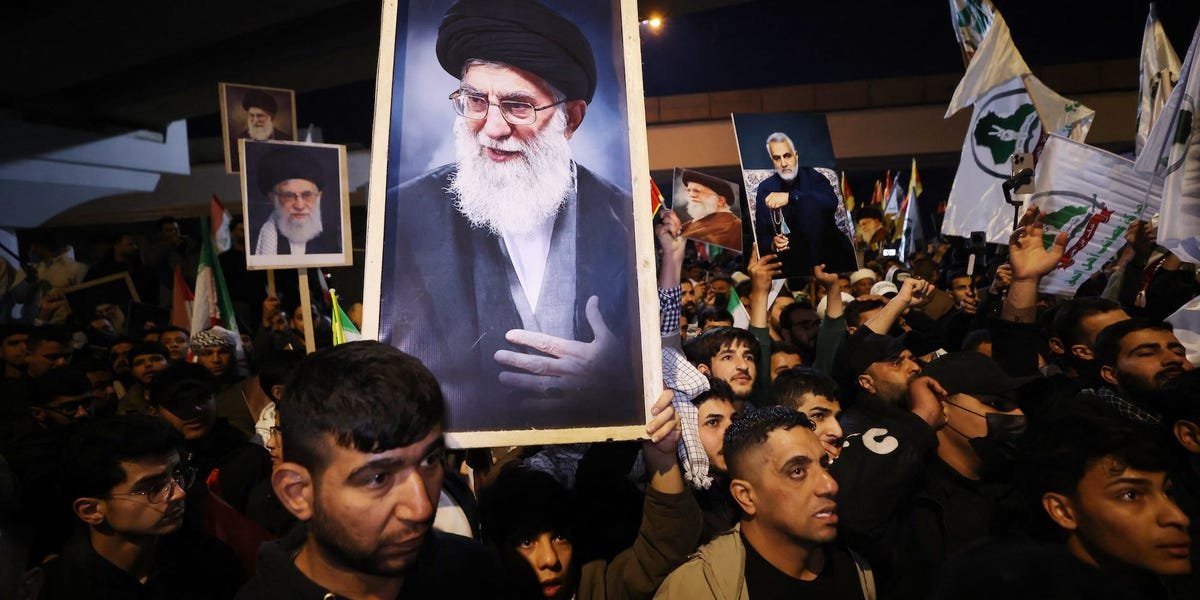
Iran’s Supreme Leader Ayatollah Ali Khamenei was killed during the massive joint US-Israeli strikes on the country, President Donald Trump said in a Truth Social post on Saturday.

“Khamenei, one of the most evil people in History, is dead,” Trump wrote. “He was unable to avoid our Intelligence and Highly Sophisticated Tracking Systems and, working closely with Israel, there was not a thing he, or the other leaders that have been killed along with him, could do. This is the single greatest chance for the Iranian people to take back their Country.”

Khamenei, 86, was in power for almost 40 years, and his reign was marked by high tensions with the US and the West more broadly, as well as a recent brutal crackdown on Iranians protesting high inflation. Tensions with the US have centered on Iran’s longstanding support for terrorism and its pursuit of nuclear weapons.

In recent weeks, as the US urged Iran to make a new nuclear deal, the American military has been building up its forces in the Middle East. The buildup has been accompanied by heated rhetoric and warnings from both Washington and Tehran.

Missiles struck several high-value targets in and around Tehran, including Khamenei’s compound near Tehran and his offices in the capital. Khamenei’s location during the strikes was previously unknown.

During President Donald Trump’s video statement announcing the start of “major combat operations” against Iran on Saturday morning, the president called for Iranian citizens to “take over your government.” He said, “This will be probably your only chance for generations.” Trump has recently made similar comments in favor of regime change in Iran.

Separately, Israel has repeatedly issued threats against Khamenei. In June 2025, after joint US-Israeli strikes on Iran, Israel’s Defense Minister Israel Katz said Khamenei “cannot continue to exist,” calling him a dictator. Other Israeli officials, like Prime Minister Benjamin Netanyahu, have made similar statements.

Khamenei became Supreme Leader in 1989, acting as the ultimate authority across all branches of the Iranian government and the military. Khamenei was also the country’s religious leader and was granted the title of ayatollah, a title for high-ranking clerics in Shia Islam, Iran’s official state religion.

His death marks a major upheaval amid US combat operations against Iran, which both the US and Israel said was aimed at eliminating imminent threats to Americans and Israelis. The American operation, called “Epic Fury,” has involved a mixture of land, air, and sea assets, including Tomahawk missiles, High Mobility Artillery Rocket Systems, and drones.

It remains to be seen how Khamenei’s death will affect the fate of the Iran’s regime, which is bolstered by the hardline Revolutionary Guard Corps and a vast internal security force.

Iran’s retaliatory strikes targeted US bases across the region, with US assets and partner forces, including Qatar and the United Arab Emirates, involved in air defenses.


Source link

Photos-show-chaos-at-airports-as-passengers-are-left-stranded.jpeg

Photos show chaos at airports as passengers are left stranded due to canceled flights

  • Airports across the Middle East have suspended all flight operations until further notice, leaving many stranded.
  • The US and Israel launched strikes against Iran on Saturday, with Iran launching retaliatory strikes across the region.
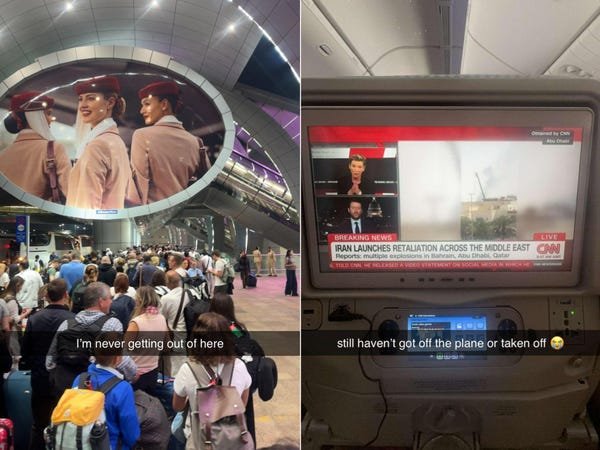
  • One Emirates passenger told Business Insider he was stuck on a plane for five hours without food before everyone was deplaned.

Travelers are in limbo as airport departure boards flip to red after air strikes in Iran resulted in closed airspace and triggered mass flight cancellations.

The heart of the chaos is in the Middle East, where airports in Dubai, Doha, and Abu Dhabi serve as megahubs for global connecting traffic. Data from the aviation analytics firm Cirium shows their home airlines — Emirates, Qatar Airways, and Etihad Airways — carry a combined 90,000 transit passengers a day.

That figure does not include the thousands of travelers whose final destination is the Middle East.

Emirates passenger Jaiveer Cheema, who was set to fly back home to the US on Saturday, told Business Insider that he was stuck on his plane for five hours with no food before everyone was deplaned and shuffled into the crowded terminal at Dubai International.

“The next several hours at the airport were chaos as no one knew what to do,” he said. “We spoke to several security guards and Emirates employees, and they all gave us different answers.”

Cheema said they stood in line after line until they eventually got a hotel voucher and took a bus to the lodging. He was still waiting for a room 90 minutes after arriving — it’s after midnight in Dubai; nearly 20 hours after he initially showed up for his 9 a.m. flight.

While many passengers are stranded within the region’s closed airspace, shuttered until further notice, the disruption has rippled far beyond it.

Flights to the affected region from places like London and the US have been canceled outright or diverted mid-journey — leaving travelers far from home in crowded airport terminals and uncertain when they will be able to depart.

Airlines have told passengers on social media to expect long wait times at airports and on customer-service phone lines as they try to manage the abrupt disruptions.

The sheer number of displaced people and planes on Saturday alone is expected to snowball worldwide if airports are unable to restart operations soon.

Passengers in Dubai were funneled into long snaking lines.

Jaiveer Cheema is one of the thousands of people stranded in limbo.

Courtesy of Jaiveer Cheema

Cheema spent hours in line but managed to secure a hotel voucher — though he had yet to secure a room when talking with Business Insider. He said he did not have answers from Emirates on what’s next.

An Emirates spokesperson did not immediately respond to a request for comment from Business Insider.

Passengers at Beirut Rafic Hariri International Airport in Lebanon are stranded.


Stranded passengers at Rafik Hariri International Airport

Passengers are stranded at Beirut Rafic Hariri International Airport on Saturday.

Anadolu/Anadolu via Getty Images

Airlines are pivoting their operations in response to the strikes. Lufthansa Group said it is suspending flights to Beirut, Tel Aviv, Amman, Erbil, and Tehran until March 7.

Airlines are suspending flights across the region, including Lebanon.


Cancelled flights at the Rafik Hariri International Airport on February 28.

Flight operations at the Beirut Rafic Hariri International Airport in Lebanon on Saturday.

Anadolu/Anadolu via Getty Images

In a statement shared on the Lufthansa Group’s website, the company said it would also suspend flights in additional areas.

“The following airspaces will also not be used until March 7: Israel, Lebanon, Jordan, Iraq, Qatar, and Iran,” the aviation corporation said. “In addition, Lufthansa Group airlines will suspend flights to and from Dubai and Abu Dhabi, Riad, and Dammam until March 1. Furthermore, the airspace of the United Arab Emirates will not be used until March 1.”

International flights at Tribhuvan International Airport in Nepal were disrupted.


Stranded passengers at Tribhuvan International Airport in Nepal.

Passengers waiting at Tribhuvan International Airport in Nepal on Saturday.

Navesh Chitrakar/REUTERS

The Tribhuvan International Airport shared a passenger advisory on Saturday, saying international flights “may be subject to delay, rescheduling, or cancellations” due to airspace restrictions.

Passengers flying with major airlines were told to check their flight status.


Passengers stranded at Tribhuvan International Airport in Nepal on February 28

Passengers at Tribhuvan International Airport in Nepal on Saturday.

Navesh Chitrakar/REUTERS

The Tribhuvan International Airport told passengers flying with major airlines — including Qatar Airways and Turkish Airlines — to coordinate with those companies to navigate travel issues.

Qatar’s airspace closure caused flight disruptions at Hamad International Airport.


Passengers at the Hamad International Airport in Qatar on February 28.

Passengers at the Hamad International Airport in Qatar on Saturday.

Stringer/REUTERS

Qatar’s Hamad International Airport said all aircraft movement has been temporarily suspended due to the country’s closed airspace.

“Our priority is always the safety of our passengers and employees. We are working closely with government stakeholders and airline partners to look after passengers that have been impacted,” the airport wrote in an advisory.

In London, flights to the countries Middle East were canceled.


A check-in counter for Emirates at London Gatwick Airport shows cancelled flights on February 28.

The Emirates check-in counter at London Gatwick Airport shows that flights are cancelled on Saturday.

Ben Stansall / AFP

Flights heading to the Middle East were also canceled at the London Gatwick Airport in England on Saturday.

London Gatwick Airport told some passengers to expect travel interruptions.


Passenger at London Gatwick Airport on February 28.

Passengers at London Gatwick Airport on Saturday.

Ben Stansall / AFP

A London Gatwick Airport spokesperson told Sky News it’s “expecting disruption to our Qatar and Emirates flights.”

Are you a stranded traveler with a story to share? Contact the reporters at ledmonds@insider.com and trains@insider.com along with your preferred contact information.


Source link

Sinéad Baker's face on a grey background

The US shared a new video of its strikes on Iran showing it launching missiles and blowing up targets

New US video footage shows elements of its strikes on Iran, including the launching of missiles and fighters and the destruction of multiple targets.

The footage shared by US Central Command on Saturday shows destroyers firing missiles at sea and carriers launching combat aircraft. It also shows repeated strikes on Iranian military targets. It said its forces are “delivering an overwhelming and unrelenting blow.”

It did not specify exactly what was hit, or attribute each attack to the US or Israel, which jointly took part in the operation, dubbed Operation Epic Fury on the American side and Roaring Lion on the Israeli side.

It said the operation, which started Saturday morning, involved precision munitions launched from the air, land, and sea, and said it “involves the largest regional concentration of American military firepower in a generation.”

A US official also told Business Insider that the US launched Tomahawk cruise missiles from warships and that ground forces used the High Mobility Artillery Rocket System, or HIMARS. Other weapons were also employed.

The Israel Defense Forces said that it used around 200 fighters in what it described as “the largest military flyover in the history of the Israeli Air Force,” adding that the jets dropped hundreds of munitions “targeting approximately 500 objectives, including aerial defense systems and missile launchers, in a number of locations in Iran, simultaneously.”

Israel has also released footage showing an attack on missile launchers at a remote site in Iran.

US Central Command said attacks were intended to “dismantle the Iranian regime’s security apparatus, prioritizing locations that posed an imminent threat.” President Trump vowed to destroy Iran’s missile program and other military capabilities and said that the aim was for Iran to “never” have a nuclear weapon. He called on Iranian forces to surrender or face “certain death.”


Grey smoke plume in a blue sky over buildings

: Smoke rises after Iran launched a missile attack in Bahrain.

Stringer/Anadolu via Getty Images


CENTCOM said targets included “Islamic Revolutionary Guard Corps command and control facilities, Iranian air defense capabilities, missile and drone launch sites, and military airfields.”

Strikes have been reported across Iran, including at military sites and the residence of Iran’s supreme leader. Satellite imagery showed a burning Iranian warship in the aftermath of the initial strikes.

Iranian officials said that at least 85 people were killed at a girls’ elementary school, and the Iranian Red Crescent humanitarian group told the BBC that 201 people had been killed in the country.

After the start of the US and Israeli strikes, Iran launched counterattacks against Israel and against multiple nearby nations, many of which have bases that host US forces and are US allies. Those nations reported many successful interceptions, but also some damage. Details about Iran’s attacks are still emerging, and attacks may continue.

CENTCOM said that its forces had successfully defended against hundreds of Iranian missile and drone attacks. It said there was damage to US military facilities, but that it was minimal and did not impact operations.

Bahrain said the headquarters of the US Navy’s 5th Fleet, located in the country, was hit by an Iranian missile attack, without giving details on the extent of any damage.

Iran’s strikes also targeted Kuwait, the United Arab Emirates, Qatar, and Jordan. Some countries reported injuries from falling debris, including Kuwait, which said that three armed forces members had minor injuries from shrapnel from the interception of drones and ballistic missiles. The United Arab Emirates said one person was killed by falling debris in its capital, and four people were injured and taken to the hospital after an incident in a part of the city of Dubai that is known for luxury hotels.

Iran’s Foreign Minister Abbas Araghchi called the US and Israeli strikes “wholly unprovoked, illegal, and illegitimate.” Iran has vowed further action, and Israel has hinted that its actions so far only represent the beginning of its operation. The US has indicated the same.

Flights have been cancelled across the region, and multiple countries have closed their airspaces, resulting in major disruption for what is one of the world’s busiest flight routes.


Source link

Someone-asked-to-switch-our-business-seats-on-a-plane.jpeg

Someone asked to switch our business seats on a plane. I said yes, and got to take photos with one of my favorite celebrities.

This as-told-to essay is based on a conversation with Denny Balmaceda. It has been edited for length and clarity.

In February, I boarded my plane that would fly from Newark Airport in Jersey City to San Francisco. My business-class seat had been booked by a clothing brand I had been working for at the time. My seat on row 11 was a window seat with my own little nook, a treat for me, who usually flies in the economy seats.

As I settled in, neatly arranging my things in the compartment above my head and around my seat, a woman I didn’t recognize kindly asked if I would mind switching seats with her so she could sit next to her husband.

I quickly said, “Sure.” I know that in economy, this kind of question can produce mixed feelings, because if you’ve booked a window seat, you’re not going to want to switch to a middle seat. But in business class, all the seats are good, so I didn’t mind.

I hadn’t realized who her husband was

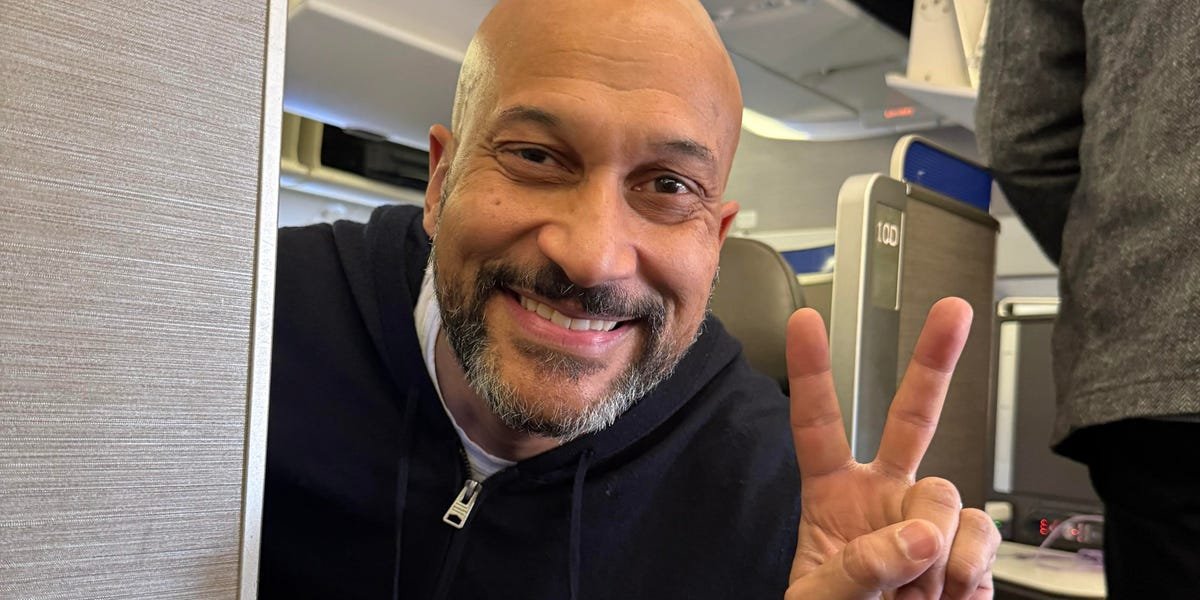
Just as I responded to her request, I looked up and saw Keegan-Michael Key. I was switching seats with his wife, so she could sit next to him. She continued, explaining she thought she had booked them to sit next to each other.

I took her seat in row 10, and she took mine in row 11.

So not only did I get to travel in business class — already a lot of fun for me — I also got to travel in front of a celebrity that I absolutely love. He’s literally one of my favourite actors.


Keegan-Michael Key on a plane

Denny Balmaceda sat right in front of Keegan-Michael Key on a plane.

Courtesy of Denny Balmaceda


His wife leaned over and said Key would be happy to take a photo with me. He did, and he was so nice. Throughout the flight, he was the same with everyone who came up to him — a real gentleman.

He was so nice

Every single person who came up to him got his time and never once seemed annoyed. He talked to everyone and let people take photos with him.

When his wife needed help with anything, he helped.

And as the flight came to an end, I asked if he could grab my bag, and he didn’t flinch — he was fine with it.

There was no sense that he thought he was above anyone on that plane. He was just a real person who happened to be a celebrity.

Working in the fashion industry, I know there are both celebrities who are rude and those who just have bad days. I know that sometimes, people just want to be themselves without the fame. They just want to travel on planes and not be recognized. But he didn’t fit into any of these categories.

After the flight landed and before we went our separate ways, I took a couple of photos of us together to show my wife.

It was a one-in-a-million chance that I’d switch seats with someone famous, and I was very happy and surprised to get to experience it.


Source link

Satellite-images-show-an-Iranian-warship-burning-pierside-after-US.jpeg

Satellite images show an Iranian warship burning pierside after US and Israeli strikes

New satellite imagery shows an Iranian warship burning pierside following widespread US and Israeli airstrikes.

The imagery, collected Saturday by US spatial intelligence firm Vantor and obtained by Business Insider, shows some of the initial aftermath of the joint US and Israeli attack on Iran, a major combat operation against Tehran after the collapse of talks on nuclear weapons.

The Vantor images show a frigate burning at the Konarak naval base in southern Iran. A large billow of smoke can be seen rising from the wounded vessel.


Overview of a burning vessel at Iran's Konarak naval base on February 28.

A frigate on fire at Iran’s Konarak naval base.

Satellite image ©2026 Vantor.


In a close-up image, two other frigates are seen sitting nearby, appearing unscathed.

Trump said earlier in his video message announcing the US campaign, Operation Epic Fury, that the US military was “going to annihilate” the Iranian navy, as well as the country’s other military capabilities.

Trump said the goal was to ensure that Iran can “never” have a nuclear weapon. The president also urged Iranian citizens to “take control” in the aftermath of US operations.

“This will be, probably, your only chance for generations,” he said.


A burning frigate at Konarak naval base in Iran.

A close-up of a burning frigate at Konarak.

Satellite image ©2026 Vantor.


War analysts at the Institute for the Study of War think tank said on Saturday that there had been unconfirmed reports of strikes on Iranian naval assets.

“An Israeli OSINT [open source intelligence] account reported strikes on the IRGC Navy frigate Jamaran,” ISW said. “There are also unverified reports of strikes on the IRGC Navy Imam Ali Navy Base in Chabahar, Sistan and Balochistan Province.”

Other images collected by Vantor show drone launch activity at two nearby airbases in Konarak. After the initial attacks by the US and Israel, Iran launched retaliatory missile and drone strikes at US military bases around the region in Bahrain, Qatar, the United Arab Emirates, Kuwait, Jordan, and Saudi Arabia.


Drones dispersed at an airbase in Iran on February 28.

Drones dispersed at an airbase in Konarak.

Satellite image ©2026 Vantor.


Iran has also launched multiple barrages at Israel, including missiles and drones, and said it was carrying out an “extensive drone offensive operation” against its longtime foe.

US strikes on Iran included a mix of weapons such as Tomahawk cruise missiles, High Mobility Artillery Rocket Systems, drones, and undisclosed standoff weapons designed for long-range strikes outside the reach of enemy air defenses.

In response to retaliatory attacks from Iran, various air defense weapons have been active, including the MIM-104 Patriot surface-to-air missile and Terminal High Altitude Area Defense, or THAAD, batteries.


Drones dispersed and a runway blocked at the Konarak drone strip.

Drones dispersed on a blocked runway.

Satellite image ©2026 Vantor.


Saturday’s strike is the second time in less than a year that the US has launched a strike campaign against Iran. In June 2025, US forces targeted Iranian nuclear facilities. In the weeks prior to the most recent attack, the US built up a massive force presence in and around the Middle East.


Source link

Israel-says-200-fighters-struck-Iran-in-the-largest-air.jpeg

Israel says 200 fighters struck Iran in the largest air operation in its history

Roughly 200 fighter jets participated in Israel’s widespread airstrikes against Iran on Saturday, the Israeli military said, calling the attack the largest air operation in its history.

The Israeli fighter jets dropped hundreds of bombs on 500 targets in western and central Iran, including air defense systems and missile launchers, the military said in a statement. The government earlier announced it had carried out a “preemptive” strike.

Attacks on the defensive systems — a tactic known as suppression of enemy air defenses, or SEAD — allowed Israel to expand its aerial superiority over Iranian territory, the military added.

“This is the largest military flyover in the history of the Israeli Air Force,” it said, adding that the operation was based on extensive planning and “high-quality intelligence.”

The strikes involved Israeli F-35 stealth fighters and F-15 jets. The full extent of the aircraft that participated is unclear.

Israeli warplanes attacked Iran alongside the US military. President Donald Trump described the American involvement as the start of “major combat operations” after nuclear talks between Tehran and Washington broke down.

A US official told Business Insider that American air, land, and naval forces were involved in the strikes against Iran and launched drones, rocket artillery, and cruise missiles, among other weapons.


An Israeli F-15C Buzz launches for a sortie in support of exercise Juniper Falcon, May 7, at Uvda Air Base, Israel.

Israeli F-15 fighter jets were involved in the strikes.

US Air Force photo by Tech. Sgt. Matthew Plew


US fighter aircraft also participated in the attacks, which targeted Iran’s Islamic Revolutionary Guard Corps command and control facilities, air defenses, missile and drone launch sites, and military airfields, the American military said.

Hundreds of Iranians have been killed and wounded in strikes so far, according to multiple reports.

Iran retaliated by launching waves of missiles against Israel and US bases across the Middle East, sending the region into an air defense frenzy.

US Central Command, which oversees Middle East operations, said its forces “successfully defended against hundreds of Iranian missile and drone attacks.”

Several Middle Eastern countries confirmed shooting down Iranian missiles as well, though some projectiles managed to slip past air defenses. CENTCOM said there are no reports of US casualties, nor has there been significant damage to American facilities.

Saturday’s strikes mark the second time in less than a year that the US has attacked Iran. American forces bombed the country’s nuclear facilities in June 2025 as part of Operation Midnight Hammer.

They also follow a steady buildup of US military forces in the Middle East and the Eastern Mediterranean Sea, including more than a dozen warships and hundreds of aircraft.


Source link

What-to-do-if-youre-an-American-in-the-Middle.jpeg

What to do if you’re an American in the Middle East right now

Americans in many Middle Eastern countries have been advised to shelter in place after the US and Israel launched strikes against Iran on Saturday.

The US Department of State Consular Affairs and related embassies posted on X that US citizens in countries including Iran, Bahrain, Jordan, UAE, Qatar, were advised to shelter in place until further notice.

Hours later it posted guidance for US citizens in Iraq, advising them to “exercise increased caution, limit their movements, and be prepared to shelter in place.”

“There are reports of missiles, drones, or rockets in Iraqi airspace. The security environment remains complex and can change quickly,” the US Department of State Consular Affairs wrote.

“If you are in Iraq, you should review your personal security plan and evaluate options to shelter in place or depart Iraq should the situation deteriorate,” it continued.

The US Embassy in Jerusalem said it had directed all US government employees and their families to shelter in place, and that Israel had closed airspace to all civilian flights.

The US Department of State Consular Affairs also warned of imminent drone and missile attacks in Bahrain.

Read more of our coverage:

The US Embassy in Beirut wrote that the Department of State “urges U.S. citizens to depart Lebanon now while commercial options remain available.”

Iran, Iraq, Kuwait, Bahrain, and Qatar have closed their airspaces. A video shared on Flightradar24 showed airplanes leaving the region.

Of the approximately 3,400 flights scheduled to the region, 230 were cancelled as of 12 p.m. Central European time, while 40 due to fly on Sunday were preemptively cancelled.

Airports in the region shared travel updates online. Dubai Airports said all flights at Dubai International and Dubai World Central – Al Maktoum International were suspended until further notice. It advised passengers not to travel to those airports at this time, and to contact their respective airlines for updates on flights.

King Abdulaziz International Airport in Saudi Arabia, Hamad International Airport in Doha, and Abu Dhabi Airports gave similar advice to passengers.

In a video statement posted on social media on Saturday, President Donald Trump vowed to destroy Iran’s missile program and navy and said the objective of the strikes is to “defend the American people by eliminating imminent threats.”

“My administration has taken every possible step to minimize the risk to US personnel in the region. Even so — and I do not make this statement lightly — the Iranian regime seeks to kill,” Trump said.

“The lives of courageous American heroes may be lost, and we may have casualties. That often happens in war,” Trump continued.

This is a breaking story and will be updated.


Source link