James Faris headshot

Warner Bros. Discovery says it thinks Paramount’s new bid could be superior to Netflix’s offer

After 10 tries, David Ellison’s Paramount Skydance has finally made a proposal that Warner Bros. Discovery’s board is excited about.

Paramount is prepared to pay $31 per share for all of WBD, including its TV networks like CNN and TruTV, up from $30 per share in its previous public offers, WBD told shareholders on Tuesday afternoon.

WBD’s board said Paramount’s offer “could reasonably be expected” to lead to a superior proposal to Netflix’s. However, WBD added that its board had “not made a determination” yet as to whether Paramount’s latest bid is actually better.

If WBD’s board determines that Paramount’s bid is better, then Netflix would have four days to submit a sweetened offer, if it wants. Netflix has offered $27.75 per share for WBD’s streaming and studio assets, and doesn’t want its cable channels. While Netflix could stand pat, doing so could put its dream of buying HBO at risk.

WBD hadn’t been impressed with Paramount’s prior offers, raising issues about everything from its equity backstop to its initial hesitation to cover costs like a breakup fee to Netflix. Paramount patched up those perceived holes by putting a guarantee from billionaire Larry Ellison, the father of Paramount’s CEO, and agreeing to reimburse WBD’s payout to Netflix if the board switched deals.

Paramount’s new offer also includes a so-called “ticking fee,” which will pay WBD shareholders $0.25 per share for each quarter that Paramount’s deal for WBD doesn’t close, starting on September 30. Previously, the ticking fee was slated to start in January 2027.

Paramount has long believed its offers for WBD were better than Netflix’s, reasoning that WBD’s cable channels don’t have much value after accounting for how much debt they’re expected to carry.

Netflix has sold its deal for WBD’s studio and HBO assets as simpler and better for Hollywood. The streaming juggernaut argued that it would “protect and create jobs in America” compared to Paramount, which has promised investors $6 billion in savings if it buys WBD. Netflix has said its deal could create $2 billion to $3 billion in synergies.

WBD warned last week that an employee exodus was possible if it took Paramount’s offer, since staffers could fear mass job cuts.

Another pivotal factor in the fight for Warner Bros. is the regulatory process, both in the US and abroad.

President Donald Trump has sent mixed signals about Netflix’s planned acquisition of Warner Bros., saying that its market share “could be a problem” before pledging to stay out of the process and leaving the antitrust decision up to the US Department of Justice.

A White House spokesperson told Business Insider last week that the president “has great relationships with all parties in this potential transaction and remains neutral in this process with no preference for either bidder.”

Days later, Trump said Netflix should take Susan Rice off its board “or pay the consequences.” Rice, a White House official under Obama and Biden, had gone on a podcast and criticized Trump and the corporations that she believes “take a knee” to him. Netflix co-CEO Ted Sarandos downplayed Trump’s complaint, saying that the company’s Warner Bros. bid is “not a political deal.”

If Netflix decides to increase its offer, WBD shareholders will be in a win-win situation.


Source link

The-longest-State-of-the-Union-addresses-in-history-ranked.jpeg

The longest State of the Union addresses in history, ranked

  • The American Presidency Project tracks the length of presidents’ State of the Union speeches.
  • Donald Trump holds the record for the longest address at 1:39:32 in 2025.
  • Trump and Bill Clinton have given eight of the top 10 longest State of the Union speeches.

Some US presidents have more of the gift of the gab than others.

The American Presidency Project has tracked the length of every president’s State of the Union address since 1964, with the timer beginning when the president opens with “Mr. Speaker” or “Madam Speaker.”

In the State of the Union, which is mandated by the Constitution, presidents typically highlight their administration’s accomplishments and lay out their legislative agenda in a speech before a joint session of Congress.

Presidents usually also introduce their legislative priorities in a joint address during their first year in office, a tradition started by President Ronald Reagan. Though this speech doesn’t technically qualify as a State of the Union, it is widely regarded as such and is included in the American Presidency Project’s dataset.

On average, State of the Union speeches from 1964 onwards have lasted 56 minutes and 24 seconds, according to the American Presidency Project. President Richard Nixon gave the shortest-ever State of the Union speech in 1972 at 28 minutes and 55 seconds.

President Donald Trump and President Bill Clinton have given eight of the top 10 longest State of the Union speeches in history. In 2025, Trump broke Clinton’s record when his joint address to Congress clocked in at 1 hour, 39 minutes, and 32 seconds.

It’s a record Trump could break again when he delivers the State of the Union on February 24 at 9 p.m. ET.

Here’s how the top 10 longest State of the Union addresses stack up.

10. In 1967, President Lyndon B. Johnson’s State of the Union address lasted 1 hour, 11 minutes, and 16 seconds.

President Lyndon B. Johnson’s 1967 State of the Union address.

Warren K. Leffler/Library of Congress

9. President Joe Biden spoke for 1 hour and 13 minutes at his 2023 State of the Union address.


Joe Biden at the 2023 State of the Union.

President Joe Biden’s 2023 State of the Union address.

Kent Nishimura/Los Angeles Times via Getty Images

8. President Bill Clinton’s 1998 State of the Union address spanned 1 hour, 16 minutes, and 43 seconds.


President Bill Clinton's 1998 State of the Union address.

President Bill Clinton’s 1998 State of the Union address.

Douglas Graham/Congressional Quarterly/Getty Images

7. In 2020, Trump gave a 1-hour, 18-minute, and 4-second State of the Union address the night before the Senate voted in his impeachment trial.


President Donald Trump at the 2020 State of the Union address.

President Donald Trump’s 2020 State of the Union address.

Mark Wilson/Getty Images

6. Clinton’s 1999 State of the Union speech clocked in at 1 hour, 18 minutes, and 40 seconds.


President Bill Clinton's 1999 State of the Union address.

President Bill Clinton’s 1999 State of the Union address.

David Hume Kennerly/Getty Images

5. In 2018, Trump’s first State of the Union address ran for 1 hour, 20 minutes, and 32 seconds.


President Donald Trump's 2018 State of the Union address.

President Donald Trump’s 2018 State of the Union address.

Win McNamee/Getty Images

4. Trump spoke for 1 hour, 22 minutes, and 25 seconds at the 2019 State of the Union.


President Donald Trump's 2019 State of the Union address.

President Donald Trump’s 2019 State of the Union address.

Alex Wong/Getty Images

3. Clinton’s State of the Union address in 1995 lasted 1 hour, 24 minutes, and 58 seconds, making it the third-longest in history.


President Bill Clinton's 1995 State of the Union address.

President Bill Clinton’s 1995 State of the Union address.

Mark Reinstein/Corbis via Getty Images

2. Clinton’s final State of the Union address in 2000 was also the second-longest at 1 hour, 28 minutes, and 49 seconds.


President Bill Clinton's 2000 State of the Union address.

President Bill Clinton’s 2000 State of the Union address.

Douglas Graham/Congressional Quarterly/Getty Images

1. Trump’s address to a joint session of Congress in 2025 was the longest on record at 1 hour, 39 minutes, and 32 seconds.


President Donald Trump addressed a joint session of Congress.

President Donald Trump’s 2025 address to a joint session of Congress.

Bill Clark/CQ-Roll Call, Inc via Getty Images


Source link

Meagan Drillinger, freelance writer

I travel for a living and can’t wait to get back to Mexico

After cartel violence erupted across the Mexican state of Jalisco this week, images and videos of burning cars and buildings, shuttered storefronts, and cities grinding to a halt hit the news. Flights into and out of Puerto Vallarta and Guadalajara were canceled. Residents were told to shelter in place and to ensure they had enough food and water. Tourists were on lockdown and frightened.

I watched it all from far away in Seattle, where I’m currently traveling, as my phone lit up every 15 seconds with messages of panic, forwarded video footage, and WhatsApp voice notes from friends and loved ones on the ground in Puerto Vallarta.

For most people, Puerto Vallarta was just one of several cities mentioned in the news cycle, but for me it was different — it’s been my chosen home base for the last five years.

I travel for a living, but Puerto Vallarta has always been special

My relationship with this city on Mexico’s Pacific coast began more than a decade ago, on my first visit in 2013. At the time, Puerto Vallarta was just another reporting assignment at a beach destination, but something hit differently, and I kept returning. It became the place I ran to whenever I needed a break from real life. Each visit stretched longer. By much of 2024 and 2025, I was there full-time.

When you spend that much time in a place, it stops feeling like an escape and becomes the backdrop of real life. You learn the traffic patterns, see familiar faces at the coffee shops and bars, pick up your mail. Routine sneaks up on you; it becomes home.

You also build relationships. As I watched footage of a still-smoldering flame-licked car skeleton at an intersection just a few blocks from my last address, I listened to voice notes from friends. Fear sounds different when it comes from people you love.

For decades, Puerto Vallarta has been framed as one of Mexico’s easiest international trips

You don’t need to be a seasoned traveler or an adrenaline seeker to feel comfortable there. There are direct flights, large resorts, familiar comforts, and an infrastructure built around welcoming visitors.

Read more stories about Mexico travel

Plus, it’s jaw-droppingly gorgeous with that broad, blue curve of the Bay of Banderas and the jungle-covered crown of peaks that rise behind it.

For many Americans, Vallarta has been shorthand for “safe Mexico.” Could incidents like this change that perception? Inevitably, for some.

Travel decisions are rarely driven by data alone. They are fueled by emotion, personal tolerance for uncertainty, and individual experience. As happens after virtually every high-profile incident in Mexico, reactions tend to fall into familiar categories. There will be people who write Mexico off forever as a country to visit or live. Others will decide to wait and see.

And there will be people, like me, who are already itching to return because they understand something fundamental about moments like this: They’re traumatic precisely because they are disruptions, not constants.


Woman near ocean in Mexico

The author says reports of violence in Mexico this week only increased her desire to return.

Courtesy of Meagan Drillinger


Like any place anywhere, Puerto Vallarta and Mexico are much more than their worst moments

Violence in Mexico is real. It’s serious. It’s also limited to very specific parts of a massive country. Mexico is vast and regionally complex. Episodes of cartel-related violence, while alarming, do not function as a constant across daily life in most destinations Americans visit.

Moments like Sunday’s violence highlight a perception gap that often shapes how Americans think about risk abroad versus risk at home. Americans tend to discuss violence in Mexico as though it exists in a fundamentally different category of danger. Yet in recent years, the US has developed its own unsettling familiarity with public acts of violence, mass shootings, random attacks, and sudden disruptions.

There is no longer a clean psychological divide between “safe at home” and “dangerous abroad.” We are, increasingly, navigating variations of the same reality.

I have no hesitation about returning to Puerto Vallarta

Living in Puerto Vallarta has not made me dismissive of safety concerns. What happened across Jalisco is devastating and serious. But living there has grounded my understanding of the city in lived experience rather than episodic headlines. It has made moments like Sunday’s violence feel personal without altering my relationship to Puerto Vallarta.

Watching the videos didn’t make me want to run further from Vallarta. If anything, it made me wish I were there with the community I love.

So, when do I plan to return? Soon. I’ll be heading back to Mexico in early March, this time to Puerto Escondido, Oaxaca, nearly 1,000 miles away from Puerto Vallarta. (Yes, Mexico is really big.) I have no hesitation about going. And, truthfully, if logistics allowed, I would go back to Puerto Vallarta this week. It’s not just a vacation destination to me, and it’s not just a clip on the news. It is nearly 13 years of memories, friendships, routines, and a sense of home that I have built over time.

Like any place anywhere, Puerto Vallarta and Mexico are larger than their worst moments. Like any place you love, those moments do not erase the steadier, more enduring reality of everyday life that surrounds them.


Source link

Google-apologizes-for-a-news-alert-about-the-BAFTAs-that.jpeg

Google apologizes for a news alert about the BAFTAs that contained the N-word

Google apologized on Tuesday for a news alert about a controversial moment at the British Academy Film Awards that contained the unedited N-word.

“We’re deeply sorry for this mistake,” a Google spokesperson said in a statement. “We’ve removed the offensive notification and are working to prevent this from happening again.”

The now-deleted news alert previewed a story about Sunday’s BAFTA awards, where an attendee with Tourette syndrome shouted the N-word while “Sinners” stars Michael B. Jordan and Delroy Lindo — both of whom are Black — were on stage to present an award.

Deadline.com initially reported that AI was to blame for the racial slur appearing in the push alert. Google said that was not the case, and Deadline has since clarified its report.

Google said it caught the mistake quickly and only a “small subset of users” received the alert with the unedited racial slur. The search giant said that its push alert systems recognized a euphemism for the slur used in stories and incorrectly inserted the full word.

“This system error did not involve AI,” Google said. “Our safety filters did not properly trigger, which is what caused this.”

Tourette syndrome advocate John Davidson, whose life story served as the inspiration for the BAFTA-nominated film “I Swear,” later said in a statement that he was “deeply mortified if anyone considers my involuntary tics to be intentional or to carry any meaning.”

According to the Tourette Association of America, roughly 10% of the millions of people living with Tourette and tic disorders experience coprolalia, which is “the involuntary vocalization of obscene or socially inappropriate words or phrases.”

“Importantly, these vocal tics are not reflective of the beliefs or values of the person experiencing them,” the association said in a statement.

The BBC and the BAFTAs have faced intense criticism for broadcasting the moment, even though the award ceremony was subject to a two-hour tape delay. On Monday, both the BBC and BAFTAs offered separate public apologies for the moment.

“We take full responsibility for putting our guests in a very difficult situation and we apologize to all,” the BAFTAs said in a statement. “We will learn from this, and keep inclusion at the core of all we do, maintaining our belief in film and storytelling as a critical conduit for compassion and empathy.”

Kate Phillips, the BBC’s chief content officer, said in a note to staff that another racial slur was edited out of the broadcast.

“We take full responsibility for what happened,” Phillips wrote on Tuesday in the note, which was provided to Business Insider. “When I was made aware it was audible on iPlayer, I asked for it to be taken down. As I’m sure you’re aware we put out a statement yesterday morning apologising that the remark was not edited out prior to broadcast.”

During the award ceremony, host Alan Cumming made multiple statements about the language the audience might be hearing. Variety reported that “shut the fuck up” among other phrases could also be heard during the show.

“You may have noticed some strong language in the background,” Cumming told the audience. “This can be part of how Tourette’s syndrome shows up for some people as the film explores that experience.”


Source link

Bio page

Bryan Johnson says he wants an AI agent between himself and his social media: ‘I never want to see the raw feed’

Bryan Johnson, fresh off a 40- and 70-hour social media fast, says he’s ready to put an AI buffer between him and his social feed.

In a post on X, the 48-year-old entrepreneur and biohacker compared social media to pollution and water toxins.

“Like other toxins, it accumulates,” he wrote. “You can’t unsee or unfeel what you’ve consumed. It settles into mental tissue like heavy metals, producing chronic low-grade inflammation.”

Eliminating social media entirely isn’t realistic, he wrote.

“‘Just put the phone down’ is as practical as telling someone in 19th-century London to stop breathing coal smoke,” he wrote.

Johnson said time away from the apps is the “only remedy,” but he also suggested that AI agents could serve as an antidote to social media.

“An AI layer between you and the feed. Filtering rage, removing vanity metrics and translating sensationalism into calm, factual language. Preserving signal and eliminating noise,” he wrote.

“I never want to see the raw feed. I want an AI agent to read it for me, strip the engagement metrics that hijack my judgment, filter the rage, and return only what I actually came for,” he added.

In a world where AI agents are already proving to be expert hackers, agreeable coworkers, and custom-built board members — as well as potential security risks — Johnson’s push for an AI layer between himself and his feed doesn’t seem all that far off.

Johnson has made it his life’s focus to try to reverse his biological age to avoid death. He spends around $2 million a year to do so, focusing on extreme treatments such as plasma therapy alongside his strict diet and exercise routine.

His wish for an AI social media buffer also ties into his quest for a longer life, he says: “I want social media to become a longevity intervention, not a longevity threat.”


Source link

Peter Kafka

That viral post about AI is right about two things

You know all that money and effort everyone’s putting into AI because they’re convinced it’s a technology that will change everything? What if they’re right?

That’s a kind of fair summary of a Substack post that went viral over the weekend, and then turned into a Wall Street phenomenon Monday, when lots of tech stocks lost value because of AI fears.

I say “kind of fair” because the “what if” post, published by Citrini Research, isn’t just a “what if” post, but a “if it happens, we’re in big trouble” post.

And now the blowback: AI boosters are calling the Citrini post “AI doomerism” and are poking at some of its doomsday scenarios.

I’m not here to argue whether any of Citrini’s individual points are reasonable — I have no idea how AI will affect the likes of, say, DoorDash.

But this also seems like a forest/trees issue. Maybe the details are wrong, but the big picture should be a sobering one: If the AI future we are being promised comes to pass, it could have a massive effect on our economy, and part of that effect could be meaningful unemployment.

Because that’s not just a wild-eyed anti-AI thesis, but one that’s core to the pro-AI thesis, too. It’s what accounts for the enormous investments tech companies are making in AI, and the crazy valuations we’re seeing for the likes of Anthropic ($380 billion) and OpenAI ($850 billion).

In short: The only way those companies are going to be worth anything close to those numbers* is if they end up having a massive impact. Yes, some of the value may be justified by amazing innovation AI could unlock, like wonder-drugs that get discovered in a fraction of the time. But a lot of the value will come from the fact that AI will let computers do lots of work humans do now.

You can’t have the upside without the downside. Full stop.

It’s easy to imagine all the ways this ripples through our economy. And every couple weeks or so, we get a new impetus to fire up our imaginations. Right now, for instance, the market is trying to get its head around the notion that AI might dramatically cut into the enterprise software industry, which is why we saw companies like IBM plummet on Monday. But you can do the same exercise for all kinds of work, in all kinds of industries: Lawyers. Consultants. Screenwriters. Truckers. Etc.

Nor do you have to be an AI “doomer” to think this way — it’s baked into the pitch of the biggest AI companies. “There are cases where entire classes of jobs will go away,” OpenAI’s Sam Altman said last year. His rival, Anthropic CEO Dario Amodei, is blunter and more pessimistic, predicting that AI will wipe out half of entry-level white collar jobs and send unemployment skyrocketing.

It is a little weird to see Wall Street whip-sawing as it thinks through how all of this might go. On Tuesday, tech stocks gained again, presumably because investors have now decided they overreacted on Monday. But I won’t be surprised to see the markets lurch again down the line when someone else makes a convincing case that computers will disrupt a different industry.

Maybe Citrini is wrong about DoorDash and right about lawyers. Maybe it’s the other way around. But the general shape of the problem stays the same: The more AI lives up to the hype, the more it will affect the way people work — or if they work at all. You can be optimistic about that prospect, or terrified. But you can’t ignore it.

*Bear in mind these are private companies, which someday expect to be worth much more when they go public.


Source link

All-the-details-you-might-have-missed-in-the-first.jpeg

All the details you might have missed in the first season of ‘A Knight of the Seven Kingdoms’

In Martin’s “The Hedge Knight,” Dunk offers to take Egg under his wing while traveling across the realm.

Egg’s father, Maekar, is offended by the very suggestion. Egg is a crown prince, after all; he can’t wander around Westeros, bald and vulnerable, trailing after a hedge knight he met less than a week ago. After Dunk delivers his final pitch, Maekar takes a long pause, then walks away without saying a word.

In the next scene, Egg suddenly materializes and says that he’s gotten his father’s blessing to squire for Dunk.

The novella is told from Dunk’s perspective, so the reader is left to speculate about why Maekar changed his mind.

In the show, however, it’s made explicit that Egg lied. He defied his father’s wishes, choosing to follow Dunk rather than return with his family to their comfy royal life.

“He’s failed with his eldest two sons. Aegon is his last chance to create a legacy that is fit for the throne,” Sam Spruell, who plays Maekar, said of the change. “[Egg] leaving is a kind of rejection of that.”

Parker also said it was a natural extension of Maekar’s character. Thus far, Maekar has proven incapable of raising his children, but he’s still a prideful man who can’t bear to cede control.

“I actually do think he really does love his children. I do think he cares about them, even though he’s not able to raise them well, he still wants to,” Parker said of Maekar. “The idea of letting Egg go off with someone else just felt like too much for me. It felt like he could reasonably say no in this moment, even though he knows it would be better for Egg.”


Source link

Jordan Hart's face on a gray background.

Your next Mac Mini might be made in the US

The Mac Mini is having a moment thanks to the OpenClaw AI agent. And, in a new development, AI enthusiasts in America can now expect a made-in-the-USA version of Apple’s small computer.

The tech giant announced Tuesday that it would be significantly expanding its factory operations to bring some production of the Mac Mini to the US for the first time. Beginning later this year, Mac Mini units will be produced at a new factory at Apple’s existing Houston manufacturing site to help fulfill US orders.

The company said it will also expand advanced its AI server manufacturing at the Houston factory, an effort that it expects to create thousands of job. It’s in line with Apple’s previous commitment to invest $600 billion into its US facilities and create 20,000 jobs over the next four years.

“Apple is deeply committed to the future of American manufacturing, and we’re proud to significantly expand our footprint in Houston with the production of Mac Mini starting later this year,” said Apple CEO Tim Cook.

There’s been some hype around the Mac Mini in 2026, as people seek to operate OpenClaw, an open-source autonomous AI agent. The buzzy AI project has renewed interest in the Mac Mini. It’s currently produced in Asia, with many models being listed as Vietnam-made. Overseas production of the computer will continue.

Apple’s 20,000-square-foot advanced manufacturing center is under construction in Houston, and it will be a site where students, supplier employees, and American businesses can receive hands-on training in the company’s manufacturing techniques.

In its announcement, Apple shouted out several milestones its hit since its $600 billion pledge, including sourcing more that 20 billion US-made chips across 12 states, opening its Apple Manufacturing Academy in Detroit, and being on track to purchase more than 100 million advanced chips produced by Taiwan Semiconductor Manufacturing Company at its Arizona facility.

The Mac Mini announcement is the latest example of Apple leaning into made-in-the-USA messaging and efforts, as Cook navigates a political balancing act in his relationship with President Donald Trump. As a consumer electronics company that sources much of production overseas, Trump’s trade tariffs have cost Apple billions in costs in recent quarters. The tech giant has made tweaks to its supply chain, shifting much of the production of US-bound iPhones to India, for example, as part of its efforts to mitigate the tariff impact.


Source link

As-a-father-of-2-young-kids-I-dont-worry.jpeg

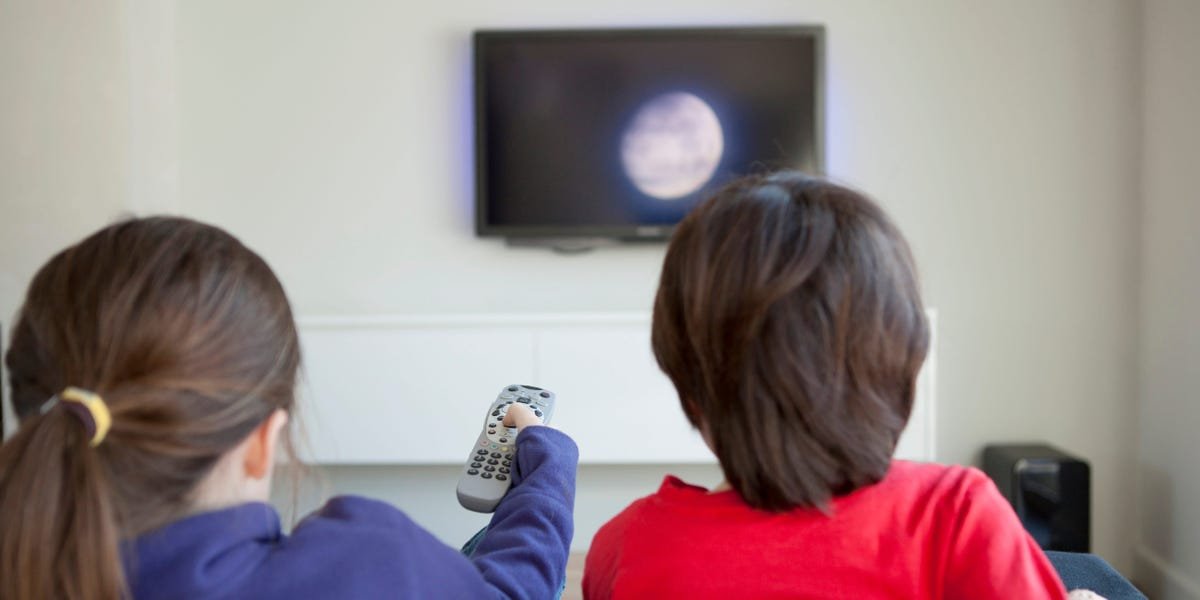
As a father of 2 young kids, I don’t worry much about screen time. I’m more concerned about what’s actually on the screen.

I didn’t know what chocolate ganache was before watching reruns of an old Food Network pre-teen baking championship with my kids. But I did spot an opportunity to talk with them about how one contestant kept building her cake after it crumbled. We talked about the word perseverance.

That’s the thing about “screen time” as a modern parenting panic: the same rectangle can either be a sedative or a springboard.

But my wife and I are still fairly new at this — our kids are under 5 — so we talk with other parents about evolving opinions on the use of phones, tablets, computers, and TVs.

From those conversations and our own parenting experience, we’re slowly realizing that it’s not about screen time, but more about what type of content we’re letting our kids watch.

We try to keep screen time to a minimum in our house

My wife, kids, and I live in a Philadelphia rowhome. We’ve kept TV out of our bedrooms and devices out of our daily routine. On trips in the car, bus, and subway, we rely on music and games (I’ve come to loathe “I spy”).

In good weather, we enjoy long walks and frequent visits to our neighborhood rec center. Forced into boredom at home, our kids have developed their own imagined worlds: singing karaoke on the couch, lava-ringed obstacle courses, and preparing elaborate meals in a play kitchen.

But especially on freezing days, when you’re stuck indoors, and everyone’s energy is somehow both too high and already spent, screens help. What’s become clear to me is that a screen’s value depends on what we watch.

Governments are cracking down on youth screen time

In recent years, the global discourse has turned aggressively anti-screen.

Governments are now intervening not just in social media but in screens more broadly. France, for example, has prohibited screen exposure for kids under 3 in childcare settings, and Virginia has moved to make schools “cell phone-free.”

Meanwhile, the American Academy of Pediatrics has long advocated against the simplistic yardstick of screen time, noting there isn’t enough evidence for a single universal time limit, emphasizing family context and habits instead.

It’s more important to me to monitor what my kids are watching than how much

It seems to me that no one can agree on what the maximum screen time should be for children, so that’s why I’m focusing less on time and more on the content.

Watching a kids’ baking show as a family, especially when we can connect the events to our own lives, can be healthy. I’ve seen the positive effects of a great show on my own kids.

For parents of young kids, the difference between cartoons like “Bluey” and “Cocomelon” is obvious: In one, characters develop over seven to 10 minutes, and in the other, brightly colored, computer-animated characters sing hypnotically rhythmic songs in short bursts.

This holds true for older kids, too. With the right guardrails, I think that screens can be genuinely social and developmental, like collaborating with friends in a shared Minecraft world, building a Roblox obstacle course over a week, or editing a goofy video together that takes planning and patience.

I see “good” screen time often involves characters, cause-and-effect, enough plot for us to talk about it together, and a bonus for when it’s social. I don’t see why there should be a time limit on any of that.


Source link

Jordan Hart's face on a gray background.

Career tips for creators from 5 of Steve Jobs’ powerful friends on what would have been his 71st birthday

Late Apple cofounder Steve Jobs had a variety of powerful friends, and they’re honoring his legacy by sharing their recipes for success.

To celebrate his birthday on Tuesday, the Steve Jobs Archive released two collections of letters from business leaders, designers, writers, and more.

The entries were originally distributed to 2023 and 2024 fellows of the SJA program for young creators, and they’ve been compiled into two volumes titled “Letters to a Young Creator.”

The volumes feature the words of advice from tech trailblazers like Tim Cook and Jony Ive, to successful businessmen Bob Iger and Arthur Rock, to creative minds like Pixar’s Pete Docter and filmmaker Jon Chu.

Some wove their lessons together with personal anecdotes about their relationships with Jobs, while others laid out lists to aid in the creative process.

Tuesday would’ve been Jobs’ 71st birthday. The former Apple CEO died in 2011 after living with pancreatic cancer for a number of years. Jobs became known for his inspirational public speeches and quotes shared by those who worked closely with him.

Volume one of “Letters To a Young Creator” ends with an email Jobs sent to himself in 2010. In the note, he reflected on how his appreciation for human creativity.

“I love and admire my species, living and dead, and am totally dependent on them for my life and well being,” Jobs wrote.

In volume two, Jobs referred to himself in a 1984 quote as a student.

“Don’t take it all too seriously,” he concluded.

Here’s what his friends had to say about pursuing success as a young creator.

Tim Cook posed one question to young creators


Apple CEO Tim Cook

Apple CEO Tim Cook took over for Jobs in 2011.

Perry Knotts/Getty Images


Cook took over as CEO in 2011 after Jobs stepped down to focus on his health. Before his death, the pair worked closely together at Apple. Cook has been with the company since he met Jobs in 1998.

In his 2024 letter, Cook described the fateful meeting that led to a decadeslong career at one of the biggest tech companies in the world. He said he was warned against taking a job at Apple as the company had been struggling around that time. One conversation with Jobs changed everything.

“I had never met someone with so much passion and vision,” Cook wrote. “I knew I had to be a part of it.”

His advice to young creators facing similar decisions on their future career paths was to ask themselves one question.

“And so when you imagine your future, and the winding path that is laid before you, remember the question you should ask is not ‘What will happen?’ but ‘Who will I be when it does?'” Cook said.

Jony Ive said that Jobs liked to focus on ideas


Former chief design officer of Apple Jony Ive

Former chief design officer of Apple Jony Ive worked closely with Jobs.

Mike Windle/Getty Images


Ive, Apple’s former design chief, worked with Jobs for nearly 15 years. The pair would often have lunch together as they came up with ideas that led to successful products like the iPhone.

Ive wrote about his relationship with Jobs.

“His insatiable curiosity was not limited or distracted by his knowledge or expertise, nor was it casual or passive,” Ive wrote. “It was ferocious, energetic, and restless.”

Ive and Jobs connected over their shared curiosity. He encouraged people to be like Jobs and show their admiration for humans by being creators themselves. According to Ive, Jobs was focused on ideas rather than the problems that come along with them.

“Ideas are fragile. If they were resolved, they would not be ideas, they would be products. It takes determined effort not to be consumed by the problems of a new idea,” Ive wrote.

Pete Docter listed tips that help his creative process along


Pixar's Pete Docter

Pete Docter directed several Pixar movies.

LISA O’CONNOR/AFP via Getty Images


Docter is the chief creative officer at Pixar, which Jobs owned before Apple’s comeback. In recent years, Docter has been vocal about the intersection of tech and animation, saying artificial intelligence won’t fully replace humans in filmmaking.

He’s known for directing hit animated movies like “Monsters, Inc.,” “Up,” “Inside Out,” and “Soul.”

Docter laid out nine tips that he uses in his own creative process. Here are three of them:

  1. Start with whatever shows up. Go as far as you can on that initial confidence and enthusiasm.
  2. Start fast and rough; worry about details later.
  3. Each day, start by pretending you’ve never seen it before, with no expectations or preconceptions. Take it in as your audience will: see what it is, not what you HOPE it is. Then change or add to make it better.

Bob Iger said to take risks


GREEN BAY, WISCONSIN - NOVEMBER 10: Walt Disney Company CEO Bob Iger looks on prior to the game between the Philadelphia Eagles and the Green Bay Packers at Lambeau Field on November 10, 2025 in Green Bay, Wisconsin. (Photo by Michael Reaves/Getty Images)

Disney CEO Bob Iger led the acquisition of Pixar in 2006.

Michael Reaves/Getty Images


Iger has had two stints as Disney’s CEO, starting in 2005. The media giant acquired Pixar in 2006. Jobs became a member of Disney’s board of directors as part of the deal.

In true Disney fashion, Iger wrote about “magic and wonder” in his letter to creators. He remarked that creativity can’t be reduced to math or science.

Being risk-averse, he said, is the “death of creativity.”

“Second-guessing creative decisions is a perilous endeavor. Learn from creative mistakes, and never second-guess why things were made,” Iger wrote. “Instead, ask how they could have been made better.”

Arthur Rock said it’s all about who you keep around

Rock is an iconic Silicon Valley investor behind Intel, Xerox, and Apple. The 99-year-old wrote his 2025 letter about what makes a good leader.

“A good leader chooses good people,” he said.

Execution outweighs ideas, according to Rock, and finding people who can execute is essential. It’s the traits that money can’t buy, like “fire in the belly,” that Rock learned to identify throughout his decades as a venture capitalist.

“You want people who know what they can do, and do it. Even more important: You want people who know what they don’t know,” Rock said.


Source link