JPMorgan plans to boost its technology budget by almost $2 billion this year, to $19.8 billion — a roughly 10% increase compared to 2025.
Speaking at the firm’s 2026 company update on Monday, CFO Jeremy Barnum said “technology remains a major driver of our expense growth,” which is up around $9 billion for the year. The bulk of the tech expenses comes from $1.2 billion in investments, including some AI-related projects.
Later in the presentation, CEO Jamie Dimon said that returns on AI are difficult to quantify initiative by initiative. Answering a question from Wells Fargo analyst Mike Mayo, who pressed him on the bank’s technology spend on a recent earnings call, Dimon said that time saved is often “too vague” to measure concretely.
“I think the hardest thing to measure has always been tech projects,” Dimon said. “That’s been true my whole life.”
When it comes to where the firm is investing, Barnum said it’s focusing on “the highest impact areas,” such as customer service in call centers, personalized insights for clients, and technology for software engineers. GenAI is, Barnum told investors, growing as a proportion of the bank’s AI usage.
Every time Alice publishes a story, you’ll get an alert straight to your inbox!
Stay connected to Alice and get more of their work as it publishes.
A slide from the company update presentation breaks down technology spending.
JPMorgan
Some of the $2 billion increase is due to inflation hitting everyone, including higher AI hardware costs. Technology head count growth isn’t a major driver — Barnum said the bank has budgeted in some additional head count in the area to work on new products, but that the culture generally discourages hiring more people whenever a new opportunity arises.
Despite JPMorgan’s status as a tech-forward firm — and No. 1 ranking on Evident AI’s index of AI maturity at banks — executives didn’t brush off competition. Marianne Lake, in response to an earlier question from Mayo, said the bank has some strategic assets, including in data.
“Only the paranoid survive,” Lake, the CEO of consumer and community banking, said. “We aren’t walking around thinking we have the divine right to success, we are walking around thinking about how to optimize the value that we give to our customers, how to perfect our processes and our systems.”
JPMorgan isn’t the only bank spending big on technology. Its rivals are also rapidly integrating AI throughout trading floors, back offices, and more to create efficiencies and improve customer experiences. Bank of America said it plans to spend around $14 billion on technology this year.
Dimon has previously asked investors to “trust him” on his bank’s spending, saying he is trying to keep the company from falling behind during its January earnings call.
“We need to have the best tech in the world,” he continued. “That drives investment, it drives margin, it drives competition.”
This story is available exclusively to Business Insider
subscribers. Become an Insider
and start reading now. Have an account? .
Lamborghini’s CEO said the company shelved its EV project late last year.
He said that an EV’s silent powertrain lacked the ’emotional connection’ Lamborghini owners expected.
Instead, Lamborghini will shift its focus to plug-in hybrid vehicles.
The roar of Lamborghini’s screaming V10 and V12 engines won’t go silent.
In an interview with The Sunday Times, CEO Stephan Winkelmann said the Italian supercar maker has scrapped plans for its first all-electric model, the Lanzador, after consumer interest in high-priced EVs flattened to “close to zero.”
“EVs, in their current form, struggle to deliver this specific emotional connection,” he told the Times, adding that engine noise is often a selling point for luxury sports cars. “The decision was made after over a year of continuous internal discussion, engaging with customers, dealers, market analysis, and global data.”
Lamborghini first announced the Lanzador EV in 2023, and the high-riding two-door coupe was scheduled to hit dealerships by 2029.
Winkelmann said the car will now come to market as a plug-in hybrid instead.
The shift marks a notable recalibration for the Volkswagen-owned supercar brand. In 2021, Lamborghini laid out an electrification road map that was supposed to add a fully-electric car by the “second half of the decade.” The company said it wanted to cut its 2024 carbon emissions in half.
Winkelmann told the Times that by 2030, its entire lineup will feature a gas engine and a battery that can be plugged into an electrical outlet.
He added that it will continue building internal combustion engines “for as long as possible.”
“Lamborghini is fully prepared for full electric,” the company said in a statement to Business Insider. “However, market readiness within the segment is not yet aligned with this transition.”
Most of the shrimp Americans consume comes from India. But in August 2025, the Trump administration announced 50% tariffs on the country. Shrimp farmers in Gujarat, who’d taken US demand and turned poor towns into valuable shrimp hubs, had to pivot.
In the US, Louisiana shrimpers applauded the tariffs but were split on whether they’d gone as far as they’d hoped. Now the Supreme Court has struck down Trump’s ’emergency tariffs’ but the President says he will still pursue them with an executive order. So, how did tariffs affect Indian shrimp farmers and Gulf fishermen? And who really wins and loses when a trade war hits an industry this global?
Lou Cohen, EY’s chief digital officer, said many marketers are not yet taking advantage of the benefits of artificial intelligence.
Cohen, who is also a professor at New York University, Yeshiva University, and Baruch College, said marketing is at an “inflection point,” with investment shifting from general digital innovation to AI transformation.
Cohen said that marketers who understand how to use AI in an assistive way, by focusing on what outcomes it delivers best, will access a deeper level of audience segmenting, targeting, and testing. He was interviewed for CMO Insider at Business Insider’s studio in New York City.
Ultimately, Cohen said, the marketing function will embrace the new opportunity. “Marketers, they’re not afraid to try things,” Cohen said. “We’re going to learn more from the things that we fail with and that don’t work than the things that do.”
The following transcript has been edited for clarity.
Every time Julia publishes a story, you’ll get an alert straight to your inbox!
Stay connected to Julia and get more of their work as it publishes.
We are at an interesting inflection point. In today’s marketing environment, you really need to understand how to make AI work for you; otherwise, you will end up working for it.
There are efficiency and operational gains to be had. But if you think about the outcomes that AI can enable from a marketing perspective, we could be smarter about how we segment our audiences for different campaigns. We could be more efficient in the ways our advertising runs. We could test more rapidly to get better-quality content in front of the right audiences at the right time in the right place.
But most marketing teams are not yet set up to take advantage of this potential. So the investments of the last 15 years in digital transformation are now shifting into AI transformation.
It’s a bit unknown now. Marketers are not totally comfortable with this because we’re so worried that it’s going to hallucinate or give us something that isn’t accurate. Marketers, they’re not afraid to try things. We’re going to learn more from the things that we fail with and that don’t work than from the things that do.
My colleague came up with a great way to evaluate the quality of our content using AI. We can paste in an article that a partner of ours wrote, and it will give us recommendations on how to make that piece of content better. But we’re never — I shouldn’t say never — we’re not likely to use content created by AI. But we certainly can use AI to enhance and give feedback to our content creators.
Hallucinations are real. The challenge is that as consumers of these technologies, we don’t yet understand the difference between probabilistic and deterministic outcomes. Probabilistic is the likely correct response that the AI is trying to give us. Deterministic is “one plus one equals two,” and arguably, one plus one always equals two.
When you’re doing a search on Google or Bing, for example, you are getting a deterministic response. You’re getting what it believes to be the likely to answer your question. Versus with the LLMs, the ChatGPTs, the Llamas, the Geminis of the world, you’re getting a probabilistic response. The model is bringing a bunch of different sources together to determine the answer it thinks you should get based on your prompt.
That means if we were using these tools for their designed purpose, we’d still need search engines to just navigate to the things we’re looking for, or to find the needles in the haystack of the internet. But LLMs give us a different opportunity. They can be assistants. That was some of the original idea behind these AI tools, to assist people in doing different tasks.
I think of these LLMs more as marketing assistants to give me real-time ideas, feedback, or suggestions, rather than doing the task for me. That’s a human putting AI to work to get better outcomes faster than if I were to just do it myself.
A crewed US Air Force fighter and an uncrewed jet-powered aircraft flew together recently, communicating and showing how autonomous drones might fight in a future air war alongside human pilots.
US defense firm General Atomics, a competitor in the Air Force’s Collaborative Combat Program aimed at developing and fielding loyal wingman-type drones, said on Monday that its MQ-20 Avenger, long a CCA stand-in, flew with an F-22 Raptor.
During the test at Edwards Air Force Base earlier this month, the stealth fighter’s pilot commanded the test drone to carry out tactical maneuvers, perform combat air patrols, and execute airborne threat engagement tasks.
The most recent demonstration is an advancement of a similar test in November 2025, when an F-22 pilot used a tablet to control an MQ-20, a test aircraft being used to demonstrate CCA-style teaming. The tablet allowed the pilot to communicate with the drone and send commands during flight.
The flight test earlier this month saw the Raptor pilot use government-provided autonomy software on the F-22 and a tactical data link to pass commands in real time to the drone.
Every time Chris publishes a story, you’ll get an alert straight to your inbox!
Stay connected to Chris and get more of their work as it publishes.
“This demo featured the integration of mission elements and the ability of autonomy to utilize onboard sensors to make independent decisions and execute commands from the F-22,” David Alexander, the president of General Atomics Aeronautical Systems, Inc., said in a statement.
The Air Force views CCAs as an attritable force multiplier that will be used with manned aircraft and autonomy.
US Air National Guard photo by Staff Sgt. John Macera
General Atomics said the latest demonstration showed how CCA-type platforms could increase the combat power available to human pilots in a future war.
The Collaborative Combat Aircraft program is a priority for the Air Force as a way to bolster American airpower. These drones are meant to fly alongside advanced fighters, including the coming sixth-generation F-47 being developed by Boeing.
Air Force officials say CCAs aren’t disposable, but they’re cheaper than fighters like the F-35 Lightning II Joint Strike Fighter. They are built to be attritable so they can be risked in combat instead of a human-piloted aircraft.
Testing with the MQ-20 is helping inform the Air Force’s CCA program, which is focused on General Atomics’ YFQ-42, Anduril’s YFQ-44, and Northrop Grumman’s YFQ-48A. The air service envisions these systems as easily upgradable platforms compatible with high-end crewed aircraft.
CCA-type drones, which include designs beyond those with dedicated Air Force program designations, are designed to carry out missions on their own, from air-to-air combat to strike and intelligence roles, while also boosting the power of a formation by adding more sensors and weapons without another pilot in the cockpit.
The Air Force says that CCAs are not intended as replacements for its crewed jets but are rather partners that will change how pilots work with artificial intelligence and drones — and expand US airpower in a fight, especially against a near-peer adversary.
Hannah Donovan is four months pregnant. And with two little ones already at home, she and her husband had been banking on one family trip before life got even more hectic.
Puerto Vallarta was meant to be a babymoon — a chance to meet up with family nearby, soak up the sun, and actually relax for a few days.
However, less than 24 hours before they were set to head to their airport in Idaho, videos and pictures of burning cars and billowing smoke began circulating on social media.
Donovan said the images she saw online followed reports that Mexican forces carried out an operation on Sunday in Tapalpa, Jalisco, that killed Nemesio “El Mencho” Oseguera Cervantes, the leader of the Jalisco New Generation Cartel. The incident sparked retaliatory violence across multiple cities in Mexico, including in Puerto Vallarta.
The Donovans have since canceled their trip to Mexico and will play it by ear on whether they’ll try to visit Puerto Vallarta later.
“We’re incredibly grateful we’re not there, but we’re worried about the people who are, including travelers and our family who live there,” Donovan, 28, told Business Insider. “We’re definitely a little traumatized by the situation.”
Americans are rethinking their travel plans to Puerto Vallarta
The Donovans are among many Americans rethinking trips, moves, and stays in the region after chaos flared across parts of Mexico following the killing of Oseguera Cervantes on Sunday. Four people at the scene were killed, according to authorities. Three others — including Oseguera Cervantes — were wounded and later died, and two people were arrested. Three members of the armed forces were also wounded.
It comes after President Donald Trump designated the cartel a foreign terrorist organization. White House press secretary Karoline Leavitt said the US provided intelligence support for the operation, but stopped short of offering details on how. The administration has prioritized cracking down on Latin American cartels, urging leaders to take a harder line and deploying military force against suspected drug-smuggling vessels in the eastern Pacific and Caribbean.
In the hours since, the US and Canadian governments have urged citizens in some areas to shelter in place, and said most domestic and international flights in Guadalajara and Puerto Vallarta were grounded. On Monday, Mexican President Claudia Sheinbaum called for calm in the country, but many of those flights remained canceled.
Smoke over the city of Puerto Vallarta.
@morelifediares via Instagram/Youtube/@morelifediares via REUTERS
Mexico has become increasingly popular with American tourists, drawn by its vibrant nightlife, strong culinary scene, and affordability compared to other trendy international destinations such as France and Japan.
“Americans, especially on the West Coast, have long used it as an inexpensive place to go on vacation,” Robin Ingle, a specialist in travel security, told Business Insider.
Mexico has also seen a surge in tourism from people who previously would have traveled to the US but are avoiding the country for various political or financial reasons, he said.
“A lot of the people I’ve spoken to over the weekend would have gone to places like Florida, California, Arizona — now they’re going to Mexico instead,” he said of the tourists he’s spoken to since cartel violence broke out.
But as unrest spreads, some Americans who had planned to vacation or relocate there, or who are already in Mexico, are watching those plans unravel.
Business Insider spoke with three of them about what comes next.
Doug Howell will return to the US if things get worse
Doug Howell, a retired sales and distribution executive from the Spokane, Washington area, bought a rental place in Puerto Vallarta and now spends roughly six months a year there — a routine he’s kept up for the past 20 years.
“It’s very vibrant,” Howell, 63, told Business Insider. “I like to walk around the neighborhoods, everything is pretty close, or a short bus ride away if you want to check out the beaches or the waterfalls. There’s always something to do, and the food is incredible.”
Doug Howell and his daughters.
Courtesy of Doug Howell
On Sunday, Howell said he was standing on his balcony when he started hearing explosions, then saw plumes of smoke rising nearby. Before long, he said, he noticed highways and roads in and out of the area had been blocked off.
He was scared at first, he said, and hunkered down with neighbors.”We just stayed inside all day yesterday, and I didn’t go anywhere,” he recalled. “They actually bombed a store on a corner and a car on the bridge that’s not even a quarter of a mile away.”
By Monday, Howell, a member of MedJetHorizon — a global air medical transport and security response membership that provides evacuations— said things had calmed down in his neighborhood.
“They’re already on it today, and people are supporting each other in the community — that’s what I like about it,” he said. “One question everybody asks me: Is it safe? And it’s like, yeah, it is, unless you go to the wrong place at the wrong time. And that’s anywhere in the world.”
For now, Howell plans to stay in Mexico, but if things worsen, he said he plans to return to the States.
Linda Armijo worries about the future of the city
Linda Armijo and her husband have been visiting Puerto Vallarta for the past 25 years.
In January, they returned for a three-month stay in the city’s Marina Vallarta district, an upscale, waterfront area in northern Puerto Vallarta.
Armijo said that on Sunday, after her husband’s massage therapist warned that roads downtown were blocked, she went up to the rooftop terrace of their condo, which overlooks the city. From there, she said she could see five or six plumes of smoke.
Linda Armijo and her husband have been spending time in Puerto Vallarta for 25 years.
Courtesy of Linda Armijo
Smoke isn’t entirely unusual in Puerto Vallarta — controlled burns are common — but Armijo said this was more than she typically sees. “I came down to our condo and told Anthony, ‘There’s something going on, there are fires everywhere,'” she recalled.
Armijo said the city was hit by a series of disruptions, including the blast of an engine as a car was set on fire, interruptions to water service, and highways and roads blocked off. Although the uncertainty has left tourists and locals scrambling, they’re relying on each other to get by.
“I met two girls from LA who are renting a condo upstairs. They were meant to fly out yesterday, and threw away all their food and supplies before learning their flight was canceled. I shared some water with them,” Armijo said. She added that a building worker told her they were also accommodating those who needed to extend their stay.
Tourists watching fires in Puerto Vallarta.
Stringer/REUTERS
Armijo plans to stay put for now and said she isn’t especially worried about her safety. Instead, she’s thinking about what this could mean for the city.
“I feel safe in my building, and we have plenty of food and water,” the Spanish-speaker said. “It’s a minor inconvenience not being able to leave, but my biggest emotions are sadness and concern for the people of Puerto Vallarta.”
Long-term impact
In the near term, Ingle, the travel security specialist, said he expects to see an impact on the tourism scene.
“I know there’s going to be a blowback in the next month, people deciding not to go, because there’s a percentage of the population that doesn’t want to take risks,” he said. “Governments are putting out warnings, and that affects travel insurance.”
When it comes to the long-term impact, however, Ingle doesn’t see this weekend’s violence creating a lasting stain on Puerto Vallarta’s ability to attract tourists.
“If all the violence dies down quickly and gets cleaned up, I think this will go away,” Ingle said. “Normally, this will take a couple days, and then it will fix itself.”
This story is available exclusively to Business Insider
subscribers. Become an Insider
and start reading now. Have an account? .
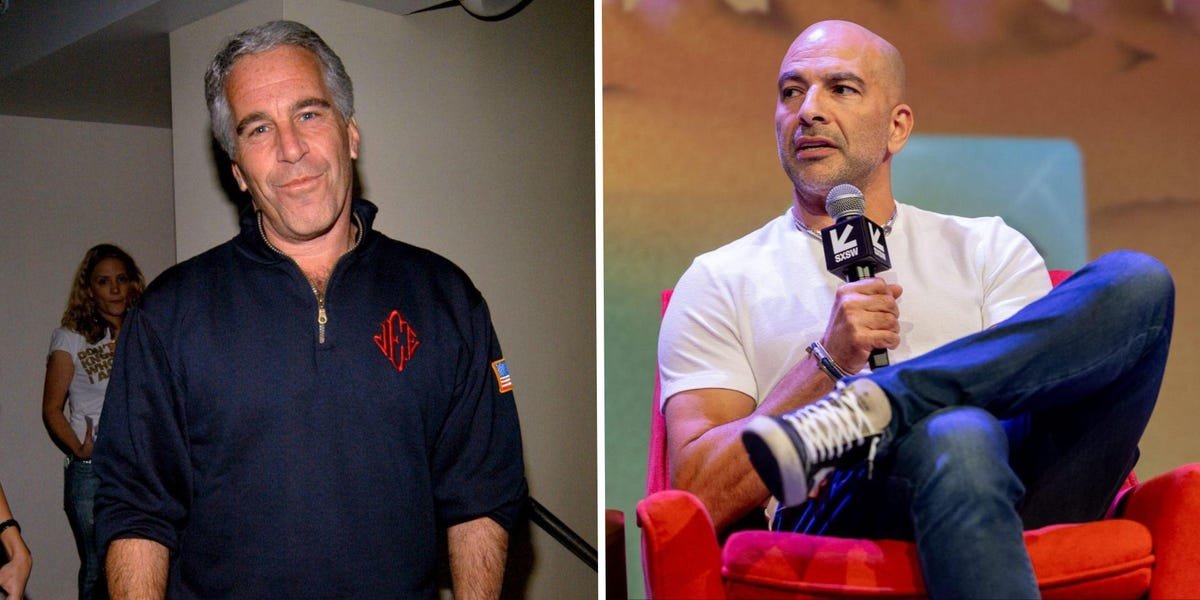
Longevity influencer Peter Attia has stepped down from his role as a CBS News contributor.
Attia’s name appears in the Epstein files over 1,700 times.
Attia also stepped down from his role at David Protein and is no longer listed as an Eight Sleep advisor.
Peter Attia, a popular longevity doctor with ties to Jeffrey Epstein, has stepped aside from his new role as a CBS News contributor, a person familiar with his decision confirmed to Business Insider.
The 52-year-old influencer, known for his podcasts and videos about living longer and his book “Outlive: The Science and Art of Longevity,” was brought on by CBS News’ top editor, Bari Weiss, in late January, along with more than a dozen other new contributors.
Days later, the latest round of the Epstein files was released. Attia appears over 1,700 times in the files, which include crude emails he sent about women’s genitalia that he later called “embarrassing, tasteless, and indefensible.”
“The man I am today, roughly ten years later, would not write them and would not associate with Epstein at all,” Attia said of his emails with the disgraced financier and convicted sex criminal.
Attia has also stepped down from his role as chief science officer at the protein bar brand David Protein and is no longer listed as an advisor at Eight Sleep.
Other famous and powerful people, including former Prince Andrew, have also faced consequences after appearing in the Epstein files.
It’d be nice to meet someone the old-fashioned way: Passing by them on the street, meeting at a restaurant, or sharing an exchange at a party.
However, apps dominate the modern dating experience, replacing kismet meet-cutes with scrolling and DMs.
222, a startup focused on relationship building with the help of AI, thinks it can bring back the spontaneity of making a new friend — or falling in love.
“We’re trying to get as close as possible to you walking into someplace with other people there, and connection just naturally happens,” CEO Keyan Kazemian told Business Insider.
At a high level, 222 matches people with strangers for experiences like dinner or a night out after they take a robust personality quiz, using machine learning models trained by its team and open-source AI models.
“When you walk in, all of those people are people we predict you’re going to be able to have a good conversation with, and you’ll like,” COO Danial Hashemi said.
222 launched its app in 2024 and has since added more features.
222/Screenshot/Apple
When 222 launched in 2021, it began as a dinner series in Los Angeles for young adults emerging from the COVID-19 pandemic, helping them meet new people. Then the project grew into a company. It was accepted into Y Combinator, raised capital, moved to New York City, and launched a mobile app to spur in-real-life (IRL) socializing.
While people who join 222 are often new to a city, Kazemian said, today they’re pretty evenly split along why they’re using the platform: they’re either looking for new friends or potential romantic connections.
Since putting out its app in 2024, the 222 experience has evolved. It’s no longer just about meeting strangers, having a fun night, and forming new relationships.
“We’re very focused on going beyond that,” Kazemian said.
The platform is now digging deeper into connecting people after the first encounter that 222 initiates. It’s helping plan follow-up hangs with friends and kindling a romantic connection by setting people up on a date if the feeling is mutual.
Simulating the meet-cute
After a 222 experience, the platform follows up to ask attendees whether they want to hang out or go on a date with anyone they met.
Once two people say they’d like to go on a date, “we fully set up the next date for them,” Hashemi said — reservation and all.
“If you think about just before dating apps, before all this stuff, how would people meet each other?” Hashemi said. “It would be you’re in the same physical space with no preconceived notions of who this person is going to be.”
Hashemi said that some of the “joy” of navigating how you feel about someone new in your life has “gone away because of dating apps.”
Meeting in a way that feels more organic, such as a social gathering or through friends, has staying power. A 2025 survey of 7,000 US adults by health company Hims found that 77% of Gen Z met their partners IRL. Even Partiful, the Gen Z replacement for Facebook Events, is getting in on the IRL event-to-dating pipeline.
At 222’s New York City office, they have a prop newspaper called “The Serendipity Times” on display.
Sydney Bradley/Business Insider
222 thinks AI can make the meet-cute more accessible.
What 222’s founding team has zeroed in on is “labeled data,” Kazemian said, which comes from its users’ feedback after they meet people.
The startup knows its first pairings may not be the ultimate match, which is why it encourages its subscribers — who pay $22 a month — to try multiple experiences. Its AI, in return, can curate better matches from 222’s network.
There are layers of factors that contribute to that, 222’s CTO Arman Roshannai said, such as similar music tastes or hometowns.
“The signal that we’re training on is after you meet this person, you spend two hours getting dinner with them, and then you hang out for a few hours afterwards, were you guys actually a good match for each other?” Roshannai added.
Kazemian added that training on this proprietary data from user feedback is a “painstakingly difficult and long process,” but gives the startup a “technical moat” to stand out from some competitors.
AI’s new role in relationships
222 isn’t the only startup — or public company — betting that AI can improve how we connect.
Several startups have launched with this premise and are raising millions, pitching matchmaking solutions that use AI to set people up. Meanwhile, Bumble, Tinder, and Facebook Dating are testing the AI waters and reimagining the swipe. Hinge’s founder recently left the Match Group-owned dating app to build an AI dating alternative.
The startup’s new office is in the buzzy NYC SoHo neighborhood.
Sydney Bradley/Business Insider
After raising another $10.1 million from venture capital investors in 2025 — bringing the startup’s total raised to $13.7 million — 222 is doubling down on hiring and expanding its product with tools that keep relationships going.
222’s next undertaking is to provide avenues for its users to reach their “next offline moment” together, so they can deepen those relationships.
The startup wants to be in the business of both creating relationships and maintaining them.
“They need to show up at the same place together,” Kazemian said, be it a hangout, a date, or a restaurant reservation. “We can help them figure out what that place is.”
The US Navy abruptly fired the commander of guided-missile destroyer USS Truxtun after his ship collided with a logistics vessel during a resupply operation at sea earlier this month.
Rear Adm. Carlos Sardiello, who leads US Naval Forces Southern Command and 4th Fleet, relieved Cmdr. James Koffi on Sunday.
The ship collision that resulted in a “loss of confidence” and cost Koffi his command occurred during a replenishment-at-sea operation involving USNS Supply, a fast combat support ship, the Navy said in a statement on the relief.
The cause of the ship collision remains under investigation but highlights the risks of at-sea logistics and the challenges of keeping naval forces on the move.
Replenishments-at-sea are resupplies in which one ship sails closely alongside another to transfer supplies such as fuel or ammunition. These missions are routine operations that support global naval activity by allowing vessels to remain at sea, rather than forcing them to return to port.
Every time Kelsey publishes a story, you’ll get an alert straight to your inbox!
Stay connected to Kelsey and get more of their work as it publishes.
At-sea replenishments carry risks, though, that can be exacerbated by a range of factors beyond proximity, such as sea state, crew fatigue, communication breakdowns, and equipment failures.
Two personnel sustained minor injuries during the February 11 collision between the Truxton and Supply.
Koffi, who took over the Truxtun just over a year ago, has been reassigned to Commander, Naval Surface Group Middle Atlantic. The Truxton, which had been deployed for under a month when the ship collision happened, is in port in Ponce, Puerto Rico. The Navy said the ship is undergoing repairs.
Cmdr. Taylor Auclair, who most recently served at US Fleet Forces Command, has been assigned to command the Truxtun.
“The Navy maintains the highest standards for leaders and holds them accountable when those standards are not met,” the Navy said in a press release.
A near-miss during a resupply in 2024 resulted in the relief of the commander of USS John S. McCain, another destroyer. And last year, the Navy relieved the captain of an aircraft carrier after it collided with a civilian merchant vessel during a deployment that experienced a string of major accidents, including the loss of three fighter jets, including one to a friendly-fire incident.
The Truxton deployed to Caribbean waters as part of President Donald Trump’s pressure campaign against Venezuela and narcotics trafficking. The administration sent nearly a dozen warships, among other combat assets, to the region late last year. The military launched strikes on suspected drug-smuggling boats, seized oil tankers, and carried out a January raid inside Venezuela that resulted in the capture of its former president, Nicolás Maduro.
More recently, roughly a dozen Navy warships have been directed to the Middle East as the administration has shifted focus to a ballooning buildup in the region. As of last week, the Truxton is now one of just five ships remaining in the Caribbean
Sam Altman is pushing back on the idea that ChatGPT consumes too much energy.
“One of the things that is always unfair in this comparison is people talk about how much energy it takes to train an AI model relative to how much it costs a human to do one inference query,” Altman told The Indian Express last week on the sidelines of a major AI summit. “But it also takes a lot of energy to train a human.”
Altman suggested it’s not an apples-to-apples comparison, arguing that it’s unfair to discount the years spent nurturing and educating someone to be capable of making their own inquiries.
“It takes a lot of energy to train a human,” he said, prompting some laughter in the crowd. “It takes, like, 20 years of life, and all of the food you eat during that time before you get smart.”
Altman said the clock really began thousands of years ago.
“It took, like, the very widespread evolution of the 100 billion people that have ever lived and learned not to get eaten by predators and learned how to, like, figure out science or whatever,” he said.
Altman also called out what he said were “totally insane” claims on the internet that OpenAI is guzzling down water to power ChatGPT.
“Water is totally fake,” Altman said, when asked about concerns AI companies use too much water. “It used to be true, we used to do evaporative cooling in data centers, but now that we don’t do that, you know, you see these like things on the internet where, ‘Don’t use ChatGPT, it’s 17 gallons of water for each query’ or whatever.”
In June, Altman said that the average ChatGPT query consumes roughly the amount of energy needed to power a lightbulb for a few minutes.
“People are often curious about how much energy a ChatGPT query uses; the average query uses about 0.34 watt-hours, about what an oven would use in a little over one second, or a high-efficiency lightbulb would use in a couple of minutes,” he wrote on X.
Altman said it is fair as a whole to point out the AI industry’s overall energy consumption because of the large growth in usage. He said it’s why he and other AI CEOs have pushed alternative energy sources like solar, wind, and nuclear.
Unlike other CEOs, namely xAI’s Elon Musk, Altman is dismissive of the idea that space-based data centers are realistic in the next decade, a concept that some companies have floated as a way to reduce energy consumption.
Outside of OpenAI, Altman is a major investor in nuclear energy. He previously served as chairman of Oklo, a nuclear energy startup, and has been a major backer of Helion, which plans to build what it calls “the world’s first fusion power plant” in Washington state.
In the US, data center energy consumption is becoming a major topic. Last month, President Donald Trump said he was working with tech companies on “a commitment to the American people” to ensure that citizens don’t pay higher energy bills because of a nearby data center.
Consulting firm McKinsey & Company estimated last year that data centers could account for 14% of total power demand in the US by 2050.