The-Enola-Gay-dropped-the-atomic-bomb-on-Hiroshima-in.jpeg

The Enola Gay dropped the atomic bomb on Hiroshima in World War II. Here’s where the plane is now.

  • Enola Gay, a B-29 bomber, dropped the “Little Boy” atomic bomb on Hiroshima on August 6, 1945.
  • The plane is on display at the National Air and Space Museum’s second, larger location in Virginia.
  • The exhibit has been the subject of controversy as interest groups have debated the plane’s legacy.

The Enola Gay, the Boeing B-29 Superfortress bomber that dropped the atomic bomb on Hiroshima in World War II, is so large that it couldn’t fit into the Smithsonian National Air and Space Museum’s flagship location on the National Mall in Washington, DC.

Instead, it’s displayed at the museum’s second location, the Steven F. Udvar-Hazy Center in Chantilly, Virginia.

The Udvar-Hazy Center features over 200 aircraft on display, but the Enola Gay remains one of the most prominent objects in its collection.

Take a closer look at the historic aircraft.

Enola Gay dropped the first-ever atomic bomb used in warfare on Hiroshima on August 6, 1945.

Enola Gay.

Photo 12/Ann Ronan Picture Library/Photo 12/Universal Images Group via Getty Images

A second “Fat Man” atomic bomb was dropped on Nagasaki on August 9, 1945, by another Boeing B-29 Superfortress named Bockscar, which is on display at the National Museum of the US Air Force in Dayton, Ohio.

The emperor of Japan announced the country’s surrender on August 15.

The plane was named after pilot Paul Tibbets’ mother, Enola Gay Tibbets.


The crew of the Enola Gay.

The crew of the Enola Gay. Paul Tibbets is second from the left.

Art Edger/NY Daily News Archive via Getty Images

Tibbets commanded the Air Force’s 509th Composite Group in charge of deploying nuclear weapons. The hand-picked squadron trained at an abandoned airfield in Windover, Utah.

The “Little Boy” atomic bomb deployed by the Enola Gay weighed 9,700 pounds.


The

The “Little Boy” atomic bomb was loaded into the Enola Gay.

PhotoQuest/Getty Images

To make the B-29 aircraft capable of carrying the atomic bomb, all of its protective and defensive armament, except for the 50-caliber tailguns, were removed to get rid of excess weight. It was also left unpainted, which saved the 850 pounds that the paint would have added.

The bomb exploded 1,900 feet above Hiroshima with devastating effects.


Hiroshima after the atomic bomb.

Hiroshima after the atomic explosion of August 1945.

Universal History Archive/Universal History Archive/Universal Images Group via Getty Images

At least 70,000 people died in the initial blast from the bombing of Hiroshima, and the death toll over five years may have exceeded 200,000 people due to the aftereffects, according to the US Department of Energy’s Office of History and Heritage Resources.

Japan and anti-nuclear weapons scientists released an updated higher estimate in the 1970s that counted 140,000 deaths at Hiroshima.

The Enola Gay was rattled by shockwaves from the explosion, even as it had already flown 11.5 miles away.

After the Enola Gay spent decades in storage, the Smithsonian began restoration work on the bomber in 1984.


The Enola Gay underwent restoration work at a Smithsonian facility.

Restoration of Enola Gay at the Paul E. Garber facility of the Smithsonian in Silver Hill, Maryland.

Ben Martin/Ben Martin/Getty Images

It took museum staff 300,000 hours to reassemble and restore the Enola Gay, with 12 truckloads transporting all of its parts.

The historical narratives around the use of the atomic bomb were fiercely debated when parts of the Enola Gay first went on display in 1995.


The fuselage of the Enola Gay on display at the National Air and Space Museum in Washington, DC, in 1995.

The fuselage of the Enola Gay on display at the National Air and Space Museum in Washington, DC, in 1995.

Jeffrey Markowitz/Sygma via Getty Images

In 1995, the fuselage and other parts of the Enola Gay were displayed at the National Air and Space Museum’s flagship location in Washington, DC, in an exhibit tied to the 50th anniversary of the bombing of Hiroshima.

The script of the exhibit was rewritten several times as various interest groups debated how it was presented and how the decision to drop the bomb was framed, according to the Smithsonian Institution Archives.

Veterans’ groups pushed for the exhibit to emphasize Japanese aggression and present the narrative that dropping the atomic bomb saved lives by ending the war. Anti-war activists opposed having the exhibit justify the use of the bomb and sought to highlight its victims by protesting with alternative exhibits on the sidewalk outside the museum.

The Enola Gay went on permanent display at the National Air and Space Museum’s Steven F. Udvar-Hazy Center in 2003.


The Enola Gay Superfortress bomber at the Smithsonian Air and Space Museum's Udvar-Hazy Center ahead of its opening in 2003.

The Enola Gay Superfortress bomber at the Smithsonian Air and Space Museum’s Udvar-Hazy Center ahead of its opening in 2003.

Mark Wilson/Getty Images

Weighing 137,500 pounds with a wingspan of 141 feet, the fully assembled plane is too large for the National Air and Space Museum’s flagship location on the National Mall in Washington, DC. The Steven F. Udvar-Hazy Center in Chantilly, Virginia, offers more room with 340,000 square feet of exhibit space.

The Udvar-Hazy Center features an elevated walkway, allowing visitors to view the plane from above as well as on the ground.


The Enola Gay viewed from an elevated platform at the National Air and Space Museum's Steven F. Udvar-Hazy Center.

The Enola Gay viewed from an elevated platform at the National Air and Space Museum’s Steven F. Udvar-Hazy Center.

Talia Lakritz/Business Insider

The Enola Gay is displayed among other aircraft from World War II, including the Northrop P-61C Black Widow, the first US aircraft designed for combat at night.

The Enola Gay stands out as one of the museum’s most historically significant aircraft.


The Enola Gay.

The Enola Gay.

Talia Lakritz/Business Insider

Over 80 years after the bombing of Hiroshima, the Enola Gay remains not just a World War II artifact, but a symbol of a turning point that ushered the world into the nuclear age.

After years of debate over how to present the aircraft, the permanent exhibition takes a minimalist approach, leaving visitors to decide how to understand its legacy.


Source link

I-took-my-first-solo-trip-to-Iceland-It-didnt.jpeg

I took my first solo trip to Iceland. It didn’t transform me, but it did wonders for my anxiety levels and confidence.

As I drove through Iceland’s dramatic landscape alone this past June, listening to Bon Iver’s “Holocene,” I started to cry.

I was crying in sheer awe at my surroundings and the lyrics of a favorite song, one about a man pondering his significance. Most of all, though, I was crying because I was proud of myself.

I had faced a fear of mine head-on, and it brought me to an emotional, yet blissful moment that I’ll never forget.

Taking my first solo trip showed me that what I perceived as a threat wasn’t really one after all — and it gave me the confidence to continue traveling alone.

After years of my anxiety holding me back, I planned a solo trip


View of waterfall on green mountains

For a long time, solo travel didn’t feel like an option.

Lily Voss


To rewind a bit, I’ve always been an anxious person, but it really manifested in my mid-20s when I started listening to true-crime podcasts.

Huge mistake. I know too much now about what horrific acts people are capable of. My mind would conjure scenarios in which something I’d just listened to could happen to me or a loved one.

This started to impact my life in different ways — if my boyfriend was on a work trip, I was scared to leave our apartment. When my mom moved into her new home, and we didn’t have an alarm system set up, I insisted I couldn’t stay the night there.

Anxiety had a tight grip on me at home, so the thought of solo traveling by myself? Absolutely not.


Lavendar field with hills in distance

As I began researching where to go, Iceland often came up.

Lily Voss


Then, last January, I found myself freshly laid off, about to turn 30 in six months, with a long list of places I wanted to travel to that year.

I’m not sure what changed in me — maybe it was hitting a milestone age — but after many internal battles, I decided I’d visit at least one of them solo.

I settled on Iceland, which is regarded as one of the safest countries in the world. This made following through on my decision a bit easier.

I also told everyone — my family, friends, even my esthetician— about my travel plans because the more people who knew, the harder it would be for me to back out.

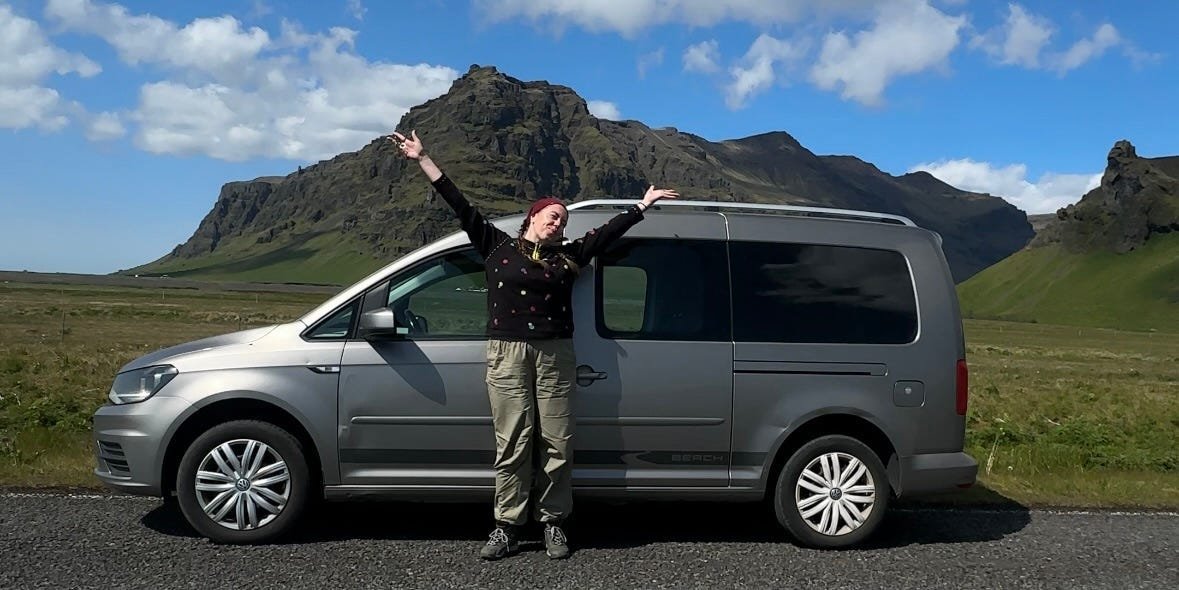
Then, I rented a campervan for three days, with a plan to explore Iceland’s Ring Road.

This trip didn’t entirely change me, but it gave me the confidence to keep solo traveling


Woman with arms up in front of car in Iceland

Seemingly small experiences on my trip helped me build confidence and overcome anxiety.

Lily Voss


No, I didn’t return from Iceland as an entirely different person, nor did I have a transformative “Eat, Pray, Love” experience that changed the fabric of who I am.

Rather, I found that seemingly small experiences on my trip helped me build confidence and overcome so much of the anxiety I’d been struggling with.

I was able to go on my first hike alone and actually enjoy myself. I drove in Iceland’s notoriously high winds solo, staying calm as they shook my van.

Even just being able to sleep (soundly, I might add) in my van at campsites — something I wouldn’t have imagined happening a few years ago — made me feel stronger.

Facing my fears head-on may have even rewired my brain a bit.

After that three-day adventure, I booked another solo trip to Annecy, France, later that summer. I’m still looking forward to going on even more adventures by myself.

Is my anxiety still there? Definitely. However, taking that trip did help me deal with it in a healthier way.

Above all, facing this fear taught me that seeing what’s on the other side of my worries might actually lead me to some of life’s best experiences.


Source link

Headshot of Jordan Pandy

My Airbnb made me $2,300 a month and was almost always booked. Nightmare guests made me quit hosting.

This as-told-to essay is based on a conversation with Wendy Martin, 50, who chose to delist the Airbnb on her property near Dayton, Ohio, after bad experiences with guests. The conversation has been edited for length and clarity.

We purchased our property from a family member who was already doing Airbnb.

The owners enjoyed it and were pretty successful at it. They made us quite a deal on the property, so we decided to go ahead and just keep it as an Airbnb.

It’s a small single-family home. It was built in 1910 as the original home on the property while the family was having the main house built.

It’s really close to the back of the main house. If I were in my home office and there were people in the living room of the Airbnb, I would be able to tell you what they looked like, so it’s a little bit awkward to be like a traditional rental.

So we thought Airbnb, with people who were here short-term coming and going, would be a really great way to give us a little bit of extra money.

It has three bedrooms, one-and-a-half bathrooms, and probably about 1,300 square feet. It has a full kitchen, washer, and dryer.

It’s located on our six-acre property, so people have full use of the trails and the woods, and we’ve got a little stream, and they can feed the fish in the koi pond.


A koi pond.

A koi pond on the property.

Courtesy of Wendy Martin


We are within 20 minutes of four or five different colleges. We’re 15 minutes to Wright-Patterson Air Force Base. We’re an hour to Columbus, Ohio, and an hour to Cincinnati — so the location is great.

We don’t get a whole lot of vacation rentals, but we get a lot of people coming to visit family or military PCSes, and a lot of college graduations and new student drop-offs and parent weekends — things like that.

From about March until the end of December every year, we’ve had almost no weekends open.

The previous owners had great success with it, and they met some great people, so we decided that we would continue doing that. We eventually re-listed it as our own after we bought the property and have been running it ever since. We’ve been hosting for about two-and-a-half years now.

Bad experiences with guests made us leave the platform

I’m taking the property off Airbnb for a few reasons.

Primarily, I was recently diagnosed with a mild form of leukemia. It’s not nearly as scary for me as it is for some people, but we don’t know when I might get sick, and at some point, I’m going to be too sick to actually run the Airbnb.

But in two-and-a-half years, we’ve had three really terrible experiences — and two of those were the same guests. This was probably the first time that it was frustrating for me to be a host.

Once, we had guests stay here for five days, and the two guys just hung out. They brought a couple of big, stinky dogs, because we allow pets with no pet fee, and they were basically just slobs. For some reason, they drove up the driveway all the way up into the yard on the grass.


A yard on an Airbnb property.

Martin’s yard.

Courtesy of Wendy Martin


They didn’t break anything or trash the house, but the house was pretty gross after they got out of there, so it took us a while to clean. A few months later, I didn’t realize the same guest who had booked before was booking the house again.

Three days before he showed up, I realized, “Oh my God, this guy again?” So that was frustrating.

Another time, a guy said he and his friends were coming to stay. They stayed for like 10 days, and they trashed our house. I mean, just filth. Food wrappers stuffed under mattresses and behind beds. They had dumped a pot of cooked food in the flower bed in the front yard. They melted a remote control.

Given the extra cleaning and the damage that they did, I filed a reimbursement request with Airbnb for $160. I sent all the documentation.


A living room.

The living room.

Courtesy of Wendy Martin


I wasn’t asking for an exorbitant amount. And then they just paid me $10 total for a remote control. I would’ve rather they sent me $0.

[Ed note: When reached for comment about Martin’s complaint, Airbnb said, “We thoroughly reviewed the photos submitted, as we do with all host damage claims, and partly reimbursed the host for the damage found. We value our hosts and do our best to support them throughout their hosting journey.”]

After that, my husband and I made the decision that maybe this isn’t going to be for us. My daughter and her girlfriend and their best friend live nice and close. They’re in their mid-20s, living in college apartments, so we agreed to let the girls come rent it.

We’ll make about half the money we would normally make, but I now no longer have to be a cleaner. I don’t have to replace all the snacks and water. I don’t have to worry about replacing linens or towels or providing shampoo or any of that other stuff.

Going forward, I’m going to rent to my daughter instead

We don’t use smart pricing — I just charged $125 a night and a $75 cleaning fee. If people stay for more than seven days or more than 15 days, then I’d give them a 10% or a 15% discount.

For a weekend stay, we’re usually clearing about $325 for a two-night stay — and that could be one person, or it could be six people because we allow up to six, and we don’t charge extra for anybody.

We’re not a tourist town, so for the people we’re serving, we’re fulfilling some kind of need for them. People do not come to Dayton, Ohio, to hang out and live their lives.

So, typically, the people that are coming here are the same people that we would have coming if it were our family, and it was important to me that we provided someplace nice that people could also afford, without it being so cheap that we were getting guests who just showed up and trashed the place.


A kitchen.

The kitchen.

Courtesy of Wendy Martin


We’ve hosted people who have unfortunately lost family members in tragic accidents, or we had one repeat guest who came because her dad was in assisted living, so she would come for the same long weekend at the beginning of every month for nine months, and she stayed with us every week or every month.

We had six bookings going into the new year already — mostly in March and April — so I reached out to each of them, explaining that I had to cancel their stays.

We’ve met some really cool people who have stayed with us multiple times, and it kind of sucks to take that option away from them.


The exterior of a home.

The front of the Airbnb property on Martin’s property.

Courtesy of Wendy Martin


Normally, we bring in about $2,300 a month on average. But we’re going to charge my daughter and her roommates about $1,300 a month — and that includes all utilities.

But they’re also going to be doing some yard work, which will save us some additional money. So I think it’ll all end up coming out in the wash because we don’t have to provide linens and snacks, and I don’t have to pay somebody to come clean.

Once I’m healthy again and they decide to move on, then likely we will go to something like Furnish Finder and do something a little more long-term where I can have a little more control over it.

Axel Springer, Insider Inc.’s parent company, is an investor in Airbnb.


Source link

How-Walmart-and-Google-became-key-to-the-search-for.jpeg

How Walmart and Google became key to the search for Nancy Guthrie

In the search for Nancy Guthrie, authorities have relied not only on traditional investigative work but also on data trails tied to two of the world’s largest companies.

Google and Walmart have both emerged as significant players in the high-profile investigation, assisting local Arizona law enforcement and the FBI as they work to locate the 84-year-old mother of “Today” show host Savannah Guthrie.

Authorities believe that Nancy Guthrie was abducted from her ranch-style home in the Catalina Foothills, just outside Tucson, AZ, nearly three weeks ago.

A major break in the case came more than a week into the elderly woman’s mysterious disappearance, thanks, in part, to the help of Google.

Initially, authorities said they were unable to retrieve any footage from Nancy Guthrie’s Google-owned Nest doorbell camera because she did not have a subscription to store her video feed.

That changed when investigators, working with “private sector partners,” managed to cover some doorbell footage from “residual data located in backend systems,” FBI Director Kash Patel said in a previous statement on X.


A

Police believe Nancy Guthrie was taken from her home on February 1.

Rebecca Noble/REUTERS


The footage, released widely to the public by the FBI on February 10, revealed a masked and armed man outside Nancy Guthrie’s home appearing to tamper with the doorbell camera on February 1, the day she vanished.

It took Google engineers several days to recover the footage, CNN has reported, citing a person familiar with the investigation. Google did not respond to Business Insider’s request for comment.

The tech giant is attempting to obtain additional video from Nancy Guthrie’s other home cameras, Pima County Sheriff Chris Nanos told NewsNation in a report published on Wednesday.

“We’ve asked Google, ‘Hey guys, can you do this?’ and they said the very same thing, ‘Sheriff, we don’t think we can get anything, but we’ll try,” Nanos said, adding that investigators remain “hopeful.

Meanwhile, authorities believe the backpack the suspect wore in the doorbell camera footage was a 25-liter “Ozark Trail Hiker” backpack sold exclusively at Walmart.

A spokeswoman for the Pima County Sheriff’s Department said this week that investigators are working with Walmart management to “identify and isolate the individual who purchased the backpack.”

In an interview with CBS News, Nanos described the backpack as “one of the most promising leads” in the case.

The sheriff said investigators have been scouring surveillance footage from local Walmart stores and that the megaretailer has turned over records of all Ozark Trail Hiker backpack purchases from the last several months, the news outlet reported.

A Walmart spokesman declined to comment on the matter.


Video image of a person of interest in Nancy Guthrie disappearance.

The FBI released this image of a suspect in the disappearance of Nancy Guthrie.

FBI


So far, the only item that has been “positively identified” on the suspect in the doorbell camera footage is the Ozark Trail Hiker packpack, a Pima County Sheriff’s Department spokeswoman said.

“Investigators are working to determine where the other items may have been purchased,” the spokeswoman said.

Nancy Guthrie’s disappearance has gripped the nation. Her famous daughter, Savannah Guthrie, has issued tearful video messages, pleading for her mother’s safe return.

Authorities have not publicly identified any suspects or persons of interest in the case.

DNA found at Nancy Guthrie’s property is being analyzed by investigators, the sheriff’s department said this week.

Earlier this week, Nanos, the sheriff, said the Guthrie family, including all siblings and spouses, has been cleared as possible suspects in the case.

“The family has been nothing but cooperative and gracious and are victims in this case,” Nanos said.


Source link

Headshot of Chris Panella.

The Army’s new drone competition is really a talent hunt. It’s scouting out what makes a top drone pilot.

The US Army used its first Best Drone Warfighter competition not just to test skills, officials say, but to identify what makes a top drone operator — and who in the force is best suited for the job.

Rather than training every soldier to fly drones, the Army is using competition to identify the skill sets of top drone operators and whether there are specific roles within units that would make the most sense for working with uncrewed aerial systems.

The effort reflects a broader shift from treating drone flying as something for all soldiers to approaching it as a specialized skill set that requires the right aptitude, training, and sustained practice.

The inaugural drone competition took place this week at the University of Alabama in Huntsville, gathering teams from across active, Reserve, and National Guard units. There were no requirements on what types of soldiers could participate or where they came from.

Rather, “it was just send your best UAS operators,” Col. Nicholas Ryan, director of Army UAS Transformation at the Aviation Center of Excellence, told reporters, prompting a mix of operators with different backgrounds and expertise.

Over three days, soldiers competed in multiple events, testing their piloting skills. The first was an obstacle course that operators navigated using first-person-view drones.


A soldier holds a drone controller.

Recent US Department of Defense directives have prioritized the development and integration of drones across the Army.

US Army photo by Spc. Michelle Lessard-Terry


The second was a hunter-killer scenario in which teams used a reconnaissance drone to survey an array of targets and decide which were highest priority for simulated strikes with one-way attack drones. The competition didn’t involve any kinetic strikes; instead, soldiers flew the drones into nets on the targets.

The third event was focused on innovation. Soldiers could build, modify, and test their own drones.

Ryan said that the Army was taking notes throughout the competition on who the top operators were, calling it talent management.

“At the end of the day,” he said, “it’s not about receiving trophies or awards,” it is about identifying what sets the top drone operators apart and figuring out how they developed those skills. The goal, he said, is to understand “what lessons can we take from this to find out who the best operator is and how they became the best operator. What skills and resources and training allowed them to become the best operator?”

Soldiers in the US and Ukraine have noticed that gamers make excellent drone pilots, as do soldiers who have experience piloting hobby drones.

“That’s something we’re absolutely looking at right now,” Ryan said.

Army leaders have previously noted a correlation between soldiers who grew up playing video games — or who are active gamers — and drone proficiency.

Troops who game have shown quick reflexes, precise hand-eye coordination, and strong spatial awareness that make them competent with drones.

At an exercise in Germany last fall, a US Army captain told Business Insider that the top pilots were soldiers who “when they got off on Fridays, then go and play video games.”

The Army has been restructuring its approach to drone warfare, rewriting its training and focusing on integrating soldiers with small drone training into front-line units. Lessons and approaches are being shared across the service, building a broader doctrine on how the Army is adopting drones.


A quadcopter drone flies on a field with trees in the background.

The competition allowed Army leadership to learn more about the skillsets and backgrounds that make drone operators successful.

US Army photo by Sgt. Aaron Troutman


Ryan said that the service is realizing that flying drones needs to be a dedicated assignment. “You can’t be a squad rifleman and a drone operator,” he said, explaining that “it’s one or the other because you have to have the level of skill and expertise in operating and employing the drones. That’s what you have to be good at and train at and focus on for most of your time.”

Other Army officials said efforts like the competition were demonstrating where drones best fit in a formation and what aspects of training are most important to maintain these highly perishable skills.

For the most part, soldiers flew their drones successfully, but the Army did take note of communication breakdowns as soldiers went through the hunter-killer lane, specifically getting drones into position and identifying and simulating strikes on targets.

“That’s an example of something we didn’t anticipate, but it’s absolutely standing out as that is something we as an Army need to do better on,” Ryan said. “If we’re going to proliferate these drones and want them to be more effective and lethal, we just need to improve on how our soldiers talk to each other to communicate when they’re using them.”

In future iterations of the Best Drone Warfighter competition, the Army hopes to include kinetic elements as well as electronic warfare and jamming to better replicate real-world scenarios.


Source link

Kelsey Baker, Military and Defense Reporting Fellow

Thousands of military families are stuck on childcare waitlists. More spots may not be enough to fix the deeper problems.

There are an estimated 7,800 children on US military childcare waitlists. Military families and advocates say the number masks deeper shortfalls that continue to sideline working spouses and strain service members.

Lawmakers raised the issue during a recent congressional hearing, calling the persistent backlog a quality-of-life problem, even as the waitlist has notably dropped from 12,000 children in 2024.

Advocates told Business Insider that the number isn’t the whole picture and excludes families who’ve given up out of frustration or can’t use base centers that lack evening, weekend, or specialized care.

“We can’t say that we are a military that cares about our families if we pretend to provide childcare and then we’ve got a waitlist that’s got 7,800 babies waiting on it,” Massachusetts Democratic Sen. Elizabeth Warren said to service senior enlisted leaders during last week’s hearing.

None of the service leaders present disputed that figure.

Master Chief Petty Officer of the Navy John Perryman acknowledged that the Navy still has roughly 1,400 children in unmet need status, while Chief Master Sergeant of the Air Force David Wolfe said his service’s waitlist stands at around 2,700, though there are efforts underway to open new spots.

It is not clear how the remaining waitlisted children are divided between other services.

In 2022, the Air Force had 95,000 children under 5 but space for only about 23,000 in its child development centers, a 2023 service report on childcare found.

An Air Force spokesperson attributed that disparity to the number of children entering and leaving care throughout the year. “The annual number served will not correlate with daily capacity and can be significantly higher,” they said.

Not all families require on-base care. But the report added that more facility construction alone would not be a “viable solution to meet all potential demand.”

Kayla Corbitt, a military spouse and the founder of a nonprofit dedicated to helping military families find reliable childcare, told Business Insider that many families lose hope amid long waits. Staying on the waitlist, she said, requires logging on every couple of months to reconfirm before families are automatically disenrolled.

And for some families, the barriers extend beyond backlogs.


A room at the CDC at Ramstein Air Base, Germany, Jan. 14, 2026.

A room at the CDC at Ramstein Air Base, Germany.


Airman Paden Henry/US Air Force


“Anyone needing evening care, weekend care, shift work care, which is a lot of the military, they aren’t going to try to get on that waitlist,” Corbitt said, explaining that most child development centers, or CDCs, on bases don’t offer late evening or very early morning care needed for troops on 24-hour duty or for deployed service members with spouses who work unusual hours.

Additionally, children with special needs face significant obstacles in finding care, Corbitt said, as many CDCs are not equipped to provide care, and the policies sometimes vary from facility to facility, making it hard for families to know what to expect when they move.

Brigit Schneider, an Air Force spouse and mother of three children, wants to return to work as a financial planner to better support her family, but because her local childcare center won’t accept children with feeding tubes, one of her young children is shut out.

“From a special needs mom perspective, it’s an extra layer of challenge,” she told Business Insider.

Schneider pays nearly $1,000 a month for one child to receive on-base childcare, another child is receiving private care due to the severity of their disability, and a third is at home. Schneider says the third should be able to receive base care.

“A G-tube really is not a hard medical device to learn how to use,” she said.

Generally, though, military CDCs won’t accept children with gastrostomy tubes. Facilities are often unable, or unwilling, to provide higher levels of care, Corbitt said.

Air Force childcare programs are “supported by a multidisciplinary team of experts who provide consultation and support to ensure the highest quality of inclusive care,” an Air Force spokesperson told Business Insider following a query regarding the service’s childcare.

The service “offers a network of on- and off-installation care options and works closely with families to identify the appropriate setting for their child,” said the spokesperson, adding that waitlist data helps inform future allocation requirements.

Staffing shortages are another obstacle to reliable access for military personnel. Military childcare workers face unusually high attrition rates, around 50%, Warren said at last week’s congressional hearing, driven largely by meager pay.

Compounding the issue is the lack of a clear pathway that would allow qualified providers to move easily between states.

Nearly 40% of childcare workers are military spouses, said the Marine Corps’ top enlisted leader, Sergeant Major Carlos Ruiz, during the hearing. “If we can just be a little bit more smart about transferring folks and directly hiring from one CDC to another, we can reduce the attrition,” he said.

Government watchdogs have repeatedly flagged childcare accessibility as a point of concern for the US military. A 2024 Government Accountability Office report found that while the services focus heavily on recruiting new childcare workers, they do not consistently measure whether employee retention efforts are effective.

The military’s childcare shortages aren’t unique to the armed forces. Many Americans in the civilian world struggle to find reliable, reasonably priced childcare.

Often, a year of childcare amounts to an entire average salary, costing tens of thousands of dollars. The cost of childcare in the US has increased by over 150% over the last quarter-century and continues to climb, often outpacing inflation. In some areas, childcare costs can exceed rent or mortgage payments.


Source link

A-26-year-old-built-a-260000-ADU-on-her-familys-property.jpeg

A 26-year-old built a $260,000 ADU on her family’s property. Now, she lives in the 748-square-foot space with her sister.

Corippo’s parents had purchased a small piece of land near the national park in California when real estate prices were low, unsure what to do with it.

When they started toying with the idea of building a cabin on the land, Corippo, her brother, and her sister decided to pool their resources and invest in the build with her parents.

“When we were little, my parents invested in Apple stock, which they bought for nothing,” Corippo said. “We used those Apple stocks in our savings to invest in this first home.”

The 650-square-foot house became a family project. It had one bedroom, a separate lofted sleeping area, and one bathroom. Corippo and her father told Business Insider the build cost around $300,000, which included creating a well, septic tank, and driveway on the property. Corippo moved into the finished space in 2024.

“It was definitely a family collaboration of making it somewhere I could live, but also something that would be an investment once I moved out,” Corippo said.


Source link

Julia Pugachevsky's face on a gray background.

More people want open relationships, but here’s why many don’t last

Open relationships have gotten a cultural glow-up among younger adults. In practice, though, they’re hard to pull off.

There’s a lot of social media chatter where people in happy non-monogamous relationships report perks such as greater sexual satisfaction, multiple deep partnerships, and less restrictive love lives.

Still, outside the tweets, threads, and curated Instagram grids, the story is a bit more nuanced. A 2023 Pew Research report found that Americans are divided on open marriages. Of about 5,000 US adults surveyed, 37% found open marriages completely unacceptable. Younger generations approved more than anyone else: roughly half of 18- to 29-year-olds were accepting of open marriages.

Dr. Justin R. Garcia, the executive director of the Kinsey Institute, has also witnessed the growing popularity of non-monogamy in his work.

“People were talking about swinging in the 60s and 70s, but the language and the amount of attention to it changed, particularly over the last decade,” Garcia told Business Insider, citing Amy C. Moors, a sexuality scientist who noticed a steady increase in people searching for terms related to polyamory between 2006 and 2015.

However, showing interest and actually engaging in the activity are two different things. In his new book, “The Intimate Animal,” Garcia said that research from his lab at the Kinsey Institute, one of the most prominent research centers for human sexuality and relationships, found that one in five single adults in the US, out of about 8,700 studied, have had some kind of consensual, non-monogamous relationship at some point in their lives.


Hands holding

Studies suggest that more people have tried non-monogamy than have maintained it long-term.

Vershinin/Getty Images


When looking at the past five years in another study of Garcia’s, however, that number dropped significantly, suggesting that “more people try it than decide that it is a lifelong relationship structure for them,” Garcia said. “In my social networks, that’s been my experience as well.”

It doesn’t mean that they never work, he added. According to multiple studies, “while consensually open relationships might not work for everyone, or even for most people, there are many people for whom they do work perfectly well,” he wrote in his book. Those in happy non-monogamous relationships, for example, don’t fare psychologically or emotionally worse than content monogamous couples.

“In terms of who’s a good candidate for it? My cheeky answer, but it’s actually true, is those people who really want to do it,” Garcia said. “It’s similar to ‘What’s the right amount of sex that we should be having?’ It’s as much as you want.”

Still, that doesn’t mean open relationships work for everyone. Based on his research, Garcia shared the most common reasons non-monogamous partnerships don’t work out.

It takes work to balance partners


Three people hugging

Devoting enough time to your partners can be challenging.

FG Trade/Getty Images


One of the most common challenges to non-monogamous partnerships might be our own biology.

“We have such a fundamental, evolved drive to form intense pair bonds,” Garcia said, ones that biologists theorize helped us thrive as a species over time. In his book, he said that “our brains don’t appear particularly well-suited to processing intimacy with more than one partner at a time,” be it another romantic partner or a sexual fling. Even fantasies of threesomes, Garcia said, more often involve an existing partner.

If romance is most often defined by sustained attention and effort, then it becomes more difficult when one or both partners have other people to focus on. Introducing a new partner into a shared home can cause friction with a spouse, as can skipping dinner with a spouse to spend it with another significant other.

Garcia said one of the “prevailing rationales” for consensual non-monogamy is having “too much love to give.” However, he wrote, the opposite is true: “Most people don’t have the biological, psychological, and social tools to love more than one person at a time.”

Extra communication can be a turn-off


Couple holding hands

Healthy non-monogamous relationships require extra communication, which some people find off-putting.

Tom Werner/Getty Images


In his research, Garcia said the happiest non-monogamous couples have the same thing in common: “They tend to engage in a lot of communication.”

One 20-person polycule, for instance, uses a software engineer strategy called “agile scrum” to resolve any relationship issues. It involves monthly reviews, discussion questions, and action points.

“Even casual polyamorous encounters take substantial effort and negotiation,” Garcia wrote, including lots of communication. “Who needs more touch? Less? Who is feeling neglected? Who needs more time with whom? What is the state of things between each member of the polycule and each of the others?”

Some people find that level of frequent, in-depth communication builds their intimacy and brings them closer. Still, for many people, it’s just too much work.

It can magnify issues instead of fixing them


Couple hugging

Non-monogamy can heighten existing issues like jealousy and mismatched libidos.

gorodenkoff/Getty Images


In any healthy relationship, Garcia said there’s a basic framework you have to follow: “There’s me, there’s you, and there’s us.” What might make one person happier, like having more romantic partners, might make the other feel neglected.

For a non-monogamous relationship to work, “you want to be able to both navigate your feelings of jealousy,” Garcia said. Furthermore, he added, it helps if you actively enjoy knowing that your partner is with others.

The last reason you should be in a polyamorous or open relationship is because you want it to “fix” your current relationship. Often, he wrote, “the same issues that plague monogamous relationships — mismatched libidos, jealousy, boredom, and more — tend to surface in consensually non-monogamous ones.” In fact, he added, they can multiply when partners aren’t communicating or devoting enough time to each other.

“As one of my friends who had attempted to form a polycule once told me, ‘It didn’t work,'” Garcia wrote. “‘I just pissed off two women instead of one.'”


Source link

blank journal

I hosted a $30 vision workshop to reset my life and career. Here’s how I did it in 3 steps.


Seng Kui Lim / Getty Images

The Year of the Fire Horse

A dozen or so friends clamoured around my fireplace’s mantel to grab their Dollar Store-bought journals and select a fancy gel pen. A ChatGPT-designed workshop on creating a 2026 vision for one’s life was about to begin, and two of my friends were fighting over who would get the last brown leather-bound journal.

It was a little before Lunar New Year, a holiday rooted in honoring the past while setting intentions for the future. And this year, instead of enjoying fireworks and celebrations, I hosted something much quieter. I invited my circle into my home to answer several journal prompts around career, love, fitness, and finances.

For me, January 1 comes with too much pressure; you may remember me writing about my intentionally slow start to the New Year. Lunar New Year, however, gifted me a second chance at intention. And what resulted around my dining room table was the perfect anecdote to help me game-plan my goals. By the end of the party, we walked away with clarity and focus, and identified the gaps standing in our way.

If you want to recreate this moment, here are three tips to create an atmosphere designed for reflection.

  1. First things first, here was my prompt into ChatGPT: What are some good prompts for self-reflection? I want to create a vision workshop that sets goals on faith, finances, work, love, family, and life. Can you create the interactive workshop?
  1. Then, we laid ground rules: Yes, I encouraged my friends to share the goals they had scribbled down, but I also encouraged them to keep some answers close to the vest, as some goals thrive in incubation.
  2. Lastly, I prioritized making my friends feel comfortable. There were candles lit everywhere, a basket of cheap yet cozy socks so they could kick their shoes off and relax, and don’t forget the fancy gel pens to make the journaling experience feel whimsical.

I still don’t know what 2026 will bring, but instead of creating rushed, vague resolutions, at least I had a moment to be reminded that life moves in cycles, and ambition requires vision.


Source link