Katie Notopoulos

I found the next hot toy trend: It’s the highland cow.

I’m calling it: If you haven’t already, you’re going to start seeing highland cows in toy aisles around the country.

After visiting one of the industry’s largest fairs earlier this week, I think I’m qualified to say: The shaggy cow is taking over as the hot new animal for plush toys.

If you’ve been paying attention to toys — or if you have kids — you probably already know capybaras are big, but they’ve been the hot thing for more than a year now. Same with axolotls, the eerily cute pink salamanders. Those trends are peaking, though.

Stuffed animals seem to go in trend cycles. In the mid-2010s, llamas and owls were all over baby and kids’ clothes and toys. Before that, hedgehogs and foxes.

Not everyone I talked to at the Toy Fair, the toy industry convention held in New York over Presidents Day weekend, agreed with my assessment. I got a few other surprising predictions:

pigeons.

frogs.

squirrels.

woolly mammoths.

But enough people I asked said the same thing — that the trending animal is the highland cow, with its caramel fur and tawny mop of hair — that I feel I can say there’s a modest consensus.


two plush animals one pig and one cow

The brown highland cow appeared all over Toy Fair.

Katie Notopoulos / Business Insider


Like I said, not everyone agreed on the cow. But there was agreement, among everyone I talked to, about three things casting a long shadow over the toy business: tariffs, TikTok, and Labubus.

I chatted with several small to midsize toy companies who said that the tariffs that began when President Donald Trump declared “Liberation Day” have hurt their businesses. One plush toy maker said they’re paying $10,000 extra per container in tariff charges for their high-end plush animals made in the Philippines. They haven’t raised prices yet, and the new fees just eat into their profit. Another plush maker said that they raised prices once after tariffs, but are trying to avoid another hike.

Toy makers’ ears must’ve been burning when Trump made comments about how perhaps kids could learn to live with just a few dolls instead of many. But Trump was right about something — kids do often have more toys now than they did 30 years ago because toys are, in fact, cheaper than ever.

The rate of inflation for toys is well below the national average for all things, meaning a Barbie or Hot Wheel costs relatively less today than it did back in 1995. (If you’re a parent looking at a mess of toys spilling out of boxes and shelves, you’re not alone.) Part of the reason toys have gotten cheaper is overseas manufacturing, which the tariffs are now hitting.

The big toy brands like Barbie, Lego, and Pokémon all had new items to debut at the fair. Among the smaller toy brands, a few trends emerged — blind boxes were huge, and many brands and distributors had cute figurines packaged in blind boxes or adopted the aesthetic of twee characters sold alongside Labubus at the Hong Kong-based retailer Pop Mart.

Still, no one seemed to think there was a clear heir apparent to Labubus, which were a singular meteoric event in the toy world (yes, there have been viral toys before, like Beanie Babies or Tickle-Me-Elmos, but the rapid internet and celebrity-fueled Labubu phenomenon feels unique).


Tokidoki toys

Tokodoki dolls are similar but different from Labubus.

Katie Notopoulos / Business Insider


“Labubu is such a great example of something from nothing, but really built on the foundation of everything. Blind boxes have been massive. Plush has been massive. It was the amalgamation of a ton of the listening, and it then getting discovered,” said Eric Morse, VP of new business initiatives at Spirit Halloween said during a panel talk about Gen Alpha trends.

Morse went on to explain they used a similar strategy for rushing out “K-Pop Demon Hunters” costumes this October after the surprise hit debuted on Netflix over the summer. (Of course, even though they pushed through a licensed costume at a far faster speed than normal, they still sold out well before Halloween, much to the ire of 8-year-olds everywhere.) “How we view the business is listen first, execute second,” Morse said.

When toy and candy trends happen rapidly on TikTok, it can be hard to predict surges in demand. And with on-again, off-again tariffs, it’s even harder to plan, lots of industry insiders told me. That’s something I kept hearing from all the vendors I talked with: uncertainty.

But one thing I feel confident about is highland cows. You heard it here first, folks.



Source link

Headshot of Ben Shimkus

Elon Musk and OpenAI posture over pizza as the AI talent war heats up

The rivalry between xAI and OpenAI is heating up again — this time, over wood-fired pizza.

Over the weekend, Elon Musk and an OpenAI engineer jockeyed on X about wood-fired crusts, dough fermentation, and campus chefs.

On its face, it was a lighthearted back-and-forth about free pizza for lunch. Underneath, it encapsulates a trend playing out in Silicon Valley: rival AI companies are publicly pitching culture — and perks like free lunch — in the talent war for top engineers.

The exchange began when Musk reposted a video of an xAI engineer calling his job the “opportunity of a lifetime.”

“Join @xAI,” Musk wrote.

The post quickly drew a response from xAI’s competitor, OpenAI.

“Or join Codex,” said Thibault Sottiaux, an engineering lead working on OpenAI’s Codex software agent, who is also hiring. OpenAI operates “with much of the same principles,” he wrote — before adding an increasingly common recruitment pitch.

“Join the bright side, we have pizza,” Sottiaux wrote.

Musk fired back: “But how good is your wood oven pizza?”

The pizza posturing then shifted to ingredients — and the corporate chefs preparing them.

“But how about the dough?” he wrote back. “Can’t take shortcuts, needs 24 hours at least. And our chef is 🔥.”

“Our chef is so good that God looked down at the food from heaven and said you my most delicious creation,” Musk replied.

“And after having a bite, he wasn’t 100% satisfied and asked our chef to improve upon the SoTA,” Sottiaux said. “Our chef delivered, and created a recipe now universally credited to accelerating the AGI timeline.”

The very real fight behind the pizza posts

The tomato pie-based banter was sweet — but the subtext was spicier.

AI labs are locked in a high-stakes dash for elite engineers, with high-end compensation packages stretching into the nine-figure territory.

Companies including Amazon, Microsoft, Meta, OpenAI, and Musk’s xAI are competing for a relatively small pool of researchers capable of building the next generation of models and infrastructure.

Aside from money, two key perks have emerged in the AI talent wars, according to professional AI poacher Mark Zuckerberg: access to GPUs and fewer direct reports.

“People say, ‘I want the fewest number of people reporting to me and the most GPUs,'” Zuckerberg said in 2025 TITV interview.

At the same time, the broader tech industry has pulled back on many of the pre-pandemic perks amid cost-cutting. Remote work has narrowed, layoffs have gathered steam, and perks like pet care stipends and expansive wellness benefits are becoming less common for new hires.

But there’s one perk that has remained: the fancy lunch spread.

Might as well throw in wood-fired pizza, too.


Source link

Headshot of Ben Shimkus

‘The Late Show’ host Stephen Colbert says CBS pulled his interview with a Democratic lawmaker — so he turned to YouTube

Stephen Colbert said CBS pulled a Democratic lawmaker’s interview from “The Late Show” over concerns about federal regulations. So, he posted it on YouTube instead.

The dispute marks the latest flash point in a growing tension between late-night hosts, broadcast networks, and the Federal Communications Commission.

James Talarico, a Democratic Texas state representative running for a highly competitive US Senate seat, was scheduled to appear on “The Late Show” on Monday night.

Colbert told viewers during his monologue that network lawyers intervened.

“He was supposed to be here,” Colbert said Monday night. “But we were told in no uncertain terms by our network’s lawyers, who called us directly, that we could not have him on the broadcast.”

Colbert said he was also told not to acknowledge the decision on air.

“Then I was told, in some uncertain terms, that not only could I not have him on, I could not mention me not having him on,” he said. “And because my network clearly doesn’t want us to talk about this, let’s talk about this.”

CBS said in a statement that it did not prohibit “The Late Show” from broadcasting the interview. It said it gave the show legal guidance.

While CBS didn’t air the interview on TV, the show uploaded it overnight to its YouTube page. By midday Tuesday, the video had racked up more than 2 million views — significantly more than other recent guest interviews, which had largely drawn between about 75,000 and 510,000 views on YouTube.

The last guest to surpass 1 million views was Bad Bunny, who appeared on “The Late Show” ahead of his Super Bowl halftime performance.

A spotlight on the FCC’s ‘equal time’ rule


Jimmy Kimmel is standing on stage in a black suit with a black tie. He is in front of a navy blue drape.

Jimmy Kimmel was briefly suspended after FCC chair Brendan Carr called out the comedian’s political jokes.

: Todd Owyoung/NBC/NBCU Photo Bank via Getty Images


Colbert said the network’s concerns stemmed from the FCC’s so-called “equal time” rule, which requires broadcast stations to provide equivalent opportunities to legally qualified political candidates.

“It’s the FCC’s most time-honored rule, right after ‘No nipples at the Super Bowl,'” Colbert said on Monday night’s television-aired monologue.

The rule applies to over-the-air television and radio broadcasters, but not to cable channels or online platforms — meaning CBS’s broadcast would fall under its purview, while YouTube would not.

He said most late-night talk shows — including his own — typically qualify for what’s known as the “bona fide news exemption.”

That carve-out is designed to give news and public affairs programs flexibility to respond to events without having to book opposing candidates for balance.

Colbert has hosted several Democratic and independent lawmakers this year, including Pennsylvania Gov. Josh Shapiro, Virginia Gov. Abigail Spanberger, and Sen. Bernie Sanders of Vermont.

In recent months, the FCC has stepped up scrutiny of broadcast networks.

On January 21, the FCC’s Media Bureau published a letter that said it had “not been presented with any evidence” that any current late-night or daytime talk show qualifies for the “bona fide news exemption.”

Colbert said that the letter is part of what worried CBS’s lawyers.

CBS said in its statement that, “The show was provided legal guidance that the broadcast could trigger the FCC equal-time rule for two other candidates, including Rep. Jasmine Crockett, and presented options for how the equal time for other candidates could be fulfilled.” It said the show decided to publish the interview through its YouTube channel instead.

Last week, the FCC opened a probe into Disney-owned ABC after “The View” hosted Talarico.

In the YouTube interview, Talarico said the regulatory scrutiny was politically motivated.

“I think that Donald Trump is worried that we’re about to flip Texas,” Talarico told Colbert. “This is the party that ran against cancel culture, and now they’re trying to control what we watch, what we say, what we read.”

Talarico is locked in a competitive Democratic primary for the Senate seat against Rep. Jasmine Crockett. The winner is expected to face a Republican nominee that could include incumbent Sen. John Cornyn, former Texas Attorney General Ken Paxton, or Rep. Wesley Hunt.

The open Senate seat is set to be decided during this year’s mid-term elections.

A broader strain between CBS and its staff

Monday’s standoff adds to an already complicated period for Colbert and his network.

In July, CBS said “The Late Show” would be canceled in May 2026, a move that was “purely a financial decision against a challenging backdrop in late night.”

It came after Colbert criticized CBS’s decision to settle a $16 million class-action lawsuit filed by President Donald Trump over its editing of a “60 Minutes” interview with his then-presidential opponent, Kamala Harris.

Some lawmakers raised concerns about CBS’s decision, questioning whether it was political.

CBS is owned by Paramount, which was acquired in August by David Ellison’s Skydance Media.

The network has faced other turbulence in recent months. Recently installed CBS News editor in chief Bari Weiss was criticized for her December decision to delay a “60 Minutes” segment on the Trump administration’s use of jails in El Salvador. And, on Monday night, Anderson Cooper said he would be leaving “60 Minutes” after 20 years on the show.

The FCC and representatives for Colbert did not immediately respond to requests for comment from Business Insider.


Source link

I-used-to-save-nice-things-for-special-occasions-Now.jpeg

I used to save nice things for special occasions. Now I wear them to the grocery store.

I used to save my favorite clothes for a version of my life that never showed up.

The blazer stayed in my closet because it felt “too professional” for a normal day. The heels were waiting for a dinner I’d yet to be invited to. The earrings were longing for an occasion that felt important enough to justify wearing them. Meanwhile, I wore the same outfits on repeat — to work, to run errands, to all the places where my actual life was happening.

I wasn’t saving them for a rainy day. I was saving them for the perfect one. The problem was that “special occasion” never came.

It wasn’t just about clothes

This habit wasn’t limited to clothes. I treated everything the same way. A Sephora gift card sat untouched in my drawer, waiting for something “really worth it.” I rationed my favorite lip gloss as if it were a limited resource. I refused to light my favorite candle unless the night felt special enough to deserve it. I even held onto the last spritz of my discontinued One Direction perfume for years, as if saving it could somehow make more.


Woman posing for selfie

The author started to feel like she was saving her life for later.

Courtesy of the author


The special occasion is always vague — an imaginary fancy dinner, a future milestone, a celebration that exists only in theory. So I wait. Years pass. The things I loved enough to save start to feel untouchable. By the time I consider using it, we’ve waited so long that it feels wrong to start now.

Looking back, it sounds dramatic, but at the time, it felt practical. Why waste something nice on an ordinary day?

Then one day, the thought hit me: why am I living my life like a waiting room?

It felt like I was saving my life for later

That mindset didn’t stop at my closet. Saving a jacket for the right moment slowly turned into saving fun for the weekends, saving joy for later, saving happiness for a version of life that felt more legitimate than the one I was already living.

I realized I was treating weekdays like something to get through instead of something to participate in. When I did the math on how many days I was mentally skipping, it felt less like discipline and more like quietly wasting my life away.

So I stopped waiting.

I started wearing my favorite pieces on regular days

The shift was small at first. I wore blazers to the bars. I strutted in my nice heels to run errands. I put on the earrings just to go to the grocery store. Not for compliments, not for Instagram, not to prove anything to anyone, but because I liked how it made me feel.

The clothes didn’t lose their value because I wore them. They gained it. Each piece started collecting moments and memories instead of dust. Now, when I reach for something I love, it reminds me of a workday that felt a little lighter or a Trader Joe’s run where I found my new favorite snack.


Woman shopping

The author says clothes are meant to be worn more than once.

Courtesy of the author


That’s the part people tend to dismiss as “romanticizing your life,” a phrase that’s been flattened into internet fluff. But this wasn’t about pretending my errands were glamorous or turning my Mondays into Fridays. It was about presence. About intention. About letting regular days count instead of treating them like placeholders.

If I’m being honest, it changed more than my outfits. Work felt less like something I had to endure. Errands felt less like chores. I stopped waiting for permission to enjoy my life. I started dressing for myself instead of an imaginary audience or a hypothetical future. I even started liking Mondays.

I realized the dinner counts. The errand counts. The workday counts. And if the opportunity does truly come? I’ll wear those pieces again. Clothes are meant to be worn more than once.

The special occasion didn’t disappear. I just stopped waiting for it to arrive.


Source link

NBCUniversal-is-suing-Group-Black-alleging-breach-of-contract-and.jpeg

NBCUniversal is suing Group Black, alleging breach of contract and seeking nearly $36 million

Comcast’s NBCUniversal has sued Group Black, a firm created to direct ad dollars to Black-owned and Black-led media, alleging it owes the media giant $35.8 million in unpaid invoices and guaranteed payments.

The suit, filed February 11 in New York Supreme Court, stems from a partnership that gave Group Black exclusive rights to sell ads in Black-led shows on NBCU’s streamer, Peacock, with Group Black and NBCU sharing the revenue.

“We dispute the claims made by NBCUniversal and intend to respond through the appropriate legal process,” Group Black said in a statement. “Group Black remains focused on its mission and serving its partners.”

NBCU has said that more than 30 brands signed on to the partnership in its first year, which began in September 2023. Group Black had predicted that NBCU would be its largest source of revenue in 2024, according to a board document dated November of that year, which was submitted in a separate court case.

NBCU’s lawsuit alleged that Group Black failed to fulfill the terms of the contract in the months after it began in September 2023, despite selling more than $30 million worth of advertising.

The suit alleged that in 2024, Group Black agreed ​​to shift its revenue share to zero to pay down the shortfall. NBCU says in the lawsuit that it repeatedly demanded payment, and that Group Black cofounder Bonin Bough had acknowledged the company’s liability multiple times, emailing at one point that he took it “very seriously.”

The partnership ended in September 2025.

Group Black has faced internal and market challenges

Group Black was launched in 2021 after the George Floyd protests that led to a national reckoning and prompted big advertisers like Coca-Cola and Walmart to increase their spending on Black-owned media. In the years that followed, the company faced a mix of internal struggles, executive departures, and broader market challenges. It pivoted last summer to focus on a wider audience with the launch of a new venture, Portrait Media Group.

Group Black has faced other legal action alleging nonpayment. Two companies owned by Essence Ventures, part of a venture led by a second Group Black cofounder, Richelieu Dennis, sued Group Black in 2024, alleging it owed them about $20 million. Group Black said in a court filing that Essence loaned it money but otherwise denied the allegations in the suit. The suit is ongoing.

In another case, Audiomob, an ad agency that provided mobile app advertising inventory for Group Black to sell to its clients, demanded about $181,000 from Group Black for invoices it alleged the company had failed to pay. The suit was terminated in August after Audiomob sought dismissal, saying Group Black had made a “partial payment” of the money owed, per court filings.


Source link

Armed-with-longer-range-missiles-a-top-Russian-fighter-jet-is.jpeg

Armed with longer-range missiles, a top Russian fighter jet is posing a bigger threat, analyst says

Russia’s Su-35 fighter jets are increasingly flying with longer-range air-to-air missiles that make them a potentially greater threat to NATO air operations, a leading airpower expert assessed in a recent report.

Justin Bronk, a researcher at the UK-based Royal United Services Institute, said in his assessment of Russian air power that regularly arming Su-35 and Su-30SM2 jets with R-37M missiles “has significantly contributed to increasing the threat that they can theoretically pose to NATO air operations.”

The R-37M missile, which NATO calls the RS-AA-13, is “much more capable at long range” than the R-77-1 missiles the Su-35 had previously relied on, Bronk told Business Insider in a discussion of his recent report.

R-77-1 missiles have a range of about 62 miles, while R-37M missiles are understood to have a range of around 200 miles. Real-world kills at range depend on a mix of factors, but reach still matters.

Bronk told Business Insider that the longer-range R-37M missiles had been “very much a specialist weapon” for a limited selection of Russian jets. But “now you see absolutely routine employment” of the weapon on Russia’s Su-35S.

The Su-35 fighter is “the primary air superiority aircraft for the Russians,” he added. The jet is key for Russia’s air force, with the UK Ministry of Defence in 2023 describing it as Russia’s “most advanced combat jet in widespread service.”

Bronk told Business Insider that for the NATO alliance, the regular arming of Su-35s and Su-30SM2s with the R-37M is “a problem” because it puts “more credible long-range air-to-air missiles at play from the Russian side.”

Those missiles used to be contained within a smaller part of the force, mainly Russia’s MiG-31s. Now, Bronk said, having them on more jets “is obviously a significant growth in the potential threat that they can pose to NATO aircraft in a direct conflict.”


A grey fighter jet in a light blue sky with fire visable in its two engines

The R-37M was previously concentrated on Russia’s MiG-31 jets.

Mikhail Svetlov/Getty Images


Additionally, he said, Russia’s Su-35 crews are “generally more highly selected, better trained, more capable than the crews on the MiG-31s.” Russia’s better pilots tend to fly its top jets, and those will be the pilots operating these missiles.

Having them routinely carry long-range air-to-air missiles, rather than the “really pretty limited” R77-1 that they used to carry, Bronk said, “is a significant shift.”

A missile with a longer reach

The R-37M’s combat effectiveness has been spotlighted by Russia’s full-scale invasion of Ukraine, which began in February 2022.

Late that year, a RUSI report said the R-37M, combined with Russia’s MiG-31BM interceptor aircraft, was proving to be “highly effective and difficult for Ukrainian pilots to evade due to its speed, very long range, and specialized seeker for low-altitude targets.”

At that time, it said Russia was just starting to put them on Su-35S jets.

A newer report from RUSI in November highlighted how much more the R-37M missile was being used, saying that this missile “in particular, has been used to destroy several Ukrainian aircraft at long range,” including one kill recorded at more than 109 miles.

“This is significantly beyond the engagement range of most NATO air-to-air munitions,” the report said. But it also said that the missiles’ success was “heavily determined by Ukraine’s lack of effective radar warning receivers,” something NATO has fielded far more robustly across its air forces.

The Su-35 threat

Making the Su-35 more powerful is a big move for Russia. In 2022, analysts at the RAND Corporation described the Su-35 as Russia’s “signature heavy fighter.”

Ukraine has shot down multiple Su-35s in its fight against Russia’s invasion, but Bronk said that despite reported losses, the fleet has “marginally increased since the start of the full-scale war.”

He estimated that in late 2020, Russia had about 90 Su-35s. Between eight and 10 have been lost in combat or accidents, he said, but 55 to 60 new aircraft have since been delivered — leaving Russia with roughly 135 to 140 Su-35s overall, a net increase despite the attrition.

Bronk’s analysis was based on interviews with Western air forces and ministries, data from Ukraine’s armed forces, and open-source information.

He said that the Russian air force has gained so much valuable combat experience against Ukraine that its air force is now “a significantly more capable potential threat for Western air forces than it was in 2022.”

He said that in air-to-air combat, where Russian aircraft take on Western ones, the West still has a strong advantage, but longer-range air-to-air missiles complicate the picture.

And any fight would not only be in the air. The West would face not only Russia’s air force but also its vast ground-based air defense network, which the war has also made more formidable.

Bronk told Business Insider that Su-35 crews are typically “much better at working with the ground-based air defenses,” meaning the jets can operate more effectively under the umbrella of Russian surface-to-air missile systems and are therefore “more credible as an air-to-air threat.”

He said that the improvement of those ground-based defenses throughout the war — combined with the fielding of more powerful missiles on Su-35s that are increasingly integrated with them — is one reason why Russian airpower “represents a greater threat to Western air power capabilities in Europe” than it did before the full-scale invasion.


Source link

A headshot of Insider's Pete Syme

Canadian airlines are pulling back from flights to the US, with one leaving the country entirely

Canadians are pulling back from visiting the US — and airlines are paying attention.

Montreal-based Air Transat will no longer fly to the US this summer, with its last flight across the border operating in early June.

In March last year, it operated nine routes to and from the US, but that number had dropped to three as of early 2026.

At the moment, Air Transat flies from Montreal to Orlando and to Fort Lauderdale, and from Quebec City to Fort Lauderdale.

Air Transat, which focuses on vacation travel, was named the world’s best leisure airline by Skytrax for the third year in a row in 2025.

An airline spokesperson told Business Insider that its presence in the US “remains very marginal today,” with only two of its 67 destinations in the US.

“This adjustment is part of a proactive management of our capacity, as we focus our efforts on markets where Air Transat is best positioned and that allow us to optimize the deployment of our resources,” they said.

The spokesperson added that its winter schedule “will be determined at a later date.”

WestJet, Canada’s second-biggest airline, is also slashing flights across the border for this summer.

It’s suspending 16 routes, including big city pairings like Boston to Vancouver and Los Angeles to Toronto.

The airline has reduced its “full-year transborder flying by close to 10%,” a spokesperson told Business Insider.

“We saw a notable decline in transborder travel demand throughout 2025,” they said.

“As such, WestJet has redeployed its fleet by increasing capacity on routes Canadians want to fly.”

Canadians’ travel demand has sunk since President Donald Trump took power early last year.

Last month, capacity was down 10% on flights from Canada to the US compared to a year earlier, according to data from Cirium, an aviation analytics firm.

Canadian residents made 1.6 million return trips from the US last month, down 24.3% from a year earlier, according to Statistics Canada.

Tensions flared when the US imposed a 25% tariff on imports from Canada and Mexico last March. It sparked a “Buy Canadian” movement and helped Prime Minister Mark Carney win last April’s elections.

Trump has also referred to Canada as the “51st state.” Following Canada’s trade talks with China earlier this year, he threatened a 100% tariff on Canadian goods and to block the opening of a bridge between Detroit and Ontario.


Source link

I-spent-26-hours-in-Qatar-Airways-business-class-Not.jpeg

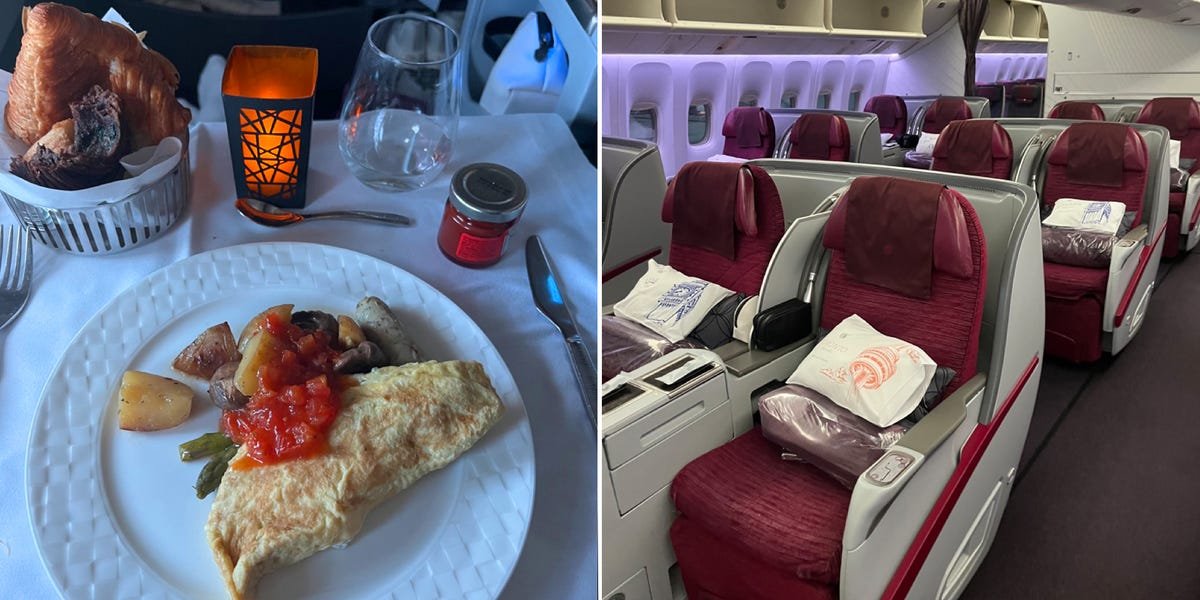
I spent 26 hours in Qatar Airways’ business class. Not all seats are created equally, but I get why it’s so beloved.

We flew from London Gatwick Airport rather than Heathrow because the flights were about $1,000 cheaper.

Arriving at Gatwick, it was a luxury to have a dedicated check-in counter with barely any queue and then fast-track through security too.

After that, though, I wasn’t super blown away.

Qatar Airways doesn’t have a dedicated lounge at Gatwick, so its business-class travelers can use the Plaza Premium Lounge, which anyone can pay to use. I found it to be quite busy and a bit underwhelming, with a rather uninspiring view.

However, it has a separate area for Qatar Airways customers where we could order from a small à la carte menu. I got a burger, and my husband had a goat-cheese sandwich — it was nice to have complimentary food.

We were also given “premium” drinks vouchers for certain beverages, such as prosecco, though Champagne would’ve cost extra.


Source link

Theron Mohamed — Profile Picture

Vinod Khosla suggests scrapping taxes for most Americans in response to AI job losses

If artificial intelligence eliminates millions of jobs, it might make sense to scrap income taxes for the vast majority of Americans and target capital instead, Vinod Khosla says.

“AI will transform economies and need a rethink of capitalism & equity,” the billionaire venture capitalist wrote in an X post on Monday. “Labor portion of economy (vs capital) will decline sharply. Should we eliminate preferential treatment of capital gains tax and equalize to ordinary income?”

Khosla — who cofounded Sun Microsystems and made the first VC investment in OpenAI — was making the point that AI replacing labor on a grand scale might warrant greater taxes on assets such as stocks and real estate.

The veteran financier, who founded Khosla Ventures after leaving Kleiner Perkins, attached a video highlighting some of the jobs that could be taken by AI, from accountants and therapists to truck drivers and chip designers.

Khosla said in a follow-up post that ramping up taxes on capital would generate so much revenue that the government could scrap taxes for most of the roughly 150 million US taxpayers.

“Could easily eliminate bottom 125 million taxpayers from the tax rolls and be revenue neutral at the same time with a capital gains tax equal to ordinary income and a few other tweaks,” he wrote.

He added that tax breaks such as carrying over tax losses and tax-free borrowing against unrealized gains — which he called a “true abuse!” — are “special interest goodies inserted by lobbyists and campaign contributions, not true capitalism.”

Khosla didn’t address common critiques of higher taxes, including that they can discourage entrepreneurship and investment, that collecting them can be tricky, and that wealthy people may leave the country to avoid them.

Khosla has previously underscored that the advent of AI may require sweeping policy changes. He estimated in late 2024 that in 25 years’ time, AI could be doing 80% of the work in 80% of all jobs, and universal basic income might be needed to compensate for job destruction.

“As AI reduces the need for human labor, UBI could become crucial, with governments playing a key role in regulating AI’s impact and ensuring equitable wealth distribution,” he wrote on his firm’s website.

Khosla isn’t alone in predicting AI will change the fabric of society. Elon Musk suggested late last year that work could become “optional” and money might become “irrelevant” if advances in AI and robotics generate abundant resources for all.

Moreover, the Tesla and SpaceX CEO recently said that retirement savings may not be needed in 10 or 20 years, as everyone might have “whatever stuff they want.”

However, skeptics such as Michael Burry of “The Big Short” fame have cautioned the AI boom is a speculative bubble, tech companies are overinvesting in microchips and data centers that will quickly become obsolete, and true AI is further away than many think.


Source link

I-moved-from-the-US-to-Brazil-after-losing-my.jpeg

I moved from the US to Brazil after losing my job. Despite the intense culture shock, I couldn’t be happier with my decision.

After an incredible three weeks traveling around Brazil, I was on the first leg of my flight home to Chicago when I received a message from my director at work — a 15-minute “check-in” with an HR representative.

Worried I might receive news of a layoff, I frantically deboarded the plane after landing in Rio de Janeiro and joined the call in a quiet corner of the duty-free section of the airport. There, I was informed that my role had been eliminated.

Faced with the reality of returning home to the frigid Chicago temperatures with no job, I quickly changed my connecting flight and decided to hostel-hop around Brazil for another month.

However, even that extra month didn’t feel like long enough in the country I’d fallen in love with. Exploring beautiful destinations while practicing a new language every day was incredibly fulfilling for me.

Once I went back to the US, I realized I was looking for ways to push myself out of my comfort zone. I had always wanted to live abroad, and my unemployment seemed like the perfect alignment to make that move to another part of the world.

So, a few months after my original trip, I relocated from Chicago to São Paulo and was greeted by lots of surprises along the way.

Coming from Chicago, I didn’t expect to feel chilly in São Paulo


The cityscape of São Paulo.

The temperatures in São Paulo caught me by surprise.

Cristian Lourenço/Getty Images


Growing up in the Midwest, I’ve endured my fair share of snowstorms and wind chills so cold that I felt as though my eyelids would freeze together. So, I felt well-equipped for any kind of cold weather Mother Nature could ever throw my way.

Even so, I wasn’t prepared for just how chilly Brazil could feel — especially during a springtime cold front while living in an area without access to central heating.

Although Brazil’s springtime temperatures (which last from September through November) are similar to what I experienced during the Chicago fall, it was difficult to adjust to the lack of central heating. So, I found myself wearing multiple layers of T-shirts and the only hoodie I brought with me.

Before I moved, I’d only visited Brazil during its smoldering summer months, so I had naively assumed the subtropical temperatures in São Paulo would be pleasant year-round.

The food is different — and that’s not a bad thing


A plate of acarajé with shrimp.

I’ve grown to love acarajé: stuffed black-eyed-pea fritters

Isaiah Reynolds


Between seeing unrefrigerated milk in grocery stores to trying vegetables I’ve never heard of, the day-to-day food in Brazil is a lot different than what I was used to in the States.

For example, contrary to the common American adage, breakfast doesn’t seem to be the most important meal of the day here; many Brazilians opt for bread or fruit instead of the hefty pancakes or sausage links I was accustomed to.

For lunch and dinner, many locals seem to rely on a tried-and-true formula: arroz (rice), feijão (beans), some meat, and salad.

Classic dishes like stroganoff (a creamy chicken or beef dish topped with crispy shoestring potatoes) or feijoada (pork and black bean stew) may enter the rotation. Still, the aforementioned combo is a popular default dish that I’ve grown to love.

Although tavern-style Chicago pizza still holds a special place in my heart, my new Brazilian favorites include acarajé (stuffed black-eyed pea fritters fried in dendé oil), acerola (a sweet cherry fruit), and doce de leite (sweet caramelized milk used as a topping or filling).

Plus, there’s a pretty great international food scene here, too. While wandering around the city, I’ve come across a wide range of cuisines, from Lebanese and West African restaurants to Colombian and Venezuelan spots.

Although I was initially worried about feeling welcomed, I can see myself putting down roots here

One thing I’ve noticed since my first visit to the country is that Brazilians are very proud to be Brazilian.

From football matches to the celebrations that occur when Brazilian films are nominated for Academy Awards, the people here seem to be the loudest and proudest fans in the room.

Because of this, I was worried I might not feel as welcome as an outsider. Instead, I’ve found an endearing level of curiosity among many Brazilians I’ve met, who either want to practice English or ask how I’m enjoying their beloved country.

This openness to connect has softened a lot of the original culture shock during my move. Although very different from my life in Chicago, I’m excited to continue building a life for myself in São Paulo.


Source link