Stanley-bets-on-wellness-as-it-navigates-the-highs-and.jpeg

Stanley bets on wellness as it navigates the highs and lows of virality

Stanley 1913 is ready to go beyond its viral moment.

The drinkware company is best known for its Stanley Quencher line of 40-ounce tumblers, which has exploded in popularity since 2020 alongside reusable water bottles. Stanley has ridden that wave with viral product launches that have flown off of shelves. Its collaboration with the “Wicked” movie franchise, for example, caused a frenzy at Target in 2024.

Now, Stanley is setting out to show it’s more than a TikTok fad known for limited-edition cup drops.

It’s trying to turn a new tide by taking advantage of another hot trend: wellness. Global President Matt Navarro told Business Insider in an interview that Stanley wants to meet customers where they’re at, which, increasingly, happens to be the gym or the yoga studio.

“They want products that support their health and wellness lives,” Navarro told Business Insider.

The company is launching a new product line on Tuesday to serve that audience and avoid becoming too reliant on TikTok virality.

Stanley’s next big bet is on accessories designed for the gym


Stanley bags

The Vitalize collection releases February 17.

Stanley 1913


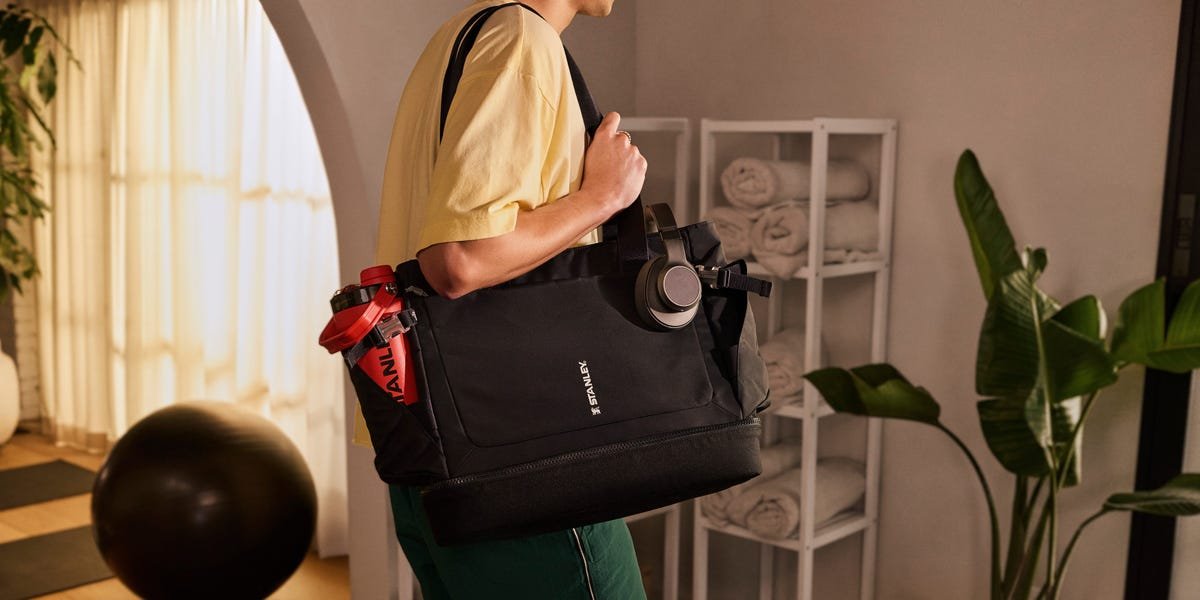
Stanley is betting on its Vitalize line to kick-start its new chapter. It features a new tote bag, backpack, and shaker bottle, designed to support people on the go who want to bring their Stanley cup with them. The bags come with pockets and straps to carry Stanley cups.

“It’s about really understanding today’s consumer,” Navarro said. “They’re constantly on the move.”

The shaker bottle is made for protein, which Navarro said is having “an incredible moment” based on his observations at the grocery store.

The Vitalize drop comes as Stanley’s position as the top drinkware brand is in question. A 2025 survey of more than 500 Morgan Stanley interns found that Stanley tumblers lagged in popularity compared to brands like Owala. Piper Sandler’s 2024 Taking Stock With Teens survey found that teens saw Stanley as “on the way out” of style.

Navarro pushed back on the narrative that Stanley is becoming stale.

“Whether you’re 14 or 44, as long as we’re meeting them in the right places in their lives, then we’ll continue to remain relevant,” he said.

Branching out while staying rooted in drinkware and cookware

Stanley’s Quencher series may be losing momentum, but the company is exploring an identity as a lifestyle brand. Navarro said Stanley is paying close attention to what consumers want while sticking to its roots.

The Vitalize bags infuse the drinkware it’s known for with wearable accessories, such as carrying straps that fit your Stanley cup.

“They’re balancing work, play, yoga, all their passions in life, and they want products that fit into their lifestyle,” Navarro said.

The tote and backpack aren’t Stanley’s first venture beyond drinkware. It also sells camping cookware, pet bowls, and a crossbody strap to carry your tumbler.

New partnerships to reach beyond its mostly female audience


An assortment of tumblers from Stanley 1913.

An assortment of tumblers from Stanley 1913.

Justin Sullivan/Getty Images


Navarro said Stanley started as a brand for the working man in 1913 before shifting to an outdoor focus in 1965. Thanks to social media, it’s evolved into a brand beloved by women. Collaborations with “Wicked” and lifestyle brand LoveShackFancy have drawn the attention of female consumers over the years.

However, with the new shaker, backpack, and tote, Stanley also aims to attract more male customers, Navarro said.

It’s also using partnerships, such as those with soccer star Lionel Messi and global football club Paris Saint-Germain, to win over men.

“Our partnerships work because they’re authentic to us, and they’re also authentic to our consumer,” Navarro said.

Navarro said Stanley’s customers span generations and genders, and the brand is working to build on the buzz it’s generated over the past six years.

“We have incredible brand fans in lots of age demographics, and I think it really speaks to our legacy and longevity beyond just being hype,” Navarro said.




Source link

It-is-an-age-of-confusion-as-consultants-try-to.jpeg

It is an ‘age of confusion’ as consultants try to measure the real value of AI

Big questions are swirling around AI’s real impact — and consultants are racing to supply the answers.

Over the past year, consulting firms have begun deploying armies of AI agents as they work to transform their own operations and advise clients to do the same — automating research, building task-specific tools, and building proprietary AI models.

McKinsey & Company CEO Bob Sternfels said last month that his firm has launched tens of thousands of internal AI agents in recent years, and eventually plans to have one for all of the company’s 40,000 employees.

Amid the rapid rollout, consultants are now asking themselves a tough question: Is it worth it? They are working to measure if AI is truly improving performance, boosting revenue, and freeing consultants to focus on higher-value work.

“I think we are now in the age of confusion,” Mina Alaghband, a former McKinsey partner, now the chief customer officer at Writer, a full-stack enterprise AI platform built for agentic AI, told Business Insider.

Alaghband said that a year ago, most companies were focused on adoption, tracking metrics such as how often a tool was used.

Now, she says said the emphasis should be on measuring the value that’s created — like the amount of human labor reassigned to higher-value work, or improvements in revenue.

PwC’s chief AI officer, Dan Priest, recently told Business Insider that PwC is now less concerned with how many agents it deploys, and more with how many human users each agent has.

Priest said his firm starts by targeting an “impact zone,” such as improving the customer experience.

Within these impact zones, the firm looks to deploy “specialized AI agents” that have earned that designation because they’re good at what they do, Priest said. “When we deploy agents, we want to see a high rate of human adoption, which means more humans are using them,” he said.

EY also prioritizes quality over quantity, Steve Newman, EY’s global engineering chief, told Business Insider. The firm tracks the value created by its AI agents through key performance indicators for productivity, quality, and cost efficiency on a month-to-month basis.

If the defining promises of the AI boom are speed and efficiency, then the metric that may matter more isn’t usage, but time reclaimed.

Boston Consulting Group tracks its agents by that metric — and whether that time is then reinvested in higher-value work, Scott Wilder, a partner and managing director based in Dallas, told Business Insider.

Wilder said humans at the firm now spend about 15% less time on low-value activities, like making slideshows, and that those people are reinvesting about 70% of their saved time into higher-value activities, such as deeper analysis.

Time saved doesn’t always mean more work. At BCG, it can mean more free time. Wilder said BCG has found that employees keep about 30% of the time AI saves. “They get a little more sleep or get to go to a yoga class or whatever someone wants to do,” he said.

Nearly a century ago, economist John Keynes predicted that as productivity rose, the balance between work and leisure would inevitably change.

“I would predict that the standard of life in progressive countries one hundred years hence will be between four and eight times as high as it is,” he wrote in his 1930 essay “Economic Possibilities for our Grandchildren.”

It’s almost 2030, but in small ways, that vision may already be surfacing.

“It’s benefiting them — and this is a tough job, so every hour of free time matters,” Wilder said.

Something to share about how consultants are using AI? Business Insider would like to hear from you. Email Lakshmi Varanasi at lvaranasi@businessinsider.com or contact her on Signal at lvaranasi.70.


Source link

The-EUs-privacy-watchdog-is-investigating-X-over-sexualized-AI.jpeg

The EU’s privacy watchdog is investigating X over sexualized AI images

X is facing mounting criticism from foreign watchdogs over its generative AI chatbot, Grok.

The Irish Data Protection Commission said Tuesday that it had opened an inquiry into Elon Musk’s X, formerly known as Twitter.

The commission said in a press release that the inquiry was linked to the creation and publication of non-consensual, sexualized images of European Union residents on X using Grok’s generative AI functions. This included pictures of children.

The commission, which is responsible for enforcing the EU’s General Data Protection Regulation, said in the release that it notified X of the investigation on Monday.

X did not respond to a request for comment from Business Insider.

Grok is a chatbot developed by Musk’s xAI, now a subsidiary of his aerospace company SpaceX.

The commission’s investigation follows several weeks of controversy around Grok and X. The platform came under fire worldwide in January after reports emerged of Grok users generating sexualized images of real people, including minors.

Countries like Indonesia, Malaysia, and the Philippines temporarily suspended access to Grok. The European Commission launched an investigation into Grok, while India’s information technology ministry voiced its opposition via a letter to the chief compliance officer of X’s India operations.

California’s Attorney General, Rob Bonta, also said in early January that he had launched a probe into Grok’s AI deepfakes.

In response, X made Grok’s AI image generation tool a premium feature limited to paying subscribers and later stopped it from generating sexualized images altogether. However, a Business Insider report found that it was still possible to trigger these images in Grok’s web and mobile applications.

In response to backlash over Grok, Musk said in an X post on January 3, “Anyone using Grok to make illegal content will suffer the same consequences as if they upload illegal content.”


Source link

Aditi Bharade

Welcome to Singapore’s hustle economy

“We’re the same age,” I told Ernest Ang, a 24-year-old who opened an eatery two years ago with his grandmother’s recipes.

And yet, it feels like we live in different worlds.

Every day, he whips up large batches of fried chicken and beef rendang in Singapore’s 90-degree tropical heat. On the other side of the island, in the glitzy financial district, I write about the Trump administration and the general chaos of the world.

I started my first job in a newsroom after graduating from college in 2024, diving headfirst into the corporate grind. I sign off at 5:30 p.m. and value the work-life balance my writing job offers.

Last year, I started collecting stories of Singaporean Gen Zers and millennials shunning the comfort and stability of the 9-5 in favor of starting their own food businesses — ventures that come with backbreaking long hours. I was humbled.


Au Hui Her preps loaves of sourdough bread before opening her bakery in the morning.

Au Hui Her, a millennial bakery owner, starts prepping loaves of sourdough bread at 4 a.m.

Aditi Bharade


Hawker centers, like where Ang set up shop, are the go-to for budget meals in Singapore. They’re cheap, hearty, and convenient, and I’ve eaten from them as long as I can remember.

There are 123 hawker centers in the country, managed by the National Environment Agency. On average, each center has about seven to 10 individual stalls.

Traditionally, they sell dishes like Hainanese chicken rice, bak kut teh, a peppery and flavorful pork soup, or nasi lemak, aromatic rice served with dishes. The stalls are typically run by middle-aged to senior hawkers.


A hawker center in Singapore

Hawker centers in Singapore are typically run by older business owners who sell traditional fare.

Aditi Bharade


But as younger hawkers join the business, there’s been an increase in specialty stalls selling matcha, craft beer, baked goods, and fusion dishes.

Success is an uphill battle, with a massive failure rate due to rising store rents and a frugal consumer base. In 2025, 3,074 food and beverage businesses in Singapore closed their doors, per statistics from the Accounting and Corporate Regulatory Authority of Singapore.

This has not deterred hopeful entrepreneurs — 4,103 new food businesses opened last year.


Ernest Ang, 24, is plating a dish in his restaurant.

Ernest Ang, 24, opened a restaurant featuring his grandmother’s recipes, and said he prefers the life to working in an office.

Aditi Bharade


Most of the young chefs I interviewed work six to seven days a week, getting up well before the sun rises to prep ingredients for the day and retiring late into the night after feeding hungry dinner crowds.

I spoke with eight Gen Z and millennial F&B owners across the country about what makes them tick, what fears give them chills at night, and if they regret choosing a risky career path.

Spoiler: They don’t.


Source link

Ukrainian-drone-pilot-found-hidden-Russian-depot-realized-it-was.jpeg

Ukrainian drone pilot found hidden Russian depot, realized it was filled with horses and cars

Cosmos floated his quadcopter over the ruined warehouse, guiding it through a corner of the roof where shattered metal sheets had collapsed to form a hole.

The drone pilot’s unit, the Wild Division, suspected that the building was a logistics hub for Russian soldiers, roughly 15 km, or about 9 miles, from the line of contact in southern Ukraine. These hidden locations often held ordnance or fuel stockpiles, and Cosmos’ fiber-optic drone was armed with explosives to destroy them.

Yet inside, the drone rotated its camera to reveal what looked more like a farmer’s garage: Four civilian cars, a pair of motorcycles, and two bridled horses.

“We had not expected to see this. It was unusual,” Cosmos told Business Insider, speaking on condition that he be identified only by his call sign.

“We were expecting to find some armored vehicles,” he added.

Video of the discovery went viral last week in Ukraine, as the war has increasingly seen Russian soldiers using unconventional transport tools, such as pack animals and bicycles, to conduct assaults or logistics missions. Cosmos said his drone mission was conducted in early February.

The smaller profile of a horse or civilian car might be harder for a drone to spot, though Russia’s repeated use of them has also raised questions about the viability of its tactics and whether it’s been producing enough military equipment to sustain its invasion.

Cosmos’ squad mates and officers at the Wild Division, a first-person-view drone company in the 82nd Air Assault Brigade, had seen clips of Russian soldiers riding on horses to attack Ukrainian positions before.

One famous example they remember was in Zaporizhzhia, when a Ukrainian drone crew attacked Russian infantry crossing the front lines on horseback last month.

Cosmos, who’s been piloting drones for a year, said it was the first time he’d personally seen the animals on the front lines.

He flew his explosive-laden drone straight into the back of one of the cars, and said his crew later struck several other vehicles inside. When Russian troops moved their transport assets, the Wild Division found the next warehouse and attacked that one, too, Cosmos said.

“The enemy usually lives in hiding close to these places,” Cosmos said of the warehouse. “It’s common for us to check all targets. Sometimes we can see the enemy infantry, or you can see their vehicles.”

Russia calculates war differently

The Wild Division declined to say where exactly the warehouse was located, but its brigade is generally deployed in the Donbas.

The commander of Cosmos’ battalion told Business Insider that the discovery of the horses surprised him, too.

“I thought it had been a location for transport vehicles, sort of a transfer hub,” said the major, whose call sign is Fizruk.

Fizruk said the appearance of horses and cars in his area of the front line could be a sign that Russian forces are running low on standard resources, but also reflects Moscow’s attritional nature of fighting.

The cars discovered by Cosmos appear to be Nivas, inexpensive civilian off-road vehicles from the Russian Lada car brand.

“They treat these like they will be losses anyway, that they will be destroyed anyway,” he said. “Look, a Niva costs, let’s say, $2,000. A Hummer, which the Armed Forces of Ukraine uses in many places, costs $20,000, maybe more.”

“Since they lose their equipment in assaults, from that point of view, why pay $20,000 for one vehicle if you can buy 10 Nivas for $20,000?” Fizruk added.

The Kremlin is known to pressure the front line with repeated ground assaults, sending small groups of infantry to approach Ukrainian positions on foot or in cheap vehicles. The strategy has been costly, with NATO now saying that up to 25,000 Russian troops are dying each month.

Sustaining that style of war has pushed Moscow to informal means of recruitment and weapons procurement, including hiring troops from overseas and receiving ammunition from North Korea.


Source link

A-top-Salesforce-executive-says-Benioffs-ICE-jokes-were-not.jpeg

A top Salesforce executive says Benioff’s ICE jokes were ‘not OK’

Salesforce cofounder Parker Harris addressed the controversy over CEO Marc Benioff’s ICE jokes in an internal meeting, saying he was “not OK with it,” Business Insider has learned.

“Marc made a very bad joke,” Harris, who is the company’s chief technical officer, said. “But that’s something that Marc did, and I’m not gonna call him out in public out on the internet.”

A transcript of Harris’ remarks at a meeting of the product and tech team last week was posted by an employee to a Slack channel. Business Insider verified that the transcript was accurate.

Salesforce did not respond to a request for comment. Benioff has not spoken about the jokes or the company’s reaction to them.


Marc Benioff wearing a blue suit and white shirt

Marc Benioff has not addressed the internal uproar over his ICE jokes.

Santiago Mejia/San Francisco Chronicle via Getty Images


In his meeting, Harris began by addressing a question about why many company leaders had not addressed Benioff’s comments at Salesforce’s employee-only company kickoff in Las Vegas last Tuesday.

“So I’ll start by saying that somebody already has, and it was immediately leaked,” Harris said, referring to a Business Insider story about another executive who criticized Benioff’s jokes.

“Let’s talk about it with each other and not out to Business Insider and other places because it doesn’t do us any good,” he said, adding, “It’s a violation of the Code of Conduct, and it’s a fireable offense. And if we do catch you, we will fire you.”

At the kickoff, Benioff made “multiple” jokes about ICE, including one about agents surveilling Salesforce employee travel, employees told Business Insider at the time.

Workers reacted with anger on Slack, which is owned by Salesforce. Slack General Manager Rob Seaman posted a comment saying he could not “defend or explain” his boss’ comments.

“They do not align with my personal values and I know this to be the case for many of you as well,” he wrote.

Craig Broscow, a Salesforce VP, acknowledged the “deep disappointment” in his own Slack message after the kickoff remarks.

“It would be a step in the right direction and for Marc to acknowledge as soon as possible — ideally publicly — that his attempted joke was extremely upsetting to large segments of his employee base,” Broscow said.

Speaking to his team, Harris said Seaman got in hot water for his post.

“I’ll tell you personally, and this is what Rob said as well, and I respect Rob for saying that, but he got in big trouble ’cause it went out on the internet,” Harris said. “Personally, I’m not OK with that joke.”

Harris went on to say that “it’s hard right now with what is going on [in] the US” and “what’s going in, like, Minneapolis is not about our software. Our software is not being used there.”

Harris said Salesforce is “not a political organization” and encouraged employees to make their views known at the ballot box.

“I’m going to use my democratic right to vote, and that’s how I’m gonna take action against some of the things that I’m not okay with,” he said.

He closed with saying, “So that’s my statement. It may not make you feel better. So I’m sorry if it doesn’t make you feel better. I think we should keep talking about it. I’m totally fine talking about it more. Please keep it confidential.”

Have a tip? Contact this reporter via email at astewart@businessinsider.com or Signal at +1-425-344-8242. Use a personal email address and a nonwork device; here’s our guide to sharing information securely.


Source link

Taylor Rains

Jet2 barred 2 passengers after an in-flight brawl — and it’s coming for their wallets

“Nothing beats a Jet2 holiday” — except when it ends in a midair brawl.

The British budget carrier has issued lifetime bans to two passengers after a flight from Turkey to England diverted to Belgium on Thursday following a fight on board, the airline told multiple news outlets.

It’s unclear what caused the altercation, but videos circulating on social media show passengers screaming and pushing as cabin crew and others attempted to break it up. The plane later continued to the UK after police removed the two passengers.

Jet2 said in a statement that the pair exhibited “appalling behavior” and that it would “vigorously pursue them” to recoup the costs of the diversion.

Diversions aren’t cheap: they can cost airlines tens of thousands of dollars in fuel, labor, and airport fees. Any hotel and transportation costs also add up.

“As a family-friendly airline, we take a zero-tolerance approach to disruptive passenger behaviour, and we are very sorry that other customers and our colleagues on board had to experience this too,” the airline said.

Jet2 has a history of chasing down unruly passengers. In 2019, the airline barred a disruptive traveler and billed her about $115,000 after she attempted to open an exit door midair, prompting a diversion escorted by military jets. In 2022, two brothers who fought on board another Jet2 flight forced a diversion and were later charged about $68,000 and issued lifetime bans.

Other airlines have taken similar approaches, seeking reimbursement from passengers whose behavior disrupted flights.

Budget competitor Ryanair, for example, last year filed a lawsuit seeking about $18,000 from a passenger it described as disruptive after a diversion to Portugal in April 2024 left 160 people needing overnight accommodation.

Unruly passenger incidents surged during the pandemic, when mask mandates fueled confrontations between travelers and airline staff.

Data from the Federal Aviation Administration shows there were nearly 6,000 reports on US airlines in 2021 — up about 500% from roughly 1,000 the year before.

Reports fell to about 2,500 in 2022 and further to roughly 1,600 in 2025, though they still remain well above pre-pandemic levels. There have been 126 reports so far in 2026.

The FAA maintains a zero-tolerance policy and has issued more than $20 million in civil fines since 2020 (these are separate from the money airlines can collect through lawsuits).

In more extreme cases — such as physical assaults on crew — passengers have faced criminal prosecution, including by the Federal Bureau of Investigation, resulting in larger fines and jail time.


Source link

Anderson-Cooper-is-leaving-CBSs-60-Minutes-after-nearly-2.jpeg

Anderson Cooper is leaving CBS’s ’60 Minutes’ after nearly 2 decades

  • Anderson Cooper is leaving CBS’s “60 Minutes” after two decades in the gig.
  • The correspondent said he balanced his CNN and CBS jobs for 20 years.
  • Now, he’s quitting one gig to spend more time with his children.

Anderson Cooper has called it quits on CBS’s “60 Minutes” after nearly two decades with the show.

Cooper, who is a political commentator on CNN’s “Anderson Cooper 360” and a correspondent on “60 Minutes,” said on Monday that he would be leaving the latter job.

“Being a correspondent at 60 Minutes has been one of the great honors of my career,” he said in a statement to multiple news outlets.

“For nearly twenty years, I’ve been able to balance my jobs at CNN and CBS, but I have little kids now and I want to spend as much time with them as possible, while they still want to spend time with me,” he added.

Cooper, 58, joined “60 Minutes” in 2006 and has become one of its most recognizable hosts.

In a statement to Business Insider, a CBS spokesperson said, “For more than two decades, Anderson Cooper has taken 60 Minutes viewers on journeys to faraway places, told us unforgettable stories, reported consequential investigations and interviewed many prominent figures.”

“We’re grateful to him for dedicating so much of his life to this broadcast, and understand the importance of spending more time with family,” the spokesperson added. “60 Minutes will be here if he ever wants to return.”

This is a developing story. Please check back for updates.


Source link

Jacob Zinkula

Nvidia rejected this international student. Then he bounced back and landed his dream job there.

As Sylendran Arunagiri considered moving from India to the US to pursue a master’s degree, some friends and mentors advised him to delay his move. They warned that the US tech job market had become too challenging.

Arunagiri’s goal was to move to the US in late 2023, begin a master’s program in product management at Carnegie Mellon University, and land a Big Tech internship for the summer of 2024. He hoped this would be a stepping stone toward landing an AI-related role, ideally at Nvidia, his “dream company” because of its central role in the AI technologies he’d long wanted to work on.

However, there were several things working against him. For one, the US tech hiring landscape was already creating headaches for job seekers. Openings had plummeted from highs reached a year earlier, and industry layoffs were increasing competition for available roles.

Additionally, Arunagiri had grown accustomed to the job market in India, where he earned a bachelor’s degree and an MBA from top institutions that he said relied on structured campus placement programs to funnel many students directly into jobs. But from what he’d heard, the US was very different. Job fairs were often more like networking events than recruiting opportunities.

“You’re completely on your own,” said the 30-year-old, who now lives in San Jose.

Arunagiri is among the many job seekers who have struggled to navigate a US hiring landscape that’s become more challenging in recent years. Amid economic uncertainty, the early effects of generative AI adoption, and a broader push to streamline operations, US businesses are now hiring at one of the slowest rates since 2013.

Still, some people have managed to break through in a challenging market. Arunagiri shared how he pursued his goal of working at Nvidia — a company he described as his dream employer — and offered his top advice for other job seekers.

Striking out on Nvidia

Many of the tech companies Arunagiri was targeting had conducted summer internship interviews the previous fall, so he began applying before moving to the US. After sending out many applications, he landed an interview with Nvidia in November 2023.

Arunagiri said the interview process went so well that he stopped applying to other internships. But after moving to the US and completing his final interview in February, he learned that he wouldn’t be getting the role — which left him scrambling to find another internship.

“I had to start from scratch, but by then many of the applications had dried out,” he said

Arunagiri was able to land an AI product manager internship based in India at the tech company Informatica. However, that summer, he found it difficult to stop thinking about what went wrong during his interview process with Nvidia — and began setting his sights on eventually landing a full-time role with the company.

A second chance at Nvidia

Upon reflection, Arunagiri suspected that his final Nvidia interview may have doomed him. He said he was lower energy than usual because he was feeling sick that day, and that he’d been hesitant to postpone it out of fear that the opportunity would be filled in the meantime. In hindsight, he said that decision was likely a mistake.

“I came off as a dull candidate, but I’m usually energetic and conversational,” he said. “I should have probably postponed it to a day that I was feeling better.”

Arunagiri decided to reach out to an HR professional from Nvidia to get insight into where he fell short, and they agreed to jump on a call with him. While they didn’t provide specific insights into his candidacy, he said they recommended he try to connect with people at Nvidia in current roles, including hiring managers and interns, to get insight into the kinds of projects they were working on and how he could better align his profile.

He eventually connected with about five Nvidia interns, who he said provided valuable insights. Those conversations helped shape the personal AI-related projects he began pursuing and sharing on LinkedIn in hopes of standing out.

After the summer, Arunagiri dove back into the job search, eager to land a role before he graduated in December 2024. He knew that if he didn’t land a job within 90 days after graduation, his F-1 visa restrictions would force him to return to India.

In September 2024, he submitted a cold application for a technical product marketing role in agentic AI at Nvidia —a role he described as his “dream AI role” at his dream company. He was asked to interview starting in October, and around the same time, he was also invited to interview for a more junior product management role at Microsoft.

Read more about people who’ve found themselves at a corporate crossroads

Advice for other job seekers

In December, with his graduation looming later that month, Arunagiri received offers from Nvidia and Microsoft within days of each other. Given that Nvidia was his dream employer, the role checked a lot of his boxes, and the pay was higher than Microsoft’s, he said the decision was fairly easy — and he accepted Nvidia’s offer. He said that so far, working at Nvidia has been “everything that I’ve dreamed of.”

Arunagiri believes that his LinkedIn presence helped him stand out. During the interview process, he said, the hiring manager told him that he’d reviewed his LinkedIn profile and noticed the projects he’d been working on, including small experiments with new generative AI tools and models he’d shared publicly.

He has a few pieces of advice for job seekers. First, he said, time management is key, particularly because applying for jobs and connecting with people can be time-consuming. Second, he said, never compare your job search journey to anyone else’s, since a variety of factors can influence how it plays out.

Rather than quietly applying and networking, he recommends sharing tangible projects publicly — such as posting about AI tools you’ve explored and linking to projects on LinkedIn or a personal website — so hiring managers can see your work.

“You need to find something that sets you apart from others,” he said.


Source link

Taylor Rains

Lufthansa is finally selling its complex Boeing 787 business class seats after a certification debacle

Lufthansa can finally start making money on its Boeing 787 Dreamliners after a certification debacle left one of its most lucrative cabins largely empty for months.

The German flag carrier said on Monday that it will begin selling tickets for its Allegris business class on the 787. Allegris, Lufthansa’s signature cabin concept, spans economy, premium economy, business, and first class, but the business class rollout has been particularly tricky.

The program first launched on the Airbus A350 in May 2024, with the cabin spanning the entire plane. The first Allegris-equipped 787 followed in October 2025, but certification of business class dragged on due to the cabin’s complexity: there are five staggered seat configurations in a single airplane cabin — some with doors or more legroom, others with extra-long beds.


Lufthansa's Allegris business class layout.

The first-row window seats have extra workspace. Some window seats don’t have doors but are billed as being more private.

Lufthansa


This is because the Dreamliner’s geometry — including a slightly tighter usable footprint and different fuselage contouring compared to the A350 — made it harder to demonstrate to regulators that passengers could evacuate quickly from every seat, whether staggered, partially enclosed, or fully cocooned, in an emergency.

The result? For months, only four of the 28 business class seats could be sold — the front-row Business Class Suites — leaving the remaining 24 empty. Business class is a cash cow for airlines, and by flying most of the cabin empty as competitors pour investments into their own premium seats, Lufthansa was essentially leaving money on the table.

It has been a particularly costly headache for a carrier in the midst of a multi-year turnaround plan to restore profitability after years of financial pressure from frequent maintenance, aircraft shortages, rising operating costs, and labor strikes.

Lufthansa even opted for an already-certified business-class seat to retrofit onto its Airbus A380s rather than risk another prolonged and costly certification process.

But the saga is nearing the finish line. Beginning April 15, Lufthansa plans to carry passengers in 25 business-class seats on its 787s, with three remaining blocked in the second row of the cabin.

Bookings are open, though it’s unclear whether the news indicates the seats have been fully certified or if that’s just Lufthansa’s expected timeline.

Lufthansa said “Classic” seats — one of the Allegris categories available — are free to secure with the premium fare.

The others require an extra fee: this includes the first-row suites, the “Privacy” seat next to the window, the “Extra Space” seat with more legroom, and the “Extra Long Bed” with an over seven-foot sleeping surface.

The three second-row seats that are blocked — and not yet available for booking — are two privacy seats and an extra-legroom seat.


Allegris business class.

One of the large, door-equipped Allegris suites on Lufthansa’s A350. It has a larger business-class cabin than the 787 and also features a luxe, ultra-private first class.

LUKAS BARTH/AFP via Getty Images


Lufthansa flies eight Allegris-equipped Dreamliners and expects to have 29 by the end of 2027.

They are set to first fly from Frankfurt to Rio de Janeiro, Bogota, Cape Town, Shanghai, Hyderabad, Hong Kong, and Austin; New York-JFK and Los Angeles join the roster in June, followed by Delhi in July.

As part of Lufthansa’s greater multibillion-dollar fleet overhaul plan, Allegris is also being fit onto the airline’s existing A350s and Boeing 747-8s, as well as its future, yet-to-be-certified Boeing 777Xs.

A similar spacing issue on the 747 double-deckers’ upper level means it will have a split business class: the lower deck will have Allegris, while upstairs will feature the plane’s original cabin.


Source link