
kristine villarroel author profile picture

After nearly a decade in Florida, these are the 7 underrated destinations I recommend to everyone

Some parts of the US might still be in the peak of winter, but down in the sunnier states, people are already bringing out their bathing suits.

As a Florida local of nearly a decade, some of my favorite days are the ones when I slow down, bask in the sun, and breathe in fresh air while tubing down a crystal-clear spring, surrounded by the peaceful sounds of nature.

Unlike the rowdy tourist beach towns or overcrowded theme parks, this is the Florida I’ve come to know and love.

Away from tourist hot spots such as Disney World or Miami Beach, Florida offers hidden gems for all tastes, whether you’re more nature-inclined or want to explore towns that will make you feel like you’re in Europe.

After living in the state for nearly a decade, I found that the best travel destinations in the state are far from the most famous.

Whether you’re escaping from cold weather or planning a summer trip to Florida, here are seven towns you should visit.

Ponte Vedra Beach


Beautiful Ponte Vedra Beach on the east coast of North Florida.

Ponte Vedra Beach is ideal for a quiet, secluded vacation.

Fotoluminate LLC/Shutterstock


When picturing a Florida beach vacation, you might think of Miami Beach or maybe Clearwater Beach if you’re aiming for the Gulf Coast. If you’re looking to avoid tourists, however, I recommend visiting the beaches near Jacksonville.

The North Florida shores in Ponte Vedra are mostly lined with single-family houses along the A1A road and can be far from downtown areas, making it the perfect escape if you’re looking to relax rather than party.

Many of these houses, which are often winter homes for their owners, can be rented as Airbnbs, making them ideal for family or group vacations.

The Guana Tolomato Matanzas National Estuarine Research Reserve, a 73,000-acre stretch of wild nature, is also the perfect spot to hike and kayak saltwater marshes while exploring Florida’s wildlife.

St. Augustine


Flagler Collage in St. Augustine with a fountain in the foreground

The historic streets of St. Augustine offer dozens of restaurants and vendors.

Mitch88/Shutterstock


The oldest town in the US, St. Augustine, was founded in 1565 by Spanish settlers. Today, the city offers a picturesque destination for those looking for history and charm.

Whether you’re enjoying its nearby beaches or immersing yourself in medieval Spanish culture in the city’s historic district, St. Augustine offers a wide range of activities for families and history enthusiasts.

During your time here, make sure to tour the Castillo de San Marcos National Monument, the oldest fort in the US, and walk along the cobblestoned streets of the historic downtown, like St. George Street, which features a 1716 schoolhouse and dozens of restaurants and boutiques.

Every holiday season, from November to January, the historic district is illuminated for the city’s “Nights of Lights” showcase. Walking through it feels like strolling through a Christmas postcard, only with palm trees and Spanish castles instead of snow.

Cedar Key


Cedar Key, Florida / United States, December 28th 2019: Waterfront buildings on stilts in Cedar Key tourist town, Gulf of Mexico

Cedar Key is a major producer of farm-raised clams.

JRP Studio/Shutterstock


Originally settled in the 1840s, this tiny community in Florida’s Nature Coast — the stretch of the Gulf Coast between Tampa and Pensacola — may not be on your travel radar, but if you enjoy fresh seafood and less crowded areas, it should be.

Cedar Key is a small island located about a 2 1/2-hour drive from Orlando and is one of the largest producers of farm-raised clams in the country. You can enjoy fresh, delicious seafood while sitting on the shore of Florida’s undiscovered coast.

The quiet town is often compared to the more touristy Key West, which was Jimmy Buffett’s home and inspiration. In Cedar Key, you can also enjoy some of the signature Key West attractions — such as key lime pies and small local boutiques — without dealing with the crowds.

As a foodie myself, I can only tell you how amazing the seafood in Cedar Key is. The rest you will have to experience for yourself.

Ocala


An arched wooden footbridge over the blue and emerald pools set amidst quiet and serene rich and lush tropical vegetation. Juniper Springs Florida. USA

Ocala is a great travel destination for those looking to immerse themselves in nature.

Rafal Michal Gadomski/Shutterstock


If you’re more of a nature person, head over to Ocala to enjoy clear freshwater springs and Florida forests.

The springs near Ocala are amazing for kayaking or just for taking a dip. While kayaking in the river streams, you might spot some alligators, manatees, and even monkeys.

Additionally, the area is home to one of America’s only elephant rescue farms, Two Tails Ranch, and the longest ziplines in the state at the Canyons Zip Line and Adventure Park.

Sarasota


Drone Fly view over beach in Siesta Key,  Florida. Beautiful Siesta Key beach on a sunny day. Turquoise transparent water and blue sea in Siesta Key beach.

Sarasota hosts the highest-rated beach in the US.

vmargineanu/Shutterstock


Some of the best beaches in Florida — and the world — are in Sarasota.

Siesta Key, which has been named as the best beach in the US and fourth best in the world, is a pristine white-sand, turquoise-water beach perfect for families or for relaxing.

The city also offers a variety of art sightseeing, such as Ca’ d’Zan, the Mediterranean-inspired mansion at the Ringling Museum.

If you’re driving from Tampa, prepare to cross the tallest bridge in the state, the Sunshine Skyway Bridge. At its peak height, I felt like I was flying on an airplane looking down.

Cocoa Village


Cocoa, Florida USA - October 8, 2022: Downtown Historic area of Cocoa Village.

This small historic town sits near the Kennedy Space Center in Cape Canaveral.

JennLShoots/Shutterstock


Near the space-themed attractions at Kennedy Space Center in Cape Canaveral is Cocoa Village, a small historic downtown filled with local vendors and plenty of art.

The small coastal town also has a variety of food spots for every occasion, including an English tavern, a French bistro, and a fully vegan New American restaurant.

And if you’re looking for a unique experience, you can kayak or paddle the bioluminescent waters of the Indian River Lagoon — you might see a few dolphins, too.

Sombrero Beach


Aerial view of Sombrero Beach with palm trees on the Florida Keys, Marathon, Florida, USA.

Sombrero Beach is one of the many underrated beaches down the Florida Keys.

Martin Valigursky/Shutterstock


If you’re making your way down the Florida Keys, you may as well stop to visit a couple of its gorgeous beaches.

While Key West deserves the hype it receives as a travel destination, some of the other spots in the Florida Keys are often overlooked.

South of Marathon Key and north of Key West is Sombrero Beach, one of the most underrated beaches in the US. On this white-sand beach, you can enjoy some of the calmest waters in Florida, perfect for families or for relaxing.

It’s also a turtle-nesting spot, so you might even see a few loggerhead turtles during nesting season.

For a fun historical sight, head a few minutes down the Overseas Highway, and you’ll see some of the remnants of the once-active Overseas Railroad in Bahia Honda Key.



Source link

We-didnt-need-childcare-but-we-still-paid-7500-to.jpeg

We didn’t need childcare, but we still paid $7,500 to send our toddler to a program for 4 hours a week. It helped her build independence.

When I first found out I was pregnant, I frankly didn’t put much thought into long-term childcare plans. Living in New York City, my husband and I knew we wouldn’t have the traditional village available to us — my parents, while local and thrilled to get a first grandchild, are older and weren’t particularly eager to volunteer for solo babysitting, while his parents live thousands of miles away.

But we were in a uniquely lucky situation: We both happened to have flexible, largely remote jobs.

For the first few months of my surprisingly generous parental leave, my husband and I, cocooned in newborn bliss (and perhaps slightly delirious from sleep deprivation), didn’t stress about what would happen when I went back to work. I figured we could make it work through a combination of creative time management and strategically scheduled naps — at least until our daughter was eligible for 3-K, free schooling available in New York City for kids the year they turn 3.

My husband became the primary parent

Surprisingly, this plan ended up working, for the most part, and for just shy of a year, we managed a fairly even 50-50 split in parenting duties. As time went on and my own work ramped up and the baby potato turned into a sprinting toddler, it became clear that my husband would need to become the primary parent.

It wasn’t something either of us had considered before having a child, but it made the most sense: He found far greater fulfillment in being a father than he’d ever found in his career, whereas I had always defined myself by my work as a writer and editor. He kept his job but scaled back, working largely in the evenings and weekends so he could be free during the day for stay-at-home parenting.

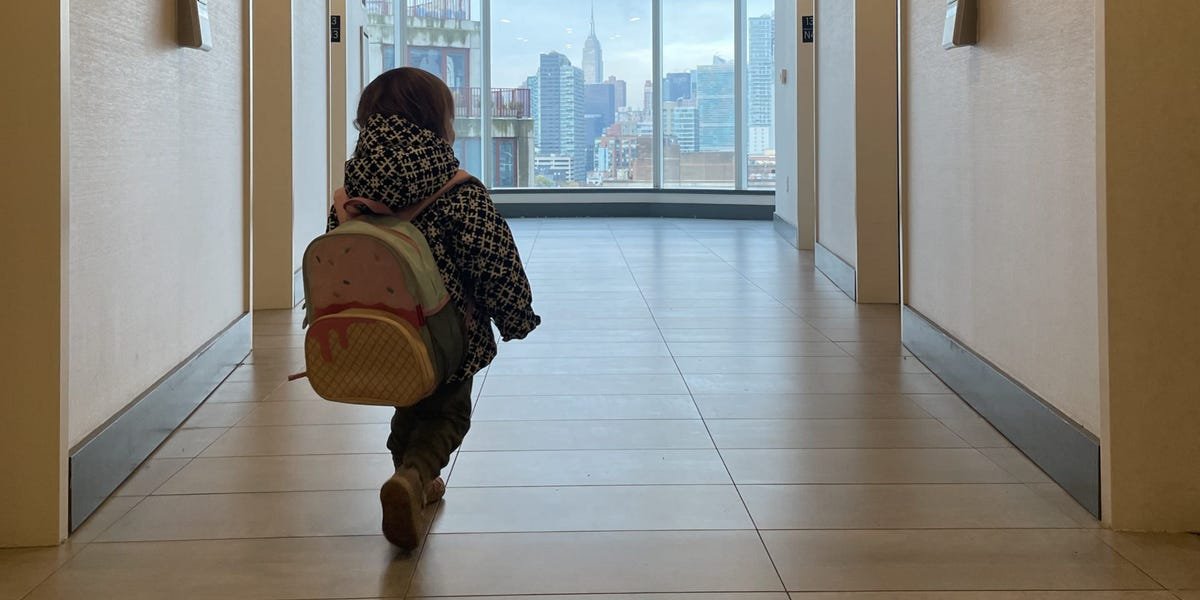
As our daughter became a toddler, she blossomed under my husband’s full-time care, with constant adventuring and frequent playdates keeping her days busy. We didn’t need outside childcare — but as it turned out, she did.

I’d considered traditional childcare, but couldn’t stomach the cost

New York City has notoriously high childcare costs.


Child playing with bubbles

The author says traditional childcare was too expensive in New York City.

Courtesy of Michael Matassa


In the interim between our delicate balancing act and deciding my husband would drastically scale down his work, I considered a number of different options, from traditional daycares (upward of $2,500 a month in my neighborhood for full-time programs) to nanny-share arrangements with other local families (maybe slightly cheaper, but a pain to coordinate).

We were lucky in that we were able to avoid childcare costs, which would have effectively canceled out one of our salaries, though I still toyed with the idea of enrolling her somewhere part time to get her used to the idea in case our situation changed.

Enter Barnard College’s Center for Toddler Development.

I first heard about the program in a local moms’ book club I’d joined. One of our first reads was “How Toddlers Thrive” by Tovah P. Klein, a prominent child psychologist — and incidentally the then-director of the Toddler Center. Another mom in the book club with a daughter two years older than mine mentioned she was now applying.

I was frankly flabbergasted when she explained the details. It’s part research program, where the toddlers are minded by teachers and selected students from the college’s graduate program and observed for published research purposes from behind a one-way mirror, and part “school,” albeit an extremely part-time one, with each “class” of toddlers meeting only twice a week for two hours each day for the duration of the school year.

I was intrigued by the program’s unique “gentle separation period” and its said mission to help toddlers have a positive first school experience while supporting healthy social and emotional development through hands-on, child-guided play.

At that point, my daughter was only 18 months old (the halfway point to our 3-K end goal), but I’d already started to suspect that separation might be an eventual issue. With two working-from-home parents, she was used to having us around constantly — and had never had a babysitter.

The few times we’d tried to step out to grab a coffee and handed her to a grandparent, she would shriek like she was being abandoned. Over the next several months, she also grew more shy, coinciding with her stranger danger peaking.

We paid $7,500 for our 2-year-old

Convinced our future would be filled with school refusals and drop-off meltdowns, I hardcore pitched the Toddler Center to my husband for the coming school year. We didn’t need it for childcare, but I became convinced we did need it to help give our daughter the gentlest, most gradual introduction to being away from us. He was less convinced, sure she would grow out of it and be OK with separating by 3-K, but agreed in the end.

If the program details were mind-boggling, the price point was eye-watering. Though there isn’t a set, publicly announced tuition rate, the Toddler Center offers sliding-scale tuition and payment plans to make the program accessible to a broader range of the population. According to its website, a third of Toddler Center families pay tuition on a sliding scale (I assume the higher-profile alum parents like Amy Schumer, Sarah Jessica Parker, and Robert De Niro paid full sticker price for their kids to attend).

After submitting a sliding-scale tuition application, which required forking over the previous year’s tax returns to prove we were indeed not flush with cash, we landed on $7,500 as the final figure for our almost 2-year-old to take her first baby steps toward school.

At first, it was torturous

It did not go well.


Toddler sitting on bench

The author says at first, her daughter wasn’t comfortable with either of her parents leaving.

Courtesy of Michael Matassa


The first few weeks of the program allowed the parents in the classroom, gradually moving us farther from it (a separate, no-toys-allowed room in the back, meant to be unappealing to the kids) to encourage the toddlers to ignore them and play in the main classroom area. That trick didn’t work on our daughter, who simply sat next to the chair of whichever of us had taken her in that day, chattering happily as we tried to gently encourage her to go away.

As I’d dreaded, the initial actual separation — when parents would bring their kids into the classroom and tell them they were leaving — was horrendous. The Toddler Center mandated that only one parent or caregiver drop off their child each morning.

For the first few weeks after separation, we could both sit in the observation room, where we were treated to a front-row show of our daughter sobbing hysterically and trying to reason with the grad students to open the door she was convinced we were right behind. It was excruciating, and plenty of tears were shed on our end as well.

There was virtually no improvement for months, which was far longer than I expected. And I felt an immense amount of guilt for having come up with this idea in the first place: Were we actually traumatizing her instead of helping her? Had I epically miscalculated this? Did I pay $7,500 to torture my toddler and myself?

I was wracked with doubt, and we debated withdrawing her from the program before the first semester had even finished. It was particularly hard on my husband, who, as the primary parent, was typically the one dropping her off and dealing with the meltdowns — and who also really missed her on school days.

Suddenly, though, and for no particular reason at all, it got better. A lot better.

Instead of sobbing by the door for a full hour and a half, she started interacting with the other kids. She found a favorite grad student she’d attach herself to. She played happily on the classroom slide. And eventually, she comforted the other toddlers during their hard separation days, assuring them their mommies or daddies would be back.

The Toddler Center was expensive, but extremely worth it for us

While it was difficult for my husband to be apart from his little buddy for the few hours a week she was at the program, they turned it into an opportunity for new adventures. In the spring semester, he began biking with her to school, stopping to pick up flowers on the way there and back. Another tradition became that he would bring her a blueberry muffin from a local café every day at pickup. These small rituals helped them bond even more.


Child jumping on sand

The author says the $7,500 she spent was worth it.

Courtesy of Michael Matassa


I don’t pretend to have a handle on the intricacies of toddler psychology, and I can’t tell you what the flipped-switch moment was where it finally clicked for my kid that being left at school with her teachers didn’t mean we were gone forever. And yes, for the record, she still cried during drop-off the first few weeks of 3-K.

But I am convinced that completing the Toddler Center program drastically reduced her adjustment period for “real school.” Tossing her into the deep end for six hours a day, five days a week, was simply not the right option for our family.

In the end, I’m glad I listened to my gut, dug into our pockets, and toughed out the tears — and I’d like to think my daughter, somewhere deep down in her toddler brain, is too.


Source link

Software-engineers-are-getting-crushed-by-AI-—-and-they.jpeg

Software engineers are getting crushed by AI — and they think you’re next.

Software engineers are getting crushed by AI, and they think you’re next.

AI’s ability to automate code is simultaneously making developers productive and overworked. One technologist said his job is harder than ever, lamenting that “AI fatigue” is real.

The good news is it won’t last forever. The bad news is that’s because most of them will be out of a job.

Software veteran Steve Yegge predicts that AI will eventually lead Big Tech companies to cut 50% of their engineers. (He wasn’t a total drag. Yegge offered advice to software engineers for avoiding the ‘vampiric effect’ of AI.)

“Ok, but I don’t work in tech. Why do I care?” you callously ask. (So cold!)

Well, according to the people in the thick of it, AI isn’t stopping with them.

Matt Shumer, the CEO of an AI startup, warned AI’s disruption will be “much bigger” than COVID. The post has racked up more than 69 million views on X, gaining traction outside traditional tech circles. Shumer spoke to BI’s Brent D. Griffiths about the post and the fact that he (surprise!) used AI to help him write it.

It’s worth noting Shumer’s company specializes in AI personal assistants. He certainly benefits from getting people on board with AI. But that doesn’t invalidate a lot of his points about workers needing to adapt to a rapidly changing environment.

There’s a counterargument to the doomsday prophecy.

Maybe engineering jobs are especially ripe for AI disruption?

The job, after all, is highly digital and requires hard skills, two factors that make it a strong candidate for AI automation.

Software engineers have also been somewhat insulated from the tech-based disruptions the rest of us have endured and adapted to during the pre-AI times. A new tool here. A new app there. At some point, many of us have gotten numb to tech disrupting what we do. You just figure out how to adapt.

Meanwhile, software engineers were living on easy street. You don’t have to worry about the tools when you’re the ones building them. For years, software developers enjoyed healthy salaries, good work-life balance, and fantastic job security.

Now the tables are turned, and suddenly it’s everyone’s problem?

I’m not suggesting AI won’t impact the rest of us. For starters, entry-level jobs across the board appear to be on the chopping block thanks to AI. Consultants also seem ripe for some shakeups. And the legal industry is certainly feeling the heat.

(I could mention journalism, but we were on the extinction list long before AI. When I started college in 2007, my professors all told me the industry was dying. Almost two decades later, we’re still here. If anything, it looks like AI has created some high-paying jobs for writers.)

AI might end up being massively disruptive for all of us, but at this point, we’re all used to it.

Where do you stand on the AI doomsday prophecy? Send me an email at ddefrancesco@businessinsider.com.


Source link

Katie Notopoulos

Coming off your parents’ family phone plan doesn’t make you an adult

Before you yell at me, let me first say that I am not, and have never been, on my parents’ cellphone plan. (I didn’t get a cellphone until I was already an adult.) But I’ve long been jealous of my friends who are still on their parents’ plans — it just makes good sense!

Yahoo News recently asked whether staying on your parents’ phone plan as a 40-year-old makes you “a harmless mooch or a generational failure?”

The reporter, Fortesa Latifi, admits that she and her husband were still on their parents’ plans until recently, and that many others are like her, some even with children of their own, and quite a few feel embarrassed about it.

There are significant savings to be had by joining a family plan. For example, right now, at T-Mobile, its unlimited talk, text, and data plan costs $85 for an individual plan. For a family of four, the same plan is around $42 per person.

Why are family plans so much cheaper per line? It’s not that there are a lot more costs to operate cell service if a phone number isn’t connected to a family plan. It’s all about how advantageous it is for the carrier to sell family plans.

For one thing, if you’re part of a family plan, you’re less likely to shop around and switch carriers. It’s also easier on the carrier’s customer service: They only have to mail bills, process credit cards each month, and all that jazz for one person instead of several. (Verizon and T-Mobile didn’t immediately respond to a request for comment on their pricing.)

Last year, AT&T added a new feature that makes it easier to automatically split the bill for people who share a friends-and-family account. The person whose name is on the bill is still ultimately responsible for the full amount, so enter into this kind of arrangement only with people you really trust.

AT&T pointed me to a news story published last year that quoted an exec saying 85% of their customers were on a multi-line plan. Think about that — that means if you actually are one of the suckers who is paying for a single line, you’re in the vast minority.

There’s no honor in paying more to have the bill in your own name — you’re just paying more for the same services. Does your dignity and independence win out here, or does T-Mobile? Hmm?

Does having your own cellphone line make you an adult?

AT&T released its own study (so take it with a grain of salt) that said that 76% of Americans think that coming off a parent’s cellphone plan is one of the “ultimate signs” of becoming an adult.

Sure, at first glance, this seems like a rite of passage into financial independence from your parents.

Is it a smart financial choice?

Consider that the T-Mobile plan — even if you paid back your mom each month for your portion of the phone bill, you’d be saving about $42.50 a month compared to the same service on an individual plan. That’s $5,100 over a decade if you did it from age 22 to 32.

In fact, I’d say that part of becoming an adult is being smart about spending habits and money. And sticking to a family plan is the obviously wise choice.

If you choose to remove yourself from a family plan, you’re just giving the cellphone carriers twice as much — and I see little glory or pride in that.

Look, of course, this all depends on your relationship with your family. You may not want to have this financial tie to them, and you may be in a better financial situation than your parents. But bundling phone lines with other people, whether they’re your family or just some friends, makes a lot of financial sense.

Millennials, it’s time to take pride in one smart financial decision that our generation is making. Embrace it! Be proud to be on a family plan!


Source link

McDonalds-execs-are-figuring-out-how-to-handle-more-customers.jpeg

McDonald’s execs are figuring out how to handle more customers on GLP-1s

McDonald’s is gearing up to feed a growing consumer group on weight-loss drugs.

In a Wednesday earnings call, McDonald’s executives talked about how the chain was testing menu items for more customers on GLP-1s.

CEO Chris Kempczinski said he expects GLP-1 adoption to continue to grow, adding, “as adoption grows, we know that consumers’ behavior changes.”

He said these customers are interested in protein-rich products, and that McDonald’s already has a menu of high-protein dishes. Vice President Jill McDonald chimed in with examples of McDonald’s Snack Wraps, Sausage Biscuit sandwich, and chicken McCrispy Strips.

“But we’re also seeing changes around maybe less snacking, changes in some of the beverages that they drink, less sugary drinks,” Kempczinski said. “And so all of those things are factoring into some of what we’re out there experimenting with and testing with.”

Jill McDonald added that the team has ideas in the works for how to better serve customers on GLP-1 drugs in the long term, though she did not share any additional details.

GLP-1 adoption in the US is on the rise. An EY consumer products expert told Business Insider last year that 10% of the entire US population was on some form of GLP-1 drugs. These drugs, like Ozempic and Wegovy, are known to suppress appetite, leading to users opting for small portion sizes.

And it’s reshaping the US food and beverage sector.

It’s not just McDonald’s that’s thinking of this growing customer base. Brands that sell packaged foods, like General Mills and Conagra Brands, have smaller-portion products targeted at people with shrinking appetites. Conagra Brands, which owns brands like Slim Jim and Marie Callender’s, labels some of its Healthy Choice frozen meals as “GLP-1 Friendly.”

Shake Shack in December introduced its “Good Fit Menu,” with high-protein, gluten-free, vegetarian, and “GLP-1-friendly” choices. The menu included three burgers wrapped in lettuce instead of buns.

McDonald’s reported a 5.7% increase in global comparable sales in its latest quarter, with sales of about $7 billion. Its stock price remained relatively flat after earnings were announced.


Source link

Amanda Goh

Olympic skier Tess Johnson, 25, says one simple daily habit powers her performance — and it doesn’t involve the gym

Olympic skier Tess Johnson, 25, starts and ends every day with the same ritual that helps her perform under pressure.

In an interview with Town & Country Magazine published on Wednesday, the American mogul skier said she always packs her journal when she travels for competitions.

“I do a little bit of journaling in the morning to set my day, set my goals for the day and a little bit of gratitude, but then in the evening I let it all out and it’s a little bit like word vomit, but whatever I need to just get out to get a good night of sleep,” Johnson said.

Johnson made the US national team at 14 — the youngest athlete to do so at the time — and later became the youngest American freestyle skier to medal at the World Championships.

She debuted at the 2018 PyeongChang Olympics and reached the finals at the 2026 Milan Cortina Games, where she finished 10th.

Johnson, whose grandfather was a former Sports Illustrated writer who covered the Olympics, said journaling plays a key role in her mental preparation.

She believes she inherited her love of writing from her grandfather and now uses journaling as a practical training tool to track her progress in skiing.

“And also an emotional tool to just work through whatever anxieties are happening because this is a very intense sport and process that we’re going through,” Johnson said.

“It’s really helpful to get it all out on paper and sift through it just by putting pen to paper. So it does a lot for me. And at the very least, it’s just a way to stay present and get off my phone from time to time,” she continued.

Johnson added that she occasionally rereads her old journals, including those from the 2018 Olympics.

“It’s really cool to see the progress I’ve made over the years,” she said.

Apart from being a part of her daily routine, journaling is also a key part of her pre-race ritual.

“The night before I like to journal, whatever in training that day, any other thoughts that I need to get out. Then the morning of, I’ll write down three goals for the day, usually relating to my skiing or a mental performance goal, or just something even maybe not related to skiing, just that I have for the day, and then I’ll write down a couple things that I’m grateful for as well,” Johnson said, adding that she does her warm ups after that.

Johnson isn’t the only elite athlete who has embraced journaling as part of their routine.

Michael Phelps told Business Insider in 2023 that he uses writing to reflect and unwind, while WNBA star Caitlin Clark has incorporated journaling into her pregame ritual to clear her head and stay focused.

Meanwhile, other Olympians are leaning into surprisingly old-school hobbies in their downtime, including cross-country skier Ben Ogden, who said knitting helps him relax.


Source link

Shuby headshot

DeepMind’s CEO does a ‘second day’ of work at night: ‘I come alive at about 1 a.m.’

You’re not the only one with a strange sleep routine.

In a video interview with Fortune released on Wednesday, Google DeepMind CEO Demis Hassabis said he sleeps very little and splits his waking hours into two working days.

“I do try and get six, but I have unusual sleeping habits,” he said, about his number of hours of sleep. “I sort of manage during the day.”

He said that any less sleep than that would be bad for the brain.

Hassabis cofounded DeepMind in 2010, which Google acquired in 2014. It merged with Google Brain in 2023 to form Google DeepMind, the lab behind tools such as Gemini and Nano Banana. The CEO and a DeepMind coworker, John Jumper, were awarded the 2024 Nobel Prize for Chemistry for their work on protein structure prediction.

Hassabis said that he tries to pack his day in the office with as many meetings as possible with “almost no time” in between. He then gets home, spends time with family, and has dinner.

“Then I sort of start a second day of work about 10 p.m. and go to 4 a.m., where I do my thinking and kind of more creative work and research work,” he said.

The CEO added that he’s followed this schedule for about a decade. Hassabis earlier spoke about his sleep routine in a 2017 interview with BBC Radio.

“I can’t imagine being creative at four in the morning. But, I come alive at about 1 a.m.,” he told Fortune’s Alyson Shontell.

Hassabis’ routine matches what other tech founders have shared about their sleep schedules, especially during the early stages of founding or growing their businesses.

Elon Musk has said that he functions best with about six hours of sleep — any less affects his performance. In a 2018 interview with Bloomberg, Musk said that he slept on the floor of a Tesla factory during some production periods.

Marc Benioff, meanwhile, said in a 2023 interview that he averages about eight hours of sleep.


Source link

Chong Ming Lee, Junior News Reporter at Business Insider's Singapore bureau.

Anthropic says it will pay 100% of the grid upgrade costs tied to its AI data centers

Anthropic says it’s going to foot the bill for electricity price increases tied to its data centers.

“We will pay for 100% of the grid upgrades needed to interconnect our data centers,” Anthropic said in a blog post published Wednesday, adding that it will absorb costs that might otherwise be passed on to American households.

Anthropic said it will secure additional power to avoid pushing up electricity prices and invest in “grid optimization tools” designed to reduce strain and keep prices low.

“The country needs to build new data centers quickly to maintain its competitiveness on AI and national security,” Anthropic said. “But AI companies shouldn’t leave American ratepayers to pick up the tab.”

Anthropic’s pledge comes months after the company said it is investing $50 billion in AI infrastructure in the US, beginning with data centers in Texas and New York.

Tech giants are pouring staggering sums into AI infrastructure as they race to expand data center capacity, a buildout that has drawn scrutiny over rising electricity costs.

In November, Meta said it would invest $600 billion in the US “to support AI technology, infrastructure, and workforce expansion.” Apple said in August it would add another $100 billion to its US infrastructure spending, bringing its total investment to $600 billion.

Meanwhile, utility bills are climbing. Electric and gas utilities sought $31 billion in rate increases from state regulators last year, more than double the $15 billion requested the year before, according to a study published last month by PowerLines, a nonprofit that advocates for utility customers. Many utilities have cited power demand from data centers as the key factor for rate increases.

President Donald Trump has urged Big Tech to prevent data centers from pushing up electricity costs.

“I never want Americans to pay higher Electricity bills because of Data Centers,” Trump wrote last month in a post on Truth Social.

The “big technology companies who build them,” the president said, “must pay their own way.”

Microsoft last month introduced similar measures, saying it would pay utility rates high enough to cover the cost of its data centers’ electricity use and reduce the impact of its data center expansion on local residents.


Source link

Katherine Li, West Coast breaking news reporter at the Business Insider.

3 takeaways from Elon Musk’s xAI all-hands, from a moon city to a company restructuring

XAI just had its first all-hands meeting since its merger with SpaceX.

In the recorded event on Tuesday night, CEO Elon Musk outlined a new organizational structure — the main Grok product and Grok Voice, Grok Code, Grok Imagine, and the company’s Macrohard project. The all-hands was later posted on X on Wednesday.

From a plan to build a catapult, or mass driver, on the moon to soothing nerves after the restructuring, here are the main takeaways from xAI’s latest all-hands meeting.

1. Addressing the restructure

There are now only six members left of an original founding team of 12 at xAI, following two more exits earlier this week.

Musk addressed the new restructuring.

“Because we’ve reached a certain scale, we’re organizing the company to be more effective at this scale,” said Musk. “Now, naturally, when this happens, there are some people who are better suited for the early stages of a company and less suited for the later stages.”

On Monday, Tony Wu announced his resignation in a post on X, writing that it was “time for my next chapter.” Less than 24 hours later, fellow cofounder Jimmy Ba followed suit, posting that Tuesday was his last day and thanking Musk for “bringing us together on this incredible journey.”

2. Shooting from the moon

Musk is promising the moon, literally.

“Ultimately, we see a path to maybe launching as much as a terawatt per year of compute from earth, but what if you want to go beyond a mere terawatt per year?” said Musk. “In order to do that, you have to go to the moon.”

His goal is to launch AI sattelites from the moon, he told employees.

“I can’t imagine anything more epic than a mass driver on the moon and a self-sustaining city on the moon, and then going beyond the moon to Mars, going throughout our solar system, and ultimately being out there among the stars and visiting all these star systems,” Musk added. “Maybe we’ll meet aliens.”

Google CEO Sundar Pichai is also researching the feasability of data centers in space, citing limited resources on Earth, such as water and electricity. Data centers are already facing backlash for driving up utility costs for average households.

3. Product updates and launches

A stand-alone app for XChat and a new transaction app called X Money are coming in the next few months, according to Musk.

During the all-hands meeting, Musk said that users who only want to use the messaging function could use the standalone XChat app without visiting the X platform. He said the app will also be on desktop and can handle multi-user video calls.

“For XMoney, we actually had XMoney live in closed beta within the company, and we expect in the next month or two to go to a limited external beta and then to go worldwide to all X users,” said Musk.

“And this is really intended to be the place where all the money is, the central source of all monetary transactions,” Musk added. “So it’s really going to be a game changer.”


Source link

A woman in glasses wearing a blue dress standing in front of a bush.

A GoFundMe was set up for James Van Der Beek’s family — ‘the extended fight against cancer have left the family out of funds’

Actor James Van Der Beek’s wife, Kimberly, appears to have backed a GoFundMe in the wake of the “Dawson’s Creek” actor’s death on Wednesday from colorectal cancer.

The campaign — shared on both James and Kimberly’s Instagram stories — states the mother of the star’s six kids as the organizer.

The initiative, which had raised over $598,000 toward the 1 million target by 7:30 p.m., primarily called for donations to help cover 48-year-old Van Der Beek’s medical bills.

“In the wake of this loss, Kimberly and the children are facing an uncertain future,” the text of the GoFundMe said. “The costs of James’s medical care and the extended fight against cancer have left the family out of funds.”

It said the bereaved family is “working hard to stay in their home and to ensure the children can continue their education and maintain some stability during this incredibly difficult time.”

Van Der Beek’s wife announced his death on Instagram

The appeal went on to say that financial support from others would make a “world of difference” as Van Der Beek’s loved ones “navigate the road ahead.”

The money raised was said to help fund the family’s living expenses, pay bills, and support the kids’ education.

“Every donation, no matter the size, will help Kimberly and her family find hope and security as they rebuild their lives,” the GoFundMe said.

In her Instagram story, Kimberly wrote, “My friends created this link to support me and our children during this time. With gratitude and a broken heart.”


Kimberly and James Van Der Beek

Kimberly and James Van Der Beek on the red carpet.

Phillip Faraone/Getty Images


A spokesperson for GoFundMe told Business Insider, “We are working with the organizer to ensure funds safely reach the intended beneficiary.”

They added, “Funds are being held safely by our payment processor in the meantime.”

Kimberly announced her husband’s death on Instagram, saying, “Our beloved James David Van Der Beek passed peacefully this morning.

“He met his final days with courage, faith, and grace. There is much to share regarding his wishes, love for humanity, and the sacredness of time. Those days will come.

“For now we ask for peaceful privacy as we grieve our loving husband, father, son, brother, and friend.”

2 months ago, the star said he felt ‘strong’

Van Der Beek received his cancer diagnosis three years ago. He made his final public appearance on NBC in December when he seemed optimistic about his health.

“I feel much, much better than I did a couple months ago,” Van Der Beek told interviewer Craig Melvin.

He added, “It’s been a longer journey than I ever thought it would be. It’s required more of me — more patience, more discipline, more strength than I knew I had. I knew I was strong — I didn’t know I was this strong.”

The same month, the 90s heartthrob auctioned off personal memorabilia from the filming of “Dawson’s Creek” to help his family and meet bills for his cancer treatment.


Source link