Irish playwright Samuel Beckett’s famous quote has become Corporate America’s new mantra.
From Okta to Salesforce to Blackstone, executives told BI’s Sarah E. Needleman and Ana Altchek getting it wrong is ok. Just do it quickly and learn from it.
The tech industry has always been a big proponent of failing fast, but Corporate America is now catching on thanks to AI. The tech allows companies to quickly launch new tools to a wide group.
And, perhaps more importantly, it’s a way for executives to prove the big money they are spending on AI isn’t going to waste. (Hence why they want you to fail fast.)
Every time Dan publishes a story, you’ll get an alert straight to your inbox!
Stay connected to Dan and get more of their work as it publishes.
It’s not just for launching products either.
Even the ideation phase can be quickly sped up with chatbots that can talk through ideas. What previously might have taken executives (or, more likely, their underlings) hours of research can get figured out a lot faster.
There are still some hurdles with the fail-fast approach.
What does failing even look like? There isn’t a big, red alarm that goes off every time an AI project fails. (Although that sure would be fun.) Executives will say they set clear guidelines for a prototype beforehand, but a tool’s benefits can be nuanced. And maybe you just need a little bit more time to really make it sing. All that makes it a lot harder to decide when to pull the plug.
Building airplanes in the sky. The rush to get things out can lead to the belief you’ll just fix things on the fly. But that’s a dangerous precedent. Just ask the video game industry. When games came in physical copies you had to blow on to get working, companies made sure their product was bulletproof. Nowadays, they can digitally ship a game knowing an update for a glitch wont be far behind. It’s a dangerous game that can cause major headaches.
Opening the floodgates. A formalized product launch slows things down, but it also makes sure everyone is on the same page. A massive greenlight risks a lack of standardization. That might not seem like a big deal for a prototype. It becomes a bigger problem down the road if the product needs to be reconfigured to fit into the company’s wider tech stack.
New US Army warfighting software is speeding up and simplifying the command job, a commander said recently, sharing that it lets him scrap the “hourlong staff meetings” to make decisions.
The Army, like other services, believes that future wars will be determined by the speed of decision-making. That’s where the new Next Generation Command and Control, or NGC2, program is expected to make a substantial impact and modernize how the service fights.
At Fort Carson, Colorado, the Army’s 4th Infantry Division has been testing NGC2 in a series of exercises. The most recent one, Ivy Sting 4, added more components to the system, with different types of sensors and weapons on the battlefield feeding into one system that everyone can access.
“So it’s all in one place, and it’s there very, very quickly, so that the staff can see it across their functional systems,” said Maj. Gen. Patrick Ellis, commander of the 4th ID, at a recent media roundtable, explaining that “the fires person can see what the logistician sees, can see what the intel person sees.”
“I don’t have to have the hourlong staff meeting anymore,” the general said.
Every time Chris publishes a story, you’ll get an alert straight to your inbox!
Stay connected to Chris and get more of their work as it publishes.
The Army’s new NGC2 system is predicting supply needs and simulating enemy actions.
US Army photo by Pfc. Thomas Nguyen
“If we’re actually using the technology as the tool that we’re prepping on and that we’re also fighting on,” he said, “I could sit there, I can look at it, I can make decisions, I can say, ‘Hey, here are my priorities for this or that.’ We all agree on it, we click save, and that’s done.”
The Army has facilitatedthe development of NGC2 with both the 4th ID and 25th Infantry Division in Hawaii and industry teams, including Anduril and Lockheed Martin, pursuing a Silicon Valley-style approach aimed at moving faster and rapidly integrating soldier feedback, delivering fixes immediately rather than months or years later.
On the heels of Ivy Sting 4, more than two weeks of field testing that involved live-fire exercises and an electronic warfare jamming scenario, Ellis and others said that NGC2 was making planning and executing battlefield missions more effective.
“We are no longer fighting with the network; we are now fighting using the network,” Ellis said.
During the Ivy Sting 4 testing event, 20 different types of sensors, such as drones, electronic warfare systems, artillery, and Stryker vehicles, were linked together.
The latest live-fire exercise included a variety of systems, weapons, drones, and capabilities.
US Army photo by Staff Sgt. Dane Howard
Data and artificial intelligence capabilities provide real-time information on the sensors. Soldiers can see how much ammunition they’ve got left or whether a Stryker will need maintenance or fuel soon. Simulations can predict what resources will be needed for certain tactics or actions, including different ways an enemy might attack.
As different platforms are brought onto NGC2, broadening what the platform can do, Army command and soldiers can see and communicate using the same data. The system is breaking down the silos that have previously hindered information flow.
“I’m feeling empowered as a commander to make more, better, and faster decisions because I’ve got access to all that data,” Ellis explained.
Many NGC2 components are being built with off-the-shelf technology and standard commercial software practices, and the vendor teams involved are working on the ground with soldiers. The closer working relationship means soldier feedback is being incorporated more quickly.
“We work through these obstacles, and we learn how to do something, and once we run into a roadblock, we figure out a way to solve that problem, and then that problem is now solved for the Army,” he said. “We’re not relearning these lessons over and over again.”
Yes, you read that right. The monthly jobs report, a Friday tradition, is coming out this morning, five days later than originally scheduled due to the partial government shutdown.
Economists expect the US added 65,000 jobs in January and unemployment remained at 4.4%.
Investors are looking at the January jobs report to see if the job market has continued stabilizing following a difficult 2025. The US added only 584,000 jobs last year, the lowest employment growth since 2003, excluding recessions.
The coming report will include revisions to past job growth, so last year’s employment level could change.
The report is expected to drop at 8:30 a.m. ET. Stay with us as we preview the data and then give you an inside look at everything you need to know about the report when it drops.
I didn’t set out to follow a political diet, or any diet at all, really. But it was January, the new food pyramid was out, and according to the people in charge, it was healthy and easy to do on the cheap. Plus, I like a challenge.
At the start of the year, Health and Human Services Secretary Robert F. Kennedy, Jr. announced the federal government’s new dietary guidelines for how Americans should aspire to eat. The gist: meat, full fats, and whole foods are in; sugars, processed foods, and excess carbs are out. After complaints that the recommendations leaned toward pricier food categories, the Secretary of Agriculture said you could follow the new protocol for as little as $3 a meal. I had my doubts, given grocery prices and inflation. Apparently she (or her staff) did, too, because Rollins later amended her indications to $15.64 a day.
Despite my reservations, I decided to try it myself. For seven days, I would follow what I came to think of as the “RFK diet” on a $15-a-day budget to see just how realistic this whole thing was. Would I have regrets? Of course. Would I learn something? Honestly, yes — among other things, that spices are my friend, that I don’t like apples that much, and that food is more political and emotional than we realize. Our identities, beliefs, and social statuses are wound up in every single decision we make, including what’s for breakfast, lunch, and dinner.
The Shopping Trip
I am not used to making a weekly grocery haul. One of the blessings of living in New York City is that there’s usually a store close enough that it’s fine to make multiple trips a week. This makes up for one of the curses of NYC, which is that most people don’t have a car, so whatever you buy, you carry. So I enlist AI’s help to ensure I don’t miss anything and to make my spending calculations easier. I input the new guidance, explain my financial constraints, and the machine spits out a shopping list. As I scribble it down, I decide that a line from ChatGPT will be my shopping philosophy: “This is not maximal pleasure. This is maximal compliance + realism.”
Once I’ve hit the aisles, I adopt a second shopping philosophy: undershoot the budget. I can spend up to $105, but I wind up paying $70.31, leaving myself a $34.69 emergency fund in case things go awry. I’m actually pretty close to that initial $3-a-meal estimate, which would have left me with a $63 weekly budget.
Since, besides the federal government, I am the one making the rules here, I decide on some adjustments. I’ll use the olive oil, butter, salt, pepper, and spices already in my apartment because part of thrift is utilizing the resources you already have. The same goes for my already-owned instant coffee that will serve as a vehicle for whole milk. Moderate alcohol consumption is not an official budget consideration, but it seems fine since Dr. Oz says it’s allowed and Dry January is passé. Price, quality, and availability are a delicate balance — I buy the cheapest peanut butter and ignore the ingredients list, which is surely not RFK Jr.-approved.
After making some tough calls, this is my haul:
1 bag potatoes
1 bag onions
1 can chickpeas
1 loaf whole grain bread, or the closest the store had to it
1 head cabbage
1 jar peanut butter
1 bag apples
1 block sharp cheddar cheese
½ gallon whole milk
2 dozen eggs
1 bag baby carrots
1 bag lentils
1 bag brown rice
1 bag frozen mixed vegetables
1 bag frozen peas
1.5 lbs ground beef
3 lb 8-piece cut chicken that I don’t think I understood what it was
Honestly, not a bad haul for $70.31.
Emily Stewart/Business Insider
Day 1: Tuesday
It would have made more sense to start this on a Monday morning, but there was a big snowstorm over the weekend, so Tuesday night kickoff it is. I start with some manageable basics, meaning I boil six eggs and rice and put them in the fridge, and I pick an easy recipe. Spoiler alert: I’m a terrible cook, so this is going to be a journey.
I’ve never been much of a food prepper (or life prepper), so I’m pretty impressed with myself for what I’d imagine others might consider a pathetic performance. My dinner is decent. ChatGPT has armed me with a plan for my leftovers. I have not yet over-potatoed, nor am I aware that sentiment is on the horizon.
Dinner: Roasted chicken breast with potatoes and carrots
The vibe: Cautiously optimistic, until I remember this plan does not allow for dessert.
One of the reasons I am bad at cooking is that my kitchen is tiny.
Emily Stewart/Business Insider
Day 2: Wednesday
My AI-assisted meal plans tell me I have a variety of breakfast options. My heart tells me I have only one — bread with peanut butter — which I fear may be the culinary highlight of my week. A midday trip to the dentist and the accompanying novocaine make me nervous about the lunch situation, but luckily, my meal is basically mush — chicken, rice, and peas. I make a different combination of ingredients into what appears to be a largely identical plate of mush for dinner, and set aside the leftovers from my lunchtime mush for the office tomorrow.
At some point during all of this, I realize that I have the ingredients for an actual good mush: mashed potatoes. This is very exciting. Post-dinner, I notice a coworker’s Instagram story of his New York Times-inspired creamy lasagna soup creation, which fits neither my diet nor my budget. My excitement fades.
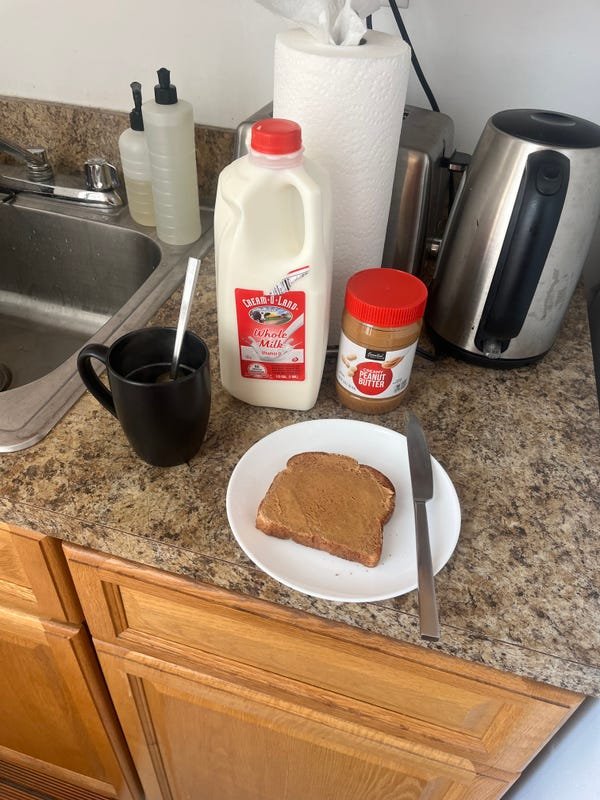
Breakfast: 1 piece of toast with peanut butter, coffee with milk
Lunch: Chicken breast, rice, and peas
Snack: 1 apple, 2 slices cheddar cheese
Dinner: Ground beef skillet with onion, carrot, cabbage, and rice
The vibe: This is a lot like how I ate when I was broke in my 20s. I remember why I’m not a big fan of peas. Thank God for cheese.
Breakfast. Emily Stewart/Business Insider
Food prep. Emily Stewart/Business Insider
The cheese <3. Emily Stewart/Business Insider
Day 3: Thursday
I’ve reached the “bargaining” stage of this endeavor quicker than I thought. I catch myself looking at the new and improved food pyramid multiple times throughout the day to see if there’s something affordable but delicious that I’m missing. Broccoli? An avocado? The official guidelines list kimchi, which seems like the coastal political elite seeping through. Also, it’s $10 in the grocery store, so no.
ChatGPT assures me the free seltzer water in my office is allowed, which is a treat. When someone in the office announces there are free Girl Scout cookies on her desk, I don’t bother asking the robot if that’s OK, because I already know the answer. I meet a friend for drinks after work and, somewhat ashamedly, explain that I can’t stay for dinner because I pitched what I have now definitely decided was a very stupid idea. I will probably cheat sooner rather than later, but not yet.
Breakfast: 2 hard-boiled eggs, coffee with milk
Lunch: Chicken, rice, and peas
Snack: 1 apple that I spent $1 on because I did not plan and forgot to bring one from home
Dinner: Ground beef skillet with onion, carrot, cabbage, and rice
Vibe: I have to find a way to mix this up tomorrow.
Mush 1. Emily Stewart/Business Insider
Mush 2. You can see the problem. Emily Stewart/Business Insider
Day 4: Friday
The point of food isn’t just nourishment — it’s pleasure. This is a sensation that this diet is severely lacking.
In the midst of my desperation, I text Morgan Dickison, a registered dietitian at Weill Cornell Medicine, to ask for advice. The first thing she asks after I show her my food diary is whether I’m hungry, which I’m not — I’m having some pretty big portions, and the food isn’t exactly triggering additional cravings. She suggests seeking out some herbs, spices, and flavored oils, budget permitting. This prompts me to take a harder look at the spices in my cabinet to see what I might be able to incorporate. Her most specific recommendation: Rao’s tomato sauce — it’s not ultra-processed, and there’s no added sugar. (This is not the case, unfortunately, with Rao’s pesto.) She also low-key recommends I cool it on so much red meat. I wonder what RFK would say.
I head to the grocery store to buy Rao’s, but over the course of my five-minute walk, I forget why I’m there. I leave with chicken, an avocado, broccoli, two tomatoes, and corn tortillas, totaling $12.62. I have $22.07 left. Plus the $1 apple, so $21.07. Despite blanking on the sauce, the Morgan consultation/pep talk inspires what has been my best meal yet. Things may be looking up.
Breakfast: 1 piece of toast with peanut butter, coffee with milk
Lunch: Beef skillet with onion, carrot, and lentils
Snack: Hard-boiled egg, 2 slices cheddar cheese
Dinner: Grilled chicken breast with mashed potatoes
Vibe: Real live dietitian >>>>> AI.
This tastes better than it looks.
Emily Stewart/Business Insider
Day 5: Saturday
I am pretty committed to this bit, but I also don’t want to be a freak. After a glass of wine at the Westminster dog show agility preliminaries (which is awesome), I realize I have to eat something, lest I be too buzzed to enjoy the amateur canine obstacle courses. I get an $8 chicken empanada, which almost certainly breaks the rules. I decide the day has no more rules and go out for dinner.
Breakfast: 1 corn tortilla with 2 slices of cheddar cheese, in a quesadilla-type situation
Lunch: 1 chicken empanada
Dinner: Don’t worry about it
Vibe: Between the very agile dogs and my cheat meal, I have had a great day.
The dog show empanada and, more importantly, a dog on the agility course, about to do “the weave.”
Emily Stewart/Business Insider
Day 6: Sunday
I wake feeling more confident about this experiment, thanks to my Friday dinner semi-success and probably the glow of Saturday’s rule-breaking. I make an actually good brunch-type situation, and by “I make” I mean I generally start some things and then my boyfriend, a much better cook, takes over.
For dinner, it’s too cold to go to the store, so I manage to scrounge up the ingredients from my boyfriend’s brothers’ apartment to make pasta and homemade pasta sauce. I use it to concoct the chicken Parmesan I’ve been thinking about since my failed Friday Rao’s trip. I’m not sure if this is completely allowed, with the pasta (which is organic!) and also chicken breading, but I’m following along in spirit.
Part of what set this exercise in motion was comments from Agriculture Secretary Brooke Rollins, where she recommended a meal composed of a piece of chicken, a piece of broccoli, a corn tortilla, and “one other thing.” This is what I choose for my lunch finale, adding a quarter of an avocado as my “other thing.” It’s pretty good, though I have to embiggen it from the description to make it actually filling.
Breakfast: 1 corn tortilla with 2 slices of cheddar cheese, ¼ avocado
Lunch: The Brooke Rollins Special — 1 corn tortilla, chicken, broccoli, and ¼ avocado
Dinner: Ground beef and chickpea skillet with broccoli
Vibe: Victory.
Thank you, Secretary Rollins, for the inspiration. Honestly, it was pretty good.
Emily Stewart/Business Insider
So what did I learn from the diet?
Doing the RFK diet on a $105-a-week food plan was not as hard as I thought it would be. I came in under budget by $13, even with the mid-week grocery trips and the dog show empanada (and not counting the Sunday freebies or Saturday cheat meal). But being on such a strict diet and budget did lead to some notable limitations. My regimen lacked any appreciable amount of variety, and it made eating into an act focused almost exclusively on survival.
I ask Dickison, the dietitian, for a final rating of my adventure once I wrap it up. She says that, like a lot of people, I have room for improvement with fruits and veggies, commends my integration of chickpeas and lentils, and says I did a good job with protein at every meal, even if I was too heavy on ground beef. The budget piece of this undertaking is the hardest part, she says. It makes it challenging to incorporate some of the new food pyramid recommendations, such as berries, fresh vegetables, and fish, and it’s not aligned with how people live. “When I’m speaking with patients, we talk about all the different ways that you get food,” she says. Sure, sometimes it’s cooking at home, but it’s also fast casual at the office, a restaurant on a night out, or delivery when people are pressed for time. “The more convenient the option, the more expensive it gets,” she says.
What’s also unrealistic: The ability to religiously follow such a rigid diet for an extended period of time. Hunger levels and cravings matter. “It can be really difficult to manage those biological drives and also this premeditated budget, even if you did have the best intentions,” Dickison says. I wish I could text her every day for food advice, but I fear she would block my number.
This funny little food journey of mine has coincided with a giant internet debate about some people using DoorDash too much and others scolding them for not cooking more at home. After a week of being bound to team cook-at-home, I’m overly sympathetic to team DoorDash, if only because I’ve spent the past week envisioning the treat I’m about to get myself — via my delivery app of choice, Seamless — now that this is all over. Variety is, as the eye-rolling adage goes, the spice of life. Being able to switch up not only the dish but also the delivery method from time to time is part of that.
The experience has made clear the sacrifices we constantly make around affordability, sustenance, and gratification when it comes to food. The cheapest option is never the healthiest option. The healthiest option is never the most thrilling option. The most thrilling option may be the cheapest, but it’s usually bad for you.
It’s an economic issue as much as it is cultural and political. When people on the lower end of the income spectrum — or public benefits — are told to focus on whole-food basics, they’re told to give up on ease and joy as well. When people rely too much on delivery, they’re almost certainly overspending, but they do so because it saves time and energy compared to an elaborate kitchen production. It’s true that it’s generally better to cook real meals with fresh ingredients at home. It’s also true that life is complicated, and for a variety of reasons, that’s not always possible. I probably could have stretched my budget just as far, if not farther, with frozen, preprepared options.
Ultimately, for most of us, dinner is less of an ideological project than it is a daily logistical problem — one that has to be solved, night after night, in perpetuity.
Emily Stewart is a senior correspondent at Business Insider, writing about business and the economy.
Business Insider’s Discourse stories provide perspectives on the day’s most pressing issues, informed by analysis, reporting, and expertise.
This story is available exclusively to Business Insider
subscribers. Become an Insider
and start reading now. Have an account? .
Of the 240 financial CEOs EY surveyed, only 28% see AI reducing head count in 2026.
Nearly half of the CEOs said AI is the most critical factor in their company’s ability to adapt.
Some Wall Street leaders have said AI will eliminate some roles, but ultimately increase head count.
Banks’ analyst classes probably won’t swap fresh-faced college grads for bots — at least not this year.
Some 60% of the 240 financial services CEOs that EY surveyed for its Quarterly CEO Outlook Survey said they think investing in AI will maintain or even increase their current head count in 2026. Only 28% of those surveyed predicted head count would drop this year.
Leaders at some of the biggest banks, including JPMorgan and Goldman Sachs, have said that they’re resisting hiring growth where it makes sense to prioritize efficiency. They, along with some other bulge-bracket leads, have predicted that AI could grow head count in the long run, though. Still, some roles are becoming obsolete: Citi CEO Jane Fraser said in a recent internal memo that some jobs “will no longer be required” as AI advances.
For their part, the financial services CEOs that EY surveyed are similarly bullish about AI’s capacity to transform the workplace, and nearly half see AI and digital investment as the most important factor in their companies’ ability to thrive and adapt this year.
Around a quarter said their AI initiatives have significantly beaten expectations, and 57% said they’ve shown results faster than expected. Just more than half said they expect the biggest transformations to come from generative AI.
When it comes to hiring for AI talent — itself a highly competitive market — 87% of CEOs in EY’s survey are optimistic about their ability to attract and keep talent in 2026. The question of returns on the AI investment, for talent and in general, also seems top of mind for the financial services leaders. Seventy-six percent of boards in the survey said they’ll review transformation ROI metrics as often as financial results.
Firms of all sizes are being asked to justify their AI spends, as analysts and investors begin to wonder whether the sometimes billion-dollar bets will show up on balance sheets.
On a Tuesday earnings call, Marriott’s outgoing finance chief, Leeny Oberg, said Marriott incurred a $23 million loss from terminating its contract with the luxury short-term rental company Sonder in November.
A Tuesday earnings report said the $23 million in charges came from termination expenses and the write-down of Marriott’s licensing agreement with Sonder. Oberg added that it was a one-time expense.
There were no other mentions in the earnings call of any fallout Marriott experienced because of the termination.
In November, Marriott made headlines for giving its guests staying at Sonder properties short notice to vacate. Affected guests that Business Insider spoke to said they scrambled to find alternative accommodations at exorbitant costs, and had their vacations ruined by the experience.
Every time Aditi publishes a story, you’ll get an alert straight to your inbox!
Stay connected to Aditi and get more of their work as it publishes.
Guests also described Marriott flip-flopping on its refund policy. The hotel chain initially assured guests who had booked Sonder properties through Marriott’s channels that they would get a full refund. A few days later, the guests were instructed to approach their credit card companies for refunds.
Sonder workers described the chaos and confusion of the messy breakup to Business Insider, saying they found out from the news that they would be losing their jobs.
Shortly afterward, Sonder, a onetime Airbnb rival founded in 2014, filed for Chapter 7 liquidation proceedings in a Delaware federal bankruptcy court. Its stock price crashed.
Despite the hit from Sonder’s termination, Marriott reported strong financial results in the latest quarter.
It reported its latest quarter revenue of $6.69 billion, a 4% increase compared to the same period the year before. Its revenue per available room increased 1.9% year on year. It had about 610,000 available rooms as of the end of December, per the Tuesday earnings report.
The company’s stock increased about 8.5% after earnings were announced on Tuesday. It’s up 18% in the past year.
Representatives for Marriott did not respond to a request for comment from Business Insider.
Kyiv officials warned that Ukrainians might be coerced into registering Starlink terminals for the Kremlin’s forces after a recent block on Russia’s access to the service.
Ukraine’s auxiliary body for handling prisoners of war posted a notice on Tuesday saying that it had learned of multiple instances where families of Ukrainian prisoners were threatened and told to enroll such terminals.
The warning comes after Ukraine’s defense ministry reached a deal with SpaceX earlier this month to cut off Russia’s access to Starlink by blocking general connectivity across Ukrainian territory.
“Looking for a way out of the difficult situation in which they found themselves, the occupiers turned their attention to the families of the prisoners,” the Coordination Headquarters for the Treatment of Prisoners of War wrote in a statement.
“Cases of threats and demands to officially register Starlink terminals have been recorded,” it added.
To maintain Starlink access, Ukrainian troops, civilians, and businesses must register individual terminals to a “whitelist,” either online or at municipal centers.
The sweeping move aimed to curb a black-market loophole that Russian forces were exploiting. In compliance with US sanctions, SpaceX doesn’t do business with Russia, but Ukraine has repeatedly said that Russian troops were obtaining terminals and using them to guide attack and reconnaissance drones.
In its latest statement, the Coordination Headquarters for the Treatment of Prisoners of War said that officials could trace the registration of terminals that were later used by Russian forces because enrollment requires an ID.
“If the terminal is used to control drones that destroy infrastructure and take lives, the fact of registering the terminal by a citizen of Ukraine is grounds for criminal prosecution,” the agency added.
Russia is not known to have a satellite internet service that compares to Starlink’s in terms of speed, availability, and stability.
“For the enemy, Starlink is so important that they have deployed a whole network to search for traitors who are ready to register Starlink for themselves in the Central Administrative Service,” wrote Serhii “Flash” Beskrestnov, a drone analyst and an advisor to Ukraine’s defense ministry, in a Telegram statement on Sunday.
In some cases, Russian troops were offering up to $230 to register a single terminal, Beskrestnov added. That’s roughly a third of the median monthly salary in Ukraine.
For the Kremlin’s forces, the service disruption has been significant enough that pro-Russian military bloggers have reported that most Russian units now lack internet access. Some have blamed Moscow for what they called a reliance on Western technology, even as the US and Europe explicitly back Ukraine.
“It’s about to suddenly become clear that units cannot operate effectively without communications. That’ll be news to some in high places,” one blogger, under the handle Belarusian Silovik, wrote.
Denying Russian access to Starlink had long been a priority for Ukraine’s new defense minister, Mykhailo Fedorov, who had previously advocated such measures while serving as minister for digital transformation.
This story is available exclusively to Business Insider
subscribers. Become an Insider
and start reading now. Have an account? .
Police have detained an individual in connection with Nancy Guthrie’s disappearance.
The Pima County Sheriff’s Department said the subject was being questioned about the case.
Nancy Guthrie, mother of “Today” show host Savannah Guthrie, has been missing for over 10 days.
The police have detained a person linked to the disappearance of “Today” show host Savannah Guthrie’s mother, Nancy Guthrie.
In a statement on X on Tuesday, the Pima County Sheriff’s Department said that earlier in the day, officials had detained an individual “during a traffic stop south of Tucson.”
“The subject is currently being questioned in connection to the Nancy Guthrie investigation,” the statement said.
This comes hours after the FBI and the sheriff’s department released videos of an individual in a full-faced ski mask arriving at Nancy Guthrie’s home in Tucson, Arizona, on the morning of her disappearance.
Officials described the individual as being armed and said that they had tampered with the camera on Nancy Guthrie’s front door. The videos were taken via her Google Nest doorbell.
The statement did not specify whether the detained individual was the one filmed in the Nest doorbell video. It added that additional information will be released as it becomes available.
Nancy Guthrie, 84, has been missing since February 1. Chris Nanos, the sheriff of Pima County, told the media that officials believe she was “taken out of her home against her will.”
Officials confirmed that the blood found on the porch of Nancy Guthrie’s home belonged to her.
A week after her disappearance, Savannah Guthrie said her family had received a message linked to her mother’s disappearance, and the family was willing to pay a ransom to get her back.
“We beg you now to return our mother to us so that we can celebrate with her,” Savannah Guthrie said in a video she posted on Instagram. “This is the only way we will have peace. This is very valuable to us and we will pay.”
This story is available exclusively to Business Insider
subscribers. Become an Insider
and start reading now. Have an account? .
Sunday’s Super Bowl was the second-most-watched after the 2025 game.
NBC’s broadcast, featuring a lopsided game and a Bad Bunny performance, was viewed by 124.9 million.
A new ratings calculation method introduced last year has helped boost ratings.
The Seattle Seahawks won Super Bowl 60 and so did NBC — but not by as much as they would have liked.
An average of 124.9 million people tuned in, per NBC Sports. NBC generated the second-most-watched Super Bowl — behind 2025’s game on FOX Sports — in its broadcast of the Big Game.It ended a two-year streak of record-breaking Super Bowl viewership.
Telemundo, however, delivered a record with the most-watched Super Bowl in US Spanish-language history with an average of 3.3 million viewers. That viewership peaked during Bad Bunny’s halftime show performance, with 4.9 million viewers.
Overall, viewership was an average of 128.2 million from 8:15 to 8:30 p.m. ET during Bad Bunny’s performance.
An all-time record 137.8 million viewers watched across NBC, Peacock, and Telemundo during the second quarter, according to NBC Sports.
Every time James publishes a story, you’ll get an alert straight to your inbox!
Stay connected to James and get more of their work as it publishes.
A more detailed breakdown will be available from Nielsen later this week, NBC Sports said in its press release.
Many major sporting events — including last year’s Super Bowl — have seen their ratings increase since Nielsen changed its ratings calculation in late January 2025 to better account for out-of-home viewing, such as people watching at restaurants and bars.
The college football National Championship Game drew in just over 30 million people, up about 36% from last year’s mark of 22.1 million and close to the all-time record of 33.9 million in 2015.
Under Nielsen’s prior ratings methodology, this year’s college football championship would have generated just over 28 million viewers. That’s based on an ESPN spokesperson telling The Athletic that the game’s ratings would have risen 27% year over year under the old format. In other words, out-of-home viewing appeared to add 2 million viewers to the game’s total.
So while Nielsen’s revamped viewership calculations may have affected Sunday’s ratings, it might not have made a massive difference.
XAI cofounder Jimmy Ba said he left Elon Musk’s startup on Tuesday.
“It’s time to recalibrate my gradient on the big picture. 2026 is gonna be insane and likely the busiest (and most consequential) year for the future of our species,” Ba wrote on X.
Ba reported directly to Musk. He ran a large portion of the company until late last year, when several of his responsibilities were split between two other cofounders, Tony Wu and Guodong Zhang, people with knowledge of the move told Business Insider.
Ba also previously ran the team that oversaw more than a thousand AI tutors, according to an org chart from earlier last year. That role was given to Diego Pasini in September, Business Insider previously reported.
Ba is the second cofounder to depart the company in less than 48 hours. Wu announced he’d resigned from the AI startup on Monday night. Wu’s Slack account was deactivated shortly before the announcement, Business Insider previously reported.
Ahead of Wu’s departure, xAI underwent another restructuring, and several of his responsibilities were shifted under Zhang.
Musk launched the AI company in 2023 with 11 other founders. Six have now left the company — five of them within the last year.
In addition to his work at xAI, Ba is an assistant professor at the University of Toronto in the computer science department. He received his Ph.D. from the school while studying under Nobel Prize winner Geoffrey Hinton, often referred to as the “godfather of AI.”
Musk has said he built xAI as an alternative to what he’s called “woke” chatbots, like OpenAI’s ChatGPT. Over the past year, the company has become known for pushing the envelope. Last July, xAI launched a sexy digital avatar called “Ani,” and its Grok chatbot went on an antisemitic rant.
Most recently, xAI has come under fire after Grok began generating nonconsensual sexual images of real people in response to X user prompts. The backlash eventually prompted the company to restrict Grok’s image-generation features on X.
Last week, Musk announced that xAI would merge with his rocket company, SpaceX. The company is reportedly gearing up for an initial public offering this year that could value SpaceX at $1.5 trillion.
Ba and xAI did not immediately respond to a request for comment.
Do you work for xAI or have a tip? Contact this reporter via email at gkay@businessinsider.com or Signal at 248-894-6012. Use a personal email address, a nonwork device, and nonwork WiFi; here’s our guide to sharing information securely.