Nvidia’s annual report, released Wednesday, came in leaner this year.
The chipmaker axed or trimmed sections on climate change and diversity, equity, and inclusion compared with last year’s version.
A 2025 section titled “sustainability and governance,” which delved into clean energy and emission commitments, was absent from Wednesday’s report. That report mentioned sustainability, but in the context of Nvidia’s business sustainability or adherence to sustainability-related laws.
The report published last year read: “These issues are important for our continued business success and reflect the topics of highest concern to Nvidia and our stakeholders.”
Next, a section on human capital was significantly cut. In 2025, the company included subheadings such as “Compensation, Benefits, and Well-Being” and “Diversity, Inclusion, and Belonging at Nvidia.” Neither section was included this year, and the word diversity was not mentioned.
Every time Shubhangi publishes a story, you’ll get an alert straight to your inbox!
Stay connected to Shubhangi and get more of their work as it publishes.
DEI efforts were summarized in one line this year: “We also utilize employee listening systems to gather feedback and maintain an inclusive culture where hiring and promotions are based on merit.”
Last year, President Donald Trump signed an executive order to end diversity programs across the federal government and ordered all federal DEI staffers to be placed on leave while their departments were disbanded.
It was a move that made waves in the private sector as well. Tech companies such as Microsoft, Meta, and Salesforce cut DEI programs. However, some companies, including Costco, have publicly defended their diversity initiatives.
Nvidia did not immediately respond to a request for comment from Business Insider about this year’s changes.
China focus
At 93 pages, Nvidia’s latest annual report was about 40 pages shorter than last year’s. Still, China got moreairtime.
Besides recapping the US government’s chip export restrictions on China, Nvidia wrote that under the current rules, it cannot deliver a competitive product for the Chinese data center market. The company added that this allowed rivals to build larger customer bases worldwide.
“Our lost opportunity and the benefit to our competitors will have a material and adverse impact on our business, operating results, and financial condition,” the report read.
The company said its estimates for the current quarter did not include any expected revenue from sales of data-center chips to China.
On Wednesday, Nvidia reported better-than-expected fiscal year 2026 earnings, owing to strong AI data center demand. It reported $68.1 billion in revenue, a 73% year-over-year increase, and about $43 billion in profits, 94% higher than the same time last year.
The chipmaker’s stock was up slightly after hours.
I thought I was on track — until the year everything fell apart.
Just weeks into January 2023, I was blindsided by an unexpected breakup. In the months that followed, I moved through my days on autopilot, watching the year continue to unravel.
That May, I was laid off from my job coordinating large conferences and corporate travel. I took a position at a family-run wedding business that was building out its travel department. I told myself things were starting to look up.
But between a 90-minute commute, sitting at a desk all day, and performing mundane tasks not listed in my job description, I began to spiral instead of heal.
Almost every day, I’d retreat to my car at lunchtime and break down in tears, overwhelmed by how unhappy I was.
The “American dream” began to feel like a trap
Since I was a kid, I’d treated success like a checklist built from American expectations I absorbed through school, TV, and social media. It seemed simple enough: Stay in line with peers, get married before turning 30, and buy a big house to raise a family in.
It was becoming clear that this narrative might not align with the life I wanted for myself.
Later that same year, I dealt with a toxic roommate, a serious health scare in my family, and a car accident. Then, just days before the New Year, I got one final surprise: another layoff. This time, however, I felt relief.
Walking out of that office for the last time allowed me to stop chasing a version of success I knew would never satisfy me.
Distance changed the pressure I was living under
As 2024 began, I set a clear goal for myself to sublet my apartment, sell my belongings, and board a one-way flight to South Korea by April 15. My plan was to begin an eight-month journey across Asia and Australia. After four months of careful planning, I boarded that flight.
Starting the trip with a friend in Seoul made the beginning — and the 15-hour flight over — feel safe and manageable. When she boarded her flight back to the US, and I headed off to Thailand alone, that distraction disappeared. I was officially left alone with my own thoughts.
Early on in Southeast Asia, I questioned what I was doing and where it would all lead. I cried in hostels and had panic attacks on the back of motorbikes. My anxiety was triggered by the blasting music of Bangkok’s Khao San Road and Ho Chi Minh City’s endless traffic.
Strum escaped the pressure she’d been living under while traveling through the mountains in northern Vietnam.
Provided by Macie Strum
The more I took note of my surroundings, the less the world around me matched the urgency in my head.
As I traveled the Ha Giang Loop in Northern Vietnam by motorbike, I realized that my idea of success was built upon a level of pressure that didn’t exist up in these Vietnamese mountains. Local life didn’t revolve around strict deadlines and productivity scales. Instead, it centered on routine, family, and staying present each day.
As I moved through each country, I connected with travelers of every age and background, many of whom were unemployed, exploring new paths, working online, or simply figuring things out as they went. Some were meticulous planners; others lived day to day.
In the jungles of Malaysian Borneo, I met a fellow American who was also redefining her life after a heavy breakup. I remember the first night we met, we talked for hours about life, expectations, and the fear of what would come next.
We ended up traveling together to Kuala Lumpur, meeting again in Penang, and later in Bali. Seeing her in so many different places reminded me how many others were navigating the same uncertainty.
It reframed my view of travel — not as a break from real life, but as an active part of it. For the first time, uncertainty no longer felt like failure.
She’s building her career in Sarajevo, Bosnia and Herzegovina.
Provided by Macie Strum
I’ve redefined success
When that trip came to an end, I felt no pull toward the life I’d left the year before.
I returned to the US briefly, but chose to keep traveling to explore what alternative versions of success could look like for me.
In 2025, that decision took me to 17 European countries. As I explored, I found myself falling in love with one of the continent’s most misunderstood regions: the Balkans.
Today, I live in Sarajevo, Bosnia and Herzegovina, building a career as a freelance journalist without sacrificing my ability to travel. While the life I’m creating may not match the version of success I was raised with, it’s more aligned with how I want to live: flexibly, deliberately, and with purpose.
While I don’t know exactly what comes next, that no longer scares me the way it once did.
Do you have a story to share about living abroad? Contact the editor at akarplus@businessinsider.com.
Ukrainian President Volodymyr Zelenskyy said on Wednesday that his country had struck a Russian military industrial plant with locally made cruise missiles that flew nearly 900 miles to reach their target.
Ukrainian officials earlier reported that the missile strike on Saturday had hit a plant in Votkinsk, an industrial town in Russia’s Udmurt Republic, some 860 miles from the Ukrainian border.
“We carried out precise strikes with Flamingo missiles at a range of 1,400 kilometers,” Zelenskyy said at a press conference in Kyiv. “I believe this is truly a success for our industry.”
Such an attack would be one of the longest-range strikes carried out so far by the Flamingo, which is touted as one of the star products in Ukraine’s local defense manufacturing scene. Kyiv has been aggressively trying to expand its weapons industry as a complement to Western supplies and as a future export sector.
The Flamingos’ target, the Votkinsk plant, manufactures some of Russia’s key munitions, such as ballistic missiles for the Iskander system and the submarine-launched Bulava missile.
Every time Matthew publishes a story, you’ll get an alert straight to your inbox!
Stay connected to Matthew and get more of their work as it publishes.
Russia has not officially confirmed that the factory was hit, but Alexander Brechalov, the governor of the Udmurt Republic, said on Saturday that an unspecified facility in the region had been attacked and three people were sent to hospital.
Brechalov did not say if the Flamingo was used, but warned against drone threats over the region.
Ukrainian open-source groups later published satellite images that appeared to show damage to one of the workshops at the Votkinsk factory, with a gaping hole in its roof and signs of fire damage.
That evening, Kyiv had unleashed a large wave of drones and missiles into Russia in one of its biggest ever long-range attacks.
Russia’s defense ministry said that it shot down 77 Ukrainian drones on Saturday, but did not mention any Ukrainian missile threats.
Zelenskyy declined to say how many missiles or drones Ukraine launched in total on Saturday.
“There were interceptions by Russian air defense, there were also missiles that were not intercepted, and there were direct hits,” Zelenskyy said. “But the most important thing is that all the missiles that were launched all reached the target.”
Kyiv has often compared the Flamingo to the US-manufactured Tomahawk, saying that the Ukrainian turbofan-powered missile is much cheaper to make per unit and has a longer range of 1,900 miles.
The ground-launched Flamingo, however, takes up to 40 minutes to prepare for launch.
Ukraine is also still trying to build up its arsenal of the missile, with reports from last October saying that its manufacturer, FirePoint, hoped to produce up to seven a day by the end of 2025.
Kyiv said earlier this month that manufacturing had been affected by a recent Russian strike, with Zelenskyy warning that Ukraine had to “work on increasing quantity” of the Flamingo.
“We had certain technical problems because one large production line was destroyed as a result of a missile strike. They have already relocated and resumed production,” Zelenskyy had said at the time.
Hilary Duff, 38, says she walked away from her first marriage because she didn’t want to sacrifice her own happiness — even as a young mom.
On Wednesday’s episode of “Call Her Daddy,” the “Lizzie McGuire” star spoke about navigating a divorce in her late 20s and how motherhood shaped her approach.
Duff split from her first husband, Mike Comrie, in 2015. They share a son, Luca, who was born in 2012.
“I knew from my parents’ divorce that I was going to show my kid that you’ve got to fight for your happiness. And I knew that it was going to be better to do it when he was younger than it was going to be when he was five and aware, or eight and aware,” Duff told podcast host Alex Cooper.
Duff added that kids can sometimes blame themselves when their parents’ marriage doesn’t work out.
“I was like, if Luca cannot remember this and have two lives that exist that he can be happy in and feel secure in, I think we’re winning,” she said.
Duff said therapy was essential in helping her process the end of her marriage, and ultimately, the experience taught her to stand up for herself.
“You’ve got to fight for yourself, and it doesn’t matter that you have kids. Your kids are going to be OK. You know what I mean? You just have to show them that you also matter,” Duff said.
As a parent, it’s easy to lose yourself in your child and feel like their needs should outweigh your own, she said. But she added it was also “important” not to let that be the deciding factor in whether she stayed in an unhappy marriage.
Duff added that mom guilt can sometimes overshadow her own feelings.
“There’s this part of your brain where you’re like, ‘Yeah, I’m still in here, and I’m still me,’ and then there’s this huge shadow over it that’s like, ‘But everything for the family and everything for your kid,'” she said.
Duff added that finding balance between motherhood and her own identity is something she has to work at.
“It’s a constant conversation to choose yourself and choose something you know that you enjoy outside of family life and kids,” she said.
In 2019, Duff married Matthew Koma, and the couple has three daughters.
Duff isn’t the only celebrity who has spoken about navigating divorce with kids.
In a 2022 podcast appearance, Kim Kardashian said she tries to protect Ye, formerly known as Kanye West, in the “eyes of my kids, for my kids.”
“One day my kids will thank me for not sitting here and bashing their dad when I could. They’ll thank me and I’ll privately answer anything that they want to know. But it’s not my place anymore to jump in,” she said.
In February, Miranda Kerr said choosing forgiveness helped her co-parent peacefully with her ex, Orlando Bloom.
“When you have a child with someone else, they’re always going to be that person’s parent for the rest of their life. There are going to be situations where you’re going to need to talk if you like it or not. So why not make it harmonious?” Kerr said.
Nvidia moved quickly to calm investor nerves during its earnings call on Wednesday.
The chipmaker delivered another blowout earnings report that underscored how little momentum the AI boom has lost. As the world’s most valuable company by market capitalization, Nvidia topped Wall Street expectations across the board in its fiscal fourth quarter and issued a forecast that sailed past analyst estimates.
The upbeat results arrive at a delicate moment for AI-linked stocks, which have recently shown signs of fatigue.
From incorporating Groq into Nvidia systems to an update on the new Vera Rubin chips, here are the biggest takeaways from Nvidia’s fourth-quarter earnings call.
1. Nvidia is becoming the backbone of Big AI
Over the course of the call, CEO Jensen Huang repeatedly positioned Nvidia at the center of the AI industry’s biggest players.
OpenAI’s latest Codex model is trained and runs on Nvidia’s Blackwell systems, and the companies are close to reaching a multibillion-dollar partnership, he said.
Meta is deploying Nvidia GPUs in its push toward superintelligence, and Nvidia also announced an up to $10 billion investment in Anthropic.
Huang said his goal is to ensure that every form of AI — from large language models to robotics — is built on its platform.
“We want to take the great opportunity that we have as we’re in the beginning of this new computing era, this new computing platform shift, to put everybody on Nvidia,” he said.
2. Huang teases Groq integration as AI shifts to inference
When asked about Nvidia’s future road map and whether it plans to build customized chips for specific workloads, Huang said the company prefers to keep as much as possible within a single design.
That said, he teased a potentially significant move involving Groq, saying more details would come at Nvidia’s GTC conference in March.
Late last year, Nvidia struck a non-exclusive licensing agreement with Groq for its low-latency AI inference technology — a deal that also brought Groq’s founder and other top engineers on board.
“What we’ll do is we’ll extend our architecture with Groq as an accelerator in very much the ways that we extended Nvidia’s architecture with Mellanox,” Huang said, referring to the networking company Nvidia acquired in 2020.
As AI workloads shift from training large models to running them, the move suggests Nvidia isn’t going to abandon its core platform but rather fold specialized inference capabilities in.
3. Samples of the Vera Rubin chips have been shipped
Nvidia has begun shipping early samples of its next-generation Vera Rubin chips to customers.
Chief Financial Officer Colette Kress said during the earnings call that the company delivered “our first Vera Rubin samples” earlier this week and expects broader shipments of the new chips to begin in the second half of 2026.
“We expect every cloud model builder to deploy Vera Rubin,” Kress said.
Huang previously said at the Consumer Electronics Show in January that compared to the Blackwell model, Rubin has more than triple the speed, could run inference five times faster, and can deliver significantly more inference compute per watt of energy.
4. Addressing future risks
Nvidia appears concerned about whether there will be enough resources to sustain the demand for data centers.
In its latest 10-K report filed with the Securities and Exchange Commission, Nvidia listed the availability of data centers, energy, and capital to support the data center buildout as a risk factor, writing that “any shortage of these and other necessary resources could impact our future revenue and financial performance.”
“Expanding energy capacity to meet demand is a complex, multi-year process involving significant regulatory, technical, and construction challenges,” wrote Nvidia.
“In addition, access to capital can be particularly constrained for less-capitalized companies, which may face difficulties securing financing for large-scale infrastructure projects,” Nvidia added.
5. An OpenAI deal may finally be ‘close’
Huang addressed the company’s growing slate of strategic investments, including a deal with OpenAI, as questions mount over whether Nvidia’s strategy creates circular relationships with its own customers.
Speaking about Nvidia’s investments in AI companies such as Anthropic and OpenAI, Huang said the strategy is centered on strengthening the broader AI ecosystem and ensuring the next generation of software and hardware is built on Nvidia’s platform, from large language models to robotics.
“We want to take the great opportunity that we have, as we’re in the beginning of this new computing era,” Huang said.
Huang confirmed that Nvidia is “close” to finalizing a deal with OpenAI. The partnership was first outlined in 2025 as part of a massive AI infrastructure initiative that could reach $100 billion.
The AI data center boom has triggered a dramatic spike in electricity costs, and President Donald Trump has a plan to stop it.
To do this, Trump said at Tuesday’s State of the Union address that he issued a mandate for data centers to build their own power plants.
Trump said he’d “negotiated” a ratepayer protection pledge with major technology companies and billed it as a unique solution to Big Tech’s mounting power demand that would also protect American consumers from higher electricity bills.
“They can build their own power plants as part of their factory,” Trump said.
Many data center sites have already started building their own power plants. The vast majority of this buildout will initially run on fossil fuels, despite tech giants’ clean energy commitments.
Every time Ellen publishes a story, you’ll get an alert straight to your inbox!
Stay connected to Ellen and get more of their work as it publishes.
When reached for comment on Wednesday morning, a White House spokesperson gave the following statement: “Major Tech companies will join President Trump at the White House next week to formally sign the Rate Payer Protection Pledge that he announced during his historic State of the Union address. Under this bold initiative, these massive companies will build, bring, or buy their own power supply for new AI data centers, ensuring that Americans’ electricity bills will not increase as demand grows. President Trump is committed to ensuring American AI dominance while simultaneously lowering costs for working families.”
A spokesperson for Amazon confirmed to Business Insider that it will attend the White House next week.
“The Ratepayer Protection Pledge is an important step. We appreciate the Administration’s work to ensure that data centers don’t contribute to higher electricity prices for consumers,” Microsoft vice chair and president Brad Smith wrote in an e-mailed statement.
A spokesperson for Anthropic referred Business Insider to a post on X made last night by Sarah Heck, the company’s head of external affairs.
“American families shouldn’t pick up the tab for AI. In support of the @WhiteHouse ratepayer protection pledge, Anthropic has committed to covering 100% of electricity price increases that consumers face from data centers,” Heck wrote.
Microsoft, Anthropic, and OpenAI have previously announced commitments to covering the costs of electricity consumption at their data centers, though details on those plans remain scant.
Big Tech is building its own power plants
In the last year, on-site power plants fueled mostly by natural gas have emerged as a key strategy for data center developers looking to stay ahead in the AI race. Meanwhile, US power demand has reached record highs.
Utilities in the US last year asked state regulators to approve $31 billion in rate increases, more than double the amount sought in 2024, according to research from PowerLines, a nonprofit advocate for utility customers. Many of those requests occurred in places experiencing heavy data center development, such as Virginia, Texas, Utah, and North Carolina.
Trump has framed data center developers building their own power plants as part of his broader promise to ensure that Big Tech pays for the infrastructure needed to power AI ambitions. For developers, building an on-site power plant can bypass long wait times for a grid connection.
Elon Musk’s xAI is the most prominent example of this. Musk has drawn intense scrutiny in Tennessee and Mississippi, where he has deployed unpermitted mobile generators to quickly get his data centers up and running.
Musk brought his first mobile generators to Memphis in 2024. In the US, dozens of data centers — about 30% of all planned data center capacity in the nation — plan to build their own power plants, according to a report issued this month from Cleanview, a data visualization software company that tracks clean energy and data center projects. Nearly all of that planned capacity — 90% — was added in 2025, Cleanview found.
In a review of permit documents, corporate filings, press releases, and local news stories, Cleanview identified 46 data center projects, many of them already under construction, that plan to draw power “behind the meter” by building on-site, private power plants that don’t need a grid connection or service from the local utility to run.
These include Meta’s plans to build an on-site natural gas plant for its data center in New Albany, Ohio, as well as Oracle and OpenAI’s plans to power their Project Jupiter data center site in New Mexico with two massive natural gas-fired systems.
While Big Tech companies often tout their commitments to clean energy, Cleanview’s review of behind-the-meter permit documents found that natural gas powered 75% of all equipment listed.
Tech companies have said they want to power AI with clean technology, such as small modular nuclear reactors and geothermal energy. Much of it is still years away from being deployed at scale.
Texas is becoming the top state for new data centers
Cleanview found that more than one-third of the behind-the-meter buildout is happening in Texas, which could soon overtake Virginia as the data center capital of the world.
Business Insider has reported on Oracle and OpenAI’s plan to power Stargate data centers in Texas with on-site natural gas plants, as well as Fermi America’s pitch to build the world’s largest combined data center and power plant in the state’s Panhandle region.
After Texas, the top five states with the most planned behind-the-meter capacity are New Mexico, Pennsylvania, Utah, and Wyoming. West Virginia, Tennessee, Ohio, Virginia, and North Carolina also have significant behind-the-meter projects.
Have a tip for this reporter? Contact Ellen Thomas at ethomas@insider.com or on Signal at 929-524-6964.
Shield AI’s artificial intelligence pilot has flown one of the US Air Force’s next-generation drone wingman contenders for the first time, the company announced this week.
Shield AI’s Hivemind, the same AI program that previously went head-to-head with a crewed fighter aircraft in aerial combat, was picked by the Air Force for autonomy testing as part of its Collaborative Combat Aircraft, or CCA, effort earlier this month. Now, it has flown Anduril’s CCA competitor, an achievement for the software that could pilot future uncrewed aircraft built to fly and fight alongside crewed US combat aircraft.
The US defense company said Hivemind, piloting Anduril’s Fury drone, also known as YFQ-44A, completed its first flight test over the Mojave Desert. The AI pilot met all required test points, including mid-mission updates and basic operational maneuvers, the company said.
The successful test opens the door for expanded mission autonomy testing with Hivemind, Shield AI said.
“This flight test showcases the potential of airpower built on mission autonomy,” Christian Gutierrez, vice president of Hivemind Solutions, said.
“Across platforms, domains, and environments, Hivemind provides resilient mission autonomy, proving that software is central to the future of airpower,” Gutierrez said, adding that “our collaboration with Anduril reflects a new era of defense acquisition, where autonomy is treated as a foundational warfighting capability on par with the aircraft itself.”
Shield AI has spent more than a decade developing Hivemind’s AI software, which is designed to perform many of the tasks of a human pilot. Unlike autopilot or other autonomous features, Hivemind is built to make real-time decisions, adjusting flight routes depending on conditions or obstacles to continue a mission, the company says.
The same AI software was used in the Air Force’s AI-enabled X-62A VISTA, a modified F-16 that flew simulated dogfights against a crewed fighter aircraft in 2024. The service has not publicly revealed which aircraft emerged victorious in those engagements.
Hivemind is also the AI pilot behind Shield AI’s new X-BAT fighter aircraft, which the company unveiled in October. Shield AI says that the X-BAT can operate without human intervention and take off without runways, as well as in contested environments where GPS and reliable communications might not be available.
Anduril’s Fury aircraft is one of the competitors for the CCA program, a priority of the Air Force that envisions uncrewed aircraft operating alongside crewed aircraft with some mixture of autonomy and human direction. Earlier this month, a test flight saw a CCA stand-in aircraft communicate and fly with an Air Force F-22 Raptor, marking another step forward in the CCA program.
On Wednesday, Col. Timothy Helfrich, the Air Force’s portfolio acquisition executive in fighters and advanced aircraft, commended the speed of work being done on autonomous pilots flying CCAs. “Quite an accomplishment going so quickly,” he said at a panel, “but we’ve got a lot ahead of us though.”
This as-told-to essay is based on a conversation with Tim Desoto, a 49-year-old founder and CEO, based in San Francisco. The following has been edited for length and clarity.
I’ve been working on my startup, an AI-powered shopping platform, since late 2024. With all the advancements in the tech industry, people might think of AI as a hammer, treating everything else as a nail, and in my experience, that just doesn’t work.
I don’t have a tech background, and since starting my business, I’ve learned a lot about where to leverage AI, and where not to. I’m always trying to be flexible about when to switch from AI to human intervention, and vice versa.
Over time, it’s become clearer to me where and where not to use AI for my business.
I rely on my network and social media to help me decide which AI tools to use
I’m fortunate to live in San Francisco. I go to meetups to hear what people are using, and I’ve attended some developer conferences. My ears always perk up when I hear that a new tool or version of something is working for somebody else in my network.
Right now, there’s a strong focus on agentic workflows. OpenClaw generated buzz as an open-source autonomous agent project, and Moltbook amplified that attention by making agent-to-agent interaction visible in a social environment. Claude Cowork is also gaining traction, particularly among teams looking for enterprise-ready agent workflows with clearer guardrails.
Desoto’s startup, Goodlife, is an AI-powered shopping platform.
Zachary Fineberg for BI
Beyond the agents themselves, the focus is moving from “what can agents do?” to “how do we run them reliably and securely at scale?”
Whether I’m looking at X, LinkedIn, or other platforms, there’s a lot of really great work being done to share these updates.
I use AI for all the typical time-saving tasks
My paid stack includes business plans for models such as Claude Max, Gemini Ultra, and ChatGPT Business, along with AI-powered development and productivity tools such as Cursor, Figma Make, Notion AI, Superhuman Ask AI, and Lovable.
Gemini’s image models have become incredible. The latest updates to the new model have really improved everything. I noticed faster performance, more stable reasoning, and stronger multimodal capabilities, especially in image generation. I was impressed by how consistent the images remained during modifications. I’ve even noticed some improvements in the responses it gives about real-time information.
Desoto uses AI models like ChatGPT and Gemini every day to help him run his business.
Zachary Fineberg for BI
I divvy up which tools I’m using based on where the latest developments are, and use them either as they’ve been designed or as I think I can use them in my current operational flow. For example, I use Lovable, an AI website builder, to make slide decks.
My ‘AI conveyor belt’ exercise helps me test different AI models
Usually, I start with a written prompt, then go multimodal, talking out loud to the model. I’ll talk back and forth with it about my idea and try to get the agent to push back because I know that some AI models tend to be more agreeable.
Once I get an output that I’m happy with, I use a different model to get a different view. For long-form analysis and structured insights, I lean toward Claude and Gemini. Gemini’s inline source linking is particularly useful for verification and deeper research. For structured reasoning and formal writing, I primarily use ChatGPT and Claude.
Sometimes, I’ll push a document out to multiple models at the same time and see what comes back simultaneously. For creative exploration and multimodal work, I use both Gemini and ChatGPT to generate early-stage concepts, mockups, and visual inputs. Some models are better than others at certain tasks, but I’m always getting a more well-rounded perspective by feeding content to multiple models.
The process can take as little as 15 minutes, or higher-impact decisions can span several hours to a couple of days, depending on complexity.
I eventually needed human developers
Desoto vibe coded the alpha of his product before bringing in developers to speed up production.
Zachary Fineberg for BI
When I was vibe coding the alpha version of my product, I would hit spots where 30 or 40% would be wrong. I didn’t know what exactly the problem was. I would have multiple screens running the code to figure it out, and I’d continue to use AI against AI until I could get to about 95% confidence.
I contracted a few developers to help move my product forward. Now I have a product developing at a faster, much more robust, and scalable rate.
As much as I can do with AI, it’s amazing what technical people can do with AI tools that a non-technical person can’t.
The human perspective is still irreplaceable in my business
I reached out to a lot of informal mentors and friends in the space who could be helpful early on in my process, but recently I formalized having advisors to bounce things off of. That has been a huge feather in my cap.
These advisors have their own expertise to draw on, and they know many smart people in this space working on projects that have helped us identify potential blind spots. It’s helped me connect with potential partners in ways that I think would be more difficult as a solo founder.
AI does a lot for Desoto, but it can’t replace human judgment.
Zachary Fineberg for BI
I feel like I have a clearer view now of what I can trust AI for, compared to what I thought at the beginning of my journey. While issues like hallucinations and agreeability can be mitigated, long-term strategic judgment and taste still require human oversight.
AI can generate possibilities, but choosing the right direction remains a human responsibility.
Do you have a story to share about running an AI-powered business? Contact this reporter, Agnes Applegate, at aapplegate@businessinsider.com.
This as-told-to essay is based on a conversation with Lora Pope, 36, a content creator and blogger, originally from Canada, who hosts three Airbnbs in Puerto Vallarta, Mexico. Pope was away during the violence in Jalisco, but was still in contact with her guests. The conversation has been edited for length and clarity.
Puerto Vallarta is my home base.
I went there for the first time in 2021 while I was a full-time digital nomad. In 2023, I bought an apartment in Puerto Vallarta and obtained residency, but I still travel for about 6 months of the year.
I own a one-bedroom condo that I rent out when I’m traveling, but I also have some long-term properties that I rent and then sublease on Airbnb — it’s called Airbnb arbitrage. You rent them, then sublease them with the owner’s permission.
I manage the Airbnb accounts and handle all guest messaging; everything falls under my purview. I just pay rent to the landlord every month. I started that in May 2025.
Every time Jordan publishes a story, you’ll get an alert straight to your inbox!
Stay connected to Jordan and get more of their work as it publishes.
Pope’s condo in Puerto Vallarta, Mexico.
Courtesy of Lora Pope.
I was actually in Mexico City during the recent violence, so I wasn’t there during the event. Still, all my places are booked out right now.
I tried my best to give my guests all the information I had
When I woke up Sunday morning, I had a ton of messages from my friends in Puerto Vallarta showing videos of the explosions. I wasn’t too sure what was happening because there was a lot of information coming quite rapidly.
I waited a few hours to gather more information about what was happening. I was already receiving some messages from guests.
One of them was obviously alarmed. I reached out to the other two just to make sure that they were OK.
At that point, there were a lot of rumors running around, and people were saying, “Don’t go outside. They’re threatening civilians.” I don’t even think that was an official thing, but just to be safe, I told my guests, “Please stay inside.”
A lot of people were asking me, “What is your opinion? What do you think? What should we do?”
I think the thing people were most concerned about was food, because, obviously, people are on vacation, and they hadn’t stocked up the kitchen, knowing that was going to happen.
One of Pope’s Airbnb properties in the Cinco de Diciembre neighborhood of Puerto Vallarta, Mexico.
Courtesy of Lora Pope.
I have filtered water in all of my apartments, so I knew they had water, but I was mainly concerned about whether they had to stay inside for days, and if they could get by.
Luckily, all of them had enough food for that day. And by Monday, things had already calmed down a lot, and the grocery stores opened up, so they were able to get food.
I’ve thought more about natural disasters because we have had earthquakes or bad hurricanes in the past, but I’ve never thought about something like this because Puerto Vallarta has historically been one of the safest places in Mexico.
I was sharing any official information I had from the municipality, trying to help my guests stay as calm as possible, and just letting them know I was there. And if they needed anything, I would do my best to get it. It was a pretty stressful situation.
Whenever I travel, I always have someone in Puerto Vallarta as my backup — like an emergency contact. And she offered to do what she could to help.
I’ve already had a few cancellations, but I’m hoping this doesn’t crush the long-term tourism economy
My properties are very much in affected areas. As far as I know, I haven’t had any reports of damage to my properties. Everything has been good. I’ve been in constant contact with my neighbors. I don’t think the intention was to harm civilians.
The guests that I currently have have not talked about leaving early. The first day, I think there were a lot of flights being canceled, so it was quite difficult to leave early.
Now, it seems like flights are resuming. My guest in Cinco actually reached out Monday, saying they were worried about their flight being canceled and asking if the apartment was available to stay longer if needed.
I have had a few cancellations for future bookings, though.
I had one guest, who was supposed to check in on Wednesday at the Zona Romántica apartment, reach out on Monday to ask me for my opinion on the situation and whether it was safe to travel there.
Another Airbnb property hosted by Pope.
Courtesy of Lora Pope.
At the time, there was still a lot of uncertainty about whether it would get better. She ended up canceling on Tuesday. Airbnb has, because it’s considered a major disruptive event, waived the cancellation policy. So even if my cancellation policy says you must cancel within five days, Airbnb will waive the cancellation for them, given the circumstances.
So far, I’ve had three future cancellations — I would assume that those are due to the event.
I really hope this doesn’t affect business down the line. I do think it’s definitely going to have an immediate effect. I just know people can get really spooked, and there’s already a lot of fearmongering that happens about Mexico. So I do think this is going to impact people’s perceptions and maybe make them feel less safe coming here, which is really unfortunate.
From what I’ve heard, Puerto Vallarta is already returning to normal — not that I’m minimizing what happened on Monday. As I said, Puerto Vallarta has always been one of the safest places in Mexico to live or visit. But I am definitely concerned about the immediate impact on the rest of the high season.
Pope in Puerto Vallarta, Mexico.
Courtesy of Lora Pope.
These properties are pretty important — they make up at least half my income. I am trying not to panic too much about the situation right now because it’s so recent.
I don’t think it’ll get to the point where I can’t cover my rent, but it’s definitely a scary thought, how much this is going to impact tourism.
For next year, I hope that, over the course of the year, as people see things are fine and visitors to Puerto Vallarta are having a good time, it’ll fade from their memories, and we’ll come back stronger.
It’s always been a really popular tourist destination, so I think in the long term it’ll be OK.
An Airbnb spokesperson told Business Insider in a statement, “We are monitoring this situation carefully and are focused on supporting guests and hosts in impacted areas. We have implemented our Major Disruptive Events Policy in the entirety of Jalisco, as well as other impacted regions, providing cancellation and refund support. We encourage any members of our community who need assistance to reach out to our 24/7 support team.”
This story is available exclusively to Business Insider
subscribers. Become an Insider
and start reading now. Have an account? .
Usha Vance’s fashion has been in the spotlight since she became the second lady.
Her best looks have been sparkly ball gowns and outfits with bright colors.
Sometimes, the second lady’s outfits don’t suit the event she is attending.
Usha Vance is finding her fashion footing as second lady.
The former lawyer and mother of three started off her tenure in brightly colored outfits and sparkly gowns during inauguration week in January 2025. In her first year as second lady, she wore a variety of outfits for her public appearances, from gowns and suits to jeans and sweaters.
Though she’s had standout fashion moments in the spotlight, they haven’t all been wins. Take a look at the best and worst outfits Vance has worn as second lady so far.
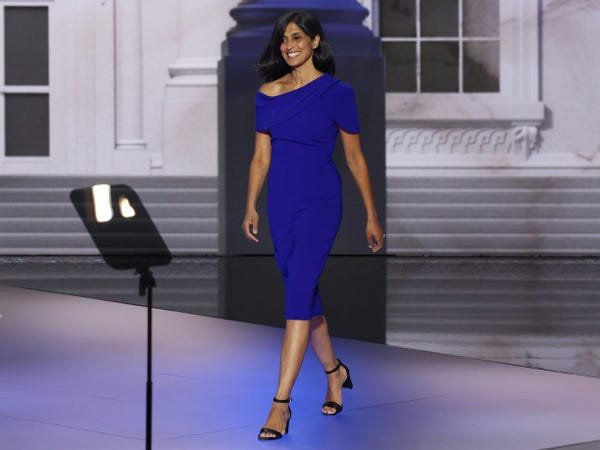
Usha Vance set the tone for her second lady style at the Republican National Convention in July 2024.
Usha Vance at the Republican National Convention in July 2024. Robert Gauthier/Los Angeles Times via Getty Images
Though Vance wasn’t the second lady yet, she shared a glimpse of what her fashion in the role could look like while on the campaign trail.
In July 2024, she spoke at the RNC in a knee-length, form-fitting dress designed by Badgley Mischka.
The bright blue color was a refreshing choice for the event, and the combination of the traditional silhouette and asymmetrical neckline gave the look a modern feel.
Vance completed the outfit with black, open-toed heels.
The outfit Vance wore at a rally the same month was a bit too plain.
JD Vance and Usha Vance at a rally in July 2024. Scott Olson/Getty Images
Vance accompanied her husband to a rally in Ohio in a light-gray top with a belt at her waist. She paired it with gray trousers.
The outfit would work well as a laid-back office look, but the neutral tone and casual feel were underwhelming for the rally, particularly next to her husband’s suit.
Her floral dress for an August 2024 rally popped in a sea of suits.
JD Vance and Usha Vance at a rally in August 2024. JEFF KOWALSKY / AFP / Getty Images
In contrast to her gray look, Vance attended a rally in August 2024 in a wrap dress with an exaggerated collar.
Covered in an orange, floral pattern and flaring around her legs, the outfit was both summery and professional. It also contrasted nicely with her husband’s blue suit and tie.
The balance was a bit off in her jacket and floral skirt for an October 2024 rally.
JD Vance and Usha Vance at a rally in October 2024. Scott Olson/Getty Images
Vance’s next floral look wasn’t as strong as her August look. She attended an October rally in a blue high-neck top, a blue blazer, and a high-waisted skirt covered in yellow flowers.
The patterned skirt was cute, but it almost contrasted too much with her simple top and jacket. The outfit would have felt more cohesive if she had also incorporated yellow into the top half.
The second lady wore a slew of stylish looks during inauguration week in January 2025, starting with a strapless black dress.
JD Vance and Usha Vance at the National Gallery of Art in January 2025. Eric Thayer/Getty Images
She stood out repeatedly the week her husband was inaugurated as vice president, starting with the black Oscar de la Renta gown she wore to a reception at the National Gallery of Art.
The strapless gown featured a sweetheart neckline, an asymmetrical hemline, and crystal brooches on the bodice. It was elegant and had just enough sparkle to stand out.
The same month, her white coat for a wreath-laying ceremony popped next to Melania Trump’s all-black look.
Melania Trump and Usha Vance in January 2025. Jim WATSON / AFP / Getty Images
While the first lady wore all black to a wreath-laying ceremony at Arlington National Cemetery, Vance opted for a white coat from Sergio Hudson. She wore brown gloves and boots with the jacket.
Despite its bright color, the simplicity of the look ensured it still felt serious enough for the occasion.
She also wore a stylish coat for the January 2025 inauguration ceremony.
JD Vance and Usha Vance on Inauguration Day in January 2025. Matt Rourke/AP
The second lady turned to Oscar de la Renta for her Inauguration Day outfit. She arrived in a pink coat and a matching dress. The coat came with a scarf, which Vance wore tucked into a thin belt around her waist.
Taupe Manolo Blahnik boots and matching gloves completed the feminine ensemble, which seemed to take inspiration from silhouettes favored by Jackie Kennedy.
The second lady changed into a sparkly dress for the inaugural balls.
JD Vance and Usha Vance at the Inaugural Ball in January 2025. Anna Moneymaker/Getty Images
Reem Acra designed her shimmering blue gown, one of the best looks at the 2025 inaugural balls.
The strapless dress cinched at the waist and had sparkles that cascaded above the neckline. It was festive and stylish.
A blue dress Vance wore in France in February 2025 could have stood out more with statement accessories.
Emmanuel Macron, Brigitte Macron, Usha Vance, and JD Vance in France in February 2025. Ian LANGSDON / AFP / Getty Images
In February, Vance accompanied her husband to meet Emmanuel and Brigitte Macron, arriving in a blue dress designed by Favorite Daughter.
The top of the dress looked like a loose blouse, cinching low on her waist before flowing into an ankle-length skirt. She paired the dress with black shoes.
The dress was pretty and professional, but the second lady didn’t wear any accessories, making the look seem incomplete. A statement watch or necklace could have elevated the ensemble.
A pair of teal pants that she wore in March 2025 were more distracting than fashionable.
Usha Vance and JD Vance in March 2025. Kevin Dietsch/Getty Images
In March, the Vances hosted Ireland’s prime minister, Micheál Martin, and his wife, Mary O’Shea, for a St. Patrick’s Day breakfast at their home in DC.
For the occasion, Vance wore a navy Veronica Beard blazer, pairing it with a high-neck black top, teal trousers, and simple pumps.
Although the pants were on theme for St. Patrick’s Day, they didn’t look cohesive with the rest of the second lady’s dark-toned outfit. She could have tied her outfit together by incorporating teal or another lighter color into the top half of her look.
In April 2025, the second lady wore a patterned dress that seemed too casual for a ceremony at St. Peter’s Basilica in the Vatican.
JD Vance and Usha Vance at St. Peter’s Basilica in the Vatican in April 2025. Andreas SOLARO / AFP
Vance wore a black-and-gray patterned dress from Ba&sh to attend a Good Friday church service at St. Peter’s Basilica.
The dress, which had short sleeves and a tiered skirt, looked a bit out of place at the ceremony, as other attendees wore fully black dresses. If the garment hadn’t been printed, it would have worked better for the event.
Later the same month, she wore an eye-catching dress for a visit to India.
JD Vance and Usha Vance in April 2025. Kenny Holston/The New York Times/Getty Images
Vance arrived in New Delhi wearing a dress from Saloni in the shade “Hibiscus,” a pale red that coordinated with her husband’s tie.
The dress had a high neckline, and the skirt cinched at her waist before flowing to her ankles. The tailored ensemble looked effortlessly chic, a vibe that Vance played up with sunglasses and nude heels.
The modern spin on second lady attire was a solid choice.
The striped pattern on her sundress during the same trip was chic and laid-back.
JD Vance and Usha Vance with their children in India in April 2025. Kenny Holston/The New York Times/Getty Images
During her trip to India, Vance visited the Taj Mahal with her family and wore a blue-and-white striped sundress.
The midi dress had a collared neckline and was cinched at the waist, and Vance paired it with white loafers.
The preppy outfit matched the color scheme of her sons’ outfits, which added a nice touch.
Vance wore a traditional look to meet Pope Leo XIV in May 2025, but the sleeves were distracting.
JD Vance, Usha Vance, Marco Rubio, and Jeanette Dousdebes Rubio meet Pope Leo XIV in May 2025. Vatican Media/Vatican Pool – Corbis/Getty Images
When Vance joined her husband and the Rubios to meet Pope Leo XIV, she wore a tea-length black dress designed by Tuckernuck. It had a high neckline and bubble sleeves.
She paired the dress with black heels and a veil, as is traditional for women to wear when meeting the pope. The modest look could have been a perfect fit for the occasion, though the puffed sleeves seemed too big for the moment.
Vance would have been better off wearing a simpler silhouette, as Jeanette Dousdebes Rubio did.
The second lady wore one of her most fashion-forward looks to date to attend a production of “Les Misérables” at the Kennedy Center in June 2025.
Usha Vance and JD Vance at the Kennedy Center in June 2025. Shannon Finney/Getty Images
Vance arrived in a navy gown from Shoshanna for the opening night of “Les Misérables.”
The $635 dress had a strapless, asymmetrical neckline and a column-style silhouette. Sparkly embellishments on the bodice and waistline gave it shape, and a slit on one side added a daring edge.
The dress was similar to both Melania Trump’s and Cheryl Hines’ gowns that evening, though the second lady stood out thanks to the sparkles.
She kept her accessories simple, wearing dark pumps, diamond earrings, and an updo. Her look also coordinated with her husband’s blue suit, making her look even more stylish.
Vance wore a stylish and patriotic travel outfit in October 2025.
Usha Vance and JD Vance at Joint Base Andrews in October 2025. OLIVER CONTRERAS/POOL/AFP via Getty Images
Heading to San Diego to celebrate 250 years of the Marine Corps, Vance wore cropped jeans, a cream sweater with an American flag on it, and white sneakers.
The look was casual and patriotic, striking the perfect tone for a vice presidential transit look.
Another travel look she wore the same month, though, wasn’t quite as successful.
JD Vance and Usha Vance at Joint Base Andrews in October 2025. NATHAN HOWARD/POOL/AFP via Getty Images
Vance was photographed again in her travel attire, walking to Air Force Two to fly to Israel with the vice president.
Though her outfit was similar in silhouette to the travel look she wore to California, the color scheme didn’t quite work. Her long-sleeve top blended into her skin tone in the evening lighting, and her floral pants felt out of place for fall. Overall, the outfit didn’t feel cohesive enough for a political trip.
The detailing on the pants Vance wore in October 2025 didn’t quite work.
Usha Vance in Jerusalem in October 2025. NATHAN HOWARD/POOL/AFP via Getty Images
On the trip to Israel, Vance wore a white suit. Her fitted jacket was pretty, but the V-cuts at the hem of her wide-legged pants distracted from the outfit’s clean lines.
Likewise, the cropped hems would work best with a boot, but Vance wore taupe heels with them instead, leaving just her ankles exposed.
Vance could have swapped the trousers for pants with no cutouts and selected different shoes for a more elevated look.
The black suit Vance wore in November 2025 was a stronger look.
Usha Vance and JD Vance arrive at the East Room of the White House in November 2025. Anna Moneymaker/Getty Images
Vance accompanied her husband to the White House for the signing of an executive order in November 2025, wearing a black suit.
Her Veronica Beard blazer had gold buttons, and her trousers were slim-fitting. She wore the blazer with no visible shirt and black heels, giving it a fashion-forward edge.
The outfit was both professional and stylish.
The colors of her outfit for an American Red Cross event in December 2025 weren’t the best.
Usha Vance speaks at an American Red Cross holiday event in December 2025. SAUL LOEB / AFP via Getty Images
Speaking at an American Red Cross holiday event in December 2025, Vance wore a dark gray, checked coat with flared, taupe pants and black heels.
The pants weren’t the best choice for an event where she was speaking, as they were nearly the same color as the podium in front of her and didn’t quite match her coat.
A darker pair of trousers could have made the outfit shine.
Vance’s black suit for the February 2026 State of the Union was a great choice.
Usha Vance at the State of the Union in February 2026. Andrew Harnik/Getty Images
Vance attended the 2026 State of the Union in a dark suit, much like Melania Trump.
She paired it with a black top for a monochromatic ensemble, along with a black-and-silver necklace and diamond earrings, which she showed off with an updo.
The outfit felt serious, sleek, and professional, which was a solid tone for the formal event.