
Im-a-British-mom-in-the-US-who-only-connected.jpeg

I’m a British mom in the US who only connected with other Brits. Now, in my 50s, my closest friends are American.

My move to San Diego came at the end of a long, restless journey around the world.

I left London for Australia at 22, not long after my mom died. I’d spent the final year of her life as her full-time caregiver as she battled with cancer.

When she was gone, I needed to escape my hometown.

I’ll never forget my friend seeing me off, excitedly saying, “You’re so lucky to move to Australia!” I forced a smile because I felt the complete opposite. I was literally running away from my grief.

For the next 15 years, I moved countries every few years, filling my life with adventure while trying to find purpose. Distraction is powerful, and it worked to some degree.

Melbourne came first, then Los Angeles, back to Sydney, and eventually Dubai in the Middle East. I chased my dream of becoming an actor, built a journalism career, and went on overland camping trips through India and Africa.

Deep down, though, I knew I was seeking a “big life” to avoid the sadness of losing my mom.


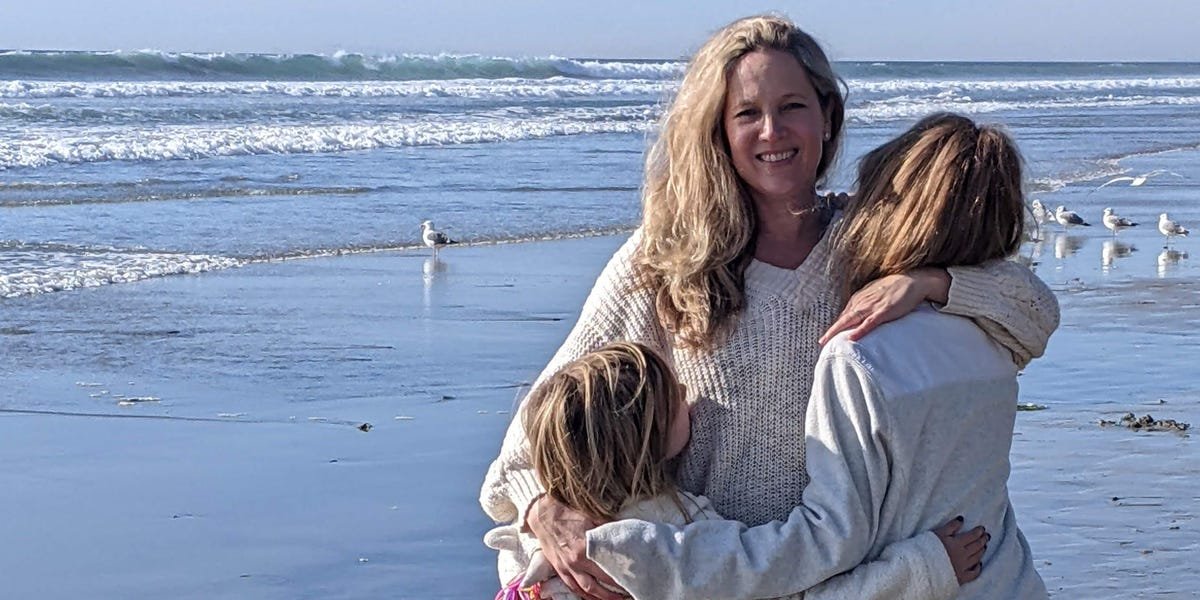
Mother and daughter on the beach together.

Collins left London at 22, after her mom died.

Provided by Madeleine Collins


Building bonds far from home

Wherever I lived as an expat, I formed close friendships with local women — apart from Dubai, where friendships with Emirati women were either discouraged or impossible.

Often, my closest friends were the women I lived with. Some of my roommates had family nearby and folded me into their lives. I spent Christmases with them and found comfort in borrowed families.

None of them were British, and I never sought that out. As a result, some of my dearest friends are now scattered across the globe.

Motherhood changed everything

I met my husband during a vacation to his native South Africa, and we bonded over our shared experiences of travel and adventure.

However, when we moved to San Diego with our baby daughter in 2009, everything — including, apparently, me — changed.

Suddenly, the unknown scared me. Adventure was replaced by Target and Trader Joe’s runs, and surviving sleep deprivation.

I joined local moms’ groups but felt out of sync. The language was different — “dummy” became “pacifier,” “pram” became “stroller” — but the deeper disconnect came from conversations I couldn’t join. Many women had grandparents nearby who helped with childcare or stepped in on weekends. I had no one, and constantly felt like an outsider.

It was hard to tell whether we had anything in common beyond motherhood, and I often wondered whether people assumed I’d eventually move back to England.

Luckily, I found a nearby British mom’s group. One friendship led to another, and soon I discovered a whole network of us in San Diego.

It felt comforting: the shared humor, the homesickness, the feeling of being outsiders together. The kinship was powerful, but it also marked a shift in me that I didn’t like.

The expat bubble I didn’t recognize

At some point, I noticed I’d become someone I didn’t recognize. I often joked that I only wanted English friends — and I meant it. It turned into a casual “them and us” mentality, even though we all felt lucky to live in California.

For someone who had moved country so many times and embraced all the challenges that come with it, I became cocooned in an expat bubble of my own making.

It felt wrong — embarrassing, even — to live in a country while avoiding the people from here. I worried that this smaller, more fearful version of myself was permanent.


A group of four women in their 50s.

In her 50s, she made friends with American women in her book club.

Provided by Madeleine Collins


Turning 50, and opening up again

Then I hit my 50s, and things changed again.

Because I had children in my early 40s, most of my English friends were about a decade younger than me, and they couldn’t relate to my new midlife woes. Mentioning HRT over dinner was met with silence and a sympathetic smile. I found myself prefacing everything with, “Well, because I’m older…”

Around that time, I joined my neighborhood book club, which was made up entirely of American women in their late 40s, 50s, and 60s. They were funny, warm, and deeply interesting. The group included women from all walks of life, from a nanny to a scientist.

After discussing the book each month, conversations quickly turned personal. We bonded over menopause, parenting teenagers, and aging parents. These women became my people.

Finding a sense of belonging

I still value my English friends in San Diego, but my American friendships have instilled in me a sense of belonging.

They laugh at my English-isms, which I love, but I’ve learned that belonging isn’t about shared accents or passports. It’s about shared seasons of life.

While I would still move home to be near my extended family, my husband doesn’t want to, and our children are in the education system here now. This season isn’t changing any time soon, and I’m finally happy about that.

Do you have a story to share about living abroad? Contact the editor at akarplus@businessinsider.com.


Source link

levittown 1950s

Vintage photos show daily life in America’s first ’50s suburb


Bernard Hoffman/Getty Images

Updated

  • Thanks to the postwar Baby Boom and other factors, families in the ’50s began moving to the suburbs.
  • Levittown in Long Island, New York, is widely recognized as the first modern American suburb.
  • Each home looked the same — they were all built in the Cape Cod-style and cost around $7,000.

As World War II came to an end, families looked for ways to start over. Emboldened by the GI Bill’s provisions for home loans, they moved out of the cities in droves for newly developed suburban communities. 

In fact, the suburbs expanded by 47% during the 1950s, according to the Gilder Lehrman Institute of American History.

Levittown in Long Island, New York, was one of the first to introduce the idea of a pre-planned, mass-produced uniform suburban community, The New York Times reported. Families started moving there on October 1, 1947.

Though the community welcomed an influx of families, non-white prospects weren’t allowed. Notably, African Americans didn’t see the same benefits from the GI Bill, and it would take some years before racial and ethnic minorities broadly shifted to the suburbs.

Here’s what it was like to live in America’s first modern suburb in the 1950s. 

Before the 1950s, people mostly lived in cities to be close to factory jobs.


children in 1940s


Historical/Getty Images

At the time, most people lived close to the city center to work in factories, or they lived in rural communities to work on farms, according to economist Jay Zagorsky.

Everything changed in the 1950s when soldiers returned from World War II, sparking the great migration to the suburbs.


soldier returns home from war


Irving Haberman/IH Images/Getty Images

The 1950 Census found that 60% of people lived in cities, while 40% lived in the suburbs. 

Thanks to factors like the construction of highways, the development of new neighborhoods from farmland, and even safety in the event of an atomic attack, these percentages would soon shift drastically.

The GI Bill made it easier to afford a new home, prompting this transition from urban to suburban.


levittown 1950s


Newsday LLC/Getty Images

The GI Bill provided each returning soldier with benefits designed to stimulate economic growth. Each soldier was given a year of unemployment and free tuition to go to college. The military pledged to back all home loans, which allowed veterans to buy houses with little to no down payments. 

The Baby Boom started at the same time, causing many families to outgrow their city apartments.


A family of four stands in front of their house in Levittown, NY.


Joseph Scherschel/Getty Images

Shortly after WWII ended, the Baby Boom began. In 1946, 3.4 million babies were born, more than ever before, and 20% more than in 1945, per History.com. This trend continued into the ’50s.

By the end of the boom in 1964, this generation made up 40% of the country’s population.

Most historians think it was because Americans were eager to have families after having postponed marriage and childbirth because of the Great Depression and World War II.

Whatever the reason, people flocked to the suburbs to accommodate their growing families.

In response to this growing need for space, suburban communities popped up at a faster rate in the ’50s.


aerial view of suburban community

An aerial view of a suburban community.

Hulton Archive/Getty Images

During the war, factories focused on creating wartime essentials, like airplanes and barracks. In the ’50s, they refocused their efforts on building home components and automobiles using the new practices — like the assembly line — they implemented in the war,

As a result, factories were able to produce materials for homes faster than ever before.

Levittown in Long Island, New York, is widely recognized as the first modern American suburb.


levittown 1950s


Tony Linck/Getty Images

Levitt and Sons, a construction company, purchased a 7-square-mile plot of potato and onion farms in Long Island in 1947. They set out to build one of the first uniform suburban communities in the US.

People flocked to home sale events to get themselves a slice of suburbia.


home sale in levittown


Al Fenn/Getty Images

The first homes in Levittown cost new residents around $7,000, The Guardian reported. For veterans, there was no down payment.

When adjusting for inflation, a Levittown home in 1950 would be roughly $97,000 in today’s money.

Every house in Levittown was identical. The Levitt family called it “the best house in the US.”


levittown


Joseph Scherschel/Getty Images

At first, all the homes were built in the same style, and some residents even admitted to walking into the wrong house at times because they couldn’t tell them apart, according to Khan Academy, citing Kenneth T. Jackson’s “Crabgrass Frontier: The Suburbanization of the United States.”

Outdoor spaces, like backyards, became focal points.


levittown


Robert W. Kelley/Getty Images

With the growing number of children, outdoor spaces became increasingly important to the suburban neighborhood. 

Inside each home, there were four rooms, a built-in TV set, and Hi-Fi for the radio.


levittown interior


Joseph Scherschel/Getty Images

At first, they were modest homes, but most families saw their new suburban lives as luxurious. 

Most Levittown residents experienced the responsibilities of owning a home for the first time.


A man and a woman clean opposite sides of a window.

A man and a woman clean opposite sides of a window. Many homeowners experienced the responsibilities of owning a home for the first time.

Newsday LLC/Newsday via Getty Images

Many Levittown homeowners learned homeownership responsibilities, such as tending to a lawn.

The suburb helped cement the idea of the “nuclear family” in American culture.

Levittown also had seven shopping centers.


levittown suburbs


Underwood Archives/Getty Images

The shopping centers were called “village greens” and were designed to make the town more of a bustling community, per Encyclopedia.com.

The suburbs were also known for being a safe alternative to the gritty city streets.


levittown school


Joseph Scherschel/Getty Images

Since the streets in the suburban neighborhood were considered safer than those in the city, parents used to allow children to bike around by themselves, per the National Center for Safe Routes to School.

Levittown was also known as a cheaper option compared to an apartment in the city.


levittown 1950s


Bernard Hoffman/Getty Images

The mortgage on a home in Levittown was reportedly about $29 per month, while most paid $90 per month in the city. 

By comparison, the average rent in New York City in 2026 is just under $3,500, according to Zillow. The monthly cost of a 30-year mortgage on a Levittown home today would be roughly $2,000.

With all the amenities and perks, the community grew rapidly. In less than a decade, the population of Levittown reached 82,000.


levittown


Bettmann/Getty Images

The community has over 17,000 homes, making it one of the largest private housing projects in the history of the US.

As a result, Levittown became a model for other suburban communities in the US during the 1950s.


suburban community in the 1950s

A suburban community in the 1950s.

Joseph Scherschel/Getty Images

Suburban home construction boomed in the 1950s. In fact, at least 15 million units were under construction by the end of the decade, according to the Wealth Management Group.

Although suburban communities boomed in the ’50s, the shift was reserved for white Americans.


levittown family


Joseph Scherschel/Getty Images

For years, there were rules that restricted minorities from buying homes in Levittown, and even as the Civil Rights Movement was starting to take form and the rest of the country began integrating after Brown v Board of Education in 1954, Levittown remained mostly white.

Two-thirds of Levittown residents today are white, according US Census estimates.

Some of the few non-white families resisted this standard.


William Cotter's Levittown home, plastered with signs.

Some non-white residents like William Cotter and his family fought against Levittown’s whites-only standard.

Newsday LLC/Newsday RM via Getty Images

In 1952, William Cotter, a Black man, and his family, sublet a home at 26 Butternut Lane. When the lease was up, Levitt refused to renew it or sell them the home.

The refusal sparked support for the Cotters, and the family eventually purchased another home from a white homeowner.

With modern highways leading to the suburbs, men commuted into the city.


Traffic on a highway near Levittown, New York.

New highways leading to the suburbs didn’t come without traffic.

Newsday LLC/Newsday via Getty Images

The suburban boom corresponded with the expansion of interstate highways in the US, starting the modern iteration of the commute from the suburbs to the city.

In 1950, 80% of men in Levittown commuted to Manhattan for work, The Guardian reported.

During a typical day, the streets of Levittown were filled with women, as the men were mostly working in the city.


levittown women


Bettmann/Getty Images

When men left to fight in WWII, women began entering the workforce, gaining newfound independence and freedom. However, they were suddenly expected to give this up again and instead focus on childbearing and rearing.

In 1963, author Betty Friedan wrote in “The Feminine Mystique” that the suburbs “were burying women alive.” However, some believe that women’s dissatisfaction with staying home “contributed to the rebirth of the feminist movement in the 1960s,” History.com reported.

Women also got active in civic engagement.


Women and children protest in favor of new stop signs.

Women and children protest in favor of new stop signs.

Newsday LLC/Newsday RM via Getty Images

In 1959, women of Levittown, with children in hand, protested in favor of putting stop signs in an area with automobile-related deaths.

Levittown became a symbol of prosperity and anticommunism in American politics and culture.


William J. Levitt speaks with three senators.

William J. Levitt speaks with three senators.

Bettmann/Bettmann Archive/Getty Images

As American politics increasingly centered on anticommunism and Cold War tensions rose, Levittown and suburbs like it took on a symbolic meaning in American culture, representing prosperity and the “American Dream.”

Levitt was once quoted saying, “No man who owns his own house and lot can be a Communist. He has too much to do.”

In 2026, Levittown is still a sizable community with a population of about 50,000. Though it’s full of modern businesses and technology, the community still holds a legacy as a post-war suburban haven.


Source link

Were-full-time-travelers-in-our-50s-whove-been-to-over.jpeg

We’re full-time travelers in our 50s who’ve been to over 50 countries. Here are 5 of the biggest mistakes we’ve made.

When my husband Shayne and I sold nearly everything we owned to travel the world full-time, we thought we were ready for anything. We had spreadsheets, backup plans, a carefully managed budget, and, as two adults in our 50s, decades of experience behind us.

What could go wrong? Turns out, plenty.

Over the past two and a half years, we’ve lived in more than a dozen countries and traveled thousands of miles. We’ve hiked to waterfalls in Bali, wandered the streets of Barcelona, and eaten our way through Thailand.

But we’ve also made mistakes that cost us time, money, and more than a little peace of mind. Some were honest slip-ups, while others came from overconfidence, but they all taught us lessons we’ll never forget. Here are five of the biggest mistakes we’ve made.

Overplanning made us feel burned out


The author and her husband in Singapore.

We’ve learned to leave room for spontaneity when traveling.

Shelly Peterson


At first, we packed every destination with nonstop activities. Sunrise temples, food tours, museums, waterfalls, cultural shows — we didn’t want to miss anything.

But within a few months, we were running on fumes. The pace was unsustainable, and on some days, it felt like we weren’t even enjoying ourselves.

These days, we travel more slowly. We leave room for naps, long walks, and spontaneous days with no agenda.

Some of our best memories now come from lazy mornings and quiet moments, not the things we planned, but the ones we stumbled into.

We underestimated how hard it is to build a real community

We assumed full-time travel would mean constantly meeting fascinating people and forming deep connections around the globe.

Although we’ve met plenty of kind and interesting travelers, most friendships are fleeting, shared over a meal or a few days before everyone moves on. We didn’t expect how lonely it can feel to always be “the new people.”

Now, we intentionally choose places with digital nomad scenes, coworking spaces, and expat meetups. In Vietnam, for example, we love that locals and expats gather for weekly street-food tours and surf lessons.

It takes effort, but building community on the road is possible. We just had to actively seek it out.

One time, we misread our visa and had to change plans at the last minute


The author and her husband in Angkor Wat, Cambodia.

We’ve learned to always double-check visa rules.

Shelly Peterson


When traveling to Vietnam, we completely misunderstood how our visa worked and accidentally arrived in the country on the day it expired.

Immigration let us in, but warned us we had to leave almost immediately and apply for a new visa. We scrambled to book a last-minute flight to Cambodia and ended up paying a fine.

It was stressful, chaotic, and expensive. Oddly enough, though, our visit to Cambodia became one of our favorite unexpected adventures. But now, we double and triple-check visa rules and requirements ahead of time.

We’ve also let our guard down


The author and her husband posing outside The Louvre.

Travelers should always be aware and alert to their surroundings.

Shelly Peterson


In Paris, Shayne had his crossbody bag slung around his back while boarding a crowded metro train. Seemingly within seconds, his phone was gone.

It was a rookie mistake, and we knew better, but sometimes travel lulls you into a false sense of security.

That one slip-up cost us days of frustration replacing his device and updating accounts, not to mention a chunk of money.

Even seasoned travelers need to stay alert, especially in busy cities and transit hubs.

Choosing accommodations with zero walkability made exploring more difficult

When we started traveling full-time, our first stop was Bali. We booked a picture-perfect villa with sweeping ocean views and dreamy Instagram potential. What we didn’t realize, though, was that it was over an hour away from the nearest town.

It was beautiful, but it made everyday activities like walking to cafés, exploring neighborhoods, or talking with locals nearly impossible.

Now, we prioritize location over aesthetics. Being able to walk out the door and explore a neighborhood, find a local market, or grab lunch at a street stall makes us feel like we’re actually living somewhere, not just passing through.

Despite the bumps in the road, traveling full-time has been incredibly rewarding

The mistakes we’ve made haven’t just taught us how to travel smarter. They’ve reminded us to stay humble, adaptable, and patient with ourselves.

We’ve learned to slow down, embrace the unexpected, and let go of the need for every day to be perfect, because no matter how experienced you are, travel always has something new to teach you.

And often, the detours become the best parts of the journey.


Source link

Burned-out-in-her-50s-she-left-corporate-life-Starting.jpeg

Burned out in her 50s, she left corporate life. Starting over in Korea helped her heal.

Jane Newman spent her evenings watching K-dramas on her recliner during the pandemic lockdowns. She didn’t expect they’d spark a curiosity about South Korea that would eventually lead her to move there and start over.

In 2023, Newman was working for a consulting firm in Brisbane, Australia. As a manager, her heavy workload didn’t let up even as the world began to return to normal.

After months of long hours spent in front of a screen, she was burned out and beginning to feel the strain.

“I started out with a whole lot of shoulder and back pain, and then it developed into arm pain, and I couldn’t use my mouse,” Newman, now 60, told Business Insider.


A woman posing in a red suit in South Korea,

Jane Newman said she burned out from her corporate job in Australia.


Greg Samborski.


Standing desks and different chairs fixed little, so she took a sabbatical.

Newman had first visited South Korea the previous year, curious about the country she’d only seen on TV. Remembering how much she had enjoyed that trip, she decided to return for a two-month break.

When she went back to work, the symptoms didn’t take long to resurface. This time, Newman found herself struggling mentally and emotionally, too.

“I found it more and more difficult to do my work,” she said. By July 2024, she and her employer agreed it was best for her to step away from the company.

“I knew that South Korea was a place that I loved, and it made me feel good,” Newman said. “So I made the decision to go back and stay for a few months to see how it felt.”

New career, new home

For three months, she lived in an Airbnb in Gwacheon, a city just outside Seoul. Newman lived with her host, a local woman who had invited her to participate in the community events.

There, she joined a group supporting former US military “comfort women,” as well as two English clubs where members met to discuss news, read English fiction together, and give weekly presentations on various topics.

“I met the most wonderful people, and they really invited me into their conversations. And I got to know a lot more about Korea itself, and its history,” she said.


A woman leaning against a tree in South Korea.

Newman says she found healing in a small community outside Seoul, where she learned more about South Korean history and culture.


Greg Samborski.


“All of those things made me feel really welcomed, and at home, and part of a community, which is what I was really lacking back in Australia,” Newman added.

In Brisbane, her social life largely revolved around people she knew at work, or old friends she’d kept in touch with from her years living in the UK when her daughters were young. She was part of a bushwalking community and a social dining community, but most of those groups faded after the pandemic.

As Newman considered her next career steps, she found herself drawn toward public speaking and coaching to help people navigate the pressures of modern society and technology.

That focus also eventually led her to begin developing a tech startup in South Korea aimed at helping young people struggling with social isolation.

By February 2025, Newman moved to Seoul to begin her next phase of life.

She said her Gen Z daughters weren’t surprised by her decision since they already knew how much she loved South Korea. Both had already taken trips to visit her there.

When it was time for Newman to look for an apartment, she wanted a place that was close to public transport, with separate spaces for living and sleeping, and a good view.

It took her about two weeks to find a place. She now lives in Dongdaemun, a popular neighborhood, where her two-bedroom apartment costs 1.43 million Korean won, or about $1,000, a month.


Skyline from Seoul City Wall at Dongdaemun.

Newman lives in Dongdaemun, a popular neighborhood in Seoul.


Jane Newman.


Building a new life from scratch

South Korea has become an increasingly popular choice for foreigners in recent years.

Data from the Ministry of Justice showed that the number of foreigners living in South Korea at the end of 2024 stood at 2.65 million, a 5.7% increase from the year before.

For Newman, building friendships in Seoul came more naturally than she expected.

“I’ve found that every time I’ve come to Korea, I’ve made new friends,” Newman said, adding that this included people she met through a fan group for a Korean actor she admired.


A photo of Cheonggyecheon stream in Seoul.

Newman says she makes it a point to get out of the house once a day to enjoy her surroundings.


Jane Newman.


These days, Newman’s routine is a mix of work and settling into life in Seoul.

She starts her mornings with a coffee from the Starbucks across the street before diving into her coaching sessions and working on getting her startup off the ground.

Compared to her previous job, where working 60 hours a week was common, Newman says she now works around 20 to 30 hours a week.

With the more flexible schedule, she has time to exercise, meet people, and sometimes work from libraries or cafés.

“But I do make sure I get out once a day to go out and enjoy this beautiful place I’m living in,” she said.

Do you have a story to share about relocating to a new city? Contact this reporter at agoh@businessinsider.com.


Source link