
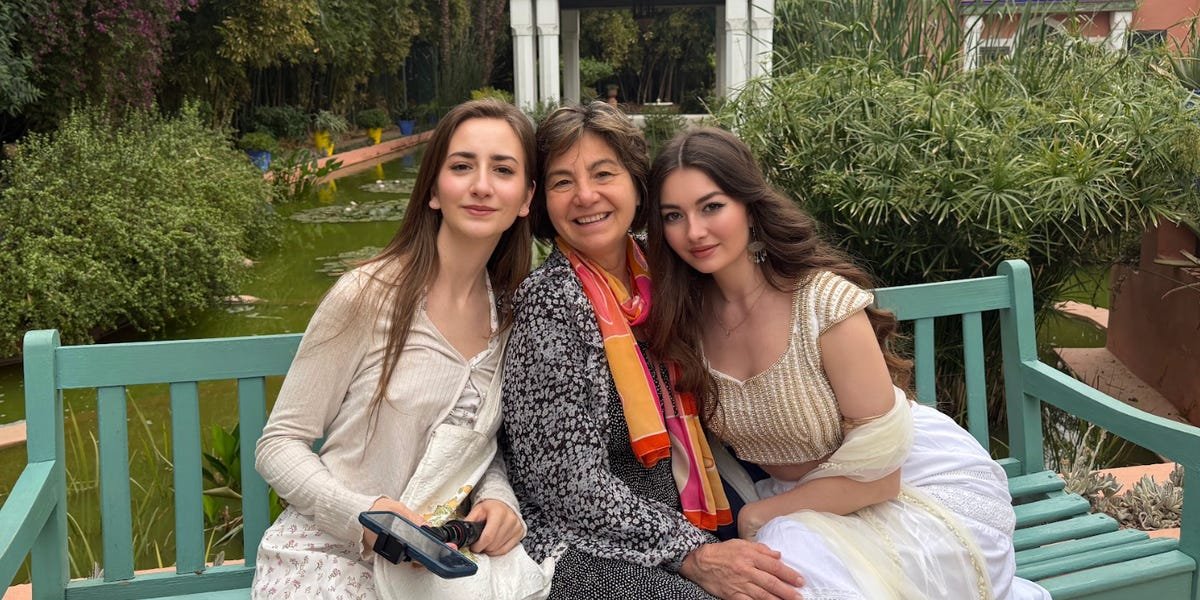
I-used-to-think-living-at-home-as-an-adult.jpeg

I used to think living at home as an adult meant going backward. Losing my dad made me realize I was wrong.

Growing up, when I imagined my 20s, I pictured living in a huge city apartment on my own, with a partner or a quirky group of roommates. I’d decorate my home with chic art pieces, paint the walls a dusty rose, and host dinner parties for my friends.

I was desperate to begin my life. I thought adulthood started when you moved out; anything else felt like going backward.

Then, my dad died, and my entire reality shifted.

Living with family as an adult is often framed as a “failure to launch,” but navigating grief at home with my mom and younger sister helped me rethink growth.

Living at home in my 20s wasn’t easy at first


The writer posing while skiing with her dad and sister.

Initially, I was eager to move out of my parents’ house and live with my boyfriend.

Maya Kokerov


After I finished college at 22, I moved in with my parents while I figured out what my long-term plan would be.

I hoped this would be a very brief stint. Impatient to be more “independent” and worried I was falling behind my peers, I vowed to rent an apartment with my boyfriend as soon as we could afford one.

Before I had a chance to move out, though, the COVID-19 pandemic pushed us into a lockdown. I settled back into living with my family until further notice. There were practical benefits, such as saving money, but I still felt restless.

In ways, I reverted back to a teenager: whispering on FaceTime, sending messages on Snapchat, even sneaking out of my window to meet up with my partner after everyone had gone to sleep. At 22, I felt emotionally crowded and missed the freedom I’d experienced at college.

More than a loss of privacy, though, I was ashamed that I was still “waiting” to reach what I saw as the first big marker of adulthood.

After my dad died, living together became a lifeline


The writer posing on vacation with her parents and sister.

Losing my dad shifted my priorities.

Maya Kokerov


Four years after I moved back home, my dad suddenly passed away.

We couldn’t properly say goodbye. Instead, we sat in fear for months. His chair was empty, leaving a hole in our home.

As guilty as I felt for not always appreciating the years I’d spent with him, I realized how lucky I was to have gotten to spend his last few years at home with him.

Many fathers who get to grow old may never spend as much time with their children as I did with mine, precisely because I stayed home.

My dad had moved out of his house at a young age and lived in four countries. In one of our last one-on-one conversations, shortly before he was admitted into the hospital, he told me how everyone keeps moving to find their place, but everywhere is virtually the same. The main difference is the people that you’re leaving behind.

Looking back, those extra years at home were convenient, yes, but they were also the happiest I’ve ever been. Now, having my mom and sister by my side gives us space to grieve together and mutually support each other.

Memories and rituals reshaped how I define adulthood

As a very tight-knit family, we built our life around traditions, from holidays and vacations to sports and movie nights.

My dad’s favorite activity was spending time with us. He taught us skills like skiing, languages, and playing tennis.

Healing came from returning to the traditions he loved. Although it was challenging at first, we forced ourselves to engage with his hobbies and rituals, reliving our memories together. We cooked his favorite food, sang songs he loved, and played lots of tennis.

With time, the sadness became more tolerable as we created new rituals while preserving treasured old ones.

This wasn’t the “20-something” life I had envisioned, but this version of home became a symbol of my growth precisely because of how much I loved my past. I realized that living at home at 27 isn’t a lack of maturity or a so-called “failure to launch.”

If anything, grief sharpened my sense of responsibility. Adulthood can be communal, and I feel lucky to have familial support. Grief has made living with my family more meaningful, grounding, and empowering than ever.



Source link

Katie Notopoulos

Coming off your parents’ family phone plan doesn’t make you an adult

Before you yell at me, let me first say that I am not, and have never been, on my parents’ cellphone plan. (I didn’t get a cellphone until I was already an adult.) But I’ve long been jealous of my friends who are still on their parents’ plans — it just makes good sense!

Yahoo News recently asked whether staying on your parents’ phone plan as a 40-year-old makes you “a harmless mooch or a generational failure?”

The reporter, Fortesa Latifi, admits that she and her husband were still on their parents’ plans until recently, and that many others are like her, some even with children of their own, and quite a few feel embarrassed about it.

There are significant savings to be had by joining a family plan. For example, right now, at T-Mobile, its unlimited talk, text, and data plan costs $85 for an individual plan. For a family of four, the same plan is around $42 per person.

Why are family plans so much cheaper per line? It’s not that there are a lot more costs to operate cell service if a phone number isn’t connected to a family plan. It’s all about how advantageous it is for the carrier to sell family plans.

For one thing, if you’re part of a family plan, you’re less likely to shop around and switch carriers. It’s also easier on the carrier’s customer service: They only have to mail bills, process credit cards each month, and all that jazz for one person instead of several. (Verizon and T-Mobile didn’t immediately respond to a request for comment on their pricing.)

Last year, AT&T added a new feature that makes it easier to automatically split the bill for people who share a friends-and-family account. The person whose name is on the bill is still ultimately responsible for the full amount, so enter into this kind of arrangement only with people you really trust.

AT&T pointed me to a news story published last year that quoted an exec saying 85% of their customers were on a multi-line plan. Think about that — that means if you actually are one of the suckers who is paying for a single line, you’re in the vast minority.

There’s no honor in paying more to have the bill in your own name — you’re just paying more for the same services. Does your dignity and independence win out here, or does T-Mobile? Hmm?

Does having your own cellphone line make you an adult?

AT&T released its own study (so take it with a grain of salt) that said that 76% of Americans think that coming off a parent’s cellphone plan is one of the “ultimate signs” of becoming an adult.

Sure, at first glance, this seems like a rite of passage into financial independence from your parents.

Is it a smart financial choice?

Consider that the T-Mobile plan — even if you paid back your mom each month for your portion of the phone bill, you’d be saving about $42.50 a month compared to the same service on an individual plan. That’s $5,100 over a decade if you did it from age 22 to 32.

In fact, I’d say that part of becoming an adult is being smart about spending habits and money. And sticking to a family plan is the obviously wise choice.

If you choose to remove yourself from a family plan, you’re just giving the cellphone carriers twice as much — and I see little glory or pride in that.

Look, of course, this all depends on your relationship with your family. You may not want to have this financial tie to them, and you may be in a better financial situation than your parents. But bundling phone lines with other people, whether they’re your family or just some friends, makes a lot of financial sense.

Millennials, it’s time to take pride in one smart financial decision that our generation is making. Embrace it! Be proud to be on a family plan!


Source link

My-husband-and-I-started-doing-adult-paint-by-numbers-to-get.jpeg

My husband and I started doing adult paint-by-numbers to get off our phones. The hobby’s benefited us more than we expected.

I’m stuck in a doomscrolling loop again.

My algorithm drags me down the rabbit hole of videos people posted to social media to declare 2026 as the year they … get off social media.

I see more and more videos with mass declarations to “go analog” and focus on screen-free activites. The irony is thick, but with the world on fire around me the sentiment has appeal.

I’m not naive enough to think this movement is new or will last in any meaningful way, but participating seems like a nice way to take a breath and find some good in the rubble.

As I watch another video and then one more, an idea starts to take root. What if I start a new hobby to get off my phone, even if just for a little while each day?

And what if my husband joins me?

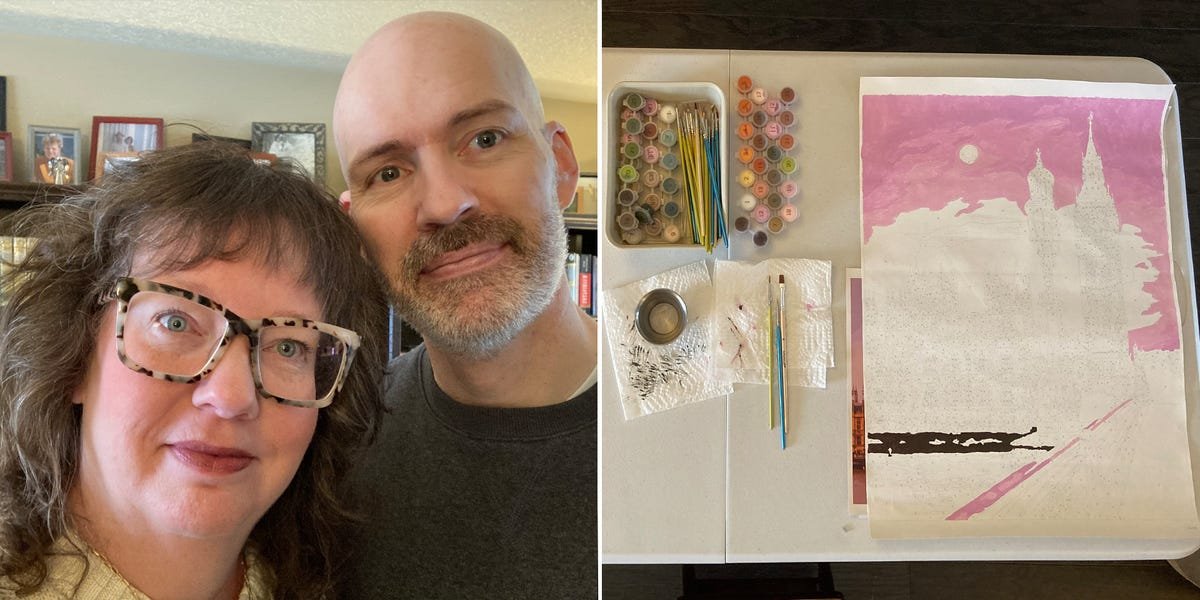
Although it felt out of our comfort zone, we bought paint-by-number kits


Table with paints, papers with partially painted artwork

I started doing paint-by-number canvases with my husband.

Tawnya Gibson


When I share this idea with my husband, he brings up the idea of buying paint-by-number kits that are designed for adults.

It’s far out of our comfort zone. But before either of us have a chance to talk ourselves out of this, we pop into an art store.

We both decide to buy larger canvases mostly to have a longer-term project, not because we are certain we have the right abilities. About $30 later, we’re still wondering what we are thinking.

When we get home, we bring down a folding table from our office. It’s just the right height to share as we sit on our loveseat, water, brushes, and paper towels between us.

Keeping our paints separated, we turn on reruns of “New Girl,” grab our reading glasses and glob the colors on our canvases — him a streetscape of Brooklyn, me a skyscape of London — both quietly hoping they’ll be nice enough to hang on our bedroom wall when we’re done.

These nights off our phone become our lifeline to feeling lighter, like when we were first married


Man and woman wearing hats, smiling

It’s nice that a simple hobby has helped us talk and laugh more.

Tawnya Gibson


Several things soon become clear. First, we may have overestimated our abilities and how difficult an adult paint-by-number could be.

Next, we are taking vastly different approaches to the task. I am starting with the larger areas, swirling my brush and not coming close to the canvas edge until the very last minute, desperate to not make a mistake.

My husband goes for the smaller details in the darkest color. He has read all the instructions. I’ve tossed mine straight into the recycle bin.

Our personalities are similar until they aren’t. I have a need to catastrophize before I build a plan. My husband is logical with a more black-and-white way of thinking. I feel these differences highlighted as we paint.

Over the span of two or three episodes of “New Girl,” I’ve delayed starting, given up, and restarted a dozen times. My sky looks terrible, punctuating my lack of artistic talents.

I declare total disaster in between every laugh, fret about running out of pink sky No. 12, and stop long before the last episode of the night comes to an end.

Still, we continue painting night after night.

The progress is slow and neither of us are sure when we’ll be done. But something happens on the nights we choose painting over retreating with phones in hands: Our home is kinder. We talk. We laugh.

The stress of getting the strokes within the lines is the lighter type of stress we used to have when our marriage was young.

On our way to bed, we stand up. Assess. Comment on our progress and sleep a little easier.

We’re remembering what it’s like to do something with no goal or agenda. We’re enjoying our time together less online.

Maybe when we’re all done, I’ll post a picture in a hazy filter and show off my pink-skyed London, mistakes on full display — a little analog badge to celebrating remembering how to live.


Source link

Im-27-dont-own-a-house-have-no-kids-and.jpeg

I’m 27, don’t own a house, have no kids, and am not married. My parents had all that by my age, so I don’t feel like an adult.

When I was born in March 1999, my parents were both 25 years old. They were married and owned a house with a mortgage, and throughout my life, they’ve always seemed like “real” adults.

I’m now older than they were when they had me. I’m turning 27 and, though I don’t want children, it’s sometimes difficult not to measure my life against theirs.

They got married at 21. When I was 21, I was finishing my bachelor’s degree in the middle of a pandemic. At 25, rather than having a child, I was moving in with my girlfriend, and we became cat parents.

In some ways, and especially when I see my rent money leave my account at the start of each month, I feel like I’m falling behind.

I remind myself that life is different now

I know I’m not alone in feeling this way. Milestones that have long defined adulthood — like getting on the property ladder — don’t seem as realistic to everyone my age as they did for our parents’ generation.

While I do know people around my age who’ve been able to buy a house, for example, it’s definitely not the majority of my friends. Even if I did want kids, I wouldn’t have even considered it in my 20s, saving that conversation for my 30s.

Also, income hasn’t risen to keep pace with rising housing prices. Becoming a homeowner in your 20s is simply not realistic anymore.

Still, I sometimes don’t feel like an adult

I don’t think any of my generation, especially my friends, truly feels like we’re adults. It feels like I’m winging it most days.

I haven’t followed any traditional path. I moved to another city for university at 18, completed my master’s in another city, then shared an apartment with a friend somewhere else, and moved cities again when I moved in with my partner.


Adam England playing with his two cats on his lap

The author has cats instead of children.

Courtesy of Adam England


Sometimes it feels like I’m a teenager cosplaying as an adult. But then I remember that I do have my life together. I live with my long-term partner and our cats. I have a master’s degree. I freelance full-time for a living, my finances are stable, and I try to be reasonably healthy.

Now and again, I’ll say or do something that makes me realize I am a “real adult.” I’ll mention something about personal finance in a conversation with a friend, or get really excited about my air fryer being delivered.

In some ways, I’m further along than my parents were at this age

My dad often reminds me that I’ve had more life experience than my parents did at my age. I continued my education, I’ve lived in multiple cities across the UK, and I’m more well-traveled.

My life is richer in ways that aren’t necessarily measured by the traditional life plan. Sometimes comparing my life to that of my parents has made me feel stressed, but I’m now more comfortable embracing my own path; after all, adulthood isn’t a race.

In December, I was on a boat on the Danube River with my girlfriend, drinking mulled wine and looking at Bratislava by evening as we enjoyed a well-deserved long weekend away from work before Christmas.

When my parents were the same age as us, they would have been at home with a one-year-old, and traversing adult life in a way I don’t think I’d be able to. Yet, looking back at when I was growing up, they made it seem so easy.

Neither version of your 20s is the objectively correct way to do it, but the contrast made me realize that I’m not falling behind or failing at adulthood. I’m simply doing it differently.


Source link

Legos-high-tech-Smart-Brick-is-dividing-its-adult-fanbase.jpeg

Lego’s high-tech Smart Brick is dividing its adult fanbase

Small speakers hum as two “Star Wars”-themed Lego lightsabers clash. Lights beam from the top of a Lego-built airplane. A roaring engine sound kicks in as multiple vehicles race across the floor.

It’s all part of a high-tech — and polarizing — update from Lego called Smart Play that the toymaker unveiled at the Consumer Electronics Show earlier this week in Las Vegas.

Lego says its new line of chip-based bricks is “one of the most significant evolutions” since the launch of figurines in 1978.

At the center of the system is what Lego calls a Smart Brick. It’s the same size as the classic two-by-four Lego piece — a design that has remained largely unchanged since the company began producing plastic bricks in the early 1930s — but it contains sensors, lights, and a tiny speaker.

The move pushes the famously analog toy deeper into the world of embedded technology. Among adult fans of Lego — known as AFOLs — the reaction has been mixed.

Online, some longtime builders and parents have voiced concern about what they see as the growing “tech-ification” of toys traditionally more reliant on one’s imagination.

In interviews with Business Insider, Lego purists, toy enthusiasts, and industry watchers said they’re intrigued by the technology — but some worry the added electronics will push Lego’s prices even higher.


Lego's new Smart Brick

Lego’s new Smart Brick can make sounds, light up, and recognize figurines.

Lego


“I’ve loved the creativity involved without Smart Bricks,” Jake Doll, 33, a Lego enthusiast who posts to AFOL communities on TikTok, told Business Insider. “I think they’ll put more investment in tech as it can increase the overall purchase price.”

The bricks can sense what’s happening around them, including light detection, player movement, and proximity to other figurines. When multiple Smart Bricks are used together, they communicate wirelessly with one another, allowing Lego sets to react in coordinated ways.

Lego says the system doesn’t rely on AI or a constant internet connection. The bricks charge wirelessly, don’t require disposable batteries, and play pre-programmed sounds directly from built-in speakers.


Lego's Smart Play system will debut in coming

Lego says Smart Brick will bring audible interactions to its toys: planes will whir when they tilt, car engines will hum, and figurines will talk to each other

Lego


The company plans to debut the technology in three “Star Wars”-themed sets: a $70 Darth Vader set with 473 pieces, a $100 Luke’s Red Five X-Wing set with 584 pieces, and a $160 Darth Vader’s Throne Room Duel & A-Wing set with 962 pieces. They will hit store shelves on March 1.

“This isn’t changing direction from what the Lego brand has always been,” Tom Donaldson, the head of Legos’s Creative Play Lab, told Business Insider in a statement. “It’s an expansion — we’re staying true to our brand while innovating to meet how kids play today. The Lego brick our fans know and love isn’t going anywhere; we’re just making our play even more magical.”

Bob Friedland, 50, a toy expert and former Toys R Us executive, told Business Insider he isn’t planning to buy the Lego Smart Play sets when they launch.

Right now, he owns 115 sets, according to his Lego app. That includes collections themed around “Hocus Pocus,” “Stranger Things,” and van Gogh’s Starry Night. In a phone interview, Friedland said he’s more interested in a $28, fully analog Lego DeLorean DMC replica from “Back to the Future.”


A bookcase with 12 lit up, ornate Lego sets

Bob Friedland, a toy expert and enthusiast, owns 115 Lego sets, some of which he displays with custom lighting.

Bob Friedland


He said that Lego — which launched a 9,000-piece Star Wars-themed build for $999 in September — risks alienating already inflation-strained customers with increasingly expensive sets.

“These bricks will definitely bump up against the already-existing feeling that Lego is too expensive,” he said.

Smart Play isn’t Lego’s first attempt to blend bricks with technology.

In 1998, the company launched Lego Mindstorms, a line of programmable robotics kits that allowed builders to create machines that responded to sensors and computer code. More recently, Lego introduced the Lego Super Mario line in 2020, which featured interactive figures that triggered sound effects when placed on certain blocks.

Friedland said that much of the online concern around toy “tech-ification” is attributable to other companies focusing on launching AI in teddy bears and dolls.

Mattel, for example, has partnered with OpenAI to put AI tech in some Barbie dolls. Child development researchers have warned that AI-enabled plushies aren’t meeting basic safety standards. Online chatbots have appeared on children’s iPads.

But other parents said they aren’t sure their Lego-loving kids are even going to be interested in the company’s new tech.

“As an adult fan, my joy stems from the building process and sharing that experience with my kids,” Reid Exley, 43, a father of two and Lego enthusiast with more than 50 sets, said. “My kids would likely enjoy the novelty of the sounds and interactivity. However, I suspect that novelty would quickly wear off and Lego play would remain largely unchanged.”

Some fans see Lego’s launch of the Smart Play system less as a distraction — and more as an intriguing puzzle with potential.

“Are dolls that cry less creative than dolls that don’t? Not really,” Friedland said. “I can already see myself trying to figure out Easter eggs that are unlocked by placing the Smart Brick in the right place or tapping it in the right sequence while it’s next to the right colored brick.”

He also told Business Insider that the current state of childhood play needs some new tech disruption. The Lego set, in his mind, could fit that bill.

“Parents who are wary of tech will likely look at this as a better alternative than a phone or iPad,” he said. “I think this is a much better solution than the AI toys out there.”


Source link