
Lawmakers appear to be at an impasse after the failure of a bipartisan bill that would have mandated something most airline cockpits still lack: a real-time view of other aircraft.
The ROTOR Act failed in the House by a single vote. It had passed with bipartisan support in the Senate and backing from families of crash victims of the January 2025 collision involving an American Airlines jet. It also had the support of pilot and flight attendant unions, airlines, and the National Transportation Safety Board.
Advocates say they will oppose a new GOP bill that does not mandate cockpit monitors.
Families were unhappy with the bill’s failure to garner the two-thirds majority needed to pass a procedural measure on Tuesday: “It was defeated by eleventh-hour objections built on misleading technical claims the NTSB’s own investigators have publicly refuted,” they said in a joint statement.
AP Photo/Mariam Zuhaib
The bill split House Republicans, with some of the 132 opponents saying the additional monitoring systems would be expensive and were unproven; some are advocating for an alternate bill, the ALERT Act, that leaves air traffic controllers primarily responsible for collision alerts and allows some military flights to opt out of transmitting their positions.
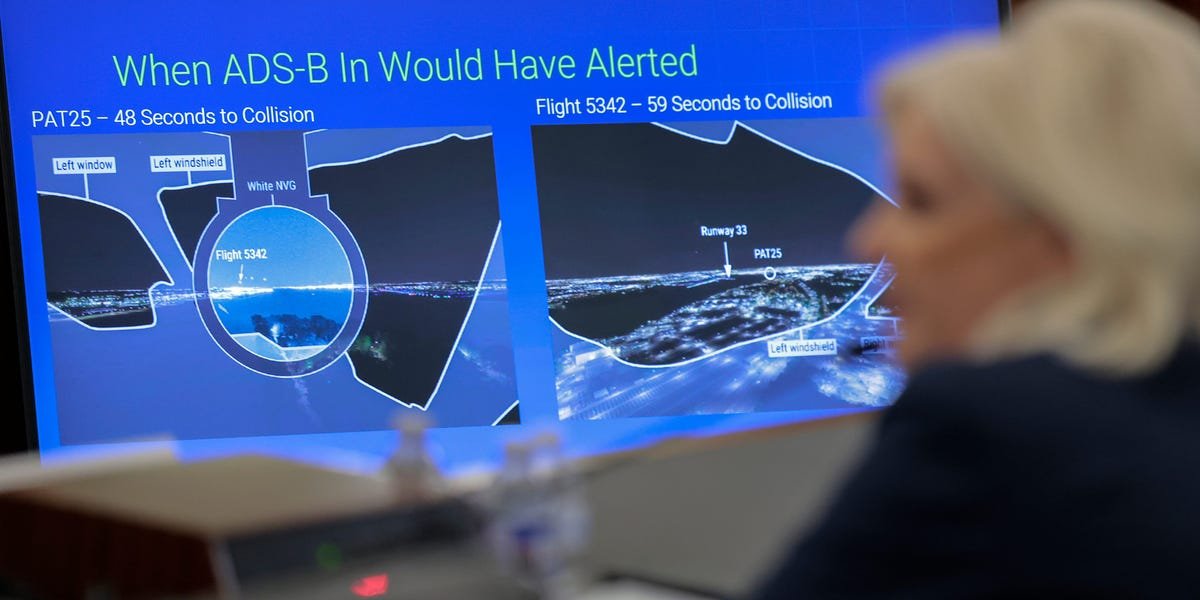
At the heart of the debate was a proposed requirement to equip commercial aircraft with GPS-based “ADS-B In,” which would display nearby air traffic on the flight deck screen — potentially closing the gap revealed by last year’s AA crash with an Army helicopter near Ronald Reagan National Airport that killed 67 people. Overstretched air traffic controllers had struggled to track the mix of commercial and military flights in DC’s crowded airspace that day.
Commercial aircraft have been required to carry the sister technology, “ADS-B Out,” since 2020, which feeds their position to air traffic control. Think of it like ADS-B Out is talking and ADS-B In is listening. ADS-B Out has drastically improved safety by being more precise than radar and enhancing pilot situational awareness.
Garmin
Supporters of the ROTOR Act — which would also require certain military planes to broadcast their position in civilian airspace — argued that adding these monitors would allow pilots, as the last line of defense, to react to hazards when seconds count.
In comments shared with Business Insider, Syracuse University professor and aviation safety expert Kivanc Avrenli said the use of ADS-B In on the American jet would have given its pilots 59 more seconds to react before impact. In reality, the traffic-avoidance collision alert came only 19 seconds before, he said, and maneuver instructions weren’t possible due to altitude limits.
“In dense airspace, that extra 40 seconds can be the difference between having time to sort out a conflict and having no real options left,” he said. “Delaying these upgrades means continuing to rely on systems that simply were not built for this kind of scenario.”
ADS-B In would not only help in flight but also on the ground, where a series of runway incursions has exposed the limits of what controllers can handle in real time. In the months after the January accident, two separate military aircraft had close calls with US passenger jets.
The Pentagon initially supported the original bill. On Monday, it changed its position and said the technology risks “significant unresolved budgetary burdens and operational security risks affecting national defense activities.” Some Republicans came out against the bill and threw their weight behind a different effort.
House Republicans Mike Rogers and Sam Graves, who voted no to ROTOR, have instead pushed a revised version of the bill.
Heather Diehl/Getty Images
During a Senate hearing on Monday, Graves said ALERT would be a “comprehensive package” that would enhance military coordination and pilot training and address all 50 NTSB recommendations. He said the ROTOR Act only addresses two of the recommendations.
ALERT would not require ADS-B use — essentially maintaining the current system that relies on air traffic controllers to detect potential conflicts in and around airports and communicate with pilots. It would also absolve military aircraft of having to use the anti-collision technology in certain airspaces, citing security risks.
Graves added that ADS-B In would be a burden to implement on the 5,500 planes in the sky, would “unintentionally lead to an operational crisis in 2031,” and be an “unworkable” mandate.
NTSB Chair Jennifer Homendy — who oversees the research and writing of the agency’s recommendations — said on Thursday that the House’s ALERT bill is “watered down” and won’t do enough to prevent future accidents, adding that the bill doesn’t address all of the NTSB’s recommendations because it takes out the ADS-B In requirement.
The NTSB has recommended ADS-B In on cockpit displays since 2008. The Federal Aviation Administration has never mandated it, partly because it lacks a clear funding mechanism. Regulators have argued that the system, which provides visual and audio alerts, would impose a cost burden on airlines and on private plane owners who may not operate in congested airspace.
Homendy told a Senate Committee in February that American Airlines paid less than $50,000 per plane to retrofit roughly 300 Airbus A321s, as an industry example. That adds up fast across hundreds of aircraft. She said general aviation planes could carry portable receivers that cost as little as $400.
Some airlines, including American and JetBlue, have voluntarily added ADS-B In to their planes.
