
Larry-Page-is-officially-moving-business-out-of-California-ahead.jpeg

Larry Page is officially moving business out of California ahead of a proposed billionaire’s tax

Billionaire Larry Page is peacing out of California.

The Google cofounder has cut ties between California and many of his assets that risked exposing him to a proposed new wealth tax in the state, meeting an end-of-2025 deadline, according to filings reviewed by Business Insider.

Page’s family office, Koop, was converted out of California in late December and incorporated in Delaware, per filings with both states. Page converted several other entities to Delaware, including Flu Lab LLC — a vehicle he has used to fund research on tackling influenza and lists its principal office address in Nevada — and another entity named One Aero, which has funded his flying car ventures and lists its principal office address in Florida.

A filing was also made to convert Dynatomics, LLC from California to Delaware with a new principal address in Keller, Texas. Page launched Dynatomics, a new startup focused on applying AI to aircraft manufacturing, in 2023, Business Insider previously reported. A source close to Page said that the team, run by Chris Anderson, continues to work out of California.

Anderson and representatives for Page’s family office did not respond to requests for comment.

The New York Times reported in December that Page had told people he was considering moving to Florida because of a proposed ballot measure that would tax the state’s wealthiest residents. The proposal, if passed successfully, would mean that any California resident worth more than $1 billion would be taxed 5% of their assets.

Under California law, residency is determined by the nature of a person’s ties to the state, with factors such as the time spent in the state and the maintenance of substantial business ties taken into account. If the ballot measure is approved in November, it would take effect retroactively for residents living in California as of January 1, 2026.

A source close to Page said the Google cofounder had already left the state. Whether Page’s move is temporary could not be learned.

Page is ranked the second-richest person in the world, according to the Bloomberg Billionaires Index.

Page’s family converts other entities to Delaware

Besides his family office and funding vehicles, Page converted out an LLC that Business Insider previously identified as being used to purchase islands in Puerto Rico and the Virgin Islands, from California to Delaware, with a new address listed in Florida.

A separate LLC Page used to purchase an Island in Fiji was also converted out to Delaware.

Page’s wife, the scientist Lucinda Southworth, founded a marine-conservation charity named Oceankind. Filings show that Oceankind converted out of California to Delaware in December.

Delaware has become a popular state for businesses to incorporate due to its favorable tax structure, privacy, and its home to a court system specifically designed to handle corporate disputes. The state does not require LLCs to disclose the names and addresses of directors when incorporating, providing them with an extra layer of privacy.

Privacy is especially important to Page, whose family office is shrouded in a level of secrecy unparalleled by most and carefully managed by its CEO, Wayne Osborne.

Cristina Rosado, an attorney who handles many of Page and Southworth’s assets, signed several of the California filings.

Page incorporated three entities in Florida last year, as previously reported by The New York Times. A Koop LLC was incorporated in Florida in January 2025, per filings reviewed by Business Insider. It could not be confirmed if it belongs to Page.

California’s billionaire tax proposal

The California billionaire tax proposal faced some opposition from leaders in venture capital and politics. In a post on X in December, venture capitalist Vinod Khosla said the proposed measure would mean California would lose its most important taxpayers and “net off much worse.”

“Long term damage unless legislature bans wealth taxes,” he added. “Easier to equalize taxes on work income and capital gains at the national level.

Matt Mahan, Democratic mayor of San Jose, California, on Monday described the tax as “a political plan that will sink California’s innovation economy.”

White House AI czar David Sacks has criticized the proposal and said it will backfire. He has also said he believes Miami and Austin will overtake New York and San Francisco for finance and tech, respectively. He announced this month that his venture capital firm, Craft Ventures, had opened an office in Austin.

Last month, celebrity lawyer Alex Spiro wrote a letter to California Gov. Gavin Newsom, warning that the proposed billionaire tax would “trigger an exodus of capital and innovation from California,” Business Insider previously reported.

Have something to share? Contact this reporter via email at hlangley@businessinsider.com or Signal at hughlangley.01. Use a personal email address and a non-work device; here’s our guide to sharing information securely.


Source link

My-dad-died-unexpectedly-It-taught-me-that-I-needed.jpeg

My dad died unexpectedly. It taught me that I needed to plan for my funeral ahead of time.

Sitting across from the funeral director, I held my husband’s hand. I needed to feel something real while my body moved between sadness and shock. I glanced at my mom to steady her and at my husband for support. There was one person noticeably missing from our group: my dad.

The day before, I wouldn’t have guessed I’d be spending my afternoon at a funeral home. I had talked to my dad that night and made plans for our weekly dinner. When I hung up the phone, I had no clue that was the last time I’d speak to him. There was no inner hunch that doom was on the horizon, and nothing that said he wasn’t feeling well. So, the next morning, when the ER doctor told my mom, husband, and me that they tried to revive him and failed — I didn’t know how to process the information. Dying of a heart attack made no sense. I thought we had plenty of time.

Throughout my life, we had relied on him to answer the hard questions, and we desperately needed him now. It had only been three hours since his unexpected passing, and here we were planning his funeral. I had no idea what he wanted.

He was healthy and active

I recall sitting at my parents’ dinner table with my then-9-year-old son. He drank his milk while my dad gestured to the desk behind him. The white stack of papers (the size of a small novel) stood out against the stack of magazines. “Do you want to read my will?” my dad asked with a wink.


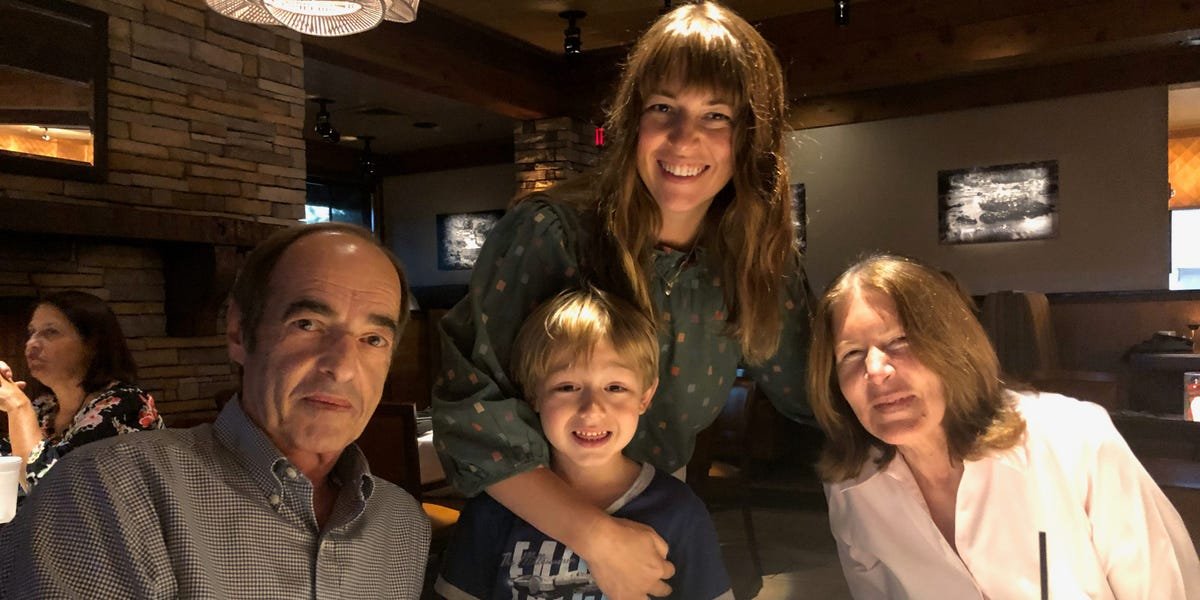
Grandfather with grandchild

The author’s dad was healthy and active before he died.

Courtesy of the author


I paused.

Not really what I’d call an uplifting dinnertime read. At 71 years young, he was active and in good shape — a recent retiree ready to travel and spend time with his grandkids. I didn’t want to think about his potential decline — my dad was invincible.

He never caught the colds and stomach flus I brought home from school. He rarely missed work, and I figured I wouldn’t have to deal with this anytime soon. My grandparents lived well into their 80s — my great-grandmother until 100. I did the quick math — that was at least another 10 years or more.

I politely declined the read, telling him there’d be plenty of time to cover that another day. “That’s all right,” he began with a smirk,” I fell asleep when I tried to proofread it.” And that was that. There was no talk of caskets or whether he preferred The Beatles or the Rolling Stones to be played at his funeral.

No reason to discuss his death when he was so full of life. That night, we finished our hamburgers, and his will stayed on the desk, gathering dust, for the next year. And then time ran out.

Not knowing what my father wanted made it hard to grieve

This memory ran through my mind as I tried to answer the questions the funeral director asked. It was hard to concentrate with this huge lump in my stomach. Mostly, I wanted to cry and run away. Even hiding under the covers right now sounded like a good option.

I concentrated on the warmth of my husband’s hand and answered some basic questions, such as where my dad was born and his age. I failed when asked for his Social Security number. My mom tried to take over, but she was so distressed that her answers were slow and hard to access. I wanted to talk to my dad. I wish I had. This would be so much easier.

Looking at my husband, I immediately thought about my son sitting in a similar seat for us. My shoulders tensed. My tears started again, but this time because I imagined an older version of my kid stumbling through unknown answers with no space to feel his feelings. I did not want this overwhelming ordeal for him. If I could make it easier or eliminate this step completely, I would.

My husband and I made plans so my son doesn’t have to

Later that night, when my husband and I had a quiet moment alone, I told him I wanted to write out our death details for our son. He looked surprised and whispered, “We have plenty of time.” I’m sure that was meant to reassure me, but it was exactly what I said to my dad not that long ago. My mom heart would do anything to protect our son’s space to grieve. I wanted cozy childhood memories to comfort him when one of us couldn’t — not images of his mom or dad in a casket.

A few weeks later, as I processed my dad’s passing, my husband and I talked about our own. We created a checklist of what we wanted, including which funeral home and cemetery to contact. My husband and I added doodles and love notes to the list and made sure our will was in order, too. Instead of freaking my 9-year-old with more morbid information, we told trusted family members where to find all the papers. Fingers crossed, it will sit in my desk drawer gathering dust for many more years to come.


Source link

Ex-Google-CEO-Eric-Schmidt-says-AI-isnt-overhyped-—-the.jpeg

Ex-Google CEO Eric Schmidt says AI isn’t overhyped — the biggest gains from automating corporate work are still ahead

If AI feels overhyped now, Eric Schmidt suggests that businesses should brace themselves — the real disruption hasn’t even begun yet.

In an interview with Professor Graham Allison at the John F. Kennedy Jr. Forum at Harvard University on Monday, the former Google CEO pushed back on the idea that AI’s rapid growth is a speculative bubble, saying that the technology is actually under-hyped.

“If anything, it’s under-hyped because you are fundamentally automating businesses,” he said.

The real transformation, he said, is happening deep inside companies, where AI systems are beginning to take over the “boring” tasks that quietly consume billions in corporate spending.

The biggest gains, he suggested, will come from automating the backbone of corporate work: the repeatable, time-consuming processes buried deep inside every organization.

The former Google chief listed billing, accounting, product design, delivery, and inventory management as examples of this.

“There’s an awful lot there — it’s extraordinary,” he said, pointing to areas like medicine, climate solutions, and engineering as sectors where automation could accelerate breakthroughs.

Schmidt, who helped steer Google’s early investments in AI and later co-authored a book on AI with Henry Kissinger, implied the technology’s economic impact will be far larger than markets or executives appreciate.

Still, not everyone agrees with that perspective. Some economists are sounding alarm bells that the AI boom is overheated.

In an interview this week, renowned economist Ruchir Sharma said the AI surge displays all four traits of a classic bubble and could unravel if interest rates rise, while tech leaders such as Sam Altman and Bill Gates have cautioned that parts of the market resemble the dot-com era.

Far beyond coding

To illustrate how quickly AI capabilities are advancing, Schmidt described watching an AI system generate an entire software program.

“Holy crap. The end of me,” he said.

“I’ve been doing programming for 55 years. To see something start and end in front of your own life is really profound,” he added.

However, he said that AI’s long-term upside extends far beyond coding.

From back-office workflows to logistics and scientific discovery, Schmidt believes the automation curve is still in its early stages of scaling and that Wall Street is underestimating the magnitude of the shift.

“The reason people are spending this amount of money,” he said, “is to automate the boring parts of their business.”


Source link