Members of Congress may have to wait in line at the TSA checkpoint alongside everyone else if they fly with Delta.
Delta Air Lines said on Tuesday that it has temporarily halted special airport services for members of Congress and their staff, including premium offerings such as terminal escorts that expedite security checks and its “red coat” customer service assistance.
“Due to the impact on resources from the longstanding government shutdown, Delta will temporarily suspend specialty services to members of Congress flying Delta,” a spokesperson for the airline said.
“Next to safety, Delta’s no. 1 priority is taking care of our people and customers, which has become increasingly difficult in the current environment,” the spokesperson added.
Priority will be determined by their SkyMiles status rather than their government roles.
Every time Katherine publishes a story, you’ll get an alert straight to your inbox!
Stay connected to Katherine and get more of their work as it publishes.
While perks like escorts through security have been suspended, Delta’s dedicated Capital Desk for congressional travel remains operational.
The decision comes as the ongoing partial government shutdown of the Department of Homeland Security strains resources and leaves Transportation Security Administration workers unpaid. Many TSA workers got a $0 paycheck in mid-March and have begun calling out sick.
DHS updates showed that as many as 10% of all TSA agents called out on several days over the past week, with absence rates averaging as much as 20% in some airports. Passengers have been left to contend with long lines at TSA checkpoints, resulting in hourslong wait times.
Ed Bastian, the CEO of Delta, appeared on CNBC’s “Squawk Box” on March 17 and said during the interview that it is “inexcusable” for frontline security agents to be “used as political chips.”
“So, we’re outraged,” Bastian said. “And if there’s a call to action here — and I think over 90% of the American public supports those people getting paid — ask our folks right here in Washington to do their job, get our people paid. They can do it.”
United Airlines told Business Insider that it doesn’t have anything to announce in terms of travel perks for Congress, and Southwest Airlines said that it is joining “the airline industry in urging Congress to fund the TSA and CBP without further delay.”
Frontier Airlines, Spirit Airlines, American Airlines, and Alaska Airlines did not immediately respond to requests for comment.
This story is available exclusively to Business Insider
subscribers. Become an Insider
and start reading now. Have an account? .
I visited the National Air and Space Museum’s second location, the Steven F. Udvar-Hazy Center.
The Virginia museum has over 200 aircraft and spacecraft in 340,000 square feet of exhibit space.
The space hangar featuring the space shuttle Discovery was a highlight of my visit.
The National Air and Space Museum’s flagship location in Washington, DC, is one of the most-visited museums in the US, but the building isn’t large enough to display all of the aircraft and spacecraft in its collection.
That’s where the Steven F. Udvar-Hazy Center comes in. The National Air and Space Museum’s lesser-known second location, a hangar-like structure in Chantilly, Virginia, offers 340,000 square feet of exhibit space with over 200 aircraft and spacecraft on display.
“What you’re going to see are the first, the last, the only, the last remaining, the most significant. So it’s an A-plus, as far as the collection,” Holly Williamson, the museum’s public affairs specialist, told Business Insider.
Here are the coolest things I saw during my visit.
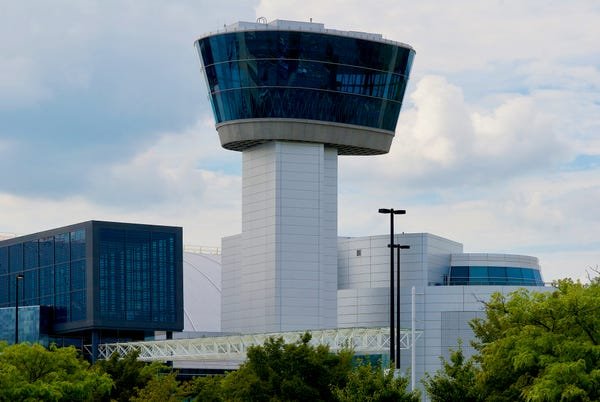
The Steven F. Udvar-Hazy Center in Chantilly, Virginia, is located on the property of Washington Dulles Airport.
The Steven F. Udvar-Hazy Center in Chantilly, Virginia. John M. Chase/Getty Images
Unlike at the National Air and Space Museum’s flagship DC location, where timed-entry tickets help manage large crowds in the smaller space, reservations are not required at the Udvar-Hazy Center.
Admission to the museum is free, and parking costs $15.
The museum takes advantage of its proximity to the airport with the Donald D. Engen Observation Tower.
Inside the Donald D. Engen Observation Tower. Talia Lakritz/Business Insider
At 164 feet tall, the observation tower educates visitors about the history of Air Traffic Control and provides a 360-degree view of the modern airport in action.
Inside the tower, I watched planes take off and land at Dulles Airport while listening to live Air Traffic Control audio.
The Mary Baker Engen Restoration Hangar gives a behind-the-scenes look at how the museum restores historic aircraft.
The Mary Baker Engen Restoration Hangar. Talia Lakritz/Business Insider
Visitors can watch restoration work happen in real time from a balcony with floor-to-ceiling windows overlooking the hangar.
Among the works-in-progress are “Flak-Bait,” a Martin B-26 Marauder that flew 202 combat missions during World War II and participated in D-Day, and a Sikorsky JRS-1 seaplane that was present at Pearl Harbor when it was attacked on December 7, 1941.
The B-29 bomber Enola Gay, which dropped the atomic bomb on Hiroshima during World War II, is in the museum’s collection.
The Enola Gay. Talia Lakritz/Business Insider
On August 6, 1945, the Boeing B-29 Superfortress bomber Enola Gay dropped the first-ever atomic bomb used in warfare on Hiroshima, killing at least 70,000 people.
The “Little Boy” atomic bomb weighed 9,700 pounds, forcing the aircraft to remove most of its protective and defensive armament in order to carry the enormous weight.
The Enola Gay exhibit sparked controversy when the plane was first displayed in 1995, as veterans’ groups and anti-war activists debated how the historical narrative around the use of the atomic bomb should be presented.
The Boeing 367-80 Jet Transport, the only model of its kind ever built, was the prototype that led to the development of the Boeing 707 jetliner.
The Boeing 367-80 Jet Transport. Heritage Images/Heritage Images via Getty Images
In the 1950s, Boeing set out to build a jet aircraft that could function as a passenger aircraft, a cargo plane, or a tanker used for mid-air refueling.
Boeing began building this prototype jet in 1952, and it flew for the first time two years later. It traveled 100 miles per hour faster than the de Havilland Comet, the world’s first jetliner developed in the UK, and had a range of over 3,500 miles, revolutionizing the air travel industry.
Known as “Dash 80,” the developed version of the aircraft entered service as the first jetliner in the US, the Boeing 707.
The museum also featured a Concorde supersonic commercial jet that was operated by Air France.
An Air France Concorde supersonic commercial jet. Talia Lakritz/Business Insider
The governments of Britain and France collaborated to create the first supersonic commercial jets, which operated commercially from 1976 to 2003.
Traveling at twice the speed of sound allowed the planes to cross the ocean in record time. Concorde’s fastest flight from New York City to London lasted just 2 hours, 52 minutes, and 59 seconds.
The museum’s Concorde jet, which flew for Air France, measures 202 feet and 3 inches long with a wingspan of 83 feet and 10 inches.
One of the museum’s centerpieces is a Lockheed SR-71A Blackbird, the world’s fastest aircraft propelled by air-breathing engines.
A Lockheed SR-71A Blackbird. Talia Lakritz/Business Insider
The Lockheed SR-71A, a supersonic reconnaissance aircraft, was designed to fly high and fast enough to avoid Russian missiles during the Cold War. It was capable of flying at an altitude of over 85,000 feet at speeds of over three times the speed of sound, or approximately 0.7 miles per second.
The aircraft became known as “Blackbird” for its black paint that was capable of absorbing radar signals.
This Blackbird logged 2,801.1 hours of flight time over 24 years of service before retiring in 1990.
The entrance to the James S. McDonnell Space Hangar, with the space shuttle Discovery placed front and center, stopped me in my tracks.
The space shuttle Discovery. Talia Lakritz/Business Insider
It’s hard to capture the full scale of Discovery in a photo, but I found it awe-inspiring to see such an enormous, historically significant spacecraft in person.
The shuttle measures 122 feet long, 78 feet wide, and 57 feet tall, towering over the other artifacts in the hangar. When fully loaded for missions, the orbiter weighed around 250,000 pounds.
Discovery was NASA’s longest-serving orbiter and flew 39 missions — more than any other space shuttle orbiter.
The space shuttle Discovery. Talia Lakritz/Business Insider
Discovery flew its first mission in 1984 and returned from its last in 2012, spending a total of 365 days in space.
Among its many historic accomplishments, Discovery deployed the Hubble Space Telescope in 1990 and became the first space shuttle to dock with the International Space Station in 1999.
Hanging above Discovery was the Manned Maneuvering Unit that astronaut Bruce McCandless used during the first untethered spacewalk in 1984.
The Manned Maneuvering Unit in action. Talia Lakritz/Business Insider ; Encyclopaedia Britannica/UIG Via Getty Images
The backpack propulsion device, powered by nitrogen jets, allowed McCandless to fly around 300 feet away from the space shuttle Challenger. His untethered spacewalk was immortalized in an iconic photo of the lone astronaut floating above the Earth.
The Udvar-Hazy Center is worth the detour from the National Mall.
The space shuttle Discovery at the National Air and Space Museum’s Steven F. Udvar-Hazy Center. Talia Lakritz/Business Insider
My phone’s step counter recorded nearly 10,000 steps on the day I visited the museum. There’s an incredible amount of ground to cover and objects to see.
I can’t believe I didn’t know that the National Air and Space Museum even had a second location when I started planning my visit to Washington, DC. Now, I’m recommending it to all of the air and space enthusiasts I know.
Global supply chains are on edge after the US and Israel launched military strikes on Iran on Saturday, triggering widespread disruption across one of the world’s most critical trade corridors.
The fallout is hitting more than oil tankers moving through the Strait of Hormuz.
Container ships loaded with consumer goods, auto parts, electronics, and food are being rerouted or delayed, while air cargo networks are fracturing under sudden airspace closures.
“Ocean container services in the Persian Gulf have continued unaffected by the recent build-up of military forces in the region, but the escalation in conflict through military strikes means ships will now avoid the area, but for as short a time as possible,” said Peter Sand, the chief analyst at freight-rate analytics platform Xeneta.
On Sunday, MSC — the world’s largest container shipping line by capacity — said it had suspended all bookings for cargo to the Middle East until further notice.
Every time Huileng publishes a story, you’ll get an alert straight to your inbox!
Stay connected to Huileng and get more of their work as it publishes.
Danish shipping giant Maersk paused Red Sea and Suez Canal sailings amid fears the Iran escalation could spill over into key shipping lanes. The company is rerouting vessels around the Cape of Good Hope in South Africa.
French shipping giant CMA CGM announced Monday it will impose an “Emergency Conflict Surcharge” effective Monday, citing rising security risks. The surcharge will add between $2,000 and $4,000 per container on shipments to and from Gulf and Red Sea countries.
On Saturday, CMA CGM ordered vessels inside or bound for the Gulf to “proceed to shelter.” It also suspended sailings through the Suez Canal and rerouted ships to the Cape of Good Hope.
German shipping giant Hapag-Lloyd introduced a $1,500 per standard container war risk surcharge and suspended vessel transits through the Strait of Hormuz.
Sailing around Africa, rather than through the Suez Canal, absorbs roughly 2.5 million 20-foot container units’ worth of global container capacity, according to Xeneta’s Sand.
Read more about the US-Iran conflict
Air cargo rates may rise
Air freight is also under strain.
Several Middle Eastern airspaces have been closed or restricted, disrupting passenger and cargo flights.
Parcel delivery giant FedEx suspended flights to and from markets including Bahrain, Israel, Qatar, Saudi Arabia, Kuwait, and the UAE, and halted pickup and delivery services in several Gulf countries.
Qatar Airways Cargo temporarily suspended operations due to the closure of Qatari airspace.
DSV, a Danish logistics company, said in an advisory that airspace restrictions are forcing carriers to suspend services or divert flights and lengthen routings.
With less cargo space available on key Asia-Europe and Middle East routes, air freight rates are likely to rise, space will tighten, and airlines may make short-notice schedule and pricing changes, according to DSV.
Ryan Petersen, the CEO of Flexport, wrote on X that conflict in the Middle East has removed 18% of global air freight capacity from the market.
If carriers begin omitting Gulf port calls, containers may be discharged at alternative hubs and trucked onward, wrote Xeneta’s Sand.
The broader concern, however, is what the escalation means for global trade flows through the Red Sea this year. The conflict comes after more than two years of disruption caused by Iran-backed Houthi attacks on commercial shipping.
“The repercussions of the joint military operation by the US and Israel against Iran and subsequent retaliatory action will see the further weaponization of trade and shatter hopes of a large-scale return of container shipping to the Red Sea in 2026,” wrote Sand.
The US and Israel’s fight with Iran shows just how key air defenses have become in higher-intensity modern wars, conflicts increasingly defined by long-range missile and drone attacks.
The conflict, which killed Iran’s Supreme Leader, has been heavily focused on air defenses, either knocking them out to permit air operations or leaning hard on them to shield bases from retaliatory strikes.
The US and Israel said their strikes focused on Iran’s air defenses and missile launch sites, and US and partner forces in the countries attacked in response relied on a mix of air defenses to fend off Iranian weapons.
Kuwait, home to installations like Ali Al Salem Air Base that hosts US troops, reported on Sunday that it had faced 97 ballistic missiles and 283 drones. Defeating this kind of barrage demands deep air defense arsenals.
When air defenses fall short
US Central Command on Saturday said the strikes on Iran aimed to “dismantle the Iranian regime’s security apparatus” and prioritized locations “that posed an imminent threat,” listing Iranian air defense capabilities, missile and drone launch sites, and military airfields as targets.
US Central Command shared footage of strikes on Iranian targets, including Iranian air assets.
US Central Command/X
The Israel Defense Forces said that they had “dismantled the majority of the aerial defense systems in western and central Iran” and are “paving the way towards establishing aerial superiority over the skies of Tehran.”
On Saturday, Israel used around 200 jets to drop hundreds of bombs on 500 targets on Saturday, including Iran’s air defense systems and missile launchers.
Having insufficient air defenses can leave a country severely vulnerable in a war of ranged strikes by creating a permissive environment for enemy airpower, as well as munitions, to find their targets, be they military installations or senior leadership. Over the past day, Iran has suffered serious losses to both.
Air defenses matter in a missile fight
Air defenses have been critical for the US and its allies this weekend.
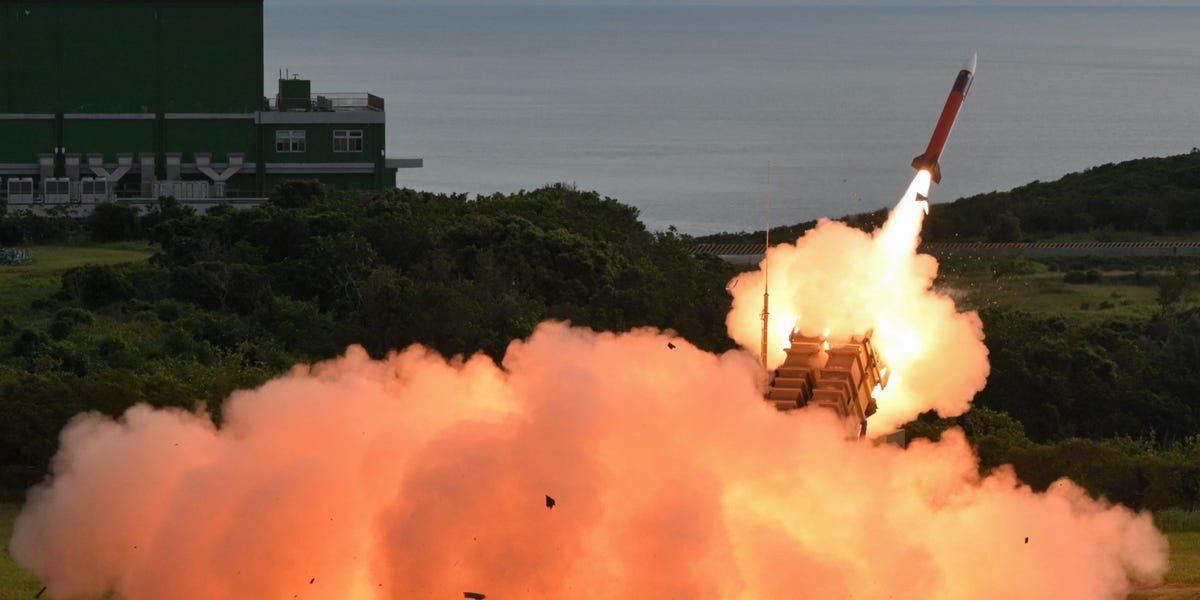
CENTCOM said it was able to defend against hundreds of Iranian missile and drone attacks, with no casualties. A US official told Business Insider that US-made MIM-104 Patriot surface-to-air missile systems and Terminal High Altitude Area Defense, or THAAD, batteries were used to protect the Middle East from Iran’s retaliatory strikes. Warship-launched interceptors and aircraft were also involved, as they’ve been in other engagements involving big Iranian missile barrages.
Nations attacked by Iran, countries like Qatar, the United Arab Emirates, and Bahrain, said they were largely able to intercept Iran’s missiles, sometimes stopping entire waves. Details are still emerging, but damage appears minimal. Casualties, likewise, have been extremely limited thus far, at least compared to what they might have been otherwise.
Some of Iran’s retaliatory strikes were successful, but countries reported intercepting entire waves of attacks with air defenses.
Stringer/REUTERS
That was only day one though. Iran has a large missile arsenal, and it has pledged to continue its attacks. Continued large barrages will put tremendous strain on air defense arsenals.
Along with other current and potential conflicts, Iran is yet more evidence that much of modern war has become ranged missile fights. If you don’t have good air defenses, you may very well lose.
This is a very different way of war compared to the fights against terrorists and insurgencies that the US and its allies waged for decades in the Middle East.
More would be needed for higher-end threats
China and Russia both field substantial missile arsenals that they are continuing to expand. The West is aware, but the war in Ukraine, where Russia bombards Ukrainian cities nightly with massive mixes of missiles and drones, has been a real wake-up call.
Ukraine has been developing its own air defenses while seeking additional options from partners. Each barrage is extremely demanding. In one engagement, Ukraine expended nearly $100 million in interceptors fighting off Russian attacks.
Much of the West has allowed air defense arsenals to atrophy, but there are significant new investments in air defense across the NATO alliance.
The NATO chief pledged a fivefold increase in air defenses, driven by the alliance’s increased spending. Established manufacturers are increasing production, and new systems are being created. President Donald Trump wants his Golden Dome missile defense system to protect against complex attacks from Russia and China.
But air defense systems and their missiles are expensive and time-consuming to make, and the industry is struggling to keep up with increasing demand, even with companies boosting output.
Mick Ryan, a retired Australian major general and strategist with a focus on future war, said that the heavier demand could cause new problems. Patriot interceptor missiles are critical to Ukrainian defenses, but are in heavy demand at present in the Middle East,” he wrote on Saturday.
Russia, he said, will want to “exploit any temporary Ukrainian capability gaps while American attention and production capacity focuses on Iran.”
The US will also need to maintain a strong air defense posture in both Europe and the Pacific as well, even as it fights Iran.
Ryan warned that concentrating US missile defense assets in the Middle East could degrade its deterrence in the Pacific: “Every carrier in the Gulf, every squadron in Europe, every missile defence battery protecting Middle Eastern countries represents capacity unavailable for containing Chinese expansion.”