Air-travel-has-been-thrown-into-chaos-with-cancellations-diversions.jpeg

Air travel has been thrown into chaos with cancellations, diversions, and airspace closures after strikes on Iran

Some of the world’s most congested airspace has been disrupted by the US and Israel’s strikes on Iran.

Iran, Iraq, Kuwait, Bahrain, and Qatar have all closed their airspaces. Dubai International Airport, the world’s busiest airport for international traffic, has suspended all flights until further notice.

A video shared by Flightradar24 showed airplanes deserting the region on Saturday morning.

Data from the aviation analytics firm Cirium shows that about 970 of the roughly 3,400 scheduled flights to the region have been canceled as of 11:00 p.m. Central European time. Factoring in outbound cancellations, that number is closer to 1,900.

The three major Middle Eastern airlines — Qatar Airways, Etihad Airways, and Emirates — operate major hubs that connect passengers to destinations around the world, creating a massive ripple effect of disruptions.

Qatar canceled nearly 60% of its flights on Saturday, Emirates canceled 65%, and Etihad canceled 50%, per Cirium. They’ve pre-emptively canceled hundreds more on Sunday.

Dubai International Airport — the world’s busiest megahub for international traffic — was damaged by an apparent missile strike on Sunday morning, local time. It’s unclear how that could further impact operations even if the airspace opens back up.

A Cirium spokesperson said these carriers collectively carry 90,000 transiting passengers through their hubs daily — not including those destined for the Middle East.

Major airline disruption

Even for flights that don’t land in the region, it’s a key corridor for flying between Europe and Asia. Some flights appeared to re-route over Saudi Arabia. Other airlines were avoiding the region altogether.

Detours are costly for airlines: They have to pay for extra fuel, labor, and any associated passenger compensation. And it’s possible mass diversions could overwhelm certain airports.

In a post on X, Emirates said it was temporarily suspending all flights to and from Dubai, its home base. That’s equal to about 500 flights a day, according to Cirium.

Emirates urged customers to check their flight statuses before visiting the airport. “We are actively monitoring the situation and engaging with relevant authorities,” the airline added.

Qatar Airways said all flights to and from the country were suspended until at least midnight UTC, or 7 p.m. ET. It also expects delays when usual operations resume.

Doha’s Hamad International Airport advised passengers “not to proceed to the airport.” Additional staff were deployed there to help passengers affected by the disruption, the airline said.

Etihad Airways, which is based in Abu Dhabi, said all departures and arrivals to the city were suspended until 2 p.m. local time Sunday.

Kuwait’s civil aviation ministry said a drone attack left some airport employees with minor injuries and damaged a passenger terminal.

Saudia said flights to and from affected airports were canceled until at least Tuesday.

Diversions and flights to nowhere

For those already in the air during the strikes, many flights diverted to other nearby airports or turned back to their origins.

Flightradar24 shows an Emirates flight from Orlando to Dubai diverted to Istanbul in a 14-hour flight to nowhere. A Qatar flight from New York to Doha crossed the Atlantic but then diverted to Rome after about 10 hours in the air.

An American Airlines flight from Philadelphia to Doha had flown for more than six hours when it turned around over Ireland and started heading back across the Atlantic Ocean, flight-tracking data showed. It looks like the total flight-to-nowhere will last about 13 hours.

An Air Canada flight from Toronto to Dubai was over the Mediterranean Sea before U-turning. Passengers appear to face a total journey time of 10 hours.

In a video statement posted to Truth Social on Saturday morning, President Donald Trump vowed to destroy Iran’s missile program and navy, and ensure that the country can “never” have a nuclear weapon.

There is likely more disruption to emerge. When Iran launched strikes on a US air base in Qatar last June, more than 160 flights were diverted.

Similar cancellations and reroutes happened in February 2022 when Russia invaded Ukraine, and again in April 2025 amid rising tensions between India and Pakistan.

Air India, for example, had to reroute flights around Pakistani airspace last year, requiring some long-haul services between India and Europe and North America to add a fuel stop in Vienna.

Some airlines, like Finnair, still fly the long way around Russia on certain long-haul treks rather than canceling the service altogether.


Source link

Israel-says-200-fighters-struck-Iran-in-the-largest-air.jpeg

Israel says 200 fighters struck Iran in the largest air operation in its history

Roughly 200 fighter jets participated in Israel’s widespread airstrikes against Iran on Saturday, the Israeli military said, calling the attack the largest air operation in its history.

The Israeli fighter jets dropped hundreds of bombs on 500 targets in western and central Iran, including air defense systems and missile launchers, the military said in a statement. The government earlier announced it had carried out a “preemptive” strike.

Attacks on the defensive systems — a tactic known as suppression of enemy air defenses, or SEAD — allowed Israel to expand its aerial superiority over Iranian territory, the military added.

“This is the largest military flyover in the history of the Israeli Air Force,” it said, adding that the operation was based on extensive planning and “high-quality intelligence.”

The strikes involved Israeli F-35 stealth fighters and F-15 jets. The full extent of the aircraft that participated is unclear.

Israeli warplanes attacked Iran alongside the US military. President Donald Trump described the American involvement as the start of “major combat operations” after nuclear talks between Tehran and Washington broke down.

A US official told Business Insider that American air, land, and naval forces were involved in the strikes against Iran and launched drones, rocket artillery, and cruise missiles, among other weapons.


An Israeli F-15C Buzz launches for a sortie in support of exercise Juniper Falcon, May 7, at Uvda Air Base, Israel.

Israeli F-15 fighter jets were involved in the strikes.

US Air Force photo by Tech. Sgt. Matthew Plew


US fighter aircraft also participated in the attacks, which targeted Iran’s Islamic Revolutionary Guard Corps command and control facilities, air defenses, missile and drone launch sites, and military airfields, the American military said.

Hundreds of Iranians have been killed and wounded in strikes so far, according to multiple reports.

Iran retaliated by launching waves of missiles against Israel and US bases across the Middle East, sending the region into an air defense frenzy.

US Central Command, which oversees Middle East operations, said its forces “successfully defended against hundreds of Iranian missile and drone attacks.”

Several Middle Eastern countries confirmed shooting down Iranian missiles as well, though some projectiles managed to slip past air defenses. CENTCOM said there are no reports of US casualties, nor has there been significant damage to American facilities.

Saturday’s strikes mark the second time in less than a year that the US has attacked Iran. American forces bombed the country’s nuclear facilities in June 2025 as part of Operation Midnight Hammer.

They also follow a steady buildup of US military forces in the Middle East and the Eastern Mediterranean Sea, including more than a dozen warships and hundreds of aircraft.


Source link

Shield-AI-says-its-Hivemind-AI-pilot-just-flew-a.jpeg

Shield AI says its Hivemind AI pilot just flew a drone vying to become a future Air Force uncrewed wingman

Shield AI’s artificial intelligence pilot has flown one of the US Air Force’s next-generation drone wingman contenders for the first time, the company announced this week.

Shield AI’s Hivemind, the same AI program that previously went head-to-head with a crewed fighter aircraft in aerial combat, was picked by the Air Force for autonomy testing as part of its Collaborative Combat Aircraft, or CCA, effort earlier this month. Now, it has flown Anduril’s CCA competitor, an achievement for the software that could pilot future uncrewed aircraft built to fly and fight alongside crewed US combat aircraft.

The US defense company said Hivemind, piloting Anduril’s Fury drone, also known as YFQ-44A, completed its first flight test over the Mojave Desert. The AI pilot met all required test points, including mid-mission updates and basic operational maneuvers, the company said.

The successful test opens the door for expanded mission autonomy testing with Hivemind, Shield AI said.

“This flight test showcases the potential of airpower built on mission autonomy,” Christian Gutierrez, vice president of Hivemind Solutions, said.

“Across platforms, domains, and environments, Hivemind provides resilient mission autonomy, proving that software is central to the future of airpower,” Gutierrez said, adding that “our collaboration with Anduril reflects a new era of defense acquisition, where autonomy is treated as a foundational warfighting capability on par with the aircraft itself.”

Shield AI has spent more than a decade developing Hivemind’s AI software, which is designed to perform many of the tasks of a human pilot. Unlike autopilot or other autonomous features, Hivemind is built to make real-time decisions, adjusting flight routes depending on conditions or obstacles to continue a mission, the company says.

The same AI software was used in the Air Force’s AI-enabled X-62A VISTA, a modified F-16 that flew simulated dogfights against a crewed fighter aircraft in 2024. The service has not publicly revealed which aircraft emerged victorious in those engagements.

Hivemind is also the AI pilot behind Shield AI’s new X-BAT fighter aircraft, which the company unveiled in October. Shield AI says that the X-BAT can operate without human intervention and take off without runways, as well as in contested environments where GPS and reliable communications might not be available.

Anduril’s Fury aircraft is one of the competitors for the CCA program, a priority of the Air Force that envisions uncrewed aircraft operating alongside crewed aircraft with some mixture of autonomy and human direction. Earlier this month, a test flight saw a CCA stand-in aircraft communicate and fly with an Air Force F-22 Raptor, marking another step forward in the CCA program.

On Wednesday, Col. Timothy Helfrich, the Air Force’s portfolio acquisition executive in fighters and advanced aircraft, commended the speed of work being done on autonomous pilots flying CCAs. “Quite an accomplishment going so quickly,” he said at a panel, “but we’ve got a lot ahead of us though.”


Source link

Headshot of Chris Panella.

A US Air Force F-22 Raptor just showed off how it might work with a loyal wingman-type drone in a future air war

A crewed US Air Force fighter and an uncrewed jet-powered aircraft flew together recently, communicating and showing how autonomous drones might fight in a future air war alongside human pilots.

US defense firm General Atomics, a competitor in the Air Force’s Collaborative Combat Program aimed at developing and fielding loyal wingman-type drones, said on Monday that its MQ-20 Avenger, long a CCA stand-in, flew with an F-22 Raptor.

During the test at Edwards Air Force Base earlier this month, the stealth fighter’s pilot commanded the test drone to carry out tactical maneuvers, perform combat air patrols, and execute airborne threat engagement tasks.

The most recent demonstration is an advancement of a similar test in November 2025, when an F-22 pilot used a tablet to control an MQ-20, a test aircraft being used to demonstrate CCA-style teaming. The tablet allowed the pilot to communicate with the drone and send commands during flight.

The flight test earlier this month saw the Raptor pilot use government-provided autonomy software on the F-22 and a tactical data link to pass commands in real time to the drone.

“This demo featured the integration of mission elements and the ability of autonomy to utilize onboard sensors to make independent decisions and execute commands from the F-22,” David Alexander, the president of General Atomics Aeronautical Systems, Inc., said in a statement.


An F-22 flies in a blue and cloudy sky.

The Air Force views CCAs as an attritable force multiplier that will be used with manned aircraft and autonomy.

US Air National Guard photo by Staff Sgt. John Macera


General Atomics said the latest demonstration showed how CCA-type platforms could increase the combat power available to human pilots in a future war.

The Collaborative Combat Aircraft program is a priority for the Air Force as a way to bolster American airpower. These drones are meant to fly alongside advanced fighters, including the coming sixth-generation F-47 being developed by Boeing.

Air Force officials say CCAs aren’t disposable, but they’re cheaper than fighters like the F-35 Lightning II Joint Strike Fighter. They are built to be attritable so they can be risked in combat instead of a human-piloted aircraft.

Testing with the MQ-20 is helping inform the Air Force’s CCA program, which is focused on General Atomics’ YFQ-42, Anduril’s YFQ-44, and Northrop Grumman’s YFQ-48A. The air service envisions these systems as easily upgradable platforms compatible with high-end crewed aircraft.

CCA-type drones, which include designs beyond those with dedicated Air Force program designations, are designed to carry out missions on their own, from air-to-air combat to strike and intelligence roles, while also boosting the power of a formation by adding more sensors and weapons without another pilot in the cockpit.

The Air Force says that CCAs are not intended as replacements for its crewed jets but are rather partners that will change how pilots work with artificial intelligence and drones — and expand US airpower in a fight, especially against a near-peer adversary.


Source link

Take-a-look-inside-the-Air-Force-One-plane-that.jpeg

Take a look inside the Air Force One plane that carried 8 presidents and brought home JFK’s body from Dallas

Updated

  • SAM 26000 operated as Air Force One from 1962 to 1998, carrying eight US presidents.
  • Lyndon Johnson was sworn in on board, and the plane transported John F. Kennedy’s body from Texas.
  • SAM 26000 is housed at the National Museum of the US Air Force, where visitors can walk through it.

“If history itself had wings, it would probably be this aircraft,” Vice President Al Gore said of the SAM 26000 Air Force One plane upon its retirement in 1998.

The first Air Force jet designed and built specifically for US presidents, SAM 26000 (pronounced two six thousand) carried eight presidents between 1962 and 1998 — every leader from John F. Kennedy to Bill Clinton.

After 13,000 flying hours over 36 years of service, the plane was retired to the National Museum of the US Air Force in Dayton, Ohio, where it remains on display.

I visited the museum in August and walked through the historic aircraft. Take a look inside.

The SAM 26000 Air Force One jet, a Boeing VC-137C, was completed in 1962 for President John F. Kennedy.

SAM 26000 at the National Museum of the US Air Force.

US Air Force photo by Ken LaRock

The Boeing VC-137C was a customized and modified version of a civilian 707-320B airliner. It was powered by four Pratt & Whitney TF33 engines, each with 18,000 pounds of thrust.

First lady Jacqueline Kennedy chose the plane’s blue and white paint colors in coordination with industrial designer Raymond Loewy.


A blue and white plane on display in a museum, with

Eight US presidents flew on this Air Force One plane known as SAM 26000.

US Air Force photo by Jim Copes

The first lady also added the words “United States of America” to the aircraft to signal its importance as the president’s plane.

In a tragic period of American history, SAM 26000 transported President John F. Kennedy’s body home after his assassination in 1963.


Air Force One arrives with President John F. Kennedy's coffin.

President John F. Kennedy’s coffin was transported on Air Force One after his assassination.

Schulman-Sachs/picture alliance via Getty Images

President Lyndon Johnson was sworn in as president aboard the plane hours after Kennedy was pronounced dead.

Now an interactive museum artifact, visitors can board the plane the same way US presidents did via a staircase leading into the cabin.


Air Force One at the National Museum of the US Air Force.

Air Force One.

Talia Lakritz/Business Insider

Admission to the National Museum of the US Air Force is free.

SAM 26000 is located in the museum’s William E. Boeing Presidential Gallery, which includes other presidential planes such as the Douglas VC-54C, the first presidential aircraft, which was known as the “Sacred Cow.”

The first stop on my self-guided tour was the cockpit, which featured a four-person crew.


The flight deck of SAM 26000.

The cockpit.

Talia Lakritz/Business Insider

The crew consisted of a pilot, copilot, navigator, and flight engineer. The navigator and flight engineer roles were eventually replaced by GPS and computerized technology on later Air Force One planes.

Two phones were located behind the flight deck.


Two phones aboard Air Force One, SAM 26000.

Two phones aboard Air Force One.

Talia Lakritz/Business Insider

A plaque above the phones read, “This telephone is subject to monitoring at all times. Use of this telephone constitutes consent to monitoring.”

An equipment storage space featured a first aid kit and firearms.


A first aid kit and weapons on Air Force One SAM 26000.

A first aid kit and weapons on Air Force One.

Talia Lakritz/Business Insider

The closet also had a rack to hang suits and coats.

Next, I walked by the plane’s communication facility.


The communication facility on board SAM 26000.

The communication facility.

Talia Lakritz/Business Insider

The secure communication center allowed presidents to place calls anywhere in the world while in flight.

Meals were prepared in the galley.


The galley on board SAM 26000.

The galley.

Talia Lakritz/Business Insider

The galley included a stovetop, oven, and sink.

This seating area was used by presidential staff, members of the press, and Secret Service agents.


A seating area aboard SAM 26000.

A seating area aboard SAM 26000.

Talia Lakritz/Business Insider

The aircraft could hold up to 40 passengers.

The seating area, like many areas of the plane, is now protected by plastic barricades.

I noticed fox decals above the seats, which a museum volunteer told me was a nod to the 89th Airlift Wing, which operates Air Force One.


A fox decal on Air Force One SAM 26000.

A fox decal on Air Force One.

Talia Lakritz/Business Insider

Stationed at Joint Base Andrews in Maryland, the 89th Airlift Wing is tasked with flying the president and high-ranking government officials. The group is also referred to as “SAM FOX,” which stands for “Special Air Missions Foreign.”

The presidential stateroom was located down a long hallway.


A hallway on Air Force One.

A hallway on Air Force One.

Talia Lakritz/Business Insider

The benches in the hallway were hollow to offer additional storage.

The president’s spacious quarters featured a desk, couch, television, and private bathroom.


The president's stateroom aboard SAM 26000.

The president’s stateroom.

Talia Lakritz/Business Insider

In 1969, Nixon redesigned Air Force One and moved the presidential quarters over the wings, which was the quietest and smoothest part of the plane during flight.

The stateroom came with two phones, each with different purposes.


Two phones in the president's stateroom on Air Force One SAM 26000.

Two phones in the president’s stateroom.

Talia Lakritz/Business Insider

Presidents used the white phone to communicate with crew members and other passengers on the plane, while the beige phone could be used to call anywhere in the world.

Behind the presidential stateroom, a conference room provided more meeting space.


A conference room on SAM 26000.

A conference room.

Talia Lakritz/Business Insider

The room was furnished with throne chairs, a folding table, and another TV.

Additional conference areas provided more seating for staff, Secret Service members, and VIPs.


Seating aboard SAM 26000.

A conference room aboard SAM 26000.

Talia Lakritz/Business Insider

Presidents Nixon, Ford, and Carter sat here while flying to attend Egyptian President Anwar El-Sadat’s funeral in 1981.

An office area across the aisle featured an electric typewriter, scanner, and more phones.


A conference room with a map of the United States aboard SAM 26000.

A conference room.

Talia Lakritz/Business Insider

Presidents used the electric typewriter to write and edit speeches while on board the plane.

The wall of the office space was decorated with a map of the United States.

President Lyndon Johnson was sworn in as president in this area of Air Force One’s cabin after Kennedy’s assassination in 1963.


Lyndon Johnson takes the oath of office aboard Air Force One after the assassination of John F. Kennedy.

President Lyndon Johnson was sworn in on board Air Force One after President John F. Kennedy’s assassination.

Universal History Archive/Getty Images

Kennedy was assassinated on November 22, 1963, while visiting Dallas. He was pronounced dead at Parkland Memorial Hospital at 1 p.m., and Johnson took the oath of office at 2:38 p.m.

Jacqueline Kennedy’s pink suit was still smeared with blood when Federal Judge Sarah T. Hughes administered the oath of office on Air Force One. Johnson’s wife, Lady Bird Johnson, stood to his right.

Standing in the very spot where Johnson was sworn in after Kennedy’s assassination was awe-inspiring.


A hallway on SAM 26000.

A hallway between conference rooms on SAM 26000.

Talia Lakritz/Business Insider

Even blocked off by plastic barricades, the plane’s cabin preserves a pivotal moment in US history.

These four seats toward the back of the plane were removed to make room for Kennedy’s coffin on the flight from Dallas back to Washington, DC, in 1963.


Seats on Air Force One.

Seats on Air Force One.

Talia Lakritz/Business Insider

The Secret Service had to break the handles off the casket to make it fit through the plane door.

Air Force security personnel operated out of this area at the back of the aircraft to secure the plane while it was on the ground.


Seats for security personnel aboard SAM 26000.

Seats for security personnel.

Talia Lakritz/Business Insider

The seating area featured six seats, a phone, and a folding table.

My tour ended at the back of the plane with a view of its call sign on the tail and an American flag.


The tail of SAM 26000.

The tail of SAM 26000.

Talia Lakritz/Business Insider

According to US Flag Code, an American flag decal must always be positioned so that the stars face forward.

Air Force One remains an instantly recognizable symbol of US might, making my walkthrough tour a memorable experience.


The presidential seal on Air Force One.

The presidential seal on Air Force One.

Talia Lakritz/Business Insider

Like many modes of presidential transportation, such as the bulletproof limousine known as “The Beast” and the Marine One helicopter, Air Force One is about more than simply getting the president from point A to point B. It symbolizes the power of the United States and its elected leader wherever it goes.

The image projected by presidential planes remains of great interest to President Donald Trump, who opted to accept a luxurious Boeing 747-8 jet from the Qatari royal family instead of waiting for Boeing to deliver its long-delayed new Air Force One jets.


Source link

Taylor Rains

Airline ‘stopover’ programs are one of the best air travel hacks

Your layover doesn’t have to mean sleeping on the airport floor or surviving on a $10 hot dog.

Some airlines offer “stopover” programs that let travelers turn a layover into a mini‑vacation, giving you a few days to explore the stopover city before continuing to your final destination.

Flight prices usually stay the same, and hotels or activities may be free or heavily discounted. Think of it as two trips for the price of one — and a chance to see a new city along the way.

It might seem counterintuitive — after all, airlines are offering free perks — but the strategy boosts tourism for the home country and encourages travelers to choose a one-stop itinerary over a nonstop flight, which can ultimately be more profitable for the carrier.

I recently took advantage of Turkish Airlines’ stopover deal, spending three days in Istanbul before flying to my final destination, Croatia.

It gave me just the right amount of time to shake off jet lag after the long flight from New York and check off Istanbul’s main sites, like the Sultan Ahmed Mosque (Blue Mosque) and the Spice Bazaar.


The Sultan Ahmed Mosque

The Sultan Ahmed Mosque, or Blue Mosque, is a stunning Ottoman-era landmark in Istanbul. I was given a headscarf to wear inside.

Taylor Rains/Business Insider


Turkish is one of roughly two dozen global carriers with a stopover setup. Other examples include Copa Airlines in Panama City, Qatar Airways in Doha, Icelandair in Reykjavik, Fiji Airways in Nadi, and Iberia in Madrid.

With so many options, stopovers are one of the industry’s best travel hacks — though they require careful planning and the rules vary.

You have to apply for your accommodation

For Turkish, the stopover deal includes a free hotel on either the outbound or return flight, provided the layover is at least 20 hours but no more than 7 days. This duration requirement varies from airline to airline.

The hotel reservation wasn’t automatic upon booking. Travelers must separately apply for the voucher on Turkish’s stopover page or via email at least 72 hours before their trip.

You can usually select your preferred hotel, but the final assignment depends on availability and isn’t guaranteed.

Because part of my itinerary was in business class and my origin was the US, I received three free nights at a five-star hotel; eligible economy fares include two nights at a four-star hotel.

I stayed at the Fairmont Quasar, about 40 minutes from the airport and 30 minutes from Istanbul’s tourist-friendly Old City. The complimentary room would normally run around $200 per night during the offseason.


A view of the Bosphorus Strait.

It was unusually snowy in Istanbul during my January trip.

Taylor Rains/Business Insider


It was a bit far from the main sites, as was the case with most of the other hotel options. Still, my room was comfortable, overlooked the Bosphorus Strait, and included breakfast.

Visa fees and transport costs between the airport, city, and hotel were not included; my cabs cost between $20 and $50, with higher fares during rush hour. There is also cheaper public transportation.

I received three nights because the program offers extended hotel stays to travelers flying from select countries, like the US, South Korea, Australia, and Canada. Those on shorter flights or from other locations receive one or two nights’ free, depending on the fare class.

I slept through much of my first day as I adjusted to the eight-hour time difference, but later headed out to explore Istanbul’s historic landmarks and eat a proper kebab.


The kabab I had in Istanbul.

The beef kebab with rice and sumac-laced onions was the best meal I had in Turkey.

Taylor Rains/Business Insider


The stopover gave me a buffer between the red-eye flight to Turkey and the hiking-focused trip I had planned in Croatia. The whole journey felt like less of a slog.

Not all stopover deals are alike

Each stopover deal works a little differently when it comes to eligibility rules and perks.

Typically, your layover must fall within the program’s specified timeframe, and your itinerary must be on a qualifying route. There may also be restrictions on fare class.

Most airlines also require you to add the stopover through a dedicated portal or customer service, either at the time of booking or within a set window afterward.


The author in Plitvice Lakes, Croatia.

My final destination was Croatia. I wanted to get out of the city, so I drove 2 hours from Zagreb to Plitvice Lakes National Park. Visiting in the winter is cheaper, and there are very few other people.

Taylor Rains/Business Insider


Like Turkish, a few sweeten the deal with complimentary stays. UAE’s Etihad Airways includes up to two free hotel nights in Abu Dhabi as part of its program.

Ethiopian Airlines provides a free night at its Skylight In-Terminal Hotel at Addis Ababa Airport for layovers between eight and 24 hours. That’s enough time to sleep, but little chance to explore the city.

Others lean on discounted options. Qatar Airways, for example, offers name-brand hotel rooms in Doha at a small fee, ranging from $14 per person for one night to $76 per person for four nights.

Airlines like Copa and TAP Air Portugal offer structured stopover perks, such as discounts on hotels, restaurants, and experiences. Emirates also includes a stopover, and travelers can optionally add a curated multi-day tour in Dubai for an extra fee.

Others, like Air Canada, Air France, and Dutch carrier KLM, simply let travelers turn a layover into a multi-day visit without risking a fare hike, making their stopovers more of a routing perk than a bundle of freebies.

That means travelers are largely on their own for planning hotels and activities. Even so, stopovers remain a smart way to see a city you might not otherwise make time for.

For aviation and travel aficionados like me, they’re a double win: a chance to experience different airlines and aircraft while squeezing more cities into a single trip.


Source link

Inside-the-restoration-hangar-where-the-National-Air-and-Space.jpeg

Inside the restoration hangar where the National Air and Space Museum repairs and preserves historic aircraft for display

When a one-of-a-kind aircraft from World War II needs work done, not just any body shop will do.

At the National Air and Space Museum’s Steven F. Udvar-Hazy Center in Chantilly, Virginia, staff members repair and preserve historic aircraft in an in-house restoration hangar that offers a behind-the-scenes look at the work that goes into maintaining the museum’s collection.


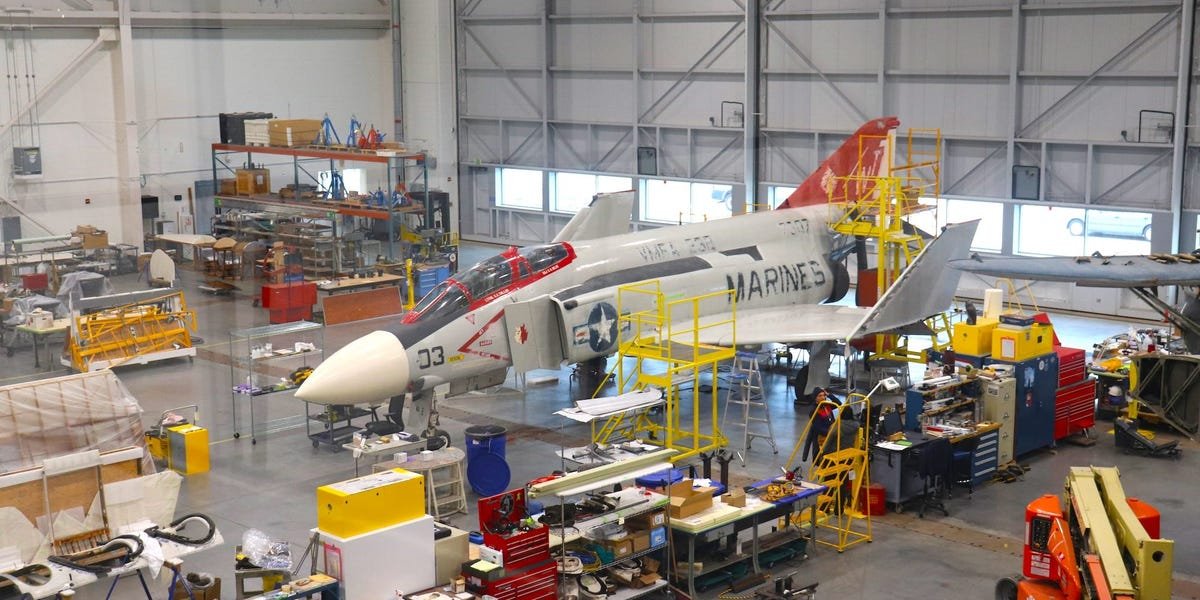
The Mary Baker Engen Restoration Hangar at the National Air and Space Museum's Steven F. Udvar-Hazy Center in Chantilly, Virginia.

The Mary Baker Engen Restoration Hangar at the National Air and Space Museum’s Steven F. Udvar-Hazy Center in Chantilly, Virginia.

Talia Lakritz/Business Insider


The Smithsonian museum’s second location, situated about 30 miles from the National Air and Space Museum’s flagship site in downtown Washington, DC, offers an expansive setting with 340,000 square feet of exhibit space.

The Mary Baker Engen Restoration Hangar, which is connected to the exhibits, can accommodate several aircraft at a time and houses everything workers might need, including a sheet-metal shop, a welding room, a paint room, and a fabric shop.

It also features floor-to-ceiling windows overlooking the hangar, allowing visitors to watch the work happening in real time.


Observation windows overlook the Mary Baker Engen Restoration Hangar at the National Air and Space Museum.

Observation windows overlook the Mary Baker Engen Restoration Hangar.

Talia Lakritz/Business Insider


Holly Williamson, public affairs specialist at the National Air and Space Museum, told Business Insider that visitors shouldn’t expect to see planes being built with the speed of a factory assembly line. Progress can be slow, with some restoration projects spanning months or years.

“This kind of will look like paint drying if you just sit here for the whole day,” Williamson said. “It’s a lot of research. It’s very detail-oriented.”

Despite the slow pace, there’s still plenty to see. One of the museum’s longer-term projects is “Flak-Bait,” a Martin B-26 Marauder that flew 202 combat missions during World War II, including D-Day.


“Flak-Bait,” a Martin B-26 Marauder.

Talia Lakritz/Business Insider


When the museum first opened in 1976, visitors were allowed to touch the aircraft’s nose, which wore down the paint. Workers have focused on restoring its appearance while preserving its authentic combat damage.

“It flew more missions than any other aircraft in World War II for the US, so we want it to look like it’s been through hundreds of missions,” Williamson said.

Another striking display is a Sikorsky JRS-1 seaplane, the only aircraft in the museum’s collection that was present at Pearl Harbor when it was attacked on December 7, 1941. After Pearl Harbor, the Sikorsky JRS-1 patrolled for Japanese submarines. It arrived at the Mary Baker Engen Restoration Hangar in 2011.


A Sikorsky JRS-1.

A Sikorsky JRS-1.

Talia Lakritz/Business Insider


Staff members are also working to restore a McDonnell F-4S Phantom II, a fighter and bomber that shot down an MiG-21 during the Vietnam War. After the Vietnam War, it underwent modernization and was redeployed in 1983, remaining in service until its last squadron duty in 1987.


A McDonnell F-4S Phantom II in the Mary Baker Engen Restoration Hangar.

A McDonnell F-4S Phantom II.

Talia Lakritz/Business Insider


The rest of the hangar floor is a maze of tools, machinery, aircraft parts, and storage bins, indicators of just how intricate the museum’s restoration efforts are.

Certainly more interesting than watching paint dry.


Source link

A map of the Caribbean with icons on each airport that had flights canceled on January 3, 2026, adjusted for size based on the number

Maps show the scale of the Caribbean air travel chaos — and how airlines are adding extra flights to rescue passengers

Almost 1,000 flights to and from the Caribbean were canceled on Saturday after the US raid on Venezuela.

The Federal Aviation Administration banned commercial aircraft from flying over Venezuelan airspace before expanding restrictions to much of the Caribbean.

Puerto Rico was the most affected, with 400 flights canceled to or from the main airport in San Juan.

There were also over 140 cancellations in the US Virgin Islands, and 91 in Aruba, which is only about 20 miles off the Venezuelan coast.

Using data from FlightAware, Business Insider put together this map to show the scale of the disruption. You can hover over an icon to see the number of cancellations at the airport.

After airspace restrictions ended early Sunday, airlines added dozens of extra flights to help passengers get where they needed to go.

The region is a particularly popular destination for vacationers seeking some winter sun over the New Year holiday.

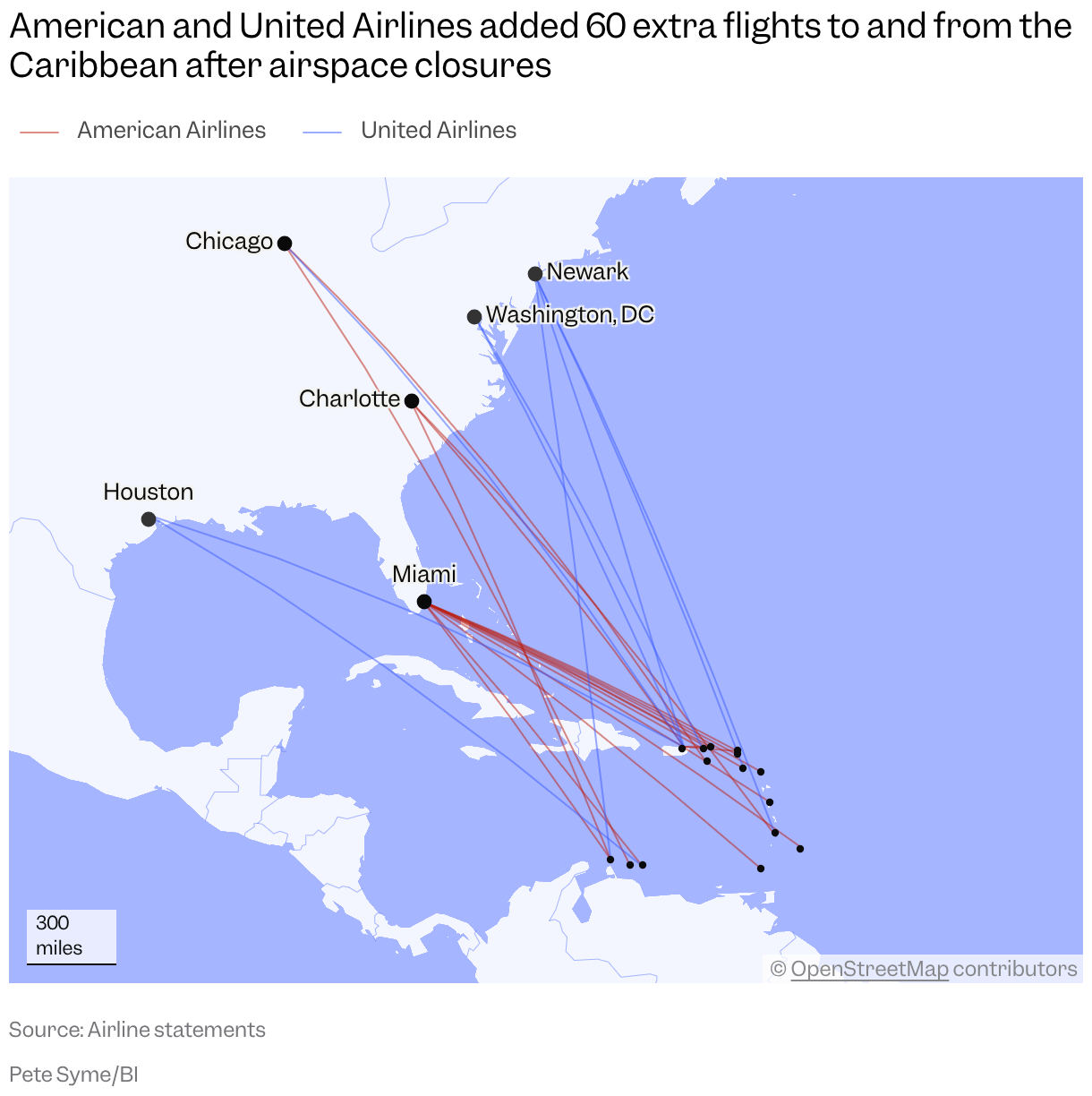
American Airlines added 43 extra flights on Sunday and Monday, with room for 7,000 passengers.

For the first time in over a decade, it operated interisland flights in the eastern Caribbean on Monday. Namely, to Puerto Rico from Anguilla and the British Virgin Islands.

American’s expanded schedule included deploying a Boeing 777-300, the largest model in its fleet, to ferry passengers between Miami and Puerto Rico.

United Airlines listed 17 additional flights scheduled for Sunday and Monday, to and from its hubs in Houston, Newark, and Washington, DC.

Delta Air Lines said that it has added space for 2,600 people on Monday. It didn’t immediately provide details of the extra flights it has scheduled.

Airlines have waived change fees and fare differences for passengers flying to or from the Caribbean, to rebook for flights later in the month.

Have you been affected by the travel disruption in the Caribbean? Reach out to this reporter at psyme@businessinsider.com or via Signal at syme.99


Source link

Im-a-personal-trainer-and-mom-of-4-Here-are.jpeg

I’m a personal trainer and mom of 4. Here are my 10 go-to meals and snacks to make in an air fryer.

  • I’m a personal trainer and mom of four, and I love using my air fryer to make meals and snacks.
  • Homemade tortilla chips and stuffed peppers are some of my favorite things to make in an air fryer.
  • I also use my air fryer to make baked apples, breakfast bowls, and kale chips. 

My health-centered, active family focuses on nutrient-dense foods that provide us with energy.

We don’t shy away from less nutritious foods (everything in moderation), but most of our meals are centered on lean protein, whole grains, fruits, vegetables, dairy, and healthy fats.

On top of that, I also face the ever-pressing need to appease all four of my kids. Making nutritious foods that appeal to everyone’s palate can be challenging, but using an air fryer helps.

I love that air fryers help create that crunchy, fried appeal without adding a ton of fat to a dish. Though fats can be nutritious, they are better consumed in proportion to the carbs and protein in your meal.

Plus, my air fryer doubles as another cooking tool when the stove or oven is in use, and my kids can use it to make food on their own without having to navigate burners and dials.

Here are some of my favorite air-fryer meals and snacks.

Ham-and-egg cups are an easy breakfast.

I make these breakfast bites in silicone cups.

Rachel MacPherson

Breakfast cups are nothing new in our house, but they require less time and effort to make because of the air fryer.

Plus, we can make them in small batches to suit each person’s tastes — and my kids have no problem creating their personalized mini egg cups.

The number of cups you can make at once may depend on the basket size of your air fryer. Usually, I can make eight at a time using silicone baking cups.

The ham-and-egg cups take about 15 minutes to make.


ham cheese in silicone wrapper in air fryer

You can easily customize the ham-and-egg cups.

Rachel MacPherson

Preheat your air fryer to 300°F.

Line each baking cup with a slice of ham or prosciutto for a fancier option. Mix eggs with salt, pepper, and any additional seasonings of your choice, such as Worcestershire sauce and red-pepper flakes.

Carefully place the ham-lined cups into the air fryer and pour the egg mixture into each. Add any veggies you prefer, such as chopped asparagus or cooked spinach. Sprinkle on a cheese of your choice. 

Let the egg cups cook for about 15 minutes. Serve hot, or let them cool slightly and store in the fridge to reheat later.

I like making breakfast bowls with air-fried veggies.


asparagus and tomatoes on foil in air fryer

You can use any vegetables you have on hand.

Rachel MacPherson

It can be challenging to have a vegetable-packed breakfast, but it’s a great way to better ensure you’ll get enough nutrients throughout your day.

With the air fryer, I can easily cook fresh produce in the morning. I like to use asparagus and tomatoes, pairing them with eggs that I’ve poached or “boiled” in the air fryer.

This produce-filled breakfast takes about 12 minutes to make and pairs well with toast.


asparagus tomato egg breakfast bowl

I like to use toast to sop up any juices.

Rachel MacPherson

Line your air fryer with foil and preheat it to 300°F.

Clean and snap asparagus, chopping it into bite-sized pieces. Add cherry or grape tomatoes to a bowl with asparagus, spritz with olive oil, and season with salt and pepper.

Place the produce in the preheated air fryer for 10 to 12 minutes. If you prefer crunchy asparagus, leave it out until the last four to six minutes, and then place it on top of the tomatoes to finish cooking.

Serve with eggs and some toast for mopping up all the yummy juices.

I make chicken Parmesan without frying my cutlets in a ton of oil.


breaded chicken breasts on a piece of parchment paper

I bread my chicken (not pictured) before I cook it.

Candice Bell/Shutterstock

Chicken Parmesan is one of my favorite comfort foods, and the air fryer helps me make it without having to pan-fry my protein in oil.

For two 8-ounce chicken breasts, you’ll need about ¼ cup of Parmesan cheese and 1 cup of breadcrumbs. You’ll also need two eggs, marinara sauce, and mozzarella for topping.

Air-fryer chicken Parmesan pairs well with pasta.


homemade chicken parmesan

My chicken Parmesan is usually served with pasta.

Nancy Salmon/Shutterstock

First, pound the chicken breasts until they are a uniform thickness, about 1/2 inch. Then set your air fryer to 360°F.

Combine the Parmesan and breadcrumbs in one dish and add any desired seasonings, such as garlic powder, salt, pepper, oregano, and red-pepper flakes. Whisk your eggs in a separate bowl. Coat each piece of chicken in egg, then in the crumb mixture.

Place the breasts in the preheated air fryer and cook for six minutes. Flip and top with marinara sauce and mozzarella. Cook an additional four minutes or so until the internal temperature of the chicken reaches 165°F.

We like to serve the cutlets on top of pasta with more marinara sauce.

Seasoned pumpkin seeds are a great snack.


pumpkin seeds with seasoning in bowl

Making your own seasoned nuts and seeds in the air fryer is game-changing.

Rachel MacPherson

We buy a lot of seeds in bulk, so switching up the flavor profile helps turn them into coveted snacks. We especially enjoy using seeds from squash, such as pumpkins, for this recipe.

Cumin, salt, cayenne pepper, garlic powder, and smoked paprika are all excellent choices for seasoning seeds, though you can experiment with other flavors you enjoy.

You can season the seeds to be sweet or savory.


pumpkin seeds in air fryer

Sometimes, I use cumin, garlic powder, and onion powder.

Rachel MacPherson

Toss your seeds with a bit of olive oil and salt. Place them in the air fryer at 320°F, periodically opening the machine to shake the seeds to ensure even cooking.

Cook for about 15 minutes or until the seeds are crispy. Then, toss the seeds in a bowl with a bit of oil and your preferred seasonings.

Baked apples are a favorite of ours, and they’re easily adaptable to most dietary preferences.


apples with cinnamon on them in an air fryer

We use our air fryer for more than just savory foods.

Rachel MacPherson

One of my family’s favorite air-fryer desserts is a fruity crumble that we usually make with apples.

After all, baking fruit is a delicious way to bring out its natural sugars and create a deeply comforting dessert that’s both nutritious and satisfying.

You can make this dessert in under 30 minutes.


baked apple crumble

You can pair the baked apples with whipped cream.

Rachel MacPherson

Simply combine 1 or 2 tablespoons of a fat, such as butter or coconut oil, with the same amount of oats, chopped nuts, and shredded coconut.

Add a sweetener, such as monk fruit, brown sugar, honey, or maple syrup, and some warming spices like cinnamon and nutmeg.

Cut the apples in half and top them with spoonfuls of the mixture you’ve created. Cook them in a preheated air fryer at 350°F for 20 minutes.

Top with vanilla frozen yogurt, ice cream, or whipped cream.

This recipe can also be made with bananas or pears, though you may need to adjust the cooking time accordingly.

Polenta pizzas are an excellent snack, mini meal, or appetizer that can be dressed up or down.


polenta rounds in air fryer

I use polenta rounds as my base for the mini pizzas.

Rachel MacPherson

My kids love the idea of mini pizzas — and if you use fresh mozzarella, basil, and a balsamic reduction, you’ve got a fancy-ish hors d’oeuvre.

For the base, I slice up a tube of precooked polenta. From there, you can use whichever sauces, cheeses, and extra toppings you’d like.

These rounds can be customized with any toppings.


polenta topped with cheese and sauce in air fryer

I often make my own marinara sauce.

Rachel MacPherson

Preheat your air fryer to 400°F, then spritz the basket with olive oil. 

Create 1-inch-thick polenta slices, and place them in the air fryer, topping them with another spritz of oil.

Sprinkle with salt and pepper. After five minutes, top the polenta with marinara sauce and your choice of cheese, as well as any other cooked toppings you desire.

Cook for another five minutes, then plate with fresh basil and balsamic glaze, if desired.

Pro tip: You can make a quick marinara using tomato sauce, a splash of balsamic and/or Worcestershire sauce, oregano, basil, garlic powder, salt, and pepper. Heat this in the microwave (lightly covered) to blend the flavors.

I make my own tortilla chips in the air fryer.


tortilla slices in air fryer

You can use corn tortillas to make chips.

Rachel MacPherson

We make a lot of tacos with corn tortillas, but they go stale quickly. To avoid food waste while creating a tasty snack, we turn them into chips in our air fryer.

The chips can be ready in under 10 minutes.


tortilla chips homemade

I use a strainer to cool chips so they don’t get soggy.

Rachel MacPherson

Preheat your air fryer to 350°F. Cut small corn tortillas into quarters, spray with olive oil, and season with salt.

Place your pieces in the air-fryer basket, ensuring they’re not overlapping. Cook in batches for five to seven minutes at a time, flipping each chip halfway through.

Use a strainer to cool your batches of chips so they don’t get soggy.

I use leftover produce to make a rich air-fryer salsa.


salsa ingredients in air fryer

“Roasting” the vegetables adds flavor.

Rachel MacPherson

Fresh salsa is incredible, but roasted salsa is an easy way of using up bits and pieces to create a deep, rich dip for your air-fried tortilla chips.

The best part is you can adjust the heat, garlic, and seasonings to your preferences.

To make the salsa, I use an air fryer and a food processor.


salsa in bowl

I usually add cumin and cayenne pepper to my salsa.

Rachel MacPherson

Preheat your air fryer to 400°F.

Add garlic cloves, hot peppers of choice, tomatoes, and onion to the preheated air-fryer basket and spritz with olive oil. Sprinkle with salt.

You may want to remove the stems and seeds from your peppers before cooking them. Leave garlic cloves in their skin, as they will roast and become deliciously mushy and caramelized.

Cook everything for about 15 minutes, or until your veggies look slightly charred. Then, pulse your ingredients in a food processor to your desired chunkiness.

Add cilantro and fresh lime juice, then season with salt and pepper to taste. Cumin and cayenne pepper make excellent additions.

For a protein-packed dish, I stuff peppers with tuna salad.


tuna stuffed peppers with shredded cheese  in air fryer

I can usually fit two whole peppers in my air fryer.

Rachel MacPherson

Tuna salad is the star of many protein-packed dishes in our house. It’s quick and requires no thawing or cooking.

However, sandwiches can become boring after a while. When we crave something warm, we stuff tuna into bell peppers.

You can also easily customize these stuffed peppers.


tuna stuffed peppers

You can customize this recipe however you want.

Rachel MacPherson

Preheat your air fryer to 360°F.

Cut your bell pepper in half and remove the seeds. Then, top each pepper slice with your favorite tuna salad — we make ours with mayo, Greek yogurt, green onions, diced pickles, and hot peppers.

Cook for 10 minutes, and then sprinkle with mozzarella or your favorite cheese. Cook for another two or three minutes until the cheese melts and bubbles.

Lastly, we love to snack on air-fried kale chips.


cooked kale in air fryer

You can season kale chips however you want.

Rachel MacPherson

This is another crunchy and quick savory snack that provides a ton of nutrients in a snap. 

Strip the leaves off the stems from a bunch of kale and rip them into pieces. Place them in a bowl and spritz with olive oil, then sprinkle with sea salt.

Massage the kale until it turns softer and becomes a brighter green. Place in the air fryer preheated to 370°F and cook for about five minutes.

Remove the leaves when they appear crispy and have a slight color. Season the kale chips as desired. We use garlic powder, salt, and pepper.

This story was originally published in 2021, and most recently updated on January 2, 2025.


Source link