This story is available exclusively to Business Insider
subscribers. Become an Insider
and start reading now. Have an account? .
A KC-135 refueling aircraft “went down” in Iraq, the US military announced Friday evening.
A second unidentified aircraft was involved but landed safely.
The status of the refueling aircraft’s crew is unknown.
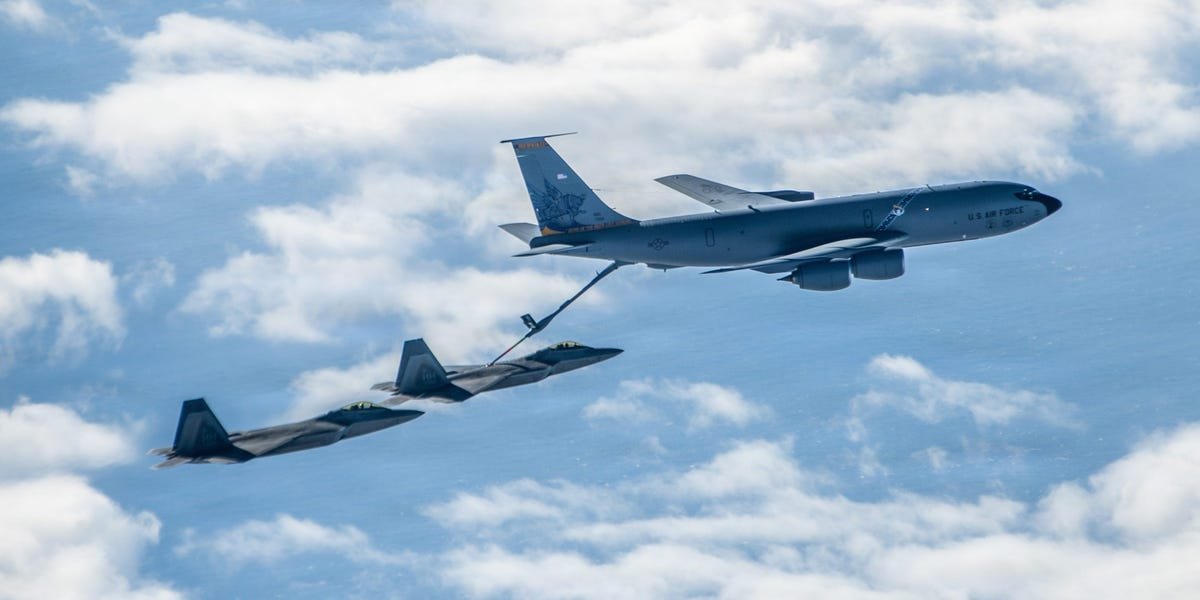
A US military KC-135 refueling aircraft involved in Operation Epic Fury has crashed in Iraq, US Central Command said in a statement on Friday evening.
“Central Command is aware of the loss of a US KC-135 refueling aircraft,” the command, which oversees US military operations in the Middle East, said, adding that the incident involved two aircraft operating in friendly airspace in support of Epic Fury.
One aircraft “went down” in western Iraq, while a second unidentified aircraft landed safely. The aircraft loss “was not due to hostile fire or friendly fire,” CENTCOM said.
This marks the fourth American aircraft loss since the start of Operation Epic Fury, the Pentagon’s name for US operations against Iran, nearly two weeks ago. Just days into the war, CENTCOM announced that three American F-15E Strike Eagles were downed by friendly fire over Kuwait. The aircraft were lost, but all six aircrew members were able to eject safely.
The KC-135 Stratotanker is an Air Force asset that supports the broader joint force by refueling other aircraft — including fighter jets, bombers, and cargo aircraft — in notoriously complex midair refueling operations. It’s essentially a flying gas station that executes fuel transfers at high speed with aircraft in close proximity.
The KC-135 typically carries a three-person crew — a pilot, co-pilot, and boom operator. The status of the crew is not known at this time. CENTCOM said rescue operations are ongoing.
When a one-of-a-kind aircraft from World War II needs work done, not just any body shop will do.
At the National Air and Space Museum’s Steven F. Udvar-Hazy Center in Chantilly, Virginia, staff members repair and preserve historic aircraft in an in-house restoration hangar that offers a behind-the-scenes look at the work that goes into maintaining the museum’s collection.
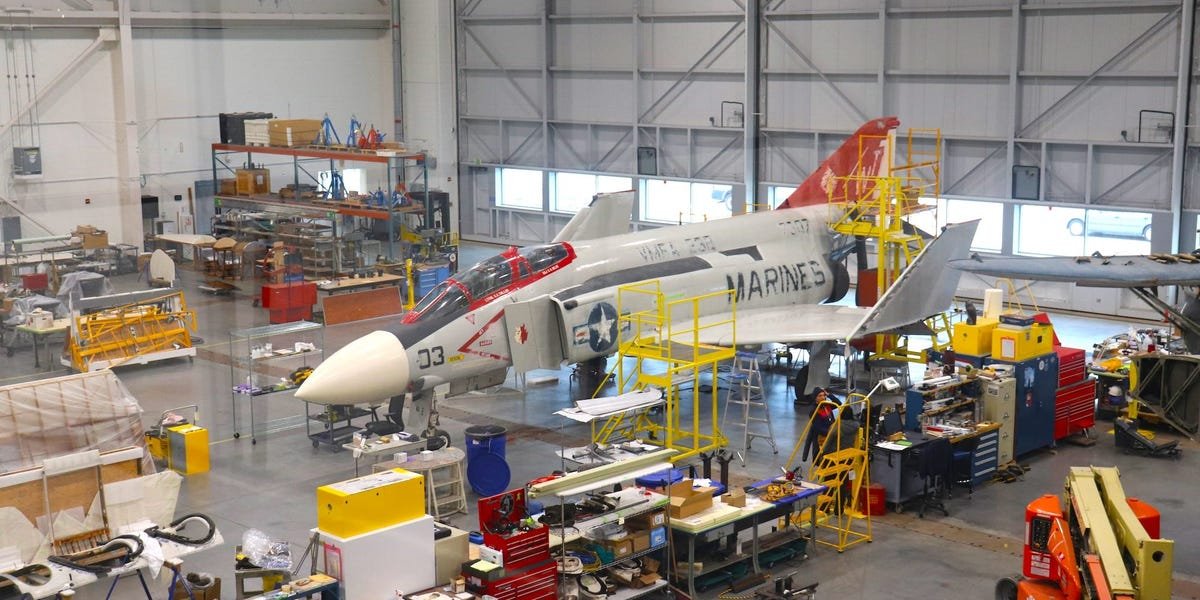
The Mary Baker Engen Restoration Hangar at the National Air and Space Museum’s Steven F. Udvar-Hazy Center in Chantilly, Virginia.
Talia Lakritz/Business Insider
The Smithsonian museum’s second location, situated about 30 miles from the National Air and Space Museum’s flagship site in downtown Washington, DC, offers an expansive setting with 340,000 square feet of exhibit space.
The Mary Baker Engen Restoration Hangar, which is connected to the exhibits, can accommodate several aircraft at a time and houses everything workers might need, including a sheet-metal shop, a welding room, a paint room, and a fabric shop.
It also features floor-to-ceiling windows overlooking the hangar, allowing visitors to watch the work happening in real time.
Observation windows overlook the Mary Baker Engen Restoration Hangar.
Talia Lakritz/Business Insider
Holly Williamson, public affairs specialist at the National Air and Space Museum, told Business Insider that visitors shouldn’t expect to see planes being built with the speed of a factory assembly line. Progress can be slow, with some restoration projects spanning months or years.
“This kind of will look like paint drying if you just sit here for the whole day,” Williamson said. “It’s a lot of research. It’s very detail-oriented.”
Despite the slow pace, there’s still plenty to see. One of the museum’s longer-term projects is “Flak-Bait,” a Martin B-26 Marauder that flew 202 combat missions during World War II, including D-Day.
“Flak-Bait,” a Martin B-26 Marauder.
Talia Lakritz/Business Insider
When the museum first opened in 1976, visitors were allowed to touch the aircraft’s nose, which wore down the paint. Workers have focused on restoring its appearance while preserving its authentic combat damage.
“It flew more missions than any other aircraft in World War II for the US, so we want it to look like it’s been through hundreds of missions,” Williamson said.
Another striking display is a Sikorsky JRS-1 seaplane, the only aircraft in the museum’s collection that was present at Pearl Harbor when it was attacked on December 7, 1941. After Pearl Harbor, the Sikorsky JRS-1 patrolled for Japanese submarines. It arrived at the Mary Baker Engen Restoration Hangar in 2011.
A Sikorsky JRS-1.
Talia Lakritz/Business Insider
Staff members are also working to restore a McDonnell F-4S Phantom II, a fighter and bomber that shot down an MiG-21 during the Vietnam War. After the Vietnam War, it underwent modernization and was redeployed in 1983, remaining in service until its last squadron duty in 1987.
A McDonnell F-4S Phantom II.
Talia Lakritz/Business Insider
The rest of the hangar floor is a maze of tools, machinery, aircraft parts, and storage bins, indicators of just how intricate the museum’s restoration efforts are.
Certainly more interesting than watching paint dry.
A US Navy aircraft carrier’s hard evasive turn to avoid enemy missile fire caught crewmembers off guard and sent a $60 million F/A-18 Super Hornet rolling off the deck and into the Red Sea, an investigation into the fighter jet loss revealed.
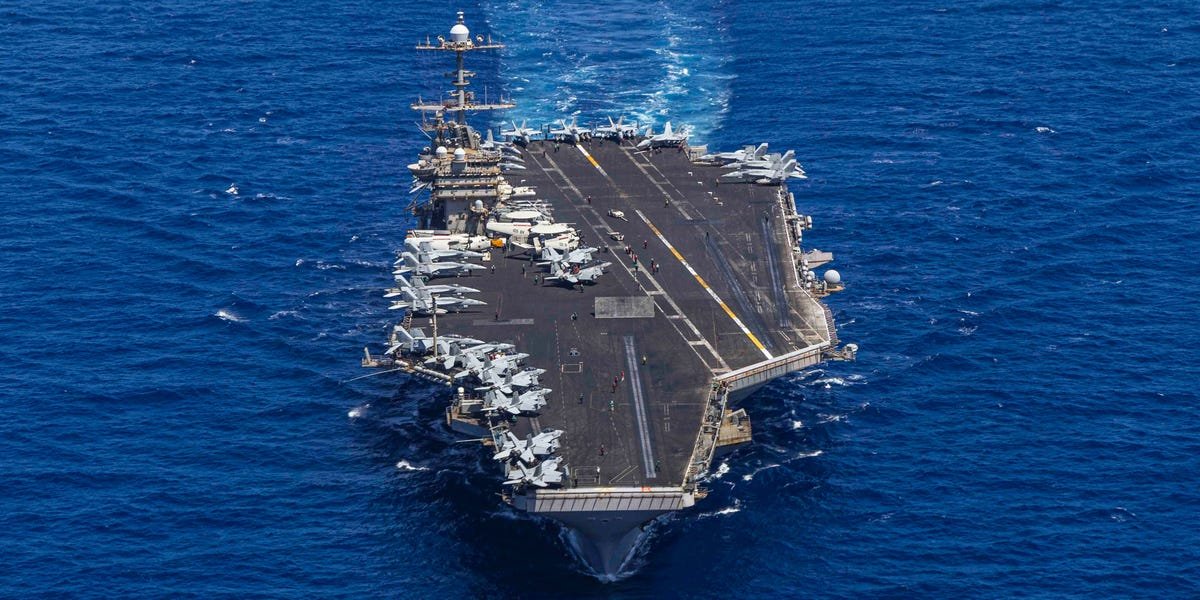
The fighter’s brakes weren’t functioning properly, investigators found, allowing the jet to slide across the deck when the carrier USS Harry S. Truman abruptly changed course during the late April action.
Poor communication, bad brakes, and a slippery surface all contributed to the loss.
A tow tractor also fell into the water alongside the expensive F/A-18 fighter jet, the second of three that the Truman lost during a monthslong Middle East combat deployment. When it went over, it nearly took sailors overboard as well.
Evading enemy fire
During their deployment, the Truman and its strike group led Navy combat operations against the Houthis, the heavily armed Iran-backed rebel group in Yemen that spent more than a year attacking key Middle East shipping lanes.
An F/A-18 fell overboard the Truman while the carrier took a hard turn.
US Navy Photo by Mass Communication Specialist 3rd Class Abbigail Beardsley
On April 28, the move crew lost control of an F/A-18 under tow in the Truman’s hangar bay, a maintenance area below the flight deck, the Navy reported at the time, and both the jet and its tow tractor tumbled into the Red Sea.
Right before it fell in, a sailor jumped from the cockpit, suffering minor injuries. The Navy didn’t share information or insight into the warship’s situation at the time of the plane loss.
According to the command investigation, the fighter jet and the tractor fell overboard while the Truman was conducting evasive maneuvers to avoid an incoming medium-range ballistic missile fired by the Houthis, a detail that had been reported but not confirmed at the time.
The move crew, which was preparing the F/A-18 from Strike Fighter Squadron 136 (VFA-136), the “Knighthawks,” for planned flight operations, didn’t hear the announcement that the ship was making a hard turn and was caught unaware when the ship began to tilt.
Sailors had removed the chocks and chains to pull the F/A-18 into the hangar bay. With the brakes engaged but not actually working, there was nothing to hold the aircraft in place when the carrier heeled in an evasive turn.
The hangar bay is an area underneath the flight deck where aircraft receive maintenance.
US Navy photo
It slid backward toward the deck edge, dragging the tow tractor behind it. The crew moving the Super Hornet abandoned their posts just before the fighter jet fell into the sea.
Bad brakes
The command investigation put the blame for the incident primarily on the fighter jet’s inadequate brake engagement and the lack of communication from the Truman’s bridge to flight deck control and the hangar bay.
Leadership also said that the non-skid, a rough, high-friction coating applied to the decks of Navy ships to keep people, vehicles, and aircraft from slipping on smooth steel surfaces, was ineffective, having not been replaced since 2018.
These problems, the investigation said, cost the Navy an F/A-18, a multirole fighter made by the US aerospace giant Boeing that has been in service with the Navy for decades.
The April incident was one of four major mishaps that the Truman and its strike group suffered during their deployment.
In December, the cruiser USS Gettysburg accidentally shot down one of the Truman’s F/A-18s in what the military described as a friendly fire incident. In February, the carrier collided with a cargo ship. And in May, the ship lost its third fighter jet after a landing failure caused it to slide off the flight deck and plunge into the sea.
In less than 10 seconds, Kelluu’s silver airships can soar from the ground to high above eastern Finland’s treelines, their motors puttering and their noses pointed skyward.
Gas blimps were first invented in the 19th century, but the Scandinavian startup is betting on a modern version of the old concept to help the West guard its territory.
Kelluu, a Finnish company located about 50 miles from the Russian border, is launching small, propeller-driven airships filled with hydrogen, which it believes can fill a gap in battlefield and border surveillance.
The startup is already finding success with NATO, being the first to secure a deal with a Western nation through a new innovators’ program run by the alliance.
Militaries or law enforcement agencies could equip a fleet of such remotely piloted airships with cameras and sensors, rotating them to monitor regions around the clock. Kelluu said its airships can be automated, meaning a human operator only has to set a target destination.
Airships won’t be easily survivable on an immediate frontline, but can surveil rear areas or combat zones near the fighting for long periods.
Small drones, meanwhile, typically can only fly for a few hours, while spy planes are often expensive, scarce, and need an onboard crew. Satellites have to wait to pass over a specific region to gather intelligence.
Niko Kuikka, the startup’s head of engineering, told Business Insider at Kelluu’s workshop in Finland that its airships can fly for half a day.
“Our customers don’t care so much what we are flying with, but they pay us to stay up in the air for 12 hours. That’s our specialty,” said Kuikka.
About as long as a city bus and six-and-a-half feet wide, Kelluu’s airships are tiny compared to the Zeppelins of World War I. The ship carries fuel, a propeller, and an onboard computer, and can be configured to transport an additional payload of up to 11 pounds for other gear such as sensors. Altitude can allow high-definition cameras or radar to survey a wider area.
Kuikka said a smaller size can be an advantage for Kelluu’s airships, which are designed to fly at top speeds of 33 mph.
Kelluu’s airships are designed to fit into regular shipping containers and are lightweight enough for one person to launch.
Matthew Loh for Business Insider
They’re cheaper and easier to mass-manufacture, so a customer wouldn’t have to worry that losing a few airships might disable an entire fleet, he said.
Kelluu declined to disclose its pricing, but said its airships are meant to be low-cost.
“Having a kind of sitting duck in the air that costs a vast amount of money isn’t going to make sense,” Kuikka said.
‘Free interference’ from Russia
At Kelluu’s workshop, employees perform the final assembly of the airship and fill it with hydrogen, a lighter-than-air gas that serves to both lift its frame and power its propeller. In the upstairs attic, a team of about 10 computer engineers finetunes in-house software and a user interface for monitoring the airships.
Kelluu has a small team working on software in a room above its assembly workshop.
Kelluu
The main team is based in Joensuu, a small city of 78,000 people just west of Russian Karelia.
That location is a key advantage for the airship company, Kuikka said.
Because Joensuu is so close to the border, it has to deal with frequent jamming from both Russia and Finland, or as Kuikka and his team call it: “free interference.”
While other firms may have to pay for tests, Kelluu’s airships must be resistant to electronic warfare to work in the first place, he said.
“We get all sorts of jamming and spoofing from the other side of the border, and also from this side of the border, so we have been proven to be pretty resilient against this sort of GSS denial,” he said.
Kelluu is also about 340 miles south of the Arctic Circle, so its team had to build its airships to withstand icy winds and temperatures that dropped in January to -15°F.
Kelluu’s airships are being tested in the Finnish winter, which the company says makes it ideal for Arctic conditions.
Kelluu
As such, the startup is positioning its airship as a particularly useful means of monitoring future Arctic bases or territories. The theory goes that the longer its fleet can stay aloft in rough conditions, the fewer people are needed on the ground to maintain and operate the airships.
“We are hoping to soon have an asset that can run multi-day missions, so you need even fewer persons working out there,” Kuikka said.
Catching NATO’s eye
Joensuu once heavily relied on Russian tourism, an income flow sapped dry in 2022 after the full-scale invasion of Ukraine prompted Finland to stop issuing tourist visas to Russians. The following year, Finnish authorities closed the country’s 833-mile land border with Russia.
Helsinki, like much of European NATO, is now grappling with the question of how to guard its eastern borders. The Finnish government is already raising concerns about illegal immigration, which it says Moscow is intentionally orchestrating as a gray warfare tactic.
Kelluu was founded in 2018, well before these issues drew public concern. It began by building airships for civilian use, such as monitoring power lines.
Kelluu provides a digital user interface for monitoring airship fleets.
Kelluu
Now, the war is turning it into a rising star in Europe’s defense industry.
Kelluu was one of 14 firms picked by NATO’s Defence Innovation Accelerator for the North Atlantic, or DIANA, to enter the second phase of the alliance’s 2025 program.
The accelerator program is trying to connect allies with startups and defense contractors, pushing governments to adopt new tech into their militaries within two years. Roughly 2,600 companies or parties initially submitted proposals to DIANA this year.
After several showcases, Kelluu was the program’s first company to land a deal with an allied country under a new “Rapid Adoption Service” to conduct national trials, a program spokesperson told Business Insider.
Neither NATO nor Kelluu named the member state, but Fabrizio Berizzi, challenge manager at DIANA, praised Kelluu’s airships as “strongly versatile in terms of maneuvering and endurance” and useful for 24/7 surveillance.
“The airship solution proposed by Kelluu fills the gaps on aerial platforms operating in altitudes in between the typical UAS and aircraft airspaces,” he told Business Insider in a statement, referring to uncrewed aerial systems.
A Kelluu airship can immediately point its nose upward after launch and climb quickly into the sky.
Screenshot/Kelluu
Berizzi highlighted the airships’ jamming-resistant capabilities, saying that they can operate in “electromagnetic contested and congested environments.”
Each airship is also “difficult to detect from radar due to its low radar cross section, or radar reflectivity,” he said.
Building thousands of airships
The material of the airship’s metallic, mirror-like skin is a company secret, the firm said. When asked if it helps avoid radar detection, the company declined to answer.
But Kuikka said the core feature of Kelluu airships is that their structure allows them to be filled safely with hydrogen, which is flammable and more dangerous than helium but provides better lift; it is also lower cost than helium.
These airships are built with a semi-rigid frame, meaning they have some structural integrity but primarily derive their shape from the gas within. Zeppelins, by contrast, had fully rigid frames, while other airships like the $21 million Goodyear blimp would collapse if they were deflated.
Janne Hietala, Kelluu’s CEO, said that lighter-than-air technology is often overlooked in the defense industry, especially with disaster stories like the Hindenburg marring its history.
Other militaries have also deployed airships, though they are typically much larger. Israel, for example, deployed a large airship in 2024 that it said was later hit by Hezbollah.
Christopher Furlong/Getty Images
NATO evaluators were surprised, he said, when they assessed the company’s airships during trials, which included naval showcases in the Atlantic.
“Nobody kind of believed us,” Hietala said. “When they looked at the specs, they were like: ‘Well, the wind is going to blow it away.’ But when we actually deploy, they’re like: ‘Oh, it actually works and makes sense.'”
Kelluu now maintains a small active fleet of just under 20 airships, but Hietala said it’s focused in the near future on scaling up mass production capacity.
Some of its airships are already being deployed in other countries, such as Latvia, for testing or client use. Kelluu now manages and operates the fleet for its clients, but is discussing the possibility that some militaries may want to operate their own airships.
“Our intention in Europe is to manufacture more than 500 for the Western world, and we expect to eventually have 3,500,” Hietala said.