

United-is-rolling-out-beds-in-economy-Heres-how-the.jpeg

United is rolling out beds in economy. Here’s how the airline’s new ‘Relax Row’ will work.

United Airlines is bringing one of the best perks of business class to economy.

Starting in 2027, United customers flying on certain international flights can book the airline’s new “Relax Row” — a set of three coach seats with legrests that flip up 90 degrees to convert into a flat bed big enough for two adults and a small child.

It’s the same idea as the “Skycouch” on Air New Zealand, one of United’s Star Alliance partners. Other global carriers offer similar bed-like seating in economy by blocking entire rows so passengers can lie across them, but few have adjustable legrests to widen the sleeping surface.

Like the Skycouch, United’s Relax Row, which can also be booked by a solo person or a duo, comes with several special amenities: a custom-fitted mattress, a plush blanket, and two extra pillows. Families get a stuffed toy and kid’s travel kit.

United said that up to 12 Relax Rows, located between the economy and premium economy sections, will be featured on over 200 Boeing 777 and Boeing 787 aircraft by 2030.

It’s unclear how much the upgrade will cost or what routes it will be available on.


A rendering of a red headed woman stretched out on the Relax Row with her laptop.

The “Relax Row” would offer one of the best perks of business class in economy. 

United Airlines


The Relax Row is another example of how United is catering to passengers willing to pay more for comfort but don’t need the caviar or expensive bubbly of business class. The carrier reported an 11% increase in premium revenue in 2025.

“Customers traveling in United Economy on long-haul flights deserve an option for more space and comfort, and this is one way we can deliver that for them,” Andrew Nocella, United’s EVP and Chief Commercial Officer, said in a Tuesday press release.

The Relax Row complements United’s premium-economy offering, Premium Plus, which features a reclining lounger, elevated meals, and a leg and footrest, but is more expensive than regular coach.

United joins an international trend

While the Relax Row is a first in the US market, United is far from the first airline globally to think up a bed in economy class.

Air New Zealand patented the revolutionary Skycouch in 2011. Its version can cost from a few hundred dollars to over $1,500, depending on the number of travelers, the route, and the season. Premium economy is usually more.

Beyond the special linens, the Skycouch also came with a “cuddle belt” to strap travelers to the seat when it’s in bed mode. United will likely have a similar seatbelt.

I flew in the Skycouch for 16 hours from Auckland to New York in 2022. I didn’t get priority boarding and received regular economy meals, but the bed was very comfortable for one adult.


ANZ's Skycouch view from the aisle.

The author flew solo in Air New Zealand’s Skycouch in 2022. 

Taylor Rains/Business Insider


A number of other carriers have created their own versions of the Skycouch. Japanese airline All Nippon Airways, for example, offers the “COUCHii” — a row of three or four seats with adjustable legrests that flip into a bed.

It’s exclusive to the airline’s Airbus A380 and costs between $96 and $540 per segment for three or four passengers, depending on the season; that jumps to $2,580 for one person with four seats to themselves during peak months.

Rather than design a special seat with flippable legrests, some carriers simply block a row for passengers who pay extra.

German flag carrier Lufthansa, for example, offers a “Sleeper Row” on long-haul flights over 11 hours, priced between $209 and $299 per leg. It can’t be booked in advance; it’s on a first-come, first-served basis at the airport.

Vietnam Airlines has its “Sky Sofa,” a row of three seats intended for one passenger to use as a narrow make-shift couch. It costs between $150 and $650, depending on the route.

Kazakh carrier Air Astana has the same setup. Its “Economy Sleeper” customers also get access to its business-class airport lounges.

Air New Zealand plans to take the coach couch idea one step further with the “Skynest” — two sets of three-high bunk beds in the economy cabin that passengers can book in time blocks.

Airline leaders previously said the Skynest would debut in early 2026, though the quirky sleeping pods have yet to fly. An Air New Zealand spokesperson told Business Insider the Skynest is expected to launch this year “once we receive delivery of our new aircraft.”



Source link

British-Airways-is-among-the-airlines-slashing-flights-to-the.jpeg

British Airways is among the airlines slashing flights to the Middle East weeks in advance or more

  • Several airlines are suspending flight routes to destinations in the Middle East well in advance.
  • British Airways cut flights to Abu Dhabi until later this year and others until later this month.
  • While some airlines are canceling routes, others are operating at a more limited capacity.

The travel fallout from the war in Iran continues, with several airlines canceling flights to the Middle East weeks in advance or more.

Thousands of flights were canceled across the region following the US-Israel attack on Iran on February 28 and subsequent retaliatory strikes. While some flights have resumed and many travelers who got stranded in places like Abu Dhabi and Doha have made it out, the travel disruptions are ongoing.

Industry experts previously told Business Insider that the lasting impacts on tourism and global travel will likely depend on how long the war lasts, as well as how it ends. Canceled flights to Dubai International Airport, which serves as a common connector for routes between Europe, Asia, and Africa, could especially have a ripple effect.

While some airlines are canceling routes altogether, others are continuing to operate but in a more limited capacity. Some airlines have also added repatriation flights to help stranded travelers get home.

Here are the airlines that have suspended services to some destinations in the Middle East.

British Airways

British Airways said Tuesday it was canceling flights to Amman, Bahrain, Doha, Dubai, and Tel Aviv until later this month, and to and from Abu Dhabi until later this year.

It’s unclear when the flights will resume. Flights from London to Abu Dhabi appeared to be bookable on the airline’s website starting April 16.

British Airways also said it had limited seats remaining on its repatriation flights from Oman to London on March 11 and 12 for customers with existing bookings.

“Following these dates, the flights will pause due to reduced demand but will be kept under continuous review,” the airline said.

Air Canada

Air Canada has canceled all flights to and from Dubai through March 28 and to Tel Aviv through May 2 due to the conflict.

“If you are in either of these regions, please do not head to the airport. Your safety is our top priority,” the airline said in a statement last week.

Virgin Atlantic

Virgin Atlantic canceled its service to Dubai for the remainder of its usual season, or until March 28. The British airline, which typically only operates flights to Dubai seasonally, said in a statement that “the recent escalation in the Middle East has brought forward the end of our operation for this season.”

Virgin also said Sunday it was canceling its flights to Riyadh for the next two weeks.

Oman Air

Oman Air said Sunday it was canceling all flights to and from the following locations through March 15: Amman, Dubai, Bahrain, Doha, Dammam, Kuwait, Copenhagen, Baghdad, and Khasab.

The airline also said it was operating extra flights to and from Muscat during that time, including to London, Istanbul, Cairo, and other destinations in Europe and Asia.

Air France

Air France said Monday it was canceling flights to and from Dubai and Riyadh until March 12, and to and from Tel Aviv and Beirut until March 13.

Lufthansa

Lufthansa said this it was suspending flights to and from the following locations: Dubai, Abu Dhabi, and Dammam until March 15 and Tel Aviv until April 2.

Previously the airline said it was suspending flights to and from Amman and Erbil until March 15, Beirut until March 28, and Tehran until April 30.

Lufthansa said flights to and from Riyadh and Jeddah would continue.

Finnair

Finnair canceled all its flights to and from Doha and Dubai between February 28 and March 29.


Source link

These-airlines-are-sending-special-flights-to-the-Middle-East.jpeg

These airlines are sending special flights to the Middle East to rescue stranded travelers

It’s been a confusing six days since missile attacks across the Middle East stranded travelers and planes in airports across the world.

Things are still far from normal as of Wednesday, but some travelers are getting home.

There is a slow-growing recovery in the United Arab Emirates, which has partially opened its skies and designated “safe” corridors for rescue planes to use.

There are a lot of people to move: cities like Dubai and Abu Dhabi host large expat populations and tourists, and their hubs usually handle tens of thousands of transit passengers a day.

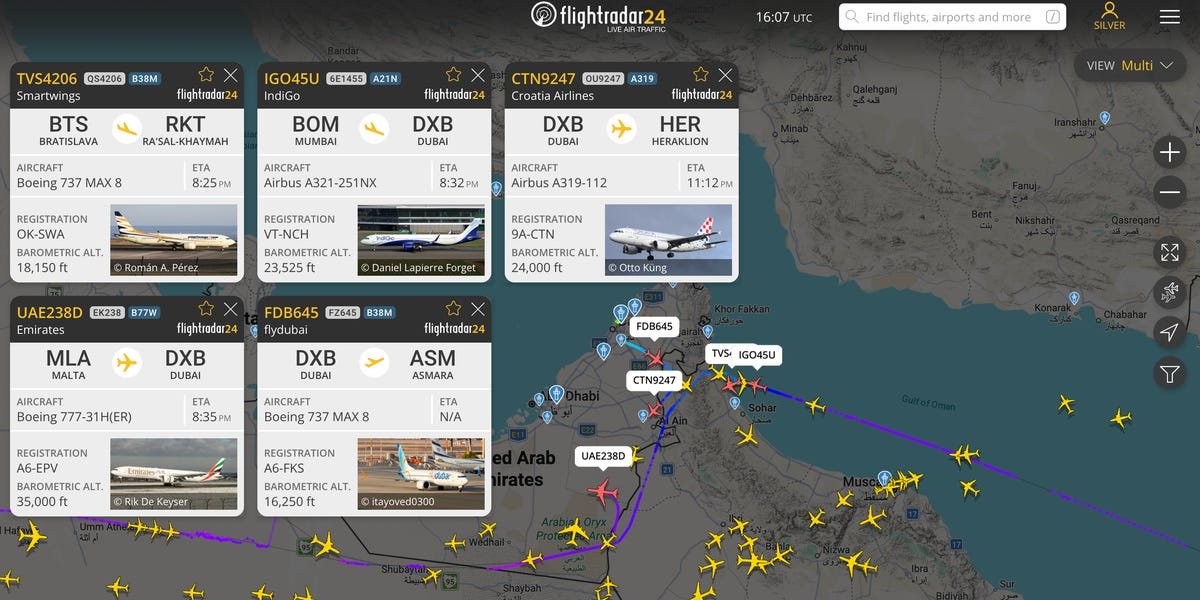
Working with local officials, Emirates, Flydubai, IndiGo, and Etihad Airways were among the first airlines to depart the UAE with passengers, crews, and cargo. Over 100,000 people followed these aircraft live on the aviation tracking website Flightradar24.

Even as Iranian threats continue to disrupt flying — forcing diversions, holds, and U-turns — airlines are still transporting passengers to destinations across Europe, Asia, and Africa.

Fortunately, Emirates and Etihad have big planes: many of their Airbus A380s, capable of carrying up to 615 passengers, have flown to cities such as London, Istanbul, Jeddah, Singapore, Paris, and Düsseldorf.

Although these flights don’t always take travelers all the way home, they offer a crucial escape from limbo — getting people into countries with open airspace and far more onward flight options.

Flightradar24 data shows several other carriers have joined the crowd: Air India, Air Arabia, Uzbekistan Airways, Kenya Airways, Morocco’s Royal Air Maroc, Saudi airline Flynas, Royal Jordanian, and India’s SpiceJet are all flying from Dubai to their respective hubs.


People hugging at an airport after being stuck in Dubai.

Passengers on a Kenya Airways rescue flight from Dubai arrive back home.

Thomas Mukoya/Reuters


European carriers, including Lufthansa, Swiss International Air Lines, Prague-based Smartwings, Aegean Air, and British Airways, are running special rescue flights from neighboring Muscat, Oman. Smartwings and Croatia Airlines are running select flights from Dubai.

Air France scheduled a repatriation flight from Dubai to Paris on Thursday evening, but suspended the plan shortly after the announcement due to “the ongoing security situation.”

Russian carriers Aeroflot and S7 Airlines have similarly departed with passengers, though their flights to Moscow are taking up to three hours longer because they have to fly the long way around closed airspace rather than fly directly over it.

Still, most airlines’ regular schedules to and from much of the Middle East remain suspended until at least the weekend, and they have asked passengers not to go to the airport unless they have been specifically notified.

No US airlines have sent rescue planes as of Thursday. Mark Dombroff, an aviation attorney with the law firm Fox Rothschild, told Business Insider that even if US carriers like United or American wanted to help, they legally can’t.

“The decision-making resides with the Federal Aviation Administration,” he said. “If the FAA says you can’t fly there as a US certificated carrier, that’s it. And in a sense, it’s no different than any other restricted airspace in this country, like Washington, DC.”

Some Americans have gotten home with the help of the State Department; it previously told those in over a dozen Middle Eastern countries to evacuate. The agency said it flew a charter flight to the US on Wednesday, and that more will be “surged across the region.”

It added that, as of Wednesday, “nearly 18,000 Americans have safely returned to the US,” including 7,300 helped by the State Department. It said thousands of others made it to Europe and Asia and are in transit back, and told those still stuck to get in touch for help by calling +1 (202) 501-4444 or filling out this form.

Some airlines remain effectively frozen. Qatar Airways has not flown a plane since Saturday due to Qatar’s airspace closure, leaving practically no options for those in Doha except to wait or drive hours to Saudi Arabia and fly out from there.

Flight options are still extremely limited

While some flights are better than none at all, special airline operations remain limited to certain routes and airports.

Flightradar24 data shows that Dubai International has seen just 100 takeoffs and landings since Saturday. Operations ramped up from Monday to Tuesday — but that was still less than 10% of the roughly 1,200 flights in and out on a usual day.

Rescue flights are largely restricted to the UAE, Oman, and Saudi Arabia: the skies over Iran, Kuwait, Iraq, Syria, Israel, Qatar, and Bahrain remain closed.


An Emirates A380 landing in Germany.

An Emirates A380 ferried hundreds of stranded people back to Germany.

Andreas Rentz/Getty Images


Aviation analytics Cirium estimates there are normally about 900,000 daily seats to, from, and within the Middle East; it said about 4.4 million seats in and out of the Middle East have been canceled since Saturday.

While airlines are actively adding flights to the schedule — despite the on-and-off missile threats in the region — there are nowhere near enough rescue seats yet to accommodate the tens of thousands of stranded travelers. British Airways said on social media on Wednesday that the rescue flights it planned through Saturday are already full.

Some wealthy travelers have abandoned commercial flying altogether, instead paying hundreds of thousands of dollars to charter private jets. Flightradar24 data shows a number of business aircraft flying to and from Oman, Saudi Arabia, and the UAE since Sunday.

Those with less deep pockets have chosen to travel by bus to Oman and Saudi Arabia, hoping to secure seats from airports still operating flights as normal.

But the drives are hourslong, and Oman Air warned Muscat-bound travelers crossing in from the UAE to arrive 12 hours early as traffic backs up for miles.


Source link

Airlines-are-being-squeezed-into-this-sliver-of-sky-to.jpeg

Airlines are being squeezed into this sliver of sky to avoid closed airspace

As much of the Middle East remains closed amid missile barrages, international airlines are being squeezed into a shrinking set of flight paths.

Iran, Iraq, Kuwait, Israel, Bahrain, Qatar, and the United Arab Emirates remained closed or partially closed as of Monday, and the nearby Russian skies have been off limits to Western airlines since the Ukraine war broke out in 2022.

For most carriers, this extremely limits their options.

Flightradar24 shows flights are being funneled into narrow corridors around the Middle East, or forced into longer detours over Saudi Arabia and other regions — adding hours of flight time, higher fuel and labor costs, and operational complexity.

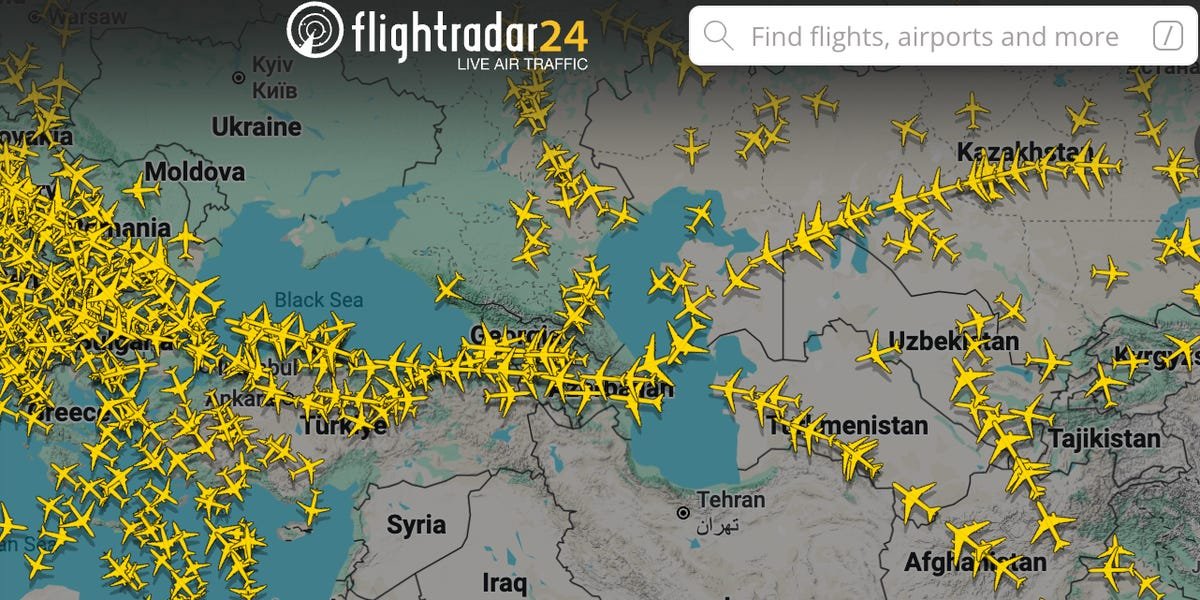
Among the most critical options is the Caucasus corridor north of Iran — including Armenia, Georgia, and Azerbaijan — which links Europe and Asia and has been absorbing detoured traffic as carriers seek alternatives to disrupted Middle East routes.


Flight traffic on Flightradar24.

The traffic over the Caucasus corridor on Monday evening Central European Time.


Flightradar24


The Caucasus region offers not only the most efficient routing around now-closed airspace — it’s also the only option for many global carriers. To the north is Russia, which remains blocked to most Western airlines amid ongoing sanctions and reciprocal airspace restrictions.

Restrictions on Russian airspace have forced carriers like Finnair to add up to four extra hours between Helsinki and Tokyo, while British Airways has similarly extended flight times on routes to Asia.

The narrow corridor can be like threading a needle, spanning just 100 miles between Russia and Iran at its narrowest point, according to Google Maps. Without it, airlines unfriendly with Russia would be forced to take significantly longer, more costly detours via Saudi Arabia.

Iranian airspace closures have sent traffic north before

Although it is a narrow route, the Caucasus corridor has successfully accommodated increased traffic when carriers have relied on it during past conflict-driven airspace closures. This route also overflies Afghanistan and Pakistan.

According to the Civil Aviation Air Navigation Service Organization (CANSO), the global association of air traffic providers based in the Netherlands, Azerbaijan airspace handled 110 additional flights per day when Iran temporarily closed its airspace in June 2025.

The agency added that the region has seen an overall year-over-year increase in traffic as airspace around it flips on and off.

“Since 2022, Azerbaijan’s airspace has played a vital role in providing alternative and efficient air routes in response to regional geopolitical crises,” CANSO said, noting the country’s investments in advanced air traffic technologies.


The airspace on a normal day.

The airspace on February 27, 2026, the day before the US and Israel attacked Iran. More planes overall were flying at that time and had access to far more airspace.

Flightradar24


Still, the influx of congestion over the Caucasus region could limit flexibility if weather restrictions arise. President Donald Trump said on Monday that the conflict could last “four to five weeks.”

If the conflict were to spread to the central Asian states that neighbor Iran to the north — which is very unlikely given the lack of US bases in Central Asia— it would effectively create a wall of unusable airspace.

Aviation leaders are emphasizing safety over these sensitive regions, especially after airports in Kuwait and the UAE were damaged during missile fire. On Monday, the director general of the International Air Transport Association (IATA), Willie Walsh, called for airlines to refrain from targeting civilian airspace.

“We all hope for an early peaceful resolution to the current hostilities,” he said. “In the meantime, it is critical that states respect their obligation to keep civilians, and civil aviation free from harm.”

The comment comes after previous inadvertent attacks on civilian airliners: a Malaysia Airlines flight was shot down by Russia over eastern Ukraine in 2014, and a Ukraine International Airlines aircraft was shot down by Iran near Tehran in 2020.

Both were a result of heightened military alert and fear during tense conflicts.

Some bottlenecks extend beyond the Caucasus

Countries including Egypt, Turkey, Saudi Arabia, and Oman saw dozens of additional aircraft rerouted through their airspace shortly after the conflict began on Saturday, and they remain among the few regions still handling flights. Etihad Airways and Emirates operated a limited number of flights from the UAE on Monday.

Westbound flights are largely using a single corridor across western Saudi Arabia and then heading up toward Europe, likely because it’s farther from conflict zones.

Flightradar24 data from before the Saturday attacks shows more direct flight paths across Saudi Arabia, Kuwait, Iraq, and the UAE, though some flights on Monday were again using UAE airspace.

One airline in particular faces a uniquely tricky routing challenge due to the Middle East’s abruptly shuttered airspace: Air India.

The airline hasn’t flown over Pakistan in nearly a year due to rising tensions, forcing it to detour across the UAE to reach Europe and North America.


An Air India flight from Bombay to New York on Monday stopped in Rome along the way.

An Air India flight from Bombay to New York on Monday stopped in Rome along the way.

Flightradar24


But, with most Gulf nations now closed, Flightradar24 shows it flying even further west across Oman and Saudi Arabia on these routes, often stopping in cities like Rome and Vienna along the way.

These are likely fuel stops, considering the now-longer flight paths. Air India made similar pit stops in April 2025 when tensions with Pakistan had previously arisen.

Flights are resuming on Monday

Eddy Pieniazek, head of Ishka Advisory, said in a Monday note that the mass disruptions across the Middle East are likely to be “short-lived” with a “gradual return of operations.”

He added how vital the Gulf region is, “particularly while Russian airspace remains restricted” and “while Africa currently lacks a comparable hub infrastructure.”

UAE airspace began partially opening up on Monday, with several Emirates and Etihad Airways flights departing from Dubai and Abu Dhabi to destinations in Europe, Africa, and Asia.


Aircraft over the UAE on Monday.

Aircraft are flying over the UAE again as of Monday, as airlines slowly resume flights. It remains unclear how wide a resumption this will be.

Flightradar24


Both Emirates and Etihad Airways’ website still say all flights to and from their megahubs are suspended, but earlier Monday said a limited number will fly. These will get people home, transport cargo, and reposition aircraft.

To ease crowds, they asked passengers not to go to the airport unless they had been specifically notified.


Source link

Lauren Edmonds Profile Photo

Blizzard triggers New York City travel ban as airlines cancel thousands of flights

The Monday morning commute won’t be messy in New York City. It will be nonexistent.

New York City Mayor Zohran Mamdani declared a state of emergency and a travel ban during a press conference on Sunday as a giant winter storm bore down on much of the Northeast.

The National Weather Service said to expect blizzard conditions and up to 20 inches of snow over the next 24 hours. Parts of New Jersey, Rhode Island, and Massachusetts could get up to 25 inches.

“The state of emergency closes the streets, highways, and bridges of New York City for all traffic,” Mamdami said. The travel ban begins at 9 p.m. Sunday and lasts until 12 p.m. on Monday.

US airlines, meanwhile, are canceling and delaying thousands of flights. As of Sunday afternoon, airlines had canceled over 3,000 flights and delayed over 2,900, according to the flight-tracking website FlightAware.

New York City’s John F. Kennedy and LaGuardia airports have the highest number of cancellations, followed by Newark Liberty International Airport, Philadelphia International Airport, Ronald Reagan Washington National Airport, and Boston Logan International Airport.

Anyone hoping to catch a flight in the region on Monday can also expect major disruptions, according to Cirium, an aviation analytics company. At LaGuardia Airport, for example, 82% of flights scheduled for Monday have been canceled.

Adding to what will likely be a chaotic 48 hours for travelers, the Department of Homeland Security announced Saturday night that it was suspending TSA PreCheck and Global Entry due to the partial government shutdown.

Despite the announcement, however, TSA Precheck and Global Entry lanes remained open at major airports on Sunday. In a statement, the Transportation Security Administration said it is evaluating the situation “case-by-case.”

“At this time, TSA PreCheck remains operational with no change for the traveling public,” a spokesperson said. “As staffing constraints arise, TSA will evaluate on a case-by-case basis and adjust operations accordingly.”

The federal government entered a partial shutdown earlier this month, delaying funding for some agencies, like DHS. TSA agents are essential workers, so they’re still working — for now. During the full government shutdown earlier this year, TSA agents and air traffic controllers went 43 days without a paycheck.


Source link

A headshot of Insider's Pete Syme

Canadian airlines are pulling back from flights to the US, with one leaving the country entirely

Canadians are pulling back from visiting the US — and airlines are paying attention.

Montreal-based Air Transat will no longer fly to the US this summer, with its last flight across the border operating in early June.

In March last year, it operated nine routes to and from the US, but that number had dropped to three as of early 2026.

At the moment, Air Transat flies from Montreal to Orlando and to Fort Lauderdale, and from Quebec City to Fort Lauderdale.

Air Transat, which focuses on vacation travel, was named the world’s best leisure airline by Skytrax for the third year in a row in 2025.

An airline spokesperson told Business Insider that its presence in the US “remains very marginal today,” with only two of its 67 destinations in the US.

“This adjustment is part of a proactive management of our capacity, as we focus our efforts on markets where Air Transat is best positioned and that allow us to optimize the deployment of our resources,” they said.

The spokesperson added that its winter schedule “will be determined at a later date.”

WestJet, Canada’s second-biggest airline, is also slashing flights across the border for this summer.

It’s suspending 16 routes, including big city pairings like Boston to Vancouver and Los Angeles to Toronto.

The airline has reduced its “full-year transborder flying by close to 10%,” a spokesperson told Business Insider.

“We saw a notable decline in transborder travel demand throughout 2025,” they said.

“As such, WestJet has redeployed its fleet by increasing capacity on routes Canadians want to fly.”

Canadians’ travel demand has sunk since President Donald Trump took power early last year.

Last month, capacity was down 10% on flights from Canada to the US compared to a year earlier, according to data from Cirium, an aviation analytics firm.

Canadian residents made 1.6 million return trips from the US last month, down 24.3% from a year earlier, according to Statistics Canada.

Tensions flared when the US imposed a 25% tariff on imports from Canada and Mexico last March. It sparked a “Buy Canadian” movement and helped Prime Minister Mark Carney win last April’s elections.

Trump has also referred to Canada as the “51st state.” Following Canada’s trade talks with China earlier this year, he threatened a 100% tariff on Canadian goods and to block the opening of a bridge between Detroit and Ontario.


Source link

A headshot of Insider's Pete Syme

Jet fuel shortage in Cuba forces airlines to cancel flights and send empty planes to pick up passengers

Cuba has warned airlines that it has no jet fuel, forcing some carriers to cancel flights, add refueling stops, or carry extra fuel.

Cuban aviation authorities issued a monthlong advisory on Monday that said jet fuel is unavailable at all of the country’s international airports.

The country relies heavily on Venezuela for much of its jet fuel, but supplies have been hit by US sanctions that have constrained Venezuelan oil exports. President Donald Trump has also threatened tariffs on countries that sell oil or petroleum products to Cuba.

Because of this, the country is running out of jet fuel, and therefore, airlines cannot refuel their planes on the island.

From the US, American Airlines, Delta Air Lines, and Southwest Airlines all operate direct flights to Cuba.

American and Delta said they are operating as usual. In a statement to Business Insider, Southwest said that it was requiring any aircraft flying there to also carry enough fuel to reach its next destination.

Some Canadian airlines are canceling flights entirely.

Air Canada, which had operated 32 flights a week to and from Cuba before, said it would suspend service to the country on Monday.

It will send empty planes to pick up some 3,000 customers who have already traveled to the island. These flights will be loaded with extra fuel, although the airline said refueling stops on the return leg may also be necessary.

Canadian airlines WestJet and Air Transat also said they would operate empty aircraft to help their customers. Air Transat said it would suspend flights to Cuba until at least April 30.

Several international airlines serve Cuba, and many of them are still operating flights. However, some of these will have to stop to refuel elsewhere.

Air Europa, a Spanish airline, said its flights from Havana to Madrid would stop in Santo Domingo, in the Dominican Republic, about two hours away.

“We apologise for any inconvenience this situation, which is beyond Air Europa’s control, may cause you,” it said in a travel alert.

Iberia, the Spanish flag carrier, Air France, and Turkish Airlines also fly to Cuba. They did not immediately respond to requests for comment, although it seems likely the distance would necessitate a refuelling stop.


Source link