Some European airlines are facing significant delays as their flights from the Middle East make fuel stops after being rerouted around Iran.
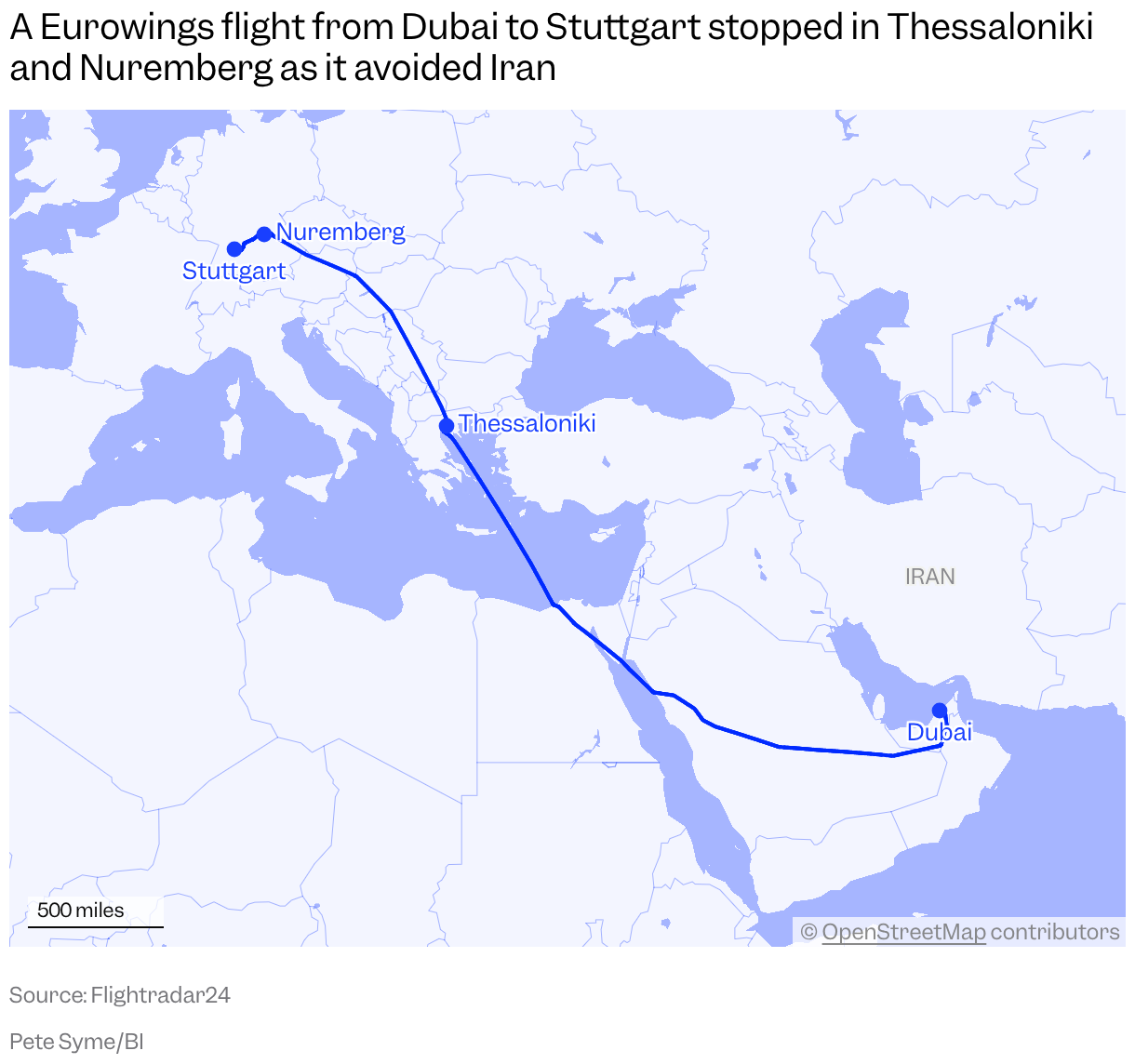
Sunday’s Eurowings Flight 1153, from Dubai, made two stopovers on its way to Stuttgart, Germany.
It first flew for just over 6 hours to Thessaloniki, Greece, for a refuelling stop, data from Flightradar24 shows.
After about 50 minutes on the ground, it took off again for Germany. However, the 2-hour flight landed in Nuremberg around 1:30 a.m.
It appears that it was too late to land in Stuttgart due to nighttime flight restrictions.
Therefore, it wasn’t until the next morning that the plane made another 30-minute flight to reach its intended destination.
In all, it arrived in Stuttgart 11 hours after the usual direct flight from Dubai.
A Eurowings spokesperson told Business Insider that its owner, the Lufthansa Group, decided not to fly over Iranian or Iraqi airspace as a precautionary measure.
They added that the refueling stop was “due to a longer flight distance and stronger headwinds on the alternative route at the time.”
“In the event of such refueling, we inform our passengers accordingly before departure in Dubai,” they said.
It isn’t the only European airline that has made such adjustments.
A spokesperson for Wizz Air, another budget airline, told Reuters that some of its flights from Dubai and Abu Dhabi would make “refuelling and crew change” stops in Cyprus or Thessaloniki.
Budget airlines are perhaps more susceptible to refueling stops because they typically operate only one type of airplane.
Their single-aisle jets are already near their maximum range for flights between the Middle East and Europe.
Meanwhile, the likes of British Airways and Air France are flying to Dubai with Boeing 777 or 787 jets. These twin-aisle airplanes have much larger fuel tanks, so any rerouting won’t require a fuel stop.
Over the past few days, flight-tracking data shows British Airways’ flight from Dubai to London has flown over Saudi Arabia instead of Iraq — taking around an hour longer than usual.
Earlier this month, the European Union Aviation Safety Agency warned airlines not to fly over Iran.
“The presence and potential use of weapons and air defense systems create a high risk for civilian flights,” it said in a statement, per Reuters. “There is a high probability of misidentification, against the backdrop of a possible American attack as well as the high alert status of Iran’s air defense systems.”
Major airlines are making it free to change your flights ahead of a dangerous winter storm.
Southwest Airlines, American Airlines, United Airlines, and JetBlue are waiving rebooking fees for flights to and from affected regions this weekend.
If your travel plans this weekend include major cities such as Dallas, Austin, Oklahoma City, Nashville, Atlanta, Charlotte, Washington, DC, Baltimore, Philadelphia, New York City, and Boston, you may want to contact your airline to avoid prolonged delays or cancellations at the airport. The National Weather Service is warning that more than 230 million Americans will be affected, from the Southwest to New England.
Even if you won’t change your plans, your flight may still get canceled. Delta Air Lines said Thursday it is canceling flights at airports in Texas, Oklahoma, Arkansas, Louisiana, and Tennessee, citing safety concerns caused by heavy snow, sleet, and freezing rain. The airline will also be bringing in cold-weather specialists.
As of Thursday evening, based on the Misery Map, which tracks real-time flight disruptions, there hasn’t been a spike in delays or cancellations.
Based on recent storms, such as the one that hit over Thanksgiving and coincided with the end of the government shutdown, mass cancellations may be inevitable. So it’s good to know your passenger rights and your options when things don’t go according to plan.
Know your rights as a passenger
Opt in to automatic flight updates via text or email so you don’t miss a flight delay or cancellation notification.
JOSEPH PREZIOSO/AFP via Getty Images
If your flight is canceled and you choose not to rebook, the airline is legally required to provide you with a cash refund — not a voucher or credit.
However, things are different for delays. The Trump Administration recently killed a proposal that would have required airlines to compensate passengers for long delays, so flyers largely have to rely on airline goodwill or their credit cards to get anything for the inconvenience.
Some airlines have committed to providing accommodations, transportation, and food during a controllable overnight delay or cancellation, as outlined in the Airline Customer Service Dashboard.
Controllable disruptions include issues such as maintenance or crew staffing. Frontier Airlines is the only carrier that does not offer accommodations in the event of a controllable overnight delay or cancellation, but it will provide a meal voucher.
It still doesn’t hurt to ask for a meal or hotel voucher when a non-controllable issue arises, such as the weather. The worst they can say is no.
Use your airline’s mobile app to change or cancel your flight
Most airlines also offer a chat function if you prefer to text.
United Airlines
During disruptions, airlines often allow you to make changes via their mobile app or website, rather than waiting on clogged phone lines or in long customer service lines.
If this isn’t an option, try an online chat. Carriers like Delta Air Lines allow you to text a representative for help.
You can put yourself in the virtual queue and wait in line at the airport, potentially upping your chances of speaking with an agent sooner.
Here are the phone numbers for each airline:
Alaska: 1-800-252-7522 or text 82008
Allegiant: 1-702-505-8888
American: 1-800-433-7300
Avelo: 1-346-616-9500
Breeze: No phone number to call, but you can text the airline at 501-273-3931.
Delta: 1-800-221-1212
Frontier: No phone number. The best way to contact Frontier is via online chat or email.
JetBlue: 1-800-538-2583
Southwest: 1-800-435-9792
Spirit: 1-855-728-3555
Sun Country: 1-651-905-2737
United: 1-800-864-8331
Check if you have travel insurance through your credit card
Some travelers rely on their travel credit card to recoup costs during non-airline-controlled flight delays.
Evgenia Parajanian/Shutterstock
Travel credit cards, such as the Chase Sapphire Reserve and the American Express Platinum, offer built-in insurance that reimburses travelers for hotel, meal, and transportation expenses incurred due to certain flight disruptions.
The weather is typically covered. For this to work, the traveler would have needed to book their flight with that travel card.
If your credit card doesn’t offer travel insurance, it may be worthwhile to purchase a separate trip insurance policy before traveling. This type of insurance can help reimburse costs you might lose due to flight problems, such as prepaid hotel stays or cruise bookings.
However, you must purchase this insurance before any travel disruptions occur — once you know a flight might be affected, it’s likely too late.
Almost 1,000 flights to and from the Caribbean were canceled on Saturday after the US raid on Venezuela.
The Federal Aviation Administration banned commercial aircraft from flying over Venezuelan airspace before expanding restrictions to much of the Caribbean.
Puerto Rico was the most affected, with 400 flights canceled to or from the main airport in San Juan.
There were also over 140 cancellations in the US Virgin Islands, and 91 in Aruba, which is only about 20 miles off the Venezuelan coast.
Using data from FlightAware, Business Insider put together this map to show the scale of the disruption. You can hover over an icon to see the number of cancellations at the airport.
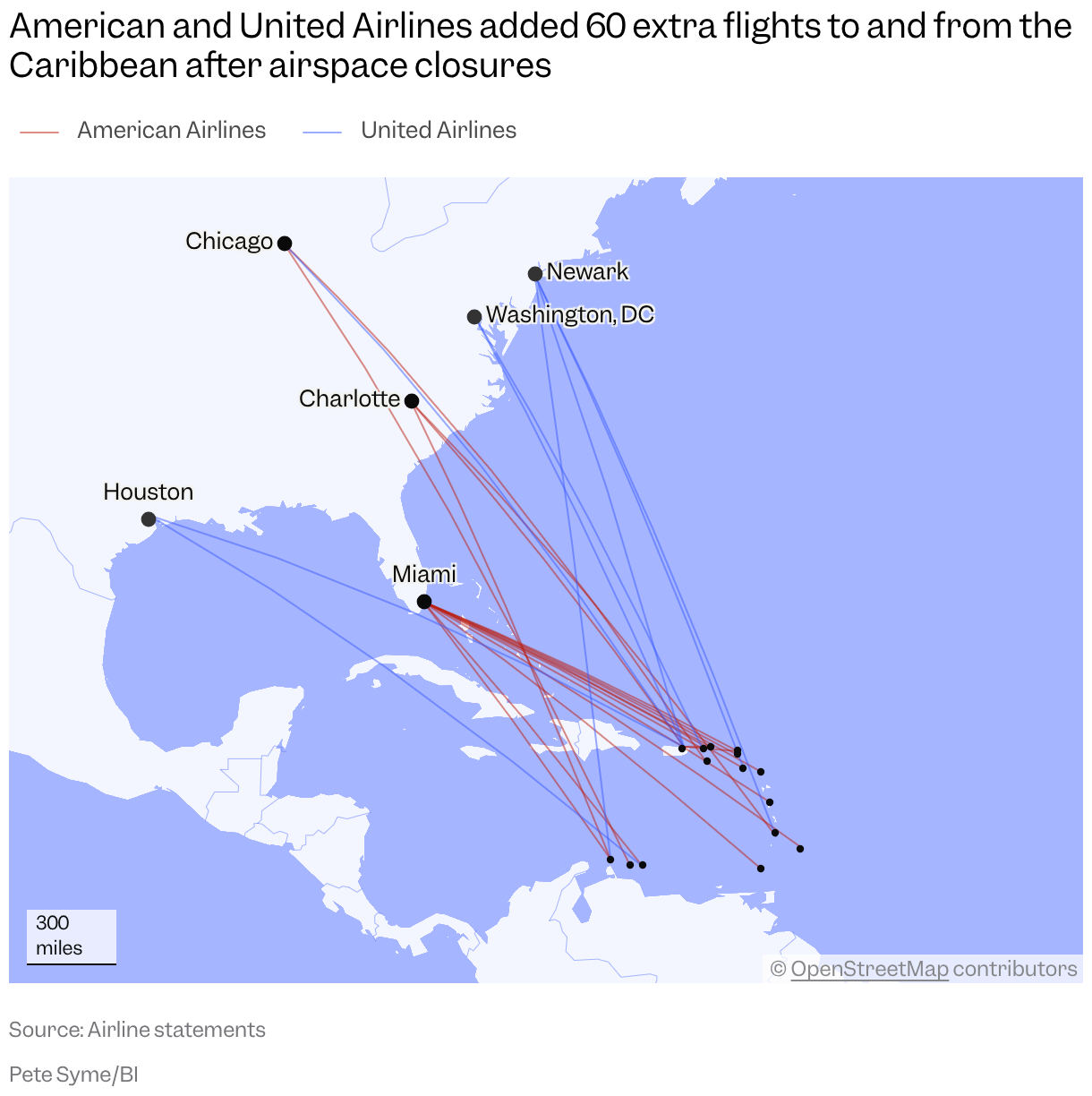
After airspace restrictions ended early Sunday, airlines added dozens of extra flights to help passengers get where they needed to go.
The region is a particularly popular destination for vacationers seeking some winter sun over the New Year holiday.
American Airlines added 43 extra flights on Sunday and Monday, with room for 7,000 passengers.
For the first time in over a decade, it operated interisland flights in the eastern Caribbean on Monday. Namely, to Puerto Rico from Anguilla and the British Virgin Islands.
American’s expanded schedule included deploying a Boeing 777-300, the largest model in its fleet, to ferry passengers between Miami and Puerto Rico.
United Airlines listed 17 additional flights scheduled for Sunday and Monday, to and from its hubs in Houston, Newark, and Washington, DC.
Delta Air Lines said that it has added space for 2,600 people on Monday. It didn’t immediately provide details of the extra flights it has scheduled.
Airlines have waived change fees and fare differences for passengers flying to or from the Caribbean, to rebook for flights later in the month.
Have you been affected by the travel disruption in the Caribbean? Reach out to this reporter at psyme@businessinsider.com or via Signal at syme.99
A winter storm expected to hit the Northeast is causing thousands of flight delays and cancellations.
The National Weather Service has issued a winter storm warning for areas around New York City, extending into Connecticut and New Jersey. The service expects heavy snow accumulations between six and nine inches.
About 1,400 flights in the US have been canceled, as of 2:20 p.m. ET, according to flight-tracking service FlightAware. Over 5,100 US flights have been delayed, per the service.
Some airlines have begun offering solutions to travelers affected by the storm. JetBlue, Delta, and Southwest have all waived fare differences for those changing flights from airports around the New York metropolitan area.
The delays and cancellations come during a high-density travel period around the winter holiday. AAA projected that 8.03 million Americans would fly domestically between December 20 and January 1.
Here is the best advice for what to do if your flight is disrupted.
1. Know your rights as an airline passenger in the US
Airline passengers have some customer rights in the US.
Li Rui/Xinhua via Getty Images
According to the Department of Transportation, there is no law requiring US airlines to compensate passengers for disruptions caused by uncontrollable events, such as weather. That also includes air traffic control delays.
The only rule carriers must follow is to refund customers in the event of cancellations, even for non-controllable events. And that does not mean travel credits or vouchers — it must be cash, and includes any add-ons, such as bags or seats.
But carriers do not owe meals, hotel rooms, or financial compensation for storm-related cancellations or delays — because the cause is the weather, not the airline.
Passengers are still entitled to a refund or rebooking on the same airline, but carriers are not required to provide additional accommodations or rebook on another airline.
If you choose to travel but your flight is delayed or canceled, ask the airline for the reason — ideally in writing — so you know what you’re entitled to. Airlines have different policies for disruptions they control, like crew or maintenance issues.
The DoT’s Airline Customer Service Dashboard — launched in 2022 — shows what the 10 largest US airlines promise in those cases, including rebookings, meal vouchers, and hotel accommodations.
2. Monitor your airline’s app for rebooking options
Most airlines allow customers to adjust their flights online.
Jaap Arriens/NurPhoto via Getty Images
When a flight delay or cancellation is announced, expect people to flock to the nearest customer service line for assistance, and for the phone lines to clog.
Wait times can be painfully long, and the best alternatives will likely go quickly. However, some airlines offer the option to rebook on their website or mobile app and waive any fees, making it sometimes easier to make changes online than in person.
If all available options are exhausted, have a plan B, such as waiting to speak with a live agent, contacting the airline through social media, or booking a hotel for the night.
Direct messaging on Facebook or Twitter can actually serve as a virtual placeholder, and you may hear back via chat before speaking to a live agent.
Here are the phone numbers for each airline:
Alaska: 1-800-252-7522 or text 82008
Allegiant: 1-702-505-8888
American: 1-800-433-7300
Avelo: 1-346-616-9500
Breeze: No phone number to call, but you can text the airline at 501-273-3931. If you call this number, it’ll tell you different ways to contact Breeze, like via email or Facebook Messenger.
Delta: 1-800-221-1212
Frontier: No phone number. The best way to contact Frontier is via online chat or email.
JetBlue: 1-800-538-2583
Southwest: 1-800-435-9792
Spirit: 1-855-728-3555
Sun Country: 1-651-905-2737
United: 1-800-864-8331
3. Ask for a hotel or meal voucher
The Hyatt hotel inside Orlando airport.
: Jeffrey Greenberg/Universal Images Group via Getty Images
For controllable delays or cancellations that result in a customer waiting at least three hours for a new flight or requiring an overnight stay, several airlines will offer meal or hotel vouchers.
Carriers offering both are Alaska Airlines, Allegiant Air, American Airlines, Delta Air Lines, Hawaiian Airlines, JetBlue Airways, Southwest Airlines, Spirit Airlines, and United Airlines, per the DoT dashboard.
Frontier Airlines is the only carrier that does not offer accommodations in the event of an overnight delay or cancellation, but it will provide a meal voucher.
For US airlines not listed on the dashboard, or in cases where the disruption is uncontrollable (like because of a winter storm), or if the compensation is unclear, simply ask.
It never hurts to request a meal or hotel during flight disruptions, and you might get lucky with a goodwill gesture from the carrier.
4. Check if your credit card company offers travel insurance
American Express and Chase have travel credit cards.
Illustration by Mario Tama/Getty Images
Several major banks offer credit cards that come with travel insurance, like Chase’s Sapphire Reserve or American Express’ Platinum Card. Both offer trip protection, meaning customers who purchased their flight with that specific card can reap the benefits.
For example, in the case of a major storm system, it’s likely many passengers will end up stranded in random cities across the US.
However, banks with travel insurance included can reimburse cardholders for unexpected expenses outside their control, including hotel, meal, and transportation costs.
Travel insurance does not apply in all circumstances, like short delays, so be sure to check your policy before making a claim — but it also doesn’t hurt to make the claim anyway, even if the answer is no.
5. Know when to walk away
Consider renting a car or taking the train.
Wang Ying/Xinhua via Getty Images
During the holidays, it’s easy to lose sight of your purpose — seeing friends and family or simply getting away from home for a few days.
However, delays and cancellations are inevitable. Don’t spend all day sitting around waiting — give yourself a cut-off time. Once that moment passes, consider alternative means of getting to your destination, such as driving or taking a bus or train (which may also be covered by travel insurance).
If you are stuck in another city and have no other option but to stay in a hotel or wait at the airport, decide how you want to spend your time and make a plan.
Editor’s note: This article was originally published in 2023 and has been updated.
This story is available exclusively to Business Insider
subscribers. Become an Insider
and start reading now. Have an account? .
Korean Air is the latest airline to sign up for Elon Musk’s Starlink WiFi.
22 other carriers have also announced deals for the ultra-high-speed internet.
It’s already available on some airlines — here’s the full list.
Elon Musk’s Starlink has gained yet another airline customer as the ultra-high-speed WiFi service continues to gain popularity.
Korean Air announced in early December that it’s installing Starlink and expects it to enter service between July and September next year, becoming the 23rd airline in total to do so.
Business Insider previously tested Starlink on Qatar Airways’ first flight with it last October. The connection speed peaked at 215 megabits per second, more than enough for a lag-free video call, and faster than many cable-based internet services.
Starlink functions thanks to a constellation of over 7,000 satellites, which allows internet connections in remote locations, such as flying over an ocean. The satellites are in low-earth orbit, which means faster internet speeds — but also disrupts astronomers.
Starlink isn’t the only game in town, however.
JetBlue has signed up for Amazon Leo, which functions similarly, but has only launched 150 satellites so far.
Another in-flight WiFi rival is Viasat, which is used by Delta Air Lines and American Airlines. It only has a handful of satellites in a geostationary orbit, which have a longer time delay.
While it has rivals, Starlink wants to cement its dominance. As Starlink grows in popularity, it could be that more carriers sign up to Starlink to keep up with competitors. All airlines with Starlink offer it free of charge, although some require passengers to sign up for their loyalty programs.
As of the Korean announcement, here are all the airlines that have publicly announced plans to launch Starlink:
Aer Lingus
An Aer Lingus Airbus A330. Nicolas Economou/NurPhoto/Getty
The Irish flag carrier is part of International Airlines Group, which announced its Starlink deal in early November. It’s set to roll out Starlink from early 2026, but plans are still being finalized across the conglomerate.
Air Baltic
An Air Baltic Airbus A220. Jakub Porzycki/NurPhoto via Getty Images
Latvia’s airBaltic flies around Europe and the Middle East only using Airbus A220 jets. It was the first European airline to adopt Starlink, and hopes to complete installation on all its planes by the end of the year.
Air Busan
An Air Busan Airbus A321. Fabrizio Gandolfo/SOPA Images/LightRocket via Getty Images
Air Busan is a budget carrier and a subsidiary of Korean Air, which announced in December that it’s adding Starlink.
While the legacy carrier has clearer plans for its wide-body jets, Korean said Air Busan will review which planes to prioritize.
“Rollout schedules will vary by carrier, with the earliest service introduction expected as early as the third quarter of 2026,” it added.
Air France
An Air France Boeing 777. AaronP/Bauer-Griffin/GC Images
The French flag carrier announced its Starlink deal last September, available to Flying Blue loyalty members. Installation began across its fleet, including regional planes, this summer.
Air New Zealand
An Air New Zealand flight arrives at Sydney Airport in Sydney, Australia. Bai Xuefei/Xinhua via Getty Images
Air New Zealand first said it was working with Starlink two years ago. It then rolled it out on two domestic aircraft in June, saying that it was “currently in the test phase.”
Air Seoul
An Air Seoul Airbus A321. Fabrizio Gandolfo/SOPA Images/LightRocket via Getty Images
Air Seoul is a budget carrier and another subsidiary of Korean Air. Like with Air Busan, it is not yet clear which jets will get Starlink.
Alaska Airlines
An Alaska Airlines Embraer E175. Kevin Carter/Getty Images
After merging with Hawaiian Airlines — the first major carrier to offer Starlink — Alaska Airlines announced its deal in August. It says it will first be available next year and will be rolled out across the fleet by 2027.
Asiana Airlines
Asiana Airlines is merging with Korean Air. AaronP/Bauer-Griffin/GC Images
Asiana Airlines is another subsidiary of Korean Air.
The two airlines merged in 2024, while the Asiana brand is set to be phased out by the end of next year.
“Following the integration with Asiana Airlines, the airline plans to complete fleetwide installation by the end of 2027,” Korean said in its Starlink announcement.
It also said it will prioritize installation on its Boeing 777 and Airbus A350 jets.
British Airways
A British Airways Boeing 787. Kevin Carter/Getty Images
The UK flag carrier is also part of IAG. BA said it would start rolling out Starlink next year and that it would be available free of charge to all its passengers.
Emirates
An Emirates Airbus A380. Nicolas Economou/NurPhoto via Getty Images
Dubai’s airline is starting to roll out Starlink this month and plans to add it to all 232 in-service aircraft by mid-2027. It’s also set to operate the first double-decker Airbus A380 with the service.
FlyDubai
A FlyDubai Boeing 737. Fabrizio Gandolfo/SOPA Images/LightRocket via Getty Images
The Emirati budget airline also announced its Starlink deal during this month’s Dubai Airshow. It only operates Boeing 737s and plans to install Starlink on 100 of them from next year.
Iberia
Mitsubishi CRJ-200ER for Iberia Air Nostrum. adolf martinez soler/Shutterstock
The Spanish flag carrier is also part of IAG. The conglomerate said it would roll out Starlink across its fleets from 2026.
Jin Air
A Jin Air Boeing 737. Fabrizio Gandolfo/SOPA Images/LightRocket via Getty Images
Budget airline Jin Air, another subsidiary of Korean Air, will also get Starlink on its planes.
It will first install the high-speed WiFi on its Boeing 737-8 jets, the announcement said.
JSX
A JSX plane. AaronP/Bauer-Griffin/GC Images
JSX is a charter air carrier and was the first carrier to equip Starlink back in 2023. Its fleet is mostly made up of regional Embraer jets.
Korean Air
A Korean Air Boeing 777. Joan Valls/Urbanandsport/NurPhoto via Getty Images
Korean Air announced in December that it’s adding Starlink, with service starting as early as the third quarter of 2026.
It said it will prioritize installation on its Boeing 777 and Airbus A350 jets, aiming for Starlink to be across the fleet by the end of 2027.
Level
A Level Airlines plane at Barcelona Airport. Joan Valls/Urbanandsport/NurPhoto via Getty Images
Level is a budget airline based in Barcelona and is part of IAG. The airline’s parent company said it would roll out Starlink from 2026.
Qatar Airways
A Qatar Airways Boeing 777 at Athens International Airport. Nicolas Economou/NurPhoto via Getty Images
Qatar Airways outpaced its regional rival, Emirates, by announcing Starlink back in May 2024. As of November, it operates the most wide-body aircraft with the service, numbering over 100. Starlink is installed on all Qatar’s Boeing 777s and is being rolled out to its Airbus A350s.
Scandinavian Airlines, or SAS, is the flag carrier for Sweden, Denmark, and Norway. It announced Starlink in January and said the rollout would begin at the end of the year. Passengers would need to sign up for its EuroBonus loyalty program for free access.
United Airlines
United Airlines planes at Newark Airport. Gary Hershorn/Getty Images
United Airlines was the second US airline to announce a Starlink deal, but the first of the Big Three. It has installed the service on over half of its regional planes, and is continuing to roll it out across its whole fleet. The airline says customers will get a notification before their flight if it is equipped with Starlink. Passengers need to sign up for its MileagePlus loyalty program for free access.
Virgin Atlantic
A Virgin Atlantic Airbus A350. NurPhoto/NurPhoto/Getty Images
Virgin Atlantic was the first UK airline to announce its deal with Starlink, which it did in July. Installation is planned to start in the second half of next year. Passengers will need to sign up for the airline’s Flying Club loyalty program to use it.
Canada’s WestJet started installing Starlink in February, and it’s now equipped on over 100 of its Boeing 737 jets. It plans for all its 737-800 and 737 Max 8s to have Starlink by the end of the year. Free access requires signing up for its loyalty program.
Zipair
ZipAir Boeing 787. Kittikun Yoksap/Shutterstock
Zipair is a Japanese budget airline and a subsidiary of Japan Airlines. It was an early adopter of Starlink, announcing its deal in early 2023, but doesn’t appear to have yet launched the service.
An Arizona pilot school has stopped Cathay Pacific trainees from solo flights after several incidents that went unreported, Bloomberg first reported.
Cathay Pacific, the Hong Kong flag carrier, is one of the world’s best airlines — one of just 10 globally to be ranked five stars by Skytrax.
In an internal memo, the AeroGuard Flight Training Center in Phoenix said it saw “an alarming increase in solo incidents during cadet training,” per Bloomberg.
It added that the incidents involved a wingtip colliding with a fixed object, a “bounced landing” leading to a “substantial” propellor strike, and a complete runway excursion.
“While each situation was unique, in each case the concern was the same — required consultation did not occur,” the memo reportedly said.
Bloomberg also reported that the students didn’t properly report the damage in two of the three incidents.
In a statement shared with Business Insider, Cathay Pacific acknowledged the events and added, “We are taking them seriously.”
“These incidents involve our sponsored students, who will become our employees upon successful graduation from the training course,” it said.
“They will then need to undergo additional structured training before being assigned any flying duty.”
A source familiar with the situation told Bloomberg that the decision would affect around 150 of the 250 to 300 Cathay cadets training at the school.
The decision hinders Cathay’s ongoing plans to increase its number of pilots after the pandemic, when the airline instituted steep pay cuts.
Several pilots quit during that time, with some telling Reuters that strict COVID measures in Hong Kong were affecting their mental health.
In the statement, Cathay Pacific said, “Safety guides every decision we make, and we fully support the decision of the training school.”
“We will continue to prioritize the safety and well-being of our cadet pilots and crew members, and we remain dedicated to upholding the highest standards in our training programs,” it added.