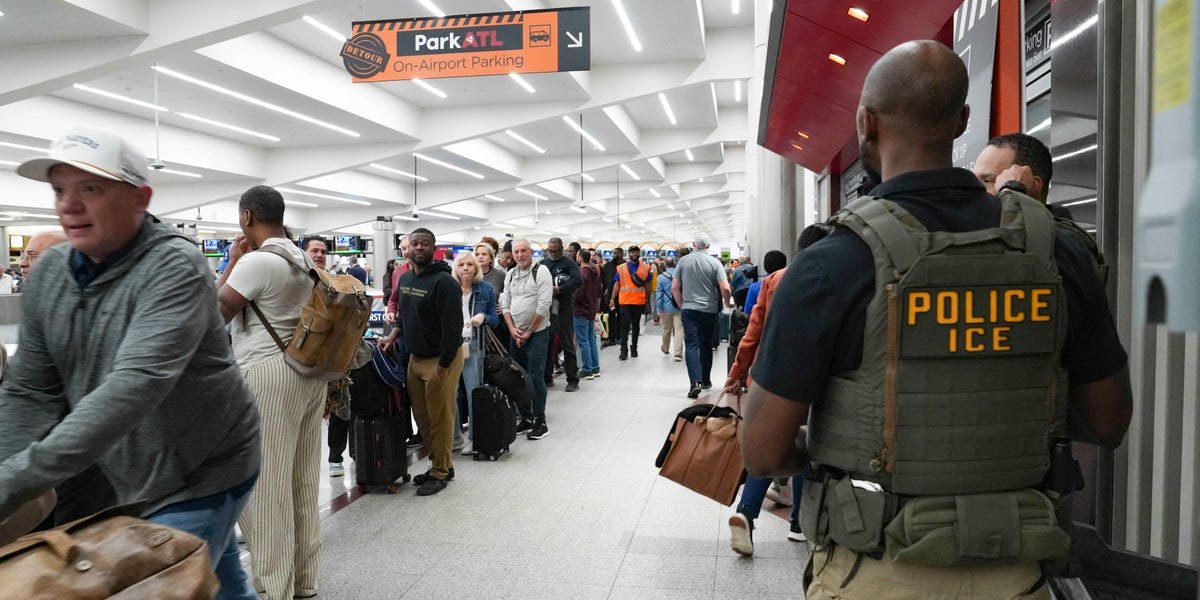
The airport chaos may not be over yet, and Immigration and Customs Enforcement agents are set to remain at many airports across the US.
Tom Homan, the White House’s border czar, told CBS News on Sunday that ICE would remain “until the airports feel like they’re 100%.”
It comes after President Donald Trump signed an executive order on Friday for Transportation and Security Administration agents to be paid.
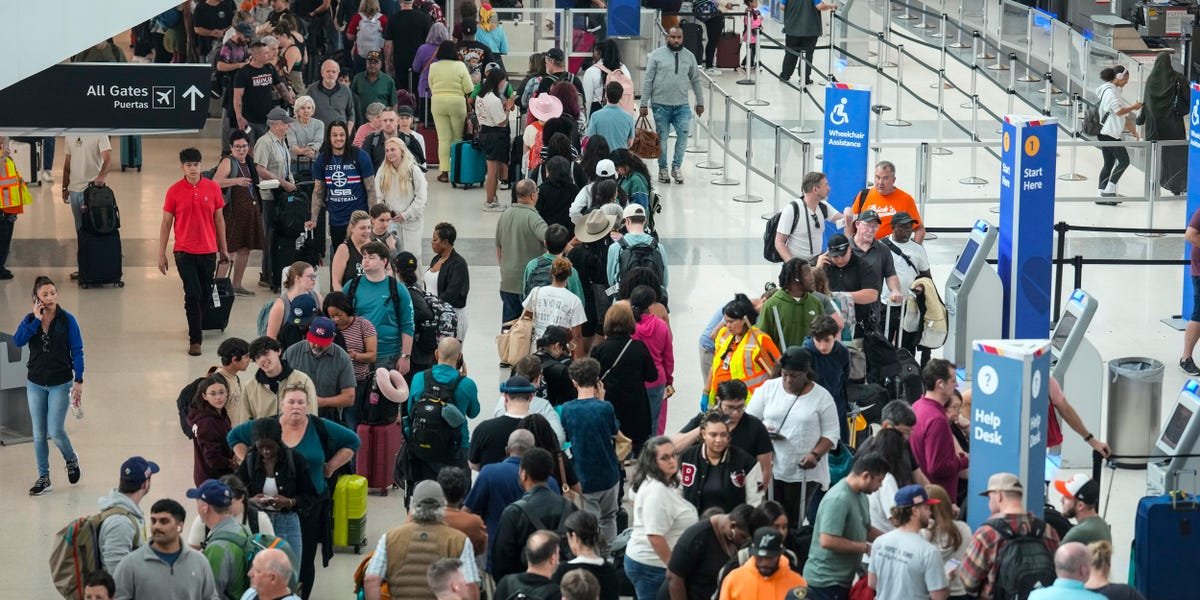
For over a month, travelers have faced hourslong lines at airport security checkpoints as more TSA agents called out of work. Some 500 of them have left their jobs since the partial government shutdown began in mid-February.
“If less TSA agents come back, that means we’ll keep more ICE agents there,” Homan told CBS News.
“We’ll be there as long as they need us until they get back to normal operations and feel like those airports are secure,” he added.
The Department of Homeland Security has said that TSA agents should be paid as early as Monday.
While wait times have alleviated, some still remain above typical levels. For example, Houston’s George Bush Intercontinental previously saw four-hour lines, and its website showed waits up to 60 minutes on Monday morning. Waits of over 30 minutes were still present at New York JFK on Monday.
ICE agents were deployed to 14 major airports. Homan told CNN on Sunday that they have been “protecting the exit lanes, doing identification checks, plugging the security holes.”
The presence of ICE at airports has drawn criticism from flight attendants’ unions.
“The introduction of ICE agents into airports creates contradictory missions, as attempts to question passengers about immigration status may distract them from ensuring airport security,” they said in a joint statement earlier this month.
The Association of Flight Attendants created an online form for its members to report any concerns or incidents, like ICE agents “doing work they are not trained to do, such as screening passengers and baggage.”
The Senate approved a deal early Friday to fund DHS, but Republicans in the House rejected it.
Republicans want more funding for ICE, but Democrats want to see the agency reformed in the wake of January’s violence in Minnesota.
The DHS did not immediately respond to a request for comment sent outside US working hours.
In a statement last Friday, it said, “Deploying ICE officers to airports was critical in helping Americans travel across the country.”
TSA checkpoints at US airports continue to face pressure amid an ongoing partial government shutdown that is now nearly a month old.
Numerous airports are telling passengers to allow longer than usual to clear security, as staff shortages cause more congestion and longer lines.
On Friday, Austin-Bergstrom International Airport told travelers to arrive up to three hours before their flight. Photos and videos shared by travelers online showed lines stretching from the terminal building into the parking lot.
Ava Brendgord, a reporter for local NBC affiliate, KXAN News, shared a video of the line snaking out of the building at around 5 a.m. local time on Friday morning.
By 7 a.m., lines had returned to more normal levels, local news outlets reported.
Similar scenes played out at many other airports this week, and things could worsen over the weekend as Americans travel for Spring Break and TSA agents face their first $0 paycheck, increasing the likelihood they will skip work.
Though waits were nowhere near the three hours some passengers experienced at Houston Hobby Airport last weekend, there was significant congestion at some airports on Friday morning. One Business Insider employee traveling from LaGuardia saw a lengthy line, and at JFK, wait times exceeded 20 minutes at most TSA screening points.
Atlanta Airport, the world’s busiest by passenger numbers, said it expects to serve 250,000 travelers this weekend, and advised people to arrive three hours early.
How to check wait times
Travelers wait in line at New York’s LaGuardia airport.
Cadie Thompson/Business Insider
The easiest way to avoid the stress of missing your flight is to arrive as early as you can. Many airports are advising travelers this week to arrive up to three hours before their flight.
To check TSA wait times, many airports, including major hubs like Atlanta, Houston, JFK, Newark, Philadelphia, Dallas-Fort Worth, and Denver, post them live on their websites.
These can also provide more specific insights. For example, DFW’s website shows the wait times at each checkpoint.
You can also use the MyTSA mobile app. It provides estimated wait times in 15-minute intervals based on average checkpoint data. The app, however, will use historical data if the live data cannot be retrieved. The TSA also says it is not “actively” managing its sites during the partial shutdown, and so the app may not always be updated.
Flying during a partial government shutdown is like playing a game of TSA line roulette.
A shortage of security agents at Houston’s Hobby Airport and New Orleans’ Louis Armstrong International Airport led to extraordinary security queues that stretched up to three hours on Sunday. The general line in Houston snaked into the parking garage.
Airports in San Juan, Atlanta, and Charlotte have similarly told travelers to budget extra time for staffing-related security delays after many TSA agents — deemed “essential” and required to work without pay during the shutdown — didn’t show up. Wait times at these airports were under 30 minutes on Thursday, but that could change with little notice as the busy spring break season goes into full swing.
Agents are expected to receive their first $0 paycheck this weekend, raising the likelihood that more fed-up agents will call in sick.
Henry Harteveldt, a travel analyst and the president of Atmosphere Research Group, told Business Insider that, for now, the TSA chaos appears localized to select airports where mass callouts collided with peak spring break travel. The US Travel Association estimated that a record 171 million people will fly in March and April.
Most other airports across the US are operating normally. Houston’s larger airport, George Bush Intercontinental, reported wait times as short as a few minutes Thursday morning; major hubs like New York, Boston, Los Angeles, Miami, and Dallas-Fort Worth were reporting 20 minutes or less.
Still, this hasn’t made the situation any less confusing.
Harteveldt said it’s likely the chaos will spread to other airports the longer security officers work without pay — with the coming missed paycheck likely motivating even more callouts, as seen during the full government shutdown in October and early November.
“We know from the last government shutdown that it’s difficult for TSA employees to work for a sustained period without any income,” he said. “So these individuals calling out or leaving to work a supplementary job that will provide some type of pay is completely understandable.”
Here are tips if you’re headed to the airport as the shutdown drags on.
Budget extra time
Between the partial shutdown and higher fuel prices due to the war in Iran, Harteveldt advised that travelers who haven’t yet booked should consider postponing until things are “calmer and more predictable.”
Consider taking a train or driving if you must travel. If you must fly, be sure to budget extra time for security, whether the airport is bottlenecked or running normally.
A TSA agent shortage caused by the partial government shutdown led to long lines at airport security.
RONALDO SCHEMIDT / AFP
“Short-staffed airports may be less diligent in updating security wait times, so the 15- or 30-minute waits you see online may not be accurate,” Harteveldt said.
Houston Hobby Airport on Tuesday told passengers to arrive three hours early for domestic flights and four hours early for international flights due to staffing shortages at TSA.
Sally French, a travel analyst at NerdWallet, said she usually recommends travelers use the MyTSA mobile app to check security lines ahead of time, but warned it may not be accurate because it is not being updated during the shutdown.
Get in the fast lane
Travelers should check whether their ticket and the airport allow them to use security lanes that bypass the general line.
“If you can opt into the TSA’s Touchless ID, that may be faster, but it and other expedited lines still may be closed during the shutdown,” Harteveldt said.
Touchless ID still requires an agent present to manage and monitor the station, but the ID process is faster.
Charlotte Douglas International Airport
Touchless ID is a voluntary system that allows enrolled passengers to enter security using facial recognition instead of showing an ID and boarding pass to a TSA agent. Eligible travelers must have a passport, an active airline profile, and be a TSA PreCheck member.
However, the feature is only available to passengers of participating airlines at certain major airports and may be unavailable during the shutdown.
French said people with certain airline status or who bought higher-fare tickets should check if they have access to expedited security lanes.
Some airlines allow people to buy separate access to speedier lines: United’s “Premiere Access,” for example, starts at $24 and includes an exclusive security line, though the perk is subject to availability.
Invest in TSA PreCheck
French said TSA PreCheck is among the most reliable ways to get through security faster: “I always recommend applying for TSA PreCheck; so many credit cards offer it as a benefit in that they cover your application fee.”
TSA PreCheck — which allows passengers to keep their toiletries and laptops in their bags, wear their shoes and jackets, and use a metal detector instead of full-body scanners — costs about $76 for a five-year membership.
Houston Hobby Airport made headlines on Sunday when the general security line reached three hours. PreCheck could be a saving grace.
Brett Coomer/Houston Chronicle via Getty Images
It requires proof of US citizenship or residency, passing a background check, and completing an in-person interview.
Credit cards like the Chase Sapphire Reserve and the Capital One Venture offer PreCheck reimbursement. The quicker line typically requires fewer agents thanks to the less intensive screening — and it’s still open at most airports despite DHS briefly closing it earlier in the shutdown.
CLEAR, a privately owned security program available at most major airports, is another option. Enrolled travelers verify their identity using biometrics and are then escorted to the front of the line — similar to Touchless ID. It’s $209 annually.
Don’t bet on compensation from your airline
If long TSA lines make you miss your flight, airlines will often rebook you on the next available flight.
But that’s largely as much as airlines offer — the shutdown is out of their control, so any hotel or meal vouchers would be a goodwill gesture. Still, it’s good to ask.
Travel insurance and credit-card trip-delay coverage also usually won’t help, since they only cover events like bad weather or mechanical problems. Staffing issues aren’t always a covered reason. Passengers can also ask their airline about standby or refunds, but policies vary.
Bottom line: give yourself extra time and know your airline’s rules before traveling this month.
Another day, another dose of air travel confusion.
Reports of multi-hour airport security lines spread quickly online this weekend as the partial government shutdown drags on and spring break travel picks up — but, for now, the chaos appears concentrated at just a handful of airports.
Houston Hobby Airport and Louis Armstrong New Orleans International Airport are the hardest hit, with peak wait times up to three hours reported in the general line on Sunday and Monday.
Social media posts from both airports and the Department of Homeland Security cited a shortage of Transportation Security Administration agents, who are running the checkpoints without pay for the second time in under four months.
Photos and videos shared online show the general security queue in Houston backed up to the parking garage on Sunday. Even expedited security lines, including TSA PreCheck and Clear, were snaking through the terminal or closed altogether.
Every time Taylor publishes a story, you’ll get an alert straight to your inbox!
Stay connected to Taylor and get more of their work as it publishes.
By comparison, most other airports — including Houston’s larger airport, George Bush Intercontinental — haven’t seen the same disruptions. Industry experts say Hobby and New Orleans may simply be outliers where agent absences came at a moment of high volume.
Sally French, a travel analyst at Nerd Wallet, told Business Insider that New Orleans and Houston Hobby are in particularly high demand right now: “New Orleans is coming off Mardi Gras, and Houston airports are huge for getting to Port Galveston for the spring break cruises.”
Henry Harteveldt, a travel analyst and the president of Atmosphere Research Group, said the seemingly localized disruptions could be due to several factors, like randomness, targeted disruptions by frustrated workers, or the union encouraging officers to call out.
Travelers at New Orleans’ Louis Armstrong airport saw hourslong lines on Sunday.
Chris Fenton
Harteveldt didn’t rule out that the Department of Homeland Security itself — whose funding expired in February as part of a political fight over aggressive actions by Border Patrol and Immigration and Customs Enforcement — could have organized the chaos at Hobby and New Orleans to get media attention; the DHS official account blamed the lines on Democrats.
“One thing we know that works in getting lawmakers back to the negotiating table is adding long queues at large airports, especially in major cities that are leisure and business hot spots,” Harteveldt said. “It becomes television news, but it’s not good for anybody.”
Spokespeople for the DHS did not immediately respond to a request for comment on Monday.
Previous shutdowns, including those under President Donald Trump in 2018-2019 and in 2025, ended partially after mass absences by TSA agents and air traffic controllers temporarily halted traffic in busy markets like New York City. This time, however, air traffic controllers are still getting paid.
Longer queues aren’t unusual during peak travel periods
The longest line at Houston’s larger airport, George Bush Intercontinental, was 51 minutes on Sunday, a TSA official told Business Insider. Airports like Hartsfield-Jackson Atlanta International Airport and Charlotte Douglas International Airport were also seeing long but less severe queues of about an hour.
That’s not unusual during peak spring break — especially on a Sunday, already the busiest travel day of the week. TSA data shows that Sunday was its busiest travel day of the year since January 4, screening nearly 2.8 million passengers across US airports.
Atlanta said it was experiencing staffing constraints but also attributed the backups to “residual impacts from two ground stops on Friday.” The city reportedly experienced hail that night, and airlines like Delta suspended operations to inspect aircraft.
Atlanta, Charlotte, and Intercontinental — along with other popular spring break gateways such as Miami, Orlando, Los Angeles, and New York — were showing security wait times of 30 minutes or less as of Monday afternoon.
Harteveldt warned, however, that some understaffed airports may not consistently update line times — meaning the projected wait you see online may not be accurate, so budget extra time.
Photos online show long TSA lines at Chicago O’Hare International Airport on Monday. It’s unclear what the wait time was.
Peter Zay/Anadolu via Getty Images
Disruptions could spread to other airports the longer TSA agents work without pay. Data from the US Travel Association, a nonprofit representing the travel industry, shows a record 171 million people are expected to pass through US airports in March and April this year.
It said nearly 50,000 TSA agents — who earn an average of $35,000 a year — will receive their first full $0 paycheck on Saturday unless Congress reaches a deal to fund DHS before then.
“They’re showing up. They’re doing their job, and they’re not getting paid,” Geoff Freeman, the president and CEO of the US Travel Association non-profit group that represents the travel industry, said. “It’s not just unfair. It’s reckless. You can’t run an industry with $3 trillion in economic impact on IOUs.”
The TSA told Business Insider that the coming missed paycheck would cause “financial hardship, absences, and crippling staffing shortages.” Officers received partial pay at the end of February for work done before the shutdown started and are expected to eventually receive back pay.
The DHS has blamed congressional Democrats for the prolonged shutdown. Democrats have opposed funding the department and said they will not support it until Republicans agree to restrictions on Immigration and Customs Enforcement (ICE) operations.
This story is available exclusively to Business Insider
subscribers. Become an Insider
and start reading now. Have an account? .
Airports across the Middle East have suspended all flight operations until further notice, leaving many stranded.
The US and Israel launched strikes against Iran on Saturday, with Iran launching retaliatory strikes across the region.
One Emirates passenger told Business Insider he was stuck on a plane for five hours without food before everyone was deplaned.
Travelers are in limbo as airport departure boards flip to red after air strikes in Iran resulted in closed airspace and triggered mass flight cancellations.
The heart of the chaos is in the Middle East, where airports in Dubai, Doha, and Abu Dhabi serve as megahubs for global connecting traffic. Data from the aviation analytics firm Cirium shows their home airlines — Emirates, Qatar Airways, and Etihad Airways — carry a combined 90,000 transit passengers a day.
That figure does not include the thousands of travelers whose final destination is the Middle East.
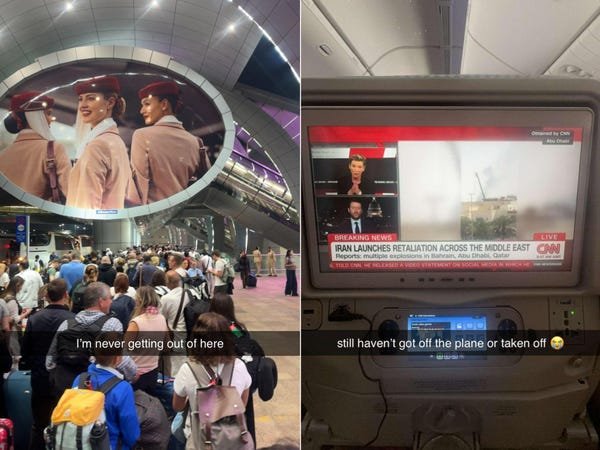
Emirates passenger Jaiveer Cheema, who was set to fly back home to the US on Saturday, told Business Insider that he was stuck on his plane for five hours with no food before everyone was deplaned and shuffled into the crowded terminal at Dubai International.
“The next several hours at the airport were chaos as no one knew what to do,” he said. “We spoke to several security guards and Emirates employees, and they all gave us different answers.”
Cheema said they stood in line after line until they eventually got a hotel voucher and took a bus to the lodging. He was still waiting for a room 90 minutes after arriving — it’s after midnight in Dubai; nearly 20 hours after he initially showed up for his 9 a.m. flight.
While many passengers are stranded within the region’s closed airspace, shuttered until further notice, the disruption has rippled far beyond it.
Flights to the affected region from places like London and the US have been canceled outright or diverted mid-journey — leaving travelers far from home in crowded airport terminals and uncertain when they will be able to depart.
Airlines have told passengers on social media to expect long wait times at airports and on customer-service phone lines as they try to manage the abrupt disruptions.
The sheer number of displaced people and planes on Saturday alone is expected to snowball worldwide if airports are unable to restart operations soon.
Passengers in Dubai were funneled into long snaking lines.
Jaiveer Cheema is one of the thousands of people stranded in limbo. Courtesy of Jaiveer Cheema
Cheema spent hours in line but managed to secure a hotel voucher — though he had yet to secure a room when talking with Business Insider. He said he did not have answers from Emirates on what’s next.
An Emirates spokesperson did not immediately respond to a request for comment from Business Insider.
Passengers at Beirut Rafic Hariri International Airport in Lebanon are stranded.
Passengers are stranded at Beirut Rafic Hariri International Airport on Saturday. Anadolu/Anadolu via Getty Images
Airlines are pivoting their operations in response to the strikes. Lufthansa Group said it is suspending flights to Beirut, Tel Aviv, Amman, Erbil, and Tehran until March 7.
Airlines are suspending flights across the region, including Lebanon.
Flight operations at the Beirut Rafic Hariri International Airport in Lebanon on Saturday. Anadolu/Anadolu via Getty Images
In a statement shared on the Lufthansa Group’s website, the company said it would also suspend flights in additional areas.
“The following airspaces will also not be used until March 7: Israel, Lebanon, Jordan, Iraq, Qatar, and Iran,” the aviation corporation said. “In addition, Lufthansa Group airlines will suspend flights to and from Dubai and Abu Dhabi, Riad, and Dammam until March 1. Furthermore, the airspace of the United Arab Emirates will not be used until March 1.”
International flights at Tribhuvan International Airport in Nepal were disrupted.
Passengers waiting at Tribhuvan International Airport in Nepal on Saturday. Navesh Chitrakar/REUTERS
The Tribhuvan International Airport shared a passenger advisory on Saturday, saying international flights “may be subject to delay, rescheduling, or cancellations” due to airspace restrictions.
Passengers flying with major airlines were told to check their flight status.
Passengers at Tribhuvan International Airport in Nepal on Saturday. Navesh Chitrakar/REUTERS
The Tribhuvan International Airport told passengers flying with major airlines — including Qatar Airways and Turkish Airlines — to coordinate with those companies to navigate travel issues.
Qatar’s airspace closure caused flight disruptions at Hamad International Airport.
Passengers at the Hamad International Airport in Qatar on Saturday. Stringer/REUTERS
Qatar’s Hamad International Airport said all aircraft movement has been temporarily suspended due to the country’s closed airspace.
“Our priority is always the safety of our passengers and employees. We are working closely with government stakeholders and airline partners to look after passengers that have been impacted,” the airport wrote in an advisory.
In London, flights to the countries Middle East were canceled.
The Emirates check-in counter at London Gatwick Airport shows that flights are cancelled on Saturday. Ben Stansall / AFP
Flights heading to the Middle East were also canceled at the London Gatwick Airport in England on Saturday.
London Gatwick Airport told some passengers to expect travel interruptions.
Passengers at London Gatwick Airport on Saturday. Ben Stansall / AFP
A London Gatwick Airport spokesperson told Sky News it’s “expecting disruption to our Qatar and Emirates flights.”
Are you a stranded traveler with a story to share? Contact the reporters at ledmonds@insider.com and trains@insider.com along with your preferred contact information.