
Airlines-are-being-squeezed-into-this-sliver-of-sky-to.jpeg

Airlines are being squeezed into this sliver of sky to avoid closed airspace

As much of the Middle East remains closed amid missile barrages, international airlines are being squeezed into a shrinking set of flight paths.

Iran, Iraq, Kuwait, Israel, Bahrain, Qatar, and the United Arab Emirates remained closed or partially closed as of Monday, and the nearby Russian skies have been off limits to Western airlines since the Ukraine war broke out in 2022.

For most carriers, this extremely limits their options.

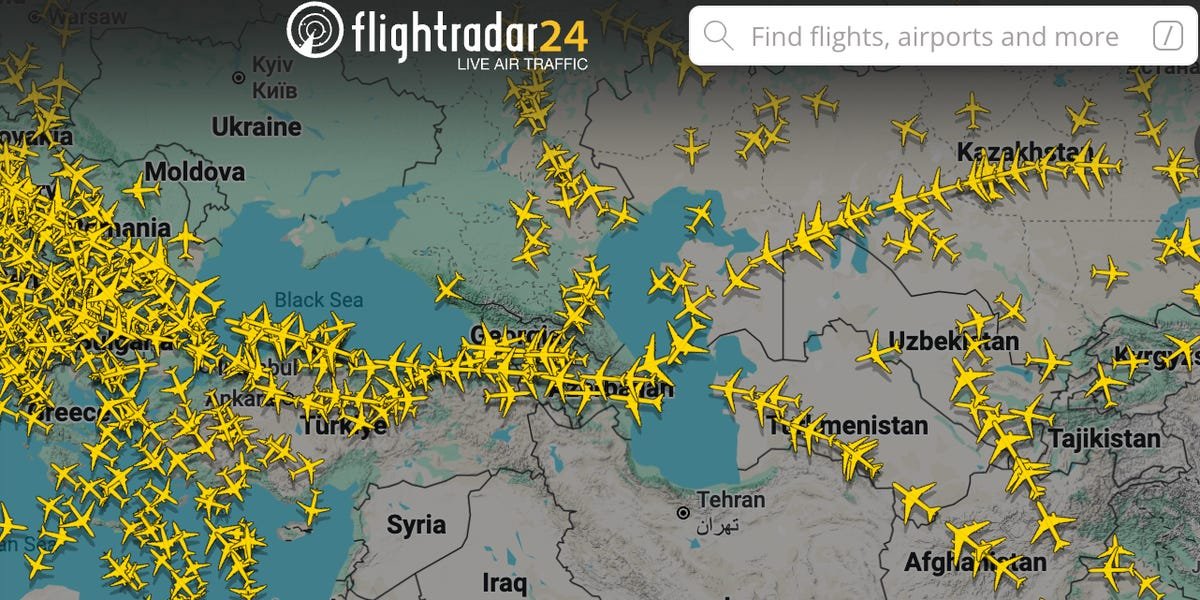
Flightradar24 shows flights are being funneled into narrow corridors around the Middle East, or forced into longer detours over Saudi Arabia and other regions — adding hours of flight time, higher fuel and labor costs, and operational complexity.

Among the most critical options is the Caucasus corridor north of Iran — including Armenia, Georgia, and Azerbaijan — which links Europe and Asia and has been absorbing detoured traffic as carriers seek alternatives to disrupted Middle East routes.


Flight traffic on Flightradar24.

The traffic over the Caucasus corridor on Monday evening Central European Time.


Flightradar24


The Caucasus region offers not only the most efficient routing around now-closed airspace — it’s also the only option for many global carriers. To the north is Russia, which remains blocked to most Western airlines amid ongoing sanctions and reciprocal airspace restrictions.

Restrictions on Russian airspace have forced carriers like Finnair to add up to four extra hours between Helsinki and Tokyo, while British Airways has similarly extended flight times on routes to Asia.

The narrow corridor can be like threading a needle, spanning just 100 miles between Russia and Iran at its narrowest point, according to Google Maps. Without it, airlines unfriendly with Russia would be forced to take significantly longer, more costly detours via Saudi Arabia.

Iranian airspace closures have sent traffic north before

Although it is a narrow route, the Caucasus corridor has successfully accommodated increased traffic when carriers have relied on it during past conflict-driven airspace closures. This route also overflies Afghanistan and Pakistan.

According to the Civil Aviation Air Navigation Service Organization (CANSO), the global association of air traffic providers based in the Netherlands, Azerbaijan airspace handled 110 additional flights per day when Iran temporarily closed its airspace in June 2025.

The agency added that the region has seen an overall year-over-year increase in traffic as airspace around it flips on and off.

“Since 2022, Azerbaijan’s airspace has played a vital role in providing alternative and efficient air routes in response to regional geopolitical crises,” CANSO said, noting the country’s investments in advanced air traffic technologies.


The airspace on a normal day.

The airspace on February 27, 2026, the day before the US and Israel attacked Iran. More planes overall were flying at that time and had access to far more airspace.

Flightradar24


Still, the influx of congestion over the Caucasus region could limit flexibility if weather restrictions arise. President Donald Trump said on Monday that the conflict could last “four to five weeks.”

If the conflict were to spread to the central Asian states that neighbor Iran to the north — which is very unlikely given the lack of US bases in Central Asia— it would effectively create a wall of unusable airspace.

Aviation leaders are emphasizing safety over these sensitive regions, especially after airports in Kuwait and the UAE were damaged during missile fire. On Monday, the director general of the International Air Transport Association (IATA), Willie Walsh, called for airlines to refrain from targeting civilian airspace.

“We all hope for an early peaceful resolution to the current hostilities,” he said. “In the meantime, it is critical that states respect their obligation to keep civilians, and civil aviation free from harm.”

The comment comes after previous inadvertent attacks on civilian airliners: a Malaysia Airlines flight was shot down by Russia over eastern Ukraine in 2014, and a Ukraine International Airlines aircraft was shot down by Iran near Tehran in 2020.

Both were a result of heightened military alert and fear during tense conflicts.

Some bottlenecks extend beyond the Caucasus

Countries including Egypt, Turkey, Saudi Arabia, and Oman saw dozens of additional aircraft rerouted through their airspace shortly after the conflict began on Saturday, and they remain among the few regions still handling flights. Etihad Airways and Emirates operated a limited number of flights from the UAE on Monday.

Westbound flights are largely using a single corridor across western Saudi Arabia and then heading up toward Europe, likely because it’s farther from conflict zones.

Flightradar24 data from before the Saturday attacks shows more direct flight paths across Saudi Arabia, Kuwait, Iraq, and the UAE, though some flights on Monday were again using UAE airspace.

One airline in particular faces a uniquely tricky routing challenge due to the Middle East’s abruptly shuttered airspace: Air India.

The airline hasn’t flown over Pakistan in nearly a year due to rising tensions, forcing it to detour across the UAE to reach Europe and North America.


An Air India flight from Bombay to New York on Monday stopped in Rome along the way.

An Air India flight from Bombay to New York on Monday stopped in Rome along the way.

Flightradar24


But, with most Gulf nations now closed, Flightradar24 shows it flying even further west across Oman and Saudi Arabia on these routes, often stopping in cities like Rome and Vienna along the way.

These are likely fuel stops, considering the now-longer flight paths. Air India made similar pit stops in April 2025 when tensions with Pakistan had previously arisen.

Flights are resuming on Monday

Eddy Pieniazek, head of Ishka Advisory, said in a Monday note that the mass disruptions across the Middle East are likely to be “short-lived” with a “gradual return of operations.”

He added how vital the Gulf region is, “particularly while Russian airspace remains restricted” and “while Africa currently lacks a comparable hub infrastructure.”

UAE airspace began partially opening up on Monday, with several Emirates and Etihad Airways flights departing from Dubai and Abu Dhabi to destinations in Europe, Africa, and Asia.


Aircraft over the UAE on Monday.

Aircraft are flying over the UAE again as of Monday, as airlines slowly resume flights. It remains unclear how wide a resumption this will be.

Flightradar24


Both Emirates and Etihad Airways’ website still say all flights to and from their megahubs are suspended, but earlier Monday said a limited number will fly. These will get people home, transport cargo, and reposition aircraft.

To ease crowds, they asked passengers not to go to the airport unless they had been specifically notified.




Source link

Air-travel-has-been-thrown-into-chaos-with-cancellations-diversions.jpeg

Air travel has been thrown into chaos with cancellations, diversions, and airspace closures after strikes on Iran

Some of the world’s most congested airspace has been disrupted by the US and Israel’s strikes on Iran.

Iran, Iraq, Kuwait, Bahrain, and Qatar have all closed their airspaces. Dubai International Airport, the world’s busiest airport for international traffic, has suspended all flights until further notice.

A video shared by Flightradar24 showed airplanes deserting the region on Saturday morning.

Data from the aviation analytics firm Cirium shows that about 970 of the roughly 3,400 scheduled flights to the region have been canceled as of 11:00 p.m. Central European time. Factoring in outbound cancellations, that number is closer to 1,900.

The three major Middle Eastern airlines — Qatar Airways, Etihad Airways, and Emirates — operate major hubs that connect passengers to destinations around the world, creating a massive ripple effect of disruptions.

Qatar canceled nearly 60% of its flights on Saturday, Emirates canceled 65%, and Etihad canceled 50%, per Cirium. They’ve pre-emptively canceled hundreds more on Sunday.

Dubai International Airport — the world’s busiest megahub for international traffic — was damaged by an apparent missile strike on Sunday morning, local time. It’s unclear how that could further impact operations even if the airspace opens back up.

A Cirium spokesperson said these carriers collectively carry 90,000 transiting passengers through their hubs daily — not including those destined for the Middle East.

Major airline disruption

Even for flights that don’t land in the region, it’s a key corridor for flying between Europe and Asia. Some flights appeared to re-route over Saudi Arabia. Other airlines were avoiding the region altogether.

Detours are costly for airlines: They have to pay for extra fuel, labor, and any associated passenger compensation. And it’s possible mass diversions could overwhelm certain airports.

In a post on X, Emirates said it was temporarily suspending all flights to and from Dubai, its home base. That’s equal to about 500 flights a day, according to Cirium.

Emirates urged customers to check their flight statuses before visiting the airport. “We are actively monitoring the situation and engaging with relevant authorities,” the airline added.

Qatar Airways said all flights to and from the country were suspended until at least midnight UTC, or 7 p.m. ET. It also expects delays when usual operations resume.

Doha’s Hamad International Airport advised passengers “not to proceed to the airport.” Additional staff were deployed there to help passengers affected by the disruption, the airline said.

Etihad Airways, which is based in Abu Dhabi, said all departures and arrivals to the city were suspended until 2 p.m. local time Sunday.

Kuwait’s civil aviation ministry said a drone attack left some airport employees with minor injuries and damaged a passenger terminal.

Saudia said flights to and from affected airports were canceled until at least Tuesday.

Diversions and flights to nowhere

For those already in the air during the strikes, many flights diverted to other nearby airports or turned back to their origins.

Flightradar24 shows an Emirates flight from Orlando to Dubai diverted to Istanbul in a 14-hour flight to nowhere. A Qatar flight from New York to Doha crossed the Atlantic but then diverted to Rome after about 10 hours in the air.

An American Airlines flight from Philadelphia to Doha had flown for more than six hours when it turned around over Ireland and started heading back across the Atlantic Ocean, flight-tracking data showed. It looks like the total flight-to-nowhere will last about 13 hours.

An Air Canada flight from Toronto to Dubai was over the Mediterranean Sea before U-turning. Passengers appear to face a total journey time of 10 hours.

In a video statement posted to Truth Social on Saturday morning, President Donald Trump vowed to destroy Iran’s missile program and navy, and ensure that the country can “never” have a nuclear weapon.

There is likely more disruption to emerge. When Iran launched strikes on a US air base in Qatar last June, more than 160 flights were diverted.

Similar cancellations and reroutes happened in February 2022 when Russia invaded Ukraine, and again in April 2025 amid rising tensions between India and Pakistan.

Air India, for example, had to reroute flights around Pakistani airspace last year, requiring some long-haul services between India and Europe and North America to add a fuel stop in Vienna.

Some airlines, like Finnair, still fly the long way around Russia on certain long-haul treks rather than canceling the service altogether.


Source link

NATO-is-deploying-a-drone-carrier-to-its-eastern-edge.jpeg

NATO is deploying a drone carrier to its eastern edge after repeated Russian airspace incursions

NATO is deploying a Turkish drone carrier to the Baltic Sea to boost its surveillance and defense in response to “repeated” Russian airspace violations, the alliance announced on Friday.

The TCG Anadolu will support Eastern Sentry, a defensive operation the alliance launched in September after Russian drones crossed into Polish airspace, forcing a military response.

The Turkish drone carrier is deploying toward the coast of Latvia, where it will contribute to air surveillance and defense along NATO’s eastern edge. Allies have been surging fighter jets and warships to the Baltic region in response to Russian drone incursions.

Allied Joint Force Command Brunssum, one of three operational-level NATO headquarters, said in a statement on Friday that the deployment of the Anadolu follows “repeated airspace violations” that have been attributed to Russia.

JFC Brunssum called the deployment “a clear signal to the east” and said that it “sends an unmistakable message” that NATO is prepared to defend its territory.


A Bayraktar TB3 drone during the NATO Steadfast Dart 2026 drill in the Baltic Sea on February 17, 2026.

A Bayraktar TB3 drone lands on the flight deck of the TCG Anadolu earlier this month.

Dursun Aydemir/Anadolu via Getty Images


It’s unclear when the carrier will arrive on station and how long it will remain there. The Turkish defense ministry could not immediately be reached for comment, and neither JFC Brunssum nor NATO’s Allied Air Command responded to a request for additional information.

The first-of-its-kind TCG Anadolu is the Turkish Navy’s only drone-carrying amphibious assault ship. It was commissioned in 2023 and is now Ankara’s most advanced vessel and flagship.

The 750-foot-long vessel was originally intended to carry helicopters and F-35B fighter jets, but after Turkey was kicked out of the F-35 program over its purchase of Russian surface-to-air missile systems, Ankara decided to repurpose the Anadolu for fixed-wing drones.

The Anadolu can carry Bayraktar TB-3 and Bayraktar Kızılelma combat drones, systems made by the Turkish company Baykar, as well as attack helicopters.

JFC Brunssum said the carrier is the largest ship in NATO’s Steadfast Dart fleet, which is comprised of 17 vessels, including amphibious landing ships, frigates, destroyers, and submarines.

Iran and China have also built their own drone carriers, and Portugal expects to receive one later this year.


Source link

The-El-Paso-airspace-closure-cost-me-100-and-a.jpeg

The El Paso airspace closure cost me $100 and a night’s sleep

This as-told-to essay is based on a conversation with Kiva Lucero, 21, who is from El Paso and studies in New York City. He is the cofounder of a Paris-based creative collective. It has been edited for length and clarity.

I was scrolling on Instagram on Tuesday when I saw the El Paso airspace was closing for 10 days. Immediately, I was stressed and anxious.

I had a flight booked from El Paso to Dallas for Thursday, and then Dallas to Paris, and had to get to Paris by the weekend for work.

When I found out that what was supposed to be a 10-day closure lasted seven hours, I didn’t feel much relief — I had canceled my flight to Dallas and spent nearly $100 on a bus that I haven’t been able to get refunded.

I booked a bus ticket at three o’clock in the morning

When I first found out about the airspace closure at around midnight on Tuesday, I called my airline immediately and explained the situation. I kind of freaked out.

I asked them if it was possible for me to cancel the El Paso to Dallas leg of my flight, and I would just figure out a way to get to Dallas.

They canceled my flight after a lot of hard negotiation. At three o’clock in the morning, I booked a ticket for a 12-hour bus ride from El Paso to Dallas, leaving at 7 p.m. on Wednesday and getting to Dallas 6:30 a.m. Thursday.

I didn’t even know if I was going to make it to the bus. I was thinking El Paso could get completely locked down. I was up all night.

I just didn’t expect anything good to come of the situation. I thought it could be a serious evacuation. I called my mom to make sure everything was good, because I didn’t want her staying in town if there was a major issue.

I felt stressed and helpless

When I saw on the New York Times in the morning that the closure was lifted, I still couldn’t sleep.

I called the airline again to reinstate my original booking, because I didn’t want to take a 12 hour bus. Luckily, they did.

But it was hours of just stress and anxiety and feeling so helpless.

I had already canceled plans with friends and work meetings because I thought I would be on the bus the next day.

Thankfully, I should make it to Paris now, but it cost me $100 and a full night of sleep.

A Trump administration official told Business Insider of the disruption: “Mexican cartel drones breached US airspace” and the Defense Department “took action to disable the drones,” and there was no threat to commercial travel.


Source link