Two of the biggest personalities in digital media, Alex Cooper and Alix Earle, are feuding, and the internet has a favorite.
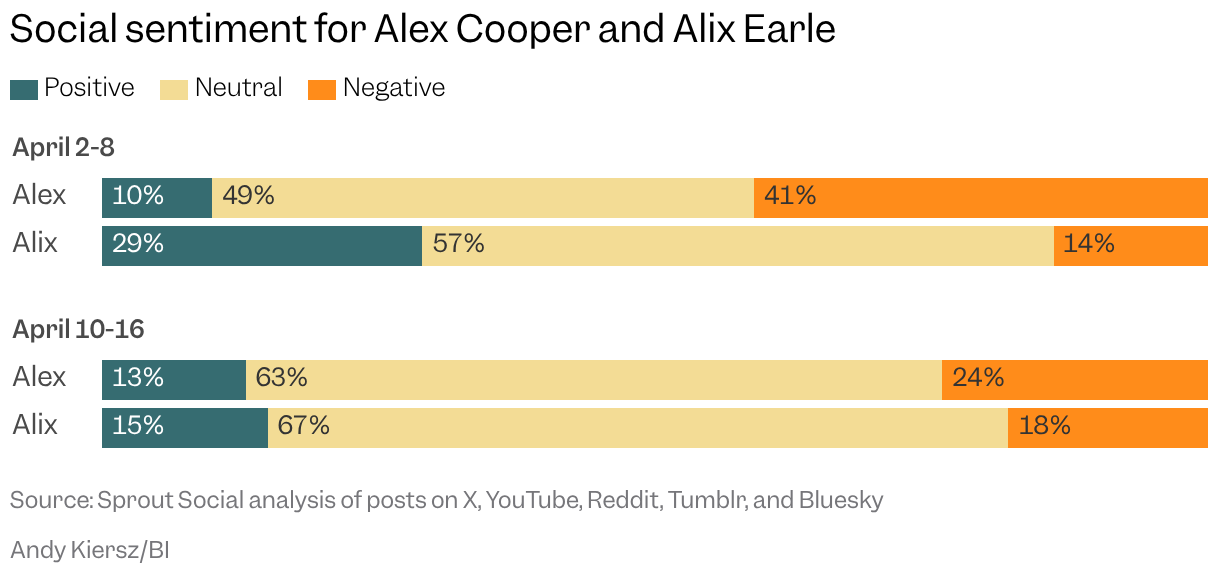
Data from two social listening firms, Muck Rack and Sprout Social, showed higher negative sentiment toward Cooper than toward Earle since the public feud kicked off late last week.
That’s not to say anyone’s truly “winning” this clash. Earle has seen negative commentary about her increase since the feud began, and Cooper entered the dispute riding a prior wave of negative sentiment.
Sprout Social said negative sentiment around Cooper was already high before the spat began. The firm attributed this partly to some Hannah Montana fans being upset about the perceived quality of Cooper’s interview with Miley Cyrus, connected to the show’s 20th anniversary celebration.
“For these large female brands, there’s always going to be a lot of haters who want to pull them down,” said Jo Wong, GM of Pop.Store, an AI commerce company that helps creators build online businesses.
Overall, though, it’s worth noting that the social listening firms found the sentiment for both Earle and Cooper was largely neutral.
A rep for Earle declined to comment, and reps for Cooper didn’t respond to multiple requests for comment.
How the recent drama started
The recent drama began last week when Earle — who used to work with Cooper’s company — reposted a critical TikTok about Cooper that called her an “ambulance chaser” for interviewing people at vulnerable times, among other accusations.
Cooper, 31, then posted a video calling out Earle, 25. She encouraged Earle to “say what you got to say about me,” to which Earle commented, “Okay on it!!”
Internet commenters have jumped to take sides. Some on social media have criticized Cooper for building an empire on sometimes-questionable advice for young women, while others have defended her as a successful businesswoman. Earle watchers have called her passive-aggressive, while others have praised her for not directly engaging.
People are looking for an escape from the politics and war-dominated news cycle, and Cooper and Earle are delivering it, said Juda Engelmayer, a crisis PR professional whose clients include Harvey Weinstein and Diddy. He said he thought online commenters were drawn to Earle because she presents as authentic and has a younger fan base that’s quick to show their support on social media.
The dustup isn’t that serious — so far — and could even benefit both by introducing them to a wider audience, he said.
“No one’s getting canceled for this,” he said. “This is just bringing name recognition.”
The social stars have a history
The social media frenzy surrounding the two women reflects their ability to command huge audiences and cut big business deals.
Earle, with more than 8 million TikTok followers, became famous for her get-ready-with-me videos in 2022 and is known for selling out products, including her new skincare line, Reale Actives.
Cooper founded the Unwell Network of podcasts, which includes her popular “Call Her Daddy” show. She’s one of the highest-paid podcasters, with a three-year, $125 million deal with SiriusXM. She also has an electrolyte beverage with Nestlé called Unwell Hydration.
In 2023, the Unwell Network signed Earle to host her own podcast, “Hot Mess,” but it ended after less than two years.
There’s been speculation that the two don’t get along — Earle took a slight jab at the situation in a 2025 interview — but this is the first time they are openly taking shots at each other.
Correction: April 17, 2026 — An earlier version of this story misspelled Jo Wong’s name.
Several months before Palantir moved its headquarters to Miami, an entity with ties to the company’s billionaire CEO, Alex Karp, put down roots in the city.
In June, Hibiscus East LLC purchased a home on Miami’s San Marino Drive for $46 million, according to property records.
Like several of Karp’s other properties, the LLC is registered in Delaware. It is connected to an attorney’s office in Manchester, New Hampshire, and an accounting office in Bedford, New Hampshire, both of which appear on documents from previous real estate transactions that are linked to Karp.
The nearly 10,000-square-foot newly built home sits on San Marino Island, one of the exclusive Venetian Islands in Biscayne Bay. A YouTube video of the home posted by listing agent Dina Goldentayer showcases the property’s waterfront and pool.
Goldentayer declined to comment to Business Insider. Representatives for Palantir and an attorney for Karp did not respond to requests for comment.
Every time Madeline publishes a story, you’ll get an alert straight to your inbox!
Stay connected to Madeline and get more of their work as it publishes.
Last month, Palantir announced it was moving its headquarters to Miami from Denver. The company has not revealed publicly why it’s making the move. Before setting up in Denver in 2020, Palantir was headquartered in Silicon Valley.
“Our company was founded in Silicon Valley,” Karp wrote in an investor letter that year. “But we seem to share fewer and fewer of the technology sector’s values and commitments.”
One of Karp’s Palantir cofounders, Peter Thiel, bought a home on one of Florida’s Venetian Islands in 2020, and his VC firm, Thiel Capital, later opened an office in Miami.
It’s not clear if Karp, who is worth $15.8 billion, according to Bloomberg, is moving to Miami full-time. He owns hundreds of acres of land in New Hampshire and, last year, made headlines for spending $120 million on a monastery outside Aspen, Colorado.
A handful of California billionaires have recently purchased properties in Miami, including Sergey Brin and Mark Zuckerberg. The real estate shopping spree comes amid an initiative in the state to get a wealth tax on November’s ballot. If passed, California residents with a net worth of more than $1 billion would be subject to a one-time 5% tax on their wealth.
Florida famously has a no-income tax policy written into its constitution.
“California’s a beautiful state, but now, because of all the political situations and all the tax laws, it’s just coming in our favor,” luxury real estate agent Saddy Abaunza Delgado previously told Business Insider.
Similarly, Howard Schultz, the former CEO of Starbucks, announced a move to Miami earlier this week — on the same day a millionaire’s tax passed Washington state’s House of Representatives.
The rush has caused prices to balloon in the 305. Zuckerberg’s $170 million purchase earlier this month on the island of Indian Creek set a Miami record.
“The influx of billionaires from California” will cause “escalation of the market,” Ana Bozovic, a founder of Analytics Miami, previously told Business Insider. “The market ceiling keeps rising,”
Molly O’Shea is a name-dropper. There’s good reason for that.
I count 29 big names in tech mentioned over our hourlong call. She told me about recently moderating a panel with Kalshi cofounders Tarek Mansour and Luana Lopes Lara. Ken Griffin took the stage after her. O’Shea breezily referenced talking about the state of new media with the TBPN bros in Peter Thiel’s house.
But it’s O’Shea’s access to executives like these that keeps her audience coming back. The podcaster is deeply immersed in Silicon Valley culture, having several years of venture capital experience under her belt.
“I am institutionally trained not to get canceled,” she said. “A lot of these people really trust me. I think it’s a wonderful component that I come in from the industry.”
Her podcast’s name, Sourcery, references “sourcing deals,” but it better represents O’Shea’s talent herself. She’sclearlysourced up, sporting an ever-growing rolodex of tech’s biggest names.
After buzzy interviews with Palantir CEO Alex Karp and Anduril cofounder Palmer Luckey, O’Shea’s platform has quickly grown. So have her critics, some of whom say she should ask tougher questions.
But her core audience — investors in the world of tech and finance — seem to love that she’s in the know.
From in-house VC newsletter to ‘monk mode’
O’Shea considers herself the first of her family to chase a “capitalistic pursuit.”
“It’s funny, there’s not many business-oriented people in my family,” she said. “My dad had a marketing agency for most of my life, but again, it was a marketing agency. My mom is a home designer and she used to be a creative director.”
She went to New York University for studio art but pivoted to entrepreneurship after learning how low the average artist’s salary was. Eventually, she narrowed in on venture capital.
O’Shea got her start working for the father of a college friend, a secondaries investor for a family office. She moved to Miami to work for him before coming back to New York as an analyst at the Global Public Offering Fund.
She then went to the seed and Series A investment firm TMV — then called Trail Mix Ventures — as an associate. She started Sourcery there as an in-house newsletter, but only made it public when she started at New York Life Ventures as a senior associate. She shared it with friends, and it eventually grew a readership.
Then Upfront Ventures’ Greg Bettinelli reached out with a job offer.
“I was a reader of her email newsletter,” Bettinelli later wrote when asked about the offer. “We were looking to hire a new investor for Upfront Ventures and I reached out as I appreciated what she built as what I think was a side project at the time.”
O’Shea said she was on a boat in the Mediterranean when she got Bettinelli’s offer. She met him in the Hamptons. “It’s like the bougiest story ever,” she said.
O’Shea moved to Los Angeles for Upfront Ventures. She’s stayed in the city and prefers it to New York. “You get so much more for your money,” she said. “I have a hot tub!”
Before O’Shea was a full-time podcaster, she worked for TMV, New York Life Ventures, and Upfront Ventures.
Molly O’Shea
Then Elon Musk took over X, partially open-sourced the algorithm, and launched ad-revenue share programs. O’Shea said, “Game on.”
She started posting more, and her follower count grew. Erik Torenberg of the podcast network Turpentine asked if she wanted to start a podcast about deals, linked to her newsletter.
While O’Shea declined to disclose exactly how much she earns, she said the Sourcery newsletter began generating revenue when it added subscriptions. That includes a $600 “I can expense it” annual tier she said “plenty of people” were willing to pay for.
Sourcery is now her full-time job and a top-200 podcast in Apple Podcasts’ investing category. She employs a “lean team” to help her film, edit, and promote.
The Palantir and Anduril interviews helped generate more interview interest. (Her next guest: Jake Paul.)
After an “insane” end to 2025, O’Shea said she spent January locked-in and focused on laying the foundation for the rest of the new year.
“I’m going into monk mode.”
Getting Karp and Luckey to say yes
O’Shea’s network is big, and her show keeps making it bigger.
Andreessen Horowitz’s Alex Immerman told her he watched her Kalshi video before investing in the company, she said. “I know plenty of people — I won’t name them — that have put millions of dollars into these companies that I’ve profiled,” she said.
That seems to be how O’Shea lands many of her guests: knowing the right people. I spoke to two early interviewees. Oden Technologies cofounder Willem Sundblad was introduced to O’Shea through an investor. Contrary general partner Kyle Harrison met her in 2018 and once considered hiring her while at Coatue Management.
“A lot of these relationships start first as friendships,” Harrison said. “We’ve enjoyed talking to each other off the record, so talking on the record is just as much fun.”
The Karp interview was a right-place, right-time situation. She was at the Hill and Valley Forum in 2025, where Karp was speaking. O’Shea said Palantir’s Eliano Younes recognized her from Pirate Wires and introduced her to Shyam Sankar, the company’s CTO.
Then she published a list of her 100 dream guests. Listed No. 1 was Ivanka Trump. Palantir staff noticed Karp wasn’t on the list, O’Shea said, and she amended it, making him 1B. That set the interview in motion.
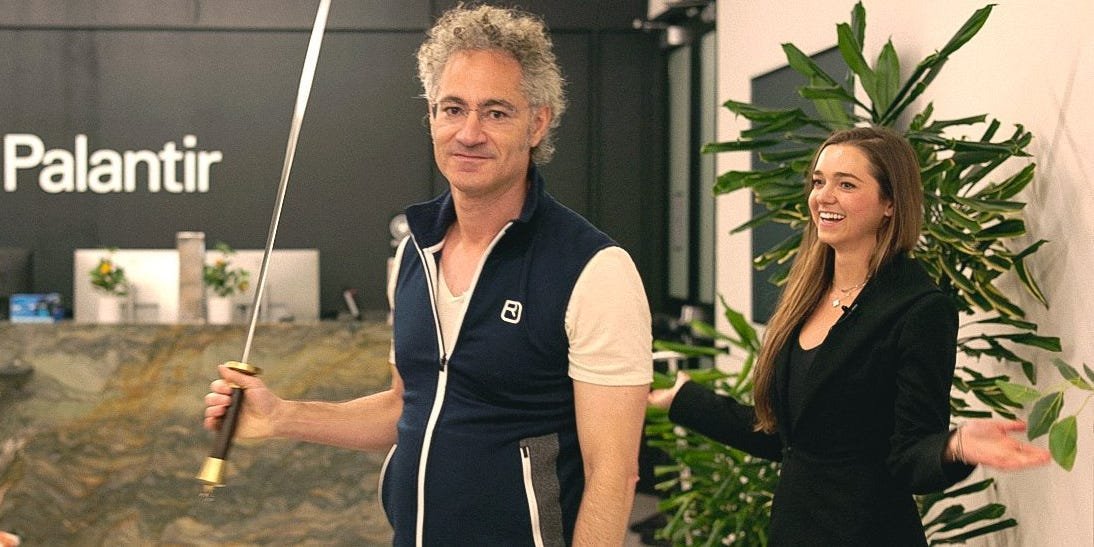
A clip of Karp brandishing a sword thrust O’Shea’s podcast into the limelight — and got the trolls commenting.
Molly O’Shea
Her Anduril series also sprang from the Sourcery 100 list. She put Anduril cofounders Palmer Luckey and Trae Stephens on the list. Matt Grimm commented and helped her set up an interview.
The Karp interview was her biggest by far. The full-length podcast has 4.3 million views on X — and that’s not including the various clips she publishes separately.
It also made her confront the challenges of being on camera.
She published the video on a Tuesday in the back of a taxi in London. She went offline on Wednesday and woke up to hundreds of texts on Thursday asking if she was OK.
In the interview, O’Shea wore an Alaïa dress her friend had lent her. She said she liked being able to “show some femininity and personal style.” Some X users mocked her attire. (Others pointed out that Karp was wearing a t-shirt.)
O’Shea said she was glad to be offline at the time and not glued to her phone watching the comments, and grateful for the women who reached out.
“There were a lot of really horrible tweets, and a lot of really disgusting things that I wish I did not see,” she said. “The internet is a scary place.”
The ‘tough questions’ question
In November, The Guardian published a feature about the “friendly media bubble” that turns CEO interview subjects into stars. O’Shea was the lead anecdote. The piece closed with her asking Karp what type of cupcake he would want to be.
O’Shea knows that some people want her to ask “harder questions.” Her response: “If you want to have criticism of a company, how about do some research on it.”
What does O’Shea say to those who think she went too easy on Karp? “How about read the biography,” she said. “That’s a good starting point.”
Sourcery/Molly O’Shea
That doesn’t mean she won’t ask the kind of in-the-weeds technical question about deal structure or strategy that you’d expect from someone with VC roots. The conversations can also veer off of investment talk.
Take a recent interview with the lightning rod venture capitalist Shaun Maguire of Sequoia — who generated widespread backlash after saying Zohran Mamdani was a secret “Islamist” who “comes from a culture of lying.” At one point, she’s asking him about the economics of telecommunications. At another, Maguire is calling Mamdani a communist and a terrorist-supporter.
O’Shea maintains that hard questions aren’t the purpose of her podcast. She’ll sprinkle one in every so often, she said, but the goal is mostly to be a resource. Sourcery is a place for investors to get information about a subject’s views — don’t expect O’Shea to dig in on a guest’s recent scandal or push back on a controversial position.
“If you want to know about lawsuits, I don’t know, go read lawsuits,” she said.
O’Shea is clearly proud of her work. She described a recent nap, dozing off to the “All-In” podcast. She woke up to a new podcast on, and thought: “Holy crap, what is this amazing interview?” It was her own.
Ending our call, I asked if she had a media analogy for herself. TBPN is often called the “SportsCenter of Silicon Valley.” What is Sourcery?
She waffled back and forth; maybe she’s “30 for 30,” maybe she’s Martha Stewart.
Later that day, she emailed me her answer: Barbara Walters, who, incidentally, was famous for her hard-hitting questions.
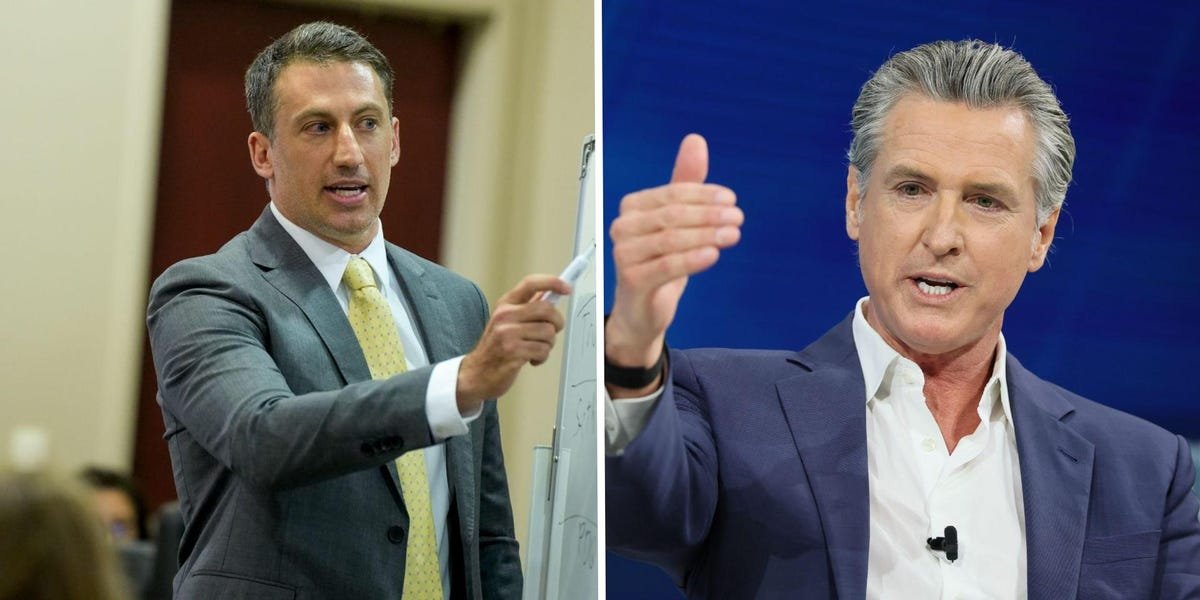
A proposed billionaire tax in California has the wealthy threatening to flee, according to a letter written by power lawyer Alex Spiro to Gov. Gavin Newsom.
In a December 11 letter that was obtained by Business Insider, Spiro lays out his opposition to the proposed tax on behalf of his clients, whom he calls “California residents who would be subject to the proposed Billionaire Tax Act.”
“It will trigger an exodus of capital and innovation from California,” Spiro wrote. “Our clients have made clear they will permanently relocate if subjected to this tax.”
The measure proposes that California residents with assets exceeding $1 billion be subject to a one-time 5% tax on the value of their assets. If the proposal receives enough signatures, it will appear on the state ballot in November 2026. If passed, it would apply retroactively to all California residents as of January 1, 2026.
While Newsom has said he is against the tax and would “fight” it, he would not have the ability to veto it if it were to pass as a ballot measure.
Several wealthy Californians, including venture capitalist Peter Thiel and Google cofounder Larry Page, have considered shrinking their presence in California, according to a New York Times report. Representatives for Page and Thiel did not respond to Business Insider when asked if they were represented by Spiro.
Over the weekend, billionaire Palmer Luckey took to X to voice his opposition to the measure.
“I made my money from my first company, paid hundreds of millions of dollars in taxes on it,” the Anduril cofounder wrote. “Now me and my cofounders have to somehow come up with billions of dollars in cash.”
While it’s not clear which clients the lawyer was referencing in his letter to Newsom, Spiro’s client roster in the past has included billionaires and A-listers. He has previously represented Kim Kardashian, Jay-Z, and Elon Musk.
Read the full letter below:
Re: Constitutional Concerns Regarding Proposed Billionaire Tax ActDear Governor Newsom:I represent California residents who would be subject to the proposed Billionaire Tax Act if it qualifies for the November 2026 ballot. I write to urge you to work to prevent this initiative from moving forward. The Act has serious legal problems and would cause significant economic damage to California and the broader economy.First, and most importantly, the Act would be unconstitutional. Although the Act purports to be a tax, it is in reality an uncompensated confiscation of property. The Act imposes a 5% levy on total accumulated wealth, including illiquid assets that generate no income. That is in substance a taking without just compensation. As the Supreme Court explained in Armstrong v. United States, the government cannot force “some people alone to bear public burdens which, in all fairness and justice, should be borne by the public as a whole.” 364 U.S. 40, 49 (1960). The Act concentrates an extraordinary burden on a small group to solve a general revenue problem— exactly what the Constitution prohibits.Second, for the people who relocate from California in 2026 before the November election, the Act would tax them after they have become citizens of other States and without any ability to vote on the measure. The Supreme Court has held that retroactive taxation cannot be “harsh and oppressive.” United States v. Carlton, 512 U.S. 26, 30 (1994). A 5% levy on total net worth imposed on former residents who departed before the law was even enacted clearly meets that definition.Third, the Act’s unprecedented novelty makes it especially vulnerable to a legal challenge. California has never imposed a wealth tax, much less one that reaches former residents and that is targeted at a small group of citizens. The Supreme Court closely scrutinizes unprecedented exercises of government power precisely because they lack historical precedent. See Biden v. Nebraska, 600 U.S. 477, 505 (2023). In fact, it has not hesitated to invalidate the retroactive application of new taxes, even for far less extreme measures. See Blodgett v. Holden, 275 U.S. 142 (1927). There can be no doubt that the current Supreme Court would carefully evaluate a law so out of step with the American legal tradition.From an economic perspective, the Act creates two serious problems. First, it will trigger an exodus of capital and innovation from California. Our clients have made clear they will permanently relocate if subjected to this tax. They are not alone. See California’s wealth-tax test: Have voters finally found a policy that the state’s inherent economic strengths can’t overcome?, Wash. Post (Nov. 17, 2025) (opinion) (describing the tax as “almost tailor-made to drive most Silicon Valley tech companies to Austin, Texas”). In other words, by passing this proposal California would exchange a one-time windfall for the permanent loss of billions in annual income taxes, capital gains taxes, property taxes, and economic activity. The state’s most economically productive residents would take their businesses, jobs, and charitable giving with them. Second, the Act will force destructive asset sales. Our clients hold equity stakes in operating businesses, venture capital funds, and real estate. Paying a 5% wealth tax would require massive forced liquidations, depressing asset values and triggering market instability that would harm ordinary investors whose retirement accounts hold these same investments.Our clients are prepared to mount a vigorous constitutional challenge if this measure advances. Litigation would be protracted and expensive, and it would generate sustained negative attention to California’s business climate. The prudent course is to prevent this constitutionally defective measure from reaching the ballot. We respectfully ask that you discourage signature gathering, oppose qualification, and if necessary, campaign against passage.Our clients prefer to remain in California and continue contributing to the state’s economy and civic life. But they will not remain if subjected to an unconstitutional confiscation of their wealth. We hope this can be resolved through political channels rather than through years of contentious litigation.Respectfully,Alex Spiro