
Ive-spent-years-living-far-from-my-older-brother-A.jpeg

I’ve spent years living far from my older brother. A 4-day trek in South America put me in the lead for once.

My older brother, Fergus, and I have spent most of our adult lives chasing the same thing — just never in the same place at the same time.

We’re both adventurous, but our lives have unfolded on different continents since 2009. That was the year he left home. I was still in high school.

He spent his 20s traveling around the world. And in 2016, when I was 25 and working as an editor in Toronto, he moved to Australia.

Two years later, when he moved back to Canada, I was the one who’d caught the travel bug. We were only in the same place for a few days before I left for Colombia.

I’ve been living in South America ever since.

Sibling adventure in South America

In January, Fergus visited me in Ecuador, where I’ve been living for eight years. To catch up properly, I planned a multi-day trek through sleepy mountain towns.

Walking for days through remote landscapes felt like the best way to make up for lost time.

We started in a small farming town about two hours outside Quito. With backpacks and a few changes of clothes, we set out along a dirt road tracing green mountains through farmland. Over 26 miles, we passed rows of peaks, clay brick homes, and a river carved into a deep gorge.

With no signal and no one around, we talked about everything: his winter plans, my writing, our younger brother’s upcoming wedding, and memories from camping trips we’d nearly forgotten.

At the river, we sat on rocks and drank beers we’d picked up before leaving town. Cows mooed faintly in the distance. “I’m so glad you finally made it,” I told him.


A man reading signs in Spanish during a hike in Ecuador.

The siblings caught up and celebrated a missed birthday. 

Provided by Sinead Mulhern


Belated celebration

It felt like a celebration six months late. Fergus had turned 40 in July, and living abroad, I’ve missed plenty of milestones. I booked a cabin along the route — a belated birthday gift, complete with a spa and traditional Ecuadorian food.

We stayed close over the years, despite the distance. Out of four siblings, we’re the most alike — athletic, adventurous, drawn to the same kinds of places. As a kid, I stole his CDs; he shaped my taste in music.

Now we both live unconventional lives: me as a freelance writer in Ecuador, him as a tree planter in western Canada.

Still, his 10 days in Ecuador were the most time we’d spent together as adults. A four-day trek through remote terrain could have been a gamble, but I knew he’d be in. No questions asked.


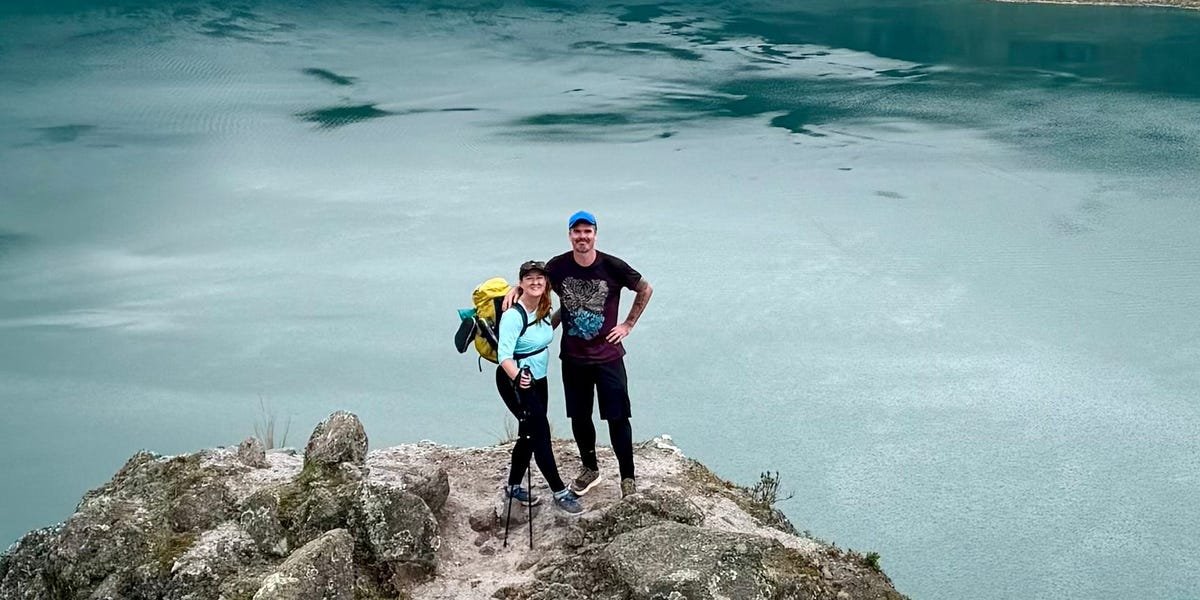
Brother and sister on a trek in South America.

The siblings caught up during the four-day trek. 

Provided by Sinead Mulhern


Witnessing his wanderlust inspired mine

Toward the end of our trip, we reached a tiny town — a church, a few dogs, a handful of homes. It was late afternoon, I was hungry and ready to stop when Fergus pushed ahead, scrambling up a steep gorge and insisting the top was “just a few minutes” away.

Sweating and irritated, I followed. Midway up this impossible-angled gorge, I checked my frustration, recognizing that I had been doing the same to hiking buddies over the past few years. And also, this trek was my idea, and I knew who I was doing it with.

Later, by a turquoise lagoon, I looked at him and saw not just the brother who packed my lunches and drove me to piano lessons, but someone I’ll rely on for decades.

When it was time to leave, our bus to Quito never came. Instead, we hitched a ride, climbing into the back of a moving truck after getting directions from other trekkers.

“Get in,” I told him, quickly translating the driver’s words from Spanish. For once, I was leading.



Source link

Kelsey Baker, Military and Defense Reporting Fellow

Defense secretary says Scouts America must end ‘woke’ merit badges

The Pentagon is pulling back on plans to cut ties with Scouting America, as long as the nonprofit organization adopts policies that echo new military directives, including eliminating diversity, equity, and inclusion programs and banning transgender youth from the Scouts.

In a video posted to X Friday, Secretary of Defense Pete Hegseth said he had been “very seriously considering” cutting all military support to the organization, citing what he described as its failure to comply with President Donald Trump’s executive order aimed at ending “illegal discrimination and restoring merit-based opportunity.”

The move is part of a growing Pentagon campaign to pressure private institutions like AI giant Anthropic, journalists who cover the US military and universities attended by troops to accept the Trump administration’s policies and preferences. The move put the defense secretary in the position of telling a private youth organization who can join and what their application asks, and doing so amid a tense build-up in the Middle East that could see the US striking Iran within days or hours.

Military support for Scouts has traditionally included logistics to the group’s National Jamboree event (which is also a significant military recruiting event) and hosting of Scouts aboard military bases.

The Pentagon is essentially enforcing Trump’s executive order, applicable to government agencies, onto private institutions, said Dan Maurer, a retired Army lieutenant colonel and associate law professor at Ohio Northern University.

“The fact that they’re capitulating at all is a little weird to me, because they can withstand the loss of the connection, frankly,” Maurer, a former Eagle Scout, said of Scouting America, expressing astonishment that the defense secretary personally focused on this. “His attention could be focused on other things.”

Scout leaders agreed to “review and replace politicized, divisive, and discriminatory language throughout the organization,” Hegseth said in the video, adding, “no more DEI. Zero.”

Merit badges that “mask” DEI “activism” have been “discontinued,” he said, and a new military service badge will be added, in partnership with the Pentagon.

A spokesperson for the Defense Department did not immediately respond to a request for comment late Friday.


Soldiers took part in the 2023 National Jamboree held in West Virginia.

Soldiers took part in the 2023 National Jamboree held in West Virginia.

Edwin L. Wriston/West Virginia National Guard


Scout participants will only be allowed to join based on their birth sex, which may amount to a ban on transgender youth.

“That means that the application, any application, will have only two sex designations, male and female, and the application must match the applicant’s birth certificate,” the defense secretary said.

It is not clear how many Scouts would be personally affected by such a shift, and it remains to be seen how families will feel about the Pentagon’s involvement in setting terms of their organization.

Hegseth said he believed Scouting should return to being a boy-only group, but added that such a change is not imminent.

In November, an NPR report revealed the Pentagon was weighing whether to sever ties with the organization. As many as 16% of recent cadets at the US Military Academy have scouting in their backgrounds, a percentage that rivaled that of students from high school JROTC programs and reflected the Scouts’ deep military ties. Many cadets were also Eagle Scouts.

Beginning in 2012, “the Boy Scouts lost their way,” Hegseth said in the Friday post. “A once great organization became gravely wounded. Diversity, equity and inclusion, DEI, crept in. The name was changed to ‘Scouting America.’ Girls were accepted. The focus on God as the ruler of the universe was watered down to include openness to humanism and Earth centered pagan religions.”

“They even welcomed the destructive myth of gender fluidity and transgenderism to infiltrate their membership. Along the way, standards were lowered and merit destroyed in favor of an insidious, radical woke ideology that is anti-America and anti-American.”

The Scouts said they had made changes to comply with the Trump administration’s policies after months of discussion.

“Scouting America is proud to uphold our longstanding commitment to military families across the globe through a renewed, strengthened partnership with the Department of War,” Scouting America said in a statement to Business Insider, referring to the Trump administration’s unofficial name for the Defense Department that Congress has not approved.

“Over several months, we engaged in dialogue with Department leadership to align on how we could deepen our service to military families, while making programmatic updates to comply with Executive Order 14173.”

Hegseth did not specify what policy changes he was referring to in 2012, though in 2013 openly gay youth were allowed to join.

The Boy Scouts adopted changes to address declining participation that was caused, in part, by thousands of decades-old child sexual abuse cases finally made public in 2012, said David Chetlain, a Navy veteran and former Boy Scout, who expressed concern about the Pentagon’s pressure campaign.

The so-called ‘perversion files’ eventually contributed to Scouting America filing for bankruptcy in 2020. Opening ranks to a more diverse array of participants was part of the group’s attempt to maintain relevance and cleanse its reputation, Chetlain said.

Various religious merit awards have been around for decades, he added, and reflect the diversity of the group, which has foreign members across the world. Two Japanese exchange scouts were in his own troop, he said, recalling his time as a young Scout in the 1970s and 1980s, and as an occasional leader since then.

“It’s always been multicultural. It’s always been agnostic to religion or accepting of all religions,” said Chetlain, though he noted that Scouts previously barred atheists for decades. “Even as a kid, I loved that inclusivity and having a place where everybody belonged and we were all accepted. And it was a safe place for me.”


Source link

After-living-in-South-America-for-7-years-theres-just.jpeg

After living in South America for 7 years, there’s just one region I always recommend to first-time visitors

In 2018, I moved to Ecuador for a “short time,” only to find myself captivated. I stayed for over seven years.

During my time in Ecuador, I was lucky enough to travel across the country, and though I was awed by the lush life in the Amazon rainforest, wowed by the coast, and truly amazed by the famous Galápagos Islands, the part that really captured my heart was the Andean Highlands.

One of the most impressive mountain ranges in the world passes through Ecuador. The Andes Cordillera is full of incredible sights, unique ecosystems, and unforgettable experiences. I believe there’s something here for everyone, from vibrant cities to towering volcanic peaks.

When making their itinerary for a trip to Ecuador, many people carve out most of their time for the jungles and the coast, and though these are great destinations, people are (literally) skipping over a real jewel: the Highlands.

Quito is so much more than a stopover city


Colorful buildings in Quito's historic center.

It’s easy to spend several days exploring Quito.

AscentXmedia/Getty Images


Ecuador’s capital city, located in the Highlands, is home to many beautiful parks and sights, museums and galleries, and world-class restaurants and artisanal breweries.

With elaborate churches, colonial architecture, and plenty of restaurants with stellar views, it’s easy to spend a few days exploring.

I love driving to The Panecillo, a small mountain topped with a massive Virgin Mary statue, which offers gorgeous views of the historic center below.

I also recommend visiting at night to enjoy the sprawling city lights while drinking a traditional canelazo, a hot beverage made with naranjilla fruit and cinnamon.

On top of all that, Quito has a rich history. You can learn all about it at its historical center, which just so happens to be one of the first UNESCO World Heritage sites.

There are also other great towns and cities to visit in the region

Quito might be the largest city in the region, but there are tons of other places worth exploring, too.

A few of my favorites are Otavalo, Papallacta, and Baños de Agua Santa. Otavalo is only two hours north of Quito, and is known for its colorful markets and scenic landscapes. There is also plenty of great traditional food to be found here — make sure you try a locro de papa, an amazing cheese-and-potato soup.

Papallacta, just an hour from Quito or from the airport, is a smaller town, but one that’s famous for its wonderful hot springs nestled among lush mountain tops. The public hot springs have many pools for relaxing, as well as cold plunges.

Baños is around four hours south of Quito, on the border where the Andes start to turn into the Amazon. I find this town to have the perfect mix of access to nature and adventure, lovely hotels and restaurants, and nightlife.

If you love the outdoors, this region is a must-visit


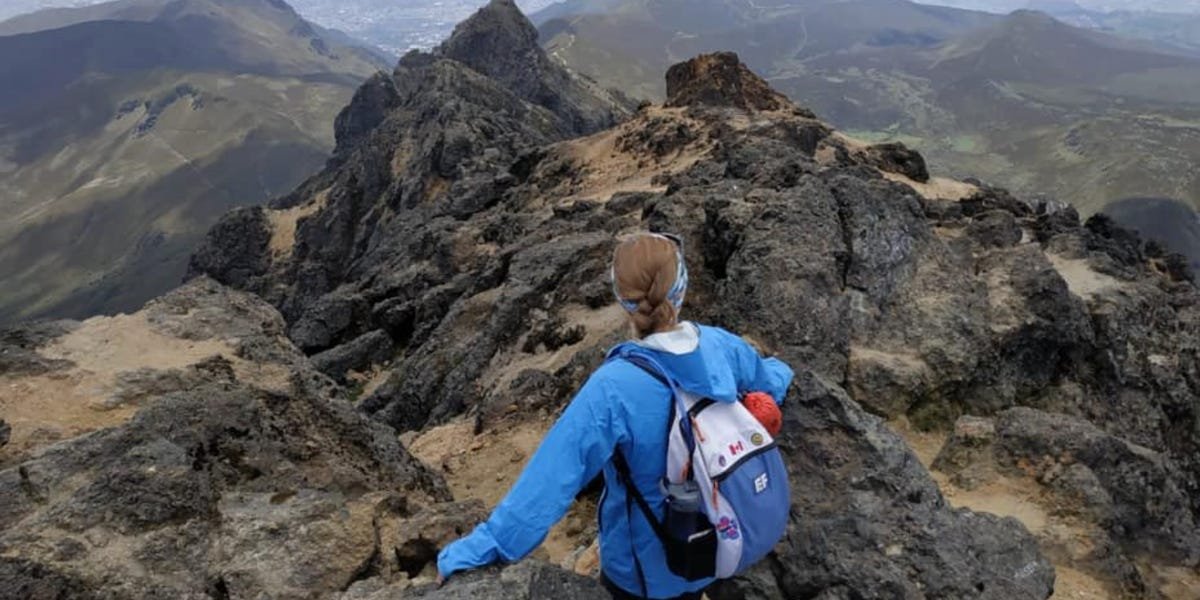
The writer posing on a cloudy hike in the Ecuador Highlands.

The hiking here is unlike anywhere else.

Kirstynn Joseph


For those who, like me, enjoy spending time in nature, the scenic route here is even more special. With most hikes even starting at heights of over 9,000 feet above sea level, the mountains — many of them volcanoes — still tower over you.

Rugged rocks and gleaming glaciers dominate the peaks; you’ll spot lots of bright green cushion plants and fields of golden grasses swaying in the winds. Bright-orange chuquiragua plants, found only at these high altitudes, dot the landscape.

One of my favorite hikes is Rucu Pichincha. After riding the Telefériqo cable car to the base camp — which has an incredible view of Quito, a lovely café, and many great spots for photo ops — you can begin to hike up the trail.

Here, you will experience the biodiverse páramo ecosystem and finish at more than 15,000 feet above sea level.

Elsewhere, in different directions but all within a few hours of Quito, the Antisana, Cayambe, and Cotopaxi volcanoes are sky-high with towering peaks covered by glistening glaciers that not even the equatorial sun can melt.


The view of turquoise water from a Quilotoa hike.

The Quilotoa crater lake is a must-visit.

Kirstynn Joseph


Last but not least, Quilotoa volcano, which is in the same province as Cotopaxi and just a bit further away, holds a turquoise crater lake where you can kayak — one of my absolute favorite things I’ve done here.

I may be biased, but I believe this region is one of the most underrated places in the world. If you find yourself in South America, it is absolutely worth it to set some time aside to get to know the Andes and everything they have to offer.

Just be careful on your journey there — you, too, may also find yourself staying just a bit longer than you planned.


Source link

callie ahlgrim headshot 2023

Bad Bunny didn’t need to sing in English at the Super Bowl to make a statement about America

When Bad Bunny took the field at the 2026 Super Bowl for a historic, joyful halftime show, he wore a jersey with his Latino heritage stitched into its very fabric.

It’s an apt metaphor for his performance, which eschewed explicit anti-ICE statements (he covered that at the Grammys, anyway) in favor of celebration with a side of symbolism.

Nods to the Puerto Rican singer’s motherland were peppered throughout the set, which was designed to evoke the US territory’s signature aesthetics, from sugar cane fields to a storefront labeled “La Marqueta” (a slang term for market) and various vendors selling tacos and piraguas (shaved ice). While performing “El Apagón,” a song about the frequent blackouts and infrastructure issues affecting Puerto Ricans, Bad Bunny brought this symbolism to the forefront, waving the Puerto Rican flag.

He also proclaimed in English, “God bless America,” and brandished a football printed with the phrase “Together, We Are America.” He added in Spanish, “We’re still here.” (Puerto Rico is a US territory, and Puerto Ricans are American citizens.)

It was a stark and knowing contrast to the Latinophobia and anti-immigrant messaging hawked by the Trump administration. So much so that President Donald Trump complained online about Bad Bunny’s performance and his choice to sing primarily in Spanish.

“The Super Bowl Halftime Show is absolutely terrible, one of the worst, EVER! It makes no sense,” Trump wrote on Truth Social after Bad Bunny left the stage. “Nobody understands a word this guy is saying.”

For those who understand visual storytelling, however, Bad Bunny’s performance made perfect sense. He didn’t need to say “ICE out” or declare an explicit political opinion. In keeping with the recent tradition of Super Bowl halftime shows, Bad Bunny used iconography to take a stand instead.

Bad Bunny’s Super Bowl performance is part of a new halftime show tradition

Bad Bunny’s performance shares DNA with Beyoncé and Kendrick Lamar’s Super Bowl appearances, both of which used bold imagery to make strong statements.

Beyoncé’s surprise appearance at Coldplay’s 2016 Super Bowl halftime show became famous — and, to some, infamous — for the iconography present in her performance of her then-new single, “Formation.” In the midst of Trump’s first presidential campaign, Beyoncé and her backup dancers wore outfits that channeled the Black Panther Party, an organization formed amid the ’60s Civil Rights Movement that fought for Black liberation.


Beyoncé performs at the 2016 Super Bowl.

Beyoncé performs at the 2016 Super Bowl.

Robert Beck/Sports Illustrated via Getty Images


The song itself isn’t explicitly political. But as a celebration of identity and legacy that features lyrics about Beyoncé’s parents, her daughter, and her features (“I like my negro nose with Jackson 5 nostrils”), Beyoncé performing it — with visual references to the song’s themes in her and her dancers’ costumes, to boot — was innately political.

It’s not that Beyoncé is allergic to making explicit political statements: She famously performed in front of the word “Feminist” at the 2014 VMAs, and sang “Votin’ out 45, don’t get out of line” on her 2022 album “Renaissance,” referring to Trump as the 45th president. But when the NFL hosts musicians for the night, they’ve lately preferred make their statements symbolic rather than overt.

Last year, Kendrick Lamar followed suit during his own Super Bowl halftime show, outfitting himself and his dancers in red, white, and blue. Although Lamar kept the music focused on his own enemies and triumphs, he used audacious visual language to pose broader, poignantly relevant questions: Who’s allowed to claim patriotism? What does it mean to be an American, especially in times of oppression and conflict?

Bad Bunny’s performance raised similar questions, but offered simpler, more optimistic solutions. For the finale, he was surrounded by backup dancers, band members, and other performers holding flags from around the world; when he proclaimed “God bless America,” he listed out all the countries in both North and South America.

Bad Bunny is not a politician, nor can he single-handedly cure the world of hatred and division. Still, for a brief moment, on a small square of American turf, he chose to use the stage to show millions of people what that could look like.


Source link

EV-sales-are-up-everywhere-in-the-world-—-except.jpeg

EV sales are up everywhere in the world — except North America

The most valuable EV company in the world is based in the US, but Americans are buying fewer battery-powered vehicles.

EV sales in North America fell 1% this year compared to 2024, according to data from supply chain data firm Benchmark Mineral Intelligence. The dip comes as the US has faced a combination of policy changes, tariffs, and supply chain upheavals this year.

There were 1.7 million EVs sold in North America between January and November — far behind the 11.6 million sold in China and below the 3.8 million sold in Europe.

US automaker execs have been sounding the alarm bells on sales. In September, Ford CEO Jim Farley predicted that the EV market share in the US would nearly halve to around 5% in the near term.

Benchmark Mineral Intelligence cited the $7,500 EV tax credit ending in September as a reason for “subdued” sales in the US, along with the Trump administration relaxing rules for automakers designed to encourage the transition to EVs and hybrids.

Elon Musk’s Tesla has had a rocky year in almost all of its biggest markets, but it weathered the October drop-off better than its rivals, according to separate data from Cox Automotive. The world’s most valuable car company, however, is facing a race against time to avoid a second consecutive year of declining sales.

Other US EV makers have been hit by slowing demand, with GM and Rivian both announcing layoffs in recent months.

China’s overall EV sales were up 19%. While BYD, the country’s biggest EV maker, hit a rough patch in its home market amid rising competition from local startups, it set a record for EV exports in October.

Globally, EV sales were up 21% compared to last year, the Benchmark Mineral Intelligence data showed.

“Overall, EV demand remains resilient, supported by expanding model ranges and sustained policy incentives worldwide,” said Charles Lester, data manager for Rho Motion, the Benchmark subsidiary behind the report.


Source link