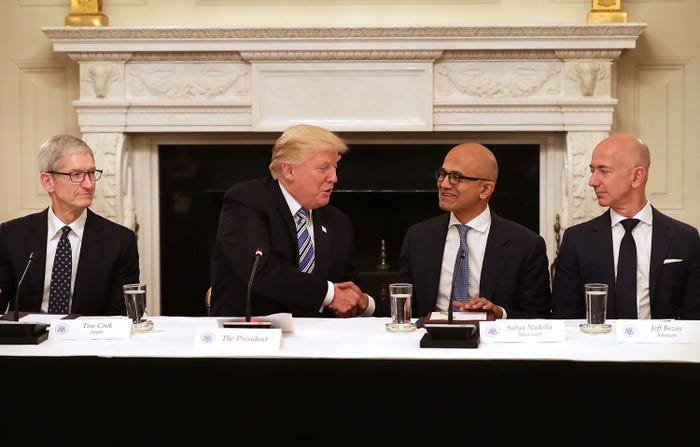
President Donald Trump speaks during an American Technology Council roundtable in the State Dinning Room at the White House in Washington, DC on Monday, June 19, 2017. From left, Tim Cook, Chief Executive Officer of Apple, Trump, Satya Nadella, Chief Executive Officer of Microsoft, and Jeff Bezos, Chief Executive Officer of Amazon. (Photo by Jabin Botsford/The Washington Post via Getty Images)

Trump says that Microsoft will ‘ensure’ Americans don’t ‘pick up the tab’ for its data center power consumption


Chip Somodevilla/Getty Images

  • President Donald Trump asks tech companies to “pay their own way” for their data centers.
  • Data centers drove up utility bills in at least 13 states, Business Insider previously reported.
  • Trump says that Microsoft will be the first to work with the White House to keep utility bills down.

President Donald Trump said on Monday that even though data centers are “key” to the AI boom, tech companies must “‘pay their own way,'” so that Americans don’t have higher utility bills.

“First up is Microsoft, who my team has been working with, and which will make major changes beginning this week to ensure that Americans don’t ‘pick up the tab’ for their POWER consumption, in the form of paying higher Utility bills,” Trump said on Truth Social, hinting at additional announcements “in the coming weeks.”

Data centers drove up utility bills in at least 13 states, Business Insider previously reported.

Over the past year, Microsoft has been planning for data centers in Wisconsin, Atlanta, Texas, and Michigan.

The White House and Microsoft did not immediately respond to a request for comment.

This is a developing story; check back for updates.


Source link

Americans-are-living-in-a-career-industrial-complex-Venture-capitalist.jpeg

Americans are living in a ‘career industrial complex.’ Venture capitalist Bill Gurley explains how to break out and find your dream job.

A top Silicon Valley investor has an antidote for “quiet quitting.”

Bill Gurley is a general partner at venture capitalist firm Benchmark and the author of “Runnin’ Down a Dream, How to Thrive in a Career You Actually Love.” Gurley told Neal Freyman and Toby Howell on the “Morning Brew Daily” podcast that aired on Sunday that it is “horrific” how some people are actively disengaged at work, but the heart of the matter is that people “aren’t ending up in the right place.”

“We developed this mindset where you push kids toward economic safety — doctors, lawyers, jobs where unemployment is low, and salaries are high,” said Gurley. “But we’ve pushed a lot of kids into what I call the ‘career industrial complex.'”

Gurley said that the “career industrial complex” means pushing children toward a “résumé arms race” of standardization and credential accumulation, rather than encouraging curiosity and exploration.

A simple test as to whether you would be successful in your dream job, said Gurley, is whether you would be willing to learn on your own time.

“I like to say, you know, if you have three episodes of Breaking Bad left, would you study this instead?” said Gurley. “Like, does it compete with what you do in your free time?”

Gurley added that he once did a survey where he asked 10,000 people if they would choose a different career if given the chance to go back in time, and 60% said yes.

Gurley’s comments came as workplace trends such as “job hugging” and “quiet cracking” emerged in 2025.

While workers feared layoffs and the prospects of landing new roles dimmed for many young professionals.

A Gallup poll done in 2024 found that employee engagement in the US fell to its lowest level in a decade, with only 31% of employees feeling engaged. Additionally, workers under the age of 35 are less engaged compared to other age groups.


Source link

Read-Bari-Weiss-new-memo-that-defends-pulling-a-60.jpeg

Read Bari Weiss’ new memo that defends pulling a ’60 Minutes’ segment and says Americans lack trust in the press

  • CBS News chief Bari Weiss sent a memo to staff defending her decision to hold a “60 Minutes” piece.
  • Weiss made the decision to pull a segment on the CECOT prison shortly before it was due to air.
  • She said winning back public trust in the news sometimes means holding stories.

CBS News head Bari Weiss sent a Christmas memo to staff on Wednesday defending her decision to pull a “60 Minutes” segment on the Trump administration’s use of El Salvador’s notorious CECOT prison.

In the memo, signed by Weiss and other CBS News leadership, she wrote that the press needed to win back the public’s trust, and that “sometimes it means holding a piece about an important subject to make sure it is comprehensive and fair.”

“Right now, the majority of Americans say they do not trust the press,” she wrote. “It isn’t because they’re crazy.”

Weiss’ decision to hold the “60 Minutes” shortly before it aired led to blowback both inside and outside CBS News, which is owned by Paramount Skydance. Sharyn Alfonsi, who reported the segment, wrote in note to colleagues that the decision was a “political one,” multiple outlets reported.

Weiss said in her memo that she and other CBS News leaders are “not out to score points with one side of the political spectrum or to win followers on social media.”

The media world has heavily scrutinized Weiss’ management since she was installed atop CBS News by Paramount CEO David Ellison in October. Paramount also acquired The Free Press, the conservative-friendly news site Weiss founded after leaving The New York Times’ opinion section, for about $150 million.

Paramount is dueling with Netflix to buy Warner Bros. Discovery. President Donald Trump has said he would be involved in the regulatory review process.

Weiss added in the memo that CBS News would hold itself to a high standard of fairness and be independent.

Here’s the full text of the memo:

Hi all,
Right now, the majority of Americans say they do not trust the press. It isn’t because they’re crazy.
To win back their trust, we have to work hard. Sometimes that means doing more legwork. Sometimes it means telling unexpected stories. Sometimes it means training our attention on topics that have been overlooked or misconstrued. And sometimes it means holding a piece about an important subject to make sure it is comprehensive and fair.
In our upside-down moment, this may seem radical. Such editorial decisions can cause a firestorm, particularly on a slow news week. And the standards for fairness we are holding ourselves to, particularly on contentious subjects, will surely feel controversial to those used to doing things one way. But to fulfill our mission, it’s necessary.
No amount of outrage—whether from activist organizations or the White House—will derail us. We are not out to score points with one side of the political spectrum or to win followers on social media. We are out to inform the American public and to get the story right.
Restoring the integrity of the news is a difficult task. We can’t think of a more important one.
Merry Christmas—and thank you, especially, to everyone who is working over this holiday.
Yours,
Bari
Tom
Charles
Adam


Source link

Bull

Median household wealth for Black Americans is projected to hit $0 by 2053. My estate plan is designed to protect me from that.

  • I’m working hard to build wealth, and I want to make sure it lasts forever.
  • My estate plan is designed to maintain my assets and ensure I don’t leave any surprise debt behind.
  • This article is part of “My Financial Life,” a series helping people live and spend better.

Estate planning is a fancy way of saying you’re planning for the future — a time when you’ll be unable to manage your health and wealth.

Many people focus on financial planning, but not as many think about the broader picture. However, the process doesn’t need to be complicated — it’s a matter of creating legal documents appointing people to speak and act for you.

I’m an estate-planning attorney, and I’ve seen how important this process is and where some people’s plans fall short.

I want to continue helping others after I’m physically unable to do so. A 2017 study by the Institute for Policy Studies looking at long-term projections for the racial wealth gap found that median Black household wealth could reach zero by 2053. That means my long-term goals need to factor into my estate plan to secure generational wealth.

I want to thrive today and help my future beneficiaries avoid conflicts, excessive taxes, financial burdens, and disputes that could cost time and money.

My financial plan and my estate are intertwined

I considered several questions about my estate when deciding on my financial goals:

  1. When I reflect on the wealth I have — and the wealth I’m building — what do I want done with it when I die?
  2. Who is or will be capable of managing my assets?
  3. What will happen to my digital legacy — my online accounts, digital files, pictures, and investments?
  4. What tax consequences will my choices have now and in the future?
  5. How will I keep my estate plan and financial plan updated as my life changes?

My estate plan consists of a financial power of attorney, an advance directive, a guardian nomination, a will, and a trust. As an estate-planning attorney, I frequently encounter families who created a trust but didn’t understand how it works and don’t have a plan for its upkeep.

My estate plan is designed to support all the assets I leave behind and ensure the financial moves I’m making now stay on track. For example, if I buy a house, I have to make sure there’s a plan so my trust (and the trustees I leave in charge) can continue paying for the house. I’m accounting for a mortgage, maintenance and remodeling costs, and property taxes. In one case I saw property taxes go from $3,000 to $11,000 a year following a property transfer.

I want to minimize the debt my trust will have to pay off

If your estate plan is set up correctly, some debts cannot be collected after death. I’ve chosen to save, invest, and pay down debts to minimize the bills my estate and trust would be responsible for. Considering my estate plan early in life will help me figure out which debts I should pay off first.

When it comes to my plans, the most important part is educating the people around me about my moves and my wishes. It’s easy for your plan to fail when the people you leave in charge don’t know what to do or how to do it. Having financial conversations and being transparent is the best way to ensure my financial and estate plans remain on track.

My goal is to create a comprehensive financial road map that will address my current needs and future aspirations. I’ve thought about my financial stability at every stage of life. I’ve found it helps to think about your long-term goals and values first. Then you can ask yourself the big questions — the who, what, why, and how — and get the ball rolling.



Source link