Oil prices have surged after fresh conflict in the Middle East raised fears of supply disruptions through the Strait of Hormuz — a move that would normally be a windfall for Russia.
But this time, it may not be enough, according to an analyst.
“The current temporary spike, filtered through sanctions discounts and an unfavorable exchange rate, is unlikely to change the fundamental arithmetic,” wrote Alexander Kolyandr, a senior fellow at the Center for European Policy Analysis, in a Wednesday post.
International benchmark Brent crude and US West Texas Intermediate were more than 3% higher, trading around $84 and $77.50 per barrel respectively late on Wednesday. Both grades are around 35% higher this year.
Russia is one of the world’s largest energy exporters, and its federal budget — and by extension President Vladimir Putin’s war in Ukraine — relies heavily on oil and gas revenue.
Every time Huileng publishes a story, you’ll get an alert straight to your inbox!
Stay connected to Huileng and get more of their work as it publishes.
Yet Moscow does not receive international benchmark prices for its crude. Its Urals oil trades at a sanctions-driven discount, and the strong ruble means each dollar of oil revenue converts into fewer rubles for the budget.
As a result, Brent above $80 does not automatically deliver the revenue Russia needs.
Oil and gas revenues plunged 50% in January from a year earlier, falling to levels last seen during the pandemic shock in 2020. Meanwhile, the federal budget ran a deficit of 1.72 trillion rubles — about 0.7% of GDP, according to Russian Finance Ministry data.
“Unless oil prices stay higher for longer and the ruble weakens significantly, the Kremlin’s budget problems are here to stay,” Kolyandr wrote.
Kolyandr’s analysis comes as investors weigh whether the latest Middle East escalation will trigger a sustained oil shock, particularly for Asian countries that are reliant on heavily reliant on Middle Eastern energy.
China and India — now two of the biggest buyers of Russian crude — still source a large share of their oil from the Middle East, leaving both exposed to disruptions in the Strait of Hormuz.
Any prolonged disruption in the Strait of Hormuz could shift trade flows, potentially increasing scrutiny on whether Asian importers turn further to discounted Russian oil.
Markets have been volatile following the US and Israeli attacks on Iran over the weekend. On Wednesday, stocks in Asia slumped on energy security fears before rebounding on Thursday.
This as-told-to essay is based on a conversation with Ivan Ureña-Valdes, who has worked at Block for nearly four years as a data analyst. It has been edited for length and clarity.
When I got an email from Jack Dorsey, I was in the middle of interviewing someone for a role at Block.
It was pretty strange because, in the past, with layoffs, I knew people had their access cut almost immediately.
A coworker messaged me: “Hey, are you okay?” My heart started racing. I knew from that message it meant that I was probably getting laid off.
I felt really bad because I was in the middle of interviewing someone. I had to tell them, “I was actually just let go from the company. I probably won’t be able to submit your feedback in time. Please reach out to your recruiter.”
Every time Lee Chong Ming publishes a story, you’ll get an alert straight to your inbox!
Stay connected to Lee Chong Ming and get more of their work as it publishes.
I’m the sole provider for my family. It was tough.
I had a hunch that AI would lead to cuts at some point
We knew there were many performance cuts happening around right now, and those have largely finished. I had no idea this cut was coming.
For 4,000-plus people to be cut without anybody knowing, that tells me decisions were made very high up.
I’ve survived three rounds of layoffs, some companywide, some engineering organization-wide. I knew I wasn’t being let go for performance-related reasons. I was in the middle of working on two large projects, probably the largest projects I’d worked on since joining the company.
I had a hunch that, at some point, the company would cut people because of AI. I just didn’t think it would be right now.
Working at Block, I saw how AI was automating tasks away
I appreciate Jack for his honesty. It’s much fairer of him to come straight out and say why it happened — that it’s because of AI and the vision he sees.
I’m honestly grateful for the generous severance and benefits. It definitely helps make the rough situation a bit easier.
I’ve felt the rumblings of AI disruption for a while now, especially since Anthropic launched Opus 4.5 late last year.
Jack loves AI and was constantly pushing us to use it. I got to use these tools as much as possible every single day.
I could see in my own work very quickly how much of it was already being automated. So much of the data analyst world is finding the right dataset, writing something that will allow you to pull the data set that you want, and then generating output. Every single one of those steps is significantly faster and easier because of AI.
It was definitely a “whoa” moment when I realized just how powerful things had gotten.
AI will continue to replace jobs
I 100% think that more disruption and more of these types of cuts will probably come at other companies, which is unfortunate.
I’m much more pessimistic about all of it than many other people probably are.
Given that we live in the US, where growth is everything, it’s inevitable that AI will continue to replace people wherever it’s financially beneficial to do so.
I’m optimistic that I can find a job in the general data field, whether it’s something I’m extremely passionate about or pays as much as I did before. It will be difficult to find something that matches the environment I was working in because I had developed really strong ties with my coworkers. The pay was fair within the data analytics or business intelligence world, and the role was remote.
There are incredible companies out there doing great work, though I am nervous about the industry as a whole and the competitiveness as I search for that perfect next role. Some people are getting really, really high salaries at AI companies, while tons of people at Block are getting laid off.
Do you have a story to share about tech layoffs? Contact this reporter at cmlee@businessinsider.com or on Signal at cmlee.81.
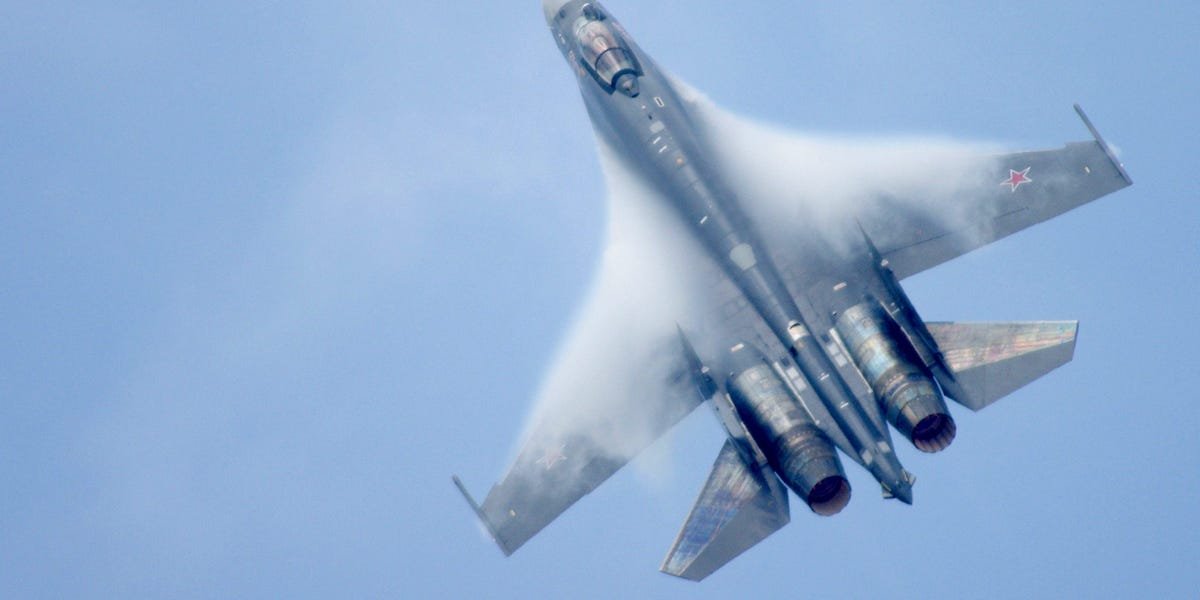
Russia’s Su-35 fighter jets are increasingly flying with longer-range air-to-air missiles that make them a potentially greater threat to NATO air operations, a leading airpower expert assessed in a recent report.
Justin Bronk, a researcher at the UK-based Royal United Services Institute, said in his assessment of Russian air power that regularly arming Su-35 and Su-30SM2 jets with R-37M missiles “has significantly contributed to increasing the threat that they can theoretically pose to NATO air operations.”
The R-37M missile, which NATO calls the RS-AA-13, is “much more capable at long range” than the R-77-1 missiles the Su-35 had previously relied on, Bronk told Business Insider in a discussion of his recent report.
R-77-1 missiles have a range of about 62 miles, while R-37M missiles are understood to have a range of around 200 miles. Real-world kills at range depend on a mix of factors, but reach still matters.
Bronk told Business Insider that the longer-range R-37M missiles had been “very much a specialist weapon” for a limited selection of Russian jets. But “now you see absolutely routine employment” of the weapon on Russia’s Su-35S.
The Su-35 fighter is “the primary air superiority aircraft for the Russians,” he added. The jet is key for Russia’s air force, with the UK Ministry of Defence in 2023 describing it as Russia’s “most advanced combat jet in widespread service.”
Bronk told Business Insider that for the NATO alliance, the regular arming of Su-35s and Su-30SM2s with the R-37M is “a problem” because it puts “more credible long-range air-to-air missiles at play from the Russian side.”
Those missiles used to be contained within a smaller part of the force, mainlyRussia’s MiG-31s. Now, Bronk said, having them on more jets “is obviously a significant growth in the potential threat that they can pose to NATO aircraft in a direct conflict.”
The R-37M was previously concentrated on Russia’s MiG-31 jets.
Mikhail Svetlov/Getty Images
Additionally, he said, Russia’s Su-35 crews are “generally more highly selected, better trained, more capable than the crews on the MiG-31s.” Russia’s better pilots tend to fly its top jets, and those will be the pilots operating these missiles.
Having them routinely carry long-range air-to-air missiles, rather than the “really pretty limited” R77-1 that they used to carry, Bronk said, “is a significant shift.”
A missile with a longer reach
The R-37M’s combat effectiveness has been spotlighted by Russia’s full-scale invasion of Ukraine, which began in February 2022.
Late that year, a RUSI report said the R-37M, combined with Russia’s MiG-31BM interceptor aircraft, was proving to be “highly effective and difficult for Ukrainian pilots to evade due to its speed, very long range, and specialized seeker for low-altitude targets.”
At that time, it said Russia was just starting to put them on Su-35S jets.
A newer report from RUSI in November highlighted how much more the R-37M missile was being used, saying that this missile “in particular, has been used to destroy several Ukrainian aircraft at long range,” including one kill recorded at more than 109 miles.
“This is significantly beyond the engagement range of most NATO air-to-air munitions,” the report said. But it also said that the missiles’ success was “heavily determined by Ukraine’s lack of effective radar warning receivers,” something NATO has fielded far more robustly across its air forces.
The Su-35 threat
Making the Su-35 more powerful is a big move for Russia. In 2022, analysts at the RAND Corporation described the Su-35 as Russia’s “signature heavy fighter.”
Ukraine has shot down multiple Su-35s in its fight against Russia’s invasion, but Bronk said that despite reported losses, the fleet has “marginally increased since the start of the full-scale war.”
He estimated that in late 2020, Russia had about 90 Su-35s. Between eight and 10 have been lost in combat or accidents, he said, but 55 to 60 new aircraft have since been delivered — leaving Russia with roughly 135 to 140 Su-35s overall, a net increase despite the attrition.
Bronk’s analysis was based on interviews with Western air forces and ministries, data from Ukraine’s armed forces, and open-source information.
He said that the Russian air force has gained so much valuable combat experience against Ukraine that its air force is now “a significantly more capable potential threat for Western air forces than it was in 2022.”
He said that in air-to-air combat, where Russian aircraft take on Western ones, the West still has a strong advantage, but longer-range air-to-air missiles complicate the picture.
And any fight would not only be in the air. The West would face not only Russia’s air force but also its vast ground-based air defense network, which the war has also made more formidable.
Bronk told Business Insider that Su-35 crews are typically “much better at working with the ground-based air defenses,” meaning the jets can operate more effectively under the umbrella of Russian surface-to-air missile systems and are therefore “more credible as an air-to-air threat.”
He said that the improvement of those ground-based defenses throughout the war — combined with the fielding of more powerful missiles on Su-35s that are increasingly integrated with them — is one reason why Russian airpower “represents a greater threat to Western air power capabilities in Europe” than it did before the full-scale invasion.
Advertising could become a $25 billion business for OpenAI — and pose a threat to Google, according to new estimates on Monday from a top tech analyst.
Evercore ISI’s Mark Mahaney sees the startup generating that level of annual ad revenue by 2030 if it executes well on rolling out this new business.
OpenAI said on Friday that free and Go users of ChatGPT would start seeing ads “in the coming weeks.” OpenAI also laid out its advertising principles, such as clearly labeling them and not sharing user conversations with advertisers.
“A path to generating several billion dollars in ad revenue in 2026, going to $25B+ by 2030, seems reasonable,” Mahaney wrote in a note to investors.
That’s based on the likely scale of ChatGPT by that time, the proven monetization of high-intent performance marketing platforms, and the current size of this market, the analyst added.
OpenAI’s revenue is growing fast already. CFO Sarah Friar said in a recent blog post that the startup’s annualized revenue topped $20 billion in 2025, up from $2 billion in 2023. However, there are big question marks over OpenAI’s losses and whether it can become profitable in the future.
Advertising could be one way for OpenAI to boost its top and bottom lines.
Mahaney noted that Google’s Search and YouTube businesses likely generated close to $300 billion in ad revenue in 2025, with Meta generating an additional $180 billion. These are highly profitable operations, with operating profit margins of 40%, according to the analyst.
ChatGPT has almost 1 billion weekly average users, many of whom share valuable details with the chatbot, such as what they want and need. Advertisers are willing to pay up for access to this treasure trove. This is the type of intent-based information that forms the backbone of the massive digital ad businesses run by Google and Meta.
OpenAI has said that initial test ads will appear at the bottom of ChatGPT answers and be relevant to the user’s conversation with the chatbot. That approach might not be too intrusive for users, while still being attractive to advertisers, Mahaney said.
“OpenAI’s move directly challenges this core revenue stream by offering an alternative, highly engaging platform for users to discover products and services,” Mahaney wrote. “If ChatGPT can successfully integrate ads that are helpful rather than intrusive, it could siphon off valuable commercial queries that traditionally go to Google.”
The analyst also warned that if OpenAI can develop a “conversational” ad format, where users research and discuss potential purchases within ChatGPT, that could prompt advertisers to shift some of their marketing budgets because this is “high-intent engagement.”
Even if ChatGPT goes all-in on ads, though, don’t expect the chatbot to take Google’s share of the market overnight, Mahaney added.
OpenAI will still have to compete with the tech ecosystem that Google has spent years creating, such as its Chrome web browser, as well as web users’ habit of Googling stuff when they need an answer, Mahaney wrote.