
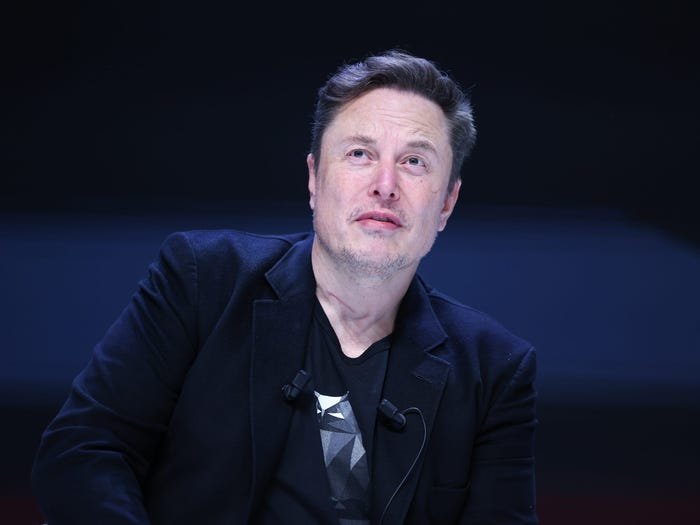
Elon Musk is in a black suit jacket and a black graphic t-shirt on stage. He is looking to the top left corner of the image.

Elon Musk says Anthropic’s philosopher has no stake in the future because she doesn’t have kids. Here’s her response.


Marc Piasecki/Getty Images

  • Anthropic’s resident philosopher, Amanda Askell, helps shape Claude’s personality and morals.
  • Elon Musk said she’s not qualified because she doesn’t have kids and no stake in the future.
  • Askell had thoughts.

Anthropic famously employs a Scottish philosopher named Amanda Askell.

Her job is to imbue its chatbot, Claude, with a personality and a set of moral guardrails. She is essentially teaching it to be cool and good.

Elon Musk, however, doesn’t think she’s qualified.

“Those without children lack a stake in the future,” Musk posted on X in response to a profile of Askell published by The Wall Street Journal.

The Journal profile does not say whether Askell has kids. Musk, who has imbued his own chatbot, Grok, with a distinct personality, has 14 of them. Musk is known for promoting a brand of pronatalism that’s become popular among Silicon Valley elites.

Askell responded with her trademark dry intellectualism.

“I think it depends on how much you care about people in general vs. your own kin,” Askell wrote. “I do intend to have kids, but I still feel like I have a strong personal stake in the future because I care a lot about people thriving, even if they’re not related to me.”

“I think caring about your children can make you feel invested in the future in a new and very profound way, and I do understand people wanting to convey that,” she added.

The responses to their short back-and-forth were as varied as you might expect on Musk’s social media network. A day later, Askell posted again.

“I’m too right wing for the left and I’m too left wing for the right,” she said. “I’m too into humanities for those in tech and I’m too into tech for those in the humanities. What I’m learning is that failing to polarize is itself quite polarizing.”


Source link

Shuby headshot

Anthropic’s CEO says we’re in the ‘centaur phase’ of software engineering

Dario Amodei has a novel analogy to describe how AI and humans are working together.

On an episode of the “Interesting Times with Ross Douthat” podcast published on Thursday, the Anthropic CEO compared human engineers and AI working together to the mythical horse-and-human combination known as the centaur.

He used chess as an example: 15 to 20 years ago, a human checking AI’s output could beat an AI or a human playing alone. Now, AI can beat people without that layer of human supervision.

Amodei, who cofounded AI lab Anthropic in 2021, added that the same transition would happen in software engineering.

“We’re already in our centaur phase for software,” Amodei said. “During that centaur phase, if anything, the demand for software engineers may go up. But the period may be very brief.”

He said he’s concerned about the “big disruption” entry-level white-collar work would see. The CEO added that it may be unfair to compare this to the shift from farming to factory to knowledge work revolution because that happened over centuries or decades.

“This is happening over low single-digit numbers of years,” he said.

Amodei is among the most prominent voices warning that AI could erase some white-collar work, especially in law, finance, and consulting. In a January essay, he predicted that AI could disrupt 50% of entry-level jobs in the next one to five years.

The leaders of other top AI labs, including Mustafa Suleyman and Demis Hassabis, have made similar comments about advanced AI automating service jobs within the next 18 months.

Execs at some software companies counter that AI would make engineers more productive and that companies would need more of them.

“The companies that are the smartest are going to hire more developers,” GitHub CEO Thomas Dohmke said on a July podcast. “I think the idea that AI without any coding skills lets you just build a billion-dollar business is mistaken.”

Atlassian’s CEO said that as AI advances, people will keep coming up with new ideas for the technology they want, and engineers will be needed to build it.

“Five years from now, we’ll have more engineers working for our company than we do today,” Mike Cannon-Brookes said in an October interview. “They will be more efficient, but technology creation is not output-bound.”


Source link

Henry Chandonnet is pictured

The creator of Anthropic’s Claude Code likes to hire engineers who do ‘side quests’ like making kombucha

Want a job at Anthropic? It might help to get a hobby.

The AI boom is changing the job requirements for an engineer. Not only do they need to have coding skills, but they also must know how to operate vibecoding tools and stay up to date with new AI models.

Anthropic leader Boris Cherny looks for something else: “Side quests.”

“When I hire engineers, this is definitely something I look for,” he said on “The Peterman Pod.”

Cherny’s definition of side quests includes “cool weekend projects,” like someone who’s “really into making kombucha.” It’s a sign that the engineer is curious and interested in other things, he said.

Much of Cherny’s own growth came from his side projects. Cherny is now a key figure at Anthropic. He created Claude Code, a tool that is now popular with engineers across the country.

“These are well-rounded people,” he said. “These are the kind of people I enjoy working with.”

Cherny also said he prefers that his new hires be “generalists.”

He gave the example of an engineer who can code, but is also able to work on product and design. That all-star engineer also seeks out user feedback.

“This is how we recruit for all functions, now,” he said. “Our project managers code, our data scientists code, our user researcher codes a little bit.”

Cherny isn’t alone in pushing for jobs to become more generalist. Figma CEO Dylan Field said in October that AI was causing job titles to merge, resulting in everyone being a “product builder.”

What else is Anthropic looking for? For some time, it monitored whether candidates use AI in their applications.

In May, Business Insider reported that Anthropic asked candidates for certain jobs not to use AI in their written responses so the company could test their “non-AI-assisted communication skills.”

Anthropic changed its policy in July, allowing candidates to seek out assistance from Claude.

For the younger engineers, a job at Anthropic may be hard to come by. In May, CPO Mike Krieger said on “Hard Fork” that he was focused on hiring experienced engineers — and had “some hesitancy” with entry-level workers.

On the podcast, Cherny said that his love of generalists came from his career trajectory. Working at startups since 18, Cherny had to do everything, he said.

“At big companies, you get forced into this particular swim lane,” he said. “It’s just so artificial.”


Source link