
We-moved-our-family-of-4-into-a-one-bedroom-apartment.jpeg

We moved our family of 4 into a one-bedroom apartment — in many ways, it’s made our lives so much better

When I first moved back to the UK in 2020, I bought a traditional Glasgow tenement apartment.

Perfect for one, it’s almost identical in size to my old place on the Upper East Side and sits at the edge of a leafy park in a trendy neighborhood.

However, when my partner and I decided to move in together, it made sense that we’d live in his palatial three-bedroom place on the other side of town. His two children live with us on alternate weeks, and my tiny one-bedroom wasn’t going to cut it.

Or so we thought.

We’d been renting out my pocket-sized pad for several years, but three months ago, we moved into it temporarily so I could be closer to my mom while she recovered from surgery.

Quickly, we realized that we’d all be happier living in this neighborhood closer to the kids’ schools — but buying a bigger place just isn’t a financial option right now.

Could we make it work as a family of four without all the extra square footage?

Only a few weeks later, we transformed my living room/dining room into a second bedroom and started a more compact life.

I thought the move would mean sacrifice for all of us, but in many ways, living in a smaller space has made our lives so much better.

We spend more quality time together now


Family in living room area

When solitude isn’t an option, we connect with each other. 

Julia Clarke


I won’t pretend I didn’t have some concerns about our plan. Our kids grew up being able to disappear into their bedrooms for hours at a time. Now they’re sharing a room where we also need to eat our meals.

As it turns out, the extra space we had in our roomier apartment meant that we spent less quality time together as a family.

As soon as we moved, we saw how much our kids thrive on connection when solitude isn’t an option.

We’ve started playing card games together after dinner and the kids often opt for a game of chess or guitar practice together without us even having to suggest it. They still have friends come over for sleepovers and playdates — we’ve just learned to be a bit more flexible about space and sleeping arrangements.

Individual screens and headphones can be a blessing when we want some quiet time, but more often than not, we find TV shows that we can all cozy up and watch together rather than splitting up.

Most miraculous of all, our teenager has even started opening up to us again.

Life is simpler now — and we’re more organized


Bunk beds in living room near couch

Life is simpler with fewer things. 

Julia Clarke


Kids aren’t known for being the tidiest beings on the planet, and I worried that such a small space would get too cluttered to breathe, but downsizing has made life simpler and mostly easier for all of us.

Living in a huge apartment meant we had more places to hide things we didn’t want to deal with, and more surface areas to cover with toys and laundry.

We could barely open a cupboard door without being buried by an avalanche of skis, camping equipment, and painting supplies. Sundays always meant a battle with the kids over tidying their rooms.

We built shelves and added some storage in my place, but mostly we moved over only what we needed — the clothes and kitchen equipment we use regularly and the books we couldn’t live without.

Everything else went into storage, to charity, or directly to the recycling center.


Family in living area

We’ve found we don’t need as many things as we thought. 

Julia Clarke


We’ve found that we actually need very little to be happy, and the smaller space means there’s no possibility of letting the laundry pile up or leaving the dishes until tomorrow.

The dishwasher needs to be emptied as soon as it finishes, and the sheets are washed the moment the beds are stripped. The kids can quickly tuck their belongings away using under-bed storage without us nagging them.

There’s very little to trip or argue over, it’s hard to lose anything, and our living space always feels neat and easy to relax in.

It’s not perfect — but it’s home


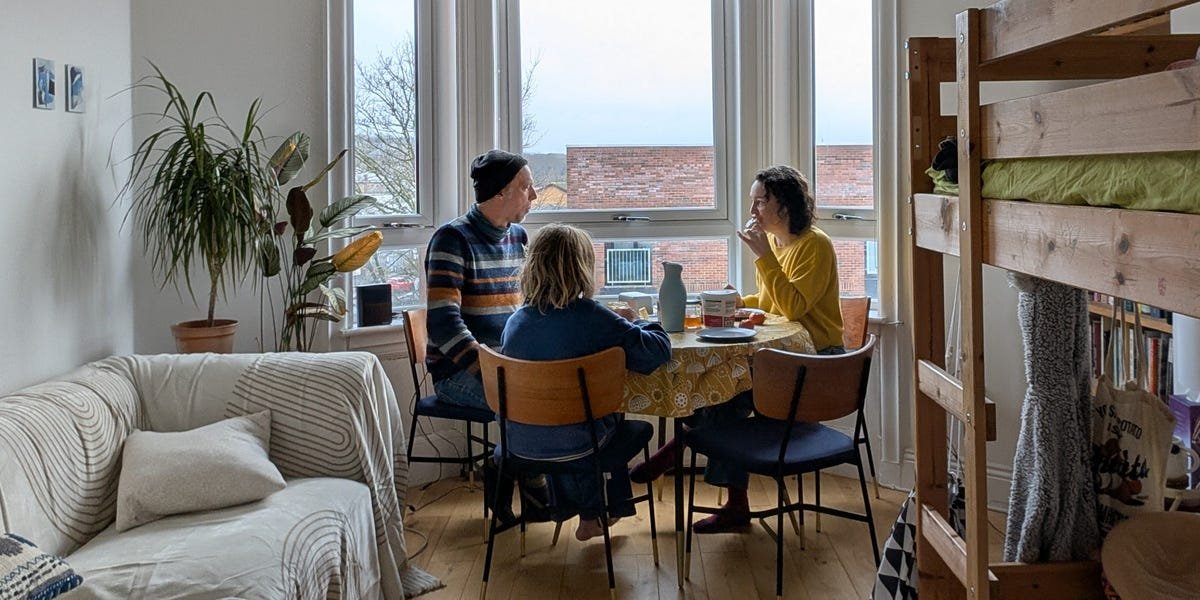
Family sitting around a table in front of windows

We’ve embraced the highs and lows of living this way. 

Julia Clarke


This arrangement can be far from perfect — we do sometimes find ourselves eating breakfast with a snoring teenager next to us.

However, for us, the advantages far outweigh any negatives.

Our neighborhood is great, and we’ve enjoyed the simpler lifestyle and more quality time that’s resulted from this setup. We’re also fortunate to live this way because we’ve chosen to, not necessarily because we have to.

Instead of feeling like a temporary drastic measure, it just feels like our cozy, slightly crazy home.



Source link

He-didnt-want-to-move-away-from-his-friends-so.jpeg

He didn’t want to move away from his friends, so he built them an apartment building. Now, they all own it.

Nearly a decade ago, real estate developer Chad Dale made a purchase that changed the way he thought about how people live together.

Dale and a small group of his friends had decided to pool their money to purchase a vacation home on Whidbey Island, about an hour from Seattle. With five families with young children cycling in and out of the four-bedroom, one-bath farmhouse sharing meals, splitting chores, and weathering the inevitable frictions of living in close quarters, Dale realized that sharing property was a great idea in theory, but not sustainable in practice.

“There were a lot of people sharing an intimate space — it was a little too intimate,” Dale told Business Insider. “There were lots [of things] about that place that were great, and lots that weren’t great.”

The vacation home experiment’s shortcomings sparked an idea for something bigger and more permanent.

For years, Dale turned over the same question: What would communal living look like if it were designed to last?

He found his answer in co-housing, an arrangement where people have private homes but share amenities and collectively manage common spaces. Not to be confused with co-living, which is when people have private rooms in shared homes, co-housing is unlike a typical rental setup in that residents also often have an ownership stake or governance role in the housing community. It’s a housing model that is gaining traction as people seek more sustainable, community-oriented housing.

An ‘adult version’ of a co-op community


A rooftop of a residential building with people sitting on furniture.

The rooftop of Shared Roof.

Andrew Storey


Dale is the developer behind Shared Roof, a 35-unit community that opened in 2023 in Seattle’s Phinney Ridge neighborhood.

Dale financed the project with the help of 13 other friends and family members, each of whom invested in the building. Contributions ranged from $50,000 to $5 million, and ownership stakes in the building’s LLC are proportional to each person’s investment. At Shared Roof, there are no HOA fees; residents still pay monthly rent, but it goes directly to the LLC rather than a traditional landlord.

“It’s a business model that you see sometimes in office buildings, but I’d never seen one done in a mixed-use building,” said Ray Johnston, who helped lead the project as a founding partner of Johnston Architects. “The things that Chad and his friends came to the table with were exciting.”

Designing the building took careful planning


Side-by-side images of the interior of a residential building and inside its greenhouse.

The building was designed to promote community interaction.

Andrew Storey


Shared Roof is meant to feel more like a European block than a typical new build in Seattle. Dale points to places like Amsterdam, where design encourages neighborly interaction and sustainability, as sources of architectural inspiration.

The five-story building wraps around an interior courtyard, with underground parking below. No two units are alike; residences range from about 2,000 to 5,000 square feet.

“One of the more interesting challenges in the project came on the fourth and fifth floors, where many of the long-term investors live, and the units were highly customized to serve the needs of different families,” Johnston said. “It required thoughtful, more detailed spatial planning than in typical multifamily projects to make those individualized layouts fit together under one roof, but it also presented an opportunity to create spaces that reflected how the residents wanted to live.”

While residents have private homes, they share a suite of amenities, including a library, an art room, and a rooftop greenhouse. Street-level retail — such as a café, a brewery, and several restaurants — help keep the community connected to the surrounding neighborhood.


A top view of Shared Roof, featuring its solar panels and greenhouse.

The building has solar panels on the roof, electric heat pumps, and energy-recovery ventilators.

Andrew Storey


For Dale, co-housing was a way to get the community and amenities he and his friends craved without paying peak city prices or having to move away entirely.

Still, living at Shared Roof isn’t cheap. Some larger units in the building have a monthly rent of $8,000. To ensure affordability, Shared Roof participates in Seattle’s Multifamily Tax Exemption program (MFTE) and has set aside about 20% of units for moderate-income renters.

“It was incredibly important for us to have as much diversity — including income diversity — in the building as we could,” Dale said. “We’re huge supporters of infill diversity, rather than separate diversity. In my opinion, that’s not the correct approach.”

It’s a multi-generational building


A man and a woman smile on a balcony.

Chad Dale and his wife.

Courtesy of Chad Dale


Nine of Shared Roof’s investors live in the building, including Dale, who lives with his wife and their three kids in a 1,800-square-foot, three-bedroom unit.

Dale views being surrounded by a mix of younger couples and older residents as a unique plus to their living arrangement.

“There are groups of people that benefit from being together, and our model was really about a generational, family-oriented approach,” he said.

“My folks and my wife’s folks are all in Michigan, so my kids didn’t get a lot of interaction with older people. To see my neighbor with Parkinson’s interacting with my 7-year-old — they’re both winning.”


Side-by-side images of a gym and a library room with people in both spaces.

The building’s gym and library room.

Andrew Storey


The kids also have plenty of other children their age in the building, and with so much to do there, from hanging out on the rooftop trampoline to playing on the 5,000-square-foot turf soccer field, hangouts are often — sometimes more than parents would prefer.

“They come home, crack the door, toss their school bag inside, and then leave because all their friends are around,” Dale said. He added that “while that’s really cool, and exactly what I was hoping for, it’s an unintended consequence.”

‘I love our life here’


A couple smiles in a selfie.

John Ware and his partner, Liesl Langley.

Courtesy of John Ware


John Ware, a technical program manager, and his partner, Liesl Langley, had been living in a large home in Phinney Ridge, but were looking to downsize as they entered the empty-nest years. After hearing about Shared Roof through word of mouth and touring the building, they were sold.

Ware and Langley are investors in the building and were among the first couples to move in. They’re in a 2,000-square-foot apartment with three bedrooms and 2.5 baths. Inside, it’s finished with hardwood floors, walnut custom cabinetry, and high-end appliances, including a Liebherr refrigerator.


A living room in an apartment, with a massive record collection and art on the walls.

Ware’s apartment.

Courtesy of John Ware


Fancy finishes aside, Ware said one of the biggest draws to living at Shared Roof is the community he and Langley have become a part of.

“I used to live in a building that had about 90 units, and I probably knew a third of folks, but we know every single person who lives in this building. We have a group chat on WhatsApp, so that folks can stay in touch with what’s happening,” Ware, 54, told Business Insider.

He and his partner have become the building’s unofficial — and, in practice, official — social directors. Every year, they host an Oscars party, and in the weeks leading up to it this month, they’ve been holding a movie night every week.

Ware said it’s little things like this that make co-housing worthwhile.

“We travel here and there, but after we’ve traveled for a while, I just want to be home, because of where we live — not just Seattle, but our neighborhood and community,” he added. “I love our life here and love this place.”

For some residents, co-housing is a lifeline in a pricey city


A woman poses next to her son, they smile in front of a greenhouse.

Mary Jo Wagner and her son.

Courtesy of Mary Jo Wagner


Mary Jo Wagner, a spa owner, fell in love with Shared Roof after visiting a client who lived there.

“I had just come to visit her one day for dinner, downstairs at one of the restaurants, and I was just thinking to myself how amazing it would be to live in a community like this,” Wagner, 53, told Business Insider.

Wagner moved in with her adult son in 2024, but he has since moved out. Over the past year, she downsized from a two-bedroom to a one-bedroom unit with her dog. Her apartment is among the roughly 20% of units set aside in the building for moderate-income earners.

“The median income in the city is so incredibly high, so it drives up all the prices of the regular rental units that are available,” Wagner said. “The fact that Shared Roof participates in this MFTE program is absolutely amazing because it is more affordable.”


A woman walks a dog, and a man and a woman sit down at a table.

People sitting outside the wine bar.

Andrew Storey


Wagner said the building’s amenities, along with its retail stores, including a wine shop and a bakery, also helped seal the deal. She especially loves the building’s library and the rooftop garden.

“I live in a small one-bedroom unit, but if I want to have my friends or family over for a larger gathering, there are spaces in the building to do that, which is just amazing.”

For Wagner, Shared Roof doesn’t feel like a typical apartment complex. Beyond the extra amenities, the connections she’s made there feel genuine.

“Everybody kind of looks out for one another,” she said. “It feels a little bit like being a part of a large family.”


Source link

I-felt-unprepared-when-I-moved-into-my-first-apartment.jpeg

I felt unprepared when I moved into my first apartment. Living alone has been challenging, but also incredibly rewarding.

I’ll be honest — when I moved into my first apartment after graduating from college, I didn’t know the difference between Tide and Cascade pods, or how to use a plunger.

But to be fair, I didn’t have the “typical” college experience.

The COVID-19 pandemic prevented me from staying in the dorms in 2020, and even after campus reopened, the cost and comfort of living with my parents kept me home through the end of junior year.

Instead of fostering independence as I’d planned, I continued residing at home, with my family taking care of me, cooking meals, running the washing machine, and restocking my favorite cereal.

By senior year, I felt pressure to move out and grow up

I was raised in Manhattan, and when I decided to go to school just one subway stop away from home, I felt behind in some metaphorical “race” to grow up.

Everyone I knew was out of town, joining sororities and exploring new territory, while I was stuck in the past.

By senior year of college, all my friends were either living in the dorms or in their own places, but I was still at home.

So, as I entered my final year of school, I decided to start looking for a place of my own, without my parents’ assistance. I felt like I would never truly consider myself a real “adult” unless I took on the process by myself.

After a few touring mishaps, the third apartment building I visited seemed like the perfect fit. It wasn’t furnished yet, but it already felt like home. It even had wooden floors that reminded me of the room I grew up in. I signed my lease one week later.


An empty apartment with white walls and wooden floors.

The apartment felt like home before I even furnished it.

Carrie Berk


However, I quickly became overwhelmed by the moving process. As I stared at boxes piled to the ceiling, I didn’t know where to start.

I started tackling the space, excited to see my NYC-style Barbie Dream House vision come to life. But the more I unpacked, the more things began to fall apart.

My mattress delivery was delayed, the trendy LED-adorned bed frame I picked out didn’t fit through the doorway, and my WiFi didn’t work. Oh, and instead of pink kitchen tools, I’d accidentally ordered green.

It felt like no matter how hard I tried, I couldn’t get anything right. I started to wonder if moving out was a mistake. Maybe I just wasn’t ready for the responsibility.

The first evening I spent alone in the apartment, I broke down. As I stared at half-open boxes, a TV that wasn’t operating properly, and an empty bedroom, my life felt out of place.

I was in the eye of the hurricane when it came to adulting, and it felt like I would never be able to figure things out on my own. But then I realized — maybe I didn’t have to.

I thought pushing my parents away would make me feel more grown up, but I learned asking for help is healthy and normal. I delegated tasks: my dad helped me fix my router, my mom accompanied me to Home Depot to purchase new utensils, and my friends even pitched in to help me find a new bed frame.

Once they set me up for success, I felt much less overwhelmed. My home began to come together, and instead of feeling scared, I was excited to embark on this new adventure.

Living alone has still presented its challenges, but I’ve learned to embrace the chaos


A bedroom with gray and pink bedding and white furniture.

It took some time to adjust to living alone.

Carrie Berk


I’ll be honest — when my parents, friends, and the movers were all gone, it was pretty disheartening. As I sat in the quiet of my apartment, merely hours after I had officially moved in, I missed the buzz.

I never thought I would say it, but I craved the noise of my dad blasting football on the television or my mom squeezing my dog’s toy. The silence felt deafening. But as days passed, I began to find peace in the quiet.

Now, I savor solo moments that I might not have had the chance to enjoy while living with my family.

I can play my Peloton class at full volume without disturbing anyone and experiment in the kitchen without my mom roasting my cooking skills. To be honest, though, curating a menu beyond scrambled eggs or a toasted bagel is still a work in progress.


A small kitchen with a heart-shaped sign on the wall that reads

Learning to cook is still a work in progress.

Carrie Berk


Now, I’ve found that solo living has become less scary and more of a superpower. As I take care of my home, I’m instilled with a new sense of empowerment that fuels other areas of my life.

If I can budget to pay my rent, then surely, I can learn how to save money for international travel. If I can practice patience in communicating with my landlord about maintenance issues, I can also extend those lessons toward work.

Plus, learning how to clean spills on the rug was a major help when I eventually started a side hustle as a dog sitter.

I’ve learned to embrace the chaos and celebrate the small wins rather than put myself down for my failures.

Now, as I stare out at my fully-furnished space, I’m proud of what I’ve accomplished, and I’m looking forward to continuing to grow in the comfort of my very own home.


Source link