
Dating-apps-arent-working-San-Francisco-singles-are-resorting-to.jpeg

Dating apps aren’t working. San Francisco singles are resorting to cash bounties and AI matchmakers.

When Patricia Tani moved to San Francisco last year, she kept hearing a koan about the city’s dating scene: “The odds are good, but the goods are odd.”

“There’s all this talk online about how dating is cooked in SF, but I never really believed that, because there’s way more guys than women,” she tells me. “Shouldn’t it be easy to find a boyfriend?”

The answer was no. Tani, who is 21, tried Tinder, Bumble, and Hinge to no avail. San Franciscans were too locked in building the future to build futures with romantic partners; it was a city of situationships. Tani had a specific list of criteria — someone ambitious, someone loyal — but there was no good way to filter for that on the apps. There were plenty of in-person events and parties, but most of those felt like networking.

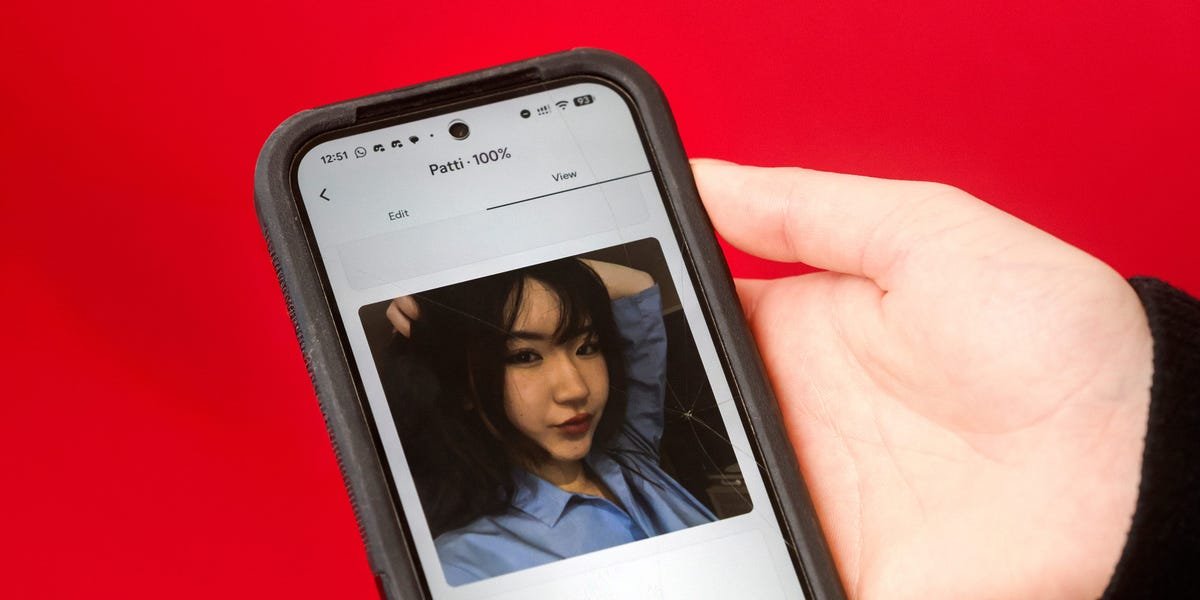
In early February, she decided to try a new tack. Tani is the cofounder of RentAHuman, a platform that allows AI agents to employ humans for gig work. She put up a “bounty” on her company’s website, offering $200 for someone to go on a Valentine’s Day date with her. She listed her requirements: a “sigma nerd” who would be willing to accompany her to a fancy restaurant, walk around the Embarcadero, and maybe hold hands while watching a sunset. Skills needed: “rizz” and “autizz.”


Patricia Tani

Patricia Tani put up a $200 bounty someone to go on a Valentine’s Day date with her. Skills needed: “rizz” and “autizz.” 

Jennilee Marigomen for BI


Of the 200 people who applied, about five met Tani’s prerequisites. One man stood out: Jonathan Liu, the 23-year-old creator of a “rizz keyboard” that helps people draft better messages in dating apps. Tani had previously met Liu at a party in San Francisco, where she said she had been too shy to make a move. Liu told me he would have “potentially” asked her out at that party, but didn’t because it looked like she was there with someone else. When he saw Tani’s call for submissions going viral on X, he thought it would be funny to apply.

On Valentine’s Day, Liu and Tani had a five-course meal at Copra, an upscale Indian restaurant in Japantown. Then they went to a club. To Tani, it felt like a reinforcement of something she already knew: Dating apps were broken. If this was the way to find a date, then so be it.

More than a decade after apps like Tinder revolutionized the way people meet, many young people are swiped out. Tinder and Bumble both reported a decline in paying users in the last quarter of 2025, even as the cost of retaining those users has gone up. And those who remain on the apps are, on average, spending less time swiping than they were before. “There’s a real backlash,” says Blaine Anderson, a matchmaker and dating coach. “I’ve certainly been hearing more and more people who are just throwing in the towels on apps altogether.”

In their place, new and unorthodox ideas are emerging. In San Francisco — where everything can be optimized — startups are selling singles on the promise of a swipeless future, where the infinite scroll of dating apps is replaced by artificial intelligence, dates-on-demand, and matchmaking at scale. Not everyone will be so bold as to offer a bounty for their dream date. But in this new frontier, young singles are signaling a shift away from the giant companies that dominated dating in the last decade, and toward concepts that promise better results with less effort. Can a dating culture ruined by technology be saved by more of it?


One theory of what’s wrong with dating apps is that there are just too many people on them. Tinder and Bumble each have more than 50 million monthly active users. Swiping through a catalog of humans, it can be difficult to differentiate. It’s even harder to commit to one choice when there are so many other options, all of which come with scant information. “Now we have a generation of people that has more optionality than anyone has ever had, and instead struggles with infinite indifference,” says Celeste Amadon, the cofounder of Known, a dating app that launched in February.


Celeste Amadon

Celeste Amadon, founder of Known, which uses a voice-based AI to interview users, then sets them up with each other. 

Don Feria for BI


Known uses a voice-based AI to interview users, similar to a matchmaker, then sets them up with each other using a proprietary algorithm. (Amadon says it is based on the work of several “very famous” love psychologists, who emphasized matching based on values rather than interests.) On the onboarding call, the soothing, female AI voice might ask about your ideal partner, and also what went wrong with your ex. This call lasts a minimum of 10 minutes but Amadon says most people spend significantly longer, offering way more information than a person would normally reveal on a dating app profile: How much do you like to party? Do you need someone who matches your energy, or complements it? Does it matter if your partner is not very successful in their career? Then, the AI looks for someone who fits the bill.

Crucially, Known only delivers one match at a time. “We’re not trying to provide you dozens, let alone hundreds, of matches,” Amadon says. A city like San Francisco — population 800,000 — might contain between five and 10 eligible matches for each person, by her estimate. If the goal of most dating apps is to infinitely expand the pool of people you could date, Known’s goal is to shrink it back to its original size. Amadon says the entire dating market in San Francisco is around 60,000 people; Known had more than 10,000 San Franciscans on its app as of March. It costs nothing to join, but if you want an introduction to the person Known selects for you, the company charges $15. The startup raised nearly $10 million last year.

As Amadon puts it, there is “no better thing than being set up by a friend,” even if that “friend” is AI. Other startups are making similar bets. Fate, an “agentic matchmaking” app that launched last year in London, also interviews users with voice AI and delivers matches without swiping. Ditto, a college-focused dating app, gives users one match every week, chosen for them by an AI matchmaker. Three Day Rule, yet another AI matchmaking app that launched last year, promises “guaranteed matches” and on-demand coaching in exchange for $25 a month. Each of these platforms is built on the idea of scaling the matchmaker model and eliminating the swipe; users feed data into the algorithm in exchange for curated dates. So far, reviews have been mixed. A reviewer for Wired who tried Three Day Rule said that “not a single person I was matched with would be someone I’d swipe right on if I saw them on a traditional dating app,” and that many matches responded to messages using AI prompts.


Celeste Amadon

“We have a generation of people that has more optionality than anyone has ever had, and instead struggles with infinite indifference,” says Amadon. 

Don Feria for BI


While algorithms can be surprisingly good at finding two people who match on paper, human matchmakers like Blaine Anderson say that the delicate work of setting people up just can’t be automated. You can use technology to sift through quantifiable features — like height, religion, or interest in having kids — but an algorithm cannot filter for the je ne sais quoi that makes matches successful. Do these people have a similar sense of humor? Will there be banter on the date? What about chemistry? “For this type of matchmaking, at this level of service, there is no shortcut,” Anderson says.

Bring Me Bae features singles offering up rewards from $10,000 to $30,000 to be introduced to their girlfriend or boyfriend.

That type of matchmaking is also very expensive. Anderson’s packages start at $30,000 for a six-month contract; the fee can get as high as $100,000, depending on how hard it may be to set the client up. Last year, Anderson experimented with building her own AI matchmaking platform to bring her work “to the masses.” The idea was to codify her expertise into an algorithm and allow greater access to her services. She tested a prototype on a few thousand users in Austin, Texas, where she lives, and ended up shutting it down after realizing that the algorithm failed to find two people who equally wanted to date each other. “My biggest learning,” she says, “is that who a person wants to match with doesn’t usually want to match with them, too.” It’s one thing to deliver a client the exact profile of the person he’s looking for — and another thing entirely for that person to also want to date the client.

So Anderson pursued another idea. She had noticed a trend of people posting Date Me Docs — often a literal Google Doc that reads like a dating résumé — on social media. Sometimes these came with a finder’s fee. It inspired her to launch a new platform in February called Bring Me Bae, which features singles offering up rewards from $10,000 to $30,000 to be introduced to their girlfriend or boyfriend. The bounty is paid after the couple is in a relationship for a year; Anderson makes each person sign a contract with terms of service and put the money in escrow to make sure they’re good for it. The financial incentive is meant to bring in more applications, as well as signal that the person is “high intent,” not looking for a hookup or a casual fling.

When the platform launched, someone made a TikTok about one of the profiles, advertising that someone could win $10,000 to set him up with a girlfriend. “We got 20 applications, and two of those 20 were really good,” Anderson says. “One of them he went on multiple dates with.”

In other words, technology can play a role in getting more exposure. But overall, Anderson thinks most singles would rather find their partner offline and in the real world. She noted a rise in in-person dating events and a general desire to meet people off-screen. “People are realizing like, I can’t just rely on how I order my groceries or how I download a show,” she says. “I can’t download a girlfriend if I want her to be real.”


On Valentine’s Day, I set out to meet some of these real-life single people daring to meet other real-life single people in real life. Known was hosting a launch party, called “The Night We Met,” at the San Francisco Mint. It promised drinking, dancing, and the potential to fall in love. The party had a formal dress code and a strict 50/50 gender ratio.

I joked to a friend that, at 33, I might be the oldest person in attendance. This, unfortunately, appeared to be true. Waiting in line to get in, I struck up a conversation with the man next to me, who was 23, had just moved to San Francisco, and had no idea that Known was a dating app. “AI matchmaking? That’s a crazy concept,” he said, before disappearing to talk to girls his own age.


Celeste Amadon

If the goal of most dating apps is to infinitely expand the pool of people you could date, Known’s goal is to shrink it back to its original size. 

Don Feria for BI


I found Amadon inside, wearing a sparkly mini dress and beaming. More than 1,000 people had bought $20 tickets, and they were showing up in droves. It had been important to Amadon that the gender ratio was equal, since the epicenter of the tech industry famously has more young men than women, but the guest list turned out to have a surplus of women. To correct this, Amadon had tried to personally recruit a number of young men. She pulled out her phone and showed me the Tinder profile she had made to advertise tickets to the party. It featured a series of photos of her posed in a T-shirt that read “I’m on Known!”

He’d be interested in an app that matched him with someone based on his ChatGPT history, which he described as “the content of my soul.”

Whatever the marketing tactics had been, they appeared to work. I found plenty of young people roving, looking nervous and excited to be mingling off-screen. The space was divided into various rooms featuring an open bar, a photo booth, and a podium with a microphone and camera, where people could describe their dream date to produce an AI-generated image on a large screen for everyone to see. The place was buzzing with the energy of young people trying to lock eyes with each other. Nearly everyone I spoke to seemed eager to gauge their chemistry in person, rather than on an app. One man told me about a singles event that had recently taken place at a Trader Joe’s, where people were invited to exchange numbers while grocery shopping. A woman told me she hadn’t had any luck on the apps, but recently had a first date with someone she met at a bathhouse. I was struck by how much these people in their early 20s, who had spent formative years of high school and college on Zoom because of the pandemic, wanted liberation from screens. Touch-starved and tech-saturated, they yearned to date in person.

I wasn’t sure what this meant for Known. Another 23-year-old man told me he thought an AI matchmaker seemed “gimmicky,” and he didn’t believe current AI models were sophisticated enough to make intelligent pairings. Other dating apps, like Hinge, also purported to use AI to suggest the “most compatible” profiles for a given user, but those suggestions often made no sense or relied on superficial data. This man said he would be much more interested in an app that used AI to match him with someone based on his ChatGPT conversation history, which he described as “the content of my soul.”

At quarter to 11, just before a DJ called Noodles started playing, I approached a pair of men in their late 20s. Both were wearing wristbands that said “I’m on Known,” but neither had any interest in using the app, or any dating apps for that matter. “There have been a million dating apps. Everyone has fatigue,” one of them said. “I’m now trying out the organic channels.”

I asked if there was anyone at the party he was interested in meeting. “Definitely,” he said. Had he talked to anyone yet? No. He was still working up the courage.


If the first generation of dating apps faltered because they turned the search for a partner into a mobile game, the new guard is betting that the fix isn’t less technology, but more “agentic” technology — the kind that engineers away some of the inefficient parts of dating. In this world, single people no longer want to choose. They want to be told whom to choose, with confidence that the choice is correct.


Patrician Tani

For all the talk of optimizing matches, it’s what happens after the match that remains the most difficult to solve. 

Jennilee Marigomen for BI


Yet the most agentic technology does not create high-agency people: the kind who might approach a stranger at a party, or who might get by without the assistance of a “rizz keyboard.” A decade after the rise of dating apps and social media, a generation of single people is ill-equipped to talk to each other in the real world, find rejection unbearable, and would rather move on to the next thing than stay and work through conflict or miscommunication. It is possible that we are seeking a technological cure for the chronic loneliness that technology itself helped architect.

For all the talk of optimizing matches, it’s what happens after the match that remains the most difficult to solve. You can develop the most sophisticated algorithm in the world, or put a $10,000 bounty on finding a match, but you can never guarantee that two people will see the same future in each other’s eyes, or even the same evening.

After spending Valentine’s Day with Liu, Tani was hoping for a second date. “I thought he was really funny, really thoughtful, and kind,” she says. “I was scared that I wasn’t going to be able to find someone, or that it would be awkward, but it actually kind of went perfectly.”

Liu, on the other hand, tells me that while the date had been fun, it had felt “more like a networking thing.” When they went to the club after dinner, Liu says he and Tani had not danced together, and she seemed like she was trying to find someone else. Plus, he was moving to New York City soon. He hoped the dating scene would be better there.


Arielle Pardes is a reporter in San Francisco covering the business and culture of technology.

Business Insider’s Discourse stories provide perspectives on the day’s most pressing issues, informed by analysis, reporting, and expertise.

Source link

A-57-billion-AI-startup-wants-to-help-cut-government.jpeg

A $5.7 billion AI startup wants to help cut government benefit fraud. Experts aren’t so sure.

An AI startup in SF focused on identity verification has set a lofty goal: securing government contracts.

Daniel Yanisse, the CEO of Checkr, told Business Insider that the company wants to help the government reduce “fraud and waste” by not only screening new employees but also verifying people’s eligibility for benefits such as Medicare and Social Security.

Though Yanisse said the company isn’t ready to make any product announcement yet, he said a frictionless government assistance system may be just years away.

AI and safety experts, however, told Business Insider that there are legal and technical hurdles for any company to undertake the task of automating benefit and welfare systems with AI.

Checkr primarily uses AI to run background checks and surface information such as criminal records and motor vehicle reports. The company has major contracts with Uber and Lyft to screen new drivers, and is valued at more than $5.7 billion after raising $120 million in funding in 2022. In 2025, Checkr reported over $800 million in revenue and surpassed 120,000 customers.

When asked what Checkr wants to do for the government, Yanisse said that for Medicare and other programs, “there’s a lot of fraud happening and just bad actors getting the government dollars instead of the right people who need help,” adding that it’s very hard for the government to actually verify people’s employment status and income.

The Medicare Fee-for-Service program estimated that there were $28.83 billion in “improper payment” in 2025 at a rate of 6.55%, though not all such cases are the result of intentional fraud. Payments made to individuals who did not submit sufficient documentation and have unverified income levels are also considered improper by Medicaid.

“With AI, unfortunately, there’s going to be even more fraud, identity theft, and scams,” said Yanisse. “It’s a lot of friction, it’s a lot of repetition, and now there are also deepfakes.”

Checkr’s spokesperson told Business Insider that the company’s potential involvement in government is “still conceptual at this point.”

The company also pointed toward a study by Middesk, a business identity verification platform, that out of $1.09 trillion in Medicaid payments that went to around 1.6 million providers between 2018 and 2024, $563 million in payouts went to providers that are blacklisted from federal healthcare programs for criminal activity or misconduct.

Automating identity verification can be challenging

Stuart Russell, professor of computer science at UC Berkeley and an AI pioneer, told Business Insider that he is “not optimistic” that the plan to use AI to determine benefits eligibility will work as advertised.

“An AI system of this kind, some version of an LLM, is incapable of producing veridical explanations of its decisions, making it impossible to challenge false decisions,” Russell said.

Russell also cited the General Data Protection Regulation in the European Union, which bars decisions with significant legal effects on individuals from being made entirely by automated systems.

Baobao Zhang, the Maxwell Dean associate professor of the politics of AI at Syracuse University, told Business Insider that though she cannot assess exactly how good Checkr’s verification system is right now, past government attempts to mix people’s benefits with an automated system are cautionary tales.

“If the federal government or other state governments are trying to contract with a vendor to automate welfare fraud detection, they need to have a serious evaluation in the real world before they deploy it, because the stakes are high, as history has proven,” said Zhang.

In Indiana, an attempt to streamline and automate its welfare eligibility system by outsourcing a contract to IBM ended in a legal battle in which the state sued the company for $1.3 billion for the scrapped project in 2010. Based on court records, the Indiana Family and Social Services Administration said that processing errors from IBM led to faulty benefits denials that brought harm to the needy.

In Australia, an automated government plan called Robodebt, designed to detect fraud, told welfare recipients to repay benefits and sent letters claiming they owed thousands of dollars in debt, based on an incorrect algorithm. A royal commission, which is Australia’s highest form of public inquiry, found that at least three people died by suicide after being falsely told to pay back debt they don’t owe by Robodebt. The system was ruled illegal by a court in 2019.

Ifeoma Ajunwa, the founding director of the AI and the Future of Work Program at Emory University, told Business Insider that if any government agency is to adopt AI, there should be an advisory council made up of technologists and social scientists, and affected constituencies should be given a say.

“I think we need to move cautiously when delegating governmental functions to AI technologies,” said Ajunwa. “While these tools are touted to increase efficiency and lower costs, we also need to establish guardrails for their use to protect citizens.”


Source link

Americans-arent-flocking-to-Florida-like-they-used-to-Higher.jpeg

Americans aren’t flocking to Florida like they used to. Higher prices are a big reason.

Kimberly Jones was born and raised in Miami, and planned to live her whole life there. It’s where she met her husband, raised her children, and built a four-decade career in logistics.

But in 2025, Jones did something she never expected: She and her husband left Plantation, Florida — nearly 20 minutes west of Fort Lauderdale — for a small rural town about an hour outside Charlotte, North Carolina.

“It was not an easy decision,” Jones, 60, told Business Insider. “Affordability was part of it, but we were also looking forward to having a slower pace of life. I lived in South Florida my entire life — and it’s not anything like what it used to be.”

Jones said Southern Florida’s population growth has made the area increasingly unrecognizable — and, for her, unlivable — pointing to hyper-development in residential construction and the gridlocked traffic she calls “ridiculous.”

“If there’s a corner available, they will build a high-rise on it,” she said. “It’s turning into an overly congested, expensive city. I used to spend two and a half hours a day in the car just going to and from work.”

People are still moving to Florida, but they’re not flocking to it like they used to. Net domestic migration — or the number of people moving into the state from elsewhere in the country minus those moving out to other parts of the US — has been steadily cooling in recent years.

There are a few likely reasons behind the cooler estimates in the Sunshine State. For some, the tax benefits of living in the state don’t outweigh the increase in cost of living. It’s more expensive to buy a home than a few years ago, and property insurance has been higher than in other states.

High housing costs have made Florida less attractive

In recent years, Florida has drawn an influx of newcomers chasing its affordability, driven in large part by its wide range of relatively lower-cost housing and lack of state income tax. Others are lured by its business-friendly tax environment and strong job market.

But the surge of newcomers has created a host of challenges for native and longtime residents who have watched home prices and rents climb, especially in popular cities like Miami and Orlando. It’s prompted some to move to less expensive cities and suburbs elsewhere in the state, or to leave Florida entirely.

“Affordability often drives a lot of domestic moves,” Jed Kolko, senior fellow at the Peterson Institute for International Economics, told Business Insider. “People tend to move toward less expensive places. In recent years, Florida’s gotten a lot more expensive, so Florida doesn’t look as affordable compared to other places as it did even just a few years ago.”

In December 2020, Florida’s median home-sale price was $298,100; by December 2025, the most recent month with available data, it had climbed to $412,100, Redfin data showed. In addition to higher home prices and rents squeezing residents, home and flood insurance costs have increased, as more frequent and severe natural disasters push homeowners’ premiums higher.


Homes flooded in Florida

Homes flooded in Florida.

Bilanol/Getty Images


Take Debra Pamplin, who moved from Florida back to the Midwest after 11 years. In 2013, Pamplin moved from her hometown of Missouri to Jacksonville, Florida. During her time there, though, she soured on the area’s traffic, high insurance costs, uncomfortable heat and humidity, and mosquitoes. Pamplin has valued living in the Midwest much more.

“I’d often have to cut spending in other parts of my life just to cover my high monthly insurance costs,” she said in a 2024 Business Insider story. “Now that I’m out of Florida, my monthly insurance expenses are lower, giving me breathing room to spend my money on more fun stuff.”

Florida hasn’t completely lost its appeal

Mariya Letdin, an associate professor of real estate at Florida State University, told Business Insider that even as net migration slows, Florida is “still a popular destination,” but she expects its population will continue to grow slowly.

Aside from slower growth, the profile of who’s moving to Florida is shifting, too.

Michael Martirena, a real estate agent with Compass in South Florida, told Business Insider he’s seen a change in the clients he works with, which he attributes in part to higher housing costs.

“Let’s go back three years ago, pre-pandemic, everyone was coming down here. It didn’t matter what socioeconomic class people were from; they just wanted to come to Florida.” Now, he said, he’s working with more buyers from abroad, as well as wealthy American buyers.

Hamilton Lombard, a demographic researcher based in Virginia, said immigrants moving elsewhere within the US could also be a factor as to why Florida’s domestic migration has weakened. Census data showed that non-citizens who moved between states in the past year from Florida increased from about 30,000 in 2022 to 53,500 in 2024, the latest year available.

Florida’s net international migration has also been cooling, but remains positive, meaning more people are immigrating to Florida from other countries than leaving for destinations outside the US.

“International and affluent buyers still continue to come down to Florida, whether it’s for tax purposes or geopolitical reasons or what’s going on in their states,” Martirena said, adding that a lot of his clientele comes from countries like Dubai, Madrid, and London.


Source link

I-run-alcohol-free-nightlife-events-in-NYC-Most-of-my.jpeg

I run alcohol-free nightlife events in NYC. Most of my guests aren’t sober — they just don’t want to drink.

This as-told-to essay is based on a conversation with Sam Bail, a data engineer and the founder of the alcohol-free pop-up event company, Bright Nights Social. It has been edited for length and clarity.

Three years ago, I had the idea to open an alcohol-free bar in New York City.

I don’t drink, but I still wanted nightlife — dancing, music, meeting new people, getting out of the house on a Friday or Saturday night. What I didn’t want was another alcohol-free space that was centered on wellness, meditation, or yoga. I wanted something that still felt like real nightlife, just without booze being the main event.

Instead of signing a lease, I started testing the idea by hosting pop-up events. I’d take over coffee shops or other venues at night and turn them into alcohol-free bars for the evening.

What started as an experiment quickly took on a life of its own.

Over the past three years, I’ve collaborated with tons of venues, experimented with a variety of new formats, and thousands of people have come through our doors. That’s been the most surprising part of all of this: the demand.

What’s even more interesting? Most of the people who attend my events aren’t even sober.

Who actually comes to alcohol-free nightlife

When people hear “alcohol-free event,” they often assume the crowd is made up entirely of sober or sober-curious people. That hasn’t been my experience at all. Based on conversations with guests, I estimate that at least 75% of the people who attend my events don’t identify as sober or even sober-curious.

They’re mostly in their mid-20s to early 30s — older Gen Z and very young millennials. Gender splits depend on the event, but many of my parties are close to 50-50 men and women. What they have in common is that they want to go out, socialize, and have fun without making drinking the center of their entire social life.

I’m 40, so I’m an elder millennial who’s already done the heavy partying phase and is over it. But many of the people who come to Bright Nights Social are younger than me and feel the same way. They’ll tell me things like, “I still drink sometimes, I just don’t want to do it every time I go out,” or “Alcohol makes me feel terrible the next day.”

They’re not abstaining out of moral opposition to alcohol or because of addiction. They’re opting out because they don’t like the cost, the hangovers, or the way drinking dominates social life in cities like New York.

Experiences > drinking

What I see aligns with a broader shift happening right now, especially among younger people. There’s a growing focus on experiences rather than just going to a bar and spending money on drinks. In New York City, you can see it everywhere: pottery classes, cooking classes, rug tufting, late-night library events, group reading clubs.

Some of my favorites have been hosting cooking classes and our crafting events, like rug-making. Coming up this month, we have a tea bar, a bagel-making (and eating!) class, and a full-on dance party, complete with DJs and a full non-alcoholic bar, to close out Dry January.

People want to do something. They want to make memories. They just don’t want to wake up feeling awful the next day.

Cost is also a big factor. When cocktails are $15 or $20 each, it doesn’t take long for a casual night out to become extremely expensive. A lot of people tell me they’d rather spend their money on an experience than on alcohol that doesn’t even make them feel good.

That doesn’t mean Gen Z isn’t drinking at all. In fact, some recent data suggests younger people are actually drinking more now than they were a year or two ago. I think part of that is a post-pandemic catch-up effect — many Gen Zers reached legal drinking age during lockdowns and simply didn’t have the chance to go out.

What I see on the ground is moderation. People might have one drink at dinner and then switch to a nonalcoholic beer. Or they’ll alternate between alcoholic and nonalcoholic drinks throughout the night — what some people call “zebra striping.” They’re being much more intentional about how and when they drink.

THC, nonalcoholic drinks, and what’s next

Another huge shift I’m seeing is the role of legal THC. I don’t serve THC products at my events, but I don’t stop anyone from having one before they come, and I hear about them constantly from guests and friends who work at nonalcoholic bottle shops. THC drinks are some of the best-selling products in those stores.

People understand what THC does. They say it helps with social anxiety, takes the edge off, and feels more manageable than alcohol when used in moderation. Compared to that, there’s still skepticism around functional or adaptogenic drinks — things with nootropics, ashwagandha, or functional mushrooms. Many people aren’t convinced that those drinks actually do anything beyond being a placebo.

That said, I think we’re still early. As people learn what works for their own bodies — whether that’s L-theanine, lion’s mane, or something else — those functional beverages may gain more traction.

At the same time, I’m also seeing conversations online about people pulling back from THC after overdoing it, so I think we’ll see a similar trend as people try to find nightlife events that best suit their needs.

I don’t think most people want to be completely sober forever, but they are actively experimenting with what moderation looks like.

Alcohol-free doesn’t mean anti-fun

The biggest misconception about alcohol-free nightlife is that it’s boring or restrictive. What I’ve learned is that people don’t want to be told what not to do — they just want more options.

Bright Nights Social isn’t about sobriety as an identity. It’s about creating a space where alcohol isn’t the default. You can still dance, flirt, meet strangers, and stay out late. The only difference is that you’re not expected to drink to participate.

The fact that so many non-sober people show up tells me this isn’t a niche idea anymore. Alcohol-free nightlife isn’t just for people who’ve quit drinking entirely. It’s for anyone who wants to go out — and wake up the next day feeling like themselves.

Do you host or attend alternative nightlife events? Contact this reporter at ktl@businessinsider.com.


Source link

AI-is-creating-a-security-problem-most-companies-arent-staffed.jpeg

AI is creating a security problem most companies aren’t staffed to handle, says an AI researcher

Companies may have cybersecurity teams in place, but many still aren’t prepared for how AI systems actually fail, says an AI security researcher.

Sander Schulhoff, who wrote one of the earliest prompt engineering guides and focuses on AI system vulnerabilities, said on an episode of “Lenny’s Podcast” published Sunday that many organizations lack the talent needed to understand and fix AI security risks.

Traditional cybersecurity teams are trained to patch bugs and address known vulnerabilities, but AI doesn’t behave that way.

“You can patch a bug, but you can’t patch a brain,” Schulhoff said, describing what he sees as a mismatch between how security teams think and how large language models fail.

“There’s this disconnect about how AI works compared to classical cybersecurity,” he added.

That gap shows up in real-world deployments. Cybersecurity professionals may review an AI system for technical flaws without asking: “What if someone tricks the AI into doing something it shouldn’t?” said Schulhoff, who runs a prompt engineering platform and an AI red-teaming hackathon.

Unlike traditional software, AI systems can be manipulated through language and indirect instructions, he added.

Schulhoff said people with experience in both AI security and cybersecurity would know what to do if an AI model is tricked into generating malicious code. For example, they would run the code in a container and ensure the AI’s output doesn’t affect the rest of the system.

The intersection of AI security and traditional cybersecurity is where “the security jobs of the future are,” he added.

The rise of AI security startups

Schulhoff also said that many AI security startups are pitching guardrails that don’t offer real protection. Because AI systems can be manipulated in countless ways, claims that these tools can “catch everything” are misleading.

“That’s a complete lie,” he said, adding that there would be a market correction in which “the revenue just completely dries up for these guardrails and automated red-teaming companies.”

AI security startups have been riding the wave of investor interest. Big Tech and venture capital firms have poured money into the space as companies rush to secure AI systems.

In March, Google bought cybersecurity startup Wiz for $32 billion, a deal aimed at strengthening its cloud security business.

Google CEO Sundar Pichai said AI was introducing “new risks” at a time when multi-cloud and hybrid setups are becoming more common.

“Against this backdrop, organizations are looking for cybersecurity solutions that improve cloud security and span multiple clouds,” he added.

Business Insider reported last year that growing security concerns around AI models have helped fuel a wave of startups pitching tools to monitor, test, and secure AI systems.


Source link