How-the-US-Army-turned-this-former-Nazi-base-into-a.jpeg

How the US Army turned this former Nazi-base into a rapid-response war machine

Just a couple of hours north of Munich, the US Army runs its largest training site outside the United States. Once a Nazi artillery training ground, the sprawling base is now home to more than 16,000 troops kept ready to fight at a moment’s notice.

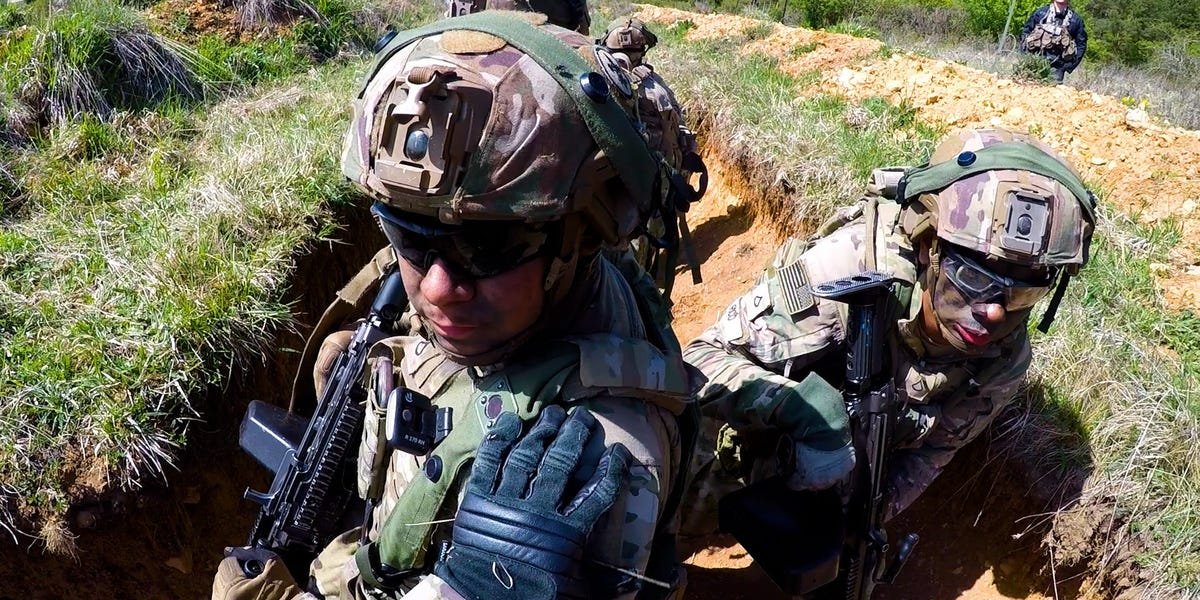
Soldiers train in trenches and with armored Stryker combat vehicles to maintain constant combat readiness “so they can answer America’s call in an instant,” said Hermes Acevedo, who was the command sergeant major and senior enlisted advisor to the garrison commander at US Army Garrison Bavaria when Business Insider’s Graham Flanagan visited last April.

That readiness serves as deterrence. From Bavaria, troops can reach the Czech Republic within about an hour and Ukraine’s capital, Kyiv, in roughly 18 hours by road. “By us being ready, by us being here in this location, [it] kind of sends a signal,” Acevedo said.


Map shows how close Bavaria is to Kyiv

The gold square on the left is the Army base in Bavaria, which is less than a day’s drive from Ukraine’s capital. 

Business Insider


He didn’t name a specific adversary, but soldiers in the trenches know who they’re preparing for.

As Russia’s war in Ukraine continues, the US Army’s presence in Germany is crucial. These soldiers could be the first ones in the fight, defending NATO’s eastern flank.

From Nazi training ground to NATO backbone


Aerial shot of trenches in US Army Garrison Bavaria.

A trench where US Army soldiers train at Garrison Bavaria. 

Business Insider


US Army Garrison Bavaria’s origins date back to pre-World War I, when the Royal Bavarian Army developed a training area for its own artillery forces.

That role expanded under Adolf Hitler, when the Third Reich used the same grounds as a major training hub for the German Wehrmacht — Nazi’s unified armed forces.

At the end of World War II, US forces took control of the area. Today, it anchors US and NATO operations in Europe.


Army troops training in Bavaria for trench warfare.

US Army troops in Bavaria train for possible trench warfare against Russia. 

Business Insider


The installation spans four main areas, including Tower Barracks and Rose Barracks. It houses the 7th Army Training Command — which sets standards for US Army Europe and Africa — and the 2nd Cavalry Regiment, a forward-positioned ground force.

“We’re not going to deploy to an incident in Europe,” Acevedo said. “We are already here.”

Training for a potential war with Russia


Headshot of Hermes Acevedo.

Hermes Acevedo, former command sergeant major and senior enlisted advisor to the garrison commander at US Army Garrison Bavaria. 

Business Insider


Troops can leave their barracks and reach live training ranges in less than two minutes, Acevedo said. Once there, they train in all conditions — snow, rain, heat, and cold — to build what he described as instinctive responses.

“It’s all about readiness,” Acevedo said.

The base also runs an opposing force, or OPFOR, that mimics enemy tactics. “We’re basically supposed to act like Russians,” Spc. Aaron Jude said, noting they study the war in Ukraine sometimes through open-source material like social media.


Army soldier wearing black pajamas.

Soldiers in the OPFOR unit wear “black pajamas” and fight with AK-style rifles. 

Business Insider


OPFOR units use AK-style rifles and train in trench warfare, reflecting the realities of the conflict.

“That’s what’s so awesome about this unit,” said Staff Sgt. Daniel Johnson, an OPFOR soldier. “Not only are we being able to train to our standards, but we’re also training to Russia’s standards. Honestly, to me, that’s like a really good way to understand our adversaries.”

Sensors across the training area collect data, allowing commanders to analyze performance and refine strategy. That constant feedback loop is central to the base’s role, allowing it to test equipment and decision-making under pressure.

A self-contained military ecosystem


Army soldier deploying a drone.

At US Army Garrison Bavaria, more than 16,000 troops are ready to fight at a moment’s notice. 

Business Insider


The installation is designed to support both troops and their families. It includes more than 3,400 housing units, K—12 schools, childcare centers, and recreational facilities. Many families live both on and off base, integrated into nearby communities.

Acevedo said that these support systems help ease one of the biggest challenges for troops arriving from the US: uncertainty.

That environment is part of what keeps the base functioning at scale. Soldiers can focus on training and missions, while families have access to services designed to mirror life in the US.

The result is a well-oiled rapid-response war machine that turns a historically significant site into a modern military hub, readying troops for a hard fight.


Source link
The-Army-is-getting-a-new-lethal-hand-grenade-for.jpeg

The Army is getting a new lethal hand grenade for the first time in decades

For the first time in nearly six decades, the US Army is getting a new lethal hand grenade.

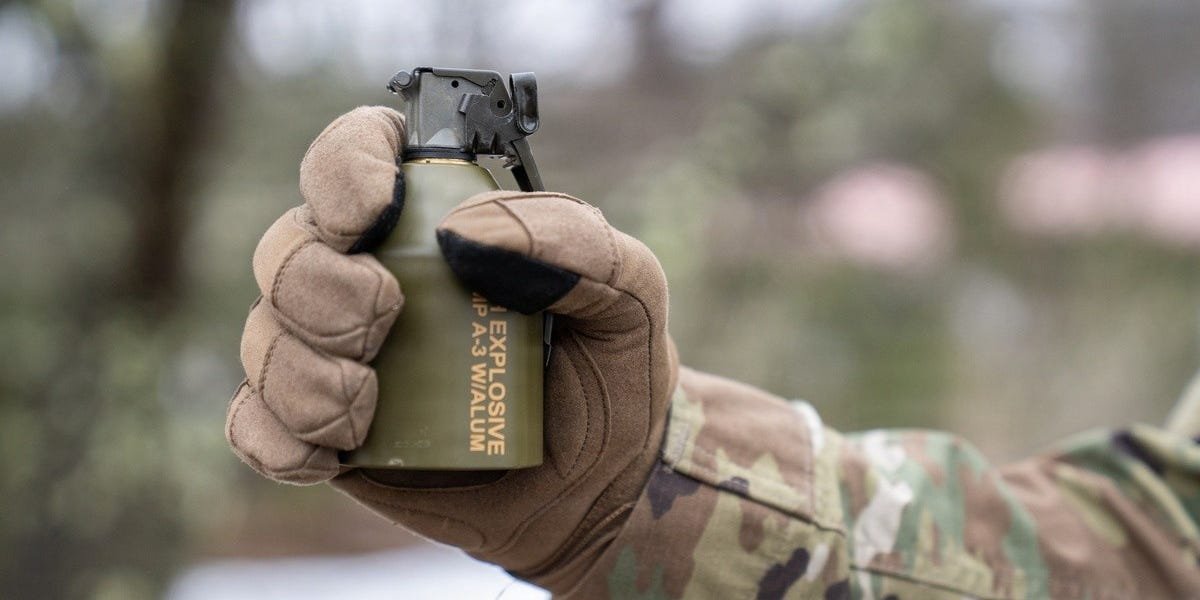
The Army cleared the new M111 Offensive Hand Grenade for full production this week. The new blast overpressure grenade is replacing the now-obsolete MK3A2 grenades, which were first adopted by the military in 1968, around the same time as the M67 fragmentation grenade.

The Capabilities Program Executive Ammunition and Energetics, together with US Army Combat Capabilities Development Command Armaments Center at Picatinny Arsenal, developed the new hand grenade, the first for the Army since Vietnam.

The M111 is made of plastic that is consumed during detonation. The older MK3A2 blast/concussion grenades, on the other hand, were made from asbestos, a carcinogenic substance that forced the service to put restrictions on the use of these grenades. The old M67 grenades are still in use.

The value of having a blast overpressure grenade is that it decreases the risk of unintentional fratricide, the accidental killing of one’s own troops at war, during close-quarters combat, but the limitations on the use of the MK3A2 meant soldiers only had the fragmentation M67 available to them in combat.

The M67 grenade propels metal fragments outward in all directions when it explodes. In tight indoor spaces like rooms or hallways, those fragments can bounce off walls or be blocked by furniture, reducing effectiveness and potentially hurting friendly troops.

The M111 grenade, similar to the MK3A2, works differently, instead producing a powerful blast and pressure wave less likely to be stopped by walls or obstacles, making it more effective inside buildings and other confined spaces.

“One of the key lessons learned from the door-to-door urban fighting in Iraq was the M67 grenade wasn’t always the right tool for the job. The risk of fratricide on the other side of the wall was too high,” said Col. Vince Morris, the Army project manager for close combat systems, in a service press statement.

Using blast overpressure instead, “can clear a room of enemy combatants quickly leaving nowhere to hide while ensuring the safety of friendly forces,” he said.

Soldiers can still use the M67 fragmentation hand grenade in open terrain, the statement said, but should rely on the newer version for “enclosed and restricted terrain.”

Blast overpressure weapons can be harmful for troops using them, and the US military has been grappling with the effects of these systems. Service members, as a result of their continuous work with artillery, breaching charges, and other heavy weaponry, have suffered traumatic brain injuries, which can come with debilitating effects.

The Army, along with other services, has sought to mitigate these risks.


Source link

The-US-Army-wants-to-see-if-it-can-get.jpeg

The US Army wants to see if it can get robots to rescue wounded troops like they’re doing in Ukraine

In a fight against a formidable enemy, there’s no guarantee medical evacuation crews will be able to reach wounded troops. Facing this possibility, the US Army is looking at using ground robots instead to get injured troops off the battlefield.

The Army’s 2nd Cavalry Regiment is drawing hard-won lessons from the war in Ukraine, where drones and artillery have made any battlefield movements extremely high-risk.

“When we’re looking at the conflict in Ukraine specifically, most of the use cases for unmanned ground vehicles have actually been in the sustainment and logistics,” said Maj. Andrew Kang, the fire support officer for the 2nd Cavalry Regiment.

That work includes casualty evacuations, Kang told reporters during a media roundtable last Friday, sharing that the regiment’s soldiers are providing industry partners with feedback during testing through the xTech innovation program.

The 2nd Cavalry Regiment, an Army Stryker brigade permanently based in Europe, would serve as a critical American combat force in a major conflict on the continent. The unit has been outfitting its soldiers with counter-drone systems through the Army’s Transformation in Contact 2.0 initiative, a force-wide push to more quickly adopt new technologies, and leaning into using uncrewed systems to its advantage.

The unit has trained Ukrainian troops cycling on/off the battlefield on American equipment, but concurrently with the training, the unit has become a sort of test bed for helping senior US leaders understand what troops will need in a future fight, experimenting with new technologies and tactics.

“During the training,” Col. Donald Neal, the 2nd Cavalry Regiment commander, said, “we learned a lot about their use of what we refer to as the triad: Unmanned Aerial Systems (UAS), counter-UAS operations, electronic warfare, and the network that enables all of it.” Those, however, aren’t the only lessons.

The Ukrainian battlefield has proven to be exceptionally grueling for casualty evacuations, a stark contrast to the quick evacuations on which American troops could rely during the wars in Iraq and Afghanistan. In Ukraine, helicopters are vulnerable to short-range air defenses, while medical teams and vehicles are haunted by drones.

That’s where the robots come in.

Ukrainian soldiers have been using uncrewed ground vehicles, or UGVs, for offensive missions. These operate like rugged flatbed trucks without a driver, and Ukraine has mounted machine guns and other weapons on them to attack Russian forces. Ukrainian troops also use them as mine-layers, scouts, and vehicle-borne improvised explosive devices.

Casualty evacuations, though, are proving to be a particularly critical area where these robots can help mitigate risk to medics.


Col. Donald Neal, Regimental Commander, 2d Cavalry Regiment.

Col. Donald Neal, Regimental Commander, 2d Cavalry Regiment, spoke at the same roundtable event.

U.S. Army photo by Sgt. Tien Dat Ngo


While aerial drones have been revolutionary for warfare, a trend that is continuing to expand abroad in the new US war in Iran, the uncrewed ground vehicles have been slower to proliferate.

Of the hundreds of thousands of Ukrainian drone missions that were executed last year, only 2,000 were UGVs. It’s more difficult to remotely drive them across varied terrain, but they offer the ability to move much larger payloads. For casualty evacuation and logistics, the ability to carry more is invaluable.

Rather than risk more injuries by sending medics forward, soldiers can send a UGV to pick up a wounded soldier. It’s an imperfect solution, as a wounded soldier has to be able to pull themselves onto the vehicle. Many UGVs are also susceptible to electronic interference and simple drone-spotting. These systems have, however, proven effective at getting troops off the battlefield, even surviving attempts to eliminate them by enemy forces. It’s another tool in the kit.

UGVs may also prove useful as decoys or sensors in areas too risky for troops, Neal said during Friday’s roundtable, and for boosting communications networks as mobile relays.

“Potentially, we see the biggest bang for our buck in utilizing them for things like breaching,” Kang added.

Breaching fortified enemy positions is one of the most dangerous jobs on the battlefield, requiring specialized combat vehicles to clear mines and cross obstacles while under fire. In Ukraine, breach operations have proven costly, with delays hindering breakthroughs and preventing armored formations from moving forward.

“Now, instead of having a manned formation go to the breach point, we could potentially load an explosive on a [remote-control] car-type platform and drive,” Kang said. The vehicle could blast a path forward for combat vehicles like 2nd Cavalry’s Strykers, wheeled armored fighting vehicles equipped with a mix of armaments.

One of the biggest challenges for the Army as it explores UGVs is the high price tag for some systems, Kang said. The platforms vary dramatically in cost, he said. While some more expendable versions are under $1,000,some cost almost $1 million.

“The cheaper the better,” Neal said of the affordability of ground robots. “In most uses for unmanned ground vehicles, we know we’re going to put them in a position where we’re not going to recover them, or they’ll be destroyed.”


Source link

What-happened-after-Elon-Musk-took-the-Russian-army-offline.jpeg

What happened after Elon Musk took the Russian army offline

This story originally ran in Welt and appears on Business Insider through the Axel Springer Global Reporters Network.

“All we’ve got left now,” the Russian soldier said, “are radios, cables and pigeons.”

A decision earlier this month by SpaceX to shut down access to Starlink satellite-internet terminals caused immediate chaos among Russian forces who had become increasingly reliant upon the Elon Musk-owned company’s technology to sustain their occupation of Ukraine, according to radio transmissions intercepted by a Ukrainian reconnaissance unit and shared with the Axel Springer Global Reporters Network, to which POLITICO and Business Insider belong.

The communications breakdown significantly constrained Russian military capabilities, creating new opportunities for Ukrainian forces. In the days following the shutdown, Ukraine recaptured roughly 77 square miles in the country’s southeast, according to calculations by the news agency Agence France-Presse based on data from the Washington-based Institute for the Study of War.


Three men sitting at brown desks in military fatigues

Analysts in Ukraine’s Bureviy Brigade eavesdrop on Russian communications from an underground listening post in northeastern Ukraine.

Viktor Lysenko/BI


SpaceX began requiring verification of Starlink terminals on Feb. 4, blocking unverified Russian units from accessing its services. Almost immediately, Ukrainian eavesdroppers heard Russian soldiers complaining about the failure of “Kosmos” and “Sinka” — apparently code names for Starlink satellite internet and the messaging service Telegram.

“Damn it! Looks like they’ve switched off all the Starlinks,” one Russian soldier exclaimed. “The connection is gone, completely gone. The images aren’t being transmitted,” another shouted.

Dozens of the recordings were played for Axel Springer Global Reporter Network reporters in an underground listening post maintained by the Bureviy Brigade in northeastern Ukraine. Neither SpaceX nor the Russian Foreign Ministry responded to requests for comment.

“On the Russian side, we observed on the very day Starlink was shut down that artillery and mortar fire dropped drastically. Drone drops and FPV attacks also suddenly decreased,” said a Ukrainian aerial reconnaissance operator from the Bureviy Brigade who would agree to be identified only by the call sign Mustang, referring to first-person view drones. “Coordination between their units has also become more difficult since then.”

The satellite internet network has become a crucial tool on the battlefield, sustaining high-tech drone operations and replacing walkie-talkies in low-tech combat. Since Russia’s February 2022 invasion, which destroyed much of Ukraine’s traditional communications infrastructure, Western governments have provided thousands of the Starlink units to Kyiv.


A man in military fatigues with a Ukrainian flag on his shoulder.

At some point, it felt like the Russians had more devices than we did,” said a Ukrainian soldier identified by the call sign Mustang

Viktor Lysenko/BI


Walkie talkies under red light on a shelf

Viktor Lysenko/BI


With the portable terminals, there is no need to lay kilometers of cable that can be damaged by shelling or drone strikes. Drone footage can be transmitted in real time to command posts, artillery and mortar fire can be corrected with precision, and operational information can be shared instantly via encrypted messaging apps such as Signal or Telegram.

At the outset of the Russian invasion, Starlink access gave Ukraine’s defenders a decisive operational advantage. Those in besieged Mariupol sent signs of life in spring 2022 via the backpack-size white dishes, and army units used them to coordinate during brutal house-to-house fighting in Bakhmut in 2023.

Satellite internet became “one of, if not the most important components” of Ukraine’s way of war, according to military analyst Franz-Stefan Gady, an adviser to European governments and security agencies who regularly visits Ukrainian units. “Starlink constituted the backbone of connectivity that enabled accelerated kill chains by helping create a semi-transparent battlefield.”

The operational advantages of Starlink did not go unnoticed by Russian forces. By the third year of the war, Starlink terminals were increasingly turning up in Russian-occupied territory. One of the first documented cases surfaced in January 2024 in the Serebryansky forest. Month by month, Ukrainian reconnaissance drones spotted more of the devices.

The Ukrainian government subsequently contacted Musk’s company, urging it to block Russian access to the network. Mykhailo Fedorov, then digital minister and now defense minister, alleged Russian forces were acquiring the devices via third countries. “Ukraine will continue using Starlink, and Russian use will be restricted to the maximum extent possible,” Fedorov pledged in spring 2024.

Yet Russian use of the terminals continued to grow throughout 2025, and their use was not limited to artillery or drone units. Even Russian infantry soldiers were carrying mini Starlink terminals in their backpacks.

“We found Starlink terminals at virtually every Russian position along the contact line,” said Mustang. “At some point, it felt like the Russians had more devices than we did.”

In the listening post this month, he scrolled through more than a dozen images from late 2025 showing Russian Starlink terminals set up between trees or beside the entrances to their positions.

“We targeted their positions deliberately,” Mustang continued. “But even if we destroyed a terminal in the morning or evening, a new one was already installed by the next morning.”

In the Russian-occupied eastern Ukrainian city of Kreminna, there was even a shop where soldiers could buy Starlink terminals starting in 2024. According to Ukrainian officials, these devices were not registered in Russia.

SpaceX’s move in early February to enforce a stricter verification system effectively cut off unregistered Starlink terminals operating in Russian-occupied areas. Only devices approved and placed on a Ukrainian Ministry of Defense “whitelist” remained active, while terminals used by Russian forces were remotely deactivated.

“That’s it, basically no one has internet at all,” a Russian soldier said in one of the messages played for Axel Springer reporters. “Everything’s off, everything’s off.”

The temporary shutdown allowed Ukraine to slow the momentum of Vladimir Putin’s forces, although the localized counteroffensives do not represent a fundamental shift along the front. Soldiers from other Ukrainian units, including the Black Arrow battalion, confirmed the military consequences of the Starlink outage for Russian forces in their sectors in interviews with the Axel Springer Global Reporters Network.

By mid-February, Russian shelling had increased again, though largely against frontline positions that had long been identified and precisely mapped — suggesting that Russia has yet to fully restore all of its lost capabilities.

Now, analysts from the Bureviy Brigade say Russian forces are scrambling for alternatives. They have been forced to rely far more heavily on radio communication, according to Mustang, which creates additional opportunities for interception.

Russian units will likely attempt to switch to their own satellite terminals. But their speed and connection quality are significantly lower, Mustang says. And because of their size, the devices are difficult to conceal.”The shutdown of Starlink, even if only of limited effect for now, highlights the limited ability of the Russian armed forces to rapidly implement ongoing cycles of innovation,” said Col. Markus Reisner of the Austrian Armed Forces. “This could represent a potential point of leverage for Western supporters to provide swift and sustainable support to Ukraine at this stage.”

Ibrahim Naber is a chief reporter at Welt.


Source link

Headshot of Chris Panella.

US Army leaders say soldiers are drowning in so much battlefield data that AI is needed to make sense of it all

Army leaders say the modern battlefield is so saturated with sensors and networked weapons generating more data than soldiers can realistically process on their own that artificial intelligence is needed to meaningfully sort it all.

For years, the Army’s focus was on fielding more sensors for battlefield information and awareness, but now the service is also having to think about information overload and managing the massive amounts of data coming in.

During a recent US Army and NATO exercise in Europe, troops used a homegrown AI system to consume and sort data. The value wasn’t strictly that the AI could do it faster but rather that it could remember context and patterns that humans couldn’t.

The case from the Dynamic Front exercise is another example of how the US military is increasingly implementing AI and automation into everything from enemy attack simulations to paperwork.

“The modern battlefield, what we’re already seeing across the globe, it is swimming in sensors, and we are drowning in data,” Col. Jeff Pickler, the Army 2nd Multi-Domain Task Force commander, said at a media roundtable on Dynamic Front.

There aren’t enough people to decipher all the available information, he said. “They will never be able to fully process all of that.”


Two soldiers stand near an artillery piece about to fire in a wintry landscape.

This year’s Dynamic Front included almost 2,000 US personnel and almost 4,000 personnel from allies and partners.

US Army photo by Kevin Sterling Payne


The software aimed at addressing that problem remains in beta testing. In the next iteration of Dynamic Front — which will merge with another exercise, Arcane Front, to pair technology experimentation with theater-level combat rehearsals — Army leaders say they intend to test the AI at a larger scale.

“If we’re looking at a target set in the European theater where we think we’re going to need to process upwards of 1,500 targets a day, that’s beyond the human scope,” Pickler said. “The answer to the equation there is in AI and automations.”

During a potential large-scale conflict in Europe, AI could assist in locating and assessing those targets.

The system can do this quickly, but the speed isn’t the main benefit. AI can remember patterns that humans might forget or not even notice. Pickler gave an example of AI realizing that unrelated shipping reports, a local power outage, and a fertilizer delivery together might suggest missile fueling activity.

“So the difference isn’t seconds versus minutes — it’s minutes instead of months. Not because the machine scans quickly, but because it keeps context across sources that humans can’t hold in memory,” Pickler said after the roundtable.

“It doesn’t replace analysts by reading faster,” he said, “it replaces the weeks analysts spend reconnecting information spread across thousands of reports.”


Two soldiers sit at a table working on laptops.

AI, autonomy, and machine learning are at the forefront of the Army’s modernization efforts.

US Army photo by Capt. Regina Koesters


In a conflict scenario, that could mean analysts reach a clearer picture of the battlefield faster. Correlations between data gathered from different sensors could surface more quickly. If an adversary were fueling, arming, or moving weapons in ways that were not immediately obvious, AI could help flag those links.

Humans, though, would still decide how to respond.

Soldiers have seen success with iterating on the current AI model, the Army said. It’s been retooled during testing, and humans remain in the loop, reviewing outputs at multiple stages.

The goal is to continue increasing the overlap the model would have with human-produced information. In a targeting example, a milestone would be if AI achieved 90 to 95% agreement with humans on 100 target sets.

The Army’s push for AI and automation is also driving the development of its Next Generation Command and Control software, a priority initiative.

The technology being developed by vendor teams including Anduril, Palantir, and Lockheed Martin uses AI and machine learning to provide commanders and soldiers with real-time data on ammunition levels, maintenance needs, intelligence feeds, targeting, and simulated enemy attacks.

But AI is also changing other aspects of how the Army works. Autonomous features in drones, weapons, and targeting might be at the forefront, but behind the scenes, personnel are using new tools, redesigned workflows, and data integration for recruiting, maintenance, and inventors. These are manual tasks that the service believes can be improved with AI.


Source link

Headshot of Chris Panella.

A US Army general says new command tech lets him ditch the ‘hourlong staff meeting’

New US Army warfighting software is speeding up and simplifying the command job, a commander said recently, sharing that it lets him scrap the “hourlong staff meetings” to make decisions.

The Army, like other services, believes that future wars will be determined by the speed of decision-making. That’s where the new Next Generation Command and Control, or NGC2, program is expected to make a substantial impact and modernize how the service fights.

At Fort Carson, Colorado, the Army’s 4th Infantry Division has been testing NGC2 in a series of exercises. The most recent one, Ivy Sting 4, added more components to the system, with different types of sensors and weapons on the battlefield feeding into one system that everyone can access.

“So it’s all in one place, and it’s there very, very quickly, so that the staff can see it across their functional systems,” said Maj. Gen. Patrick Ellis, commander of the 4th ID, at a recent media roundtable, explaining that “the fires person can see what the logistician sees, can see what the intel person sees.”

“I don’t have to have the hourlong staff meeting anymore,” the general said.


Soldiers stand around an artillery piece preparing to fire it in a field.

The Army’s new NGC2 system is predicting supply needs and simulating enemy actions.

US Army photo by Pfc. Thomas Nguyen


“If we’re actually using the technology as the tool that we’re prepping on and that we’re also fighting on,” he said, “I could sit there, I can look at it, I can make decisions, I can say, ‘Hey, here are my priorities for this or that.’ We all agree on it, we click save, and that’s done.”

The Army has facilitated the development of NGC2 with both the 4th ID and 25th Infantry Division in Hawaii and industry teams, including Anduril and Lockheed Martin, pursuing a Silicon Valley-style approach aimed at moving faster and rapidly integrating soldier feedback, delivering fixes immediately rather than months or years later.

On the heels of Ivy Sting 4, more than two weeks of field testing that involved live-fire exercises and an electronic warfare jamming scenario, Ellis and others said that NGC2 was making planning and executing battlefield missions more effective.

“We are no longer fighting with the network; we are now fighting using the network,” Ellis said.

During the Ivy Sting 4 testing event, 20 different types of sensors, such as drones, electronic warfare systems, artillery, and Stryker vehicles, were linked together.


A soldier holds up a radio to his mouth and holds a notebook. He's standing in a mountainous location.

The latest live-fire exercise included a variety of systems, weapons, drones, and capabilities.

US Army photo by Staff Sgt. Dane Howard


Data and artificial intelligence capabilities provide real-time information on the sensors. Soldiers can see how much ammunition they’ve got left or whether a Stryker will need maintenance or fuel soon. Simulations can predict what resources will be needed for certain tactics or actions, including different ways an enemy might attack.

As different platforms are brought onto NGC2, broadening what the platform can do, Army command and soldiers can see and communicate using the same data. The system is breaking down the silos that have previously hindered information flow.

“I’m feeling empowered as a commander to make more, better, and faster decisions because I’ve got access to all that data,” Ellis explained.

Many NGC2 components are being built with off-the-shelf technology and standard commercial software practices, and the vendor teams involved are working on the ground with soldiers. The closer working relationship means soldier feedback is being incorporated more quickly.

“We work through these obstacles, and we learn how to do something, and once we run into a roadblock, we figure out a way to solve that problem, and then that problem is now solved for the Army,” he said. “We’re not relearning these lessons over and over again.”


Source link