

Amanda Krause headshot

A woman spent $25 on a quirky cat statue at an estate sale. It turned out to be an Italian art piece worth $3,000.

When Jordan Piluso went to a New Jersey estate sale in late January, she had one goal: to purchase a porcelain rabbit from the designer brand Herand.

She’d learned about the sale online and viewed photos of the items available. She didn’t plan to buy any other decorative animals.

But her mission quickly changed.

“When I walked into the house, this [ceramic] cat was sitting on a piano right in the entryway,” the 34-year-old stay-at-home mom told Business Insider. “No one was looking at it, so I just grabbed it. I thought it was such a whimsical, out-there decor piece, and that’s my style.”

She later purchased the $25 cat decoration, along with a few other pieces. She didn’t know it at the time, but her secondhand find was actually an Italian art piece from Fornasetti.

“I love very eclectic, conversational pieces, and I just thought: I’ve never seen anything like this cat,” she added.


Jordan Piluso and the Fornasetti cat she bought at an estate sale.

Jordan Piluso and the Fornasetti cat she bought at an estate sale.

Jordan Piluso


Hidden in plain sight

When Piluso purchased her cat statue, she didn’t immediately look for markings or a signature indicating the artisan who made it.

“I picked it up and was like, ‘You’re coming with me,'” she said. “It was just a no-brainer.”

The people running the estate sale were equally unaware of its origins.

“They were just happy to get rid of it,” she said.


The Fornasetti cat decor piece that Jordan Piluso bought at an estate sale.

The Fornasetti cat that Jordan Piluso found at an estate sale.

Jordan Piluso


It wasn’t until Piluso got home and did a Google image search that she realized it might be valuable. She saw photos of similar cat pieces by the Italian artist Piero Fornasetti and noticed that each had a stamp at the base of its tail.

Sure enough, her cat statue has one too. It reads “Fornasetti Milano, Made in Italy” and features an image of a hand holding a paintbrush.


The Fornasetti stamp on the ceramic cat purchased by Jordan Piluso.

The Fornasetti stamp at the base of the cat statue.

Jordan Piluso


Cats have been a signature motif for the late artist and his brand for decades.

Its modern feline pieces retail between $73 (€62) and $2,353 (€2000) each, while vintage cat statues like Piluso’s have sold for upward of $2,500 on secondhand sites.

Piluso confirmed with the brand via email that it’s authentic and was hand-painted between the late 1950s and early 1960s. Business Insider reviewed the email exchange.

Ken Farmer, an antique and fine-art appraiser, told Business Insider that Fornasetti created over 13,000 designs during his career and aimed to bring art into ordinary homes.

“This playful, smiling cat ceramic figure with black leopard spots on a white field, circa 1960, is likely worth $1,000 to $1,500 at auction and $3,000 retail,” he said.

Valuable, but priceless

The potential profit she could gain from her Fornasetti piece doesn’t matter much to Piluso. She has no intentions of selling it.

“It’s something that brings me so much joy,” she said. “I’m always going to be able to talk about this when people come over. I can tell my kids the story someday.”

“To me, that is a far more valuable gift than the monetary value this cat could bring,” she continued.

Her husband, a dog person, was less convinced that they should keep the decor piece when Piluso originally brought it home. However, he’s since come around, she said.

The couple is keeping the ceramic cat, which doesn’t have a name, on a tall mantle out of reach of their toddler.

Secondhand treasures

Don’t worry — Piluso didn’t leave the estate sale without the pink-and-gold embellished bunny she had initially gone there for.

She purchased the rabbit piece for $600 and a ceramic tiger for $50 — both of which will be displayed prominently in her home.


The ceramic pieces Jordan Piluso bought at an estate sale.

The decor pieces Jordan Piluso bought at a recent estate sale.

Jordan Piluso


Piluso said she’s relatively new to shopping secondhand. She was looking for a hobby after having her second child, and eventually landed on decorating her home with vintage pieces.

She said she loves the charm vintage decor adds to her home and the stories she can share with guests. That’s why her husband encouraged her to create a TikTok account to share her finds with a wider audience.

And clearly, she’s a natural at finding hidden gems.

“When you go to estate sales or thrifting, don’t be afraid of the oddities,” she said. “They can be the coolest, and in this case, some of the most valuable things you can find.”


Source link

My-kids-went-to-an-outdoor-elementary-school-with-no.jpeg

My kids went to an outdoor elementary school with no art, music, or library. They loved it, but adjusting to public school was hard.

In 2019, my 5-year-old son and 4-year-old daughter were excited to start their first year of public school. But like millions of students in March of 2020, they never got to finish the school year.

The COVID pandemic closed the classrooms, forcing my husband and me to rethink how we wanted to handle our children’s education. An outdoor learning school at The Learning Tree, a local day care, became our solution.

The unique education exceeded our expectations in every way.

Why we chose an outdoor learning school

The pandemic made us nervous to send our kids back to school after summer break. We were told that if someone in their class contracted COVID, the entire class would shut down for two weeks. This wasn’t feasible for us as parents with full-time jobs, plus it would disrupt the learning experience for our kids.

That summer, the day care our kids attended prior to starting school announced a new opportunity: a K/1 program focused on interactive, accelerated education. It promised small class sizes (roughly 12 students per class), project-based and student-led learning, and academics balanced with outdoor activities and healthy habits.

Despite the $125 weekly tuition fee per child, we were sold on smaller classes, less exposure to others, and the included after-school care.

We enrolled our kids for the 2020-2021 school year: our daughter in kindergarten and our son in first grade. When the school added second grade the following year and then third grade the year after, we stayed.

We missed out on traditional opportunities, but gained so much more

We didn’t plan on sending our kids to a private program for most of their elementary school years. But after comparing what public school offered that The Learning Tree didn’t, and vice versa, the outdoor learning school was a no-brainer.


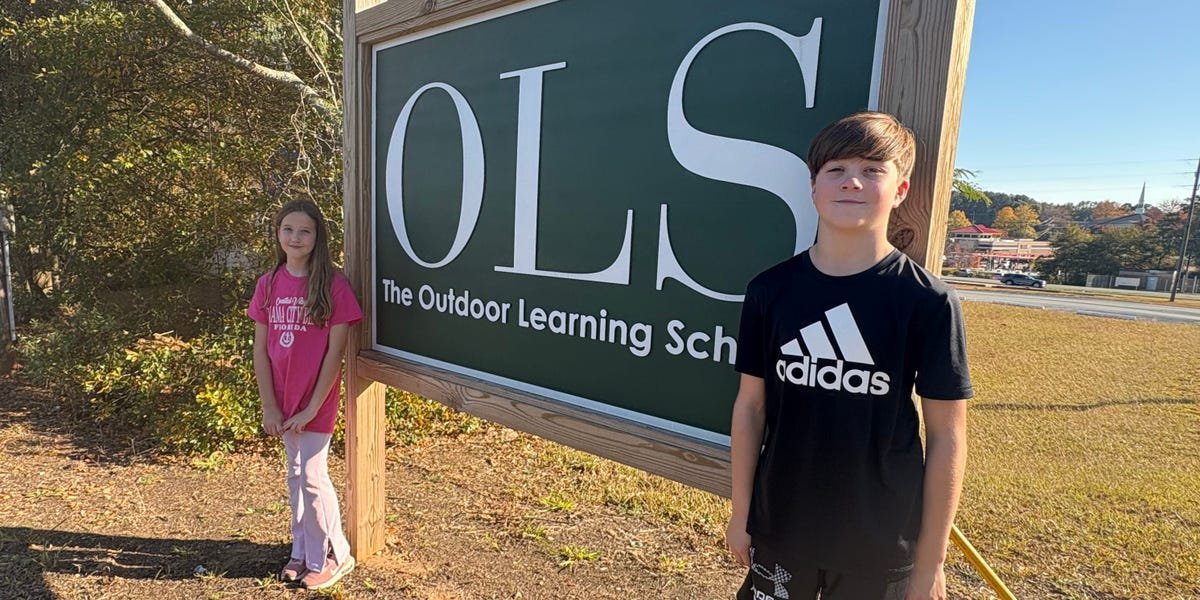
Alli hill's children at their outdoor learning school

The author’s kids loved their outdoor school.

Courtesy of Alli Hill


At The Learning Tree, there was no library, computer lab, or even a cafeteria. They didn’t have art, music, or gym classes. The playground was small, and there was no option for gifted testing.

However, they did have an in-ground swimming pool, and swimming was built into the curriculum during warm months. A mile-long nature trail and morning fitness exercises replaced the gym. Students helped to build gardens and grow food, which made its way into their lunches. Most notably, screen time was minimal — almost nonexistent.

There was also more parental involvement. We went kayaking on the river as part of a history lesson, and we always had special celebrations for Thanksgiving and Christmas.

Instead of reading math word problems, they acted them out in real time with things like farmers’ markets and food prep. Projects, not worksheets, were a focal point for each grade. And since students played a role in their own education and pacing, there was no need for a separate “gifted” curriculum.

Transitioning back to the ‘real world’ was a tough lesson

The original K/1 program added a new grade each year, up to fifth grade. However, we pulled our children out when they started fourth grade to give them time to transition back into public education before middle school. Where we live, fifth grade is at the middle school, and we felt like jumping from outdoor learning to a public middle school would be too stressful.

Both of our kids already had lots of friends in public school, so it wasn’t completely unfamiliar to them. Still, it was challenging.

They went from spending most of the day outside to getting only 20 minutes of recess. Classes were much larger, so they didn’t have the opportunity to learn at their own pace. They had more rules and a more rigid structure to follow. There was more sitting and busywork than they were used to.

They missed the kindness and genuine interest of their teachers at their old school. They also lacked the opportunities to guide their own education and pursue their own interests in the classroom.

While we loved our time at the outdoor learning school, all good things must end. Our kids gained a solid foundation of work ethic, self-discovery, and leadership that continues to help them in and out of the classroom, and we’d do it again in a heartbeat — pandemic or no pandemic.


Source link