I-dreaded-being-asked-what-I-did-for-fun-As.jpeg

I dreaded being asked what I did for fun. As a working mom, I didn’t have an answer.

For years, the question at the office every Monday, as I got coffee, was, “What did you do for fun over the weekend?”

This question made me want to crawl under the table. Not because I didn’t love small talk, but because as a young executive juggling a demanding job, two little kids, and the constant low-grade scramble of just getting through the day, contemplating this question after a long parenting weekend felt like a cruel joke.

I typically responded back with something lame like, “It was really nice, thanks,” and quickly turned the question back to them, which would be 1000% more interesting. Especially because I worked with talented designers, researchers, strategists, and futurists. Over the weekend, they definitely learned how to DJ, planned a trip to Costa Rica, and painted a mural for a local coffee shop.

My honest answer, never spoken out loud, would have been: “I watched my kids grind Play-Doh into the carpet, get into 10 fights, and devour all my berries. It was riveting.” Not exactly the best commentary for an early-morning office icebreaker.

If I’m being honest with myself, I was jealous. I missed having a fun response to the question.

I had artistic dreams

I have always been a creative person, ever since I was a kid with an artistic dream, glitter, and a glue gun. I would spend hours coming up with crafts, ride my bike to get supplies, design them with my friends for days, and eventually sell them on the sidewalk in my neighborhood. That creative spirit continued into my pre-parent life: painting, DIY home repairs, jewelry making, and throwing dinner parties.

Now that I’m in the self-proclaimed “middle motherhood” stage of parenting with more independent elementary- and middle school-aged kids, I have a bit more time on my hands. In this new stage of parenting, I want to be able to answer, “What do you do for fun?” with something unique and creative, honoring the little girl with paint-splattered overalls and big artistic dreams.

I started painting again

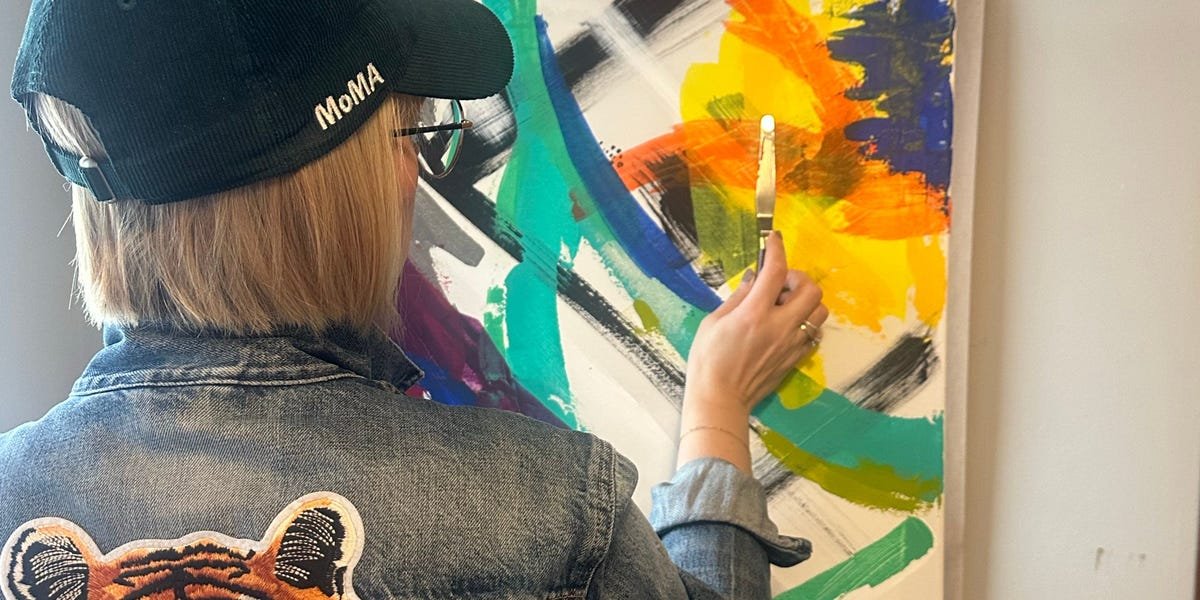
A few years ago, I started this quest to infuse more creativity into my life. Starting out small, I pulled out paintbrushes I hadn’t touched in a decade and found an easel on Facebook Marketplace. I set up in my office area, and my background became my painting progress. Being a mom and an executive, I couldn’t paint for hours at once. Instead, my painting sessions were 30 seconds between bathtime or 15 minutes during a lunch break. When I had a moment, I would take a couple of swipes with acrylic paint. Over time, the painting started to reveal itself.


Woman on computer camera

Courtesy of the author


At first, I was nervous about sharing my background art in Zoom meetings. What would my talented designer colleagues say about my mediocre, mom-ish, abstract artwork? But guess what: they loved it! It became a positive topic of conversation on calls. They would catch new strokes, comment on techniques I used, or provide advice when I was stuck.

Making something, even badly, felt like hitting a reset button in my brain. I felt more alive and calm at the same time. So I kept going, aiming for bite-sized creative bursts.

I kept doing creative little things

I took my creativity on the road, packing friendship bracelet supplies for my son’s travel baseball tournaments so my daughter and I could pass the time. Every once in a while, another feral sports sibling would join, and I played camp counselor, showcasing my superior bracelet-making skills.

For a girls’ trip, I brought paint gems — just like paint-by-numbers, but with sticky paper designs like plants and tiny plastic bits that stick to the paper. It’s an absolute joy, especially the ASMR effect of all those plastic pieces clicking into place. And afterward it became a family activity, our dining room table littered with gems.

Emboldened by these small creative steps, I took a leap to start writing again. I wrote to process my feelings about parenting, share my leadership experiences, and put my UW-Madison Journalism degree to good use.


Paintings in office

Painting made the author more patient. 

Courtesy of the author


My creative action was taking me to new heights, and I hadn’t realized how much I needed it.

Being creative helps me in ways I hadn’t thought of

I learned that when I give myself even tiny pockets of creative time, I’m more patient. I don’t feel as depleted. It turns out that making something, even if it takes time and isn’t outcome-driven, quietly brings me back to myself and makes me an even more present parent. In my opinion, parents should be doing it more, not less.

For a long time, I treated creativity like a luxury, even though it was part of my day job running a design and innovation studio. Sure, I could do it for clients and colleagues. But for myself, I treated it like something I’d return to when life slowed down.

The thing is, parenthood doesn’t really work that way. It never slows down.



Source link

Dan Whateley

Netflix’s Ted Sarandos says he asked Trump not to pursue movie tariffs. Here’s what he proposed instead.

Netflix co-CEO Ted Sarandos doesn’t think tariffs are the right way to boost US movie and TV production — and he thinks he’s gotten through to President Donald Trump on the issue.

“He has brought up tariffs for the movie and television industry many times, and I’ve hopefully talked to him the way out of them,” Sarandos said in a new interview with POLITICO, which, alongside Business Insider, is part of the Axel Springer Global Reporters Network.

Trump has been keen on using tariffs to encourage more filming in the US. In May, he announced on Truth Social a plan to impose a 100% tariff on films produced outside the US. He hasn’t implemented it so far.

Trump’s plan to add tariffs on foreign movies stemmed from a desire to slow production declines in Hollywood and other areas of the US that “are being devastated” by filming incentive programs abroad, he wrote in his May announcement on Truth Social.

Los Angeles production work has been dropping off for years, and the city’s media professionals are feeling the pain. Overseas filming hubs like London have been courting production work by offering big cost-saving incentives.

Sarandos said he’d prefer the US use similar tax incentives to bring filming back home.

“Healthy incentive programs attract a lot of production, and you’ve seen a lot of them move from California to Georgia to New Jersey,” Sarandos told POLITICO. “Having the incentives versus tariffs is much better.”

The tariff structure for a movie, which isn’t a physical good, isn’t entirely clear. A White House spokesman said in a statement shortly after Trump’s announcement that “no final decisions on foreign film tariffs” had been made and that the administration was “exploring all options to deliver on President Trump’s directive to safeguard our country’s national and economic security while Making Hollywood Great Again.”

A fee on foreign productions could become very expensive for Netflix, which has released a slate of international films and TV shows over the years, including “All Quiet on the Western Front,” “Squid Game,” and “Adolescence.”

Netflix’s global reach and its ability to turn a South Korean or German drama into a global hit have been key differentiators for the company, which is expected to spend as much as $20 billion on content this year.


Source link

I-asked-Taco-Bells-CMO-what-his-go-to-order-is.jpeg

I asked Taco Bell’s CMO what his go-to order is. I wasn’t ready for the hot-sauce count.

A person’s go-to Taco Bell order is a sacred thing.

Selena Gomez was eating a Mexican Pizza when Benny Blanco proposed. Jason Sudeikis grabbed two chicken tacos on the night his son was born. When Dolly Parton would go through the drive-thru on dates with her husband Carl Dean, she always ordered a Taco Supreme.

I’m partial to the Cantina Chicken burrito, and just last week, I convinced three different friends to try it during our 1 a.m. Taco Bell run (which somehow racked up to $117, but that’s another story).

So, when I recently sat down with Taco Bell CMO Taylor Montgomery, I knew I had to find out what his usual order is. Montgomery eats at the fast-food chain every other day, but his go-to hasn’t changed — nor has his wild hot-sauce count.


Taylor Montgomery and Benson Boone at Live Más LIVE,

Taylor Montgomery and Benson Boone at Live Más Live on March 3.

Courtesy of Taco Bell


“My order is still the same,” Montgomery, who has worked at Taco Bell for a decade, told me. “Crunchy tacos, one Fire sauce packet per bite. I have like 10 sauce packets per taco.”

“If I’m really hungry, it’s three tacos,” Montgomery added. “If it’s a normal day, it’s two.”

“Per bite!?” I asked. I’ve been known to rip through a few of Taco Bell’s hot and avocado verde salsa packets myself, but 10 was a whole new level.

“Oh yeah,” Montgomery replied. “You gotta go big. Fire sauce, only Fire.”

‘We truly are one of one’

While some fast-food brands have spent the past week trying to outdo each other with burger taste-test videos, Taco Bell has been focusing on the premiere of Live Más Live, an annual event where the chain unveils every new menu item it plans to release during the year.

Montgomery was originally inspired by Apple’s Worldwide Developers Conference when he helped launch the first Live Más Live in 2024. This year, the CMO knew he wanted to shake up the format.


Taco Bell Live Más LIVE 2026

Taco Bell Live Más Live 2026 took place at the Hollywood Palladium in Los Angeles.

Courtesy of Taco Bell


“We truly are one of one, just like Apple, just like Amazon, just like Tesla,” Montgomery said. “So I started to look at how some of those companies are behaving, and they are behaving like entertainment companies. That’s what consumers want. That’s what consumers’ expectations are.”

“That’s how Live Más Live, an unhinged night in Hollywood, was born,” he added.

Taco Bell hired the production team behind the Academy Awards, made a streaming deal with Peacock, and rented out the Hollywood Palladium in Los Angeles for a one-hour awards show on March 3. Celebrities like Sudeikis, Doja Cat, Benson Boone, and Demi Lovato were on hand to help announce the 20-plus new items coming to Taco Bell’s menu in 2026.


Taco Bell's Fire Queso Sauce Packet

Taco Bell’s Fire Queso Sauce Packet is an edible version of the famous hot-sauce packet.

Courtesy of Taco Bell


Montgomery said he hopes the event makes Taco Bell’s fans feel “seen and heard,” noting that the chain also listened to their pleas for more sweet treats.

“One of the most requested things we hear from our fans is, ‘I want more desserts at Taco Bell,'” he said.

Crème Brûlée Crunchwrap Sliders, Strawberry and Cream Mexican Pizza Bites, and chocolate fudge empanadas will all be coming soon, but Montgomery said the core of Taco Bell’s brand is still “crunchy, cheesy, saucy, spicy.” This year’s menu slate even includes an edible version of Taco Bell’s Fire hot-sauce packet.

The real question is, will Montgomery be using 10 of them per taco?


Source link

My-husband-asked-for-a-divorce-A-few-days-later.jpeg

My husband asked for a divorce. A few days later, we went on vacation together.

Last June, my husband came back from a long surfing trip and asked me for a divorce. I was stunned. Confused. Heartbroken.

By then, we’d been married for nearly seven years — June 15th would’ve been our seventh wedding anniversary. To celebrate it, I had organized a short getaway.

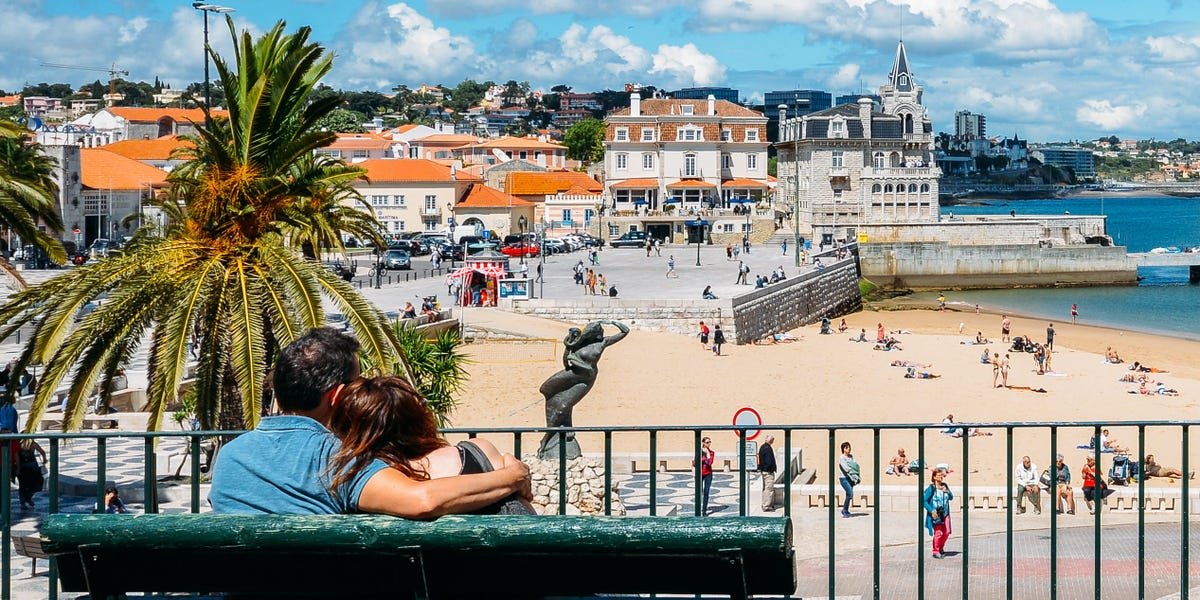
We’d stay in a five-star hotel in Cascais, a gorgeous seaside just outside of Lisbon. Our schedule was packed with fun stuff like a helicopter tour, high-end massages, and lunch at a Michelin-starred restaurant by the beach.

Everything was locked in, and it felt far too late to cancel. So, a few days after the bombshell request, we went.

Our ‘perfect’ getaway felt confusing, tense, and awkward


View of chairs around body of water in front of hotel

We stayed in a beautiful hotel right along the beach.

Alix Campbell


As we embarked on the three-and-a-half-hour drive to our hotel, I brought up all the exciting activities awaiting us whenever the silence became uncomfortable.

I had pictured our anniversary getaway completely differently. I thought we’d be in a happy cloud of not having seen each other for weeks, ready for a little romantic adventure.

Instead, we were stuck in this weird place. I didn’t fully understand what was going on between us, and he wasn’t fully able to communicate his feelings. Although he seemed to have made up his mind about splitting, I still believed we could work things out.

For most of our four-day trip, I tried to pretend that everything was fine, but, of course, I felt it wasn’t.

The usual silly banter between us felt forced. When we sat in a restaurant after a full day of activities, we giddily chatted about the fancy dishes being served to us, but when we walked back to our hotel post-meal, we were mostly silent.

To put a cherry on top of this awkwardness, the hotel surprised us with a bottle of Champagne and chocolate-covered strawberries on the date of our anniversary. I didn’t know whether to laugh or cry as a staff member wheeled these goodies into our room.

The connection between us still felt undeniable — there were still the inside jokes we’d curated over the years, that familiarity, and a feeling of safety that I’d taken for granted over the years.

We both seemed to cycle through a bunch of emotions, ping-ponging between feeling like strangers wildly attracted to each other (especially after a few cocktails) and a couple grappling with the fact that their relationship was broken.

By the time we got home, it was clear that we’d take some time apart. He moved out and stayed with friends, while I remained in our home looking after our cats.

Looking back, I don’t regret going on the trip


Table set for dinner with view of beach behind it

Our Michelin-starred dinner was delicious, even if it was a bit awkward.

Alix Campbell


A few months after our vacation, we finally sat down together and really talked.

Having had more time to let everything settle, I reflected on our vacation during this turbulent time. I realized it was OK for me to feel confused in the middle of a breakup.

I could acknowledge that although we laughed and had romantic moments, I felt disillusioned. I felt nostalgic, but I also noticed a rift between us that made me incredibly sad.

He’d lost himself along the way as our relationship progressed, and whenever I noticed him withdrawing I wouldn’t dig too deep because I was afraid he’d tell me something I didn’t want to hear.

The pressure built up, and this lack of communication led to the very issues we were trying to avoid: Me, being left, and him, having to deal with all of these emotions instead of running from them.

Going on this trip was weird and uncomfortable; a desperate attempt to “fix” us. It didn’t. Instead, it provided the confined space away from home we needed to be confronted with issues we most likely would’ve kept avoiding.

In Cascais, I didn’t know where our relationship would end up. Now, we’re working on finalizing our divorce, and believe it or not, we’re on good terms.

I’m glad we went on the trip.


Source link

Someone-asked-to-switch-our-business-seats-on-a-plane.jpeg

Someone asked to switch our business seats on a plane. I said yes, and got to take photos with one of my favorite celebrities.

This as-told-to essay is based on a conversation with Denny Balmaceda. It has been edited for length and clarity.

In February, I boarded my plane that would fly from Newark Airport in Jersey City to San Francisco. My business-class seat had been booked by a clothing brand I had been working for at the time. My seat on row 11 was a window seat with my own little nook, a treat for me, who usually flies in the economy seats.

As I settled in, neatly arranging my things in the compartment above my head and around my seat, a woman I didn’t recognize kindly asked if I would mind switching seats with her so she could sit next to her husband.

I quickly said, “Sure.” I know that in economy, this kind of question can produce mixed feelings, because if you’ve booked a window seat, you’re not going to want to switch to a middle seat. But in business class, all the seats are good, so I didn’t mind.

I hadn’t realized who her husband was

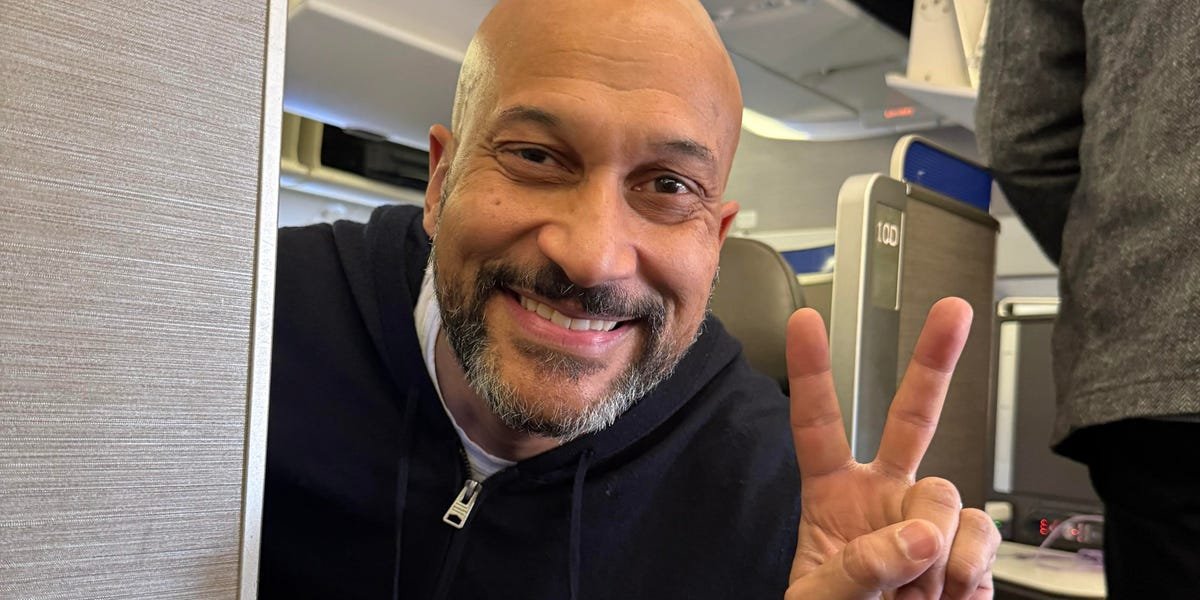
Just as I responded to her request, I looked up and saw Keegan-Michael Key. I was switching seats with his wife, so she could sit next to him. She continued, explaining she thought she had booked them to sit next to each other.

I took her seat in row 10, and she took mine in row 11.

So not only did I get to travel in business class — already a lot of fun for me — I also got to travel in front of a celebrity that I absolutely love. He’s literally one of my favourite actors.


Keegan-Michael Key on a plane

Denny Balmaceda sat right in front of Keegan-Michael Key on a plane.

Courtesy of Denny Balmaceda


His wife leaned over and said Key would be happy to take a photo with me. He did, and he was so nice. Throughout the flight, he was the same with everyone who came up to him — a real gentleman.

He was so nice

Every single person who came up to him got his time and never once seemed annoyed. He talked to everyone and let people take photos with him.

When his wife needed help with anything, he helped.

And as the flight came to an end, I asked if he could grab my bag, and he didn’t flinch — he was fine with it.

There was no sense that he thought he was above anyone on that plane. He was just a real person who happened to be a celebrity.

Working in the fashion industry, I know there are both celebrities who are rude and those who just have bad days. I know that sometimes, people just want to be themselves without the fame. They just want to travel on planes and not be recognized. But he didn’t fit into any of these categories.

After the flight landed and before we went our separate ways, I took a couple of photos of us together to show my wife.

It was a one-in-a-million chance that I’d switch seats with someone famous, and I was very happy and surprised to get to experience it.


Source link

After-Jeff-Bezos-bought-the-Washington-Post-things-went-great.jpeg

After Jeff Bezos bought the Washington Post, things went great — for a while. I asked an insider what happened.

Lots of people are angry at Jeff Bezos because of the massive cuts he’s ordered at his Washington Post. But a decade ago, Bezos was widely celebrated for his ownership of the Post, which he had bought for $250 million in 2013.

Under Bezos’ ownership, the Post made huge investments in tech and staff. And readers loved the results — especially during the first Trump era, when the paper turned profitable.

Now things are very different: The Post says it has been losing gobs of money for the past few years, and Bezos has made a series of moves interpreted as a shift toward Trump — which spurred reader revolts, which made things even worse. And all of that led to this week’s cuts.

I talked to Erik Wemple, a New York Times media reporter who previously worked at the Post for 14 years, to try to reconcile the two eras of Bezos and the Post, and to get a sense of what might happen next. You can hear our entire chat on my Channels podcast; what follows is an edited excerpt from our conversation.

Peter Kafka: What shape was the Post in when Bezos bought it in 2013?

Erik Wemple: The Graham family, which had owned the Post forever, was an amazing steward for the paper. But they had to scale back their newsroom, because the internet had blown holes in classified ads. Classifieds used to be huge at The Washington Post.

At the time Bezos bought it in 2013, it was not dysfunctional. These were really good journalists, but the paper was in a bit of a funk. It wasn’t a reclamation project, but it had seen better days.

It was faded when he bought it.

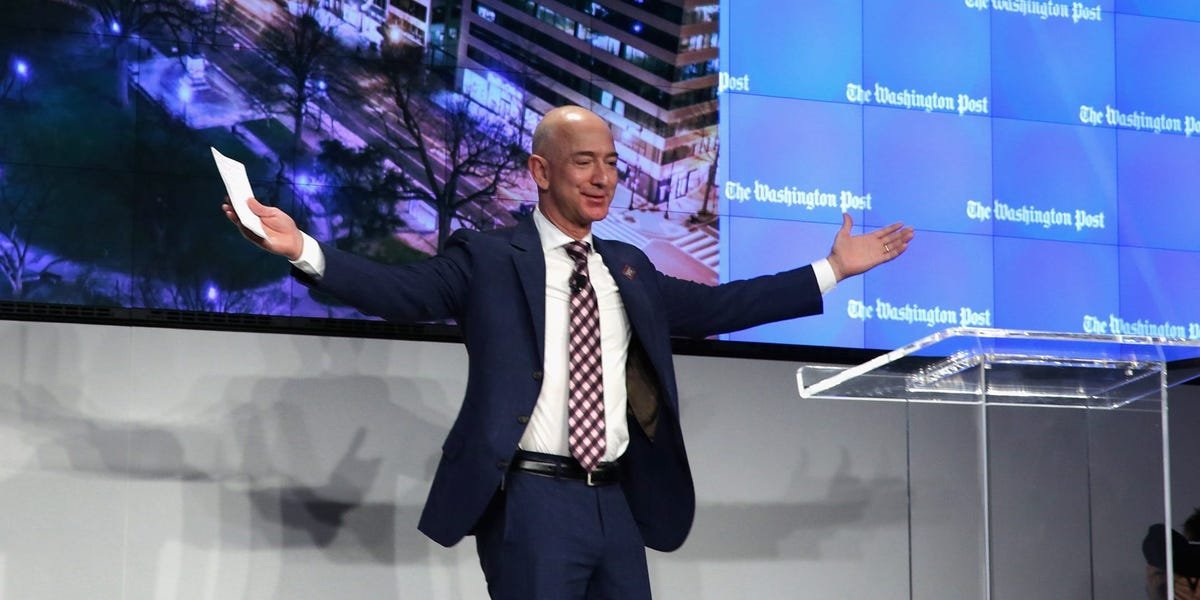
Correct. And when Bezos came in 2013, he really wowed the staff. We all asked him questions. He answered those questions with tremendous enthusiasm and competence. He seemed really energized by this.

What did he think he was going to do?

When he came in, he was energetic, but deferential on the particulars of running the newspaper. He’s like, “You know what? I’m not in this business, but I do know how to organize discussions about the future of a business.” And that’s what he did. I was in one of them; it was really remarkable.

He had these things that he believed in. He was important in guiding conversations. And it was really remarkable because he backed it up with money. He invested in the newspaper. He invested in political coverage, big time. Investigative went up. International got a huge, huge boost. And the technology did too.

This is exactly what you want from your billionaire tech owner: Give us a bunch of money. Improve our tech. Also, stay away. Don’t tell us what to do.

That was exactly the sentiment. And one of the things you mentioned in there is really worth pausing on for a second, which is the lack of intervention, the lack of meddling. He just sort of looked on. And the newsroom really, really, really roared. Especially in the first Trump period.

So not only does this produce great journalism, it seems like it becomes a business success story — the paper becomes profitable again. Then, after Trump left the White House, there was a lot of hand-wringing about what happens after the Trump bump. People expected audiences to decline across lots of different publications, and that happened, so it makes sense that the Post would struggle a bit. But the numbers you hear about the reported losses — $77 million in 2023, $100 million in 2024 — are staggering. I still don’t understand how you can swing to losses like that just because your traffic goes down. What am I missing?

I share your knowledge gap.

One of the things that has been reported and pretty well substantiated is they may have over-indexed on staff growth. They vaulted up over a thousand in early 2021, up to 1,100. So I think they got ahead of themselves, and they had to pair that back. That’s one of the things.

Another consideration is that the digital advertising market sort of dried up, so that was a big deal.

It’s all somewhat of a mystery, but I don’t doubt that there are meaningful losses.

Can this just be as simple as the Post overhiring? Lots of companies have done that — the tech guys did during the pandemic.

No, I don’t think so. Especially if you look at the more recent past, when they tinkered with the opinion side and shot themselves in the foot.

In October 2024, the Post announced it would not be endorsing a candidate in the presidential election. And that happened after the Washington Post editorial board had drafted an editorial in favor of Kamala Harris. And hell broke loose — a subscription desertion of hundreds of thousands.

That’s an astonishing number. I remember thinking that it couldn’t be real.

The cause and effect could not have been more direct. People said, “No way. I’m not giving my money to this organization.”

The Post has continued to do lots of news reporting that is critical of the Trump administration. Which made me curious about this line in editor Matt Murray’s explanation of the cuts this week. He praises the work the paper has done, and then points out problems, and says “even as we produce much excellent work, we too often write from one perspective, for one slice of the audience.”

It almost sounds like what David Ellison and Bari Weiss say about remaking CBS News. Does that mean we should expect the Post’s news reporting to change in some sort of ideological way?

If Matt Murray or any of his top editors had actually edited that memo, they would’ve asked for specifics. And they would’ve put a big question mark alongside that and ask, “What the hell are you talking about here? Why are you speaking in such elliptical language? Why are you trying to whisper to the newsroom some message that you’re not willing to articulate?”

We need to ask him exactly what he’s saying. I think that that is coded language, and I think that could be political.

It’s a strange thing for the executive editor to be saying. It’s almost as if he’s asking for some force to adjust the newsroom cadence and its sensibility — when he has the power to do that.

(Editor’s note: Business Insider contacted the Post for comment, but didn’t hear back immediately.)

Why does Jeff Bezos own The Washington Post? It seems to be nothing but a headache for him the last few years. It doesn’t seem like it helps him curry favor with Donald Trump. It’s not like he’s using it to buy the “Melania” documentary for $75 million. What is the upside for him, and why does he continue to own it, do you think?

Erik Wemple: I have no idea. That is something all of us in the media trade have been trying to figure out. It is entirely a black box.

Many years ago, he seemed to be deriving a great deal of satisfaction from this. There was a close bond between The Washington Post Establishment and Bezos. I’m pretty sure it isn’t as strong as it once was.

So I think that the enjoyment he got from his association with his institution has probably faded.

But in 2024, he said, “We saved The Washington Post once, and we’re going to save it a second time.” So there’s another challenge, right? I guess that that would be something that he would derive some pleasure from. And I would imagine that if he wanted to get really involved and engaged, the way he was back in 2013-2015, the newsroom would welcome that.

A lot of the success stories we hear about in digital media these days are specifically publications that are focused largely or entirely on Washington, DC: Politico, Axios, Punchbowl, Semafor. Some of them have direct DNA from The Washington Post. Is there any chance of the Post reclaiming any of that, either through an acquisition or just by focusing on Washington and policy?

They have this Washington Post Intelligence thing now, which is sort of akin to that. But I don’t know if there are new streams of revenue opening up at the Post. And I think that that’s one of the reasons that the staff is so disaffected and so disappointed in the current management — they don’t see any sort of progress towards new business.

They’re just seeing cuts.

I think they’re seeing cuts. And also a fair amount of silence. I don’t think that they’re getting the feedback from management that they deserve.


Source link

Woman posing for photo in the 80s

I wanted to be perfect like my grandmother. Then she asked me a question that changed my approach to life.

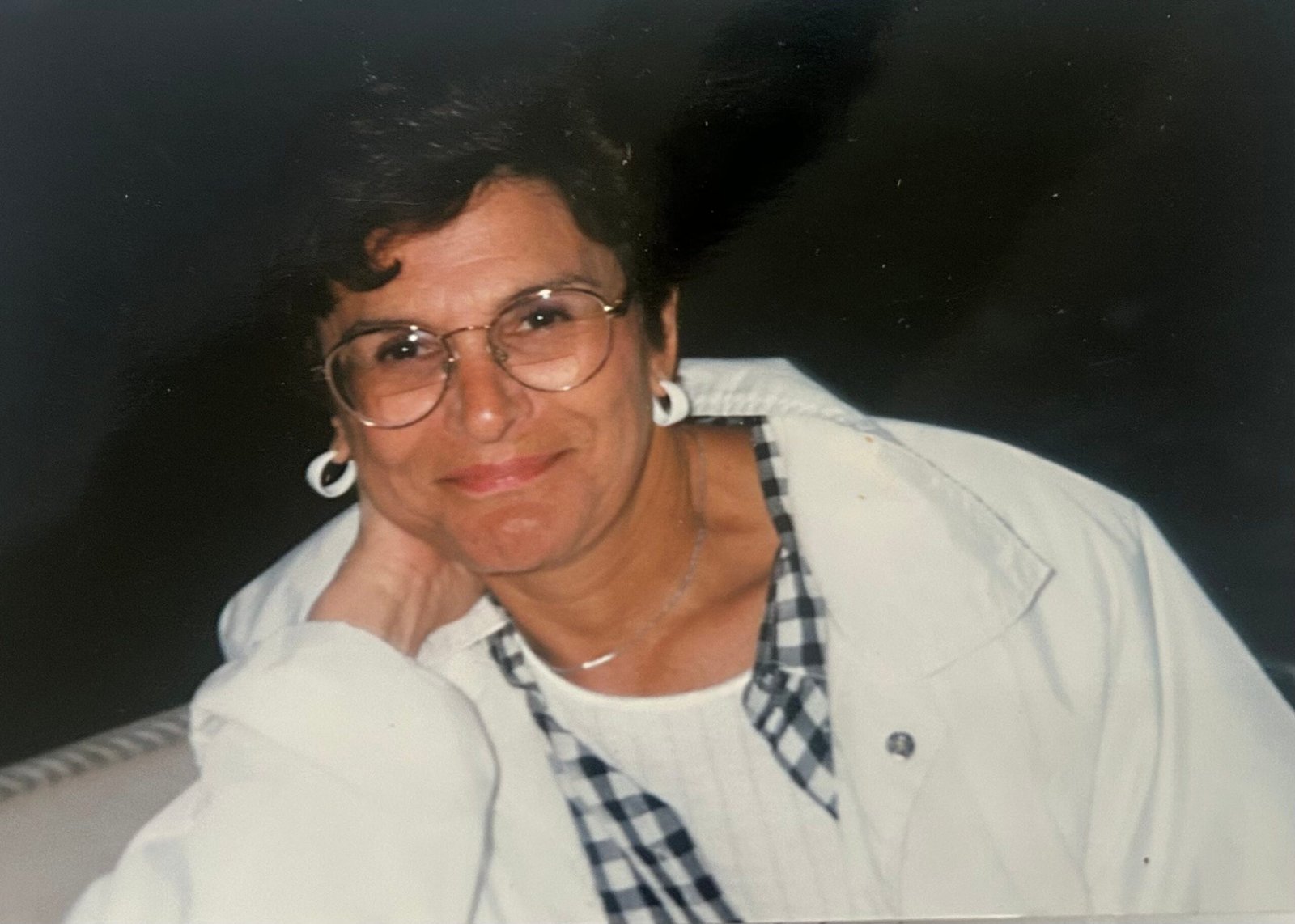
The author’s grandma was a perfectionist.

  • My grandmother’s terminal cancer diagnosis taught us both to let go of perfectionism.
  • Her lifelong pursuit of order and perfection shaped our family’s habits and expectations.
  • Facing illness, she embraced acceptance and inspired me to value effort over unattainable ideals.

My grandmother strove for perfection, convinced that it was an attainable goal if only you worked hard enough.

This meant eating less to lose weight. Food deprivation became a family bonding activity when my grandmother was on a diet. Diets lasted decades. We had marathon cleaning weekends while friends went to the mall. Play clothes were swapped out for school clothes for our rare trips to Burger King. Random dust checks were performed to ensure vacuuming of floors was done correctly. I’ll never forget her finger with a perfectly manicured nail grazing the cool Italian tile floor. Chore lists graced our refrigerator in the same way my friends’ quizzes and pictures graced theirs.

My grandmother wanted and demanded order, believing it led to perfection. My childhood was spent trying to please. She did not expect more from us than she did from herself, though. I hold many memories of Gram chastising herself for her too-big thighs or her less-than-stellar self-control around chocolate. It was a weakness that caused her significant guilt.

I followed her steps

Years later, as I began my own journey toward motherhood, I vowed that my children would not endure what I had. I would allow them to make messes. That dog I always wanted, but was never allowed to have because pets were dirty, would complete the large family I also always wanted. Perfection would become what it was meant to be, a foolish ideal — not a reality to strive for at all costs.

Family birthday
The author’s grandmother was diagnosed with terminal cancer.

Instead, I repeated exactly what I knew. My kids had to have matching outfits, picture-perfect Christmas cards, and all the things perfection required. I would clean and exercise until I reached the point of exhaustion. I worked out through all four pregnancies and directly after.

I recall throwing a birthday party for my son. He was turning 3 or 4. Someone commented on how great I looked. “Nicole makes sure everything is always perfect,” someone else said. I reveled in the praise. Gram heard the comment and smiled. We shared a common bond. When one of us inched closer to it, the other one felt proud.

Then my grandmother was diagnosed with cancer

The exhaustion of parenting four kids and attempting to create the perfect world for them and me was intense. I was stuck in a cycle. It would not break until one sunny fall day. I was running around attempting to clean and wrangle the kids for lunch. The plan was to work out after they took their naps. The phone rang, and my grandmother greeted me on the other end. All I heard was the word sick. I assumed it was regarding my grandfather, who had had heart problems for decades. I thought perhaps it was another heart attack.

“No, baby, it’s me. I’m sick.” It was shocking. Gram had lived a life of such order and perfection. She was in her 70s and active. She took only one pill for high blood pressure. Gram had Stage 4 ovarian cancer, which meant we discovered it late. We looked up the statistical odds of survival. My grandmother had a terminal illness.

The diagnosis changed her. For the first time, her constant need for perfection seemed foolish. Weight didn’t matter, nor did matching a purse to shoes to a blouse. When Gram lost her hair, one of her most beautiful features, and found herself struggling to keep the house clean, she understood things had to change. Maybe a wig wouldn’t be so bad. Maybe hiring someone to come in and help was OK. Her new favorite saying became, “Don’t sweat it.” What mattered was time and how she spent it.

She asked 1 simple question

When she saw me working myself to death to provide a perfect life for my family, Gram realized I had become just like her. She said, “Perfection isn’t worth it. It isn’t even real.” Then, she asked a question that changed everything for me.”Did you do your best?” When I answered that I had, she said, “Well, that’s all you can do then.”

It changed the way I lived my life and significantly reduced the pressure on me.

Watching her health diminish and understanding that she had limited time helped Gram realize what was important. Perfection and holding onto unrealistic expectations and ideals no longer fit into her life. Watching her learn this lesson allowed me to learn it alongside her. She taught me so that I didn’t have to wait until I was in my 70s battling a terminal illness. When I remember her now, I am forever grateful.

Read the original article on Business Insider

Source link