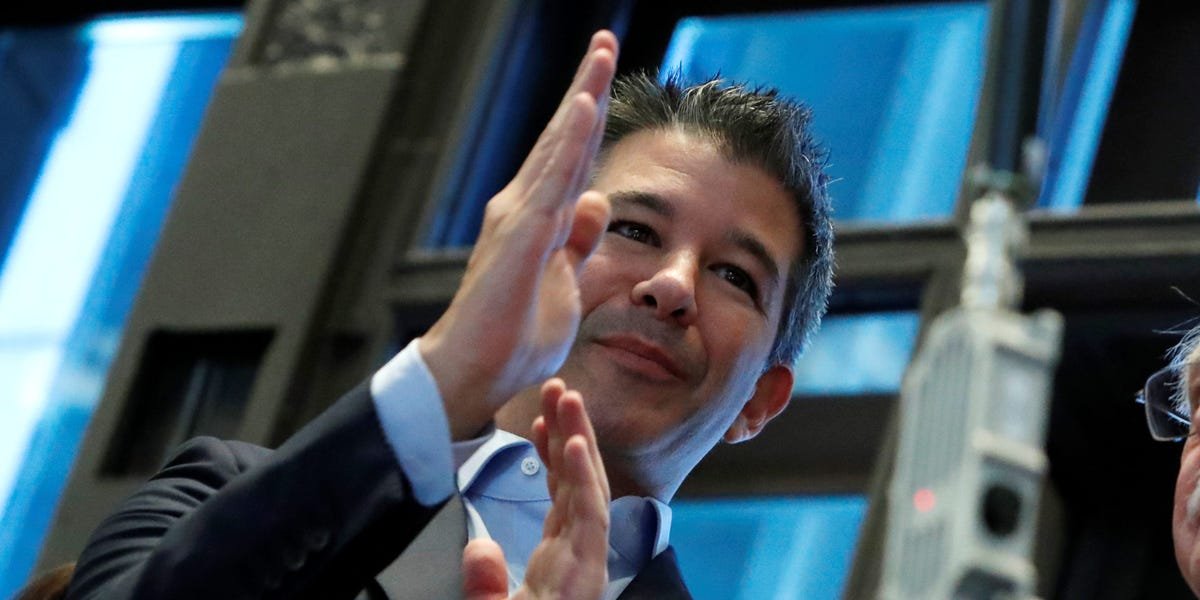
Travis Kalanick is back. The Uber founder, ousted as CEO, is now betting on the physical world. His startup has evolved into Atoms, spanning manufacturing, logistics, mining, and robotics. Jeff Bezos is doing something similar.
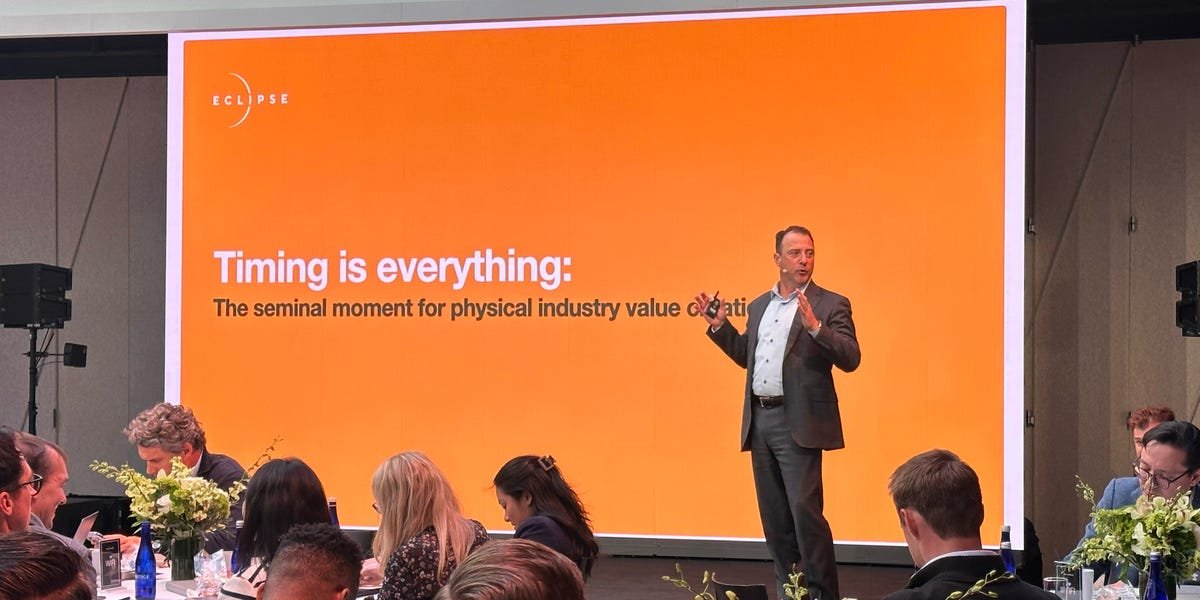
Why choose “atoms” over more profitable “bits”? I asked Joe Fath at Eclipse, a VC firm that invests in similarly gnarly physical assets.
Fath previously worked alongside Henry Ellenbogen at T. Rowe Price, where Ellenbogen pioneered tech startup investing at the mutual fund giant. Fath often joined those deals at later stages through large-cap growth funds.
Here’s my conversation with Fath, edited for length and clarity:
Historically, “bits”-based businesses — software and internet — needed far less capital to reach escape velocity, where cash flow can sustain the business without additional funding. Investors tended to shy away from more capital-intensive models because it’s been hard to gauge when (or if) escape velocity shows up. This has traditionally been a tougher path than the “easy button” of software and consumer internet — but that’s changing quickly.
Why is this changing?
AI is driving a couple of structural shifts. First, it’s accelerating and materially improving digital tasks — especially across white-collar service work — as LLMs continue to advance. Second, that capability is starting to move into the physical world, where historically analog environments can now be digitized through progress in areas like VLA (video, language, action) models, world models (which simulate and help systems understand how the physical world works), and embodied AI. The punchline: For the first time, AI is making physical industries meaningfully programmable — opening the door for faster scaling with less capital and labor, and starting to flip the dynamic in question #1 on its head.
AI is making it easier to produce a lot more digital content, potentially denting the value. Meanwhile, physical things are still hard, so those could retain their value. Do you subscribe to this view?
I agree with your premise. Marc Andreessen famously said, “Software is eating the world.” Now AI is eating software — which is a big part of why you’re seeing pressure on SaaS in the public markets. But in physical industries, you still must build and operate real things. AI can’t fully replace the way it can take over a call center, act as a coding agent, or turn a novice into a capable designer by abstracting away skill. And that dynamic is now extending into legal, accounting, finance — there’s nowhere to hide.
The punchline: in physical industries — manufacturing, logistics, energy, defense — AI is a powerful complement. It makes things faster, cheaper, less capital-intensive, and ultimately drives better returns. But it’s not a full replacement in the way it will be across large parts of the service economy. I’m a strong believer in this thesis based on what I’m seeing — and it’s a big reason I left T. Rowe to come to Eclipse. You’re already seeing it play out in real outcomes with companies like Amazon, Tesla, SpaceX, OpenAI, Anthropic — and I’d add Anduril to that list. My bet is there are many more coming, and that capital that once flowed primarily into software and consumer internet will increasingly shift in this direction over the coming years.
What examples are you seeing in the market, or within Eclipse’s portfolio?
The sample size is growing quickly. I mentioned some of the household names in #3, and we’re seeing many of the same dynamics across our own portfolio. A few examples: Wayve, Anduril, True Anomaly, Redwood Materials, Mytra — plus earlier-stage names like Mind, Matter, and BotCo. And then you have the “picks and shovels” layer powering the buildout of more advanced AGI — and ultimately ASI — capabilities, with companies like Cerebras, Oxide, and Tenstorrent.
Any new investments you’re making that fit into this broad thesis?
Mentioned several in #4, but at a high-level, Eclipse’s focus areas remain general-purpose robotics, defense tech, next-gen manufacturing, semiconductors and next-gen compute, energy and batteries, and autonomy. At the same time, we’re constantly trying to “look around corners” — pressure-testing new theses and deciding where it makes sense to invest or even build from scratch. That includes areas like fusion, water, space, world model builders, workforce development for the skilled trades, and neuromorphic computing, to name a few.
Where might this thesis go wrong?
Physical industries aren’t easy — you’re not just solving a technical or engineering problem, you then must scale it. And when you’re physically building things, scaling well is incredibly hard. Elon Musk has talked about this as “production hell,” and it’s very real. Even with AI helping accelerate and improve execution, finding enough smart, capable people to do this at a high level is still a challenge.
On top of that, these businesses require a lot of capital, and there’s a growing wave of entrepreneurs entering the space — so capital allocation really matters. You need to back the right outcomes: Defensible, high-impact ideas, exceptional founders who can attract top talent, and teams that can scale. Lastly, while the AI and geopolitical shifts feel durable, it’s worth acknowledging the counterfactual. If global relations — particularly between the US and China — were to materially improve, you could see some slowing in re-shoring and the push to digitize physical industries, with a partial reversion to lower-cost, analog production overseas.
Sign up for BI’s Tech Memo newsletter here. Reach out to me via email at abarr@businessinsider.com.