

Lloyd Lee

Uber’s new plan to deploy 25,000 robotaxis will come from an autonomous trucking company led by ex-Uber alum

Uber has a new plan to get 25,000 robotaxis on the road — and it will come with the aid of some Uber alums and an autonomous trucking company.

On Wednesday, the ride-hailing giant announced a partnership with Waabi, a Canadian self-driving trucking startup founded by Raquel Urtasun. The partnership will include a $250 million investment from Uber, dependent on a set of milestones Waabi will have to achieve. The companies did not disclose what those were.

There are a few familiar faces here. Urtasun was the chief scientist at Uber’s self-driving car division, Advanced Technologies Group. That division was sold in 2020 to Aurora Innovation, another autonomous trucking company and Waabi’s competitor.

Waabi’s chief operating officer, Lior Ron, is also an Uber alum who founded and led the ride-hailing company’s trucking business, Uber Freight.

“Uber has always been great in building marketplaces, in matching supply and demand, and in pricing,” Ron told Business Insider. “That’s what created Uber, that what’s created Uber Eats, and that’s what I created with Uber Freight.”

Alphabet’s Waymo and Amazon’s Zoox are already on the ground providing unsupervised rides. Even in its core business, that is, autonomous trucking, Waabi has yet to deploy a fully driverless truck without safety drivers on commercial routes.

The startup didn’t disclose a timeline or announce a partnership with an automaker that can deliver that many cars.

However, Ron dismissed the first-mover advantage narrative.

“I think it’s really about: Can the system scale? Can the system be mass-deployed?” he said. “It’s not about getting the first driver out of the car or truck. It’s not about the first lane. It’s not about the first neighborhood.”

How will an autonomous trucking startup cater to robotaxis?

Trucking and ride-hailing are two different beasts. One has set routes and long stretches of highway driving; the other sees dense neighborhoods and unpredictable pedestrians.

Ron told Business Insider that Waabi has been building a generalizable AI “brain” that can be transferred to different vehicle platforms since “day one.”

“Nothing needs to be rebuilt,” Ron said.

In addition, Ron said Waabi has built a sophisticated simulator that allows the AI driver to learn from an infinite number of scenarios that can’t easily be replicated in the real world.

The simulation allows for “mixed reality testing”: An AI driver steering a truck or car is deployed on a closed course but responds to simulated events like a traffic jam or a lane-changing car that isn’t really there.

Video from Waabi shows how a truck driving on a closed-course environment can slow down, reacting to a virtual traffic jam.

“Now we can test anything you can imagine — every permutation of traffic jam under the sun, every millions of different scenarios of construction zone,” Ron said. “A motorbike cutting you off — you can never do that because you’ll be endangering the tester.”



Source link

Man-uses-4999-autonomous-snow-blower-to-clear-his-driveway.jpeg

Man uses $4,999 autonomous snow blower to clear his driveway during winter storm: ‘I’m inside sipping a coffee’

Forget robotaxis — a man and his robo-snow blower were the envy of X during the weekend’s winter storm.

More than 250 million Americans are thawing out after a massive winter storm swept the country with freezing temperatures and heavy snowfall.

Tom Moloughney, however, stayed inside. He watched a nearly 230-pound robot clear his long New Jersey driveway, documenting the process in a video posted to his X account.

Moloughney is a certified techie, host of the State of Charge YouTube channel and a senior editor at InsideEVs. He’s been reviewing a $4,999 autonomous snow blower from robotics company Yarbo.

The storm dumped about six inches of snow in Moloughney’s town over 24 hours, according to the National Weather Service. It was the perfect opportunity to give the bot a whirl.

“This is going to be a great test to see if this robot can handle a 6,000 sq.ft. driveway during a major winter storm,” Moloughney wrote on X. “I’m inside sipping a coffee while it’s doing its job and so far so good!”

Videos Moloughney posted during the storm showed the Wi-Fi-connected machine clearing snow from his long driveway, a walkway, and the curved area in front of his two-car garage. When its battery ran low, the robot returned on its own to a charging pad, recharging for about an hour and a half before heading back out into the freezing temperatures.

According to Yarbo’s website, the autonomous snowblower can clear snow up to 12 feet of snow, throw it as far as 40 feet, and operate in temperatures as low as minus 13 degrees Fahrenheit.

“It will continue to do that until the driveway is completely done twice,” Moloughney updated viewers on X during the storm. “I’ll then send it out again and continue to do so until the snow stops.”

Still, the robotic helper hasn’t been flawless, according to Moloughney. The reviewer said the machine required extensive digital setup before the storm and struggled to establish GPS connectivity in parts of his driveway. During a previous storm, he said hail fell before the snow, leaving a sheet of ice the robot couldn’t remove. And, during a previous storm, hail fell before the snow, leaving a sheet of ice covering his driveway before the bot cleared the snow.

Moloughney and Yarbo did not respond to Business Insider’s requests for comment.

Despite the hiccups, Moloughney said the robot worked through the night as the final flakes fell, calling its performance “kicking ass.”

You can watch the reviewer’s unboxing of the robo-snow blower in the video below.


Source link

Im-at-CES-in-Las-Vegas-to-check-out-the.jpeg

I’m at CES in Las Vegas to check out the latest in autonomous driving. Here’s what I’ve learned so far.

  • Robotaxis and autonomous cars once again have a large presence at CES 2026.
  • Several companies, including Amazon’s Zoox, are providing off-site demos.
  • Business Insider is providing an on-the-ground look at the latest in the advanced mobility space.

Business Insider is taking on CES 2026.

I’m on the ground in Las Vegas from Tuesday to Thursday, taking in all there is to know about the latest in the driverless space.

Robotaxis and self-driving cars have already had an outsize presence at the tech conference, especially in the previous hype cycle of the late 2010s and early 2020s.

Things have changed since then. The industry has largely moved on from mere concepts and technology validation to: How are we going to realistically scale autonomy?

It’s day one of the conference, and there’s already a lot to take in.

Nvidia CEO Jensen Huang unveiled the Alpamayo family, which will serve as an autonomous-driving stack for OEMs to deal with those stubborn edge cases — or the “long tail” of self-driving.

Uber and Nuro showed off an early look at the Lucid Gravity SUV that the companies hope public riders will be able to take by late 2026.

I’ll be spending less time at keynotes and speaker events and more on real-life demonstrations and meetings with industry leaders and commentators in autonomy

Think of this as my personal notebook, where I jot down everything I’ve learned and seen at the conference.

Check back in for more updates.

Amazon-backed Zoox is unlike any other robotaxi.

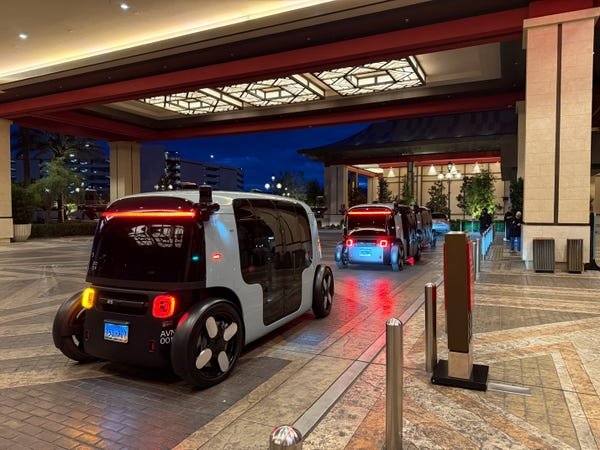
Zoox robotaxis line up in front of Resorts World Las Vegas

Lloyd Lee/BI

This is the first year Zoox, an Amazon-backed robotaxi company, will be giving live demonstrations of its service during CES.

I got to take a ride in one on Monday night in front of Resorts World. (The company tagline that I saw from an ad at the Harry Reid International Airport was: “Don’t just do the Strip. Zoox it.”)

My immediate thoughts were that Zoox feels unlike any other robotaxi or pseudo-robotaxi on the market. It felt more like I was on a theme park ride than in an everyday car we’re familiar with.

Unlike Waymo’s robotaxis, Zoox is not a regular car you could buy that’s been retrofitted with sensors. The Zoox car is bi-directional — meaning there’s no real front or back of the car — and the inside has no steering wheel, just seats.

The robotaxis were clearly a great tourist attraction from what I saw. My Uber driver wasn’t too happy about them.

Uber, Lucid, and Nuro have big plans to scale.


Uber, Lucid, Nuro

Left to right: Uber’s Sarfraz Maredia, Lucid interim CEO Marc Winterhoff, and Nuro cofounder Dave Ferguson.

Lloyd Lee/BI

Uber, Lucid, and Nuro had a swanky cocktail hour at Fontainebleau Las Vegas, where they quite literally wined and dined a room full of reporters, analysts, and investors: endless glasses of wine and an open bar, lobster tails, jumbo shrimp, too many appetizers to count, and a giant charcuterie board — the works.

Maybe understandably so? 2026 will be a big year for the three companies.

Uber’s plan is to roll out a robotaxi service by late 2026. The first market is San Francisco, where Uber will directly compete with Waymo. These two companies are partners in other markets, like Austin.

“We’ve been moving very, very quickly,” Nuro’s co-CEO and cofounder Dave Ferguson said. “We signed this partnership last July. We’re already testing the production-intent vehicles on public roads. And very soon, we’re going to have tens of thousands of them worldwide.”

Here’s a 60,000-pound John Deere combine for scale.


John Deere

John Deere’s X9 combine.

Lloyd Lee/BI

A quick image to get a sense of how big CES’s mobility division is at West Hall of the convention center: There’s a 60,000-pound combine from John Deere that’s sitting in the middle of the showroom.

The combine is one of the world’s largest on the market, according to Julian Sanchez, an engineer at the machinery company.

Even so, John Deere doesn’t even have the largest footprint on the floor. This year, it’s Hyundai.

The combine isn’t autonomous in the way we think about self-driving cars, Sanchez told me, but it is self-steering.

The world got a reality check on self-driving cars since the last hype cycle.


Tensor

Tensor aims to sell a personally-owned vehicle that will have Level 4 driving.

Lloyd Lee/BI

There’s a lot of talk of self-driving cars in the automotive industry, but the scope of what it can realistically achieve has narrowed down in the last decade or so.

Paul Costa, an ex-Apple veteran of 25 years who worked on the company’s abandoned self-driving car project, gave me a bit of interesting color from what he saw at CES in 2015 — when the driverless car hype was reaching its peak — and what’s different now.

“My sense at the time was that people really wanted to focus on Level 5 autonomy,” Costa, who now leads Ford’s electrical engineering team, told me. Level 5 is the highest level of autonomous driving set forth by the Society of Automotive Engineers. That means full autonomy in all weather conditions and no geofences. Waymo is currently Level 4.

The tone has been brought down to reality, according to Costa. The focus is on highly advanced driver assistance systems and eyes-off driving or Level 3 systems, he said.

“Now, I feel like here in 2026, L3 is extremely interesting,” Costa said. “It’s interesting for me to see how the industry — its focus has changed over the years.”

Signup Today: Connectivity and Tech Pro by Business Insider Intelligence


Source link