A narrow flight corridor that’s become vital to airlines is shrinking as the Iran conflict expands.
On Thursday, Azerbaijan’s foreign ministry said that Iranian drones attacked the Nakhchivan Autonomous Republic. It’s an exclave to the north of Iran, which is separated from the rest of Azerbaijan by Armenia.
One drone damaged the terminal at Nakhchivan Airport, and another fell near a school building, the ministry said. Two civilians were injured, it added.
As a result, Azerbaijan closed the southern sector of its airspace.
It leaves airplanes flying between Europe and Asia with an even smaller space to navigate.
Since the US and Israel launched strikes against Iran on Saturday, airlines have been unable to fly over the Persian Gulf, which was previously the main route.
Following drone strikes on Nakhchivan International Airport (NAJ) earlier today, Azerbaijan has closed the airspace in its southern sector. Learn more about this, and more, in our updated list of airspace closures and restrictions: https://t.co/AU0KOdzprtpic.twitter.com/X19SnOglD5
Instead, they have been rerouting through Saudi Arabia or the Caucasus. The region consists of Armenia, Georgia, and Azerbaijan, and links the Black Sea with the Caspian Sea. It is bordered by Iran and Turkey to the south, and Russia to the north.
Most airlines have been unable to fly over Russia since the invasion of Ukraine in 2022.
The Caucasus is not without its own tensions, either.
In 2023, Azerbaijan launched a military offensive against Nagorno-Karabakh, a region within its territory that was governed and mostly populated by ethnic Armenians.
The conflict in Iran, however, is encouraging Armenia and Azerbaijan to refrain from escalating tensions.
After the drone attack on Nakhchivan, the two foreign ministers held a phone call where they “noted the importance of sustainable peace between Armenia and Azerbaijan and exchanged views on matters of mutual interest,” according to a press release.
As much of the Middle East remains closed amid missile barrages, international airlines are being squeezed into a shrinking set of flight paths.
Iran, Iraq, Kuwait, Israel, Bahrain, Qatar, and the United Arab Emirates remained closed or partially closed as of Monday, and the nearby Russian skies have been off limits to Western airlines since the Ukraine war broke out in 2022.
For most carriers, this extremely limits their options.
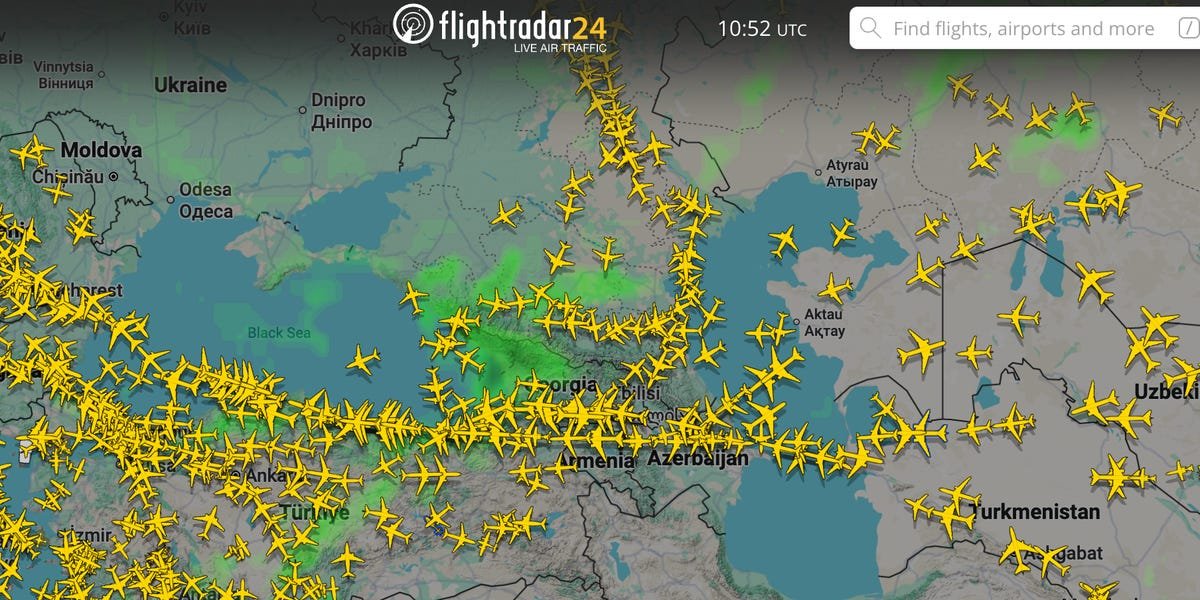
Flightradar24 shows flights are being funneled into narrow corridors around the Middle East, or forced into longer detours over Saudi Arabia and other regions — adding hours of flight time, higher fuel and labor costs, and operational complexity.
Among the most critical options is the Caucasus corridor north of Iran — including Armenia, Georgia, and Azerbaijan — which links Europe and Asia and has been absorbing detoured traffic as carriers seek alternatives to disrupted Middle East routes.
The traffic over the Caucasus corridor on Monday evening Central European Time.
The Caucasus region offers not only the most efficient routing around now-closed airspace — it’s also the only option for many global carriers. To the north is Russia, which remains blocked to most Western airlines amid ongoing sanctions and reciprocal airspace restrictions.
Restrictions on Russian airspace have forced carriers like Finnair to add up to four extra hours between Helsinki and Tokyo, while British Airways has similarly extended flight times on routes to Asia.
The narrow corridor can be like threading a needle, spanning just 100 miles between Russia and Iran at its narrowest point, according to Google Maps. Without it, airlines unfriendly with Russia would be forced to take significantly longer, more costly detours via Saudi Arabia.
Iranian airspace closures have sent traffic north before
Although it is a narrow route, the Caucasus corridor has successfully accommodated increased traffic when carriers have relied on it during past conflict-driven airspace closures. This route also overflies Afghanistan and Pakistan.
According to the Civil Aviation Air Navigation Service Organization (CANSO), the global association of air traffic providers based in the Netherlands, Azerbaijan airspace handled 110 additional flights per day when Iran temporarily closed its airspace in June 2025.
The agency added that the region has seen an overall year-over-year increase in traffic as airspace around it flips on and off.
“Since 2022, Azerbaijan’s airspace has played a vital role in providing alternative and efficient air routes in response to regional geopolitical crises,” CANSO said, noting the country’s investments in advanced air traffic technologies.
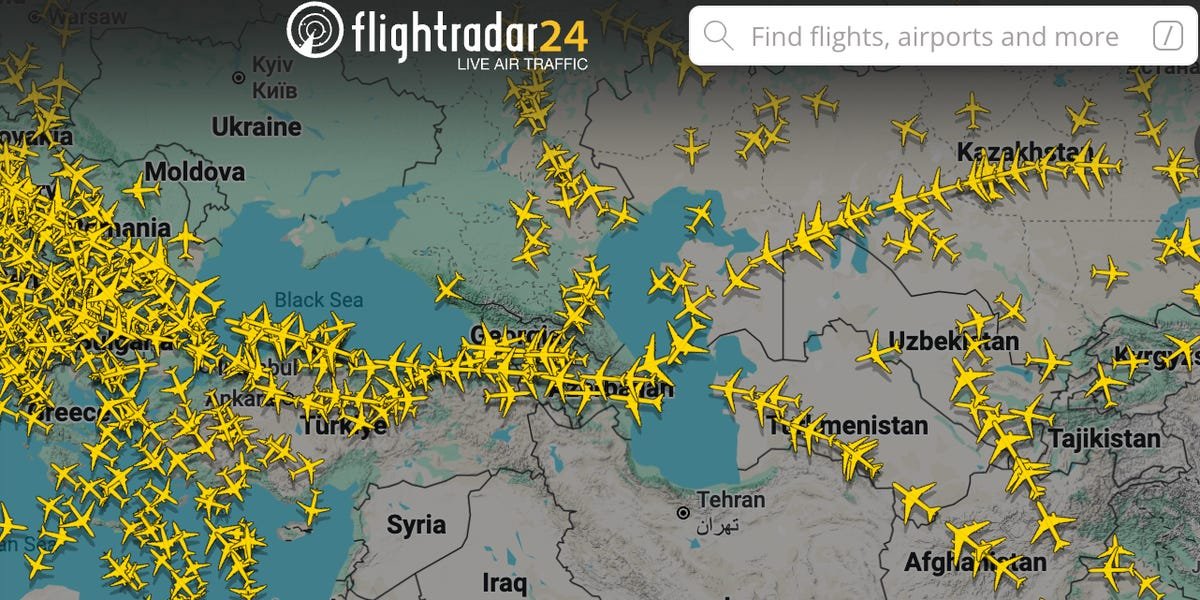
The airspace on February 27, 2026, the day before the US and Israel attacked Iran. More planes overall were flying at that time and had access to far more airspace.
Flightradar24
Still, the influx of congestion over the Caucasus region could limit flexibility if weather restrictions arise. President Donald Trump said on Monday that the conflict could last “four to five weeks.”
If the conflict were to spread to the central Asian states that neighbor Iran to the north — which is very unlikely given the lack of US bases in Central Asia— it would effectively create a wall of unusable airspace.
Aviation leaders are emphasizing safety over these sensitive regions, especially after airports in Kuwait and the UAE were damaged during missile fire. On Monday, the director general of the International Air Transport Association (IATA), Willie Walsh, called for airlines to refrain from targeting civilian airspace.
“We all hope for an early peaceful resolution to the current hostilities,” he said. “In the meantime, it is critical that states respect their obligation to keep civilians, and civil aviation free from harm.”
The comment comes after previous inadvertent attacks on civilian airliners: a Malaysia Airlines flight was shot down by Russia over eastern Ukraine in 2014, anda Ukraine International Airlines aircraft was shot down by Iran near Tehran in 2020.
Both were a result of heightened military alert and fear during tense conflicts.
Some bottlenecks extend beyond the Caucasus
Countries including Egypt, Turkey, Saudi Arabia, and Oman saw dozens of additional aircraft rerouted through their airspace shortly after the conflict began on Saturday, and they remain among the few regions still handling flights. Etihad Airways and Emirates operated a limited number of flights from the UAE on Monday.
Westbound flights are largely using a single corridor across western Saudi Arabia and then heading up toward Europe, likely because it’s farther from conflict zones.
Flightradar24 data from before the Saturday attacks shows more direct flight paths across Saudi Arabia, Kuwait, Iraq, and the UAE, though some flights on Monday were again using UAE airspace.
One airline in particular faces a uniquely tricky routing challenge due to the Middle East’s abruptly shuttered airspace: Air India.
The airline hasn’t flown over Pakistan in nearly a year due to rising tensions, forcing it to detour across the UAE to reach Europe and North America.
An Air India flight from Bombay to New York on Monday stopped in Rome along the way.
Flightradar24
But, with most Gulf nations now closed, Flightradar24 shows it flying even further west across Oman and Saudi Arabia on these routes, often stopping in cities like Rome and Vienna along the way.
These are likely fuel stops, considering the now-longer flight paths. Air India made similar pit stops in April 2025 when tensions with Pakistan had previously arisen.
Flights are resuming on Monday
Eddy Pieniazek, head of Ishka Advisory, said in a Monday note that the mass disruptions across the Middle East are likely to be “short-lived” with a “gradual return of operations.”
He added how vital the Gulf region is, “particularly while Russian airspace remains restricted” and “while Africa currently lacks a comparable hub infrastructure.”
UAE airspace began partially opening up on Monday, with several Emirates and Etihad Airways flights departing from Dubai and Abu Dhabi to destinations in Europe, Africa, and Asia.
Aircraft are flying over the UAE again as of Monday, as airlines slowly resume flights. It remains unclear how wide a resumption this will be.
Flightradar24
Both Emirates and Etihad Airways’ website still say all flights to and from their megahubs are suspended, but earlier Monday said a limited number will fly. These will get people home, transport cargo, and reposition aircraft.
To ease crowds, they asked passengers not to go to the airport unless they had been specifically notified.
More than 1.1 million people were laid off in the US in 2025, and there were more job cuts in January 2026 than any January since 2009, according to reports. Business leaders are predicting that things will only get worse as AI disrupts the workforce.
When Amazon announced layoffs earlier this year, the tech career coach Kyle Elliott shared what he thinks employees should do immediately after being laid off to put them in the best position to find a new role.
He also shared three common mistakes to avoid after a layoff.
1. Posting a hit piece on LinkedIn
After the sting of a layoff, Elliott has seen workers turn to LinkedIn to share negative posts about their former employer.
“Sometimes people just really react from that emotion or wound, instead of waiting until it heals,” he said.
Such posts could be detrimental when applying for a new job, when recruiters and hiring managers check your LinkedIn profile.
“People want to work with other positive people, so if they see that you’re venting, they may worry, ‘if we have to conduct layoffs in the future, are you going to then put a hit piece out on us as soon as you get laid off?” Elliott said.
Instead, consider waiting until you are more able to position the event differently in your post, which could be a month or two after, Elliot said. In the post, share lessons you learned and the amazing work you did at your previous company, he added.
2. Venting to former colleagues
Former colleagues can be a good resource when you’re looking for jobs in the future. In your last conversation with your former colleagues before leaving the company, reiterate the work you’re proud of and share what kind of opportunity you’re looking for next, Elliott said.
With this in mind, it may be better to vent about your layoff experience to a trusted confidant like a spouse, best friend, or therapist rather than a former colleague, he added.
Venting to a colleague could damage their perception of you and jeopardize the connection.
“A lot of people will remember that last piece, and you don’t want them to be like, ‘oh, they’re bitter.'” he said.
3. Being afraid to network
Elliott has noticed that clients are sometimes afraid to network because of the stigma associated with layoffs, and their fear that they can’t add value to conversations while unemployed.
“Layoffs are normal now,” Elliott said, so there’s no need to avoid reaching out to people out of fear.
He recommended starting small. For example, meet a former colleague whom you were close to.
In your first conversation, focus on putting yourself out there and taking small steps toward your next role, and don’t expect to be offered a job, he said.
“If you were fired and you’re calling it a layoff, it’s a little different. But if you were truly just laid off as part of a reorganization or cost-cutting measures, people understand that, and there shouldn’t be shame in that,” he said.
In a charged political climate where even small missteps can spark a brand backlash, many of this year’s Super Bowl advertisers are sticking with the safest bet in the playbook: comedy and celebrities.
Much like last year’s Super Bowl, the vast majority of the big game ads released so far are playing it safe. Advertisers hope that A-list stars will be a shortcut to attention in the crowded field of commercials, and that humor will leave audiences feeling uplifted and warm toward their brand.
“In general, advertisers want to play it safe,” said Peter Daboll, head of North America at the creative testing platform DAIVID. “There’s a high anxiety level here in the US, and people are probably very afraid of triggering anything.”
Viewers aren’t in the mood to be preached to, he added, and even heartwarming ads that might have performed well in Super Bowls past could come across as too “syrupy” and fall flat.
Of the Super Bowl LX trailers and teasers the TV measurement platform iSpot has tested with its consumer panel so far, 63% triggered “funny” reactions from viewers. The highest “funny” score right now goes to Bud Light for its “Keg” ad, which features Shane Gillis, Post Malone, and Peyton Manning flailing down a hill in an attempt to catch up with a runaway beer keg.
Other ads hoping to raise a chuckle:
Andy Samberg stars as “Meal Diamond” for Hellmann’s, performing a “Sweet Caroline” parody in a deli to customers, including Elle Fanning.
Fanatics Sportsbook tapped a self-deprecating Kendall Jenner to mock the “Kardashian Curse,” the internet conspiracy that dating members of the family ruins an athlete’s game.
Instacart’s vintage-style ad features actor Ben Stiller and singer Benson Boone in a high-energy— and ultimately calamitous — musical performance about choosing the perfect banana.
Novartis is making itself the butt of Super Bowl joke ads, with NFL players telling viewers to “relax your tight end” and get a blood test for prostate cancer.
Comcast’s Xfinity reunites some of the original “Jurassic Park” cast to suggest that many of the famous dinosaur park’s problems could have been avoided with better WiFi.
Anthropic is taking a swipe at OpenAI over its decision to bring ads to ChatGPT.
Even the heartwarming story of a Budweiser Clydesdale horse helping a bald eagle learn how to fly ends with a joke about getting misty-eyed.
The cast of celebrities in the commercial breaks will range from Sabrina Carpenter for Pringles to Emma Stone for Squarespace and Guy Fieri for Bosch.
Mark Gross, cofounder of the ad agency Highdive, which has produced several Super Bowl campaigns over the years, said the Hollywood landscape had changed and that celebrities are now more open to appearing in commercials than in previous years.
“It’s the job of us at ad agencies and marketers to tell great, original stories that stand out without just hiring the celebrity first and expecting that to do the work for you,” he added.
Highdive worked on a Super Bowl commercial for Lay’s this year.
Money talks
There’s a lot at stake.
The Super Bowl remains one of the last mass-reach media advertising destinations. Last year’s Super Bowl averaged a record-high US audience of 127.7 million viewers, per Nielsen, the TV ratings company.
The average price for 30 seconds of airtime during Super Bowl LX was $8 million, with some spots selling for more than $10 million, according to this year’s big game broadcaster, NBCUniversal. Then there are the millions of dollars spent on talent fees, production, and media buys to amplify the ad after the game ends.
“CMOs are under so much pressure,” said Kerry Benson, SVP of creative strategy at the data and analytics company Kantar.
“They have to prove ROI in these ads,” she said, referring to return on investment.
The rewards can be handsome if brands play their Super Bowl strategies right.
In 2024, Kantar found that Super Bowl ads delivered an average return on investment of $8.60 for every $1 spent, making them 20 times more effective than regular TV ads. Benson said this reflects the size of the audience during the game and all the supporting activity and discussion around a Super Bowl campaign.
A different approach
Not every brand is adopting the comedy-and-celebrity playbook.
Rocket and Redfin’s ad amplifies the emotion with a stirring Lady Gaga cover of Mr. Rogers’ “Won’t You Be My Neighbor?” The spot leans into a moment of heightened division in many US communities, highlighting the importance of small acts of kindness and human connection.
Elsewhere, Hims & Hers’ “Rich People Live Longer” spot strikes a provocative tone about US healthcare inequality, featuring a couple of characters that resemble Jeff Bezos and the biohacker Bryan Johnson.
“When you are challenging a system that has been broken for generations, the work cannot feel familiar or safe,” said Hims & Hers chief design officer, Dan Kenger. “The creative has to feel disruptive because that’s what is needed to change the status quo of healthcare.”
Anselmo Ramos, creative chairman at the advertising agency GUT, is nostalgic for ads that didn’t lean on celebrity as a shortcut to success — Apple’s “1984,” Budweiser’s frogs, the Geico caveman, and the E-Trade baby. He’s also hoping to see more bold, anthemic spots in the sea of comedic commercials.
“I’m missing executions with a brand purpose, with a clear point of view,” Ramos said. “We need them more than ever.”
This story has been updated with additional information.
Some European airlines are facing significant delays as their flights from the Middle East make fuel stops after being rerouted around Iran.
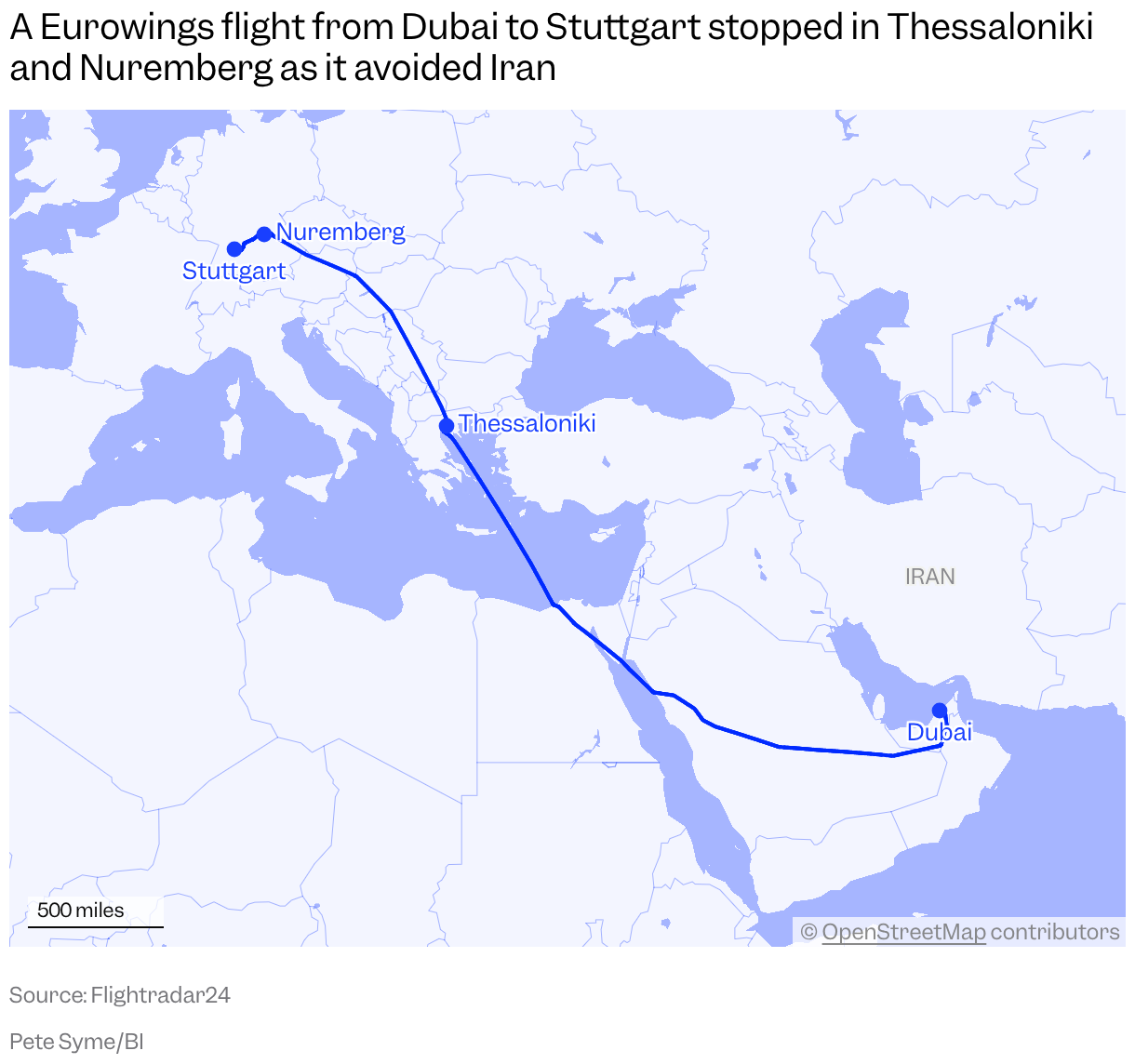
Sunday’s Eurowings Flight 1153, from Dubai, made two stopovers on its way to Stuttgart, Germany.
It first flew for just over 6 hours to Thessaloniki, Greece, for a refuelling stop, data from Flightradar24 shows.
After about 50 minutes on the ground, it took off again for Germany. However, the 2-hour flight landed in Nuremberg around 1:30 a.m.
It appears that it was too late to land in Stuttgart due to nighttime flight restrictions.
Therefore, it wasn’t until the next morning that the plane made another 30-minute flight to reach its intended destination.
In all, it arrived in Stuttgart 11 hours after the usual direct flight from Dubai.
A Eurowings spokesperson told Business Insider that its owner, the Lufthansa Group, decided not to fly over Iranian or Iraqi airspace as a precautionary measure.
They added that the refueling stop was “due to a longer flight distance and stronger headwinds on the alternative route at the time.”
“In the event of such refueling, we inform our passengers accordingly before departure in Dubai,” they said.
It isn’t the only European airline that has made such adjustments.
A spokesperson for Wizz Air, another budget airline, told Reuters that some of its flights from Dubai and Abu Dhabi would make “refuelling and crew change” stops in Cyprus or Thessaloniki.
Budget airlines are perhaps more susceptible to refueling stops because they typically operate only one type of airplane.
Their single-aisle jets are already near their maximum range for flights between the Middle East and Europe.
Meanwhile, the likes of British Airways and Air France are flying to Dubai with Boeing 777 or 787 jets. These twin-aisle airplanes have much larger fuel tanks, so any rerouting won’t require a fuel stop.
Over the past few days, flight-tracking data shows British Airways’ flight from Dubai to London has flown over Saudi Arabia instead of Iraq — taking around an hour longer than usual.
Earlier this month, the European Union Aviation Safety Agency warned airlines not to fly over Iran.
“The presence and potential use of weapons and air defense systems create a high risk for civilian flights,” it said in a statement, per Reuters. “There is a high probability of misidentification, against the backdrop of a possible American attack as well as the high alert status of Iran’s air defense systems.”
Silicon Valley is raising its standards for talent.
Adrien Friggeri spent over a decade combined at Meta — including back when it was called Facebook — with stints at Michael Bloomberg’s Hawkfish and Clubhouse as well. Now, he works as a partner software engineer at Microsoft, according to his LinkedIn profile.
The consequences of underperforming are “more drastic” now than they were 10 years ago, Friggeri said on “The Peterman Pod.”
In an email to Business Insider, Friggeri wrote that there is less “organizational ‘slack'” and higher expectations for tech employees.
“That means performance gaps are identified and addressed faster, and if someone is not meeting clearly defined expectations over time, the path to a formal performance-management process (and potentially a role change or exit) can be shorter than it used to be,” Friggeri wrote.
Meta has been especially strict with its performance expectations. The tech giant laid off roughly 3,600 employees in February, labeling them low performers.
There are also benefits to being above the pack. Meta is introducing higher bonuses for top performers, Business Insider reported on Monday.
In his email, Friggeri clarified that the trend was not specific to Meta. Rather, it was industry-wide and reflected the state of the market. Meta did not respond to a request for comment.
Friggeri shared four tips with Business Insider to stay ahead and avoid underperformance.
1.)Workers should make expectations explicit.
“Align with your manager on priorities and what ‘great’ looks like for the next 30/60/90 days,” Friggeri wrote.
2.) Employees should seek out feedback.
They shouldn’t wait for review cycles, Friggeri wrote. Feedback should be sought out “early and often.”
3.) Focus on “visible, high-leverage work.”
“Pick projects tied to clear outcomes and communicate progress, risks, and tradeoffs,” he wrote.
4.) Keep investing in your skills
Friggeri wrote that employees should “treat learning as part of the job, especially as teams and priorities shift.”
On the podcast, Friggeri advocated for being independent and building new projects — and not being silent about them. It’s not helpful to “lock yourself in a room,” build for three months, and show up with the finished product.
“Overcommunicate is really the strategy I would recommend,” he said.
This story is available exclusively to Business Insider
subscribers. Become an Insider
and start reading now. Have an account? .
Tesla has introduced a wave of incentives to shift as many EVs as it can before the end of the year.
The incentives include free paint jobs and financing deals.
Elon Musk’s automaker is racing to avoid another decline in annual sales after a difficult year.
Tesla is piling on incentives for buyers as it aims to end a rocky year on a high.
Elon Musk’s automaker has introduced a smorgasbord of discounts and deals in the US, with Tesla facing a race against time to avoid a second consecutive year of declining sales.
Tesla is offering 0% APR financing for up to 72 months on select Model Y Standard purchases and is also advertising the option to lease a Model Y without a down payment on its website.
Buyers can also trade in a gas car to receive 2,000 miles of free supercharging, and Tesla is offering complimentary upgrades, including premium paint jobs, tow hitches, and 19-inch “Nova” wheels valued at up to $1,500 on select inventory vehicles.
Tesla often offers more incentives toward the end of the year. But this time, the company is racing to avoid another year of declining sales, following Tesla’s first-ever year-over-year fall in sales in 2024.
Repeating that pattern would provide more evidence that Tesla’s momentum is stalling after years of rapid growth.
In October last year, Musk predicted Tesla sales would grow 20-30% in 2025. Tesla needs to sell 555,000 EVs in the final three months of the year — more than it’s ever sold in a quarter — just to match its sales figures from last year.
That’s a tall order, with Tesla facing difficulties in all its main markets. The Cybertruck maker’s sales have cratered in Europe amid backlash over Musk’s politics. In China, Tesla has been squeezed by a wave of competition from local rivals.
Tesla also faces major headwinds in the US after the Trump administration scrapped the $7,500 tax credit for new EVs in September. Tesla’s US sales fell 35% between September and October after the tax credit disappeared, according to data from Cox Automotive.
It comes as Musk has increasingly shifted Tesla’s focus toward AI and robotics. The billionaire has described the steering wheel-less Cybercab and Tesla’s Optimus robot as the future of the company, with both set to enter production next year.
A US Navy aircraft carrier’s hard evasive turn to avoid enemy missile fire caught crewmembers off guard and sent a $60 million F/A-18 Super Hornet rolling off the deck and into the Red Sea, an investigation into the fighter jet loss revealed.
The fighter’s brakes weren’t functioning properly, investigators found, allowing the jet to slide across the deck when the carrier USS Harry S. Truman abruptly changed course during the late April action.
Poor communication, bad brakes, and a slippery surface all contributed to the loss.
A tow tractor also fell into the water alongside the expensive F/A-18 fighter jet, the second of three that the Truman lost during a monthslong Middle East combat deployment. When it went over, it nearly took sailors overboard as well.
Evading enemy fire
During their deployment, the Truman and its strike group led Navy combat operations against the Houthis, the heavily armed Iran-backed rebel group in Yemen that spent more than a year attacking key Middle East shipping lanes.
An F/A-18 fell overboard the Truman while the carrier took a hard turn.
US Navy Photo by Mass Communication Specialist 3rd Class Abbigail Beardsley
On April 28, the move crew lost control of an F/A-18 under tow in the Truman’s hangar bay, a maintenance area below the flight deck, the Navy reported at the time, and both the jet and its tow tractor tumbled into the Red Sea.
Right before it fell in, a sailor jumped from the cockpit, suffering minor injuries. The Navy didn’t share information or insight into the warship’s situation at the time of the plane loss.
According to the command investigation, the fighter jet and the tractor fell overboard while the Truman was conducting evasive maneuvers to avoid an incoming medium-range ballistic missile fired by the Houthis, a detail that had been reported but not confirmed at the time.
The move crew, which was preparing the F/A-18 from Strike Fighter Squadron 136 (VFA-136), the “Knighthawks,” for planned flight operations, didn’t hear the announcement that the ship was making a hard turn and was caught unaware when the ship began to tilt.
Sailors had removed the chocks and chains to pull the F/A-18 into the hangar bay. With the brakes engaged but not actually working, there was nothing to hold the aircraft in place when the carrier heeled in an evasive turn.
The hangar bay is an area underneath the flight deck where aircraft receive maintenance.
US Navy photo
It slid backward toward the deck edge, dragging the tow tractor behind it. The crew moving the Super Hornet abandoned their posts just before the fighter jet fell into the sea.
Bad brakes
The command investigation put the blame for the incident primarily on the fighter jet’s inadequate brake engagement and the lack of communication from the Truman’s bridge to flight deck control and the hangar bay.
Leadership also said that the non-skid, a rough, high-friction coating applied to the decks of Navy ships to keep people, vehicles, and aircraft from slipping on smooth steel surfaces, was ineffective, having not been replaced since 2018.
These problems, the investigation said, cost the Navy an F/A-18, a multirole fighter made by the US aerospace giant Boeing that has been in service with the Navy for decades.
The April incident was one of four major mishaps that the Truman and its strike group suffered during their deployment.
In December, the cruiser USS Gettysburg accidentally shot down one of the Truman’s F/A-18s in what the military described as a friendly fire incident. In February, the carrier collided with a cargo ship. And in May, the ship lost its third fighter jet after a landing failure caused it to slide off the flight deck and plunge into the sea.