
Amanda Krause headshot

I spent $61,000 building a personal pub in my backyard. There are 3 mistakes I wish I hadn’t made.

This as-told-to essay is based on a conversation with Stephen Hutyra, a 42-year-old program analyst living in the small town of West, Texas. It’s been edited for length and clarity.

In November 2020, I was inspired to build a pub in my backyard after seeing a Facebook post.

We have a saying that everything is bigger and better in Texas, so I wanted our pub to be bigger and better than the one I saw in the pictures online.

I spent three years and $61,000 building the space we call The Thirsty Goat on half an acre of land. A construction team built the structure, and I finished the work with my family’s help.

My family, friends, and I find ourselves sitting out here in the middle of the week until midnight, or until 2 or 3 a.m. on the weekends. We’ve thoroughly enjoyed it since finishing back in August, but we’re only just starting to see how much we’ll use it.

Still, there are a few things I wish I’d done differently.


Inside the pub Stephen Hutyra built in his backyard.

Inside The Thirsty Goat pub.

Stephen Hutyra


I should’ve connected a hot-water heater

The main mistake I made is something that my wife reminds me of all the time: I didn’t hook up hot water to the bathroom or the bar.

There’s only cold water coming out of both sinks.

I didn’t think I’d have the space for a hot-water heater, but I probably could have gotten one of those little tankless ones and put it on the outside.

It wouldn’t have taken much to add that on, and it’s been very cold washing hands and dishes in the winter, so I regret not doing that.


The bathroom inside Stephen Hutyra's backyard pub.

The bathroom inside The Thirsty Goat.

Stephen Hutyra


Unfortunately, I didn’t install a dishwasher either

It’s another thing my wife reminds me of all the time. I should have planned to install a small dishwasher below the cabinet that sits behind the bar.

I either have to wash dishes with cold water in the bar sink or load dirty glassware into a tub I haul into the house to wash in the dishwasher.

Having a dishwasher would really come in handy to load dirty dishes and cutlery throughout the day and night. But with the compact floor plan I mapped out, I just didn’t have the room.


The cabinets and sink in Stephen Hutyra's backyard pub.

The countertop area of the pub.

Stephen Hutyra


A little extra space behind the bar would have been nice

Initially, I only planned to put one mini fridge behind the bar. After I installed it, though, I measured the space left and realized I had enough room for a second fridge.

Having two has really made a big impact. I frequently use the second to store juices, lemons, limes, and other items for mixed drinks.

If I didn’t have the fridge, I’d probably have to use a small cooler with ice packs.

What I didn’t realize, though, is that because the countertop edge extends into that corner, the door to the second mini fridge can only open about halfway.

If I had installed shelves there as I initially planned, there wouldn’t be an issue.


The two mini fridges inside Stephen Hutyra's backyard pub.

The second fridge behind the bar can’t fully open.

Stephen Hutyra


Thankfully, there’s room for other appliances on top.

A microwave, coffee maker, and ice maker have taken about 40% of the empty counter space I had built behind the bar. The ice machine saves space, the microwave is good for guests to quickly reheat items, and adding Keurig single-serve coffee has been nice as well.

We no longer have to walk back into the house to make a cup of coffee in the mornings when we’re enjoying the pub.

I’ve had to adjust to a smaller workspace, but it’s worked out.


Source link

New-York-City-homeowners-can-apply-to-build-a-backyard.jpeg

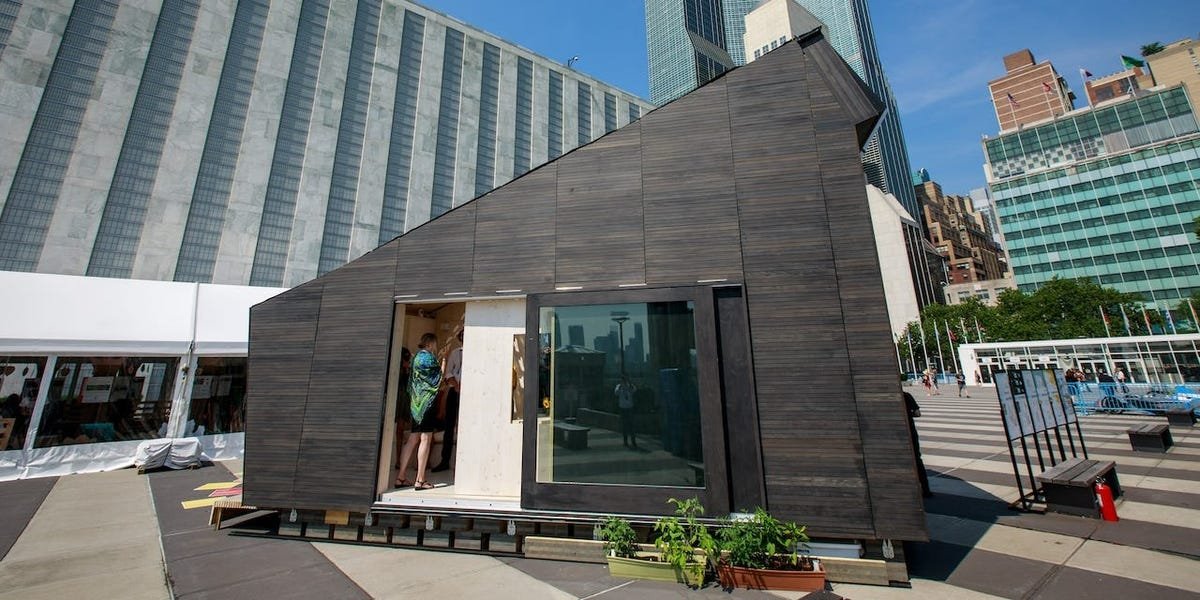
New York City homeowners can apply to build a backyard tiny home

It’s open season for some New York City homeowners interested in building a tiny home in their backyard.

Under a sweeping zoning reform Mayor Eric Adams signed into law late last year, the city made it legal for certain one- and two-family homeowners to add an additional home, also known as an “ancillary dwelling unit” or ADU, to their property.

On September 30, 2025, the city finalized its rules for backyard and attic ADUs and began accepting applications from homeowners, although the government is still working on the rules for basement units. The city estimates that the reform — part of its City of Yes for Housing Opportunity package — will help create about 25,000 new homes in backyard cottages and converted garages, attics, and basements over the next 15 years. But the success of the reform will depend in large part on homeowners navigating high construction costs and regulations.

Wil Fisher has spent the last year preparing for this. The former city government employee founded a Queens-based firm, Unit Two Development, that helps homeowners determine whether their property is eligible for an ADU and connects them with contractors and others who can help them build one. Fisher said he and his team have identified well over 100,000 eligible individual properties, and they’ve talked with more than 100 of these homeowners, who largely live in Queens and Staten Island.

“The rules of the road are now written,” Fisher said. “It was a long process, but for the most part we’re off to the races.”

Most of the people Fisher has talked with are interested in adding an ADU to house a family member, including an aging parent or a relative with disabilities who needs care, or an adult child.

Maggie Ornstein is one of these homeowners. Ornstein, 47, lives with her mother in a house in western Queens that has been home to five generations of her family since the 1800s. She hopes to build an ADU for her mother, who’s undergoing treatment for cancer and is having difficulty navigating the stairs in their two-and-a-half-story home.

Ornstein, a public health geographer, has consulted with Fisher and determined that she could legally convert her garage into a home.

“My dream for an ADU on my property would be something that would be accessible, but might also have a second floor where a family member could potentially stay if they wanted to visit, or if I wanted to be with my mom in the ADU,” she said.

After months of planning and big picture discussions with potential clients, Fisher is starting to nail down the specifics of what his clients could build and what it might cost.

“Now is sort of the pivot from the conceptual to here’s exactly what it will take, and here are the cost implications of that,” he said.

Are you a New Yorker interested in building an ADU? Reach out to this reporter to share your experience at erelman@businessinsider.com.

Dealing with costs and regulations

One inevitable obstacle homeowners face is the steep price of building in the city. Fisher estimates that adding a backyard unit or converting a garage will start between $300,000 and $400,000, depending on the project’s size. That’s compared to the city’s median home price of $800,000.

The construction cost is out of reach for many homeowners who’d benefit most from adding an ADU to their property, said Thomas Yu, executive director of Asian Americans for Equality, an advocacy organization and affordable housing provider. Yu said there needs to be a much clearer and more affordable path to adding an ADU before the regulatory reform will unleash construction in lower and middle-income neighborhoods. He suggested tax abatements or grants for homeowners with more modest means.

Many of the New Yorkers Yu and his team work with live in overcrowded homes with multiple generations of their family. They could benefit from having a home for an older relative or an adult child who couldn’t otherwise afford to stay in the city.

“The ability for that generation to achieve independent homeownership is zero, particularly in New York City,” Yu said of younger New Yorkers. “So ADUs are the next half-step that’s needed for that.”

Ornstein said she’s been discouraged by the price tag on her potential project. She’s also turned off by how extensive and involved the construction would likely be, especially given her work schedule and caregiving responsibilities. She’s hoping to find some government funding to help pay for the project.

“It’s so much more expensive than I would have anticipated,” she said. “On the one hand, you wouldn’t be able to buy an apartment in New York City for what an ADU would cost to build. But on the other, it’s really a lot of upfront cost.”

The expense and hassle of adding an ADU might not make sense for homeowners who are just looking for rental income, Fisher said. But he expects the units will be easily rentable for those who want a tenant either immediately or in the future. Adding an ADU also tends to hike the property’s resale value.

“As far as I’m seeing, construction costs are a little too high for them to be a slam dunk rental investment from day one,” Fisher said. “But for folks who have a relative or an immediate need that exists within their own family or social network, these are going to be good investments in the long term.”

ADU construction is also limited by a slew of regulations. The units can’t be bigger than 800 square feet or take up more than a third of a homeowner’s backyard. The law also restricts basement ADUs in areas prone to flooding and prohibits them in attached homes, like townhouses.

The Regional Plan Association, a pro-housing nonprofit focused on the tri-state area, found that just 68,000 lots — 12% of the city’s one- and two-family properties — are eligible to add an ADU.

The city says it’s creating a “one-stop shop” full of information for homeowners interested in building an additional unit. The site will include a set of public, pre-approved backyard ADU designs submitted by architects, designers, and builders that homeowners can use to lower design costs and speed up the construction process.

“Efficiencies that can be built in are really going to be make or break for this market,” Fisher said.


Source link