Alex-Karp-says-AI-is-bad-news-for-humanities-trained-largely.jpeg

Alex Karp says AI is bad news for ‘humanities-trained, largely Democratic voters’

Palantir CEO Alex Karp says AI will upend society and that even people in tech underestimate “how disruptive these technologies are.”

“If you are going to disrupt the economic and, therefore, political power significantly of one party’s base, highly educated, often female voters who vote mostly Democrat, and military and working class people who do not feel supported, and you feel like that’s, you believe that that’s going to work out politically — you’re in an insane asylum,” Karp told CNBC on Thursday on the sidelines of AIPCon 9 in Maryland.

Karp said that, since AI will largely disrupt white-collar work, it will place greater value on vocational skills, upending the political paradigms of the Trump era.

“This technology disrupts humanites trained, largely Democratic voters, and makes their economic power less, and increases the power, economic power, vocationally trained, working class, often male voters, and, and, and so, these disruptions are going to disrupt every aspect of our society,” he said.

Studies show that many white-collar fields are the most exposed to the initial wave of AI-related disruption. Anthropic CEO Dario Amodei has warned that AI could wipe out up to half of all white-collar, entry-level jobs over the next 1 to 5 years.

Karp has long positioned himself and Palantir as champions of the working class, with a particular focus on the US military. He’s declared the software company “completely anti-woke” and has pushed back against employees who have questioned the firm’s contracts with US immigration authorities.

The US can justify pursuing such a disruptive technology as AI only if it is coupled with national security, Karp said.

“These technologies are dangerous societally,” he said. “The only justification you could possibly have would be if we don’t do it, our adversaries will do it, and we will be subject to their rule of law.”

Later in the day, Karp sketched out what could happen in a world that doesn’t come together in the face of AI. In particular, he called for wholesale changes to the US education system to better prioritize skills-based training.

“The problem, the danger is if we don’t do these reforms, you are going to get the pitchforks, because then the only solution people are going to have is, well, let’s go after the unlikeable, rich people in tech, especially AI tech,” he said during a recent interview on TBPN.

While Palantir has not disclosed why, the firm recently relocated from Colorado, a state that has become more Democratic in recent years, to Florida, where Gov. Ron DeSantis has overseen an explosion in Republican support.

Karp contrasted the future of America with that of Germany, where he spent significant time pursuing a Ph.D at Goethe University in Frankfurt.

“There are a lot of people like you guys, young people building things that feel hampered and are correct to feel hampered,” he said. “I think the American version, if we’re not careful, is not going to be the German version. I think it’s going to be, ‘Hang the rich.'”

Source link

Im-a-native-Floridian-who-left-after-60-years-The.jpeg

I’m a native Floridian who left after 60 years. The high prices, traffic, and bad weather made it unlivable.

This as-told-to essay is based on a conversation with Kimberly Jones, a 60-year-old native Floridian who moved to North Carolina in 2025. The conversation has been edited for length and clarity.

I was born and raised in Miami and spent my entire life living in South Florida. But last year, my husband and I moved to North Carolina, and it wasn’t an easy decision.

Our reasons for moving were multifaceted. A major factor was affordability; the cost of living in Florida had gotten out of control. Prices increased for everything — homeowners’ and auto insurance, and even for everyday expenses like groceries and eating out. Those costs felt particularly high in South Florida compared with other parts of the state.

Another reason was that South Florida feels overly developed. If there’s a corner available, they’ll build a high-rise on it. It’s turned into a congested, expensive city. I used to spend 2.5 hours a day commuting to and from work.

Beyond affordability and congestion, my husband and I were also looking forward to a slower pace of life.

My children are still in Florida, along with the rest of my family, my friends, and the life I’d always known. For us to leave, it was a big deal.

I hardly recognize Florida anymore


A sunset over buildings in Miami, Florida, with cranes over new high-rise buildings under construction.

New high-rise buildings under construction in Miami.

Bilanol/Getty Images


South Florida is nothing like what it used to be.

When I passed another cluster of cranes and new buildings going up, I would always think: who’s living in all of these places, especially at these prices? It’s not the people who actually keep the city running. Not the teachers, the grocery store workers, or the hospitality workers.

These days, even young adults with a college degree and a decent job are having a hard time affording to live here unless they have a partner to help pay half the bills.

My kids are single and already out of college. My daughter works two jobs to keep up with expenses, and my son also has a secondary income.

My daughter managed to buy a condo a few years ago, when prices were lower, and interest rates were still low. But my son has little chance of buying anytime soon; he’ll be renting for the near future, like most of his friends — most of my friends talk about the same thing with their kids.


Construction workers building a mansion on Miami Beach.

Construction workers building a mansion on Miami Beach.

Miami Herald/TNS


I grew up in Florida, so seeing what’s happened is surreal. It’s just sad to watch that kind of change. Buildings just keep going up and up; they’re even trying to push farther into the Everglades. It feels like they’re displacing wildlife and disrupting the ecosystem.

And then there’s the question of infrastructure — what are they doing to support all of this growth?

My quality of life has improved since moving to North Carolina

In January and February, there’s no better place to be than South Florida. But the other months of the year, the heat and the humidity were just brutal. You couldn’t leave your house, and your AC never shut off.

We wanted better weather, but my husband and I didn’t want to go somewhere far, like the Northeast. Many Floridian transplants are moving to Southern states like North Carolina, South Carolina, Georgia, and Tennessee.

We chose to move to North Carolina.


A woman holds a dog as she sits on a boat.

Jones and her dogs in the family boat on their lake, next to their house.

Courtesy of Kimberly Jones


My husband retired a few years ago, and I was able to transition to remote work. We live in a small rural town about an hour from Charlotte. We love its slower pace of life and the fact that people are very nice up here.

My husband and I custom-built a lakefront home on 1.5 acres of land we bought in the town 20 years ago. There’s no way we could have afforded this quality of a home in Florida.


A woman and a man pose in front of a backdrop at a concert.

Jones and her husband at a concert in North Carolina.

Courtest of Kimebrly Jones


Living in North Carolina does have its give-and-takes. For one, there’s a state income tax, which Florida doesn’t have. Still, sales tax is pretty much the same in both states, and overall, the cost of everything else here is much lower than in Florida. We’ve been saving money on home insurance. Even grocery stores and restaurants are more affordable.

My quality of life — my stress level, everything — has improved tremendously just from being out of what felt like a rat race.

A lot of my friends have already left Florida, and the ones who haven’t want to, but they’re stuck for different reasons, like owning a business. I think my husband and I are really lucky our timing worked out.


Source link

Kavanaugh-in-dissent-Bad-policy-or-not-Trumps-tariffs-were.jpeg

Kavanaugh in dissent: Bad policy or not, Trump’s tariffs were ‘clearly lawful’

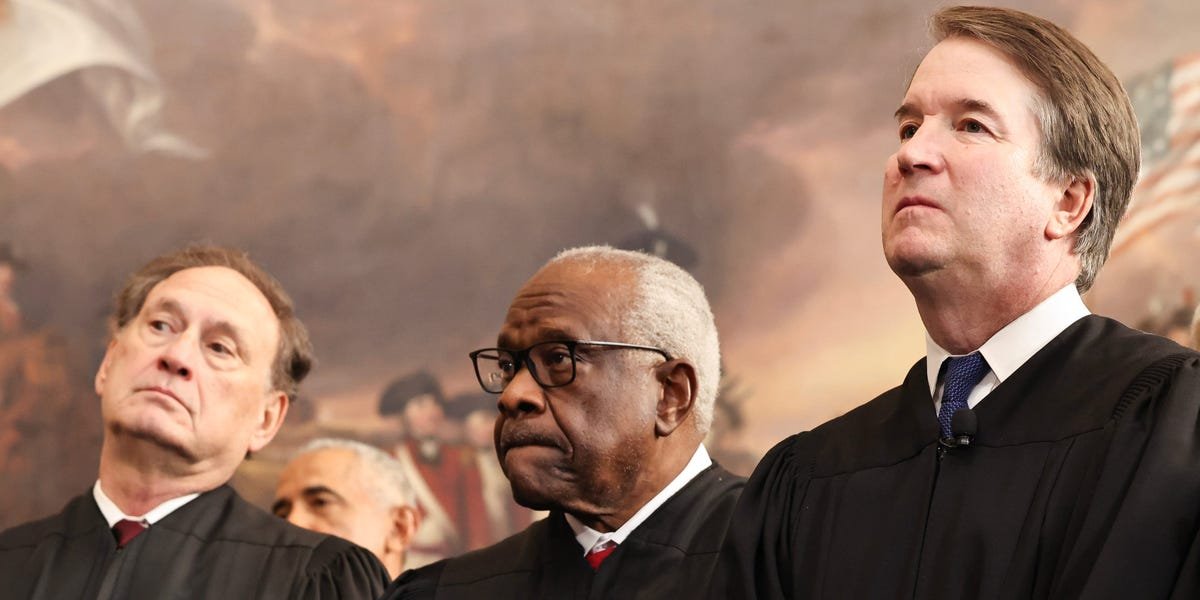
Three conservative justices of the US Supreme Court — Brett Kavanaugh, Clarence Thomas, and Samuel Alito — broke with the majority Friday, arguing that President Donald Trump had clear authority to impose his sweeping tariff policy.

The three dissenting justices said the president’s tariffs were perfectly legal under the 1970-era law Trump used that says presidents can “regulate” importation in the case of emergencies.

“The tariffs at issue here may or may not be wise policy,” Kavanaugh wrote. “But as a matter of text, history, and precedent, they are clearly lawful.”

The three justices also noted that the majority 6-3 decision is silent on how to return billions of dollars in tariffs that have already been collected.

That process “is likely to be a ‘mess,'” as was acknowledged at oral arguments, Kavanaugh wrote in a lengthy dissent that Thomas and Alito joined.

The two dissents differed with the majority on two fronts: Trump’s bypassing of Congress in imposing tariffs, and the legality of the president’s invocation of the International Emergency Economic Powers Act, or IEEPA.

In the dissent written by Kavanaugh, the justices argued that presidents have “commonly” imposed tariffs to regulate imports throughout American history.

Interpreting IEEPA to exclude tariffs “creates nonsensical textual and practical anomalies,” Kavanaugh wrote. As with quotas and embargoes, tariffs are a “traditional and common tool to regulate importation,” he said.

“It does not make much sense to think that IEEPA allows the President in a declared national emergency to, for example, shut off all or most imports from China, but not to impose even a $1 tariff on imports from China,” Kavanaugh wrote.

Reversing the tariffs may be an exercise in futility, Kavanaugh added. Even without IEPPA, “numerous other federal statutes authorize the president to impose tariffs and might justify most (if not all) of the tariffs at issue in this case,” Kavanaugh wrote.

In a separate dissent, Thomas tackled the constitutional question, arguing that the Constitution allows Congress to delegate tariff authority to the president.

“Historical practice and precedent confirm that Congress can delegate the power to impose duties on imports,” he said.


Source link

Bad-Bunnys-custom-Zara-Super-Bowl-shirt-is-popping-up.jpeg

Bad Bunny’s custom Zara Super Bowl shirt is popping up on resale sites and fetching high price tags

  • Bad Bunny’s Super Bowl shirt has led to lookalikes appearing on resale sites such as eBay and Vinted.
  • Some of the Zara-designed shirts are being listed for thousands of dollars.
  • The shirts were reportedly given to employees at Zara’s parent company and weren’t intended for sale.

Shirts inspired by Bad Bunny’s Super Bowl outfit are fetching high price tags on resale sites.

The Puerto Rican singer wore an ensemble designed by retail giant Zara during his Super Bowl LX performance on Sunday. In the days following the show, similar T-shirts have popped up on resale platforms such as eBay and Vinted.

They’ve appeared in listings that feature a thank-you card from Bad Bunny, whose name is Benito Antonio Martínez Ocasio, and tags that state that the garment is not intended for sale.

A limited number of the tops were given to some employees at Zara’s parent company, Inditex, to commemorate the performance, multiple outlets reported. In the thank-you note, the pop star praised the time, talent, and heart that went into the project.

Zara and Inditex did not immediately respond to requests for comment by Business Insider.


Vinted listing

Sellers posted the T-shirts along with a thank-you card from Bad Bunny.

Vinted


As of Tuesday afternoon, the shirts were being listed for between 500 euros ($595) and thousands of dollars on eBay and Vinted, with at least one Vinted post asking for nearly $10,000.

Some of the cheaper options came without the thank-you note.

“This garment has been created as a special gift from Benito to Puerto Rico,” read the tag on one shirt, which was listed without the thank-you note.

The jersey features the name Ocasio across the back and the number 64, in honor of his late uncle, representatives for Bad Bunny told Complex.


Source link

photo-of-Ana-Altchek

Salesforce exec shares the advice he gives entry-level talent: ‘Hard isn’t necessarily bad.’

As companies rethink how they train early-career workers in a job market shaped by AI, Salesforce executive Andy White said resilience is top of mind for him — both at work and at home.

White oversees Salesforce’s implementation of Slackbot, an AI personal agent that generates responses based on conversations, files, and workflows inside Slack.

As White raises his son and daughter during a period of rapid technological change, he said he preaches to his kids the importance of powering through moments that don’t go as planned. He said resilience is pivotal and that it’s important for people to focus on doing the hard things and being OK when things don’t go as expected.

The senior vice president of business technology said he recently spoke with his daughter about the importance of dealing with situations rather than merely labeling them as “good” or “bad.”

“Hard is hard,” White told Business Insider. “Hard isn’t necessarily bad.”

Expectations, he said, are the “destroyer of hope and joy,” and that when things don’t go as planned, it often turns out to be a good thing down the line, even if it doesn’t seem that way in the moment.

“It’s when we look back, and it’s like, ‘Oh man, I’m glad that didn’t go the way I expected,'” White said. “But when you’re in it, it’s really hard.”

The importance of persistence

The resilience lesson is one White also thinks is relevant for entry-level workers. While junior hires often arrive ready to use new tools and deliver a “pretty high output,” he said, persistence is an area where some still need to grow.

He described today’s entry-level talent pool as “incredibly capable, very bright, and very driven,” with a stronger grasp of how to use AI tools to solve problems.

“They’re much more fluent at being able to leverage AI tooling in the flow of their work,” White said.

However, he said the group sometimes struggles when it comes to working through challenges.

“There’s more willingness to give up sooner,” he said, adding that this trait doesn’t apply across the board.

Finding confidence

White said he’s seen AI tools, such as the company’s recently upgraded Slackbot, help boost entry-level workers’ confidence. He said they could help reduce feelings of imposter syndrome by helping early-career workers navigate challenging situations that arise at work.

With that said, White added that workers need to stay balanced and not let tools make them “overly confident.” He said workers need to bring skepticism to “any kind of information” they get, and be diligent about reviewing sources and citations when using AI.

“If you don’t believe something, read the citation, and if it doesn’t have a citation, you have to assume it’s a hallucination,” White said, adding that he tells his kids the same thing.


Source link

I-was-in-the-stands-for-Bad-Bunnys-Super-Bowl.jpeg

I was in the stands for Bad Bunny’s Super Bowl halftime show. Here’s what it was like.

  • I was at Levi’s Stadium when Bad Bunny performed his historic Super Bowl halftime show.
  • We missed the surprise cameos from Pedro Pascal and Cardi B.
  • The crowd absolutely lost it when Lady Gaga appeared.

“Look for us on TV!” I told my parents before my fiancé and I headed to Levi’s Stadium in Santa Clara, California, for our very first Super Bowl.

“Oh, we’re not going to watch the game,” they replied. “But can you text us before Bad Bunny comes on?”

This year’s Super Bowl halftime show might have been even more anticipated than the Big Game. And after a lackluster performance from the New England Patriots against the Seattle Seahawks, it was clear that the real star of Sunday was Bad Bunny.

Here’s what it was like to watch his halftime show from the Super Bowl stands.

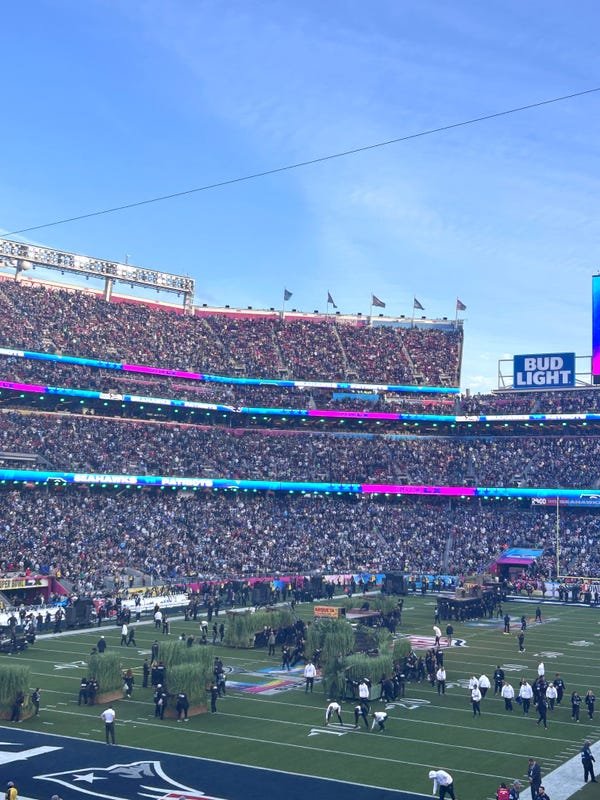
Right after the first half came to an end, dozens of crew members rushed to prepare the field.

Staff members rolled out carts with the tufts of grass.

Anneta Konstantinides/Business Insider

We got a sneak peek at Bad Bunny’s set as we watched people wheel out carts with tall tufts of grass, a nod to the sugarcane fields of his native Puerto Rico.

Everyone in the stands laughed as we watched extras dressed as grass walk by.


Super Bowl halftime set up

Extras dressed as grass added to the scenery.

Anneta Konstantinides/Business Insider

I assumed the extras were going to dance, but they were actually added to accommodate rules for protecting the natural grass at Levi’s Stadium.

Bruce Rodgers, who has produced the Super Bowl halftime show for the past two decades with his company Tribe Inc., told Wired that the NFL limited how many carts could be wheeled out onto the football field. So the team decided to dress up performers to help re-create the lush greenery of Vega Baja, Bad Bunny’s hometown.

Andrew Athias, one of the extras, told Business Insider that the grass costume weighed 40 pounds. He flew to California from the East Coast and spent two weeks in rehearsals to be part of the field cast.

“I got paid $18.70 per hour for the gig, but I would’ve done it for free,” he said.

Once the stage was set, we realized our seats were the farthest away from the performance.


Super Bowl halftime set up

Most of the performance took place on one end of the football field.

Anneta Konstantinides/Business Insider

La Casita, a major stage piece from Bad Bunny’s “No Me Quiero Ir De Aquí” residency, arrived at the end zone for the Super Bowl halftime show — just not the one we were behind!

Still, the excitement was palpable as Bad Bunny kicked off his 15-minute performance with “Tití Me Preguntó.” One guy in front of me even started FaceTiming his friend, holding the phone so she could watch the entire show.

We caught parts of the halftime show with the help of one of the stadium’s jumbotrons…


Super Bowl halftime show

We watched a lot of Bad Bunny’s performance via a jumbotron.

Anneta Konstantinides/Business Insider

Bad Bunny walked through the tall grass, passing by various set pieces that paid homage to Puerto Rico — including stands selling Coco Frio and piraguas — at the start of his performance.

From the stands above, all we could see were the tops of the grass. However, a jumbotron directly across from our seats showed us what fans at home were seeing on their TV screens.

… but sometimes it only showed stock images.


Superbowl Halftime Show

One of the stock images on the jumbotron.

Anneta Konstantinides/Business Insider

Everyone around me was confused when the jumbotron in front of us kept cutting away from Bad Bunny to show random images, including some leaves and a cityscape.

People quickly realized that the screen behind us was still showing the halftime show, so we wondered if the stock images were due to a technical issue.

When I rewatched the show at home, I noticed our jumbotron was often visible on camera. I’m not an expert in production design, but I figure the decision might have been made to make it look less distracting in the telecast.

We completely missed the surprise cameos.


Cardi B and Jessica Alba during the Super Bowl halftime show

Multiple celebrities were dancing in Bad Bunny’s casita during the halftime show.

Christopher Polk/Billboard via Getty Images

I found out that stars including Cardi B, Alix Earle, Pedro Pascal, and Jessica Alba made a quick surprise cameo during the halftime show, thanks to excited texts from my friends who were watching from home.

But there was no missing Lady Gaga.


Bad Bunny and Lady Gaga perform at the 2026 Super Bowl.

Bad Bunny and Lady Gaga perform at the 2026 Super Bowl.

Kevin C. Cox/Getty Images

Lady Gaga was also a total surprise for the fans in the stands, and I just about lost it when she appeared to sing a salsa version of “Die With a Smile.”

Alas, I have no pictures of this moment because I was too busy crying tears of joy.

The surprise halftime wedding went by in a flash.


A couple got married during Bad Bunny's halftime performance.

A couple got married during Bad Bunny’s halftime performance.

JOSH EDELSON / AFP via Getty Images

Watching the couple say “I do” from the stands was a quick but special part of the show, especially when it was later revealed via ESPN that the couple had originally invited Bad Bunny to their wedding — only for him to invite them to get married during his Super Bowl performance instead.

Bad Bunny and his dancers ran across the football field for the parade of the Americas.


Superbowl Halftime Show

We could spot all the flags from our seats in the stands.

Anneta Konstantinides/Business Insider

The show made its way over to our side of the football field as Bad Bunny’s backup dancers carried flags from countries in North and South America.

The show ended with fireworks and a powerful statement.


Superbowl Halftime Show

The grand finale of the Super Bowl halftime show.

Anneta Konstantinides/Business Insider

“The only thing more powerful than hate is love,” the sign read, evoking Bad Bunny’s statement during his Grammys acceptance speech the week prior.

The stadium erupted as Bad Bunny began singing “DTMF,” his message emblazoned for all to see — no matter where we were sitting.

As fireworks lit up California’s slowly darkening blue sky, I knew I had just watched something historic.

And yes, my parents loved it.


Source link

Details-you-missed-in-Bad-Bunnys-Super-Bowl-LX-halftime.jpeg

Details you missed in Bad Bunny’s Super Bowl LX halftime show

  • On Sunday, Bad Bunny took the stage at Levi’s Stadium for the Super Bowl LX halftime show.
  • The show was full of nods to Puerto Rico and included subtle political and cultural statements.
  • Here are some details from Bad Bunny’s halftime performance that you might have missed.

Bad Bunny’s Super Bowl LX halftime show was more than a hit-filled performance — it was a carefully staged cultural statement.

Beyond the headline moments, the show was packed with intentional details, from visual symbolism to casting choices, that were easy to miss in real time.

We’ve rounded up the moments you might not have caught, and why they mattered.

Bad Bunny’s “Ocasio 64” jersey

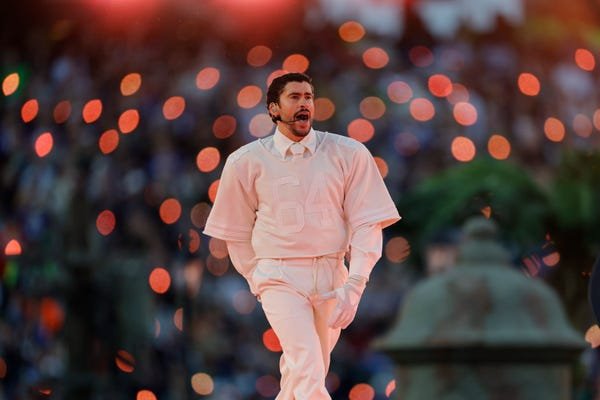
Bad Bunny wore Zara for his Super Bowl halftime performance.

Bob Kupbens/Icon Sportswire via Getty Images

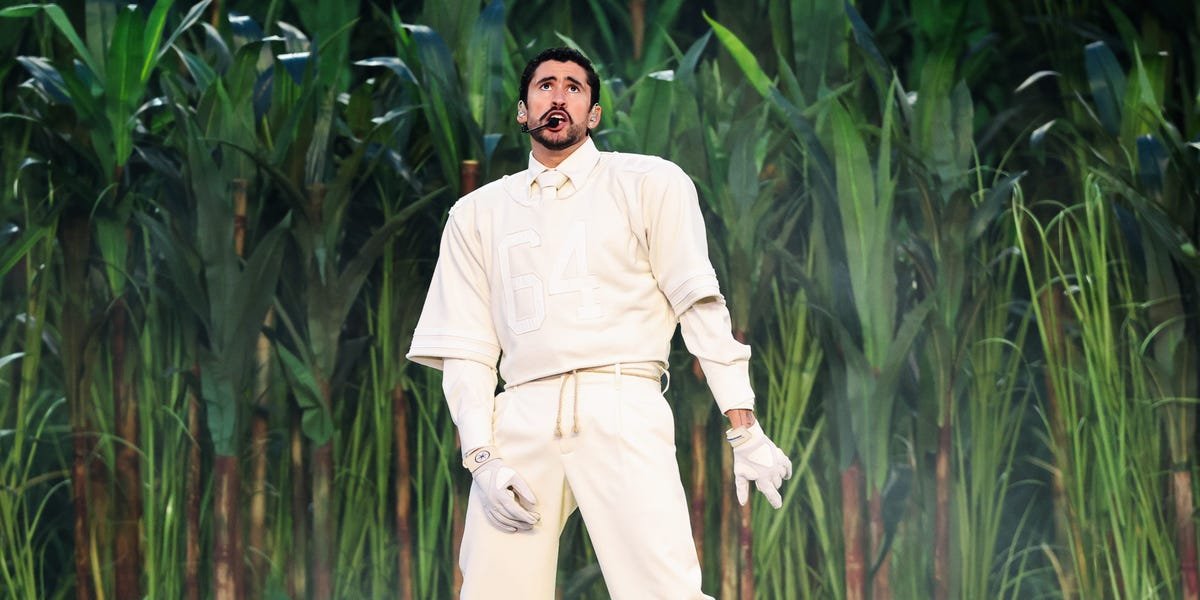
Bad Bunny — born Benito Antonio Martínez Ocasio — wore a white Zara football jersey emblazoned with his last name, “Ocasio,” and the number “64.”

The number set off widespread online speculation about its meaning, with theories ranging from personal and musical references to Hurricane Maria, but no definitive explanation has been confirmed.

The cameos


Bad Bunny and Lady Gaga at the Super Bowl halftime show.

The halftime performance featured several celebrity cameos.

Christopher Polk/Billboard via Getty Images

Bad Bunny’s halftime show featured several celebrity cameos from the likes of Lady Gaga, Ricky Martin, Pedro Pascal, Cardi B, Karol G, Jessica Alba, and Young Miko.

Lady Gaga appeared in a blue dress and sang a salsa rendition of her chart-topping hit “Die With a Smile,” while fellow Puerto Rican native Ricky Martin took to the stage to perform Bad Bunny’s “Lo Que Pasó a Hawaii.”

Maria Antonia Cay, known as Toñita, also made a cameo, briefly appearing onstage to hand Bad Bunny a drink. She runs Caribbean Social Club in Williamsburg, one of the last Puerto Rican social clubs in New York City.

An actual wedding


A couple got married during Bad Bunny's halftime performance.

A couple got married during Bad Bunny’s halftime performance.

JOSH EDELSON / AFP via Getty Images

A couple featured in Bad Bunny’s performance actually got married during the set, league sources confirmed to ESPN.

The outlet said that the couple had originally invited Bad Bunny to their wedding. Instead, the singer invited them to get married during his show.

The power lines


Bad Bunny's halftime set featured electricity poles as stage props.

Bad Bunny’s halftime set featured electricity poles as stage props.

Kevin Sabitus/Getty Images

During his performance of “El Apagón,” a song whose title translates to “the power outage,” Bad Bunny leaned into the track’s themes about the frequent blackouts in Puerto Rico.

The stage featured his dancers dressed as jíbaros, or traditional Puerto Rican farmers, who began climbing utility poles that sparked and exploded.

The dancers dressed as plants


A dancer dressed as a plant for Bad Bunny's halftime show.

The halftime show featured dancers dressed as plants.

San Francisco Chronicle/Hearst Newspapers/San Francisco Chronicle via Getty Images

Bad Bunny brought Puerto Rico to Levi’s Stadium by covering the stage in greenery inspired by Vega Baja, where he grew up.

In another stadium, that kind of lush landscape would typically be created by wheeling carts of plant props onto the field, Bruce Rodgers, whose company Tribe Inc. handled the show’s production design, told Wired.

But NFL rules limited how many carts could be used to protect Levi’s Stadium’s natural grass, so the team dressed performers as plants to get the same effect, Rodgers said

Boricua pride on display


Bad Bunny's halftime performance featured references to Puerto Rico, such as a piragua stand.

Bad Bunny’s halftime performance featured various references to Puerto Rico, including a piragua stand.

Patrick T. Fallon / AFP

Bad Bunny’s halftime performance featured several cultural symbols of Puerto Rico, including sugar cane fields, a piragua stand, and a casita.

The billboard message at the end of the performance


A billboard at the end of Bad Bunny's halftime performance.

The billboard at the end of Bad Bunny’s halftime performance was a reference to his Grammys speech.

JOSH EDELSON / AFP

As fireworks lit up the sky to mark the end of Bad Bunny’s halftime performance, a stadium screen displayed the message, “The only thing more powerful than hate is love.”

The quote echoed a line from the singer’s Grammy acceptance speech last week.

While accepting the award for best música urbana album, Bad Bunny called out ICE.

“We’re not savage,” he said. “We’re not animals. We’re not aliens. We are humans, and we are Americans.”

Later that night, Bad Bunny also made history as the first artist to win Album of the Year with an all-Spanish record.


Source link

Aditi Bharade

I flew across the country to be dancing grass at Bad Bunny’s Super Bowl halftime show

This as-told-to essay is based on a conversation with Andrew Athias, 33, a Philadelphia-based digital marketer and content creator. It has been edited for length and clarity.

I was one of the 500 bunches of dancing grass at Bad Bunny’s Super Bowl halftime show. I got paid $18.70 per hour for the gig, but I would’ve done it for free.

I’m a big Bad Bunny fan. I’ve been to three of his concerts since my girlfriend introduced me to him in 2021.

I found the grass gig through a company called Backlit, which handles finding extras for the halftime show. I found it last year when I saw Kendrick Lamar at the Super Bowl halftime show, but I forgot about it until Bad Bunny was announced as Super Bowl’s headliner in October, and I decided to apply.

I was one of the few crazy people to fly over from the East Coast to be part of the field cast. I flew out to San Francisco from Philadelphia in the middle of a snowstorm and have been out here for two weeks, rehearsing for the big day, and it has been worth it.

Job description: Be athletic

The requirements for the role were pretty basic. You had to be no taller than six feet, no shorter than five feet seven inches, and of an athletic build.

The listing said we had to be able to wear a 40-plus-pound costume and to be comfortable dancing in proximity with other performers for long periods. Other than that, we had to measure every part of our body from head to toe, elbow to floor, shoulder to clavicle, etc. Those were the only requirements.

They didn’t tell us we’d be wearing a grass costume and kept it super vague.

12-hour rehearsals with a 40-pound grass costume

My part was actually really easy. They just told me where to stand, and they said, “Don’t move. Stand here and be one with the grass.”

The suits were heavy and uncomfortable. Every now and again, you’ll have a blade of plastic grass going places where grass should not go. Fortunately, we were given some protective goggles.

There were definitely times when we were wearing the suits for about six or seven hours because they had to make alterations. There were about eight practices in total, with the last three lasting 12 hours each.

But the production crew did their best to make this suit as wearable as possible; they listened to every complaint and tried to fix it.

And getting to see behind the scenes of the production was a treat.

It was really cool to see Bad Bunny perform just a foot away. But because he was in LA for the Grammys during some of our rehearsals, the crew had a Bad Bunny stand-in they called “Good Rabbit.”

An electrifying atmosphere


Bad Bunny performs onstage during the Apple Music Super Bowl LX Halftime Show at Levi's Stadium on February 08, 2026 in Santa Clara, California.

Bad Bunny’s Super Bowl halftime performance.

Kevin Mazur/Getty Images for Roc Nation


One of the other things they asked for in the application was whether you had marching band experience or experience in the entertainment industry. I was in a collegiate a capella group, so I’m not scared of performing in front of big crowds.

But it’s definitely different when you have a stadium full of people vibing, moving, grooving to Bad Buddy’s music.

I spent about $2,600 on flights, hotels, and a rental car for the two weeks. I’m a content creator without a full time job now, so I didn’t have to take any paid time off for this.

The hardest part of the gig was keeping quiet

The hardest part of the whole thing wasn’t the long hours or the heavy costume, but rather keeping quiet about it. They made us sign an NDA to not talk about it or post anything on social media for two weeks.

So when I saw people posting about what his setlist was going to be, it was so hard to have so much knowledge and power and not be able to do anything with it.

I told only a very small handful of people that I was going to San Francisco and would be involved in the half-time show.

I didn’t tell them what I was dressed as. I didn’t tell them where to look for me on the field. All I said was, “You’re going to see me. You just didn’t know that you saw me.”


Source link

callie ahlgrim headshot 2023

Bad Bunny didn’t need to sing in English at the Super Bowl to make a statement about America

When Bad Bunny took the field at the 2026 Super Bowl for a historic, joyful halftime show, he wore a jersey with his Latino heritage stitched into its very fabric.

It’s an apt metaphor for his performance, which eschewed explicit anti-ICE statements (he covered that at the Grammys, anyway) in favor of celebration with a side of symbolism.

Nods to the Puerto Rican singer’s motherland were peppered throughout the set, which was designed to evoke the US territory’s signature aesthetics, from sugar cane fields to a storefront labeled “La Marqueta” (a slang term for market) and various vendors selling tacos and piraguas (shaved ice). While performing “El Apagón,” a song about the frequent blackouts and infrastructure issues affecting Puerto Ricans, Bad Bunny brought this symbolism to the forefront, waving the Puerto Rican flag.

He also proclaimed in English, “God bless America,” and brandished a football printed with the phrase “Together, We Are America.” He added in Spanish, “We’re still here.” (Puerto Rico is a US territory, and Puerto Ricans are American citizens.)

It was a stark and knowing contrast to the Latinophobia and anti-immigrant messaging hawked by the Trump administration. So much so that President Donald Trump complained online about Bad Bunny’s performance and his choice to sing primarily in Spanish.

“The Super Bowl Halftime Show is absolutely terrible, one of the worst, EVER! It makes no sense,” Trump wrote on Truth Social after Bad Bunny left the stage. “Nobody understands a word this guy is saying.”

For those who understand visual storytelling, however, Bad Bunny’s performance made perfect sense. He didn’t need to say “ICE out” or declare an explicit political opinion. In keeping with the recent tradition of Super Bowl halftime shows, Bad Bunny used iconography to take a stand instead.

Bad Bunny’s Super Bowl performance is part of a new halftime show tradition

Bad Bunny’s performance shares DNA with Beyoncé and Kendrick Lamar’s Super Bowl appearances, both of which used bold imagery to make strong statements.

Beyoncé’s surprise appearance at Coldplay’s 2016 Super Bowl halftime show became famous — and, to some, infamous — for the iconography present in her performance of her then-new single, “Formation.” In the midst of Trump’s first presidential campaign, Beyoncé and her backup dancers wore outfits that channeled the Black Panther Party, an organization formed amid the ’60s Civil Rights Movement that fought for Black liberation.


Beyoncé performs at the 2016 Super Bowl.

Beyoncé performs at the 2016 Super Bowl.

Robert Beck/Sports Illustrated via Getty Images


The song itself isn’t explicitly political. But as a celebration of identity and legacy that features lyrics about Beyoncé’s parents, her daughter, and her features (“I like my negro nose with Jackson 5 nostrils”), Beyoncé performing it — with visual references to the song’s themes in her and her dancers’ costumes, to boot — was innately political.

It’s not that Beyoncé is allergic to making explicit political statements: She famously performed in front of the word “Feminist” at the 2014 VMAs, and sang “Votin’ out 45, don’t get out of line” on her 2022 album “Renaissance,” referring to Trump as the 45th president. But when the NFL hosts musicians for the night, they’ve lately preferred make their statements symbolic rather than overt.

Last year, Kendrick Lamar followed suit during his own Super Bowl halftime show, outfitting himself and his dancers in red, white, and blue. Although Lamar kept the music focused on his own enemies and triumphs, he used audacious visual language to pose broader, poignantly relevant questions: Who’s allowed to claim patriotism? What does it mean to be an American, especially in times of oppression and conflict?

Bad Bunny’s performance raised similar questions, but offered simpler, more optimistic solutions. For the finale, he was surrounded by backup dancers, band members, and other performers holding flags from around the world; when he proclaimed “God bless America,” he listed out all the countries in both North and South America.

Bad Bunny is not a politician, nor can he single-handedly cure the world of hatred and division. Still, for a brief moment, on a small square of American turf, he chose to use the stage to show millions of people what that could look like.


Source link

A-US-aircraft-carriers-hard-turn-to-avoid-enemy-fire.jpeg

A US aircraft carrier’s hard turn to avoid enemy fire surprised sailors and sent a jet with bad brakes into the sea

A US Navy aircraft carrier’s hard evasive turn to avoid enemy missile fire caught crewmembers off guard and sent a $60 million F/A-18 Super Hornet rolling off the deck and into the Red Sea, an investigation into the fighter jet loss revealed.

The fighter’s brakes weren’t functioning properly, investigators found, allowing the jet to slide across the deck when the carrier USS Harry S. Truman abruptly changed course during the late April action.

Poor communication, bad brakes, and a slippery surface all contributed to the loss.

A tow tractor also fell into the water alongside the expensive F/A-18 fighter jet, the second of three that the Truman lost during a monthslong Middle East combat deployment. When it went over, it nearly took sailors overboard as well.

Evading enemy fire

During their deployment, the Truman and its strike group led Navy combat operations against the Houthis, the heavily armed Iran-backed rebel group in Yemen that spent more than a year attacking key Middle East shipping lanes.


Three F/A-18 Super Hornets prepare to launch from the flight deck of the Nimitz-class aircraft carrier USS Harry S. Truman, December 21, 2021.

An F/A-18 fell overboard the Truman while the carrier took a hard turn.

US Navy Photo by Mass Communication Specialist 3rd Class Abbigail Beardsley


On April 28, the move crew lost control of an F/A-18 under tow in the Truman’s hangar bay, a maintenance area below the flight deck, the Navy reported at the time, and both the jet and its tow tractor tumbled into the Red Sea.

Right before it fell in, a sailor jumped from the cockpit, suffering minor injuries. The Navy didn’t share information or insight into the warship’s situation at the time of the plane loss.

According to the command investigation, the fighter jet and the tractor fell overboard while the Truman was conducting evasive maneuvers to avoid an incoming medium-range ballistic missile fired by the Houthis, a detail that had been reported but not confirmed at the time.

The move crew, which was preparing the F/A-18 from Strike Fighter Squadron 136 (VFA-136), the “Knighthawks,” for planned flight operations, didn’t hear the announcement that the ship was making a hard turn and was caught unaware when the ship began to tilt.

Sailors had removed the chocks and chains to pull the F/A-18 into the hangar bay. With the brakes engaged but not actually working, there was nothing to hold the aircraft in place when the carrier heeled in an evasive turn.


Two US Navy Aviation Ordnancemen transport ordnance across the hangar bay aboard the Nimitz-class aircraft carrier USS Harry S. Truman in the US Central Command area of responsibility.

The hangar bay is an area underneath the flight deck where aircraft receive maintenance.

US Navy photo


It slid backward toward the deck edge, dragging the tow tractor behind it. The crew moving the Super Hornet abandoned their posts just before the fighter jet fell into the sea.

Bad brakes

The command investigation put the blame for the incident primarily on the fighter jet’s inadequate brake engagement and the lack of communication from the Truman’s bridge to flight deck control and the hangar bay.

Leadership also said that the non-skid, a rough, high-friction coating applied to the decks of Navy ships to keep people, vehicles, and aircraft from slipping on smooth steel surfaces, was ineffective, having not been replaced since 2018.

These problems, the investigation said, cost the Navy an F/A-18, a multirole fighter made by the US aerospace giant Boeing that has been in service with the Navy for decades.

The April incident was one of four major mishaps that the Truman and its strike group suffered during their deployment.

In December, the cruiser USS Gettysburg accidentally shot down one of the Truman’s F/A-18s in what the military described as a friendly fire incident. In February, the carrier collided with a cargo ship. And in May, the ship lost its third fighter jet after a landing failure caused it to slide off the flight deck and plunge into the sea.


Source link