
Theron Mohamed — Profile Picture

Greg Abel pays tribute to Warren Buffett in his first letter as Berkshire Hathaway CEO, calling him a ‘very hard act to follow’

Greg Abel paid tribute to Warren Buffett and reassured Berkshire Hathaway shareholders he wouldn’t do anything drastic as their new CEO in his first letter to them on Saturday.

Buffett handed Berkshire’s reins to Abel at the start of this year, ending a six-decade run during which he transformed the failing textile mill into a sprawling conglomerate worth more than $1 trillion.

The legendary investor oversaw a 6,100,000% return for Berkshire shareholders between 1965 and 2025, trouncing the S&P 500’s total return of 46,100% including dividends. His compounded annual gain of 19.7% was nearly double the index’s 10.5% figure over a 60-year timeframe.

“Warren is obviously a very hard act to follow,” Abel wrote, continuing Buffett’s decades-long tradition of penning an annual shareholder letter.

Berkshire’s new boss dedicated the first section of his letter to Buffett, praising everything from his patience and judgment to his investing prowess, legacy as an educator, track record as a CEO, and the unique company he built with the late Charlie Munger.

Abel used the letter to properly introduce himself to shareholders, and even tried to inject some of Buffett’s trademark wit.

“I will not be your CEO for the next 60 years as simple arithmetic makes that — shall we say — an ambitious plan,” he quipped.

More of the same

Abel made it clear to shareholders that he “gets it” — he understands what makes Berkshire special and has no plans to ruin it.

He walked through what he called Berkshire’s “foundational values”: its decentralized model, integrity, financial strength, capital discipline, risk management, and operational excellence.

Abel lingered on the topic of capital discipline, showing he’s aware of how much scrutiny Berkshire has received for hoarding more than $370 billion of liquid assets.

He signaled there won’t be any rushed deals or immediate dividend payouts on his watch. He described Berkshire’s cash pile as both its rainy-day fund and its “dry powder” for stock purchases and acquisitions, but said he’ll remain disciplined in spending it “regardless of the size” of the company’s reserves.

Digging into the details

Abel’s letter contained several key nuggets for close followers of Berkshire.

First, he described its Kraft Heinz investment as “disappointing” with a return “well short of adequate,” echoing Buffett’s uncharacteristic bashing of the food giant.

Second, Abel broke out the five stakes in Japanese companies purchased by Buffett a few years ago. The dedicated table showed Berkshire paid a total of $15.4 billion for positions worth a combined $35.4 billion at December’s close, and collected $862 million in dividends from them last year.

Third, he revealed that Ted Weschler now oversees about 6% of Berkshire’s investments after assuming control of the recently departed Todd Combs’ portion of the company’s portfolio.

Abel also positioned Weschler as one of his key deputies, writing that his “impact extends beyond these investments” to weighing in on big opportunities and Berkshire’s businesses, and providing other support.

Finally, he signaled a shift to a bigger brain trust at Berkshire. Instead of Buffett and Munger holding court for the entire Q&A at Berkshire’s annual meeting, as they did for many years, Abel will field questions with Berkshire’s insurance chief, Ajit Jain, and later with Katie Farmer and Adam Johnson, two of his top deputies.


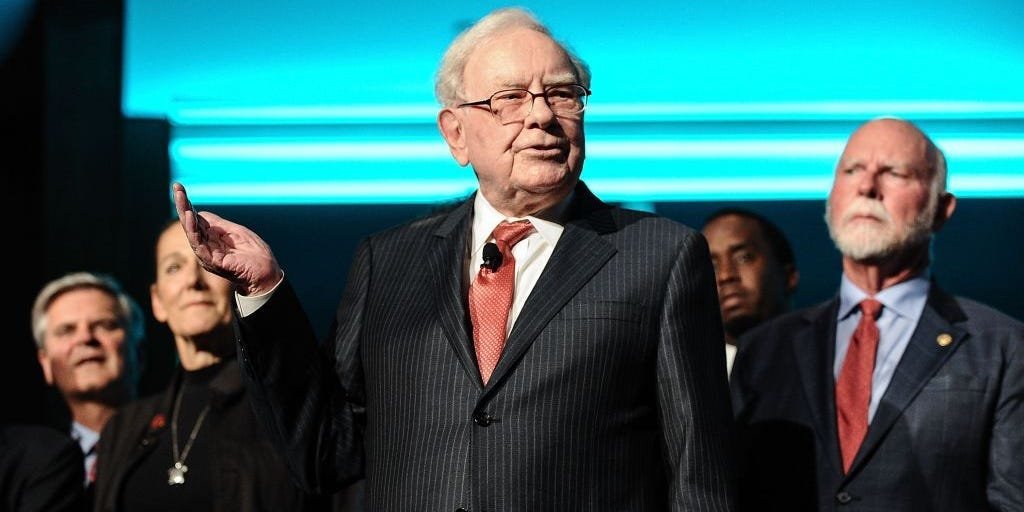

Source link

Why-Berkshire-Hathaways-New-York-Times-bet-is-a-fitting.jpeg

Why Berkshire Hathaway’s New York Times bet is a fitting end to the Warren Buffett era

Warren Buffett’s Berkshire Hathaway bought one new stock in his last quarter as CEO: The New York Times Company. It’s a fitting final bet for the Buffett era.

The famed investor’s conglomerate scooped up around 5.1 million shares of the newspaper publisher, securing a stake worth $352 million at December’s close, a Tuesday filing revealed.

The position’s small size points to one of Buffett’s two investment managers at the time — Ted Weschler and the since-departed Todd Combs — making the purchase.

Read all about it

Buffett is a lifelong lover of newspapers. He delivered 500,000 papers as a teenager running multiple routes, and for years, he challenged shareholders to best him at newspaper tossing during Berkshire’s annual meetings.

He went from throwing newspapers to owning dozens of publishers, including The Buffalo News and The Omaha World-Herald. He was close friends with the late publisher of The Washington Post, Katharine Graham, and one of the paper’s biggest financial backers.

By 2010, the billionaire stock picker was openly worried about declining circulation and advertising revenues for newspapers.

During Berkshire’s 2010 meeting, he recalled looking at the circulation of major titles such as the San Francisco Chronicle, and said it “blows your mind how fast people are dropping it.”

“The world has really changed, in terms of the essential nature of newspapers,” he said.

In 1965 or 1970, there was “probably nothing looked more bulletproof than a daily newspaper where the competition had melted away,” he continued. “But it’s a form of distributing information and entertainment that has lost its immediacy in many cases.”

Buffett pointed out that people no longer rely on papers to find out how their stocks were performing, or whether their sports team won. The resulting decline in circulation made newspapers less attractive to advertisers, he noted.

“And so you get this chicken and egg thing that the newspaper becomes less valuable as the advertisers float away, and the advertisers float away as the subscribers diminish,” he said.


Warren Buffett newspaper toss

Warren Buffett made the newspaper toss a fixture at Berkshire Hathaway’s shareholder meetings.


Rick Wilking/Reuters


Despite his concerns, he acquired 28 daily papers in the early 2010s.

“Charlie and I believe that papers delivering comprehensive and reliable information to tightly-bound communities and having a sensible Internet strategy will remain viable for a long time,” Buffett wrote in his 2012 letter to shareholders. “Charlie” referred to his late business partner, Charlie Munger.

“Newspapers continue to reign supreme … in the delivery of local news,” he added.

Buffett struck a far more bearish tone in 2019, telling Yahoo Finance that he expected only a few national titles, such as The New York Times, to survive, while the rest would “disappear.” He also bemoaned the demise of the newspaper ad business.

“It went from monopoly to franchise to competitive to … toast,” he said.

Berkshire’s surprise return

Buffett offloaded Berkshire’s newspapers to publisher Lee Enterprises in 2020. Given his long history in the newspaper business and eventual exit from it, it’s striking to see Berkshire return with its recent stock purchase.

One reason was undoubtedly The New York Times’ recovery in recent years. It grew revenues by 9% to $2.8 billion and its net income by 17% to $344 million last year, as subscription revenues rose 9% and advertising revenues jumped 12%.

A key driver was the paper’s addition of 1.4 million digital-only subscribers, which lifted its total subscriber count to 12.78 million as of December 31.

The publisher’s stock price has already seen some of the benefits. After collapsing from over $50 in mid-2002 to below $5 in early 2009, it has surged roughly 15-fold — including 50% in the past year — to trade at a record high of $74 at Tuesday’s close.

The shares gained another 3% in Wednesday’s premarket, perhaps marking one of the final cases of the “Buffett Effect,” where other investors mimic his buys and sells, moving markets.

The publisher’s comeback might explain why Buffett and his team decided to revisit one of his favorite industries so soon after turning the page.


Source link

Berkshire-Hathaways-new-CEO-has-a-higher-salary-than-Warren.jpeg

Berkshire Hathaway’s new CEO has a higher salary than Warren Buffett

  • Berkshire Hathaway disclosed that Greg Abel will make $25 million in his new CEO role.
  • Abel’s pay is a significant increase from Warren Buffett’s famous $100,000 salary.
  • Abel is expected to maintain Berkshire Hathaway’s investment philosophy.

Berkshire Hathaway is paying its new CEO, Greg Abel, $25 million each year, a big bump from Warren Buffett’s pay.

The company disclosed Abel’s annual cash salary in a filing with the Securities and Exchange Commission on Tuesday. He took on the role at the Omaha-based company on January 1.

Buffett, who retired last year, famously took an annual salary of $100,000 with no bonus or stock awards for over 40 years. Bloomberg estimates his net worth at $150 billion, the tenth-richest person in the world.

As Berkshire Hathaway’s former CEO and current chairman, Buffett recommended to his board of directors how much he should be paid and set compensation for Abel and other executives.

Abel, who was previously Buffett’s deputy, was paid $21 million last year. CEOs of S&P 500 companies were paid an average of $18.9 million in 2024.

At Berkshire’s annual shareholder meeting last year, Buffett, who is 95, announced that he would be stepping down after 55 years as the conglomerate’s CEO. Hours later, the board unanimously voted for Abel to replace him.

“I think the time has arrived where Greg should become the chief executive of the company at year end,” Buffett told the audience at the meeting.

Abel, 62, has been Berkshire Hathaway’s vice chair of non-insurance operations since 2018. He’s also chair of Berkshire Hathaway Energy, which Buffett hailed as one of the conglomerate’s four “jewels” in his annual shareholder letter in 2021, the same year Buffett first tapped Abel as his successor.

Investors expect Abel to maintain the company’s current investment philosophy. He is known for having a more hands-on leadership style than Buffett.


Source link

Meet-the-new-leaders-wholl-be-stepping-up-at-Greg.jpeg

Meet the new leaders who’ll be stepping up at Greg Abel’s Berkshire Hathaway

Berkshire Hathaway is reshuffling its top ranks ahead of the departure of its legendary CEO, Warren Buffett, in January.

The company announced on Monday that Todd Combs, one of Buffett’s key deputies and CEO of Berkshire-owned Geico, is departing the company to take on a role at JPMorgan.

Alongside Combs’ departure, Berkshire Hathaway announced a series of new leadership appointments.

The company said that the new leaders are “stewards of the company’s culture, demonstrate strong business acumen and judgment, and enable Berkshire’s distinctive way of operating.”

The shake-up of Berkshire Hathaway’s top ranks comes weeks before Greg Abel is due to take over from Warren Buffett as CEO in January. 95-year-old Buffett will remain as chairman of the business that he has led for the past 60 years.

Here’s the full list of appointments, most of which are effective immediately, according to Berkshire Hathaway’s Monday announcement.

Nancy Pierce becomes Geico CEO


Berkshire Hathaway pose with the Geico Gecko, the insurance company's mascot.

The Geico Gecko is one of America’s best-known corporate mascots.

Scott Olson/Getty Images


Nancy Pierce is succeeding Todd Combs as CEO of Geico, the auto insurer owned by Berkshire Hathaway and one of the conglomerate’s core subsidiaries.

Pierce joined Geico in 1986 and was chief operating officer of the company before being tapped as CEO. She has held leadership roles across claims, underwriting, product management, and regional operations.

“Nancy knows the business inside and out. She’s practical, decisive, and focused on results,” said Ajit Jain, vice chairman for insurance operations.

Adam Johnson takes over as head of Berkshire’s consumer division

Adam Johnson has been appointed president of Berkshire Hathaway’s consumer products, service, and retailing businesses.

Johnson has been CEO of the Berkshire-owned private jet company NetJets for over 10 years — a role he’ll continue alongside the new appointment.

“Adam is an accomplished leader with a proven ability to deliver long-term shareholder value,” said Abel, Berkshire’s incoming CEO, in Monday’s press release.

“In his new role, he will support the outstanding CEOs of our 32 consumer products, service, and retailing businesses, and uphold Berkshire’s culture and values.”

Johnson’s new role hints at Abel’s plans for Berkshire. Under Buffett, the incoming CEO oversaw all non-insurance businesses.

The new CEO is splitting up the non-insurance businesses owned by the company.

Johnson will be in charge of consumer firms like See’s Candies and Fruit of the Loom, while Abel will manage the rest, including BNSF Railway, BHE, Pilot, and McLane, alongside his CEO duties.


A man and woman walk alongside each down a path looking to the left

Greg Abel will succeed Warren Buffett as Berkshire Hathaway CEO in January.

Kevork Djansezian/Getty Images


Marc Hamburg retires as chief financial officer

Marc Hamburg, the long-serving senior vice president and chief financial officer of Berkshire Hathaway, will retire on June 1, 2027.

Now 75 years old, Hamburg joined Berkshire in 1987.

Hamburg’s role was to oversee the conglomerate’s finances. The company hit a record $1 trillion market value in August 2024 and is currently valued at $1.09 trillion.

“Marc has been indispensable to Berkshire and to me. His integrity and judgment are priceless. He has done more for this company than many of our shareholders will ever know,” said Buffett in Monday’s press release.

“His impact has been extraordinary.”

Charles Chang replaces Hamburg

Stepping into Hamburg’s shoes when he retires in June 2027 is Charles Chang.

Chang has been a senior vice president and chief financial officer of Berkshire Hathaway Energy since 2024, and will take over as finance chief of Berkshire. He will be based in Omaha.

Chang is a former partner at the Big Four professional services firm PwC, where he developed over three decades of experience in public company financial reporting and mergers and acquisitions for some of PwC’s largest clients.

Michael O’Sullivan joins as general counsel

A new position has been created for Michael O’Sullivan when he joins Berkshire on January 1, 2026.

O’Sullivan will become senior vice president and general counsel at Berkshire and will be based in Omaha. The company has historically relied primarily on external legal counsel for corporate matters.

O’Sullivan was formerly an attorney at Munger, Tolles & Olson — the firm founded by Buffett’s late right-hand man, Charlie Munger — for over twenty years.

The law firm has been Berkshire’s go-to law firm for decades, meaning O’Sullivan knows the company well. He joins from Snap, where he has served as general counsel since 2017.


Source link