The-rise-and-fall-of-Allbirds-The-sneaker-company-once.jpeg

The rise and fall of Allbirds: The sneaker company, once valued at $4 billion, just sold for $39 million

Editor’s note: This list was first published in August 2023 and has been updated to reflect recent developments.

After years of losses, Allbirds has agreed to a sale.

The company announced on Monday that it would be acquired by American Exchange Group, a New York-based fashion and consumer goods company, for $39 million.

The announcement follows several years of plummeting sales for the shoemaker, once famous for its wool sneakers worn by tech bros and venture capitalists. At the height of its popularity, during its IPO trading debut in 2021, its stock soared about 116% and gave the company a $4 billion valuation. It has reported declining net revenue every quarter since 2022.

In November, the company posted quarterly net revenue of $33 million, a 23.3% decrease from the same period a year earlier.

The company had 23 stores globally, including 21 in the US, at the end of September 2025 — down from over 50 stores worldwide at the end of 2022 — and said earlier this year it planned to close nearly all remaining stores.

Here’s a history of Allbirds and how it went from a buzzy sustainable footwear brand to a company on the brink.

Tim Brown and Joey Zwillinger cofounded Allbirds in 2015 as a sustainable-footwear company

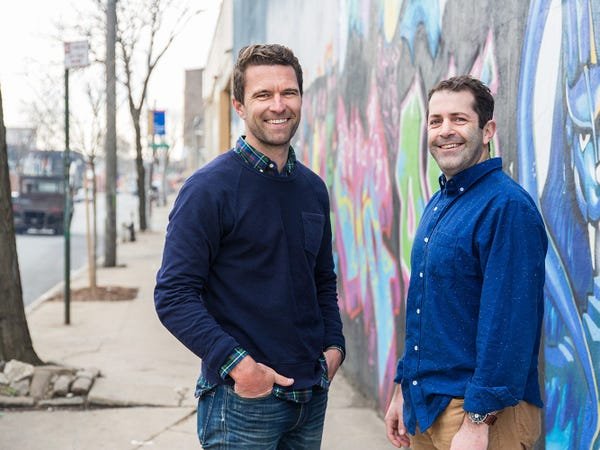
Tim Brown and Joey Zwillinger, the cofounders and co-CEOs of Allbirds. 

Allbirds

According to its initial filing with the SEC, Allbirds’ mission was to “make better things in a better way, through nature.” 

Zwillinger previously worked as a vice president of industrial products at a biotechnology company


Joey Zwillinger, who is sitting in a boat, and Tim Brown posing for a picture on a dock with boats moored around them.

Allbirds’ Joey Zwillinger and Tim Brown. 

Allbirds

Brown’s background included serving as the vice-captain of New Zealand’s soccer team.

Allbirds roared to life in 2016 with a Kickstarter campaign that hit its $30,000 goal in five days.


Allbirds' Kickstarter page where a banner has been added to note that their wool runner shoes are now sold out.


Kickstarter

The company raised nearly $120,000 to make a wool running shoe designed to make a lighter environmental impact than traditional athletic shoes.

In 2016, Allbirds received B Corp certification, a designation given to companies that work to advance environmental and social causes, and shareholder concerns.


A model's legs from the thigh down. They are wearing green trousers and AllBirds Wool Runners.


Allbirds

For Allbirds, the designation codified, “how we take into account the impact our actions have on all of our stakeholders, including the environment, our flock of employees, communities, consumers, and investors.”

In only its second year in business, Allbirds gained the title of world’s most comfortable shoe.


A man sitting on a flower-lined sidewalk with his legs out to show off his Allbirds wool runners.


Allbirds

Time magazine said Allbirds’ hero product, the Wool Runner, was the “World’s Most Comfortable Shoes.”

By 2017, Allbirds, Warby Parker, and Casper were considered among the “DTC pioneers” shaking up their respective industries — sneakers, eyeglasses, and mattresses.


A street window looking into a Warby Parker store with artistic patterns on the walls.

Warby Parker and Allbirds were among the DTC pioneers. 

Interim Archives/Getty Images

By 2018, direct-to-consumer business plans proliferated. In 2018, Inc. reported that more than 400 startups were trying to “become the next Warby Parker.”

Allbirds sneakers became synonymous with Silicon Valley dressing


A screenshot of an article by The New York Times article with an image of a model wearing a pair of Allbirds sneakers.


The New York Times

In August 2017, Allbirds got another shot of national publicity when The New York Times described Wool Runners as part of the Silicon Valley uniform.

A month later, Allbirds opened its first store,


Multiple pairs of sneakers lined up on a wall in Allbirds' first store in Soho, New York City.

The first Allbirds store was in NYC’s Soho neighborhood. 

Business Insider/Jessica Tyler

The 1,450-square-foot store is located in New York City’s Soho neighborhood. In 2022, the company operated 58 stores.

By 2020, Allbirds’ popularity had spread well beyond Silicon Valley. President Barack Obama was repeatedly spotted wearing Wool Runners.


President Barack Obama standing at a podium and speaking with his finger raised in a questioning manner.

Former President Barack Obama has worn Allbirds sneakers. 

Brynn Anderson/AP

But the shoe started to fall out of favor with the trendsetters and the press, with GQ even lamenting the sight of Obama wearing them. “Can’t someone send him a pair of Jordans?” the magazine wrote.

Allbirds launched the Dasher in 2020.


A promotional-style image of Allbirds Tree Dasher in front of a white background.

Allbirds’ Wool Runners. 

Allbirds

With the success of Wool Runners waning, Allbirds launched its first performance-running shoe, called the Dasher, in May 2020. Gear Patrol called it “shockingly good.”

Also in 2020, Allbirds partnered with Adidas to make a low-carbon shoe, another sign of the company’s willingness to disrupt industry norms.


Adizero x Allbirds sneakers

The Adizero x Allbirds 2.94 kg CO2e. 

Allbirds

Large footwear brands are typically reluctant to partner with one another. The shoe, called the Adizero x Allbirds 2.94 kg CO2e, had the lowest carbon footprint of any Adidas or Allbirds sneaker.

In August 2021, ahead of a public offering, Allbirds disclosed growing annual sales and mounting losses.


A woman walking inside an Allbirds store, with sneakers on the wall behind her.

People shopping inside an Allbirds store in NYC in 2021. 

Spencer Platt/Getty Images

Sales increased from $193.7 million in 2019 to $219.3 million in 2020, but losses also increased, growing from $14.5 million in 2019 to $25.9 million in 2020. 

Allbirds went public in 2021.


allbirds


Allbirds

A little more than 2,100 days after it launched its Kickstarter campaign, Allbirds went public on November 3, 2021. Shares soared 90% on the opening day of trading, a sign of Wall Street’s bullish outlook for the company.

Allbirds dropped claims about being the first “sustainable” IPO.


A wall with sneakers on display in the Allbirds store in Soho.

The Allbirds store in Soho. 

Business Insider/Jessica Tyler

After the Securities and Exchange Commission objected, Allbirds dropped claims about being the first “sustainable” IPO, the Financial Times reported in November 2021.

Allbirds launched wholesale in 2022.


A set of doors outside a Nordstrom department store.


Jeff Greenberg/Contributor/Universal Images Group Editorial via Getty

Although it was launched as a direct-to-consumer company, in May 2022, Allbirds announced its first wholesale partners, Zalando and Public Lands, then Nordstrom — a signal that DTC sales would not be enough to get the company to profitability.

As Allbirds added wholesale partners, the backlash began to build against DTC companies.


The Allbirds store in Green Hills, Nashville.

Allbirds has announced plans to slow store openings and increase wholesale partnerships. 

Allbirds

“It’s the de-DTC era,” said Simeon Siegel, the managing director for equity research at BMO Capital Markets. Analysts including Siegel said the benefits of direct sales were often overstated.

As DTC companies started to fall out of favor and investors started to pay more attention to profitability, Allbirds’ stock started to drop.


A blue and red collage depicting Allbirds's drop in stock price over the last six months.


Allbirds; Insider

Allbirds shares, which hit $28.64 on the company’s first day of trading, had fallen to under $5 fewer than eight months later. Stock pickers said the company needed to expand beyond Wool Runners.

In 2022, Allbirds officially lost its novelty in Silicon Valley wardrobes.


A screengrab of an Allbirds story from The Wall Street Journal which includes an image of a flock of birds are attacking a scarecrow that is dressed up like a


Wall Street Journal

Roughly five years after The New York Times christened Wool Runners part of the Silicon Valley uniform, The Wall Street Journal in December 2022 said that “tech bros” had moved on.

In March 2023, Allbirds’ shares plummeted 47% after a disastrous earnings report that included a $101 million annual loss.


A promotional-style image of Allbirds' Tree Flyers in front of a white background.

Allbirds’ Tree Flyers. 

Allbirds

On a call with stock analysts, executives announced a sweeping four-part reorganization, including slowing the pace of store openings, adding more wholesale partners, and working to “reignite product and brand.” Co-CEO Joey Zwillinger also said some of the company’s marketing veered too far from what Allbirds consumers wanted, including marketing for the Tree Flyers, above, which focused on its technical-performance attributes.

Allbirds began to rethink its big bet on DTC.


A logo for Dick's Sporting Goods on the side of a building.


Reuters

As part of the reorganization plan, Zwillinger said the company was considering adding more wholesale partners. By then, the company’s wholesale partners included Nordstrom, REI, Scheels, and Dick’s.

In 2022, while still based in San Francisco, Allbirds quietly opened an office in Portland, Oregon, to take advantage of the city’s talented-footwear workforce.


Allbirds' office, a red building on a city street in Portland, Oregon.

In 2022, Allbirds opened an office in Portland, Oregon. 

Matthew Kish/Business Insider

Nike is based in a Portland suburb, and Adidas has its North American headquarters in the city.

Allbirds hired several Nike and Adidas veterans to run the office, including Ashley Comeaux, who spent more than 10 years at Nike before becoming Allbirds’ vice president of product design.

In early 2023, Allbirds released a string of products designed and developed by Comeaux and her team.


A model in a white gown jumping out of frame to reveal a grey pair of SuperLight sneakers.

SuperLights, the latest shoe from Allbirds, doesn’t have a Strobel board, which makes the shoe lighter and more comfortable. 

Courtesy Allbirds

Risers and Pacers got strong reviews from Business Insider.  Although the new products were well received, shares of the company traded below the $15 IPO price, trading for $1.23.

In March 2023, Allbirds announced disappointing earnings, and Zwillinger told analysts that the company had lost focus on its core.


Allbirds M0.0nshot carbon neutral shoes

Allbirds claims its M0.0NSHOT is the world’s first carbon-negative shoe. 

Allbirds

Since then, the company has focused on its best-sellers, the Wool Runner and Tree Dasher, while it discontinued underperforming products, like much of its apparel, the Wall Street Journal reported. 

In June 2023, the company released what it said was the world’s first carbon-negative shoe, which it calls the M0.0NSHOT.

In May 2023, Allbirds announced a leadership shake-up.


Allbirds cofounder Tim Brown

Allbirds co-founder Tim Brown 

Tommaso Boddi/Getty Images

Brown said he would step into the role of chief innovation officer, leaving fellow cofounder Joey Zwillinger as the sole CEO.

The company also laid off 21 employees globally in May 2023, it said in a filing with the US Securities and Exchange Commission.


allbirds 2847

An Allbirds store. 

Business Insider/Jessica Tyler

The shoe company generally had a disappointing start to 2023. The company reported a 13% decline in year-over-year revenue in the first quarter.

‘As we’ve tried to expand and grow the brand, we created products that haven’t quite met the mark,’ Brown told The Wall Street Journal.


A pair of the Allbirds Tree Flyer in the Blizzard color.

The Allbirds Tree Flyer sneakers. 

Mara Leighton/Insider

In a July 2023 article, Brown and Zwillinger told The Wall Street Journal that their attempts to appeal to customers younger than its 30- to 40-year-old base didn’t go over well. The Tree Flyer was one of those attempts that missed the mark. 

The company reported second-quarter earnings were above expectations. Sales fell 10% compared to a projected 18%.  

“We laid out a road map for our strategic transformation back in March, and now two quarters into our work, we have gained traction and are solidly on track to drive toward profitability expectations,” Zwillinger said in an August 2023 earnings call. 

In November, Allbirds released an updated version of its first Wool Runner.


screenshot of new wool runner advertised on allbirds website

The new Wool Runner is available on the Allbirds website. 

Allbirds/Screenshot

The Wool Runner 2 has been updated with a new version of its SweetFoam midsole and improved durability.

Full-year earnings for 2023 were dismal indeed, with sales down 14.7% and a net loss of $152.5 million for the year.


The Allbirds Pacer doesn't look anything like the company's iconic Wool Runner.


Courtesy Allbirds

The company also promoted Joe Vernachio from COO to CEO, with Zwillinger stepping down to serve as a special advisor and remaining on the board of directors.

The company continued to struggle with declining sales.


Allbirds store

Earlier this year, the company said it would close most of its remaining stores. 

Business Wire/AP

Allbirds lost more than $20 million in the quarter ending September 30, according to its most recent earnings report. The company noted “substantial doubt” about its future in that filing and said it could “engage in strategic transactions.”

From March 2025 to March 2026, shares slid more than 50%.

In January, the company said it would close its remaining full-price stores in the US by the end of February, leaving it with two discount stores in the US and two full-price stores in London. The US made up the bulk of its revenue.

Allbirds said in March 2026 that American Exchange Group would buy it for $39 million.


An Allbirds store on Fifth Avenue in New York, US, on Wednesday, May 4, 2023. Allbirds Inc. is scheduled to release earnings figures on May 9.


Bloomberg/Getty Images

Allbirds said in a statement on Monday, March 30, that American Exchange Group, a New York-based fashion and consumer company, would acquire it for $39 million.

The company added in the statement that the sale would close in the second quarter. The distribution of the net proceeds of the sale to stockholders would be made in the third quarter, it said.

Allbirds’ stock has fallen about 50% in the past year. However, it rose about 24% in after-hours trading on Monday after the sale was announced, to $3.70 per share.

Matthew Kish, Ben Tobin, and Jennifer Ortakales-Dawkins contributed to earlier versions of this article.


Source link

Google-officially-snaps-up-Wiz-as-it-closes-mammoth-32.jpeg

Google officially snaps up Wiz as it closes mammoth $32 billion deal

  • Google’s $32 billion Wiz deal has officially closed.
  • The search giant said last year it would buy the cybersecurity firm to bolster its cloud business.
  • It’s Google’s biggest-ever acquisition.

Google’s $32 billion acquisition of cybersecurity firm Wiz has officially closed.

The search giant announced on Wednesday that Wiz will join Google Cloud at a moment when AI is making cloud security more vital. Wiz offers a platform that helps customers protect data across different cloud services.

“In today’s AI era, more businesses and governments are migrating their most important data and systems to the cloud and turning to agile and continuous software development,” Google wrote in a post announcing the news.

“As these organizations operate in a multicloud environment and adopt AI, attackers are using AI to operate with greater speed and sophistication,” the company added.

Google announced last year that it intended to buy Wiz for $32 billion in the search giant’s biggest-ever acquisition.

The deal, which was also viewed as a test for President Donald Trump’s antitrust agenda, could be a boon for Google’s cloud business as it pursues customers for its AI products.

Google said Wiz would remain a multicloud offering after the acquisition, meaning it will continue to be made available through rival cloud providers such as Amazon and Microsoft.

“Our mission remains as bold as ever: to protect everything organizations build and run,” Assaf Rappaport, the CEO of Wiz, said in a blog post. “And we are still just getting started.”


Source link

Ben Bergman

AI vibe coding darling Lovable is racing toward $1 billion in revenue

Lovable, a Swedish vibe coding startup valued at $6.6 billion, saw its torrid growth accelerate even as Anthropic’s Claude Code went viral over the past few months.

The Swedish startup says its annual recurring revenue has surged by more than 30%, from $300 million to $400 million in a single month, and could top $1 billion by year’s end, Lovable’s chief revenue officer, Ryan Meadows, told Business Insider in an exclusive interview. ARR refers to the predictable revenue a company expects to generate over a year from subscriptions or recurring contracts.

Lovable’s breakout growth comes amid a broader boom in AI-powered coding tools, which include Claude Code and startup Cursor, which was last valued at nearly $30 billion. In late 2025, Cursor said it had $1 billion in annualized revenue.

Lovable launched at the end of 2024 and reached $100 million in ARR just eight months later, doubling to $200 million by the end of 2025.

Vibe coding allows novices with limited programming expertise to create code using AI. Lovable, founded by Anton Osika and Fabian Hedin, aims to make coding even more user-friendly, enabling non-engineers to make software and applications. It was valued at $6.6 billion in a December funding round led by CapitalG and Menlo Ventures’ Anthology fund.

“It’s accelerating quite a bit,” Meadows said. “We’ve doubled the number of active users daily just in the last couple of months.” Lovable now boasts over 15 million daily active users and sees 200,000 new vibe coding projects created each day, according to Meadows.

The vast majority of Lovable users are still non-technical founders and entrepreneurs, but Meadows says the company is seeing its fastest growth from the enterprise business it launched in August.

Anthropic is a partner rather than a competitor

Lovable’s most recent growth spurt occurred after the release of Claude Code. But rather than eating into Lovable’s market share, Meadows says most customers use both tools. Professional software developers and engineering teams use Claude, while non-technical staffers prefer Lovable.

“It’s a rising tide,” he said. “We’ve been super happy with what we’re seeing.”

Lovable is powered by Claude, and when Anthropic launched its marketplace this week, it prominently featured Lovable.

“They’re pretty committed to working with us to pass business through,” said Meadows. “We’re going to keep investing in that partnership.”

A hiring spree

Lovable has rocketed to $400 million in ARR with a lean staff of just 146 employees, said Meadows. This year, the company will embark on a hiring spree, mostly in product and engineering roles, and will end the year with around 350 employees, he added.

Though its engineering team will continue to be based in Stockholm, the company will be opening its first US office this year in Boston to house go-to-market roles.

“We can’t hire fast enough,” Meadows said.

Have a tip? Contact Ben Bergman via email at bbergman@businessinsider.com or Signal at BenBergman.11


Source link

Yann-LeCuns-startup-has-a-new-CEO-—-and-1.jpeg

Yann LeCun’s startup has a new CEO — and $1 billion

Yann LeCun’s AI startup has raised more than $1 billion in seed funding and appointed a new CEO.

In a post on X on Tuesday, entrepreneur and former Facebook researcher Alex LeBrun said he is joining LeCun and the founding team of Advanced Machine Intelligence (AMI) Labs, also known as AMI Labs, as CEO.

“We have secured a $1.03 billion USD seed round to fuel our mission to build intelligent systems capable of truly understanding the real world—a long-term scientific endeavor,” LeBrun said.

AMI Labs said in an X post on Tuesday the round was co-led by Cathay Innovation, Greycroft, Hiro Capital, HV Capital, and Bezos Expeditions, alongside other investors.

The startup added it is building a team of researchers and engineers across Paris, New York, Montreal, and Singapore.

AI researcher and New York University computer science professor Saining Xie also said in a post on X on Tuesday that he has joined the founding team. Xie, who serves as cofounder and chief science officer, wrote that “AMI isn’t a conventional lab.”

“We don’t intend to become one,” he added.

AMI Labs is recruiting engineers, scientists, and researchers across its four global hubs, according to the company’s job postings.

LeCun revealed plans to launch the startup in November after departing Meta, where he spent 12 years leading its AI research efforts.

AMI Labs will focus on building world models, a type of AI system designed to better understand and reflect how the real world works. LeCun had said that the startup will be among the few frontier AI labs that are “neither Chinese nor American.”

Speaking at an event in Paris in December, LeCun said Meta would partner with the new venture, though it would not invest in the company.

“This new architecture is a project that Mark Zuckerberg really likes. He thinks maybe that’s the future,” LeCun said.

In an interview with MIT Technology Review published in January, the AI pioneer said he disagreed with some of the decisions made by Zuckerberg, including the shutdown of the robotics team inside FAIR.

LeCun also took aim at Alexandr Wang, the former CEO of Scale AI, after Wang briefly became his boss following Meta’s AI reorganization.

“There’s no experience with research or how you practice research, how you do it. Or what would be attractive or repulsive to a researcher,” LeCun said in an interview with the Financial Times in January.

“You don’t tell a researcher what to do,” LeCun said. “You certainly don’t tell a researcher like me what to do.”


Source link

Katherine Li, West Coast breaking news reporter at the Business Insider.

AI researchers rally in support for Anthropic as company says it risks losing $5 billion in Pentagon feud

Employees at rival companies — including OpenAI — are rallying behind Anthropic as the startup warns its escalating dispute with the Pentagon could cost $5 billion in lost business.

More than 30 researchers from OpenAI and Google, including Jeff Dean, the chief scientist of Google DeepMind, filed a joint amicus brief on Monday supporting Anthropic in its legal battle with the government. The employees signed in a personal capacity and do not represent their companies’ official views.

Their filing argues that the Pentagon’s decision to label Anthropic a “supply-chain risk” could harm the broader US AI industry.

“If allowed to proceed, this effort to punish one of the leading US AI companies will undoubtedly have consequences for the United States’ industrial and scientific competitiveness in the field of artificial intelligence and beyond,” the employees wrote.

The dispute stems from a breakdown in negotiations between Anthropic and the Pentagon over guardrails around how its AI models could be used, particularly around mass domestic surveillance and autonomous lethal weapons.

Last month, Defense Secretary Pete Hegseth said that “no contractor, supplier, or partner that does business with the United States military may conduct any commercial activity with Anthropic,” marking a dramatic expansion of the “supply chain risk” designation.

Anthropic has since sued the government in two courts, arguing the decision violates its First Amendment rights and unfairly retaliates against the company.

In court filings, Anthropic executives warned that the fallout is already hitting the company’s finances. Chief financial officer Krishna Rao wrote in a court statement that hundreds of millions of dollars in expected revenue tied to Pentagon-related work are at risk this year. If the government succeeds in discouraging companies from working with Anthropic more broadly, Rao added, the company could ultimately lose up to $5 billion in sales, which is roughly equivalent to its total revenue since commercializing its AI technology in 2023.

Anthropic’s chief commercial officer, Paul Smith, wrote in a separate court statement that the pressure from the government is causing business partners to take steps that “reflect deep distrust and a growing fear of associating with Anthropic.” Smith added that some customers have paused negotiations or demanded escape clauses, while others have canceled meetings entirely after the supply-chain designation.

The situation has also drawn criticism from industry leaders. OpenAI CEO Sam Altman, despite singing its own contract with the Pentagon after Anthropic’s fell apart, wrote on social media that enforcing the supply chain risk designation “would be very bad for our industry and our country.”

Major cloud providers like Amazon and Microsoft have said they will continue offering Anthropic’s Claude AI models to customers without ties to the Pentagon.

Anthropic is now seeking a temporary court order that would allow it to continue working with military contractors while the legal fight continues. The first hearing could take place in San Francisco as soon as Friday.

The Pentagon did not immediately respond to a request for comment outside normal business hours.


Source link

Chong Ming Lee, Junior News Reporter at Business Insider's Singapore bureau.

The CEO of a $15 billion AI company says the biggest AI winners won’t be software — they’ll be mines, farms, and trucks

AI’s biggest impact will likely happen far from laptops, says the CEO of a $15 billion AI company.

Qasar Younis, the cofounder and CEO of Applied Intuition, said on an episode of “Lenny’s Podcast” published Sunday that “the real impact of AI in the next 5 to 10 years” would show up in physical industries, like “in farming, in mining, in construction, in self-driving trucks.”

Applied Intuition develops software to test and power autonomous vehicles and other machines. The company said in June that it raised $600 million in a funding round, valuing it at $15 billion.

Software tools like Moltbook and OpenClaw may excite developers, but Younis said they touch only a small slice of society.

“I love the stuff that’s happening on these platforms, but it’s still segregated to, like, frankly, developers,” he added.

Instead, he said the biggest shift will come from adding intelligence to machines already embedded in the physical economy.

“More pragmatically, it’s actually just putting intelligence into things that already exist all around us.”

Industries like trucking and farming urgently need that kind of autonomy, he said.

“People are not fighting for those trucking jobs,” Younis said. The average farmer is already in their late 50s, meaning many will retire in the coming decade, potentially worsening labor shortages.

AI is more likely to help fill labor shortages in these industries than replace them entirely, he added.

The company has tested autonomous trucks in Japan, where an aging workforce means a driver shortage, and it’s working on AI in mining safety and efficiency.

AI’s impact on blue-collar industries

Earlier this year, Wall Street grew worried that new AI tools and agents could replace some software products entirely.

A research paper by Citrini, an investment firm focused on thematic equity investing, triggered a global stock sell-off last month after researchers outlined a scenario in which the AI boom wipes out white-collar jobs and ultimately slows economic growth.

Against that backdrop, some industry leaders say physical industries could end up benefiting from the technology.

For instance, robots could help address labor shortages in manufacturing. Daniel Diez, the chief business officer of Agility Robotics, told Business Insider in a report published on Sunday that manufacturers globally “simply can’t find the people to do this work.”

Ford CEO Jim Farley said last year that AI-powered augmented-reality tools are helping technicians repair trucks more efficiently, though he warned that automation could still reshape jobs across the broader economy.

Business Insider reported last year that some Gen Z workers are increasingly considering trade and blue-collar careers as automation and AI create uncertainty around traditional white-collar professions.


Source link

A-57-billion-AI-startup-wants-to-help-cut-government.jpeg

A $5.7 billion AI startup wants to help cut government benefit fraud. Experts aren’t so sure.

An AI startup in SF focused on identity verification has set a lofty goal: securing government contracts.

Daniel Yanisse, the CEO of Checkr, told Business Insider that the company wants to help the government reduce “fraud and waste” by not only screening new employees but also verifying people’s eligibility for benefits such as Medicare and Social Security.

Though Yanisse said the company isn’t ready to make any product announcement yet, he said a frictionless government assistance system may be just years away.

AI and safety experts, however, told Business Insider that there are legal and technical hurdles for any company to undertake the task of automating benefit and welfare systems with AI.

Checkr primarily uses AI to run background checks and surface information such as criminal records and motor vehicle reports. The company has major contracts with Uber and Lyft to screen new drivers, and is valued at more than $5.7 billion after raising $120 million in funding in 2022. In 2025, Checkr reported over $800 million in revenue and surpassed 120,000 customers.

When asked what Checkr wants to do for the government, Yanisse said that for Medicare and other programs, “there’s a lot of fraud happening and just bad actors getting the government dollars instead of the right people who need help,” adding that it’s very hard for the government to actually verify people’s employment status and income.

The Medicare Fee-for-Service program estimated that there were $28.83 billion in “improper payment” in 2025 at a rate of 6.55%, though not all such cases are the result of intentional fraud. Payments made to individuals who did not submit sufficient documentation and have unverified income levels are also considered improper by Medicaid.

“With AI, unfortunately, there’s going to be even more fraud, identity theft, and scams,” said Yanisse. “It’s a lot of friction, it’s a lot of repetition, and now there are also deepfakes.”

Checkr’s spokesperson told Business Insider that the company’s potential involvement in government is “still conceptual at this point.”

The company also pointed toward a study by Middesk, a business identity verification platform, that out of $1.09 trillion in Medicaid payments that went to around 1.6 million providers between 2018 and 2024, $563 million in payouts went to providers that are blacklisted from federal healthcare programs for criminal activity or misconduct.

Automating identity verification can be challenging

Stuart Russell, professor of computer science at UC Berkeley and an AI pioneer, told Business Insider that he is “not optimistic” that the plan to use AI to determine benefits eligibility will work as advertised.

“An AI system of this kind, some version of an LLM, is incapable of producing veridical explanations of its decisions, making it impossible to challenge false decisions,” Russell said.

Russell also cited the General Data Protection Regulation in the European Union, which bars decisions with significant legal effects on individuals from being made entirely by automated systems.

Baobao Zhang, the Maxwell Dean associate professor of the politics of AI at Syracuse University, told Business Insider that though she cannot assess exactly how good Checkr’s verification system is right now, past government attempts to mix people’s benefits with an automated system are cautionary tales.

“If the federal government or other state governments are trying to contract with a vendor to automate welfare fraud detection, they need to have a serious evaluation in the real world before they deploy it, because the stakes are high, as history has proven,” said Zhang.

In Indiana, an attempt to streamline and automate its welfare eligibility system by outsourcing a contract to IBM ended in a legal battle in which the state sued the company for $1.3 billion for the scrapped project in 2010. Based on court records, the Indiana Family and Social Services Administration said that processing errors from IBM led to faulty benefits denials that brought harm to the needy.

In Australia, an automated government plan called Robodebt, designed to detect fraud, told welfare recipients to repay benefits and sent letters claiming they owed thousands of dollars in debt, based on an incorrect algorithm. A royal commission, which is Australia’s highest form of public inquiry, found that at least three people died by suicide after being falsely told to pay back debt they don’t owe by Robodebt. The system was ruled illegal by a court in 2019.

Ifeoma Ajunwa, the founding director of the AI and the Future of Work Program at Emory University, told Business Insider that if any government agency is to adopt AI, there should be an advisory council made up of technologists and social scientists, and affected constituencies should be given a say.

“I think we need to move cautiously when delegating governmental functions to AI technologies,” said Ajunwa. “While these tools are touted to increase efficiency and lower costs, we also need to establish guardrails for their use to protect citizens.”


Source link

Microsoft-backed-Wayve-raises-15-billion-to-take-its-robotaxis-global.jpeg

Microsoft-backed Wayve raises $1.5 billion to take its robotaxis global and take on rival Waymo in London

Wayve is revving up its global robotaxi ambitions with fresh funding as it prepares to take on Waymo in London.

The UK-based autonomous vehicle software startup announced early Tuesday in the UK that it had raised $1.5 billion from a host of Big Tech giants and major automakers.

The funding round, which values the startup at $8.6 billion, includes $1.2 billion from investors including Microsoft, Nvidia, and Uber, as well as Mercedes-Benz, Nissan, and Stellantis.

It also includes additional capital from Uber, which is tied to deployments of Wayve-powered robotaxis across the globe. The two companies have a deal to launch self-driving vehicles on Uber’s app in over 10 markets worldwide, starting with London this year.

“We’ve been learning to drive on British roads for the last eight years, and so this is our home turf,” Alex Kendall, CEO of Wayve, told Business Insider in an interview.

The CEO said the latest funding round is key to pursuing the company’s ambition to license its software to major automakers and robotaxi fleet platforms like Uber.

Unlike Tesla or Waymo, Wayve is solely focused on developing software for other companies looking to deploy self-driving cars. It is not building its own fleet of robotaxis.

Kendall said owning a fleet is expensive, and Tesla’s approach to building its own car can be a constraint since it limits the company to one vehicle platform.

“Everyone wants autonomy, but not everyone wants to buy a Tesla,” he said.

Kendall added that Wayve’s AI driver is designed to be generalizable — the same way a human can quickly learn to drive different cars and in new cities.

That allows Wayve’s technology to quickly adapt to new driving environments and learn new road rules, from switching to the opposite side of the road to right turns at a red light, without relying on high-definition mapping and sensors, the approach taken by rivals like Waymo. It also allows the AI driver to be adapted by different automakers, which may have different sensor configurations on their cars, such as lidar or cameras.

“Because that’s what we’ve built, it enables us to take this business model that enables high-margin software revenues,” Kendall said.

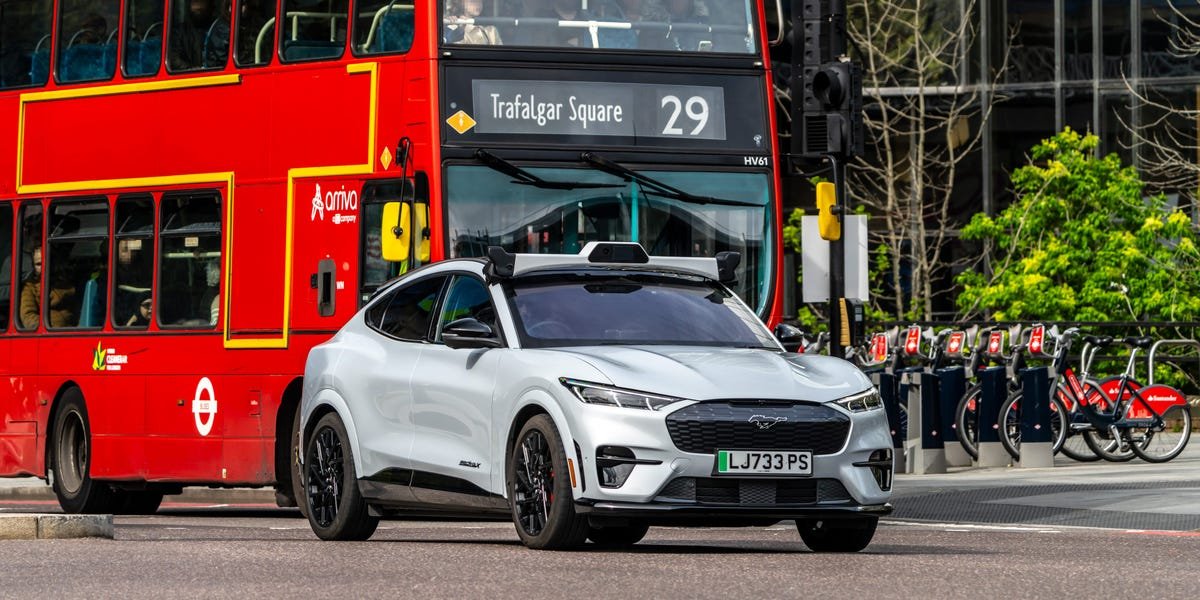
Wayve says that over the past year, its fleet of Ford Mach-Es outfitted with its AI driver has driven in more than 500 cities across Europe, North America, and Japan without being trained on city-specific data.

The company is also planning to license its technology to carmakers as an advanced driver-assistance system like Tesla’s Full Self-Driving, which handles most driving tasks with human supervision. Wayve has a deal with Nissan that will see its AI tech power the Japanese carmaker’s ProPilot driver assistance system from 2027.

The UK-based startup has been testing its tech in London since 2017, and its public debut comes as the city’s robotaxi scene gets increasingly crowded.

Waymo is aiming to begin operating its autonomous vehicles in London, its first international location, this year, while Wayve vehicles will be joined on the Uber app by robotaxis from Chinese tech giant Baidu, which is also partnering with Lyft.


Source link