Private-jets-are-flocking-to-a-small-regional-airport-for.jpeg

Private jets are flocking to a small regional airport for The Masters, the billionaires’ favorite golf tournament

As The Masters teed off on Thursday at the rarefied Augusta National Golf Club, at the small regional airport 11 miles away, hundreds of private jets were undertaking their annual pilgrimage to the billionaires’ favorite golf tournament.

On Thursday, nearly 300 aircraft arrived at the Augusta Regional Airport, about five times the typical number of arrivals and departures combined, according to data from FlightAware.

The aircraft, many registered to charter and fractional ownership companies like NetJets and VistaJet, came from tony locations, such as Palm Beach, Florida, and Hilton Head, South Carolina.

To prepare for the influx this year, the airport, which charges as much as $4,000 per aircraft to land, hired additional staff, increased the number of fuel trucks, and expanded aircraft parking, according to a letter sent to aircraft operators.

“It’s organized chaos to us,” Lauren Smith, the Augusta Regional’s assistant director of marketing and public relations, told Business Insider ahead of last year’s tournament, during which third-party flight tracking data showed more than 2,100 private flights flying in and out of the airport.

The Masters, along with the Super Bowl and Formula 1 races, is one of the biggest events of the year for private jet operators, who use the golf tournament to market and mingle with their wealthy clientele.

NetJets hosts an annual party with A-list entertainment, and Wheels Up, which booked over 150 flights to and from the tournament last year, opens a clubhouse for its members, where golf personalities record live podcasts and a fashion illustrator captures guests’ outfits.

VistaJet rents a private home nearby and hosts its members for programming, including dinners, live entertainment, and visits from golf insiders.

“We give them something they never want to get rid of,” Matteo Atti, the chief marketing officer of VistaJet’s parent company, Vista Global, told Business Insider of his company’s membership perks last year.

The Masters is a premier event on the billionaire social calendar. In past years, the jets of Nike CEO Phil Knight and investor Herbert Allen Jr. have made the trip.

While official tickets to the Masters, given out through a lottery system, are relatively inexpensive — $160 per day, at most — they are hard to come by. Though the tournament prohibits reselling tickets, they are available on resale sites, where they cost exponentially more. In the days leading up to the event, resale passes were going for upward of $50,000.

Once you’re through the door, though, rest assured that your food won’t cost much. The price of the tournament’s famous pimento cheese sandwich hasn’t budged in years: $1.50.



Source link

Dan DeFrancesco

Why California’s billionaires are dreaming of going to Miami

They’re California dreaming of going to Miami.

A proposed California wealth tax on billionaires has some of the state’s wealthiest residents looking at real estate in South Florida, BI’s Jordan Pandy and Madeline Berg write.

I know what you’re thinking: Rich people moving to Florida for tax reasons? What a concept!

But this isn’t about the retired doctor you know settling down in Boca or Palm Beach. These people have three-comma net worths and are looking for nine-figure homes.

Larry Page recently spent more than $180 million on three properties, and Mark Zuckerberg and Sergey Brin are also reportedly looking.

That’s led to a massive spike in purchases of these ultramansions. In 2018, one single-family home sold for more than $30 million in Miami-Dade County. In 2025, that figure jumped to 19.

With its many islands and inlets, Miami also offers plenty of unique neighborhoods suitable for the ultra-rich. Madeline and Jordy mapped out all the areas billionaires are eyeing. That includes the uber-exclusive Indian Creek, which is also known as … Billionaire Bunker.

“Miami is the new BLANK” is practically a meme at this point.

From Wall Street to crypto to tech, the city has toyed with becoming the new hub for various industries over the years. Some companies have actually moved their headquarters to the region, most notably Citadel, and, more recently, Palantir. But often the hype passes quickly, leaving little trace it was ever there at all — like one of the region’s sudden thunderstorms.

But maybe that was Miami’s issue all along. Instead of becoming the new iteration of something else, it should just focus on its own thing. Miami has plenty of characteristics that make it unique in its own right, and an influx of billionaires only makes it more interesting. If nothing else, we’ll likely get some drama. When you bring together a bunch of super-rich people who aren’t used to being told no, someone is bound to get upset.


Source link

billionaires-named-in-the-Epstein-files.jpeg

billionaires named in the Epstein files

Jeffrey Epstein shared emails, flights, and meals with some of the richest people on the planet. Here’s how these billionaires made their money and how they were connected to Epstein. Read more below:

A list of people facing consequences over the DOJ’s release:

https://bit.ly/46DOFOc

How emails between Jeffrey Epstein and powerful people ended up on your social media feeds:

https://bit.ly/4kxqkiM


Source link

Peter Kafka

Billionaires like Jeff Bezos can save The Washington Post until they decide they won’t. We need a better model.

The cuts at The Washington Post are brutal.

They are brutal for the paper’s readers, who lose crucial coverage like sports and international reporting. And they are brutal for hundreds of Post employees, including lots of people whose work I pay to read with my Post subscription.

The Post’s cuts have also led lots of people to point out the obvious — that Post owner Jeff Bezos, who is currently the world’s fourth-richest man, worth an estimated $261 billion, could easily fund the paper’s losses … forever, without ever noticing the tab.

For the record: I also wish that Bezos would take his loose change and spend it on journalism.

Note that I didn’t say “journalism instead of” because when you are talking about Bezos-level wealth, you don’t have to choose: You can pay for journalism and rockets and superyachts and Venetian weddings and parties in St. Barts. (And yes, I realize that Bezos’ Amazon expenditures on things like the “Melania” doc are different from Bezos’ personal spending. The point is, he can afford it. In the same way that I can afford to buy a fancy coffee now and then.)

I’m also not weighing in on how much of the Post’s problems are the same problems facing every news organization, versus ones Bezos exacerbated by pivoting toward Trump. Or whether the new Post plan — focus on a handful of topics it thinks will resonate with a national audience, like politics and wellness — makes sense or is simply a too-late move already made by many Post competitors.

But the focus on Bezos underscores the problem the Post has been facing for years: It was a money-losing operation that relied on a billionaire’s goodwill. First, to buy it from its previous owners, who let it go for the price of a Joe Rogan podcast deal, and then to fund its losses for years.

Maybe Bezos really is sick of paying for the Post’s losses. Maybe funding the Post no longer syncs with a turns out, Donald Trump is actually good now, worldview. The point is that the Post has been in the can’t-win position of hoping Jeff Bezos would continue to fund those losses for years. Now he doesn’t want to. (Bezos has yet to comment publicly on the cuts; Matt Murray, the Post’s top editor, told his staff that the cuts are meant to help “reinvent The Washington Post for this new era. This work is difficult, but is essential.”)

Which, again, points out how precarious a position just about every news organization in the US is in right now.

There are a handful of really excellent publications, which are controlled by billionaires or very wealthy families — The New York Times, The Wall Street Journal, and Bloomberg News — that are aimed at an upscale, national audience, and they are doing well. There are some thriving startups and niche publications that tend to focus on topics that rich people — or their employers — will pay to learn more about. (Several of them, it turns out, are focused on power and Washington, DC — a sector the Post should have owned.) And there are various forms of aggregators that make a living by repackaging news other people generate, like newsletter publisher 1440.

And that’s … kind of it. The local news market is so bad we routinely use the word “desert” to describe it. There have been many attempts to solve that, and people keep trying new ways to tackle the problem. I wish all of them well because we really, really need local news. TV news is contracting because TV is contracting. Magazines are now frequently “brands attached to hotels or travel agencies.”

Faced with this grim reality, it’s natural to look at Bezos and think: Just pay for it. And again — I wish he would. But relying on billionaire goodwill is a hope, not a plan.

Journalism — no matter how much we right-size, automate, and innovate — is expensive. And up until the internet, journalism usually existed in the US in spite of those costs because it was bundled with other things people (subscribers, advertisers) were willing to pay for.

Now that bundle has been torn apart, so we need both new models that support what we have today — and ownership structures that will be satisfied with self-sustaining businesses, not ones with huge profit expectations. If I knew how to do that, I’d be doing it. I just know that hoping a billionaire will fix it isn’t the answer.


Source link

See-the-list-of-Californias-200-plus-billionaires-who-could-be.jpeg

See the list of California’s 200-plus billionaires who could be hit by the proposed wealth tax

California has a lot of billionaires, more than any other state and more than most countries. So a proposed wealth tax on its billionaires could be a windfall, if they stick around.

Under the Billionaire Tax Act, California residents worth over $1 billion would face a one-time tax totaling 5% of their assets.

If the tax plan receives enough signatures, it will appear on the ballot in November and, if passed, would apply retroactively to billionaires living in the state as of January 1. The tax would be due in 2027, with the option to spread the payment out over five years, with interest.

The idea has drawn sharp reactions from lawmakers and business leaders.

Google cofounders Larry Page and Sergey Brin moved entities tied to them out of the state last month just ahead of the deadline, Business Insider first reported.

Nvidia CEO and billionaire Jensen Huang said he was “perfectly fine” with the tax. Palmer Luckey, the billionaire founder of defense tech startup Anduril, said it would force companies to “immediately pivot into profit obsession over mission or long-term sustainability.”

Critics of the tax have warned it will encourage ultrawealthy residents to flee the state and hurt California’s economy.

As of January 1, there were 214 billionaires in California, according to Forbes data compiled by Americans for Tax Fairness, a group that advocates for higher taxes.

Below is the full list of billionaires in California. Names with asterisks have recently moved at least some of their business entities out of the state.

Loading
Loading
Loading
Loading
Loading
Loading
Loading
Loading
Loading
Loading
Loading


Source link

Larry-Page-is-officially-moving-business-out-of-California-ahead.jpeg

Larry Page is officially moving business out of California ahead of a proposed billionaire’s tax

Billionaire Larry Page is peacing out of California.

The Google cofounder has cut ties between California and many of his assets that risked exposing him to a proposed new wealth tax in the state, meeting an end-of-2025 deadline, according to filings reviewed by Business Insider.

Page’s family office, Koop, was converted out of California in late December and incorporated in Delaware, per filings with both states. Page converted several other entities to Delaware, including Flu Lab LLC — a vehicle he has used to fund research on tackling influenza and lists its principal office address in Nevada — and another entity named One Aero, which has funded his flying car ventures and lists its principal office address in Florida.

A filing was also made to convert Dynatomics, LLC from California to Delaware with a new principal address in Keller, Texas. Page launched Dynatomics, a new startup focused on applying AI to aircraft manufacturing, in 2023, Business Insider previously reported. A source close to Page said that the team, run by Chris Anderson, continues to work out of California.

Anderson and representatives for Page’s family office did not respond to requests for comment.

The New York Times reported in December that Page had told people he was considering moving to Florida because of a proposed ballot measure that would tax the state’s wealthiest residents. The proposal, if passed successfully, would mean that any California resident worth more than $1 billion would be taxed 5% of their assets.

Under California law, residency is determined by the nature of a person’s ties to the state, with factors such as the time spent in the state and the maintenance of substantial business ties taken into account. If the ballot measure is approved in November, it would take effect retroactively for residents living in California as of January 1, 2026.

A source close to Page said the Google cofounder had already left the state. Whether Page’s move is temporary could not be learned.

Page is ranked the second-richest person in the world, according to the Bloomberg Billionaires Index.

Page’s family converts other entities to Delaware

Besides his family office and funding vehicles, Page converted out an LLC that Business Insider previously identified as being used to purchase islands in Puerto Rico and the Virgin Islands, from California to Delaware, with a new address listed in Florida.

A separate LLC Page used to purchase an Island in Fiji was also converted out to Delaware.

Page’s wife, the scientist Lucinda Southworth, founded a marine-conservation charity named Oceankind. Filings show that Oceankind converted out of California to Delaware in December.

Delaware has become a popular state for businesses to incorporate due to its favorable tax structure, privacy, and its home to a court system specifically designed to handle corporate disputes. The state does not require LLCs to disclose the names and addresses of directors when incorporating, providing them with an extra layer of privacy.

Privacy is especially important to Page, whose family office is shrouded in a level of secrecy unparalleled by most and carefully managed by its CEO, Wayne Osborne.

Cristina Rosado, an attorney who handles many of Page and Southworth’s assets, signed several of the California filings.

Page incorporated three entities in Florida last year, as previously reported by The New York Times. A Koop LLC was incorporated in Florida in January 2025, per filings reviewed by Business Insider. It could not be confirmed if it belongs to Page.

California’s billionaire tax proposal

The California billionaire tax proposal faced some opposition from leaders in venture capital and politics. In a post on X in December, venture capitalist Vinod Khosla said the proposed measure would mean California would lose its most important taxpayers and “net off much worse.”

“Long term damage unless legislature bans wealth taxes,” he added. “Easier to equalize taxes on work income and capital gains at the national level.

Matt Mahan, Democratic mayor of San Jose, California, on Monday described the tax as “a political plan that will sink California’s innovation economy.”

White House AI czar David Sacks has criticized the proposal and said it will backfire. He has also said he believes Miami and Austin will overtake New York and San Francisco for finance and tech, respectively. He announced this month that his venture capital firm, Craft Ventures, had opened an office in Austin.

Last month, celebrity lawyer Alex Spiro wrote a letter to California Gov. Gavin Newsom, warning that the proposed billionaire tax would “trigger an exodus of capital and innovation from California,” Business Insider previously reported.

Have something to share? Contact this reporter via email at hlangley@businessinsider.com or Signal at hughlangley.01. Use a personal email address and a non-work device; here’s our guide to sharing information securely.


Source link

What-its-like-visiting-the-island-of-St-Barts-—.jpeg

What it’s like visiting the island of St. Barts — a beloved party spot for billionaires and their superyachts

  • St. Barts, also known as St. Barthelemy, is a Caribbean island where billionaires often vacation.
  • The destination offers stunning beaches, luxury shopping, historic sites, and more.
  • A yacht belonging to Amazon founder Jeff Bezos was spotted there at the start of 2026.

Where is Amazon founder Jeff Bezos kicking off the new year?

If the location of his $500 million yacht Koru is any indication, the answer is St. Barthelemy, or St Barts for short.

The French-speaking Caribbean island is a luxurious hot spot for billionaires, where visitors can relax on beautiful beaches, shop designer brands, and, naturally, enjoy some privacy.

Of course, many of us are waking up today at home, not on an island. But if you’re curious, here’s what it’s like to visit the destination.

St. Bart’s is an island off Saint Martin in the Lesser Antilles.

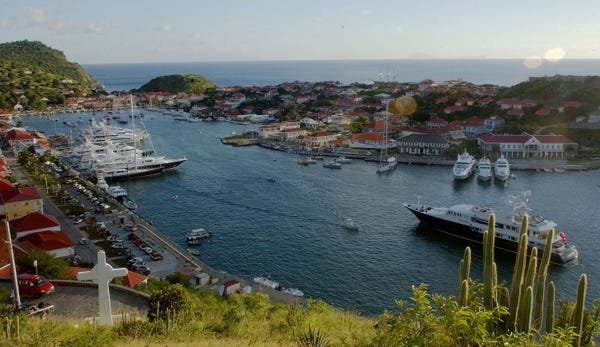
Gustavia Harbor in St. Barts.

Mark Mainz/Getty Images

Located in the French West Indies, the small island runs about 11 miles long and 2.5 miles wide.

It’s typically warm and sunny most of the year, with temperatures often in the 70s, 80s, or low 90s, and peak tourist season starts in late fall and lasts through the spring.

As a French territory, the official language of St. Barts is French, though English is also widely spoken.

It’s got rich beaches and a French flair.


Boats anchored off Shell Beach, Gustavia, St Barts.

A view of Saint Barthélemy, the popular Caribbean destination.


Holger Leue/Getty Images


The exclusive-feeling island is home to more than a dozen beaches, where visitors can soak up the sun on smooth, sandy shores and in crystal-clear water.

“I always say if you want to have your toes in the sand and eat a croissant that feels like you’re in Paris, St. Barts is the place for you,” Elisabeth Brown, the membership director at the luxury concierge service Knightsbridge Circle, told Business Insider’s Madeline Berg.

Surrounded by shallow coral reefs, St. Barts has some top-tier snorkeling spots, such as Grand Cul-de-Sac — home to sea turtles and a range of tropical fish.

Local natural sights also include mountains and hills formed from volcanic eruptions. That said, there are no active volcanoes on St. Barts.

Billionaires like Jeff Bezos seem to love St. Barts.


Koru screenshot

Jeff Bezos’s yacht Koru has been spotted near St. Barts in the Caribbean

Screenshot

Jeff Bezos and his wife, Lauren Sánchez Bezos, were photographed in St. Barts this week — and the Amazon founder has been spotted in St. Barts on multiple occasions over the years.

No matter the time of year, though, the island regularly welcomes the wealthy.

Celebrities like Beyoncé, Kim Kardashian, and Leonardo DiCaprio have visited in the past, and influential banking families, like the Rothschilds, have famously purchased property there.

The influx of .001% travelers means yachts are everywhere.


yachts in st barths

St. Barths is a wintertime destination for superyachts.

Walter Bibikow/Getty Images

In addition to Bezos’ vessel, massive yachts owned by Playrix founder Dmitry Bukhman, Dallas Mavericks owner Miriam Adelson, and entertainment mogul David Geffen also parked in St. Barts during the recent holiday.

While the yachts are primarily used for transportation to the island, they’re also attractions in and of themselves, featuring amenities such as jacuzzis and movie theaters.

Travelers without private yachts can still reach the island by flying into an airport on a larger Caribbean island, like San Juan. From there, they could take a ferry or private boat to St Barts.

Hotels can get pricey, but they’re quite luxurious.


The Eden Rock hotel in St. Barts.

The Eden Rock hotel in St. Barts.

Education Images/Getty Images

Visitors have several options for accommodations, ranging from villa rentals starting at over $900 a night to luxurious hotels for an even higher price.

The Eden Rock hotel is just one example. It overlooks St. Jean Bay — home to one of the most popular beaches on St. Barts — and is home to fine-dining restaurants and holistic spas.

During holiday seasons like New Year’s, a single-night stay at its largest villa can cost upward of €13,000, or about $15,200.

There’s also the Rosewood Le Guanahani resort, located on a private peninsula that’s home to two secluded beaches, giving travelers the ultimate getaway far from crowds.

Such privacy comes at a price, as even its most basic room can run guests thousands of dollars a night.

Even shopping is elevated on the island.


Pastel green boutique shops with shutters Gustavia St Barts

St. Barts has some high-end boutiques.

Andrew Woodley/Education Images/Universal Images Group via Getty Images

With billionaire travelers always on-site, the island’s retail scene largely caters to shoppers who can drop thousands at any given moment.

Some of the designer brands that have boutiques on St. Barts include Hermès, Cartier, Dior, and Louis Vuitton.

The island’s also home to luxury retailers like Patek Phillipe, which sells one-of-a-kind timepieces you can’t find anywhere else. Some retail for five, six, and even seven figures.

There’s even a club scene for those who want to party until morning.


Kygo performs at Nikki Beach in St. Barts on December 31, 2019.

A New Year’s Eve celebration in St. Barts.

Romain Maurice/Getty Images

A trip to St. Barts isn’t all about relaxation, though. There are plenty of places to party and experience live music.

One of the most popular spots for this on the island is Nikki Beach, an upscale restaurant and beach club. In past years, big-name musicians like Kygo and Mariah Carey have even performed at its New Year’s Eve celebrations.

It’s also a go-to for people looking to relax poolside with a drink in hand — though keep in mind that even just renting a lounge chair may cost you over $100.


Source link