Celebrate-Hubbles-36th-birthday-with-36-of-the-telescopes-most.jpeg

Celebrate Hubble’s 36th birthday with 36 of the telescope’s most breathtaking space photos

Since it launched into space on April 24, 1990, the Hubble Space Telescope has been an invaluable instrument to astronomers in unraveling the mysteries of the universe.

As it orbits the Earth from 340 miles above, the telescope has imaged distant galaxies, black holes, and planets, making over 1.7 million observations in its lifetime so far, according to NASA.

Scientists have published more than 22,000 studies using its data.

And (almost) every year, the Hubble team chooses a celestial object for the telescope to spend considerable time imaging that year, and releases a special photo to celebrate its birthday.

Here are 36 breathtaking images from Hubble’s 36 years in space.

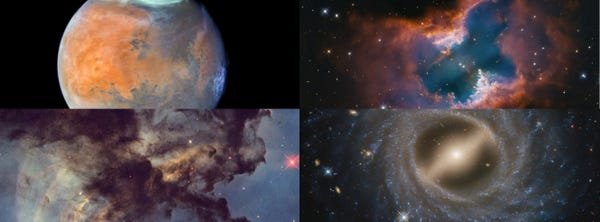
NASA marked Hubble’s 35th anniversary in 2025 with a composite image of four of the telescope’s photos.

Four Hubble images in quarters released for the telescope’s 35th anniversary. 

NASA, ESA, STScI

The top left image is a photo of Mars. The top right shows the planetary nebula NGC 2899. The Rosette Nebula is pictured at the bottom left, and the spiral galaxy NGC 5335 is on the bottom right.

Hubble’s 34th anniversary photo in 2024 showed the Little Dumbbell Nebula.


The Little Dumbbell Nebula photographed by Hubble.

The Little Dumbbell Nebula. 

NASA, ESA, STScI

Located 3,400 light-years away in the Perseus constellation, the Little Dumbbell Nebula features a red giant star that is collapsing into a white dwarf.

Hubble photographed a nebula known as NGC 1333 in an image released for its 33rd birthday in 2023.


NGC 1333 photographed by Hubble.

NGC 1333. 

NASA, ESA, STScI; Image Processing: Varun Bajaj (STScI), Joseph DePasquale (STScI), Jennifer Mack (STScI)

NGC 1333 is located in the Perseus molecular cloud about 960 light-years away.

This photo, released in 2022, shows a collection of five galaxies known as the Hickson Compact Group 40.


The Hickson Compact Group 40, a group of five galaxies photographed by Hubble.

The Hickson Compact Group 40. 

NASA, ESA, and STScI

The five galaxies will eventually merge together in about 1 billion years.

NASA celebrated Hubble’s 31st anniversary in 2021 with a photo of the star AG Carinae.


AG Carinae photographed by Hubble.

AG Carinae. 

Space Telescope Science Institute Office of Public Outreach/NASA, ESA and STScI

Clouds of gas and dust surrounded the star.

For Hubble’s 30th birthday in 2020, an image titled “Cosmic Reef” showed two nebulae in the Large Magellanic Cloud.


“Cosmic Reef.” 

NASA, ESA, and STScI

Located 163,000 light-years away, the Large Magellanic Cloud is one of the Milky Way’s satellite galaxies.

A photo of the Southern Crab Nebula was shared for Hubble’s 29th birthday in 2019.


The Southern Crab Nebula.

The Southern Crab Nebula. 

NASA, ESA, and STScI

The Southern Crab Nebula features a double star in its center made of a red giant and a white dwarf.

NASA shared a photo of the Lagoon Nebula taken by Hubble in honor of the telescope’s 28th anniversary in 2018.


The Lagoon Nebula photographed by Hubble.

The Lagoon Nebula. 

NASA, ESA, STScI

The Italian astronomer Giovanni Battista Hodierna was the first to catalog the Lagoon Nebula in 1654. Hubble’s photo only shows a snippet of the enormous nebula, which measures 55 light-years wide and 20 light-years tall.

For Hubble’s 27th anniversary in 2017, four photos were combined into one image showing a pair of galaxies 55 million light-years away.


Two galaxies photographed by Hubble.

NGC 4302 (left) and NGC 4298. 

NASA, ESA, and M. Mutchler (STScI)

The galaxies, NGC 4302 and NGC 4298, were photographed with Hubble’s Wide Field Camera 3.

Hubble’s 26th birthday image in 2016 showed a bubble nebula between 7,000 and 11,000 light-years away.


A bubble nebula photographed by Hubble.

A bubble nebula. 


NASA, ESA, Hubble Heritage Team


Bubble nebulae are formed by the solar wind of a nearby star crashing into a molecular cloud of dust and gas.

A photo of Westerlund 2, a giant cluster of about 3,000 stars, was the 25th anniversary image in 2015.


Westerlund 2.

Westerlund 2. 

NASA, ESA, The Hubble Heritage Team

Westerlund 2 is located 20,000 light-years away,

Hubble’s 24th anniversary photo in 2014 showed this colorful plume of gas and bright stars, known as the Monkey Head Nebula.


The Monkey Head Nebula.

The Monkey Head Nebula. 

NASA, ESA, The Hubble Heritage Team

Located within the Orion constellation, the Monkey Head Nebula is 6,400 light-years away.

For Hubble’s 23rd birthday in 2013, the team released this photo of the Horsehead Nebula in the Orion constellation.


The Horsehead Nebula.

The Horsehead Nebula. 

NASA, ESA, The Hubble Heritage Team

The photo was taken with infrared imaging.

This image of the Tarantula Nebula marked Hubble’s 22nd anniversary in 2012.


The Tarantula Nebula.

The Tarantula Nebula. 

NASA, ESA, The Hubble Heritage Team

The nebula is named for its glowing filaments that resemble spider legs.

This “rose,” released for Hubble’s 21st anniversary in 2011, showed two galaxies interacting with each other.


A pair of galaxies known as Arp 273.

A pair of galaxies known as Arp 273. 

NASA, ESA, The Hubble Heritage Team

The bigger galaxy’s mass is five times larger than the smaller one, so it’s pulling the smaller one into a spiral shape. The pair of galaxies is called Arp 273.

This image of the Carina Nebula was captured by the Hubble Space Telescope in 2010 and released for its 20th anniversary.


The Carina Nebula in 2010.

The Carina Nebula. 

NASA, ESA, The Hubble Heritage Team

The photo showed pillars of gas where stars are born.

Hubble’s 19th anniversary image in 2009 was titled “Fountain of Youth.”


“Fountain of Youth.” 

NASA, ESA, The Hubble Heritage Team (STScI/AURA)

The image showed a cluster of galaxies where stars, gas, and dust shoot up in a stream that stretches over 100,000 light-years.

For Hubble’s 18th birthday in 2008, the team released not one but 59 images of colliding galaxies. Here are 12 of them.


Colliding galaxies photographed by Hubble.

Colliding galaxies photographed by Hubble. 

NASA, ESA, The Hubble Heritage Team

At the time, it marked the largest simultaneous release of Hubble images to the public.

At the time, this 17th anniversary photo was one of the largest panoramic images ever taken in 2007.


The Carina Nebula.

The Carina Nebula. 

NASA, ESA, The Hubble Heritage Team

The image captures a 50 light-year-wide swath of the Carina Nebula, where stars are being born and dying.

The Hubble team celebrated the telescope’s sweet 16 in 2006 with this image of Messier 82.


Messier 82.

Messier 82. 

NASA, ESA, The Hubble Heritage Team

In this starburst galaxy, stars are born 10 times faster than in the Milky Way.

For its 15th birthday in 2005, the Hubble team released an image of a tower of gas and dust rising from the Eagle Nebula.


The Eagle Nebula.

The Eagle Nebula. 

NASA, ESA, The Hubble Heritage Team (STScI/AURA)

The plume is 9.5 light-years long.

This photo of the Lindsay-Shapley Ring Galaxy commemorated Hubble’s 14th birthday in 2004.


The Lindsay-Shapley Ring Galaxy.

The Lindsay-Shapley Ring Galaxy. 

NASA, ESA, the Hubble Heritage Team

The galaxy is 300 million light-years away, and the ring alone is 150,000 light-years across — making it 50% wider than our own Milky Way galaxy.

This photo of the Swan Nebula, located about 5,500 light-years away, celebrated Hubble’s 13th anniversary in 2003.


The Swan Nebula photographed by Hubble in 2003.

The Swan Nebula. 

J. Hester (ASU), NASA, ESA

The Swan Nebula is part of the Sagittarius constellation.

These Hubble photos, released in 2002, helped scientists estimate the age of the universe.


White dwarf stars photographed by Hubble.

White dwarf stars photographed by Hubble. 

H. Richer/NASA

Scientists estimated that the universe is more than 13 billion years old based on the ages of these white dwarf stars.

This eerie image of the Horsehead Nebula was shared on the telescope’s 11th anniversary in 2001.


The Horsehead Nebula.

The Horsehead Nebula. 

NASA, ESA, the Hubble Heritage Team

The Horsehead Nebula is a cold, dark cloud of gas and dust in the middle of a glowing nebula.

Hubble’s 10th anniversary image, released in 2000, showed the planetary nebula NGC 6751.


The planetary nebula NGC 6751 photographed by Hubble in 2000.

The planetary nebula NGC 6751. 

NASA/ESA, The Hubble Heritage Team, STScI/AURA

The nebula, which resembles an eye with a star at its center, is located in the constellation Aquila.

In 1999, Hubble took these photos of Jupiter’s moon Io.


Io passing in front of Jupiter.

Io passing in front of Jupiter. 

John Spencer/NASA

The image showed Io’s sulfur dioxide “snow” as it passed in front of the planet.

This wacky false-color image of Saturn celebrated Hubble’s eighth year in the sky in 1998.


Saturn photographed by Hubble.

Saturn photographed by Hubble. 

Erich Karkoschka/NASA

The infrared camera that produced it helps scientists figure out what the planet’s atmosphere and rings are made of.

This 1997 image was the sharpest view of Mars ever taken from Earth at the time.


Mars photographed by Hubble in 1997.

Mars photographed by Hubble. 

Erich Karkoschka/David Crisp/WFPC2 Science Team/NASA

Hubble was refurbished again in 1997, making clearer images of the Red Planet possible.

Hubble’s 6th birthday photo from 1996 shows multiple images of the same primeval galaxy, seen in blue.


Multiple images of the same galaxy captured by Hubble.

A primeval galaxy. 

W.N. Colley and E. Turner/Princeton University, J.A. Tyson/Bell Labs, Lucent Technologies, NASA

The image of the blue galaxy appears duplicated because of the intense gravitational lens of the group of yellow galaxies (near the center of the picture), which “bends light to magnify, brighten and distort the image of a more distant object,” NASA explained.

The team didn’t release a specific fifth birthday image, but this photo of the Eagle Nebula was one of the most famous from 1995, titled “Pillars of Creation.”


The Eagle Nebula photographed by Hubble.

The Eagle Nebula. 

Jeff Hester and Paul Scowen/Arizona State University, NASA/ESA

Inside this hydrogen gas and dust, stars are born.

In 1994, Hubble captured this image of part of the Great Nebula in the Orion constellation, where stars are born.


The Orion Nebula photographed by Hubble.

The Orion Nebula. 

C.R. O’Dell/Rice University/NASA/ESA

The image already appeared sharper than in previous years after astronauts first serviced the telescope in 1993.

In 1993, Hubble took a set of images of pulsating stars called Cepheids, which help identify distances in space.


Images taken by Hubble in 1993.

Images taken by Hubble in 1993. 

STScI/NASA/ESA

One of the main objectives of the telescope was to help refine the Hubble Constant, the rate at which Edwin Hubble calculated the universe is expanding.

In 1992, Hubble took the first image of the nebula NGC 2440, which contains one of the hottest known stars at the center.


Nebula NGC 2440 photographed by Hubble.

Nebula NGC 2440. 

S. Heap/Goddard Space Flight Center/NASA/ESA

A reading from the International Ultraviolet Explorer satellite found that the central star’s temperature measures over 360,000 degrees Fahrenheit.

The team didn’t officially celebrate Hubble’s first birthday, but this was the first true-color photograph that the telescope took of Jupiter in 1991.


Jupiter photographed by Hubble in 1991.

Jupiter photographed by Hubble in 1991. 

J. Westphal/Caltech/NASA/ESA

The photograph captured cloud formations in Jupiter’s atmosphere.

And finally, the image on the right was the first image Hubble ever took in space in 1990, showing what astronomers called “first light.”


Hubble's first image.

Hubble’s first image (right). 

STScI/NASA/ESA


Source link

Jordan Hart's face on a gray background.

Career tips for creators from 5 of Steve Jobs’ powerful friends on what would have been his 71st birthday

Late Apple cofounder Steve Jobs had a variety of powerful friends, and they’re honoring his legacy by sharing their recipes for success.

To celebrate his birthday on Tuesday, the Steve Jobs Archive released two collections of letters from business leaders, designers, writers, and more.

The entries were originally distributed to 2023 and 2024 fellows of the SJA program for young creators, and they’ve been compiled into two volumes titled “Letters to a Young Creator.”

The volumes feature the words of advice from tech trailblazers like Tim Cook and Jony Ive, to successful businessmen Bob Iger and Arthur Rock, to creative minds like Pixar’s Pete Docter and filmmaker Jon Chu.

Some wove their lessons together with personal anecdotes about their relationships with Jobs, while others laid out lists to aid in the creative process.

Tuesday would’ve been Jobs’ 71st birthday. The former Apple CEO died in 2011 after living with pancreatic cancer for a number of years. Jobs became known for his inspirational public speeches and quotes shared by those who worked closely with him.

Volume one of “Letters To a Young Creator” ends with an email Jobs sent to himself in 2010. In the note, he reflected on how his appreciation for human creativity.

“I love and admire my species, living and dead, and am totally dependent on them for my life and well being,” Jobs wrote.

In volume two, Jobs referred to himself in a 1984 quote as a student.

“Don’t take it all too seriously,” he concluded.

Here’s what his friends had to say about pursuing success as a young creator.

Tim Cook posed one question to young creators


Apple CEO Tim Cook

Apple CEO Tim Cook took over for Jobs in 2011.

Perry Knotts/Getty Images


Cook took over as CEO in 2011 after Jobs stepped down to focus on his health. Before his death, the pair worked closely together at Apple. Cook has been with the company since he met Jobs in 1998.

In his 2024 letter, Cook described the fateful meeting that led to a decadeslong career at one of the biggest tech companies in the world. He said he was warned against taking a job at Apple as the company had been struggling around that time. One conversation with Jobs changed everything.

“I had never met someone with so much passion and vision,” Cook wrote. “I knew I had to be a part of it.”

His advice to young creators facing similar decisions on their future career paths was to ask themselves one question.

“And so when you imagine your future, and the winding path that is laid before you, remember the question you should ask is not ‘What will happen?’ but ‘Who will I be when it does?'” Cook said.

Jony Ive said that Jobs liked to focus on ideas


Former chief design officer of Apple Jony Ive

Former chief design officer of Apple Jony Ive worked closely with Jobs.

Mike Windle/Getty Images


Ive, Apple’s former design chief, worked with Jobs for nearly 15 years. The pair would often have lunch together as they came up with ideas that led to successful products like the iPhone.

Ive wrote about his relationship with Jobs.

“His insatiable curiosity was not limited or distracted by his knowledge or expertise, nor was it casual or passive,” Ive wrote. “It was ferocious, energetic, and restless.”

Ive and Jobs connected over their shared curiosity. He encouraged people to be like Jobs and show their admiration for humans by being creators themselves. According to Ive, Jobs was focused on ideas rather than the problems that come along with them.

“Ideas are fragile. If they were resolved, they would not be ideas, they would be products. It takes determined effort not to be consumed by the problems of a new idea,” Ive wrote.

Pete Docter listed tips that help his creative process along


Pixar's Pete Docter

Pete Docter directed several Pixar movies.

LISA O’CONNOR/AFP via Getty Images


Docter is the chief creative officer at Pixar, which Jobs owned before Apple’s comeback. In recent years, Docter has been vocal about the intersection of tech and animation, saying artificial intelligence won’t fully replace humans in filmmaking.

He’s known for directing hit animated movies like “Monsters, Inc.,” “Up,” “Inside Out,” and “Soul.”

Docter laid out nine tips that he uses in his own creative process. Here are three of them:

  1. Start with whatever shows up. Go as far as you can on that initial confidence and enthusiasm.
  2. Start fast and rough; worry about details later.
  3. Each day, start by pretending you’ve never seen it before, with no expectations or preconceptions. Take it in as your audience will: see what it is, not what you HOPE it is. Then change or add to make it better.

Bob Iger said to take risks


GREEN BAY, WISCONSIN - NOVEMBER 10: Walt Disney Company CEO Bob Iger looks on prior to the game between the Philadelphia Eagles and the Green Bay Packers at Lambeau Field on November 10, 2025 in Green Bay, Wisconsin. (Photo by Michael Reaves/Getty Images)

Disney CEO Bob Iger led the acquisition of Pixar in 2006.

Michael Reaves/Getty Images


Iger has had two stints as Disney’s CEO, starting in 2005. The media giant acquired Pixar in 2006. Jobs became a member of Disney’s board of directors as part of the deal.

In true Disney fashion, Iger wrote about “magic and wonder” in his letter to creators. He remarked that creativity can’t be reduced to math or science.

Being risk-averse, he said, is the “death of creativity.”

“Second-guessing creative decisions is a perilous endeavor. Learn from creative mistakes, and never second-guess why things were made,” Iger wrote. “Instead, ask how they could have been made better.”

Arthur Rock said it’s all about who you keep around

Rock is an iconic Silicon Valley investor behind Intel, Xerox, and Apple. The 99-year-old wrote his 2025 letter about what makes a good leader.

“A good leader chooses good people,” he said.

Execution outweighs ideas, according to Rock, and finding people who can execute is essential. It’s the traits that money can’t buy, like “fire in the belly,” that Rock learned to identify throughout his decades as a venture capitalist.

“You want people who know what they can do, and do it. Even more important: You want people who know what they don’t know,” Rock said.


Source link

You-cant-cop-Jensen-Huangs-GPUs-but-you-can-eat.jpeg

You can’t cop Jensen Huang’s GPUs but you can eat the same cake he got for his birthday at work

Nvidia’s GPUs may be hard to snag, but Jensen Huang’s birthday cake might just be sitting in a display case at your local mall.

A strawberry soft cream cake from Korean bakery brand Paris Baguette was served at a birthday dinner for the Nvidia CEO near the company’s Santa Clara headquarters last Saturday, according to The Korea Times, which cited an interview with the bakery brand’s operator, Paris Croissant.

Huang, who turned 63 on Feb 17, invited about 30 engineers involved in South Korea’s SK Hynix DRAM and high-bandwidth memory for a dinner party at a fried chicken restaurant called 99 Chicken.

Korean business newspaper Hankyung reported that Huang had instructed Nvidia employees to “organize a dinner to encourage SK Hynix HBM engineers.”

“Please supply the highest-performance HBM4 without a hitch,” he told SK Hynix engineers that day, according to Hankyung.

SK Hynix is one of Nvidia’s key suppliers of high-bandwidth memory chips, or HBM chips — the advanced chips that sit alongside GPUs and feed them data at extreme speeds. Memory chips have become one of the biggest choke points in the AI boom.

At one point, Huang personally prepared and served somaek — a mix of soju and beer — to guests at each table.

For about two hours, Huang went table to table thanking his guests, according to Hankyung.

Huang’s cake is a huge marketing win for the bakery brand.

“It was all about the symbolic moment — our brand’s cake being present at a birthday party for the current leader of the global AI industry. It was a total boon without costing us anything,” a Paris Croissant official told The Korea Times.

Paris Croissant operates about 280 Paris Baguette locations across the US, including several in Silicon Valley. It aims to expand to 1,000 outlets in North America by 2030.

The bakery chain is a household name in South Korea, with about 3,400 stores there. Since making its first push overseas in 2004, the Paris Baguette brand has expanded to 15 countries.

The Paris Baguette cake is described as a “vanilla cake filled with soft cream and fresh strawberries, topped with more berries.”

A global AI superstar

Huang has become something of a spectacle wherever he goes.

In October, Huang sat down for fried chicken in Seoul with the heads of Samsung and Hyundai. The casual meal quickly turned into a media event.

A crowd of journalists, photographers, and fans gathered outside the restaurant, while national broadcasters aired live footage of the executives eating and talking inside.

Photos from the evening also captured reflections in the restaurant windows, showing fellow diners lifting their phones to snap pictures.

Following Huang’s visit to the Seoul restaurant, crowds lined up before opening hours, hoping to dine at the same table occupied by the Nvidia chief and his high-profile guests, Korean media outlets reported.

The restaurant has imposed a one-hour time limit on the table used by Huang and the Korean business leaders, the reports added.


Source link

A woman in glasses wearing a blue dress standing in front of a bush.

90-year-old determined not to miss birthday party, despite heart attack

My father has always been a sociable person who loves nothing better than chatting with relatives, friends, and ex-colleagues.

So it seemed like a fun idea to throw him a surprise party for his milestone 90th birthday at a cricket club in the English town where I grew up.

Our intention was “go big or go home,” and my sister, Alison, and I asked dozens of people to join the celebration.

We decided on a newspaper theme because Dad was the former editor in chief of a local newspaper. I spent hours designing the invitation, emphasizing that the event was top secret, and using the font of an old-fashioned typewriter.

The party was organized with military precision

Mom was also kept in the dark because we wanted it to be a surprise for her, too.

The guest list grew by the day as we contacted people from every part of Dad’s life, including his sister-in-law, cousin, nieces, nephews, and neighbors.

Most of the attendees were journalists who’d worked with him during his seven decades in print. We imagined his delight when he met them again.

My sister and I planned the party with military precision from our homes on either side of the Atlantic Ocean.


A group of people at a birthday party.

The party took place after all.

Courtesy of the author.


We bought runners for the tables, framed a huge welcome poster, made bunting, and ordered a massive cake that looked like the front page of Dad’s beloved paper.

Then, two weeks before the party, Dad had a cardiac arrest. He’d shown signs of slowing down over the previous few months, but it was a terrible shock.

Thankfully, the heart attack was relatively mild — but it was enough to keep him in the hospital, followed by a rehab facility for the next seven days.

Mom and Ali stayed at his bedside, while I made concerned calls from the US. It was horrible to live so far away while my family was in need.

The worry was bad enough, but I admit it was compounded by the fact that we’d organized the birthday party. Dad’s health was the absolute priority, but people had been looking forward to the occasion and booked train tickets and hotels.

Dad could have made a virtual appearance

I felt selfish for having those thoughts, but couldn’t bring myself to cancel the celebration quite yet. I consulted with Ali, who agreed we should reassess in a few days’ time.

While Dad quickly showed signs of improvement, we faced a dilemma. Should we do the “sensible thing” and call off the party? Perhaps there was a compromise. What if the event went ahead in Dad’s honor, whether he attended or not?

He was as generous as he was sociable, and wouldn’t have wanted anyone to be disappointed or sad. Besides, he’d get a kick out of all the tributes to him.

We sent an email to tell the guests what had happened. We said we understood if they wanted to decline, but hoped they wouldn’t. Dad could even make a virtual appearance on a giant TV screen, we said.


A woman in a blue dress making a speech

The author making a speech at her father’s birthday party.

Courtesy of the author.


Most people thought it would be nice to get together for a reunion and celebrate Dad. If they couldn’t raise a glass and appreciate him together, then when could they?

To our relief, Dad rallied over the following week. He returned from the hospital and became quite jovial again. My husband and I flew to England as planned, and he was pleased to see us.

Nevertheless, a big question mark remained over the party. Dad’s medical team was impressed by his continued recovery, and Ali sought their advice. She wanted to know whether it was safe for him to attend. They said it would boost his morale and give him something to look forward to.

Dad delivered a speech himself

Obviously, we no longer kept the lunch a surprise and asked Dad for his opinion. There was no pressure, we said, but if the thought of a celebration appealed to him, we’d do our best to get him there.

His face lit up. “I can’t wait to see everyone,” he said.

We left it until the morning itself for him to finally decide. If he felt up to coming, great. If not, that would be fine. It didn’t really matter because he’d be there in spirit.

Still, proud and determined, Dad made it in person. He shook hands with everyone in the room and laughed at the speeches. He even gave one himself.

The party was a roaring success. Ali and I agreed that we’d done the right thing. We hadn’t seen Dad so happy in years.


Source link

A woman in glasses wearing a blue dress standing in front of a bush.

I took my 5-year-old to the wrong birthday party. It taught me a lesson about the grace of strangers.

My son, Bobby, had always been a shy person. When he started kindergarten, I was hoping he’d make a lot more friends.

I was delighted when I saw an Evite in my inbox from a mom inviting him to a classmate’s 6th birthday party. The little boy’s name was Nathan.

The event took place at a retro slot-car raceway, where you raced tiny, electric-powered replicas of full-size cars on narrow tracks with “grooves,” known as “slots.”

Neither of us had been to one before, and we were excited to accept the invitation. I was also looking forward to finally meeting the other parents.

I didn’t buy a physical gift

I didn’t know anyone, partly because Bobby attended a school in a different suburb, about five miles from ours.

He took the bus, so my husband and I never did pick up or drop off. We worked in the city, so there was no waiting at the school gate and chatting with fellow moms and dads.

Nathan’s mother asked people to give half the money we’d have spent on gifts to an animal shelter. She’d use the other half to buy something big that he really wanted.

I ignored red flags

I was relieved that I didn’t have to go out of my way to purchase a present, so I donated $20 online.

As a result, Bobby and I arrived, empty-handed, at the slot-car venue at 11 am on a rainy Sunday morning. The hostess greeted us at the door.

“Is that Nathan?” I asked, pointing to the child I assumed was her son. The boy had a giant rosette on his sweater. “You mean, Oliver,” she replied. It was the first red flag that I ignored.

My son had a lot of fun

I’ve always been forgetful and apologized profusely. Bobby and I sat down by the racetrack and grabbed his remote control. A dad showed us how to work the cars.

Time went by, and Bobby had a lot of fun. He didn’t interact much with the other children, and they didn’t interact much with him either. I thought nothing of it because he was often withdrawn in busy settings.

I introduced myself to many of the parents. They talked animatedly in groups and clearly knew each other well. Still, they included me by asking me how Bobby liked the teacher.


A group of children at a slot-car racing track.

The author’s son, far left, thoroughly enjoyed himself at the party.

Courtesy of the author.


“Oh yes, he loves her,” I told one of the moms, mentioning the teacher’s name. She looked puzzled. It was another red flag, but I didn’t see it waving right in front of my face.

I spotted a large pile of presents on a table nearby. Wasn’t it odd, I thought, that so many guests bought gifts when Oliver’s mom had wanted us to make donations instead? Still, the penny didn’t drop.

It was time to cut the birthday cake. I helped hand out the slices. I wanted to leave a good impression. One mom said how nice it was of me. I joked that I was expecting a tip. She laughed politely.

Something was off

We left 15 minutes later. “Did you have a good time?” I asked Bobby. He nodded,

Fast forward a week, and I looked through my email and clicked on the Evite from Nathan’s mom. I intended to write down her number and see if her son would be interested in a playdate.

“Come to Nathan’s 6th birthday celebration,” the invitation said. I thought it was Oliver’s party. Something was off. I looked at the date. Nathan’s slot-car racing took place at 11 am the previous Saturday, not 11 am the previous Sunday. We missed his party by 24 hours.

Worse, we’d shown up at the wrong party. Most of the kids were much bigger than Bobby. Now I knew why.

We had crashed a party

I recalled the moment when Oliver cut his cake. I was fairly certain there were more than six candles on top.

No wonder there were so many presents on that table. No wonder the woman looked at me strangely when I mentioned the teacher’s name.

I cringed. What on earth had Oliver’s mom thought of me? I was the bonkers party crasher who showed up uninvited with their kid. I didn’t even bring a gift. What if the other parents gossiped about me and sniggered behind my back? It was mortifying.

My negative reaction shifted

After I called Nathan’s mom to apologize for missing his party, I took a breath and reflected on what had happened. It was actually quite amusing. My negative reaction shifted. Bobby thoroughly enjoyed himself, which was a promising outcome for someone so shy.

The hostess might have wondered who the heck I was, but she was too considerate to ask and embarrass me in front of people.

Everyone at the party had been warm, kind, and full of goodwill. It didn’t matter who I was. They welcomed me with open arms. Those strangers taught me a lesson in grace.


Source link

A-rattlesnake-bit-my-toddler-at-a-birthday-party-What.jpeg

A rattlesnake bit my toddler at a birthday party. What happened next changed me.

I was sick at home when my 2-year-old son was bitten by a rattlesnake at a kid’s fairy-themed birthday party in LA.

My husband, Mac, was with our two kids when our son fell into the grass, crying and pointing to his hand. At first glance, Mac thought he was having an allergic reaction to a bee sting, a fair assessment for an Angelino parent, until he identified a second puncture wound in the divot between his little fingers.

It’s one thing to be present when your child gets hurt. The self-blame is straightforward — “It’s all my fault. I wasn’t quick enough. I should have seen it coming.” But when it happens without you, the guilt wanders until it emboldens — “Had I been there, I would have prevented it. I would have lured the snake away with the live mouse I keep in my first aid kit next to the Paw Patrol Band-Aids and butt cream.”


Toddler at hospital crying

The author’s son was admitted to the hospital after being bitten by a snake.

Courtesy of the author


Mac rushed to the Children’s Hospital LA while I went through the suddenly delicate motions of being a parent to our oldest. The CHLA attending doctors, in tandem with California’s leading poison specialist, determined that he would require an anti-venom treatment. A Marvel comic book plotline except this was real life, and the idea of Mads becoming Sssnake-Man was far-fetched, even in our desperation. Ironically, this is when you’re meant to conjure hope. Even if your son’s hand has gone from swollen pink to rigid gray.

As we waited to see if the anti-venom would work, I ran through the unthinkable what-ifs until I landed on a firm bed of memories from the last time I feared death.

My mom died at 67

The first time someone deeply close to me died was 10 years ago, when I lost my mother.

Her death made no sense to me. She was 12 years younger than my dad and only 67 when she died. She’d lived a self-proclaimed glamorous life before meeting my dad and becoming surprisingly pregnant with me at 39.

Before that, she was a “walking model” at Bal Harbour Shops in the 70s, touting signage from the then-emerging designers of couture. We loved each other completely, but it was no secret that becoming a mother deprived her of her golden years.


Mom and daughter

The author’s mom died when she was 67.

Courtesy of the author


I traveled across the county to be with her after her first heart attack. She refused medical advice to be added to a heart transplant list and was vehemently against keeping a low-sodium diet. For this, I was angry. I plead with her. I begged. Did she want to live? What if I were to get married one day? Wouldn’t she want to meet her future grandkids? All she wanted was sodium-rich tomato soup. I was so mad, I decided to cut my trip short so I didn’t have to watch her kill herself. Harsh, maybe, but that’s what it felt like at the time.

“Won’t you stay and hold my hand?” she asked before I left.

She died a few weeks later from sepsis after another heart attack. I made it back in time for her last breath.

Then my dad died at 82

I tried to do better when my dad became ill three years later. His death made more sense. He was an 82-year-old personal injury attorney with diabetes, Parkinson’s disease, and eventually bladder cancer.


Dad and daughter

The author’s dad died at 82.

Courtesy of the author


In a word, my dad was basic before it became a popular insult. I mean it in the most endearing way. He was a New York Jew who grew up at the tail end of the Great Depression and was generally satisfied as long as he had a Miami Hurricanes game on and a palmful of peanuts that, in his final hours, he wouldn’t be able to swallow. It was then that I’d watch the games with him and drop ice chips into his mouth to offer some relief.

I knew it wouldn’t be long before he died, but I guess I expected to be there when it happened. Instead, I got a call very early one morning to let me know that my father had “expired.” Like a carton of milk.

My son’s snake bite taught me something important

In the weeks leading up to Madsen’s snake bite, we were preparing to move across the country to be closer to Mac’s family. The decision was made at the last minute, and we had limited assistance. We were moving so fast, we forgot what mattered until Mads was admitted to the ICU.

A decade ago, I had somehow mistaken my mother’s autonomy for abandonment. It was only now that I understood, far too late, that my mom needed me just as much as I needed her.

Madsen received 21 doses of anti-venom over a 72-hour period. And it worked. When I saw him, he kept saying “I got you!” which is what Mac had been telling him since they arrived.

“I got you, too, little buddy,” I said and held his hand in mine.


Source link