
Exploding-drone-boats-have-entered-the-Iran-fight-Oman-says.jpeg

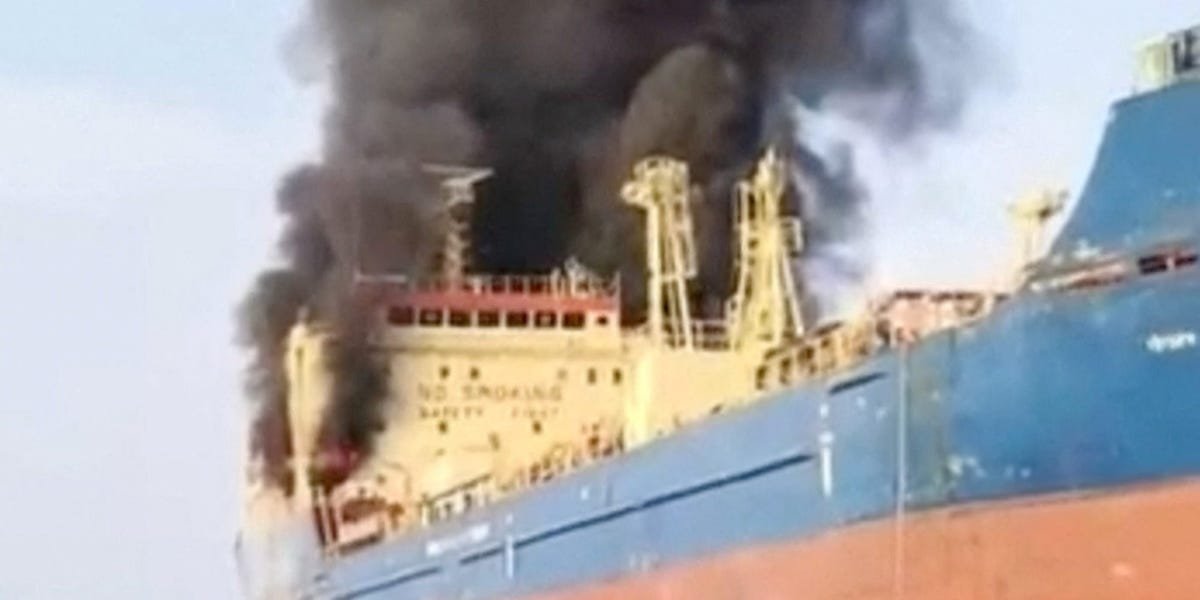
Exploding drone boats have entered the Iran fight. Oman says one hit a tanker in a fatal blow.

Exploding drone parts are now part of the growing fight between the US and its partners and Iran. Oman said one struck a tanker and resulted in the death of a crew member.

Oman News Agency, the state news agency of the Sultanate of Oman, said on Monday that an oil tanker flagged to the Republic of the Marshall Islands “was attacked by an unmanned surface vessel.”

It said “the attack triggered a fire and explosion within the main engine room, resulting in the fatality of one crew member of Indian nationality.”

The tanker, MKD VYOM, was around 52 nautical miles off the coast of Oman and had 21 crew members on board: 16 Indian nationals, four Bangladeshi nationals, and one Ukrainian national. They were evacuated by commercial vessel MV SAND, which flies Panama’s flag, the report said.

It said that a vessel from Oman was monitoring the condition of the tanker that was hit and that it was giving navigational warnings to ships nearby. The hit tanker was carrying an estimated 59,463 metric tons of cargo.

The use of drone boats adds to what was already a growingly precarious situation in highly strategic waters, with reports of vessels being targeted and hit by incoming munitions.

Oman did not say who the drone boat belonged to. Iranian officials have said that Iran has them in its arsenal, and Iran has also repeatedly tried to steal US drone boats. The Iranians and their proxies in the region have also previously threatened and attacked merchant vessels.

No naval force operating in the region has said it is using the technology in the conflict that boiled over this past weekend.

Drone boats are an increasingly prominent warfighting technology. They gained notoriety as Ukraine used them against Russia’s Black Sea Fleet, leveraging the low-cost assets to damage and destroy expensive Russian warships. Russia has since adopted the tech. Other actors, like the Houthi rebels, an Iranian proxy group in Yemen, have used them in attacks as well. Western militaries are using this technology too, but primarily for reconnaissance.

The waters around Oman and Iran are hugely important to global trade. They include the Strait of Hormuz, where around 20% of the world’s daily oil supply passes through.

Multiple ships came under fire in this area over the weekend and on Monday, with crews evacuated and some injured. Several major shipping companies have said that they are avoiding the area to keep crews safe.

The US and Israel launched attacks on Iran on Sunday, hitting aircraft, command and control centers, warships, missile sites, and killing Iran’s Supreme Leader. Iran retaliated by firing towards a host of nearby countries that have US bases. Fighting continues.




Source link

World-Cup-2026-ticket-prices-blow-past-original-projections-as.jpeg

World Cup 2026 ticket prices blow past original projections as FIFA embraces variable pricing

It’s been over 30 years since Americans have had the chance to watch their national soccer team play on their home turf.

They’ll get another chance next year, but it’ll cost them.

Fans could pay over $2,700 for a ticket to watch the USA’s first match in the 2026 FIFA World Cup against Paraguay, which is scheduled to take place in June at SoFi Stadium in Inglewood, California.

That far exceeds the estimated ticket prices included in the original joint bid submitted by the United States, Canada, and Mexico to host the World Cup.

FIFA, which sets ticket prices, says it is using variable pricing to determine ticket costs, and “may adjust ticket prices throughout the sales phases based on a review of demand and availability for each match.”

The organization said it isn’t using dynamic pricing — when ticket prices change in real time based on demand and other factors — for the 2026 World Cup. In addition to third-party sites like StubHub, which sell tickets, FIFA offers a resale and exchange marketplace for fans.

FIFA launched its third phase of ticketing last week. Soon after the portal opened, fans took to social media, expressing shock over what they described as steep prices.

World Cup tickets are divided into four categories, with Category 1 selling the most expensive tickets and Category 4 the cheapest options.


Screenshot of 2026 FIFA World Cup ticket prices (third phase)

Ticket prices for the USA’s match against Paraguay on June 12.


FIFA


As of Saturday, there are no available Category 4 tickets for the USA’s opening match against Paraguay on June 12. Instead, the cheapest ticket is selling for $1,120 under Category 3. The most expensive ticket costs $2,735, followed by $1,940.

The most expensive ticket for Mexico’s opening match against South Africa costs $2,355, and Canada’s opening match costs $2,170. Neither of those matches is offering Category 4 tickets.

As the tournament continues, ticket prices drop but are typically still far above original estimates.

When the USA faces off against Australia on June 19, the most affordable ticket is $265, while the most expensive is selling for $700. When the USA plays on June 25, fans will have to pay between $910 and $340.

Those prices are a far cry from what the United States, Canada, and Mexico estimated in their bid to host the tournament. The countries submitted a combined bid — dubbed the “United bid” — and were selected in 2018.


Screenshot from the US, Mexico, and Canada's FIFA World Cup Bid Book

The Ticket Pricing Summary Table in the United bid book.


FIFA


In their pitch, the countries estimated that a Category 1 ticket for an opening match would cost $774, followed by $614 for Category 2, $320 for Category 3, and $60 for Category 4.

Tickets for the final match were estimated to cost between $1,550 and $128. Under FIFA, the current final match prices — held at MetLife Stadium in New Jersey — start at $4,185. The most costly ticket is $8,680.

Despite the hefty price, fans eager to snag tickets in this phase can purchase them now until January 13.

The 23rd edition of the tournament will take place this summer in 16 cities across North America. The first game kicks off on June 11, and teams will play until the final match on July 19.


Source link

Judge-orders-Google-to-rebid-for-default-search-deals-every.jpeg

Judge orders Google to rebid for default search deals every year in a major antitrust blow

  • A federal judge ordered Google to limit default search and AI app contracts to one year.
  • The ruling follows a 2024 finding that Google illegally monopolized online search markets.
  • The decision aims to boost competition from rivals in search apps and generative AI.

A judge opened the door to upending Google’s dominance as the default search on your phone.

On Friday, a federal judge ordered Google to limit all default search and AI app contracts to one year, a setback for the long-term deals that have helped cement the company’s dominance on billions of devices.

The ruling, detailed in a December 2025 judgment, requires Alphabet’s Google to renegotiate every default-placement agreement annually, including lucrative deals with Apple’s iPhone and manufacturers like Samsung.

Judge Amit Mehta of the US District Court of the District of Columbia said the “hard-and-fast termination requirement after one year” is necessary to enforce antitrust relief after his landmark 2024 finding that Google illegally monopolized online search and search advertising.

The decision aims to open the door for rivals, especially fast-moving generative AI companies, to compete for default spots that have historically been held for years at a time. It builds on a separate September order requiring Google to share some of the data behind its search rankings with competitors.

While Google can still pay device makers for default placement, the annual renegotiation rule sharply restricts its ability to secure long-term control over the search market.

Google and the Justice Department did not immediately respond to requests for comment.


Source link