

Katherine Li, West Coast breaking news reporter at the Business Insider.

The author of a viral AI report warns that blue-collar jobs won’t be safe from an AI-driven recession

The coauthor of an AI research paper is speaking out after his work triggered a global stock sell-off.

Citrini, a firm focused on thematic equity investing, alongside Alap Shah, CEO of Littlebird.ai, theorized a future where, instead of transforming the economy in a positive way, the AI boom erases white-collar jobs and severely reduces the spending power of those workers, and eventually stunts economic growth.

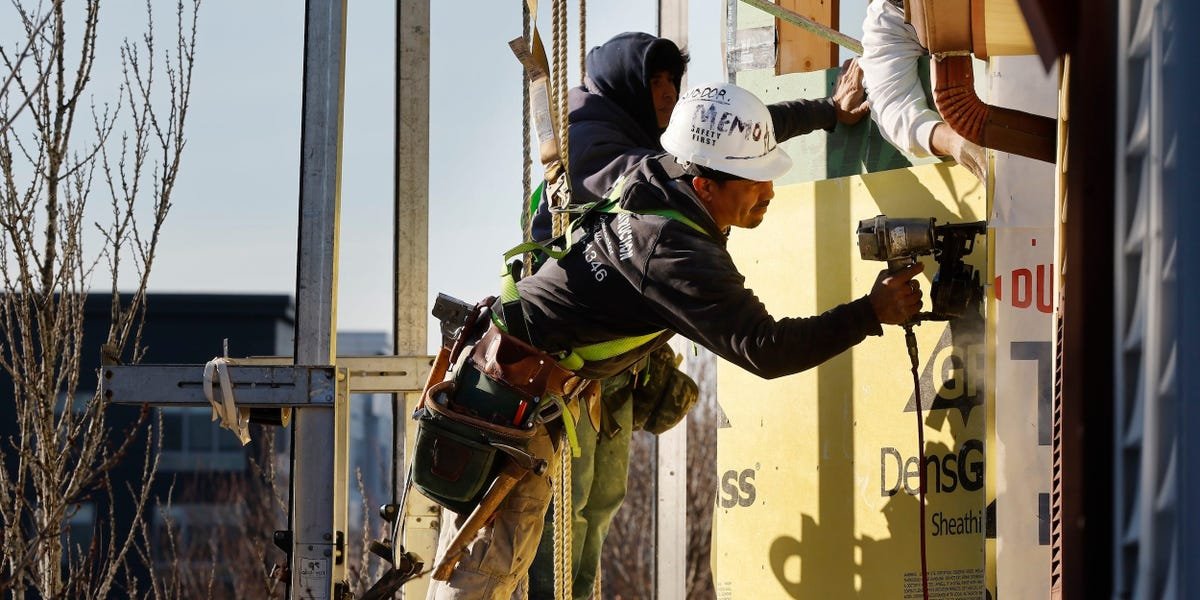
On Monday, Shah told “TBPN” podcast hosts John Coogan and Jordi Hays that despite how well it seems to be going for blue-collar jobs at the moment in terms of growth and the lack of mass layoffs, these jobs won’t be safe if white collar jobs go away because ultimately, there is only “one labor market.”

“Let’s say in our scenario, we talk about 5% of folks might get fired in a couple of years,” said Shah. “Those 5%, if there aren’t white collar jobs for them to relocate into, then they’re going to have to move into the gig economy and the blue collar labor force.”

“And so that puts pressure on the entire labor market, not just the white collar one,” Shah added.

Shah and Citrini published a report on Sunday, written from a futuristic point of view set in 2028, that predicts a negative domino scenario triggered by the AI boom. The research theorizes that AI will kick off a mass white-collar layoff too quickly, which will then deal a blow to the metro housing and mortgage market, and eventually lead to a global stock sell-off and a widespread recession in all sectors. In this scenario, the paper said, AI growth could also lose momentum due to a lack of funding.

“The system turned out to be one long daisy chain of correlated bets on white-collar productivity growth,” the paper theorizes. “The November 2027 crash only served to accelerate all of the negative feedback loops already in place.”

Shah elaborated on these concerns on “TBPN.” When asked what he thinks of the current growth in the health and education sectors, Shah said most of it could be spurred by government spending, which would go away if personal income declines.

“Those sectors continue to grow because government spending grows,” said Shah. “But again, gets very circular if government spending is coming primarily from taxes and primarily payroll taxes because the average worker pays a lot more in taxes per dollar than the average corporate does.”


Source link

New-poll-shows-the-shifting-conversation-around-blue-collar-work-in.jpeg

New poll shows the shifting conversation around blue-collar work in the age of AI

Americans think the future of work is in their hands.

A poll commissioned by the Business for Good Foundation, a nonprofit focused on reducing the wealth gap, found that 75% of Americans agree that “hands-on skills and practical experience matter more than formal degrees when it comes to career success.”

“You’ve got a lot of people that have historically didn’t think the American dream was for them,” Ed Mitzen, cofounder of the Business for Good Foundation, told Business Insider ahead of the poll’s release. “I would argue that it isn’t broken, it’s just moved, and it’s moved to places we stop looking.”

The survey, conducted by The Harris Poll, comes as leading names in AI point to a potential boom in blue-collar work as agentic AI redefines, and in some cases, replaces white-collar work.

The poll also found that 76% of respondents agree that “jobs that rely on hands-on experience are less likely to be replaced by AI.”

Overall, three in four Americans said they agreed with the statement that what they consider a “good” job today is different than what it would have been five years ago. And 78% agreed with the statement “the stigma around trade or blue-collar work is declining” as society puts a greater emphasis on hands-on skills.

Researchers have found that jobs that require human interaction and physical presence are less likely to be replaced by AI.

Indeed’s GenAI Skill Transformation Index recently examined how generative AI could perform jobs that require problem-solving ability and physical labor. Their findings were that nursing, childcare, and construction were the least likely to be affected by AI.

AI leaders talk up blue-collar work

AI leaders continue to debate the degree to which the revolutionary technology will upend the current workforce. Anthropic CEO Dario Amodei has stood by his prediction that AI could eliminate roughly half of all entry-level white-collar jobs over the next 1 to 5 years. Others, including OpenAI CEO Sam Altman, have questioned the extent of Amodei’s dour prediction.

Nvidia CEO Jensen Huang recently said at the World Economic Forum that now is the perfect time to go into the trades. In part because the AI industry itself will need an influx of workers to help build the massive data centers it wants to build.

“So we’re talking about six-figure salaries for people who are building chip factories or computer factories or AI factories, and we have a great shortage in that,” Huang said in a conversation with BlackRock CEO Larry Fink.

xAI CEO Elon Musk previously said that any job that involves manual labor is likely to survive much longer amid the “supersonic tsunami” that is AI.

“Anything that’s physically moving atoms, like cooking food or farming, anything that’s physical, those jobs will exist for a much longer time,” Musk told podcaster Joe Rogan in November. “But anything that is digital, which is just someone at a computer doing something, AI is going to take over those jobs like lightning.”

The Business For Good Foundation commissioned The Hariss Poll to survey 2,085 adults 18 or older. Harris Poll conducted the survey online in the US from January 13th through January 15th. The overall margin or error is ±2.5 percentage points.


Source link