

Dominick Reuter

Target boycott organizers claim victory in their yearlong protest — but they say more work needs to be done

A fast is typically 40 days, but the Target Fast lasted nearly 10 times that long.

The organizers of the nationwide boycott against Target declared victory Wednesday after they said the company is largely satisfying the demands that were laid out a year ago.

Pastor Jamal Bryant and community leaders said at a press conference that their protest of the bullseye retailer’s DEI policies is over after a series of conversations with Target representatives, including new CEO Michael Fiddelke.

“We are effectively, today, closing this chapter because we have other fights that we’ve got to see,” Bryant said. “Stay tuned for the next fight, but this fight for us has now reached its conclusion.”

Bryant said the Target Fast pledge garnered more than 300,000 signatures from people across the US. The company said last year that the reaction to its DEI changes dragged on first-quarter sales.

The bullseye retailer welcomed the conclusion of the Target Fast, saying it is more committed than ever to supporting growth and opportunity for all the people it serves.

“We’re pleased to be moving forward, and we will continue showing up as trusted neighbors while delivering results for our team members, guests, and the more than 2,000 communities in which we serve,” a spokesperson said.

The end of the action marks a cultural win for Target, a week after it unveiled an ambitious turnaround strategy to re-engage shoppers and win them back.

So far in 2026, the company’s share price is up more than 20% after a down year in 2025 marked by falling foot traffic and net sales. The S&P 500 is roughly flat year-to-date by comparison.

Target provided the receipts to address organizers’ concerns

Bryant said Target’s programs have met three of the four demands his coalition expressed last year, including commitments to Black entrepreneurs, partnerships with HBCUs, and internal programs that support diversity and inclusion.

The outstanding issue is the organizers’ call for Target to deposit $250 million in Black-led banks, which Bryant conceded would take more time to identify institutions that could work with that amount of capital.

Bryant said a demand that the company commit $2 billion to Black-owned businesses was 97% complete and on a path to be exceeded by another $100 million this spring.

He also said the company is piloting an HBCU partnership that will equip students with business skills and serve as a model for future engagement with Black schools. Target says it has provided $10 million over the past five years for 1,000 HBCU students in its Target Scholars program.

Most of the goals were met through Target’s ongoing community engagement efforts, which the company has been seeking to communicate about more effectively under Fiddelke’s leadership.

‘We will not be going back to Target’

Although this specific boycott is over, co-organizer Nina Turner says she’s not yet ready to go back to Target until she hears a public apology from the company for breaking its trust with the Black community.

“People have to make their own decision, but as for me and my house, we will not be going back to Target,” the former Ohio state senator said.

Some social media users were similarly skeptical about returning to Target’s stores.

“I’m still not going to shop there but sure the boycott is over,” one user posted on X.

On social media, mentions related to Target boycotts spiked in January 2025 but tapered off during the year before climbing again in January and February 2026, according to data from PeakMetrics.

Bryant said new challenges for Target and other large companies have emerged in the past year, particularly related to the company’s response to immigration issues. But those are distinct from the demands his coalition made last year, and he’s happy with what he’s learned.

“This journey for all of us was not a symbolic one,” he said.

Have you participated in the Target boycott? Are you planning to start shopping again this year? Contact Dominick Reuter via email at dreuter@businessinsider.com


Source link

Unsubscribe-and-opt-out-A-new-Big-Tech-boycott-to.jpeg

‘Unsubscribe’ and ‘opt out’: A new Big Tech boycott to protest ICE starts February 1

Economic boycotts are a familiar tool of protest. The problem is they often place the greatest strain on the smallest businesses.

That was the case during Friday’s nationwide general strike, which was designed to pressure the Trump administration to dial back its aggressive anti-immigration policies.

For many small business owners, the shutdown created a dilemma. Supporting the cause often means losing a day’s revenue and risking their ability to keep staff employed. Across social media, owners voiced solidarity alongside an apology for staying open.

There may, however, be another way, according to Scott Galloway, a marketing professor at New York University famous for his critiques of Big Tech.

Instead of a blanket shutdown, Galloway is calling for Americans to focus on major tech companies by unsubscribing from — or opting out of — services like OpenAI’s ChatGPT, Amazon’s Prime Video, and Microsoft Office.

A targeted boycott starting on Sunday and lasting the entire month of February could move markets, he says, which would, in turn, affect the CEOs who have the ear of President Donald Trump.

“We’re proposing something quieter and less cinematic than a protest that will run all day on cable TV, but much more disturbing to the Trump administration. A one-day slowdown is irritating. A one-month slump is terrifying,” he wrote in a blog post announcing the boycott.

Major tech CEOs have sought favor with the president during his second term. Many of them donated to his inauguration, for starters.

AI executives, like OpenAI CEO Sam Altman and Meta CEO Mark Zuckerberg, also accepted an invitation to a White House dinner with Trump in September, where the leaders took turns lauding the president. Apple CEO Tim Cook and Amazon CEO Andy Jassy attended the White House premiere of the documentary about first lady Melania Trump at the height of January’s anti-ICE protests in Minneapolis.

Supporting the AI industry in its competition with China is a major pillar of Trump’s economic agenda.

“These are the leaders who have his ear,” Galloway writes. “A modest reduction in their companies’ growth could have a substantial impact on valuations priced to perfection. Small changes in consumer behavior — starting on the first day of February — could have an enormous ripple effect, one that extends all the way to the White House.”

The anti-ICE movement

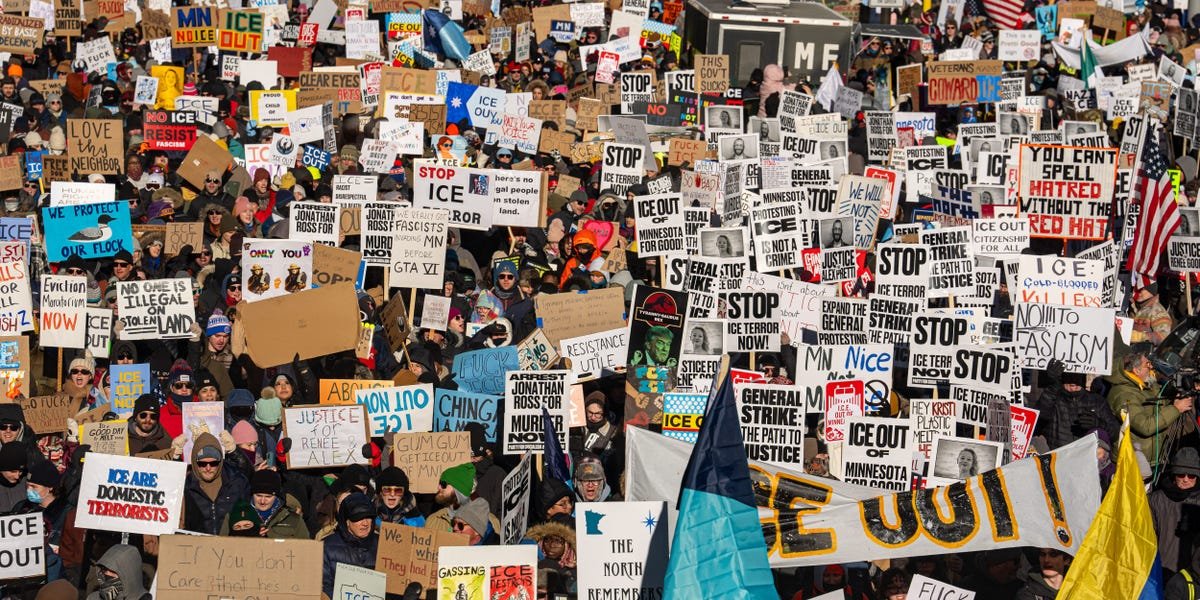
Regular protests against the tactics of ICE and Border Patrol personnel have gripped the country for months. Thousands marched through Minneapolis again on Saturday. Tensions rose dramatically in January after the killings of Renee Good and Alex Pretti in Minneapolis, both at the hands of federal immigration agents.

In both instances, protesters recorded videos and posted them to social media for the world to see, leaving little room for the Trump administration to spin the events in its favor.

While those videos and the subsequent protests — as well as the attempted nationwide shutdown — have spread awareness, they have so far done little to substantively shift the administration’s immigration policies.

The Department of Homeland Security demoted a key Border Patrol official last week and promised more changes. At the same time, however, the acting director of ICE expanded the power agents have to carry out warrantless searches, according to an internal memo seen by The New York Times.

“Real change always comes from the American people, not from our political parties. But power doesn’t fear protests nearly as much as economic withdrawals,” Galloway writes. “Getting off your couch, taking to the streets, and building community is important, but the most radical act in a capitalist society isn’t marching, it’s not spending.”


Source link