
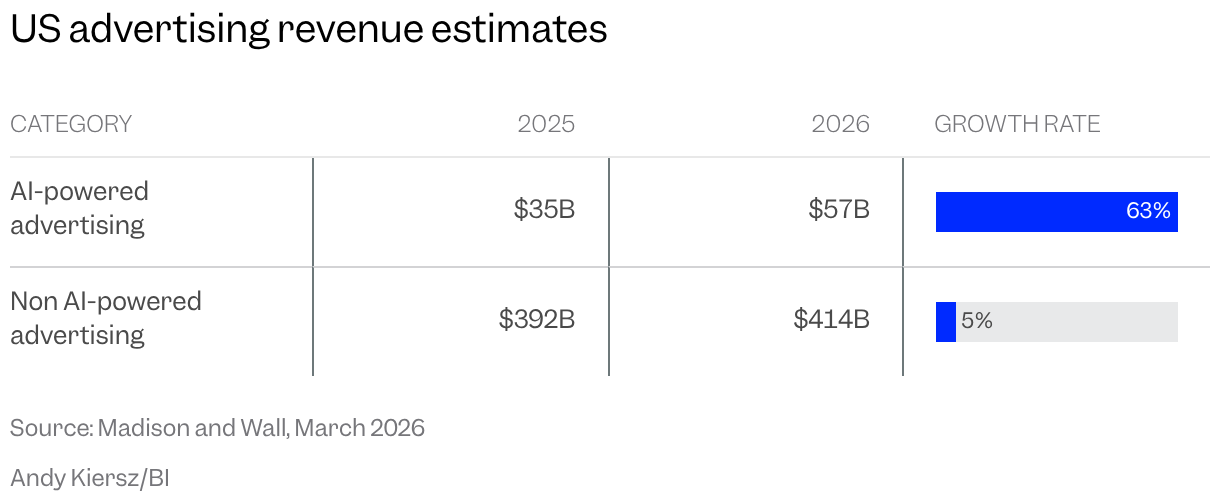
Table

AI-powered ad spend is set to soar 63% this year as brands ditch manual controls

AI-powered ad tools are rapidly gaining market share.

Meta CEO Mark Zuckerberg memorably declared last year that its automated ad tools had become so powerful that brands could simply connect a bank account, set their campaign objectives, and let its artificial intelligence take over. New data suggests a growing number of advertisers are doing just that.

A report released this month by the Madison and Wall consulting and advisory firm estimated that AI-powered advertising revenue in the US will grow 63% to reach $57 billion in 2026, accounting for 12% of total advertising spending.

Madison and Wall said the 88% of advertising that doesn’t rely on AI-powered tools will grow by 5% in the same period.

“We think it’s a new dimension” of advertising growth, said Luke Stillman, managing director at Madison and Wall.

The firm defines AI-powered advertising as spend that flows through platforms where AI controls targeting, bidding, budget allocation, and campaign optimization with minimal human intervention.

The two biggest tools of this kind are Google’s Performance Max and Meta’s Advantage+, though many other platforms, from Amazon to TikTok, offer similar AI-powered advertising products. Search and social media are the dominant channels for AI-powered ads, Madison and Wall said.

Tech companies often cite these tools as a way for advertisers to speed up the time it takes to create and deliver ad campaigns, though some advertisers are wary about handing over the reins entirely to black box systems. Generative AI ad tools, in particular, can occasionally go rogue and produce bizarre ads if not closely monitored.

Stillman said that while use of AI-powered ad tools leans slightly more toward small advertisers, the spending figures are now so large that it’s clear big brands are adopting the tech as well.

“Every advertiser is going to say, ‘We really value control, and we want transparency to understand where every one of our dollars is spent,'” Stillman said.

That said, when Madison and Wall looked at where companies are deploying their budgets, the firm saw “little evidence that they are not willing to trade transparency and control in return for price and performance.”

If AI-powered tools help an advertiser hit their return on ad spend targets, “transparency is a nice-to-have, not a must-have,” Stillman said.

Madison and Wall estimated that AI-powered ad budgets will grow at a compound annual rate of around 29% through 2030.

Source link

SoftBank-backed-unicorn-LTK-lays-off-staff-and-doubles-down-on.jpeg

SoftBank-backed unicorn LTK lays off staff and doubles down on new tech for brands

LTK, a Softbank-backed startup and creator economy unicorn, let go of some staff on Thursday as part of a reorganization, a company spokesperson confirmed to Business Insider.

The cuts were designed to refocus LTK’s business around its revamped brand platform and to account for structural changes to internal teams like marketing, according to the company.

The job reductions, which hit a variety of roles including software engineers and staffers who worked with creators, affected a low single-digit percentage of LTK’s overall head count, which numbers over 550 employees, they said.

“LTK recently completed a targeted organizational restructure to ensure we are aligned around the skills and priorities required for our next phase of growth,” the spokesperson said. “This was not a broad-based layoff, but a strategic realignment focused on strengthening performance and positioning the business for long-term success.”

LTK, previously known as RewardStyle, was founded around 15 years ago by president Amber Venz Box. The company, which says it’s profitable and doubled its EBITDA in 2025, has raised a little over $300 million in its lifetime. Most of that capital came in a 2021 round from SoftBank’s Vision Fund 2, which valued the startup at $2 billion.

Over the last decade, LTK has established itself as one of the leading players in affiliate marketing, building a network of influencers who promote products on social media in exchange for commissions.

Recently, the company has made a series of moves to establish itself beyond social media affiliate marketing.

The company relaunched its app for influencer-driven shopping, called LTK, in early 2025, to add more consumer-facing features as it sought to build its own brand identity with consumers.

In late 2025, the company announced it was revamping its platform for brands, offering features such as creator discovery and performance tracking at no cost. LTK makes money by collecting a commission on sales. The company said that over 1,000 brands have been onboarded onto the platform.

LTK is one of several creator economy startups that have focused their businesses on e-commerce. Other big players in the space include affiliate platform ShopMy and live-selling app Whatnot, which in October raised $225 million at an $11.5 billion valuation.


Source link

The-founder-of-First-Brands-whose-bankruptcy-rattled-Wall-Street.jpeg

The founder of First Brands, whose bankruptcy rattled Wall Street, charged in multibillion-dollar fraud

The founder of an auto parts company whose bankruptcy rattled Wall Street and prompted a debate about private credit has been charged with fraud.

Manhattan federal prosecutors on Thursday charged Patrick James and his brother Edward James in a multibillion-dollar fraud scheme that they allege involved years of fake invoices and the double- and even triple-pledging of assets.

Patrick James is the founder and former CEO of auto parts maker First Brands, which filed for Chapter 11 bankruptcy protection in September. Its bankruptcy was followed by the collapse of subprime auto-lender Tricolor Holdings, sparking a broader debate about the health of the credit market that drew in JPMorgan CEO Jamie Dimon.

His brother had been a senior executive at the company.

The two men were charged with wire fraud, bank fraud, and conspiracy, including money laundering conspiracy. Patrick James faces an additional count, stemming from allegations that he ran a continuing financial crimes enterprise. A third former executive, Peter Andrew Brumbergs, has pleaded guilty in the case.

Prosecutors said the men inflated invoices, repeatedly pledged the same assets as collateral for loans, and falsified corporate financial statements in a series of schemes that yielded billions of dollars in financing.

A spokesperson for Patrick James said he denies the charges.

“He built First Brands from nothing,” the spokesperson said, adding, “Mr. James looks forward to presenting his case in court.”

Edward James’s lawyer issued a statement blasting his client’s arrest in Ohio as “needless theater.”

“We look forward to appearing in New York on his behalf, and we have complete confidence in Mr. James,” the lawyer, Seth DuCharme, said.

Jefferies and UBS are among the financial firms that have acknowledged exposure to First Brands.

“The James brothers obtained billions for First Brands — and millions for themselves — by presenting their lenders with the impression of a successful, growing international business,” Manhattan US Attorney Jay Clayton said in a statement.


Source link

San-Francisco-is-suing-food-brands-like-Kraft-Heinz-and.jpeg

San Francisco is suing food brands like Kraft Heinz and Coca-Cola, accusing them of selling processed foods

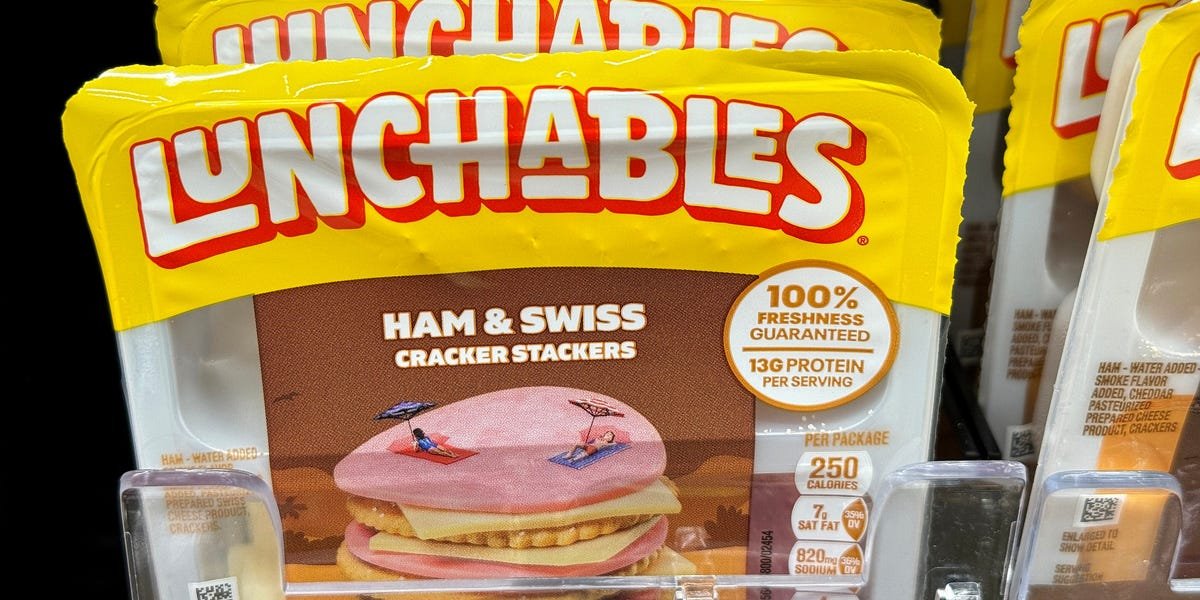
San Francisco is going after food brands that produce “ultra-processed foods,” accusing the companies of fueling a public health crisis.

The 64-page lawsuit, filed on December 2 by San Francisco City Attorney David Chiu, accused some of the country’s biggest food brands of selling dangerous, ultra-processed foods to residents of San Francisco.

It named 11 brands as defendants: The Kraft Heinz Company, Mondelez International, Post Holdings, The Coca-Cola Company, Pepsico Inc., General Mills, Nestlé, Kellanova, WK Kellogg Co., Mars Inc., and Conagra Brands.

The city attorney said the brands had profited from selling ultra-processed foods, which make people crave what they otherwise would not. The attorney accused the brands of failing to include health warnings, making fraudulent claims about the products being healthy, and of targeted marketing at children.

Products from these brands include cereals, candies, soft drinks, and ready-to-eat meals.

“They designed food to be addictive, they knew the addictive food they were engineering was making their customers sick, and they hid the truth from the public,” the attorney wrote, adding that taxpayers were left to foot the bill of a resulting public health crisis.

It said that ultra-processed foods majorly contribute to obesity, type 2 diabetes, cardiovascular disease, and other chronic illnesses.

Chiu called for the brands to cease further deceptive marketing and pay civil penalties to the city of San Francisco.

Representatives for the 11 brands did not respond to requests for comment from Business Insider.

The lawsuit comes as the US is clamping down on processed foods, a result of Health Secretary Robert F. Kennedy Jr.’s “Make America Healthy Again” movement.

In April, Kennedy said he would phase out eight petroleum-based food dyes in the US by 2027. And in July, President Donald Trump said that Coca-Cola had agreed to use real cane sugar in its products in the US, instead of corn syrup that it now uses.


Source link

Sports-Illustrated-ex-publisher-wants-200-million-from-Authentic-Brands-Group.jpeg

Sports Illustrated ex-publisher wants $200 million from Authentic Brands Group, saying it stole website and employees

The former publisher of Sports Illustrated has filed a $200 million legal counterpunch against the magazine’s new publisher and the owner of its intellectual property.

In late 2023, the Arena Group lost the rights to publish SI, its best-known brand, after the 5-Hour Energy creator Manoj Bhargava took over Arena and missed a licensing payment to Authentic Brands Group. ABG awarded the publishing license to Minute Media and sued Bhargava for $49 million, accusing him of acting like a “gangster” in their negotiations.

On Friday, Bhargava and his company hit back — and they’re seeking $200 million for what they claim was a plot by ABG and Minute Media to string the Arena Group along while making copies of its websites and laying the groundwork to poach its employees and biggest spenders.

“ABG deceived Arena by promising to work with Arena in good faith to renegotiate Arena’s license so as to allow Arena to continue to operate Sports Illustrated,” the complaint says, adding, “Privately, ABG and Minute had been partnered for weeks, conspiring to steal Arena’s code and publisher relationships.”

The countersuit also took aim at CVC Capital Partners and BlackRock, investors in ABG, though they weren’t named as parties to the lawsuit. In the complaint and in a statement, Steve Janisse, a spokesman for Arena and Bhargava, said it was unethical for them to have assisted in what Arena and Bhargava characterized as ABG’s sham negotiations.

“It’s amazing that CVC Capital and BlackRock would condone this type of corporate behavior,” Janisse said. “To be honest, we’re surprised they aren’t calling for a change of leadership at ABG.” An executive at CVC didn’t immediately respond to emails, and a representative for BlackRock declined to comment.

Bhargava has a history of aggressive legal action. A 2012 Forbes profile noted that he had already filed more than 90 lawsuits. Bhargava, who made his billions selling 5-Hour Energy drinks, showed the Forbes reporter a “cemetery” bookcase in his office, lined with energy-shot bottles from competitors his company had sued or legally bullied out of the market, calling them the gravestones of his vanquished rivals.

Bhargava’s lawsuit adds to the morass of legal actions that have formed around the Arena Group. In early April, ABG sued Arena and Bhargava over the missed licensing payment and a $45 million termination fee.

Arena, whose stock trades for less than half of what it did at the start of 2024, included that $45 million fee in a loss of nearly $91 million that it recorded in connection with the loss of the SI brand last quarter.

Ross Levinsohn, the Arena CEO who was fired in 2023 when Bhargava took over, has also sued Arena, claiming he was retaliated against. Shortly thereafter, Levinsohn, who became the CEO of Arena in 2020, became the target of a lawsuit filed by Arena’s founders, who claim he mounted a “fraudulent coup” to enrich himself at the expense of Arena and other shareholders, according to Front Office Sports.

ABG and Minute Media didn’t immediately reply to requests for comment.


Source link