
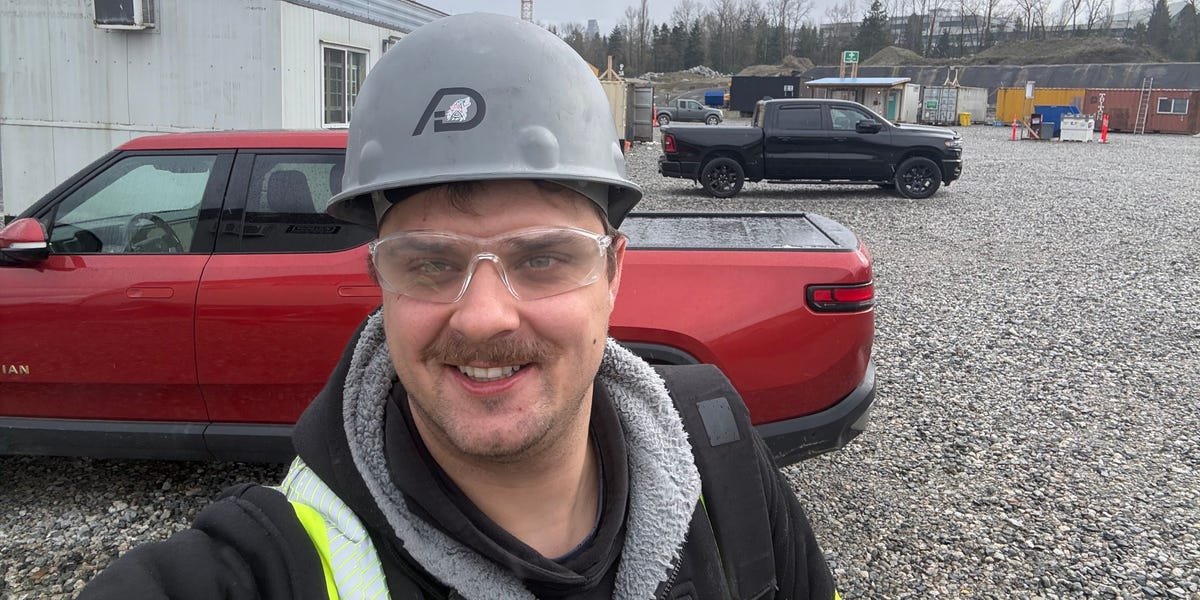
Im-a-construction-manager-who-vibe-coded-a-paperwork-tracker.jpeg

I’m a construction manager who vibe coded a paperwork tracker. My workers loved it — until I accidentally broke it.

This as-told-to essay is based on a conversation with Pawel Mniszak, a 34-year-old construction superintendent who lives in Vancouver. It’s been edited for length and clarity.

My dad made his keep working in construction, specializing in towers. He is dyslexic, so languages and writing comes hard for him. I would translate for him and copy drawings. I learned the industry from my dad.

My parents always pushed me to get an education. I got a degree from Douglas College in programming and business management. I understood the business side more and was better at that than at being a coder.

I tried to get a job in programming, but I’d always talk to people who did the work better than I did. I wasn’t the greatest programmer. I tried to do some websites for people here, but they didn’t understand how much work it actually takes. Here’s $500 for a website, and I’d spend a month on it. The money was never there.

I got good at construction, and I stuck with that. There are so many similarities, in a funny way, between construction and programming. You’ve got to lay a good foundation, stand the walls, and do the plumbing and electrical. There’s a structure to it. Now, I’ve moved on from working with my dad, and I’m a superintendent.

Two years ago, I started my vibe coding journey. I had a second baby, and I had to do something with my time while holding the baby. Every evening, I was plugging away, learning. I got excited. I didn’t have to actually memorize languages anymore, which I struggled with.

Then, I started building.

I was feeding my code to ChatGPT. I started to get more into it, solving problems, asking questions. Then, I got Cursor. It was like getting a Ferrari for the first time; I was enamored. But the token usage was becoming expensive. For the last month, I’ve been using Claude, and it’s been amazing.

I always knew I wanted a tool to help me out with paperwork. I know how busy it is on-site. Upper management doesn’t realize how much time paperwork can take up in the morning.


Pawel Mniszak's vibe-coded paperwork site, HrdHat.

Pawel Mniszak built a tool to complete field level risk assessments. 

Pawel Mniszak


I can have 50 to 110 people on the job site, and the expectation is to have the paperwork completed. Usually, that meant I had to do all of them. They would have to sign off on whatever I wrote. In theory, the foremen are supposed to identify what they’re doing, what the hazards are, and how they are going to fix it. That’s the basic process of safety.

A superintendent can be stuck doing the paperwork. We’ve been given software to help do this, but, because of the price and seating, the software is given to me. It didn’t trickle down to the subcontractors and workers.

I’m like: Screw it, I’m going to make my own FLRA thing. When a worker comes in, I hand out the tasks for the day, and by 8 a.m., you fill out this form, you send it to me, and I’ll audit it. I learned to vibe code it, and the stuff that I learned started coming back to me. It’s been an exponential learning curve.

I created a stable-ish copy, which was a website hosted on Vercel. It was as simple as: fill out the form, convert it to a PDF, attach it to an email, and send it to me. I didn’t even tell my company I was doing it. I told my guys: “You guys are my guinea pigs.” They thought I was a wizard.

I got overly confident, and the worker side was stable, so I created a supervisor layer where you could receive and review the forms. It also helped me with note-taking, the way that I did it. I made a product for the way my brain operates.

I got eager, added Stripe to see what would happen if I monetized it, and posted it on Reddit. It got butchered. My Stripe stuff didn’t function, and I added features until it broke.

I had security vulnerabilities. I didn’t even realize I had a function where you can communicate to all accounts. One guy used it to broadcast a message to all my workers: “AI slop.”


The

After Mniszak posted his tool on Reddit, one user sent out an “AI slop” notification to his workers. 

Screenshot via Reddit


I went down a security rabbit hole. I chatted with him and said, “Thank you for doing this. I obviously need to learn a lot more. Once I make my next version, can you help me?”

He apologized and said, “Sure, I’ll help you out.”

I don’t know; he’s a rando on the internet, so we’ll see. Either way, it opened up a whole new world for me about security.

After I posted on Reddit, I started again. The old one is still hanging around. It’s good for me to use for note-taking.

The new one is going to be a little bit of LinkedIn meets construction management programs like Procore and SiteDocs.

I’m rebuilding now, and trying to start with a strong foundation.


Source link

I-won-28-million-in-the-Powerball-when-I-was.jpeg

I won $28 million in the Powerball when I was 21. One choice saved me from becoming a broke lottery winner.

The holiday season may have most of us ready to slow down, but the stakes for Wednesday night’s Powerball are just heating up. The top prize for Wednesday night’s drawing is estimated to be $1.7 billion, making it the sixth-largest jackpot in Powerball history.

If there is a winner on Wednesday, it could feel like a Christmas miracle, but former Powerball winner, Timothy Shultz, said there’s also a slim chance of going broke within a few years, despite amassing that amount of wealth.

Schultz won $28 million in 1999 while working at a gas station and retired a multimillionaire by the age of 21. In an effort not to become one of the unfortunate winners who eventually lose it all, he put a specific plan in place.

Consulting wealth professionals is the first step Schultz took after winning the Powerball

“Suddenly, I’d gone from a gas station attendant to retired at 21,” Shultz told Business Insider in a 2024 interview. “I felt like I was holding a magic wand. Everything was possible, but I also wanted to be financially responsible.”

He said, “At 21, I had no idea what to do with that kind of money and was lucky I sought professional guidance. I didn’t want to become a statistic of lottery winners going broke within a few years.”

Before turning in the ticket, he said he consulted with wealth professionals to understand how much he could afford to spend and give to others. “I helped many people, but also wanted to live within my means.”

Investing the money helped him maintain his wealth

Before he received any of the money, he established a plan with advisors to invest it conservatively, ensuring the returns could last him a lifetime. “I mostly invested in stocks, bonds, and mutual funds,” he said.

Emily Irwin, a Wells Fargo advisor who guides lottery winners on how to spend their money, told Business Insider in a 2023 interview that this is exactly what winners should do.

She also advised assembling a team of financial planners as soon as possible and that, “You must carefully consider experts specializing in high-net-worth and ultra-high-net-worth tax planning.” Irwin also said winners should interview several candidates, as these advisors will most likely be in their lives for years.

Other ways the 1999 Powerball winner spent his money

The first thing Shultz purchased with the money was the latest video game system. A luxury, he said, he “couldn’t afford before winning.” The next thing he did was set up his investments.

After establishing his investments, Schultz said he helped his family, bought vehicles, and traveled. He even went back to college to study film and broadcast journalism, a dream come true for him

But after winning, and still being surrounded by other struggling college students, Shultz felt pressure to pay for friends’ vacations, meals, or anything they did together.

He said, “When you win the lottery, people don’t view the money as something you’ve earned. A family member explicitly told me I got something for nothing by winning the lottery and should keep giving them and others money.”

Despite his successful investments, he still has one regret

These days, Schultz said he spends most of his free time exercising and working on his podcast and YouTube channel, “Lottery, Dreams, and Fortune,” which highlights the story of other lottery winners. “YouTube brings in some money, but I can live off my investments,” he said.

Despite making great investment choices, Schultz still regrets overlooking one specific investment.”I wish I had invested in bitcoin a few years ago, but that’s my only regret about how I’ve spent the winnings,” he said.

Still, Shultz’s initial decision to seek professional financial help set him up for years of success.

Correction: December 23, 2025 —An earlier version of this story misstated the details of the next Powerball drawing. It is for $1.7 billion on Wednesday night.


Source link